This month marks 150 years since the opening of the Bethnal Green Museum, the first public museum located in London’s east.
The museum had at its core a pre-fabricated building which had earlier been erected as part of the first phase of the South Kensington Museum. It was brought to the Bethnal Green site and encased in a red brick exterior designed by James Wild.
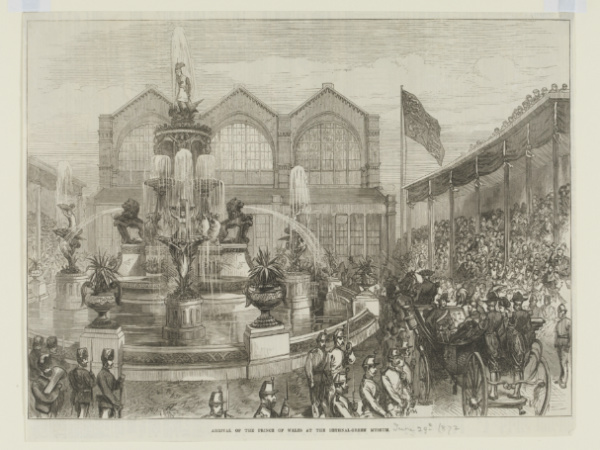
Black and white print of the Prince and Princess of Wales arriving at the official opening of the Bethnal Green Museum (now Young V&A) on 24th June, 1872. Originally printed in the London Illustrated News. PICTURE: Courtesy of Young V&A
Formally known as the East London Museum of Science and Art, it was opened on 24th June, 1872, by the Prince of Wales, later King Edward VII, amid considerable pomp and great crowds.
The museum, a branch of what became the Victoria & Albert Museum in South Kensington, was built to house and display many of the collections which had been exhibited at the Great Exhibition of 1851. Among the art collections on show was that of Sir Richard Wallace (now housed in the Wallace Museum).
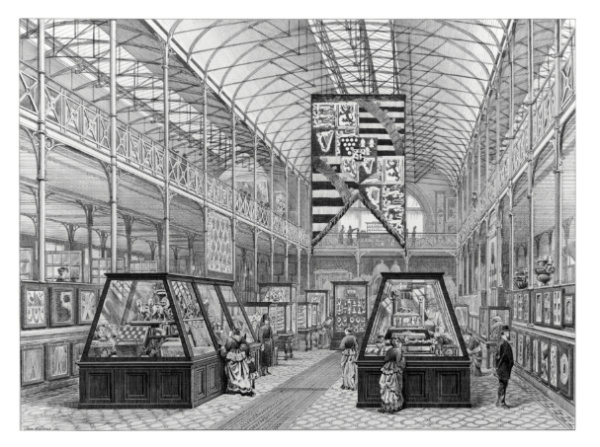
An interior view of the Bethnal Green Museum (now Young V&A). PICTURE: Courtesy of Young V&A.
After World War II, the museum was remodelled as an art museum and included a children’s section. Then, in 1974, the museum became the Museum of Childhood with displays focusing on everything from toys and dolls houses to children’s dress and books.
It underwent an extensive renovation in the mid 2000s and reopened in December, 2006, as the Victoria & Albert Museum of Childhood.
The now Grade II*-listed museum, located on Cambridge Heath Road, is currently undergoing a £13 million redevelopment and will reopen in mid-2023 as Young V&A, a new museum dedicated to 0 to 14-year-olds, their families and carers.
Young V&A creative Story Telling session. PICTURE: Courtesy of Young V&A
• The V&A is celebrating 150 years since the opening of the Bethnal Green Museum (now known as the Young V&A) with the launch of a year long celebration on Friday. The museum, which opened in 1872 as the first ever museum in east London, is currently undergoing a major redevelopment and is scheduled to reopen in summer, 2023, as a new national museum dedicated to children to the age of 14. To mark the 150th – and a year until Young V&A’s opening – the museum has launched a year-long ‘Reinvent Festival’ with the first event – an online summit called Sparking Creative Futures headlined by children’s author, Ed Vere, and live-illustrated by Beano’s youngest ever artist, Zoom Rockman – on Friday. On Sunday, Young V&A will celebrate its birthday with families at Rich Mix’s ‘Everyone a Maker’ event with free, fun activities. Further events will be held over the year including pop ups at Queen Elizabeth Olympic Park’s Great Get Together on 23rd July featuring large-scale, creative construction and making sessions for children and families using playful building materials by Hackney-based architect Emilie Quene. For more (including the full programme of events), see www.vam.ac.uk/blog/museum-life/reinvent-festival-young-va-summer-family-events.
• Europe’s biggest free musical theatre festival – West End LIVE – will transform Trafalgar Square into an open-air theatre this weekend. A joint production by Westminster City Council and the Society of London Theatre, the event will feature hundreds of performers, creatives and production staff, showcasing the best the West End has to offer. No tickets are required for the free event. For more, head to www.westendlive.co.uk.
• An English Heritage Blue Plaque has been unveiled on a house in Hackney, commemorating the hundreds of stranded and sometimes abandoned South and East Asian nannies, known as ayahs, who sheltered there in the early 20th century. The Ayah’s Home at 26 King Edward’s Road housed around 100 women a year between 1900 and 1921 after which the home moved to another address nearby. The ayahs were women who served the British in India and other colonies as children’s nannies, nursemaids and ladies’ maids and who were sometimes required to care for babies, children and their sea-sick mothers on the long sea voyage from the colonies to England but who were generally not expected to serve the families once they arrived, instead either contracted to wait until needed for the return journey or take a passage home. The Hackney shelter, which also welcomed ‘amahs’ – nursemaids of East Asian origin, appears to have been the only one of its kind in Britain for almost the whole of its existence. For more, see www.english-heritage.org.uk/visit/blue-plaques/.
Send all items for inclusion to exploringlondon@gmail.com.
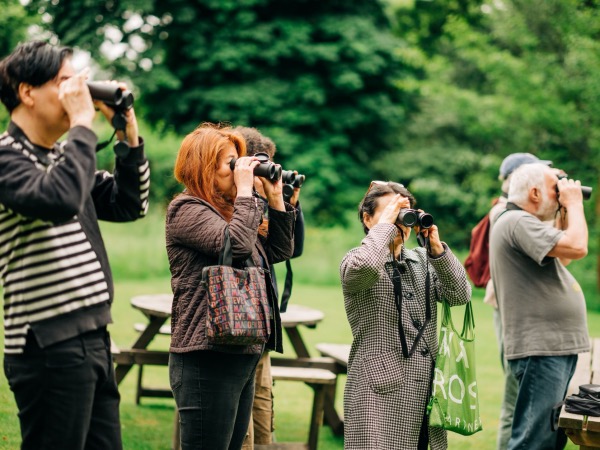
• The Royal Parks are running a series of free sessions for bird-watching novices in all eight of its London parks during June and July. The sessions, for which binoculars will be provided, last up to two hours. Pete Lawrence, The Royal Parks’ biodiversity manager, says many people growing up in a city may not have had the “opportunity, the equipment or the know-how to take up this activity” before. “These free sessions aim to make bird watching more accessible, and, if they prove popular, we hope to repeat them in future years.” Author and TV naturalist David Lindo, aka ‘The Urban Birder’, will be leading some of the free bird watching sessions along with The Royal Parks’ conservation officer, Tony Duckett – a six decade veteran birdwatcher, and local bird enthusiast Julia Holland. To book a place, head to www.royalparks.org.uk/birdingtours. The Royal Parks is also hosting a bird watching photography competition with a top prize, binoculars worth £400. Entrants need to take a photo of one of the birds included on the parks’ bird spotter sheets and send it to competition@royalparks.org.uk or submit via The Royal Parks’ social media channels. Find out more here.
• The “music, people and places” central to the grime scene which first emerged in London in the early 2000s are the subject of a new exhibition at the Museum of London. Grime Stories: from the corner to the mainstream, which opens on Friday, is co-curated by Roony ‘Risky’ Keefe, one of grime’s early documentarians, and features a series of newly commissioned films that explore the community at the heart of grime’s success as well as a large-scale illustration from artist Willkay and personal artefacts from the MCs and producers who developed grime’s unique sound. Admission is free. For more, see www.museumoflondon.org.uk/museum-london/whats-on/exhibitions/grime-stories.
• The ideas of repair, care and healing are explored in a new exhibition which opened at Somerset House this week. Eternally Yours, which is being staged across three Terrace Rooms, showcases some diverse examples of creative reuse including transformed items salved in the aftermath of Japan’s 2011 earthquake, shoes worn by Syrian migrants which have stories of survival sewn into the soles and a jumper from Annemor Sundbø’s ragpile collection which has been transformed by Celia Pym. At the heart of the exhibition is ‘The Beasley Brothers’ Repair Shop’, a pop-up created by designer Carl Clerkin and modelled on traditional East End repair shops of old, which is hosting live workshops and demonstrations from artists and designers. The free exhibition and accompanying events runs until 18th September. For more, see www.somersethouse.org.uk.
Send all items for inclusion to exploringlondon@gmail.com.
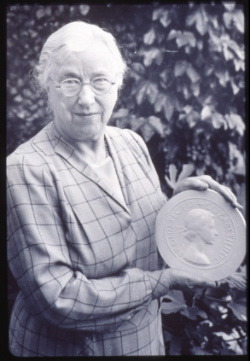
• A free display featuring the first coin bearing a portrait of Queen Elizabeth II has opened at the British Museum. Part of the celebrations marking the Queen’s Platinum Jubilee, The Asahi Shimbun Display Mary Gillick: modelling The Queen’s portrait showcases the production and reception of the coin which was designed in 1952 and released the following year. Gillick’s portrait – which remained in circulation on coins in the UK until the 1990s and was also adapted for use on commemorative stamps – combined modern design with Italian Renaissance influences. Can be seen until 31st July. For more, see www.britishmuseum.org.
• The UK’s first Stolperstein or “stumbling stone” has been installed in Soho as part of an initiative to remember the victims of the Nazis. The small brass plaque commemorates former resident Ada van Dantzig, a Dutch-Jewish paintings conservator for the National Gallery who came to London in the 1930s and worked and resided in Golden Square in Soho (where the plaque has been installed). She later re-joined her family in the Netherlands and was arrested in France in early 1943 along with her mother, father, sister and brother. Deported to Auschwitz, Ada, along with her parents, was murdered there on 14th February, 1943. Artist Gunter Demnig created the project almost 25 years ago to commemorate victims of Nazi Persecution during the Holocaust. More than 100,000 of stones have now been laid in 26 countries throughout Europe with the location of the stones the last address of those being remembered.
• A pioneering female landscape gardener has been honoured with an English Heritage Blue Plaque at her former flat in Shaftesbury Avenue. Fanny Wilkinson, who is believed to be Britain’s first professional female landscape gardener, was also a campaigner for the protection of open space in London. She lived and worked at the flat, which overlooks an open space she laid out herself, between 1885 and 1896. Wilkinson began her career as an honorary landscape gardener to the Metropolitan Public Boulevards, Gardens and Playgrounds Association – an organisation whose mission was the formation of gardens and public parks that would create playgrounds and green ‘lungs’, especially in poor districts of the capital. In June, 1885, it was agreed that she could charge five per cent on all her MPGA payments, leading her to drop the ‘honorary’ title and become Britain’s first professional female landscape gardener. For more, see www.english-heritage.org.uk/visit/blue-plaques/.
• A painting by Pablo Picasso – Woman with a Book (1932) from the Norton Simon Museum in Pasadena, California – and a painting by Jean-Auguste-Dominique Ingres – Madame Moitessier (1856) – are being shown together for the first time at The National Gallery. Picasso admired Ingres and referred to him throughout his career and this connection can be seen not only in his paintings but in drawings and studies he made during his ‘neoclassical’ phase in the 1920s. He encountered Madame Moitessie at an exhibition in Paris in 1921 and 11 years later painted Woman with a Book. The paintings, which are being show under a collaborative initiative between the two institutions, can be seen in Room 1 until 9th October. Admission is free. For more, see www.nationalgallery.org.uk.
Send all items for inclusion to exploringlondon@gmail.com
• A new exhibition exploring the Queen’s role during wartime opens at IWM London in Lambeth tomorrow. Part of a suite of events at IWM venues celebrating the Queen Elizabeth II’s Platinum Jubilee, Crown and Conflict: Portraits of a Queen in Wartime features 18 images drawn from the museum’s image archive which chart the Queen’s experience of war – from growing up during World War II when she served in the Auxiliary Territorial Service to her role in carrying out important public duties involving the armed forces, including at the annual Service of Remembrance. Among newly digitised photographs included in the display are an image of the Queen dressed in overalls and cap while working on a vehicle during her time in the ATS, and another showing her with her father, King George VI, and mother, Queen Elizabeth, during a visit to airborne forces in 1944. IWM London is also launching a dedicated trail of historic objects spread across five gallery spaces which explores the Royal Family’s long-standing association with the British armed forces. Objects include a Princess Mary Gift Fund box which was sent to those serving at Christmas in 1914. Runs until 8th January. Admission charge applies. For more, see www.iwm.org.uk/events/queens-platinum-jubilee-iwm-london.
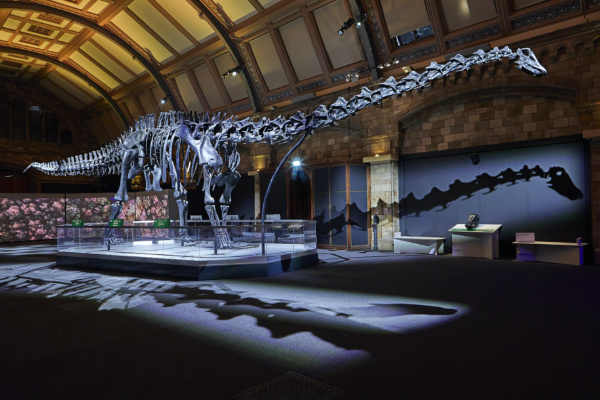
• Dippy the dinosaur is back for a limited time at the Natural History Museum in South Kensington from tomorrow. A free, temporary exhibition – Dippy Returns: the nation’s favourite dinosaur – gives visitors the chance to get up close and personal with the 26 metre-long dinosaur which first went on display at the museum in 1905. The display comes at the end of a record-breaking tour of the UK in which Dippy was seen by more than two million people. Can be seen until 2nd January. To book tickets, head to www.nhm.ac.uk.
• The first major exhibition to explore the history and future of cancer treatment and research opened at the Science Museum in South Kensington this week. Cancer Revolution: Science, innovation and hope features more than 100 objects including some never-before seen as well as information on cutting edge treatment and research, new artist commissions and installations, interactive exhibits and a breadth of personal stories. Runs until January, 2023. Admission is free but bookings required. For more, see www.sciencemuseum.org.uk/see-and-do/cancer-revolution-science-innovation-and-hope.
Send all items to exploringlondon@gmail.com for inclusion.
• Marble Hill in London’s west reopens on Saturday following a restoration and the reinstatement of a lost pleasure garden. Once home to King George II’s mistress Henrietta Howard, Countess of Suffolk, Marble Hill is a rare example of a home built by and for a woman in Georgian England and is one of the last survivors of the many 18th century villas that once fronted the Thames in the area. Marble Hill was built as a country retreat from London’s crowds and among those entertained here were poet Alexander Pope, Horace Walpole, John Gay and Jonathan Swift. English Heritage has invested £3 million into a major transformation of the house and 66 acres of riverside parkland which also used a £5 million grant from The National Lottery Heritage Fund and The National Community Lottery Fund. This has included the reinstatement of a pleasure garden – an “Arcadian landscape” which was inspired by sketches made by Pope – with the opening up of previously inaccessible woodland areas, the reinstallation of paths and the replanting of avenues of trees that led from the house to the river. Howard’s ninepin bowling alley has been restored and an 18th-century garden grotto has been excavated and returned to its 18th-century appearance. Inside the house, English Heritage has re-instated the paint scheme that existed during Howard’s lifetime in several interior spaces, including the Great Room, conserved the fine collection of early Georgian paintings which includes portraits of Howard’s circle and re-created furniture including an intricate carved peacock motif table and luxurious crimson silk wall hangings in her dressing room. The new display has reframed Howar’s beyond being simply the King’s mistress by also exploring her abusive first marriage and the role deafness played in her life as well as her rise in Georgian society and the social circles she captivated. Entry to the house is free. For more, head to www.english-heritage.org.uk/visit/places/marble-hill-house/.
Harry Kane of England celebrates after scoring their side’s second goal during the UEFA Euro 2020 Championship Round of 16 match between England and Germany at Wembley Stadium on 29th June, 2021 in London, England. PICTURE: Catherine Ivill/Getty Images.
• England football captain Harry Kane is the subject of a new exhibition opening at the Museum of London on Saturday. Harry Kane: I want to play football features sporting memorabilia including the shirt Kane, who grew up in Chingford, East London, wore on his debut for England where he scored against Lithuania just 79 seconds after coming on the pitch, Kane’s MBE which was awarded to him in March 2019 for ‘services to sport’ and the 2018 World Cup Golden Boot (Kane being one of only two British players to receive a Golden Boot at a World Cup competition, where he was named Man of the Match three times) as well as family photos. The display also includes a changing room space where visitors can listen to Kane’s pre-match playlist and an interactive area where visitors can learn more about who has inspired Harry and share their own hopes and dreams. A programme of activities for families and children will run alongside the free display. Runs until December. For more, see www.museumoflondon.org.uk.
• The use of gold in embellishing and enhancing the written word across cultures, faiths and through time is the subject of a new exhibition opening at the British Library. Gold, which opens Friday, showcases some of the most luxurious illuminated manuscripts, gold-tooled books, sacred texts and scrolls from the British Library’s collection with objects on display including the Harley Golden Gospels, the Lotus Sutra and a treaty in Malayalam, beautifully inscribed on a long strip of gold itself. Admission charge applies. Runs until 2nd October. For more, see www.bl.uk.
• Charles Jennens, who is best-known as the librettist of Handel’s Messiah but was also a patron of the arts, scholar and educator, is the subject of a new exhibition opening at the Foundling Museum in Bloomsbury on Friday.Charles Jennens: Patron & Polymath features portraits, correspondence and printed documents reflecting the varied interests and achievements of this Georgian character. Jennens was a non-juror – meaning he supported the legitimacy of the deposed Catholic Stuarts – but was also a Protestant. His art collection was one of the best in Britain and his Palladian mansion, Gopsall Hall in Leicestershire, featured a music room with an organ built to Handel’s specifications. Admission charge applies. Runs until 16th October. For more, see https://foundlingmuseum.org.uk/event/charles-jennens-polymath/.
• Dr John Conolly, an early advocate of human treatments for people living with mental illness and the former Hanwell Asylum have been commemorated with an English Heritage Blue Plaque to mark Mental Health Awareness Week. The plaque has been placed on what was the left wing of the asylum and is now part of St Bernard’s Hospital. It was here that Conolly, who was appointed Resident Physician at the Middlesex County Pauper Lunatic Asylum in 1839 – then one of the biggest asylums in London, advocated a system of ‘non-restraint’ which, though initially seen as controversial, drew support from reformers and which by 1846 had been embraced as ruling orthodoxy by the then-new national Lunacy Commission. For more, see www.english-heritage.org.uk/visit/blue-plaques/.
• On Now: The works of Kawanabe Kyōsai, the most popular Japanese painter of the late 19th century, are on show in the Royal Academy’s Gabrielle Jungels-Winkler Galleries.Kyōsai: The Israel Goldman Collection focuses largely on the art of sekiga or ‘spontaneous paintings’ which were produced at ‘calligraphy and painting parties’ (shogakai), often fuelled by prodigious amounts of saké. The display – the first monographic exhibition of Kyōsai’s work in the UK since 1993 – includes around 80 words, many of which have never been exhibited. Admission charge applies. Runs until 19th June. For more, see www.royalacademy.org.uk.
Send all items for inclusion to exploringlondon@gmail.com
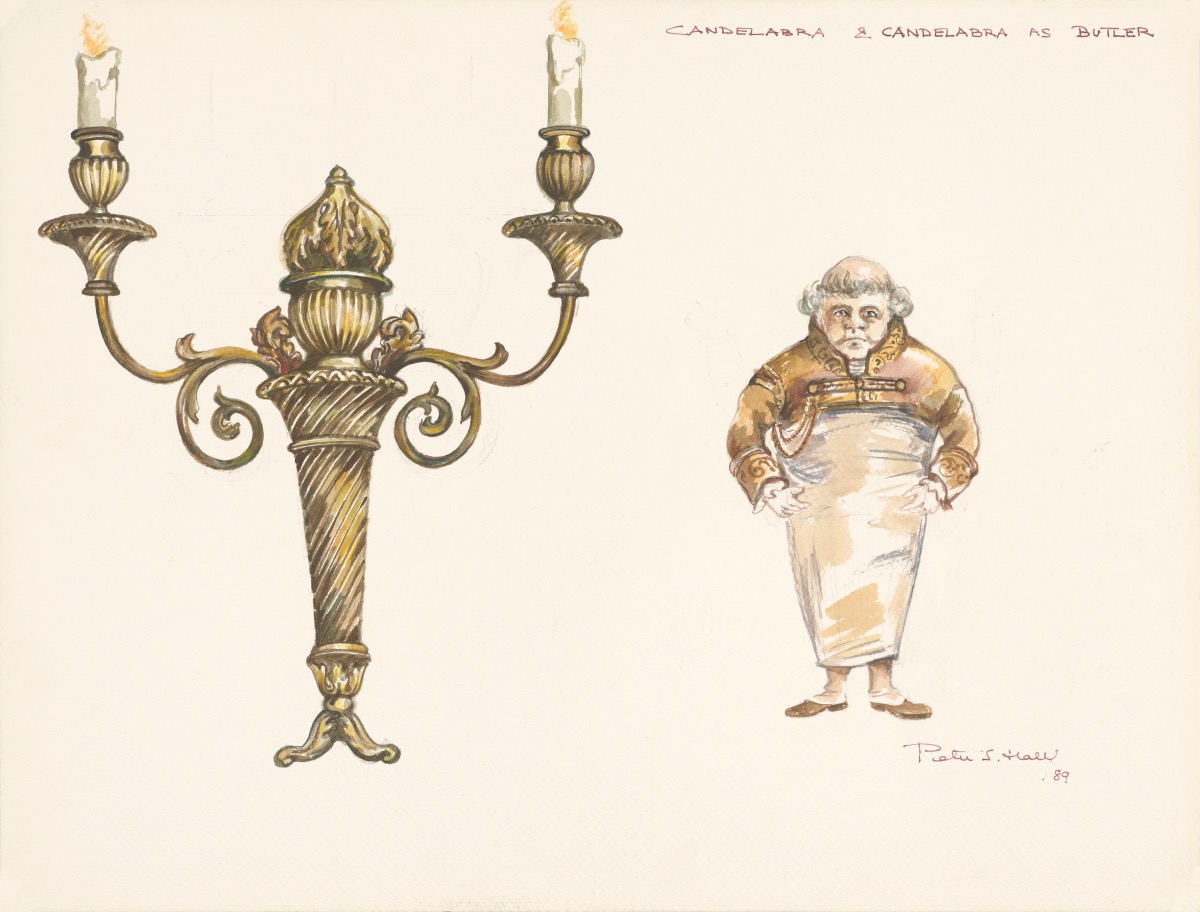
• The connection between Disney’s animated films and French 18th-century art is explored in an exhibition at the Wallace Collection.Inspiring Walt Disney: The Animation of French Decorative Arts, which is being held in collaboration with New York’s Metropolitan Museum of Art, features more than 120 examples of production artwork and works on paper from the Walt Disney Animation Research Library and the Walt Disney Archives alongside approximately 30 18th-century artworks. The latter include Jean-Honoré Fragonard’s much-loved painting, The Swing (c1767), which provided inspiration for Disney films including Beauty and the Beast (1991), Tangled (2010) and Frozen (2013) and which is being showcased for the first time since its recent conservation. The exhibition, which was previously at the New York’s Metropolitan Museum of Art, can be seen until 16th October. Admission charge applies. For more, see www.wallacecollection.org.
• Eid in the Square returns to Trafalgar Square this Saturday for the first time since 2019. The day, held from noon to 6pm to mark the celebration that follows the end of Ramadan, features Islamic inspired art, culture and comedy on the main stage alongside a feast of food stalls from across the world. Performers include Baha Yetkin Sufi Ensemble, Nafees Ifran & Qalandar Qawwali Band, Dur Dur Band, Star Children’s Choir, spoken word poet Hussain Manawer, comedy sketch show favourites, ‘The Halalians’, Alif New Beginnings, and award-winning music producer Naughty Boy who will present his Naughty Boy Kitchen pop-up serving signature dishes fusing his British upbringing and Pakistani heritage. Other family-friendly activities being held on the day including calligraphy, storytelling, mehndi, face painting, and drama and poetry workshops, as well as a variety of sports activities including Muslim Girls Fencing and Sisterhood FC.
• World renowned philosopher and historian of ideas, Sir Isaiah Berlin (1909-1997), was commemorated with an English Heritage Blue Plaque at his former Holland Park home. Berlin lived at 33 Upper Addison Gardens for nearly six-and-a-half years while attending St Paul’s School, then located in Hammersmith – a period he later referred to as “my golden childhood”. The house, which was purchased by his timber merchant father, was the family’s first permanent home in the UK following their arrival from Latvia. Berlin was also commemorated this week with a plaque on another of his former homes, this one in Hampstead. The Heath and Hampstead Society plaque was placed on the property at number 49 Hollycroft Avenue which was where Berlin’s family moved in October, 1928. While he left for Oxford University that same month, he spent much time there during his university vacations. Oxford was Berlin’s main base for the rest of his life. For more, see www.english-heritage.org.uk/visit/blue-plaques/.
Walter Sickert, ‘Little Dot Hetherington at the Bedford Music Hall’ (1888) Private collection. Photo: James Mann
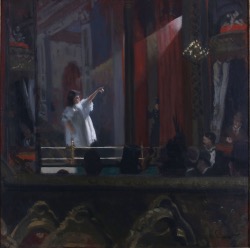
• Britain’s biggest retrospective on the work of artist Walter Sickert (1860-1942) in almost 30 years opens at the Tate Britain in Millbank today. The exhibition features more than 150 of his works spanning the six decades of his career. They include paintings and drawings of music halls in London and Paris such as The Old Bedford (1894-5) and Théâtre de Montmartre (c1906) and an examination of key influencers upon his work such as American artist James Abbott McNeill Whistler whose A Shop (1884-90) is being shown with Sickert’s A Shop in Dieppe (1886-8) as well as Whistler’s 1895 portrait of Sickert. Other works on show include The Camden Town Murder (1908), Ennui (1914) and Off To the Pub (1911). Admission charge applies. Runs until 18th September. For more, see www.tate.org.uk/whats-on/tate-britain/walter-sickert.
• A new exhibition at the Dulwich Picture Gallery explores the truth behind 18th century gossip suggesting 17th century Dutch artist Philips Wouwerman was a plagiarist. True Crime: The Case of Philips Wouwerman looks at claims the painter, who created more than 600 paintings over his career, stole the drawings of the dead artist Pieter van Laer and subsequently used them for his own works. The display features works by Wouwerman and Van Laer as well as expert testimony from the past and present. It’s the first in a series of displays – Unlocking Paintings – which have been devised by the recently appointed curator Helen Hillyard to present new perspectives on the Gallery’s collection. Can be seen until 21st August. For more, follow this link.
• A self-taught Victorian physicist, Oliver Heaviside, has been commemorated with an English Heritage Blue Plaque at his former home in Camden Street. The property is where the young Victorian scientist, who had been left almost entirely deaf after suffering scarlet fever in childhood, continued with his self-education after leaving school at 16 and where he later worked on his ground-breaking interpretation of James Clerk Maxwell’s Treatise on Electricity and Magnetism. Heaviside played a key role in the development and advancement of electrical communications and was even name-checked in Cats where a line referring to “the Heaviside layer” is a reference to his discovery of a reflective layer in the upper atmosphere which allowed radio waves to be ‘bent’ around the earth. For more, see www.english-heritage.org.uk/visit/blue-plaques/.
Send all items for inclusion to exploringlondon@gmail.com.
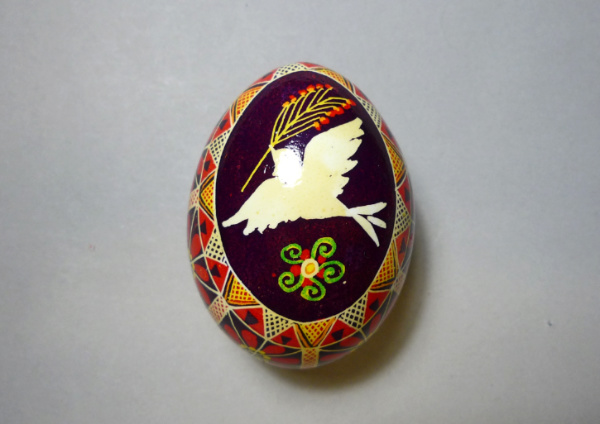
• A free display on the cultural heritage of Ukraine has opened at the British Museum. Located in the museum’s ‘Collecting the world’ gallery, Ukraine: Culture in crisis features objects drawn from the museum’s collection including a 5,500-year-old painted storage jar, hand-coloured lithographs of a man and a woman in Ukrainian dress dating from about 1813, and, an Easter egg decorated with the dove of peace (pictured) dating from between 1970 and 1980. There are also objects from the Greek colony of Olbia established on the Black Sea between 600 and 300 BC including a black glazed, fluted amphora from southern Italy dating from between 300 and 250BC. For more, head to www.britishmuseum.org. To learn more about the protection of cultural heritage in Ukraine visit icom-poland.mini.icom.museum/icom-poland-appeal-help-us-help-ukraine.
• The earliest surviving printed news report in Britain of the 1513 Battle of Flodden and an original BBC radio script of the D-Day landings are among exhibits at the British Library’s first major exhibition putting a spotlight on the role news plays in our society. Other exhibits on show at Breaking the News, which opens on Friday, include smashed hard drives used by The Guardian to store Edward Snowden’s hard files. The display explores what makes an event news and the meaning of a free press as well as the ethics involved in making the news, news objectivity and how the way we encounter news has evolved over five centuries of news publication in Britain. Runs until 21st August. Admission charge applies. For more, head to www.bl.uk/events/breaking-the-news.
• St George’s Day celebrations return to Trafalgar Square this Saturday. The free family event, which runs from noon until 6pm, will feature live music by the likes of string quartet Bowjangles, hoedown collective Cut A Shine, brass band Das Brass and folk headliner James Riley & the Rooftop Assembly. There will also be appearances from St George with his Dragon, Divine stilt walkers and the Pearly Kings and Queens as well as a range of food stalls. Other family-oriented activities including The Knights Training School, the Storytorium, a dragon Selfie station, face painting, upcycled arts and crafts, and a games area.
• The art and poster stores at the London Transport Museum’s Depot in Acton Town will be open to the public this weekend. The Art of the Poster Open Days, which run from today until Sunday, will give the public the chance to view some of the more than 30,000 posters in the depot’s collection and hear from expert guides about how posters have characterised London and its transport over the past century. There will also be talks from artists, curators and historians and visitors have the chance to design their own posters in creative workshops as well as, on Saturday and Sunday, riding the London Transport Miniature Railway. Timed tickets must be booked in advance. Admission charges apply. For bookings, head to www.ltmuseum.co.uk/whats-on/depot/art-poster.
Send all items for inclusion to exploringlondon@gmail.com.
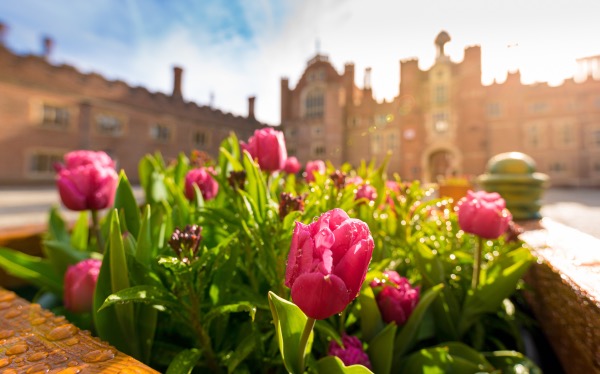
• Hampton Court Palace’s Tulip Festival – the largest of its kind in the UK – is returning following its successful inaugural year in 2021. From Friday until 2nd May (depending on flowering periods), the palace’s 60 acres of formal gardens are expected to be filled with rare, historic and specialist tulip varieties inspired by Queen Mary II’s famous 17th century collection which was once housed at the palace. Some 120,000 tulip bulbs of 60 different varieties have been planted, including breath-taking floating tulip vases located in the palace’s famous fountains, and floral displays which will fill the cobbled courtyards of Base Court and Clock Court. Visitors will be able to find out all about the links between the flower and the palace’s history with a dedicated Tulip Festival Guide. Included with admission. For more, head here.
• New exhibits marking the 40th anniversary of the Falklands Conflict have gone on show at the Imperial War Museum in Lambeth. Among the new items on display are drawings by Linda Kitson, the first female artist commissioned by IWM to accompany troops into conflict, and images of the conflict – many of which have never been seen before – taken by photographer Paul RG Haley who covered it for Soldier Magazine. The museum is also exploring the story and legacy of the conflict through a digital programme of events including a series of short films and a new episode of the Conflict of Interest podcast featuring actor Katherine Parkinson. For more, see www.iwm.org.uk.
• The Regent’s Park will soon boast a new 1.5 acre garden at its centre in honour of Queen Elizabeth II’s Platinum Jubilee. The new garden, to be created on the site of a former plant nursery near the Inner Circle, will include design features that reflect the Queen’s “love of trees and nature”. The Royal Parks will be committing £1 million to the project and will seek external funding and public donations. Designs for the new park will be shared as they are developed. Meanwhile, The Royal Parks have also announced they will be creating a new wood in Richmond Park as part of the Queen’s Green Canopy Initiative. The new woodland, which will be located adjacent to Ham Cross, will be planted with 70 large trees, each one to mark a year of Her Majesty’s reign.
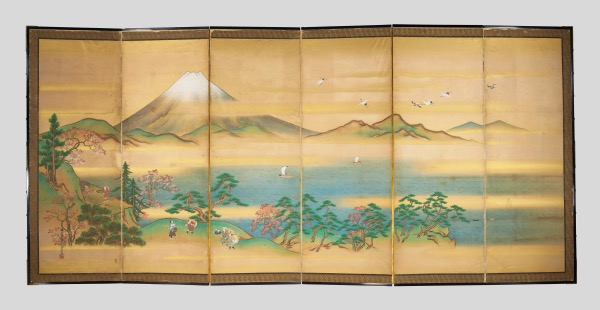
Itaya Hiroharu, folding screen paintings, 1860. Sent to Queen Victoria by Shōgun Tokugawa Iemochi, 1860.
• A first-of-its-kind exhibition featuring the Royal Collection’s Japanese works of art opens at the Queen’s Gallery, Buckingham Palace, tomorrow.Japan: Courts and Culture, features more than 150 works including rare porcelain, samurai armour, woodcut prints, embroidered screens and a range of diplomatic gifts sent during the reigns of monarchs ranging from King James I to Queen Elizabeth II. Among the highlights are a pair of folding screens sent to Queen Victoria in 1860 from the Japanese Shōgun Tokugawa Iemochi which will go on public display for the first time since they arrived at the British court 162 years ago. The screen paintings, which depict the changing seasons, were not thought to have survived but in recent years research has revealed the two screens were the work of Itaya Hiroharu, one of the artists likely to have worked on Queen Victoria’s gifts. Also included in gift was a set of lacquer furniture, spears inlaid with glittering mother of pearl, and swords made by leading court swordsmiths – all of which will also be on display. Admission charge applies. Runs until 26 February, 2023. For more, see www.rct.uk.
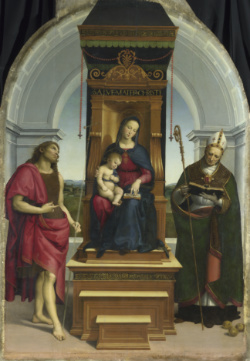
• Marking the 500th anniversary of the death of Raphael, one of the first-ever exhibitions to explore the complete career of this giant of the Italian Renaissance opens at The National Gallery on Saturday. The Credit Suisse Exhibition: Raphael, which was supposed to be held in 2020 and was delayed due to the coronavirus pandemic, features more than 90 exhibits. They include a rare gathering of Raphael’s paintings of the Virgin and Child including Ansidei Madonna (The Virgin and Child with Saint John the Baptist and Saint Nicholas of Bari) (1505), two bronze roundels – The Incredulity of Saint Thomas and The Descent into Limbo – from Santa Maria della Pace which have never previously exhibited outside Italy and which are attributed to Cesarino Rossetti after designs by Raphael, and a room devoted to Raphael’s frescoes for Pope Julius II’s private apartments. There are also several of his original print designs, an survey of ancient Rome he undertook for Pope Leo X, tapestry designs including Saint Paul Preaching at Athens (workshop of, or on behalf of, Pieter van Aelst, active about 1490–1533, after design by Raphael, about 1517–19), and portraiture from his final years including Portrait of Lorenzo de’ Medici (1518) and Portrait of Baldassare Castiglione (1519). Admission charge applies. Runs until 31st July. For more, see www.nationalgallery.org.uk/exhibitions/the-credit-suisse-exhibition-raphael.
• The British Library’s Food Season kicks off today with almost two months of online and in-person events inspired by the cookbooks, recipes and culinary stories in the collection. Highlights include chef Ainsley Harriott talking about his life and career with food-writer Melissa Thompson, food-writer Maunika Gowardan celebrating India’s breadth of food cultures with chefs and food-writers including Ravinder Bhogal, Romy Gill, Kavi Thakrar and Farokh Talati, chef and broadcaster Andi Oliver discussing Jessica B Harris’ 50- year career examining the history and meaning of food for the African diaspora, and psychologist Kimberley Wilson chairing a discussion about the food prisoners are fed inside British correctional institutions and if it impacts rehabilitation. Now in its fifth year, the 2022 Food Season is supported by KitchenAid. For the full programme of events, head to www.bl.uk/events/food-season.
• Textile designer Enid Marx – famous for her seat fabric designs on the London Underground – has been honoured with an English Heritage Blue Plaque. The plaque was unveiled this week at her former home at 39 Thornhill Road where she lived and worked for more than 30 years. Marx, who shared the house with her partner, Margaret Lambert, and friends Eleanor Breuning and Grace Lambert (Breuning continues to live at the house today), had a purpose-built studio in the back garden which remains in similar condition to when she left it almost 25 years ago. Alongside her work for the London Underground, Marx also is known for her design of postage stamps marking the start of Queen Elizabeth II’s reign in 1953. For more, see www.english-heritage.org.uk/visit/blue-plaques/.
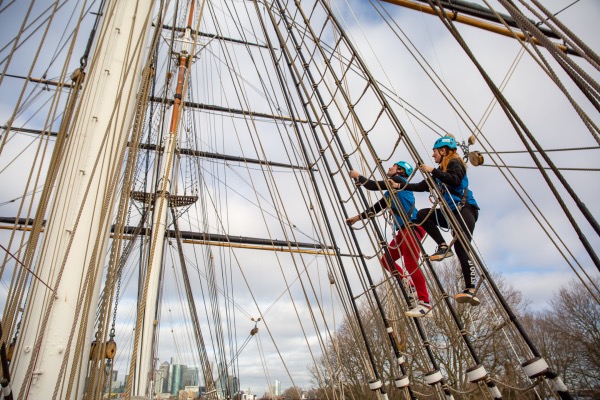
Visitors to the Cutty Sark now have the opportunity to climb the ship’s rigging for the first time since the ship arrived in Greenwich in 1954. The ‘Rig Climb Experience’, which was launched last weekend, sees those bold enough to do so stepping up from the main deck onto the ship’s ratlines, climbing up its shrouds and traversing one of the ship’s lower yardarms to reach the tops platform where they’ll be able to take in magnificent views over Greenwich and The Thames. One of the fastest tea clippers of its day, the Cutty Sark – which was built in Dumbarton in 1869 – had more than 11 miles of rigging, 32 sails with an original sail area of 32,000 square feet, and a 152 foot main mast. Prices start at £41 for adults and £26 for children for a ‘Standard Rig Climb’ and £51 for adults and £36 for children for the Rig Climb Experience Plus. For more, head to www.rmg.co.uk/cuttysark.
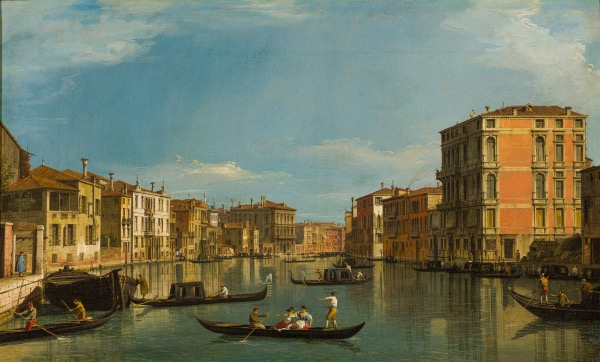
• Twenty-four of Canaletto’s Venetian views which are normally found at Woburn Abbey form the heart of a new exhibition opening at the National Maritime Museum in Greenwich on Friday.Canaletto’s Venice Revisited explores some of the most iconic view paintings of Venice and how tourism, which helped establish Canaletto’s career, today threatens Venice’s future. The views from Woburn Abbey were painted by Canaletto for Lord John Russell, the 4th Duke of Bedford, in the 1730s and this is the first time the paintings, which are thought to be Canaletto’s largest single commission, will be on display in their entirety outside of the abbey. As well as 22 smaller views of Venice depicting iconic landmarks such as Piazza San Marco and the Grand Canal, as well as campi, palazzi and churches, the works include two monumental views, A Regatta on the Grand Canal and The Grand Canal, Ascension Day: The embarkation of the Doge of Venice for the Ceremony of the Marriage of the Adriatic. Runs until 25th September. Admission charge applies. For more, see www.rmg.co.uk/canaletto.
• The story of the postcode is the subject of a new exhibition at The Postal Museum.Sorting Britain: The Power of Postcodes charts the journey of postcodes in the UK, from the post postal districts in London, Liverpool and Manchester and the first trial of postcodes in Norwich in 1959 to how postcodes are used today as an indicator of social standing. Highlights in the display include ELSIE, one of the only original 1950s Electronic Letter Sorting Indicating Equipment left in existence, images of ‘Poco the Postcode Elephant’ – one of the biggest advertising campaigns of the 1980s and unseen maps of London from the 19th century. Runs until 1st January. Included in admission ticket. For more, see www.postalmuseum.org.
• The Lindt GOLD BUNNY Hunt is returning to both Hampton Court Palace and Kensington Palace this Easter for the first time since 2019. Children aged four to 12 are invited to use a trail map to explore each palace and gardens and find the Lindt GOLD BUNNY statues while learning about people from the palaces’ past and, on successfully completing their mission, claim their chocolatey reward. Check the website for details of dates. The hunt is included in palace admission. For more, see www.hrp.org.uk.
• The representation of foundlings, orphans, adoptees, and foster children in comics and graphic novels comes under scrutiny in a new exhibition at the Foundling Museum in Bloomsbury. Opening Friday, Superheroes, Orphans & Origins: 125 years in comics looks at traditional orphan superheroes ranging from Superman and Batman to Spider Man and Black Panther along with characters from early newspaper comic strips, Japanese Manga and contemporary graphic novel protagonists. The display includes historical newspapers, original artwork and contemporary digital work as well as examples of international comics rarely exhibited in the UK. There are also three new artistic commissions specifically made for the exhibition. Can be seen until 28th August. Admission charge applies. For more, see https://foundlingmuseum.org.uk/event/superheroes-orphans-origins/.
Send items for inclusion to exploringlondon@gmail.com.
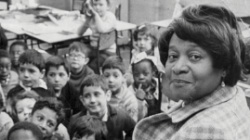
• The archive of writer, teacher and ethno-psychotherapist Beryl Gilroy has been acquired by the British Library. Highlights from the archive, which includes working drafts for published and unpublished novels, letters with publishers and literary agents and ‘born-digital’ material, is at the centre of the free Celebrating Beryl Gilroy display which opened in the Treasures Gallery earlier this month. Gilroy, who was born in Guyana (then British Guiana) and who immigrated to Britain in 1952, became the first black head teacher in London in 1969 and wrote a number of acclaimed children’s books to better reflect the lives of her pupils. Her works – which explore the lives of families, particularly of women and children, the impact of 20th century migration and societal change that came as a result – also included number of novels, a collection of poems, non-fiction writing and a 1976 memoir, Black Teacher. The free display can be seen until 26th June. For more, see www.bl.uk.
• A controversial bronze statue of merchant and slave trader Robert Milligan which formerly stood on West India Quay outside the Museum of London Docklands is joining the museum’s collection. The statue was removed in June, 2020, following a petition signed by over 4,000 people called for it to be removed from public view. Its acquisition by the museum follows a public consultation conducted in partnership with the Tower Hamlets Council and landowners Canal & River Trust, which concluded that the statue should be housed in a museum where it can be fully contextualised. “Over the last 15 years, the museum has been working with academics, community leaders and activists to tell the story of London’s involvement in the transatlantic slave trade, and give voice to its legacy,” said a museum spokesman. “The West India Docks, championed by Milligan using wealth from the slave trade, are a visible reminder of how this history has shaped our city. It is right and important that we acknowledge this in the statue’s story. We will now take time to consult with the local community to decide how best to take this forward as part of our collection.” The statue will be held in storage whilst the museum consults further with local communities about how best to present it.
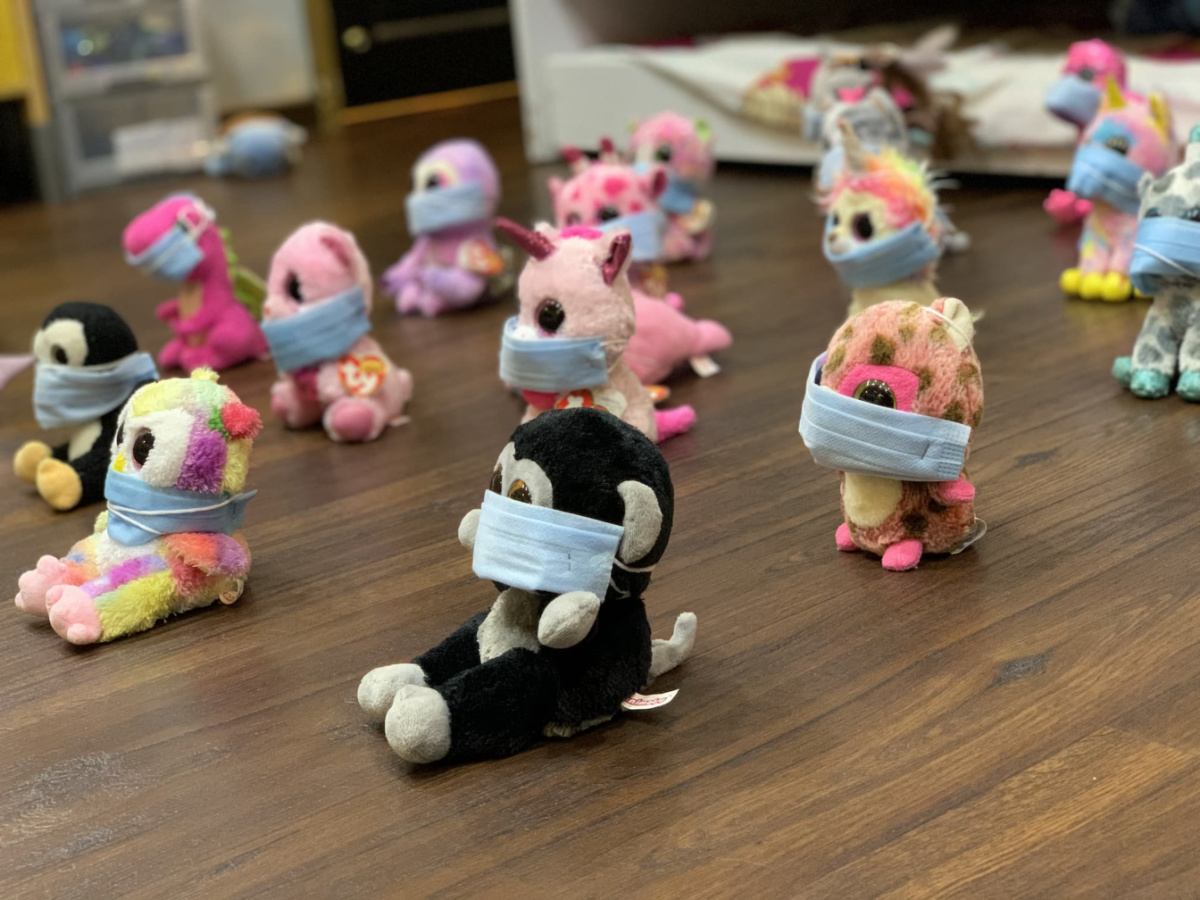
• The impact of the global coronavirus pandemic on children’s play is the subject of an online exhibition launched by Young V&A and its partners UCL and the University of Sheffield this week.Play In The Pandemic features some of the 100 submissions sent in from around the globe in answer to a call-out from The Play Observatory research project for people to submit their experiences of play – everything from music videos to children’s artworks and films made by parents showing their children splashing in puddles – alongside objects from the Young V&A’s collection. The exhibition, which takes the form of an unfolding origami house, also features a series of activities – ranging from how to make your own origami house to creating dens and window boxes for people to get involved. Head to the Play Observatory website.
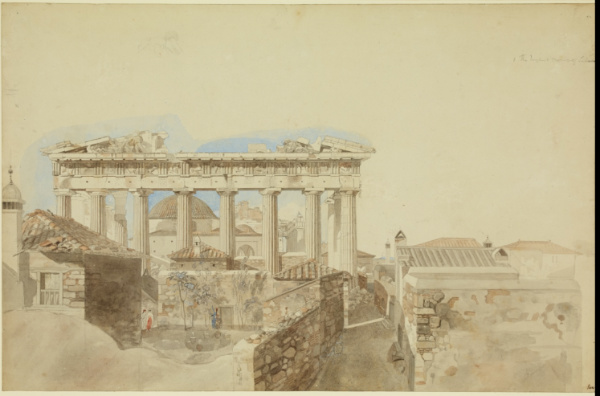
• A new display celebrating the influence of the ancient Greek architectural influence on the British Museum building is open at the museum. The Asahi Shimbun Displays Greek Revival: simplicity and splendour centres on a 200-year-old drawing of the west side of the Parthenon in Athens by British architect Robert Smirke. Smirke drew the Parthenon – still surrounded by medieval and later structures – when he was just 23-years-old and would go on, in the 1820s, to design the British Museum, one of the largest and most famous Greek Revival buildings in the world. Alongside the display is a online visitor trail which features 11 stops around the museum including the south facade and its colonnade and portico of 44 Ionic columns and the opulent Enlightenment Gallery. The free exhibition can be seen until 8th May in Room 3. For more, see britishmuseum.org/exhibitions/greek-revival-simplicity-and-splendour; for more on the trail head to britishmuseum.org/visit/object-trails/greek-revival-architecture-simplicity-and- splendour.
• The first major exhibition to celebrate “the power, artistry and diversity” of masculine attire and appearance opens at the V&A’s Sainsbury Gallery on Saturday.Fashioning Masculinities: The Art of Menswear features around 100 looks and 100 artworks displayed across three galleries – Undressed, Overdressed, and Redressed – and includes both contemporary looks and historic treasures. Fashion designers Harris Reed, Gucci, Grace Wales Bonner and Raf Simons will be represented along with paintings by Sofonisba Anguissola and Joshua Reynolds, contemporary artworks by Robert Longo and Omar Victor Diop, and an extract from an all-male dance performance by Matthew Bourne’s New Adventures. Interspersed will be outfits worn by such famous faces as Harry Styles, Billy Porter, Sam Smith, David Bowie and Marlene Dietrich. Runs until 6th November. Admission charge applies. For more, see vam.ac.uk/masculinities.
Send all items for inclusion to exploringlondon@gmail.com.
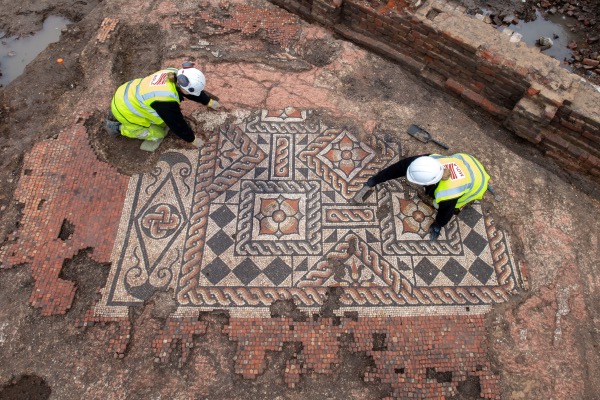
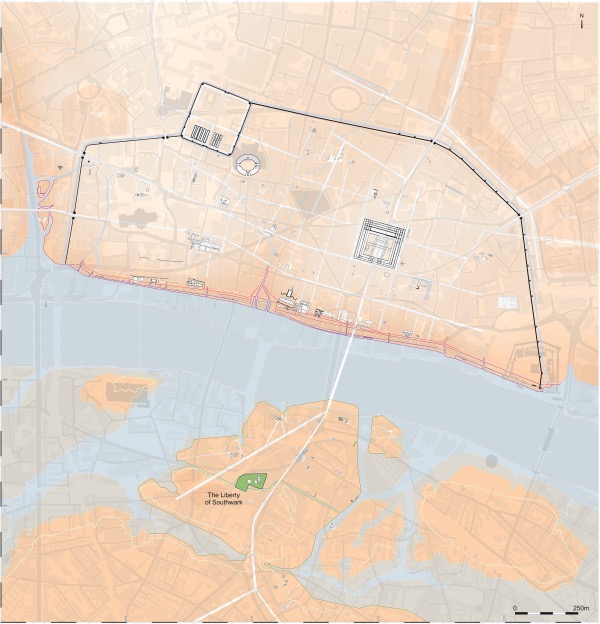
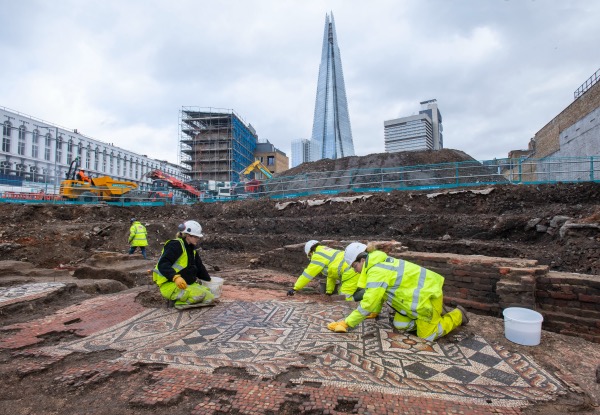
The largest Roman mosaic to be unearthed in London in 50 years has been found near The Shard in Southwark.
The well-preserved mosaic, parts of which are thought to be 1,800-years-old, features two highly decorated panels.
The largest of the two shows large, colourful flowers surrounded by bands of intertwining strands – a motif known as a guilloche – while the design also features lotus flowers and several different geometric elements, including a pattern known as Solomon’s knot which is made of two interlaced loops.
The smaller panel features a simpler design, with two Solomon’s knots, two stylised flowers and striking geometric motifs in red, white and black. Its design is the “almost exact parallel” of a mosaic found in the German city of Trier which suggests a travelling group of artists may have been responsible for both.
The mosaic is believed to be floor of a dining room or ‘triclinium’ of a Roman ‘mansio’, an “upmarket ‘motel'” which offered accommodation, stabling, and dining facilities to people of high rank. The room would have contained couches on which people would have reclined to eat and would have featured brightly painted walls. Fragments of colourful wall plaster have been found on the site as well as traces of an earlier mosaic underneath the one they discovered.
The discovery was made by archaeologists from Museum of London Archaeology (MOLA) during an excavation ahead of building work on a new mixed use development to be constructed on the site, which was previously used as a car park.
MOLA site supervisor, Antonietta Lerz, described the discovery in a statement as a “once-in-a-lifetime find in London”.
“It has been a privilege to work on such a large site where the Roman archaeology is largely undisturbed by later activity-when the first flashes of colour started to emerge through the soil everyone on site was very excited!”
The archaeologists have identified another large Roman building neighbouring the mansio which they believe is likely to have been the private residence of a wealthy individual or family.
Plans for the future display of the mosaic are currently under discussion.
• A 5,000-year-old chalk sculpture – described as “the most important piece of prehistoric art to be found in Britain in the last 100 years” – has gone on show at The British Museum as part of its The world of Stonehenge exhibition. The sculpture was unearthed by members of Allen Archaeology during a routine excavation on a country estate near the village of Burton Agnes in East Yorkshire in 2015. Uncovered alongside the burial of three children (it had been placed near the head of the eldest child and included three hastily added holes possibly to represent the children), the sculpture is decorated with elaborate motifs that the museum said “reaffirms a British and Irish artistic style that flourished at exactly the same time as Stonehenge was built”. The sculpture is similar to three barrel-shaped cylinders made of solid chalk – dubbed the ‘Folkton drums’ due to their shape – which have been in the museum’s collection since they were unearthed in the excavation of a child burial in North Yorkshire in 1889. It is thought the items are works of sculptural art rather than intended to serve a practical purpose and were perhaps intended as talismans to protect the children they accompanied. Radiocarbon dating of the Burton Agnes child’s bones identifies the burial as from 3005–2890 BC. The world of Stonehenge can be seen until 17th July. Admission charge applies. For more, see www.britishmuseum.org/stonehenge.
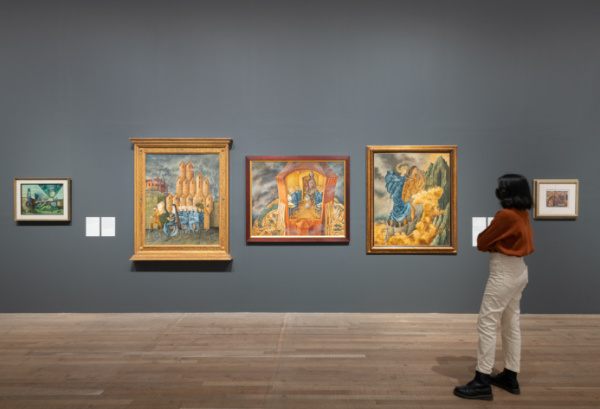
• Spanning 80 years and 50 countries, a new exhibition opening at the Tate Modern today takes an in-depth look at how Surrealism has inspired and united artists around the globe. Surrealism Beyond Borders, running at the Tate in partnership with New York’s Metropolitan Museum of Art, features more than 150 works ranging from painting and photography to sculpture and film, many of which have never been seen in the UK before. Among the highlights Cecilia Porras and Enrique Grau’s photographs, which defied the conservative social conventions of 1950s Colombia, and paintings by exiled Spanish artist Eugenio Granell, whose radical political commitments made him a target for censorship and persecution. There’s also iconic works such as Max Ernst’s Two Children are Threatened by a Nightingale (1924) and lesser known, but significant, pieces such as Antonio Berni’s Landru in the Hotel, Paris (1932), and Toshiko Okanoue’s Yobi-goe (The Call) (1954). Runs until 29th August in the Eyal Ofer Galleries. Admission charge applies. For more, see www.tate.org.uk/whats-on/tate-modern/exhibition/surrealism-beyond-borders.
• A “bold” new artwork by Nigerian-born artist, Victor Ehikhamenor, has gone on display in the crypt of St Paul’s Cathedral. The specially-commissioned mixed-media work is part of 50 Monuments in 50 Voices, a partnership between St Paul’s Cathedral and the Department of History of Art at the University of York which involves inviting contemporary artists, poets, musicians, theologians, performers and academics to respond to 50 historic monuments across the cathedral. Still Standing combines rosary beads and Benin bronze hip ornament masks to depict an Oba (King) of Benin and was made in response to a 1913 brass memorial panel commemorating Admiral Sir Harry Holdsworth Rawson (1843-1910) which is in the Nelson Chamber of the Cathedral’s Crypt. Rawson had a long career in the Royal Navy which culminated in his commanding the Benin Expedition of 1897. The work is on show until 14th May. Admission charge applies. For more, head to https://pantheons-st-pauls.york.ac.uk/50-monuments-in-50-voices/.
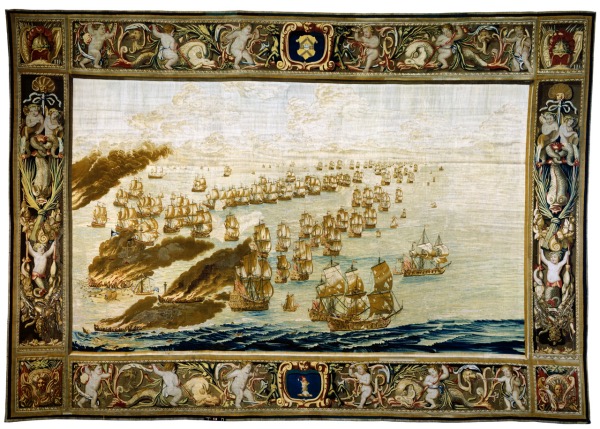
A monumental tapestry – and the only surviving one of its era depicting an English naval scene, the Solebay Tapestry was actually one a series of six designed by father and son team, Willem Van de Velde the Elder and Younger.
Commissioned by King Charles II and his brother, James, Duke of York (later King James II), the tapestry – known as The Burning of the Royal James at the Battle of Solebay, 28 May 1672 – commemorates the Battle of Solebay, a naval battle fought in Southwold Bay off the coast of Suffolk on 28th May, 1672. The first battle of the Third Anglo-Dutch War, it ended with both sides claiming victory and was the final naval battle in which James was engaged.
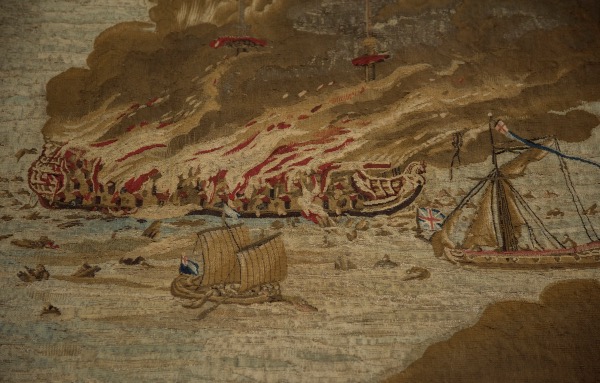
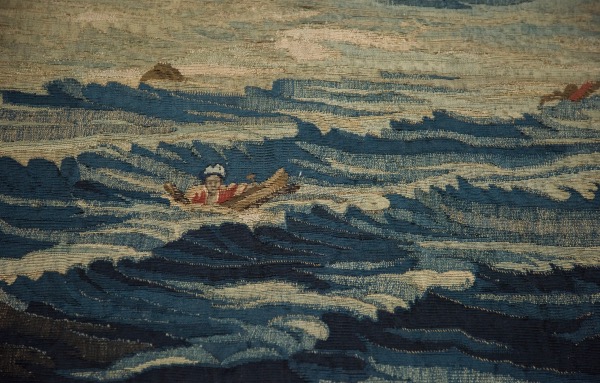
It depicts the dramatic climax of the battle and shows the Royal James engulfed in flames after it wasset alight by Dutch fireships. Edward Montagu, the first Earl of Sandwich whose was aboard the Royal James, died in the attack.
William Van de Veldes the Elder, who was a contemporary of Rembrandt and, along with his son, is considered the founder of English maritime painting, was present at the battle and made a series of sketches from a boat at the scene (he was actually there for the Dutch, not the English).
Subsequently commissioned to reimagine the battle from the English point-of-view, it was the studios of the Van de Velds in the Queen’s House in Greenwich that a series of ‘cartoons’ – large-scale paper designs – were produced using the sketches.
These were then presented to weavers who, once thought to have been based in Mortlake but now believed to have been based in either at Clerkenwell or Hatton Garden, used them to create the tapestries.
The tapestry in the collection of Royal Museums Greenwich was displayed behind King George VI during his speech at the opening of the National Maritime Museum in 1937 but hasn’t been able to be displayed for the past 22 years due to its fragile condition.
In urgent need of repair, the first phase of a conservation project was completed last year. Royal Museums Greenwich has now launched an urgent crowdfunding campaign through ‘Art Happens with Art Fund’ to raise £15,000 for the completion of the project. This will mean the tapestry can be included in an exhibition at the Queen’s House next February marking 350 years since the Van de Veldes’ arrival in England.
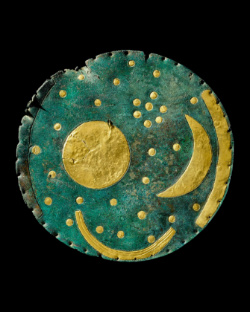
Nebra Sky Disc, Germany, about 1600 BC. PICTURE: Courtesy of the State Office for Heritage Management and Archaeology Saxony – Anhalt, Juraj Lipták.
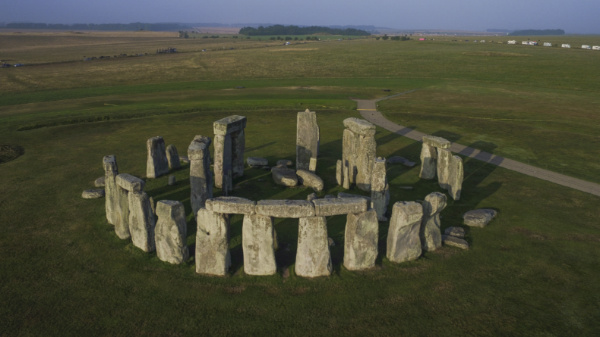
• The UK’s first major exhibition on the story of Stonehenge opens at the British Museum today. The World of Stonehenge features more than 430 objects gathered from across Europe including Bronze Age grave goods unearthed near Stonehenge in the grave of a man known as the Amesbury Archer, the Nebra Sky Disc – the oldest surviving representation of the cosmos anywhere in the world, and the 4,000-year-old wooden monument, called Seahenge, that was discovered in 1998 on a Norfolk beach (and is being loaned for the exhibition for the first time). Admission charge applies. The exhibition can be seen in the Sainsbury Exhibitions Gallery until 17th July. For more, see www.britishmuseum.org/exhibitions/world-stonehenge
• The contribution people of Caribbean heritage have made to London’s transport history is the subject of a new exhibition at the London Transport Museum in Covent Garden.Legacies: London Transport’s Caribbean Workforce features personal oral histories from past and present generations of people of Caribbean descent along with newly commissioned and re-edited films, archive photography, historic advertising posters, and objects such as a Syllabus of Training for Cooks manual from staff canteens. The exhibition is expected to run until summer 2024. Included in general admission. For more, see www.ltmuseum.co.uk/legacies.
Send all items for inclusion to exploringlondon@gmail.com






 Exploring London