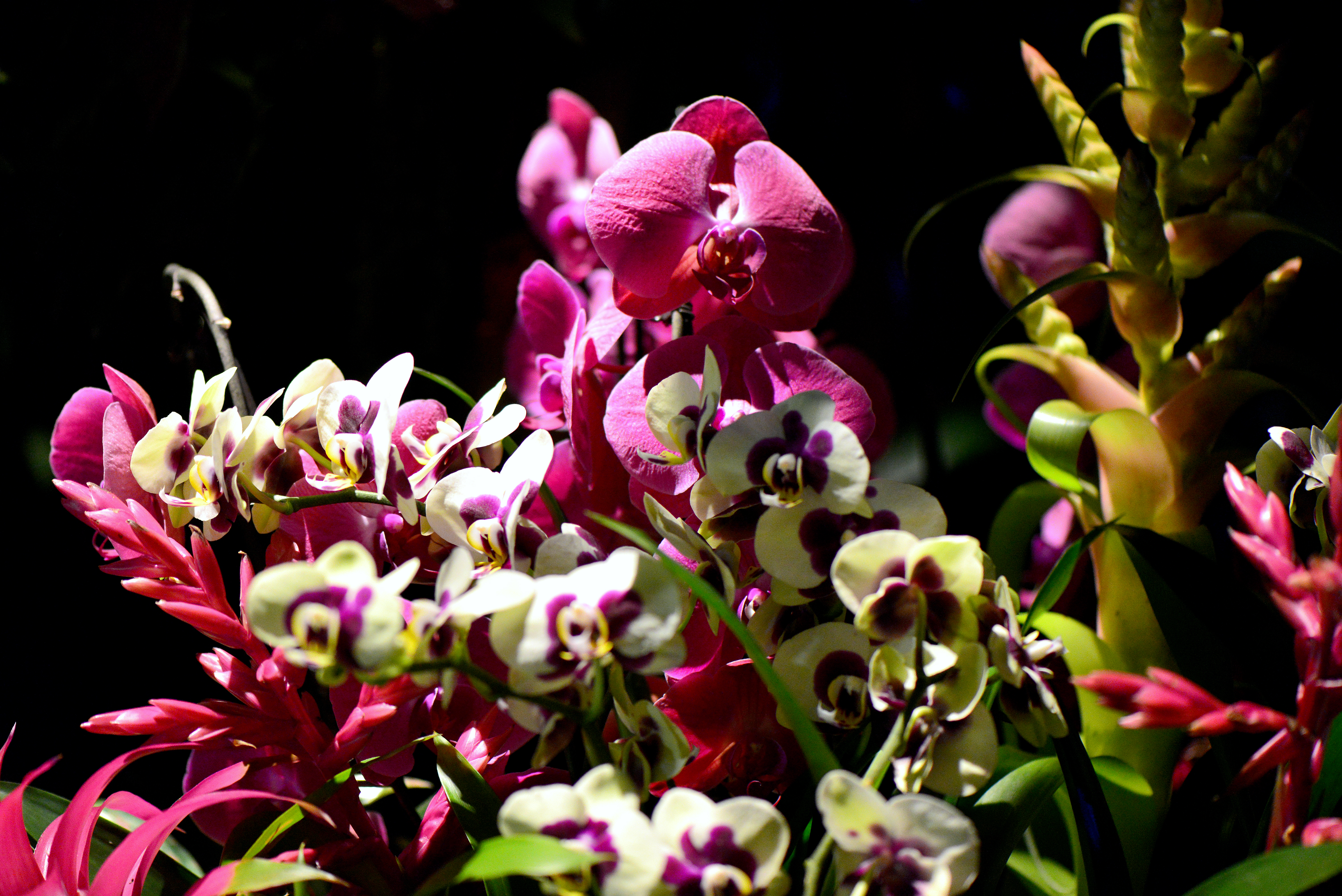
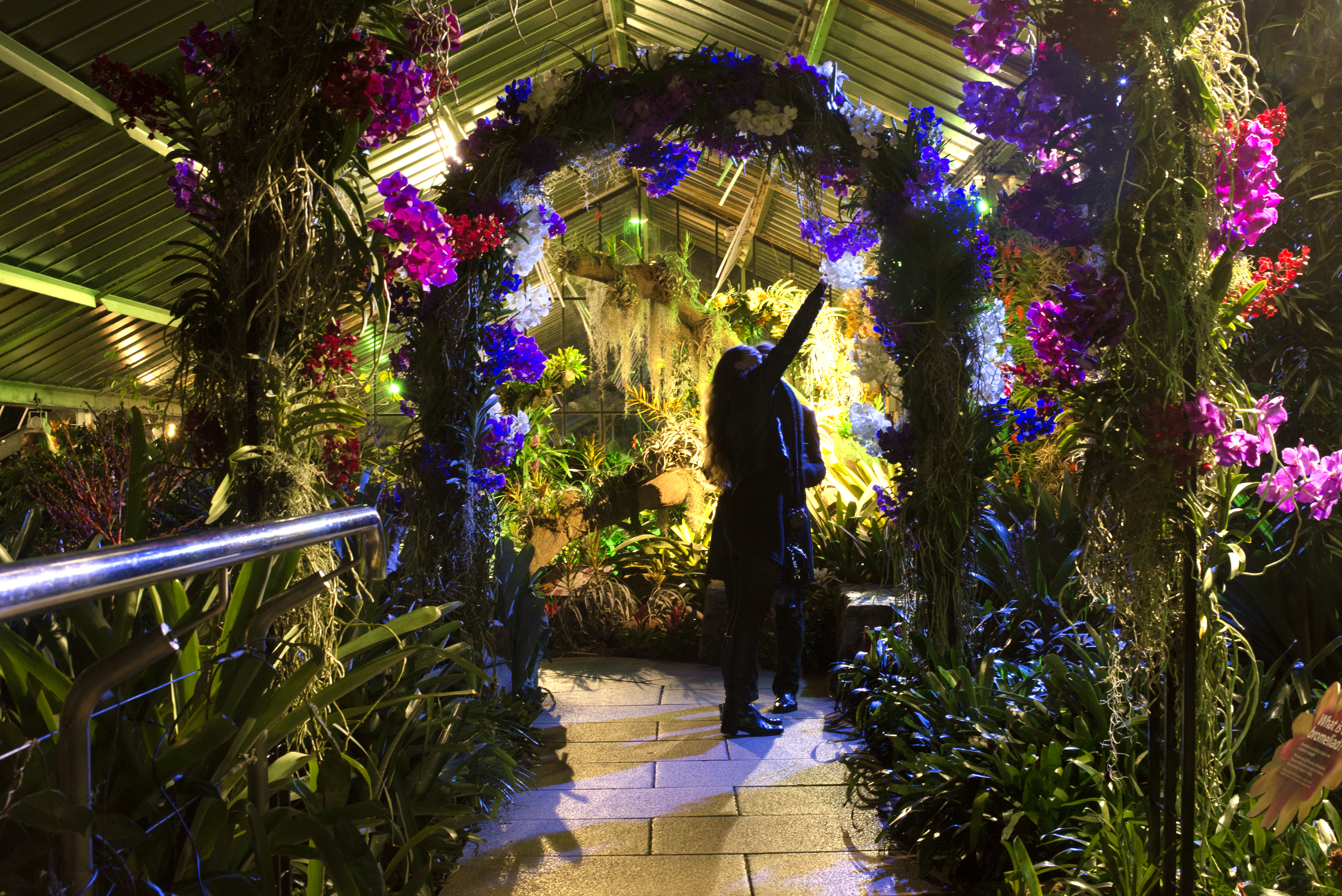
Get a taste of the tropics at Kew Gardens. The rare beauty of orchids is on show in the Princess of Wales Conservatory as part of the annual Orchid Festival which runs until 6th March. And as was the case last year, the festival once again features a series of late openings giving visitors the chance to experience the colourful display after dark. Admission charge applies – for more information on dates and times, see www.kew.org. PICTURES: Jeff Eden/RBG Kew.
News
This Week in London – Behind the scenes at London’s (and New York’s) theatres; Leonardo da Vinci’s mechanical talents; and, deeper inside the Queen’s wardrobe…
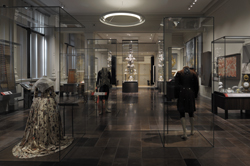
• London’s West End “Theatreland” and New York’s Broadway are jointly the subject of a new exhibition which opened at the V&A this week. Curtain Up: Celebrating 40 Years of Theatre in London and New York takes visitors on an immersive, behind the scenes look at how award-winning plays, musicals and productions are made as well as the history of theatrical awards and life on the red carpet. Objects – taken from the V&A collection and that of The New York Public Library for the Performing Arts at Lincoln Centre – on display include Maria Bjornson’s original costume designs from The Phantom of the Opera (1986), one of the longest-running West End musicals and the longest running Broadway production in history as well as a selection of golden top hats from A Chorus Line which won both the Tony Award and the inaugural Olivier Award for Best New Musical in 1976, a tunic worn by Rudolf Nureyev in Romeo and Juliet, winner of the Olivier Award in 1977, and a dress designed by Bob Crowley and worn by Dame Helen Mirren in The Audience, a production which earned the actress both an Olivier award in 2013 and a Tony Award in 2015. The free exhibition, organised in partnership with the Society of London Theatre as part of a year long celebration of 40 years of the Olivier Award, runs until 31st August in the V&A’s Theatre and Performance Galleries before touring to The New York Public Library for the Performing Arts at Lincoln Centre later this year. For more, see www.vam.ac.uk/curtainup. PICTURE: © Victoria and Albert Museum.
• A visually stunning exhibition highlighting the talents of Leonardo da Vinci opened at the Science Museum in South Kensington yesterday. Leonardo da Vinci: The Mechanics of Genius takes a look at some of the unique mechanical concepts dreamt up by one of “history’s greatest minds”. The display features 39 historical models of designs da Vinci drew – including those of flying machines, diving apparatus and weapons – which were made in Milan in 1952 to mark the 500th anniversary of his birth. Runs until 4th September. Admission charge applies. For more, see www.sciencemuseum.org.uk/leonardo.
• Kensington Palace is taking you even further into the wardrobes of Queen Elizabeth II, Princess Margaret and Diana, Princess of Wales, in a new display of dresses as part of the Fashion Rules exhibition. The new display continues the exhibitions exploration of how each of the three women have navigated the fashion ‘rules’ defined by their royal duties in their own unique style. Among the dresses on display is a candy-striped dress in the “Parisian style” created by Norman Hartnell in the late 1940s for Princess Margaret – on show for the first time at the palace, as well as formal dresses worn by the Queen on state visits to France and the Middle East, and a bottle green silk velvet halterneck worn by Diana which was later made famous in images by photographer Mario Testino. The new display goes on show today. Admission charges apply. For more, see www.hrp.org.uk/kensingtonpalace.
Send all items for inclusion to exploringlondon@gmail.com.
This Week in London – Norway on show at Dulwich; Bruegel the Elder at the Courtauld; and, Kew Gardens celebrates the orchid…
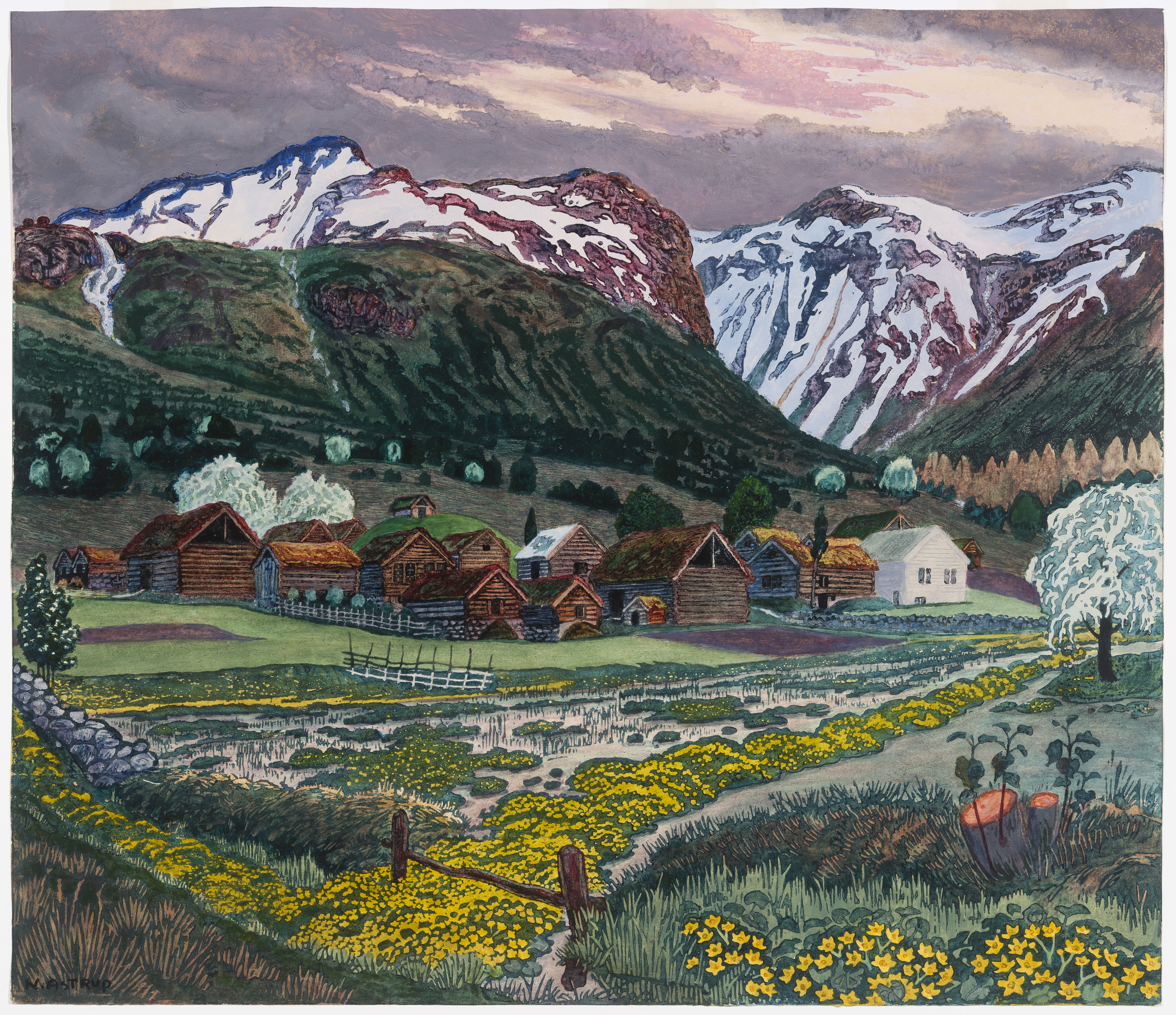
• The first UK show dedicated to the works of Norwegian landscape painter and printmaker, Nikolai Astrup, opens at the Dulwich Picture Gallery tomorrow. Painting Norway: Nikolai Astrup (1880-1928) features more than 120 paintings, woodcuts and archive material – many of public display for the first time. Astrup is described as one of Norway’s finest 20th century artists and long with Munch, expanded the possibilities of woodcuts to capture the wild landscapes and traditional way of life in his western Norway home. Works on show include everything from the woodcut A Clear Night in June (1905-07), the many coloured masterpiece A Night in June in the Garden (1909), and the celebratory Midsummer Eve Bonfire (1915). Runs until 15th May. Admission charges apply. The gallery is also hosting a series of related events. For more, head to www.dulwichpicturegallery.org.uk. PICTURE: Marsh Marigold Night, c.1915 – The Savings Bank Foundation DNB/The Astrup Collection/KODE Art Museums of Bergen. Photo © Dag Fosse/KODE.
• Bruegel the Elder’s only three surviving grisaille paintings have been brought together in a new exhibition opening at the Courtauld Gallery at Somerset House today. The works, painted in shades of grey, include the Courtauld’s Christ and the Woman Taken in Adultery as well as The Death of the Virgin (brought from the National Trust-managed Upton House) and Three Soldiers (borrowed from the Frick Collection in New York. They’re among the less than 40 works attributed to the artist (c1525-1569) and while The Death of the Virgin was owned by his friend, map-maker Abraham Ortelius, Christ and the Woman Taken in Adultery was one of few paintings kept by the artist himself. The exhibition Bruegel in Black and White: Three Grisailles Reunited also includes replicas made by Bruegel’s sons as well as other grisailles while other works by Bruegel from the Courtauld’s collection will be displayed in the Butler Drawings Gallery. Runs until 8th May. Admission charges apply. For more, see www.courtauld.ac.uk.
• Head to Kew Gardens for a splash of colour as the annual Orchid Festival kicks off in the Princess of Wales Conservatory on Saturday. And, following the success of last year’s events, the conservatory will once again throw its doors open after dark on the 11th, 18th and 25th February and 3rd March for Orchid Lates at Kew Gardens (there’s also a special Valentine’s Late at Kew Gardens on 13th February). Admission charges apply. For more, head to www.kew.org.
Send all items for inclusion to exploringlondon@gmail.com.
LondonLife – Lost Beatrix Potter story found in V&A…
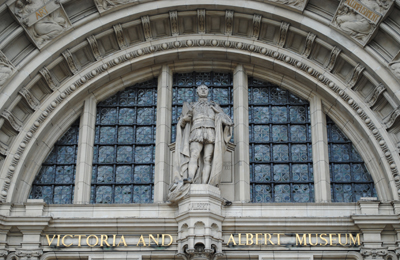
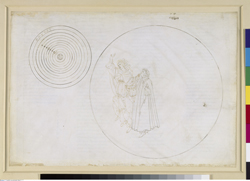
A new tale written by Peter Rabbit creator Beatrix Potter will be published last this year following its discovery in the Potter archives at the Victoria & Albert Museum (pictured above).
The Tale of Kitty-In-Boots, which apparently tells the story of a black cat that leads a double life, was found two years ago by Penguin Random House Children’s publisher Jo Hanks. Its publication forms part of the celebrations surrounding the 150th anniversary of Ms Potter’s birth.
The story, which Ms Hanks unearthed in three separate manuscripts in the archive, was sent to Ms Potter’s publisher in 1914 and Ms Hanks told the BBC that Ms Potter had “fully intended” to publish it but, thanks to interruptions including World War I, her marriage and illness, she never went back to it.
Ms Hanks told the BBC that “the tale really is the best of Beatrix Potter”.
“It has double identities, colourful villains and a number of favourite characters from other tales. And, most excitingly, our treasured, mischievous Peter Rabbit makes an appearance – albeit older, slower and portlier!”
Artist Quentin Blake has been asked to illustrate the new book.
The V&A holds the world’s largest collection of Beatrix Potter’s drawings, literary manuscripts, correspondence, photographs and related materials. For more, see www.vam.ac.uk/content/articles/t/beatrix-potter-collections/.
This Week In London – Artists and gardens at the RA; London tattoos; and, out of this world photos at the Natural History Museum…
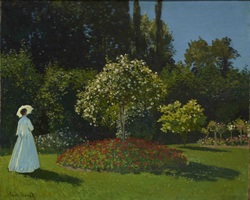
• A major exhibition looking at the role of gardens in the paintings of Claude Monet and his contemporaries opens at the Royal Academy of Arts in Piccadilly on Saturday. Painting the Modern Garden: Monet to Matisse spans the period from the 1860s to the 1920s and includes more than 120 Impressionist, Post-Impressionist and Avant-Garde works including 35 by Monet as well as “rarely seen” masterpieces by Paul Klee, Emil Nolde, Gustav Klimt and Wassily Kandinsky. Highlights include Monet’s Agapanthus Triptych (1916-1919) as well as his Water Lilies (1904) and Lady in the Garden (1867), Auguste Renoir’s Monet Painting in His Garden at Argenteuil (1873) , Kandinsky’s Murnau The Garden II (1910) and Pierre Bonnard’s Resting in the Garden (1914). The exhibition, which has previously been at The Cleveland Museum of Art in Ohio, runs until 20th April. Admission charge applies. For more, see www.royalacademy.org.uk. PICTURE: Claude Monet, Lady in the Garden, 1867; © The State Hermitage Museum/Vladimir Terebenin.
• The world of professional tattooing is the subject of a new display at the Museum of London. Tattoo London, which opens at the City-based museum tomorrow, looks at the history of tattooing in the capital – which dates back to a time before Captain Cook – as well as life inside four contemporary tattoo studios. Also on display will be newly commissioned artworks by tattooists from the studios – Lal Hardy at New Wave, Alex Binnie at Into You, Claudia de Sabe at Seven Doors, and Mo Coppoletta at The Family Business. A series of events are being held in conjunction with the display which runs until 8th May. Entry is free. For more, see www.museumoflondon.org.uk.
• A new photographic exhibition exploring the solar system has opened at the Natural History Museum. Otherworlds: Visions of our Solar System features 77 composite images pieced together from date collected on NASA and ESA missions by artist, curator and writer Michael Benson. Highlights include A Plutonian haze – a colourised image of Pluto created from data captured during New Horizon’s flyby of the dwarf planet in July last year, Enceladus vents waters into space – captured in 2009 by NASA’s Cassini mission it shows Saturn’s sixth largest moon Enceladus spraying water into space, and, A Warming Comet – a picture of the twin-lobed comet 67P/Churyumov-Gerasimenko venting gas and dust captured by ESA’s Rosetta probe in July last year. The exhibition can be seen until 15th May at the South Kensington museum. Admission charge applies. For more, see www.nhm.ac.uk/otherworlds.
Send all items for inclusion to exploringlondon@gmail.com.
LondonLife – Facelift for one of the UK’s “most unique” cemeteries…
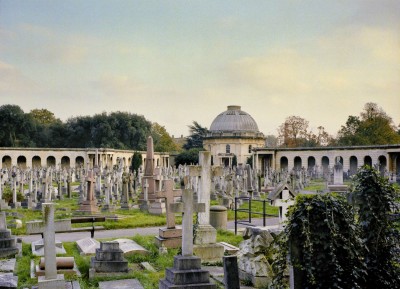
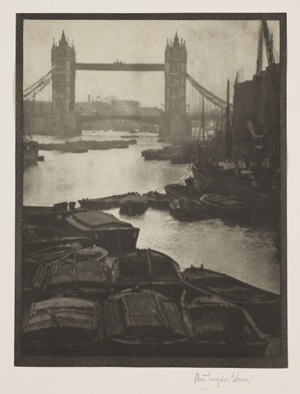
Brompton Cemetery in London’s west is to undergo a major renovation thanks to a £6.2 million project. Designed by Benjamin Baud and consecrated by the Bishop of London in 1840, the 39 acre cemetery – one of the oldest Grade I listed cemeteries in the country and known as one of London’s “magnificent seven” cemeteries – was strongly influenced by landscapes around St Peter’s in Rome. Among the 205,000 people buried there are suffragette Emmeline Pankhurst, Sir Thomas Spencer Wells – Queen Victoria’s surgeon, and thousands of former Chelsea pensioners. The project will see the chapel, central colonnades and catacombs restored and the transformation of North Lodge into a visitor’s centre with shop and cafe as well as other conservation and improvement works. It is funded by an almost £4.5 million grant from the BIG Lottery Fund and the Heritage Lottery Fund as well as a £1.2 million investment from The Royal Parks, managers of the site, and £500,000 from The Royal Parks Foundation, only half of which has been raised. Those looking to donate to the foundation’s appeal, can visit www.SupportTheRoyalParks.com. PICTURE: © The Royal Parks
This Week in London – Literary ‘foundlings’; Anthony Van Dyck re-examined; Astronights; and, Liberty in Fashion…
• A new exhibition featuring drawings of fictional child protagonists who were orphaned, adopted, fostered or ‘found’ opens at the Foundling Museum in Bloomsbury tomorrow. Drawing on Childhood shows how illustrators, spanning the period from the 18th century until today, was inspired by Lemn Sissay’s 2014 commission, Superman was a Foundling. It features original drawings, first editions and special illustrated editions depicting everyone from James Trotter (James and the Giant Peach) to Cinderella and Rapunzel. Among the artists whose work will be on display are Phiz (Hablot K Browne), Arthur Rackham, Quentin Blake, Stref, George Cruikshank, Thomas Rowlandson, Nick Sherratt and David Hockney. Three contemporary artists – Chris Haughton, Pablo Bronstein and Posy Simmonds – have also been invited to produce a new illustration for Henry Fielding’s 1749 novel, The History of Tom Jones, a Foundling. Runs until 4th May. Admission charge applies. For more, see www.foundlingmuseum.org.uk.
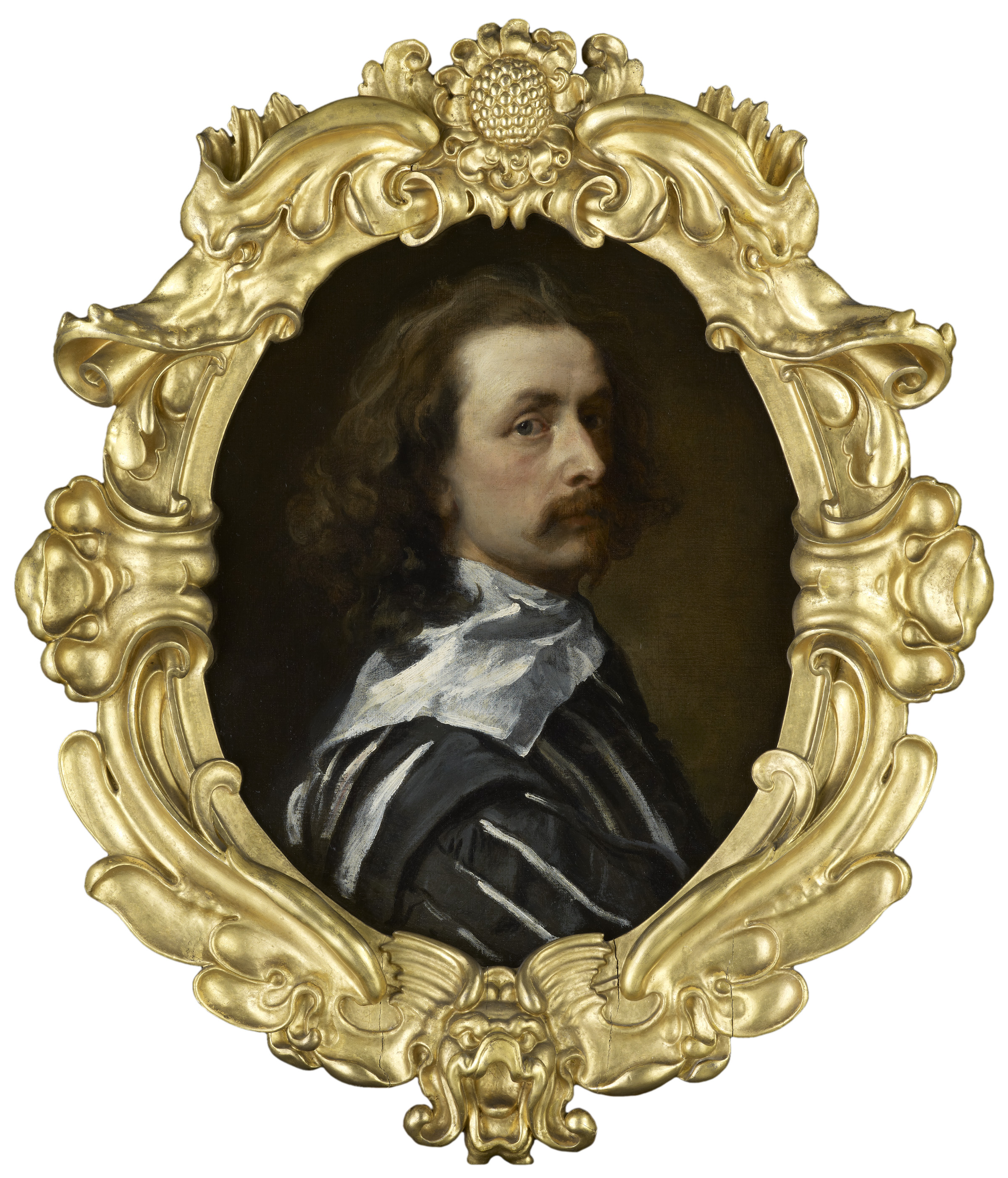
• The works of Anthony van Dyck are the subject of a new display at the Dulwich Picture Gallery. I Am Van Dyck centres around a self-portrait of the artist recently acquired by the National Portrait Gallery and lent to Dulwich and juxtaposes the painting with two works by contemporary British artist Mark Wallinger – Self (Times New Roman) and I Am Innocent – in an effort to explore the meanings of individuality and our sense of self. The display – the first of four under the umbrella of Making Discoveries: Dutch and Flemish Masterpieces – also reveals new information on works by Van Dyck held by the gallery and shows how he developed and altered his compositions. Runs until 24th April. Admission charge applies. For more, see www.dulwichpicturegallery.org.uk.
• The Science Museum is holding the first of its Astronights – “sleepovers for grown-ups” – this Saturday night. Guests will be treated to a midnight screening of Star Wars: Episode VII – The Force Awakens before which they’ll enjoy a three course meal with live music and an evening of entertainment. The next Astronight will be held on 4th March. Charges apply. For more, see www.sciencemuseum.org.uk/astronights.
• On Now: Liberty in Fashion. Commemorating the 140th anniversary of the company in 2015, this exhibition at the Fashion and Textiles Museum in Bermondsey Street explores the impact of Liberty & Co on British fashion and features more than 150 garments, textiles, and objects which demonstrate the company’s relationships with designers such as Yves Saint Laurent and Vivienne Westwood. The exhibition, which opened in October, runs until 28th February. Admission charge applies and there’s a series of events accompanying the exhibition (many of which have still to run). For more, see www.ftmlondon.org.
Send all items for inclusion to exploringlondon@gmail.com.
This Week in London – London illuminated; commemorating Shakespeare’s death; and, of bees and pollination…
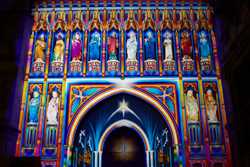
• The biggest ever light festival to hit London opens tonight. Lumber London, produced by Artichoke with the support of the Mayor of London and visitlondon.com, will see a host of international artists transform a series of iconic buildings and locations in four areas across the city – Piccadilly, Regent Street and St James’s, Trafalgar Square and Westminster, Mayfair and King’s Cross. The 30 installations include French collective TILT’s Garden of Light featuring giant illuminated plants in Leicester Square, Patrice Warrener’s The Light of the Spirit which envelopes the west front of Westminster Abbey in colour and light, Deepa Mann-Kler’s Neon Dogs – a collection of 12 neon dogs inspired by the balloon dogs seen at children’s parties, this sits near Trafalgar Square, and, Pipette, a colourful installation by Miriam Gleeman (of The Cross Kings) and Tom Sloan (of Tom Sloan Design) which sits in the pedestrian subway, the King’s Cross Tunnel. Other highlights include Julian Opie’s work Shaida Walking, 2015 which will be permanently located in Broadwick Street, Soho, and Janet Echelon’s enormous net sculpture 1.8 London which is strung between buildings at Oxford Circus. The festival runs from 6.30pm to 10.30pm over the next four nights. You can download a free map on the installations or use the free London Official City Guide app to locate them. For more information – including the full programme – see www.visitlondon.com/lumiere.
• A property deed signed by playwright William Shakespeare and one of the most complete first folios of his works have gone on show in the London Heritage Gallery at the Guildhall Art Gallery. Alongside the two documents which dates from 1613 and 1623, the Shakespeare and London exhibition marks the 400th anniversary of Shakespeare’s death – to be commemorated on 23rd April this year – will also display other documents related to the story of London’s playhouses. The property deed – which relates to a property in Blackfriars – is only one of six surviving documents to bear the playwrights authenticated signature while the first folio is one of five of the most complete copies in existence and is apparently usually only brought out for consultation by Shakespearean scholars and actors. The exhibition runs until 31st March. Admission is free. For more on it and other events being run to commemorate the Bard’s death, see www.cityoflondon.gov.uk/shakespeare400. For more on other events this year, check out www.shakespeare400.org.
• See your art featured in an upcoming exhibition on the importance of bees and pollination by attending a drop-in workshop at Victoria Tower Gardens next to the Houses of Parliament next week. The workshop, which will be held from 10am to 2pm on 20th January, will see participants create their own 3D flowers based on famous paintings by Vincent Van Gogh and Jan Van Huysum currently in The National Gallery’s collection – all as part of a focus looking at what plants bees are attracted to. The art created in the workshop will be seen in an exhibition A Right Royal Buzz which is the result of a collaboration between The Royal Parks, The National Gallery and Mall Galleries and will be seen across all three venues (Victoria Tower Gardens representing the Royal Parks) from 17th t0 20th February. For more, head to this link.
Send all items for inclusion to exploringlondon@gmail.com.
LondonLife – Australia House’s holy well…
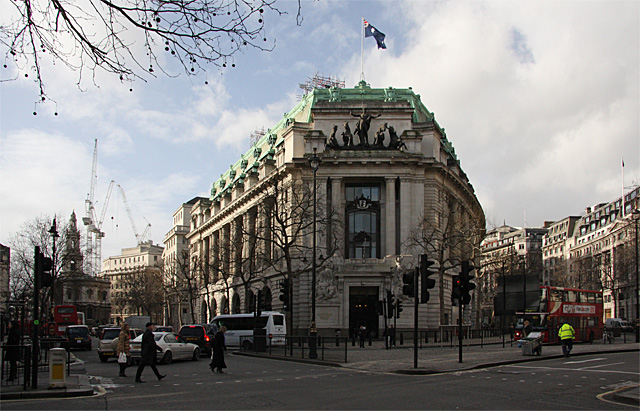
News this week that scientists have confirmed an ancient sacred well beneath Australia House in the Strand (on the corner of Aldwych) contains water fit to drink. The well, believed to be one of 20 covered wells in London, is thought to be at least 900 years old and contains water which is said to come from the now-subterranean Fleet River. Australia’s ABC news was recently granted special access to the well hidden beneath a manhole cover in the building’s basement and obtained some water which was tested and found to be fit for drinking. It’s been suggested that the first known mention of the well – known simply as Holywell (it gave its name to a nearby street now lost) – may date back to the late 12th century when a monk, William FitzStephen, commented about the well’s “particular reputation” and the crowds that visited it (although is possible his comments apply to another London well). Australia House itself, home to the Australian High Commission, was officially opened in 1918 by King George V, five years after he laid the foundation stone. The Prime Minister of Australia, WM “Billy” Hughes, was among those present at the ceremony. The interior of the building has featured in the Harry Potter movies as Gringott’s Bank. PICTURE: © Martin Addison/Geograph.
Treasures of London – The Lampedusa Cross…
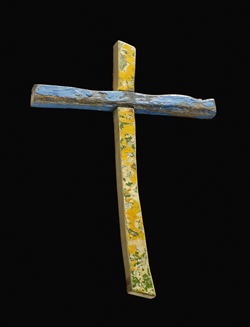
Donated to the British Museum in October (the last acquisition made under former director Neil MacGregor), the Lampedusa Cross was constructed by carpenter Francesco Tuccio out of wreckage from a refugee boat which sank off the Italian island of Lampedusa on 3rd October, 2013. At least 349 of the 500 refugees on board were drowned, some of whom were Eritrean Christians fleeing persecution, while 151 survived. Mr Tuccio, a resident of Lampedusa, decided to make a series of small crosses from the wreckage after meeting some of the refugees in the church of San Gerlando as a gift for them to both reflect their salvation and as a symbol of hope for the future. He was subsequently also asked to make a further cross which was carried by Pope Francis at the memorial service for the survivors. Asked by the British Museum if it could acquire a cross for its collection, Mr Tuccio made a cross specifically for the museum which he then donated to the institution, saying after he received a letter of thanks that “it is I who should thank you for drawing attention to the burden symbolised by this small piece of wood.” The cross went on display in Room 2 of the museum on 18th December (the last day of Mr MacGregor’s directorship). Entry is free. For more on the British Museum, see www.britishmuseum.org. PICTURE: © Trustees of the British Museum.
This Week in London – New guides to British Museum; Jean-Etienne Liotard at the RA; and Peter Lanyon’s gliding landscapes…
• The British Museum has unveiled a new audio guide to provide the museum’s 6.7 million annual visitors with a new way to interact with its permanent collections. The guide comes in 10 different languages as well as in British Sign Language, an updated and improved audio descriptive guide and a “family game guide” for children to play with their parents. It boasts 70 new commentaries detailing the most recent research on key objects as well as new tours for China and A History of the World, a highlights feature and Top 1o tour, stunning new photography and a ‘My visit’ feature which sends visitors a visual record of their visit by email. The guide is available for hire at the Bloomsbury institution. See www.britishmuseum.org for more.
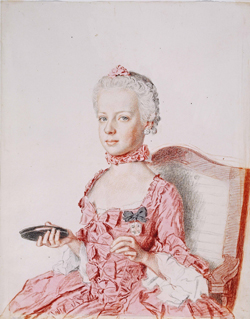
• On Now: Jean-Etienne Liotard. This exhibition at the Royal Academy of Arts’ Sackler Wing of Galleries off Piccadilly, which closes at the end of the month, features more than 70 works by the 18th century Swiss artist including works in pastels (of which he was an undisputed master), oil paintings, drawings and miniatures. The exhibition is divided into six sections – they include a detailed look at the artist and his family, his four year sojourn in Constantinople and his royal portraits which include Archduchess Marie-Antoinette of Austria, painted in 1762 (pictured). Runs until 31st January. Admission charge applies. For more, see www.royalacademy.org.uk. PICTURE: Bettina Jacot-Descombes/RA
• On Now: Soaring Flight: Peter Lanyon’s Gliding Paintings. The first exhibition devoted to the post-war artist’s gliding paintings, this display at the Courtauld Gallery in Somerset House explores Lanyon’s (1918-1964) pioneering artistic breakthroughs in landscape painting as he created works inspired and influenced by his own gliding experiences in West Cornwall. The display features 15 major paintings from public and private collections around the world. Closes on 17th January. Admission charges apply. See www.courtauld.ac.uk.
Send all items for inclusion to exploringlondon@gmail.com.
LondonLife – King Henry VIII’s lost tiltyard tower rediscovered…
Archaeologists have uncovered the remains of one of five highly ornate towers, luxurious banqueting houses from which the court would view tournaments in King Henry VIII’s walled tiltyard at Hampton Court Palace.
Built in the 1530s, the multi-storey towers were largely demolished by the 1680s and, with the exception of one of the towers which still stands at the palace (and is now a Grade I listed building), their precise location eventually lost.
Until now, that is. The green-glazed tiled floor of one of the ‘lost’ towers were unearthed earlier this month during works taking place as the tiltyard undergoes a family-oriented makeover by award-winning landscape architect, Robert Myers (to be known as ‘The Magic Garden’, it will be unveiled next Easter).
The richly decorated towers – where the king entertained dignitaries and ambassadors – are thought to slightly predate the tiltyard which was apparently laid out in 1537 – perhaps, it’s been suggested, to mark the birth of King Henry VIII’s son, the future King Edward VI.
The first recorded tournament at Hampton Court took place in 1557 when Queen Mary I held one to celebrate Christmas. Her sister Queen Elizabeth I continued the tradition by occasionally holding tournaments there but most days the tiltyard was used to train the young men of the court in warfare.
When tournaments gradually fell out of fashion, the towers were used as multi-purpose storage facilities housing, according to Historic Royal Palaces, everything from pigeons to two Catholic priests in service to King Charles I’s queen, Henrietta Maria, who were spent time ‘quarantined’ there after an outbreak of plague.
For more on Hampton Court Palace, see www.hrp.org.uk/hampton-court-palace/.
LondonLife – Baby gorillas get to know each other…
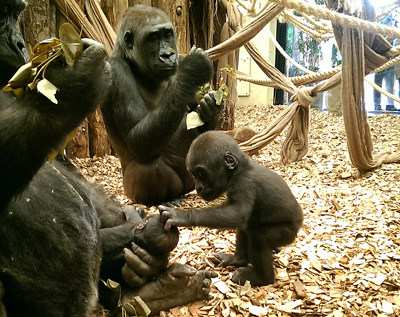
Female infant gorilla Alika, who celebrated her first birthday at ZSL London Zoo in Regent’s Park last week, is pictured getting to know her two week old baby brother, Gernot. Named after the partner of a generous donor who has supported the Zoological Society of London’s (ZSL) international work for wildlife, Gernot (below, top) was born to 22-year-old female Effie and 17-year-old silverback Kumbuka on 25th November, both Western lowland gorillas, and can most often be found tightly snuggled in Effie’s arms (below, bottom). Gorilla keeper Glynn Hennessy said while Gernot had become the “centre of attention” at the zoo’s Gorilla Kingdom, “one-year-old Alika has embraced her new role of the doting big sister”. “Western lowland gorillas live in troops and learn how to act from observing each other’s behaviours and manners and here we can see Alika demonstrating some of the nurturing skills she’s learned from the adults.” This has included touching his head and stroking his face as he sleeps in his mother’s arms. For more, see www.zsl.org. PICTURES: ZSL London Zoo.
Treasures of London – Royal Charter for the Society of Artists in Great Britain……
The Charter for the Society of Artists of Great Britain and its associated Roll of Obligation have been rediscovered at the Royal Academy of Arts, 250 years after was society was founded. The documents, long thought to have been missing, date from 1765 and signify the formation of artists as a professional group in Britain. They form a crucial piece in history of the development of the Royal Academy of Arts, which formed in 1768 when a group of artists broke away from the society. The Charter, which consists of three pages of vellum with a portrait of a young King George III, hadn’t been seen since 1918. It and the Roll of Obligation – which features the crossed-out names of artists ‘expelled’ from the society, including the RA’s first president, artist Joshua Reynolds and German-born Johann Zoffany – were rediscovered earlier this year during an audit of the RA collections. The finding coincides with the 250th anniversary of the formal foundation of the society when it was granted a Royal Charter by King George III. Both documents will go on show from 2018 – the 250th anniversary of the founding of the RA – in new exhibition areas being created as part of the transformation taking place at the RA. For more on the Royal Academy, see www.royalacademy.org.uk.
This Week in London – V&A reopens Europe 1600-1815 galleries; the Victorian era’s finest; and, ‘Handel’s Performers’…
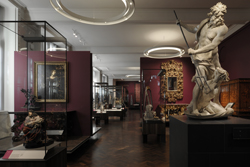
• The V&A has reopened its ‘Europe 1600-1815’ galleries to the public this week following a major £12.5 million refurbishment. The seven transformed galleries, located close to the South Kensington museum’s grand entrance, tell the story of how France succeeded Italy as the “undisputed leader” of fashionable art and design in Europe in the late 17th century and how Europeans systematically “explored, exploited and collected” resources from Africa, Asia and the Americas. Featuring more than 1,100 objects, the galleries – redesigned in conjunction with architectural practice ZMMA – include four
large rooms introducing the story of Europe across the period and three smaller rooms focusing on specific activities – ‘collecting in the Cabinet’, ‘enlightened thought in the Salon’, and ‘entertainment and glamour in the Masquerade’. Objects on display include a highly ornate Rococo writing cabinet made from Augustus III (on show for the first time since it has undergone a conservation work), a newly conserved 18th century bed from the Parisian workshop of George Jacob – furniture maker to Napoleon, a 17th century Venetian table by Lucio de Lucci and Pierre-Denis Martin’s oil painting, The Visit of Louis XIV to the Chateau de
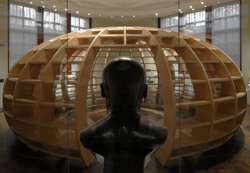
Juvisy (both on show for the first time) as well as several large recently cleaned tapestries including the 1860s Gobelins tapestry, The infant Moses tramples on Pharoah’s crown. The display also includes three recreated period rooms – a 17th century French bedchamber, Madame de Sérilly’s cabinet and a mirrored room from 18th century Italy – while in the Salon can be found a contemporary installation, The Globe. A curved architectural sculpture, it is the creation of Havana-based artist collective Los Carpinteros and forms a “room within a room” within the ‘Salon’. It will be used for events and discussions. Entry to the galleries is free. For more, see www.vam.ac.uk/europegalleries. PICTURES: David Grandorge/©Victoria and Albert Museum, London.
• On Now: Handel’s Performers. This display of portraits and documents in The Foundling Museum’s Handel Gallery is a showcase of celebrities and singers who brought the work of composer George Frideric Handel’s work to the public in the 18th century. Among those depicted are Anastasia Robinson and Senesino, among the highest paid singers of their time, Anna Maria Strada, a leading soprano, Gustavus Waltz, a bass singer who sang at the benefit performance of Handel’s Messiah at the Foundling Hospital in 1754, and John Hebden, who played in the orchestra during benefit performances of the Messiah in 1754 and 1758. Runs at the Bloomsbury museum until 1st May. Admission charge applies. For more, see www.foundlingmuseum.org.
Send all items for inclusion to exploringlondon@gmail.com.
This Week in London – Christmas at Kensington and the Geffrye; and Ebola and ISIS at the IWM…
• Christmas is looming and that means Christmas themed events happening all over London. Here’s a couple worth considering:
• Kensington Palace: Head back into the Victorian era where so many of the Christmas traditions we know and love find their origins. The palace and gardens have been decorated with period-inspired decorations while inside decorations include the beautifully decorated tables where Queen Victoria and Prince Albert showcased their Christmas gifts. There’s talks on the origins of Christmas foods such as plum pudding, music and carolling, and the cafe is serving up seasonal food and drink while on Saturday, a special brunch time lecture will look behind the curtains into the world of Victorian pantomime and performance. Admission charges apply – check the website for dates. For more, see www.hrp.org.uk/kensington-palace/.
• The Geffrye Museum: This Shoreditch institution is once again celebrating Christmas traditions of the past in its annual display showcasing the past 400 years of Christmas traditions. Christmas Past has taken place at the museum for the past 25 years and is based on ongoing, original research. It provides insights into everything from traditional Christmas feasts to kissing under the mistletoe, playing parlour games, hanging up stockings, sending cards, decorating the tree and throwing cocktail parties. A series of related events, including a concert by candlelight, are being held over the Christmas season. The display, which has free entry, closes on 3rd January. For more, see www.geffrye-museum.org.uk.
• Ebola and the fight against ISIS are the subject of a new exhibition which opened at the Imperial War Museum in Lambeth last month. Fighting Extremes: From Ebola to ISIS looks at the experiences of British personnel serving on recent operations including the response to the Ebola outbreak in Sierra Leone and the fight against ISIS in the Middle East. The display features behind the scenes interviews such as an in-depth talk with Corporal Anna Cross, a British Army nurse who contracted Ebola, photographs, and recently acquired objects such as the Wellington boots worn by healthcare worker Will Pooley, the first Briton to contract Ebola who was evacuated from Sierra Leone by the RAF, a headset used by an RAF drone pilot, and a shooting target depicting a silhouette of an ISIS suicide bomber used by the British Army to train Peshmerga troops. For more, see www.iwm.org.uk.
Send all items to exploringlondon@gmail.com.
LondonLife – An illuminated Christmas at Kew…
It was Queen Charlotte who first dressed the branches of a Christmas tree in Kew Palace in the 1790s and, drawing on that tradition, Kew Gardens is once again hosting a mile long winter light experience. Visitors can walk through ribbons of light, count the festooned Christmas trees and listen to a holly bush choir as well as see larger than life winter flora such as snowdrops and Christmas roses and pause at the scented Fire Garden for a moment of reflection. Santa and his elves are appearing on stage at the Princess of Wales Conservatory and a Victorian carousel and other rides are located at the White Peaks Cafe where visitors can sample goodies like mulled wine, spiced cider and roasted chestnuts. The after-dark event runs from 5pm to 10pm on select dates until 2nd January. Admission charge applies. For more, see www.kew.org. PICTURE: The Palm House at Kew Gardens lit up for Christmas. Courtesy Kew Gardens.
This Week in London – Alice in Wonderland’s 150th; Remembering Julia Margaret Cameron; and, Imperial Britain’s artistic influence…
• A new exhibition has opened at the British Library in Kings Cross to mark the 150th anniversary of the publication of Alice’s Adventures in Wonderland. The free exhibition explores the story of how the tale came to be written and features Lewis Carroll’s handwritten manuscript of Alice’s Adventures Under Ground (complete with 37 illustrations by Carroll) as well as an entry from Carroll’s diary in which he relates how he first came to tell the story to Alice Liddell and her sisters on the “golden afternoon” of 4th July, 1862. Other highlights include two first editions of Alice’s Adventures in Wonderland with illustrations by Sir John Tenniel (including the suppressed first edition; suppressed because Carroll and Tenniel were unhappy with the quality of the illustrations), the first movie adaption of the story – a 1903 silent film, early Alice memorabilia, and three new computer game concepts. The exhibition, which runs until 17th April, is accompanied by a series of events and a pop-up shop. For more, see www.bl.uk/events/alice-in-wonderland-exhibition. PICTURE: Sir John Tenniel’s illustration of Alice and the Cheshire Cat from the 1866 edition of Alice’s Adventures in Wonderland by Lewis Carroll © The British Library Board.
• An exhibition featuring more than 100 photographs by celebrated 19th century photographer Julia Margaret Cameron opens at the V&A on Saturday to mark the bicentenary of her birth. The display at the South Kensington museum offers a retrospective of her work and looks at her relationship with the V&A’s founding director Sir Henry Cole who presented the only exhibition of her work during her lifetime in 1865. Her relationship with the museum goes back to the very start of her work – within two years of being given a camera by her daughter she was selling and giving photographs to what was then the South Kensington Museum while, in 1868 she was granted the use of two rooms at the institution to use as a portrait studio, becoming the museum’s first artist-in-residence. The exhibition features original prints acquired from Cameron as well as a selection of her letters to Cole, his 1865 diary, the first photograph identified as being of her studio and a variety of her portraits in which family, friends and servants posed as characters from Biblical, historical and allegorical stories. The free exhibition runs until 21st February. For more, see www.vam.ac.uk/juliamargaretcameron.
• The influence of the British Empire on art over the past 400 years is the subject of a new exhibition which opened in Tate Britain’s Linbury Galleries yesterday. Artist and Empire will showcase art from across the empire – including the British Isles, North America, the Caribbean, the Pacific, Asia and Africa – and features some 200 paintings, drawings, photographs, sculptures and artefacts. These include paintings by the likes of George Stubbs and Anthony Van Dyck through to Indian miniatures, Maori objects, and the works of contemporary artists such as Sonia Boyce and Judy Watson. Runs until 10th April at the Milbank gallery. The exhibition is free. For more, see www.tate.org.uk.
Send all items for inclusion to exploringlondon@gmail.com.
LondonLife – Rediscovering Londinium’s residents…
A detailed picture of the inhabitants of Roman London, known as Londinium, has been created for the first time, the Museum of London announced this week. Detailed analysis of the DNA of four skeletons has revealed a culturally diverse population. The examined skeletons include that of a Roman woman (pictured left), likely to have been born in Britain with northern European ancestry, found buried with high status grave goods at Harper Road, Southwark, in 1979, and another of a man, whose DNA revealed connections to Eastern Europe and the Near East, who was found at London Wall in 1989 with injuries to his skull which suggest he may have been killed in the nearby amphitheatre before his head was dumped in a pit. The other two skeletons examined were found to be that of a blue-eyed teenaged girl found at Lant Street, Southwark, in 2003, believed to have been born in north Africa, whose ancestors lived in south-eastern Europe and west Eurasia, and that of an older man found at Mansell Street who was born in London and whose ancestry had links to Europe and north Africa. The examination – the first multi-disciplinary study of the inhabitants of a Roman city anywhere in the empire – also revealed that all four suffered from gum disease. Caroline McDonald, senior curator at the museum, said that while it has always been understood Roman London was a culturally diverse place, science was now “giving us certainty”. “People born in Londinium lived alongside people from across the Roman Empire exchanging ideas and cultures, much like the London we know today.” The four skeletons will form the basis of a new free display, Written in Bone, opening at the Museum of London on Friday. PICTURE: © Museum of London
WHERE: Museum of London, 150 London Wall (nearest Tube stations are Barbican and St Pauls); WHEN: 10am to 6pm daily; COST: Free; WEBSITE: www.museumoflondon.org.uk.
LondonLife Special – Expressing solidarity with Paris…
A week ago tonight the world was left reeling in the wake of the devastating series of coordinated terrorist attacks in Paris, France, which have left 132 people dead and hundreds more wounded. In the wake of the attacks, national landmarks across the world were lit up in the colours of the French flag, among them, the London Eye, overlooking the River Thames. PICTURE: Martin Sylvester/Digital Concepts.