Famous Londoners – John Flamsteed…

Memorialised in the name of the house where he once lived at the Royal Observatory in Greenwich, John Flamsteed was the first Astronomer Royal.

Flamsteed was born in Denby, Derbyshire, on 16th August, 1646, and was the only child of Stephen Flamsteed, who among other things was involved in the brewing industry, and his first wife Mary (who died when John Flamsteed was still quite young).
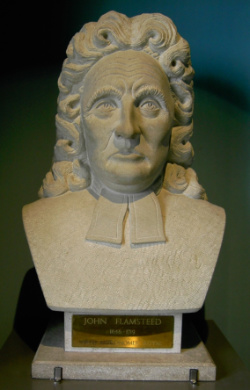
A bust of John Flamsteed at the Royal Observatory Greenwich.

He was educated at local schools but left off his studies at the age of 15 due to his own ill health and his father’s need for his assistance in the household and with his business.

His poor health meant he pursued some more sedentary activities and it was during this period that he established interest in astronomy, writing his first paper in 1665. Flamsteed did briefly attend Jesus College in Cambridge in the early 1670s, although it’s not thought he ever took up full residence.

Flamsteed was ordained a deacon and was preparing to take up a living in Derbyshire in 1675 – having by then obtained an MA from Cambridge – when his patron Jonas Moore, whom he’d met in the summer of 1670 during a visit to London and then visited again in mid-1674, invited him to return to the city, ostensibly to establish an observatory which Moore, who was Surveyor-General of the Ordnance, had offered to pay for.

Flamsteed arrived in February, 1675, stayed with Moore in the Tower before, after meeting King Charles II, was made an official assistant to a Royal Commission which the king had established charged with examining the merits of a proposal – put forward by a “le Sieur de St Pierre” to find longitude by the position of the Moon.

The commission decided the proposal wasn’t worth taking further but did recommend the establishment of an observatory from which the movement of the stars and Moon could be mapped in the hope of developing a method of finding longitude. Flamsteed was subsequently appointed “The King’s Astronomical Observator” – the first Astronomer Royal – on 4th March, 1675, by royal warrant, and in June that same year, another royal warrant provided for the founding of the Royal Greenwich Observatory. Flamsteed laid the foundation stone on 10th August.

He was admitted as a fellow of the Royal Society in February the following year and in July he moved into the observatory, now known as Flamsteed House (it contains famed Octagonal Room with large windows from which celestial events could be watched), which was designed by Sir Christopher Wren. It was to serve as Flamsteed’s home for next decade or so.
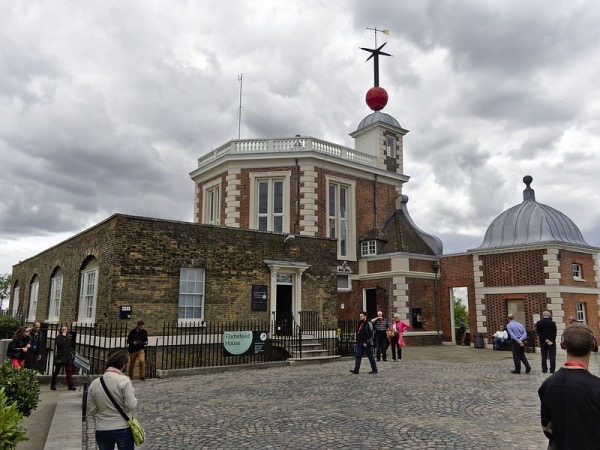
Flamsteed House, Royal Greenwich Observatory, its named after John Flamsteed. PICTURE: Dmitry Djouce.

Flamsteed’s achievements as an astronomer included the accurate calculation of the solar eclipses of 1666 and 1668 and recording some of the earliest sightings of Uranus which he mistakenly thought was a star. He was also in regular contact with many other scientific luminaries of the day and famously fell out with both Sir Edmond Halley (his one-time assistant and future successor as Astronomer Royal) and Sir Isaac Newton.

Flamsteed’s own catalogue of almost 3,000 stars wasn’t published until after death in 1725 thanks to the effort’s of his wife Margaret – whom he had married on 23rd October, 1692 (they were to have no children although Flamsteed’s niece, Ann Heming, did live with them). Margaret also published his star atlas, Atlas Coelestis, posthumously in 1729.

In 1684, Flamsteed was elevated to the priesthood and made rector of the village of Burstow, near Crawley in Surrey – a post, which, along with that of Astronomer Royal, he held until his death on 31st December, 1719.

He was buried in Burstow and there is a plaque on the wall of the church there marking his grave (which was added long after his death). Aside from his earthly honours – which includes the name of Flamsteed House at the Royal Observatory, a crater on the Moon is named after him as is an asteroid.
10 historic stairways in London – 4. The Nelson Stair…

PICTURE: Nick Garrod (licensed under CC BY-NC-ND 2.0)

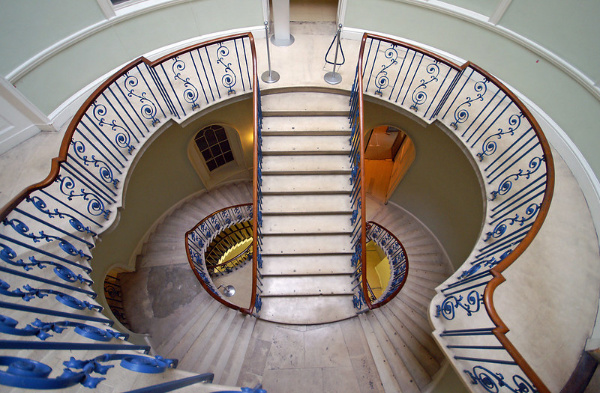
Located in Somerset House, this grand rotunda stairway rises up through the building to the Navy Board Rooms.

The present five storey stair is a replica of what was there up until the original suffered significant damage in The Blitz during World War II. It was rebuilt in the early 1950s under the supervision of Sir Alfred Richardson using original plans which had been kept safe in Sir John Soane’s House in Lincoln’s Inn Fields.

The architecturally interesting stair, which is located in the South Wing, was originally built in the late 18th century to the designs of Sir William Chambers with each flight a different configuration to the one underneath (the design was apparently made to reflect something of the stairs on ships).

It was initially known as the Navy Stair but renamed the Nelson Stair, ostensibly in honour of the heroic Vice-Admiral Horatio Nelson.

It’s not the only historic stair of note in Somerset House. The cube-like Stamp Stair, also located in the South Wing, is so-named for the stamping of newspapers that once took place here. Meanwhile, the Miles Stair, designed by Eva Jiricna Architects and named for Gwyn Miles, former director of the Somerset House Trust, is a stunning contemporary addition featuring a steel-mesh newel and a transparent balustrade.

Somerset House, Strand (nearest Tube stations are Temple and Charing Cross): WHEN: Daily (check website for times); COST: Free (but charges for exhibitions); WEBSITE: www.somersethouse.org.uk.

Treasures of London – Wren’s Great Model of St Paul’s Cathedral…

PICTURE: Andrea Vail (licensed under CC BY-ND 2.0)

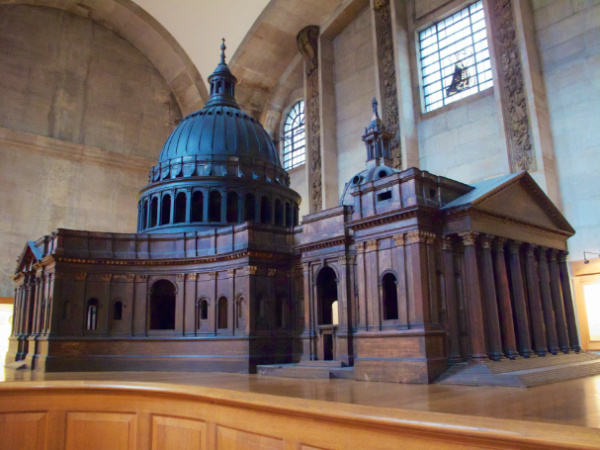
Housed now in the building it depicts, the Great Model of St Paul’s Cathedral was created by architect Sir Christopher Wren to show King Charles II what his proposed grand new English Baroque cathedral would look like (following the destruction of the medieval cathedral in the Great Fire of 1666).

Made of oak, plaster and lime wood, the model was made by William Cleere to Wren’s design in between September, 1673, and October, 1674, at a scale of 1:25. It measures 6.27 metres long, 3.68 metres wide and more than four metres tall, making it one of the largest in the UK.

The model, which cost about £600 to make – an extraordinary sum which could apparently buy a good London house, was designed to be “walked through” at eye level and, as well as being a useful way to show the King what the proposed building would look like, was also something of an insurance policy in case something happened to Wren.

It was based on drawings made by Wren and his assistant Edward Woodroofe on a large table in the cathedral’s convocation or chapter house (later demolished in the early 1690s) and was originally painted white to represent Portland stone with a blue-grey dome and gilded details.

There are some differences between the model and the finished cathedral – among them was a substantial extension of the quire, double-height portico on the west front, and, of course, the bell towers on the west front which were made in place of the cupola which was located halfway down the nave on the model.

Part of an earlier wooden model from 1671 also survives – it was apparently lost for many years and rediscovered in 1935.

The Great Model can be seen on tours of the Triforium.

WHERE: St Paul’s Cathedral (nearest Tube stations are St Paul’s, Mansion House and Blackfriars); WHEN: 8.30am to 4.30pm Monday to Saturday; COST: £21 adults/£18.50 concessions/£9 children/£36 family (these are walk-up rates – online advanced and group rates are discounted); WEBSITE: www.stpauls.co.uk (for tours, head to www.stpauls.co.uk/visits/visits/guided-tours)

10 historic stairways in London – 3. The Monument stairs…

PICTURE: thtstudios (licensed under CC BY-NC-ND 2.0)

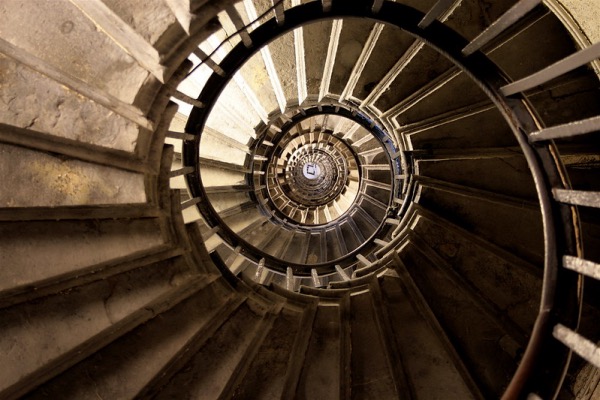
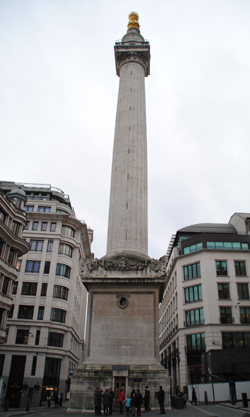
Running up the centre of the tallest free-standing stone column in the world, this 311 step stairway takes the visitor straight to the top of the Monument erected to commemorate the Great Fire of 1666.

The Monument

The Monument – actually a Doric column – was built close to Pudding Lane in the City – where the fire is believed to have started – between 1671 and 1677. It was designed by Sir Christopher Wren in collaboration with City Surveyor Sir Robert Hooke.

The cantilevered stairway – each step of which measures exactly six inches high – leads up to a viewing platform which provides panoramic views of the City. Above the platform stands is a large sculpture featuring a stone drum topped with a gilt copper urn from which flames emerge as a symbol of the fire (King Charles II apparently squashed the idea of an equestrian statue of himself lest people think he was responsible for the fire).

Interestingly, the circular space in the centre of the stairway was designed for use as a zenith telescope (a telescope which points straight up). There is a small hatch right at the top which can be opened up to reveal the sky beyond and a subterranean lab below (reached through a hatch in the floor of the ticket both) where it was envisaged the scientist could take measurements using a special eyepiece (two lenses would be set into the actual telescope). But it wasn’t successful (reasons for this could have been vibrations caused by passing traffic or the movement of the column in the wind).

Hooke also apparently attempted to use the staircase drop for some other experiences – including measuring differences in air pressure.

Among those who have climbed the stairs was writer James Boswell who visited the Monument and climbed the stairs in 1763. He suffered a panic attack halfway up but was able to complete the climb.

WHERE: The Monument, junction of Fish Street Hill and Monument Street (nearest Tube station is Monument); WHEN: Check website; COST: £5.40 adults/£2.70 children (aged five to 15)/£4.10 seniors (joint tickets with Tower Bridge available); WEBSITE: www.themonument.org.uk

10 historic stairways in London – 2. Queen Mary’s Steps, Whitehall…

PICTURE: Paul Farmer (licensed under CC BY-SA 2.0).

This small stone stairway which now sits in the midst of a grassy expanse at the back of the Ministry of Defence was once part of the Palace of Whitehall.

Named for Queen Mary II, wife of King William III, for whom they were designed, the stairs were part of a terrace built in 1691 abutting the Thames in front of an old river wall constructed for King Henry VIII.

Designed by Sir Christopher Wren, the stairs were one of a pair located at either end of the terrace which gave direct access to the river – and state barges – from the Royal Apartments.

Excavations in 1939 during construction of the MoD revealed the Tudor river wall, the terrace and the northern-most of the two flights of steps. The upper part of the steps have been repaired and the terrace and wall reconstructed.

The steps and palace fragments are now a Grade I listed monument.

10 historic stairways in London – 1. The Tulip Stairs, The Queen’s House, Greenwich…

London has many beautiful stairways – and some of them have some incredible historic connections. In this series, we’re going to be looking at 10 of them and the history that goes with them. First up, it’s the spectacular Tulip Stairs found in The Queen’s House in Greenwich.

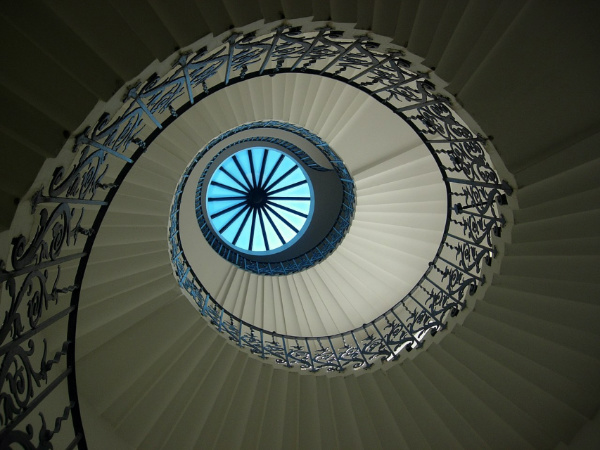
The Tulip Stairs. PICTURE: Mcginnly (licensed under CC BY-SA 3.0)

The wrought-iron stairs – which have the honour of being the first self-supporting spiral stair in the UK (meaning each tread is cantilevered from the wall and supported by the stair below rather than being supported by a central pillar) – were designed by Inigo Jones in 1635.

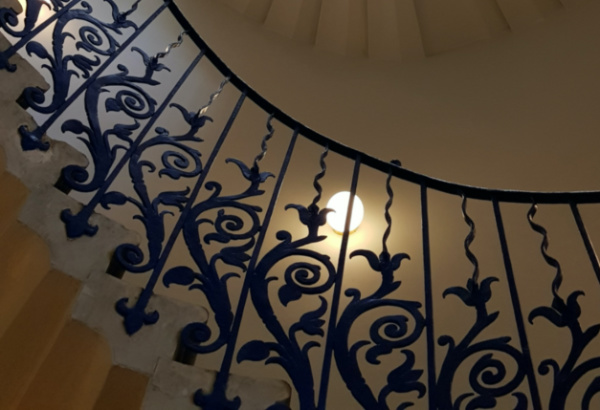
They are so named because the stairs, which are topped with a glass lantern, feature a flower pattern on the railings which resembles tulips although it is thought the flowers could be actually French lilies designed to compliment the Queen at the time of their completion.

Detail of the flowers on the Tulip Stairs. PICTURE: Maarten de Loud/Unsplash

For while Jones originally designed the house for Queen Anne of Denmark, wife of King James I, the building was unfinished and the stairs weren’t in place when she died in 1619. It was Queen Henrietta Maria, wife of King Charles I and daughter of French King Henry IV, who was Queen when he completed the property.

The stairs were at the centre of a ghost sighting in the mid 1960s when retired Canadian clergyman Rev RW Hardy took a photograph while visiting the house with his wife which appeared to show a couple of spectral figures on the staircase. The couple were both adamant that the stair was clear when the photo was taken and the mystery of the image, despite subsequent investigations, apparently remains unsolved.

WHERE: The Tulip Stairs, The Queen’s House, Greenwich (nearest stations are Cutty Sark DLR, Greenwich Station and Maze Hill Station or by water, Greenwich Pier); WHEN: Daily 10am to 5pm (but check the website for closures); COST: Free (but a prebooked ticket is required); WEBSITE: www.rmg.co.uk/queens-house.

A Moment in London’s History – The ‘Cock Lane Ghost’ appears…

It’s 260 years ago this month that a supposed poltergeist known as the ‘Cock Lane Ghost’ was at the centre of an infamous scandal.

There had been several reports of strange sounds and spectral appearances at the property prior to January, 1762, but it was the events which took place that month which were to elevate the hauntings to the national stage.

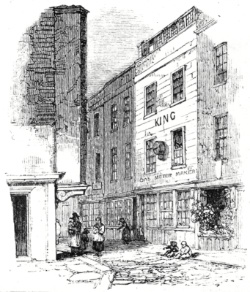
Cock Lane, shown in Charles Mackay’s 1852 work ‘Haunted Houses’. PICTURE: Via Wikipedia

It was in that month that Elizabeth Parsons, the 11-year-old daughter of Richard Parsons, the officiating clerk at St Sepulchre Church, reported hearing knockings and scratchings while she was lying in bed. Her father, Richard Parsons, the officiating clerk at nearby St Sepulchre, enlisted the aid of John Moore, assistant preacher at St Sepulchre and a Methodist, to find their cause and the two concluded that the spirit haunting the house was that of Fanny Lynes, who had formerly lived in the property before apparently dying of smallpox in early February, 1760.

The two men devised a system for communicating with the spirit based on knocks and based on the answers they received, concluded that Lynes had not died of smallpox but actually been poisoned with arsenic by her lover (and brother-in-law) William Kent.

Kent had been married to Fanny’s sister Elizabeth and after her death, he had lived with Lynes as man and wife despite prohibitions on them being married due to their status as in-laws. Parsons, who was their landlord at the time, had taken a loan from Kent while they were living at the property but subsequently refused to pay it back leading Kent to successfully sue him for its recovery.

It was against that backdrop – and earlier reports that the ghost of Fanny’s sister Elizabeth had haunted the property after her death – that the story of ‘Scratching Fanny’ began to spread and led to crowds gathering in Cock Lane to witness the phenomena. Writer Horace Walpole was among them – he attended along with Prince Edward, the Duke of York and Albany, and, apart from not hearing the ghost (he was told it would appear the next morning at 7am), noted that the local alehouses were doing a great trade.

Such was the case’s fame that the Lord Mayor of London, Sir Samuel Fludyer, ordered an investigation – among those who was involved was famed lexicographer Samuel Johnson. They concluded that the girl had been making the noises herself (Dr Johnson went on to write an account of it which was published in The Gentlemen’s Magazine). Further investigations were held – Fanny’s body even exhumed – and Elizabeth was later seen concealing a small piece of wood (apparently to make the sounds), subsequently confessing that her father had put her up to it.

Kent, however, was determined to clear his name and Moore, along with Parsons, Parson’s wife Elizabeth, Mary Frazer, a relative of Parsons, and a tradesman Richard James, were all subsequently charged with conspiracy to take Kent’s life by alleging he had murdered Frances. The trial, which took place at Guildhall before Lord Chief Justice William Murray, on 10th July, 1762, saw guilty verdicts returned for all five defendants. Moore and Richards agreed to pay Kent a sum of more than £500 but the others refused and so in February the following year they were sentenced – Parsons to three turns in the pillory and two years imprisonment, his wife Elizabeth to a year in prison and Frazer to six months hard labour in Bridewell.

The case, which also caused controversy between the new Methodists and Anglicans over the issue of ghosts, was widely referred to in literature of the time including by satirical poet Charles Churchill in his work The Ghost. It was also referenced by William Hogarth in his prints and Victorian author Charles Dickens even alluded to the story in A Tale of Two Cities.

This Week in London – ‘Westminster Elves’; a song for Nelson; and, Caribbean-British art…

Christmas is fast approaching and, to add to the festivities, Westminster City Council has created an augmented reality experience for families to enjoy at four landmark locations. Under the ‘Westminister Elves’ initiative, families are invited to scan a QR code at Piccadilly Circus, Marble Arch Mound, Soho Square and Hanover Square which will lead them to a microsite which, in turn, will transport them into the elves’ world. There, they can throw snowballs, share a moment with Santa’s reminder and glimpse inside Santa’s workshop as well as, of course, seeing the man himself. Those taking part are also invited to take a selfie or picture of a family member or friend alongside the elves at one of the four locations and post it on Twitter, Instagram or Facebook using the #WestminsterElves and tagging @CityWestminster. They’ll then be entered into a competition to win a £50 Love to Shop voucher. The competition closes at midnight next Wednesday with the winner announced on Christmas Eve. For more, see www.westminster-elves.co.uk.

A recording of old sea song paying tribute to Horatio Nelson was released by the Museum of London this week. The song, which was  thought to have been sung after the battle of Cape St Vincent in 1797 and subsequently transcribed by Nelson, was brought to life by musicians from the Guildhall School of Music & Drama. The recording marked the first performance of the piece in more than 200 years. While th song’s existence had previously been known about – it was referred to in a letter from Nelson to William Douglas, 4th Duke of Queensberry, which was was sold at auction in 2013 – it was one of four rediscovered last year among songbooks belonging to Nelson’s lover, actress and model Emma Hamilton. “The song was written by Nelson’s crew in one of his early victories,” said Lluis Tembleque Teres, the Museum of London librarian who found the songs. “It is fascinating how, some four years later and already a national hero, he recovers the lyrics and sends them to the Duke of Queensberry, almost as if showing off his early successes. The Duke then adds music and a chorus, and gifts the manuscript to Emma Hamilton, thus allowing us exactly 220 years later to relive Nelson’s fame while performing it.” The song’s release follows a special one-off live performance of all four songs at the Museum of London Docklands on 11th December, which will be available to watch in full as an online event – DIGITAL Emma’s Songbooks: rediscovered music for Nelson – next Tuesday, 21st December. Admission charge applies. For more, see museumoflondon.org.uk 

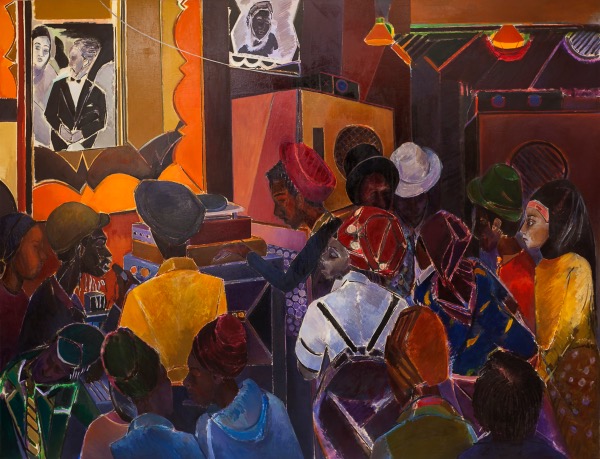
Denzil Forrester Jah Shaka, 1983. Collection Shane Akeroyd, London © Denzil Forrester

A landmark exhibition exploring the extraordinary breadth of Caribbean-British art over four generations can be seen at Tate Britain. Life Between Islands  spans 70 years of culture, experiences and ideas expressed through art and features more than 40 artists, including those of Caribbean heritage as well as those inspired by the Caribbean, such as Ronald Moody, Frank Bowling, Sonia Boyce, Claudette Johnson, Peter Doig, Hew Locke, Steve McQueen, Grace Wales Bonner and Alberta Whittle. Highlights include Neil Kenlock’s Black Panther school bags (1970), Denzil Forrester’s Death Walk (1983) – a tribute to Winston Rose who died in police custody, Lisa Brice’s After Ophelia (2018) – a work inspired by her time on Trinidad and new works including designs by Grace Wales Bonner evoking the brass bands and parades of the Commonwealth Caribbean. Runs until 3rd April. Admission charge applies. For more, see www.tate.org.uk.

Send all items for inclusion to exploringlondon@gmail.com.

Treasures of London – Bas-relief of Charles Dickens (and some famous friends)…

PICTURE: Eden, Janine and Jim (licensed under CC BY 2.0).

Christmas is fast arriving so we went in search of some related monuments in London and found one depicting two famous characters from an iconic Yuletide text.

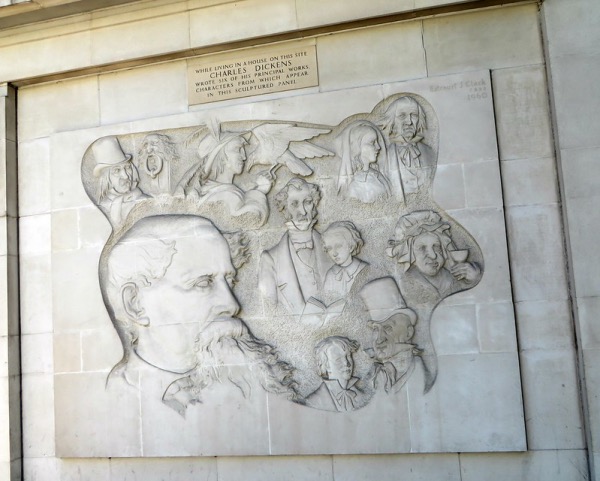
Located on the site of a house where 19th century writer Charles Dickens wrote six of his famous books, including A Christmas Carol, is a stone relief featuring several characters from them including Scrooge and Marley’s Ghost (represented as a door knocker in the top left).

Dickens lived at the property at what was then 1 Devonshire Terrace, Marylebone, between 1839 and 1851. It was demolished in the late 1950s and replaced with an office block upon which was incorporated the stone relief.

The bas-relief is the work of Estcourt J “Jim” Clack and features a large portrait of Dickens as well as the characters who, alongside the characters from A Christmas Carol.

They apparently include Barnaby Rudge with his raven ‘Grip’ (from the book of the same name), Little Nell and Granddad (The Old Curiosity Shop), Dombey and his daughter Florence (Dombey and Son), Sairey Gamp (Martin Chuzzlewit), David Copperfield and Wikins Micawber (David Copperfield).

Correction: The name of Barnaby Rudge’s raven has been corrected.

London Pub Signs – The Churchill Arms, Kensington…

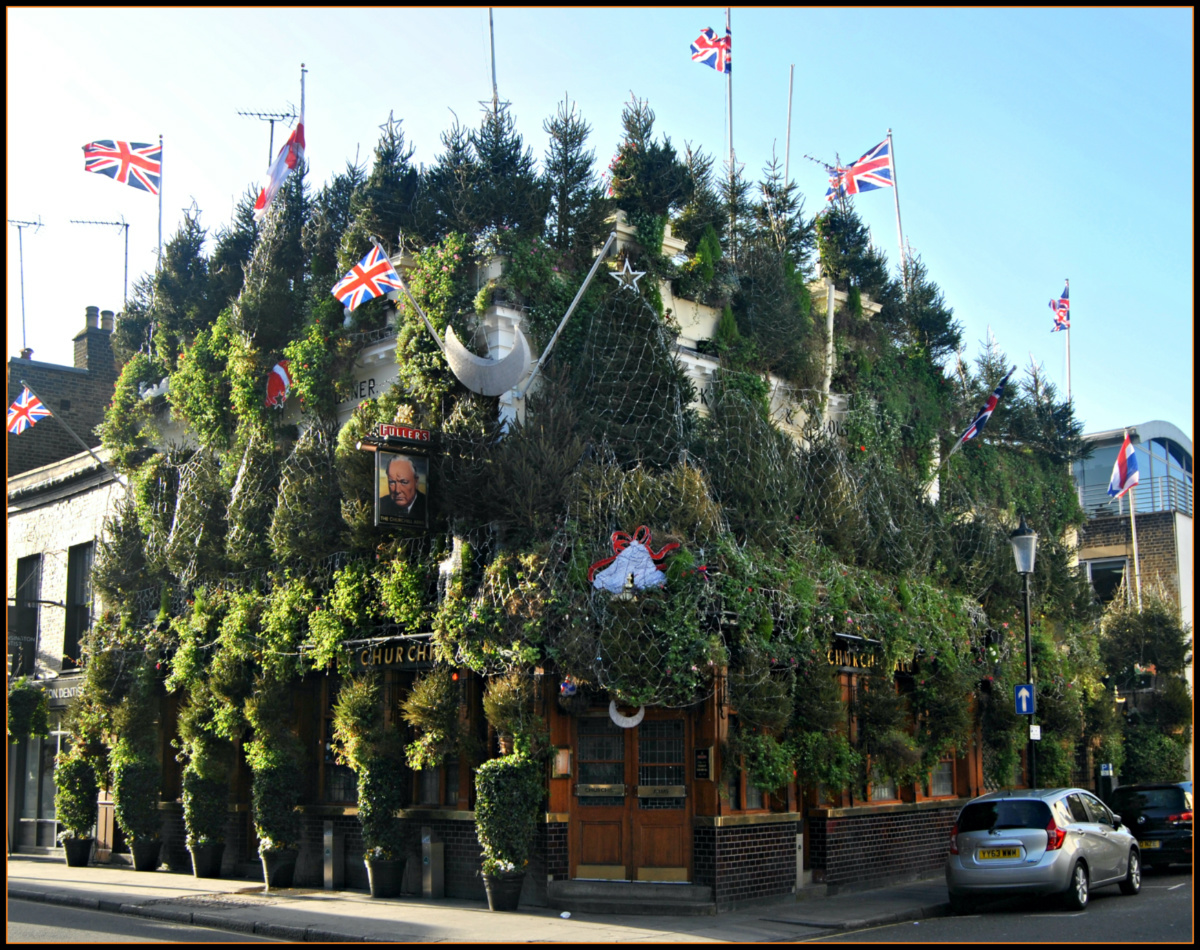
The Churchill Arms decorated for Christmas in 2015. PICTURE: Loco Steve (licensed under CC BY-SA 2.0)

It’s Christmas in London and for such a festive occasion, one pub immediately springs to mind – The Churchill Arms.

The name is certainly not a mystery and doesn’t really have anything to do with the Christmas theme. It stems from, of course, wartime Prime Minister Winston Churchill – or rather, his grandparents, the Duke and Duchess of Marlborough, John and Frances Anne Spencer-Churchill, who were patrons here and which, in honour of Churchill and them, saw the pub so-named after World War II.

Churchill remains a theme in the interior where a good deal of related memorabilia can be found – including wartime posters, pictures of the man himself and a (fake) plaque commemorating Churchill’s use of the pub for his wartime broadcasts (there’s even a celebratory night held each year around Churchill’s birthday).

The pub, which is located at 119 Kensington Church Street, dates from 1750.

But in recent times, it’s become famous for its stunning Christmas light displays which this year reportedly feature some 80 Christmas trees and 22,000 lights. The pub is also known for its extraordinarily profuse flower displays which cost thousands of pounds each year and which have even won at none other than the Chelsea Flower Show.

It also holds the claim to fame of being the first London pub to serve Thai food when it did so as far back as 1988.

A Fullers pub, for more head to www.churchillarmskensington.co.uk.

Famous Londoners – Thomas Arne..

Eighteenth century English composer Thomas Arne, considered one of British greatest theatrical composers and most well known for creating the music for his patriotic song Rule Britannia, spent most of his life in London.

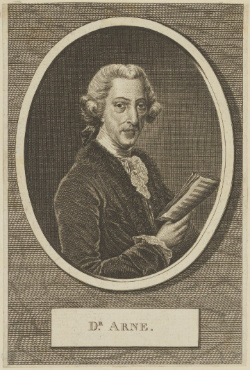
Thomas Augustine Arne after Robert Dunkarton line engraving, circa 1775-1800 (NPG D13867) PICTURE: © National Portrait Gallery, London

The son of an upholster, Arne, whose middle name was Augustine, was born in Covent Garden in 1710 and baptised in St Paul’s, Covent Garden. Arne was educated at Eton College where, such was his passion for music, he is said to have secretly practised with a spinet, a smaller type of harpsichord, in his room at night, muffling the strings to keep from being discovered.

He became a violin student of composer Michael Festing and, such was his love of music, that he is said to have disguised himself in the livery of servant to attend the opera.

Following his father’s wishes, Arne worked briefly as a solicitor after leaving school but was subsequently permitted to leave the law and pursue a life in music (there were other family connections to music and performance – his father had actually been involved in financing some operas and both his sister Susannah Maria and brother Richard would go on to have careers in the theatre and music worlds).

Over the more than 40 years between 1733 and 1776, Arne wrote music for about 80 stage works which included everything from plays and masques to pantomimes and operas.

His big break came when he became house composer at Drury Lane Theatre, writing music for various plays and pantomimes and involving both his brother and his sister in the performances (his residences at this time are said to have included properties in Great Queen Street and Lincoln’s Inn Fields).

Arne was already a star when, on 15th March, 1737, he married the singer Cecilia Young (he may have already had a son prior to this).

In 1738, he – along with others including George Frideric Handel – founded the Society of Musicians (which would become the Royal Society of Music). Arne also received the patronage of Frederick, the Prince of Wales – in fact, it was at the prince’s country house, Cliveden, that he debuted Rule, Britannia, during a performances of his Masque of Alfred in 1740.

Arne and his wife spent two years in Dublin in the early 1740s and on his return to London in 1744, he was again composing music for Drury Lane. He also composed music for performances at Vauxhall Gardens.

PICTURE: Spudgun67 (licensed under CC BY-SA 4.0)

Arne left Drury Lane for the Covent Garden Theatre in 1750 after he had begun to fall out of favour with theatre manager David Garrick who was increasingly turning to other composers.

In 1755, while again in Dublin, he separated from Cecilia, alleging she was mentally ill, and began a relationship with one of his students, Charlotte Brent. Brent would perform in several of his works including in Thomas and Sally (the first English opera to be completely sung) and Artaxerxes (which became one of the most successfully and influential English operas of the era). Brent would eventually go on to eventually marry a violinist in 1766.

His career took a downturn in the mid 1760s but in 1769, Garrick appointed Arne musical director for the Shakespeare festival at Stratford upon Avon. Arne composed several pieces for the event including An Ode upon Dedicating a Building to Shakespeare, the success of which put him back into favour with the London theatres.

In late 1777, Arne was reconciled with his wife (their son, Michael, went on to become a composer). But his health deteriorated soon after and Arne died on 5th March, 1778, at a house in Bow Street, Covent Garden. He was buried in the churchyard of St Paul’s, Covent Garden.

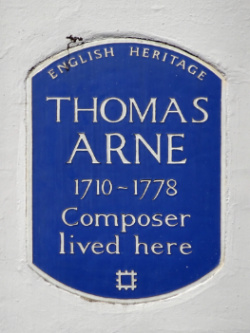
An English Heritage Blue Plaque was erected at the site of his former home at 31 King Street, Covent Garden, in 1988 (pictured above).

Lost London – Arundel House…

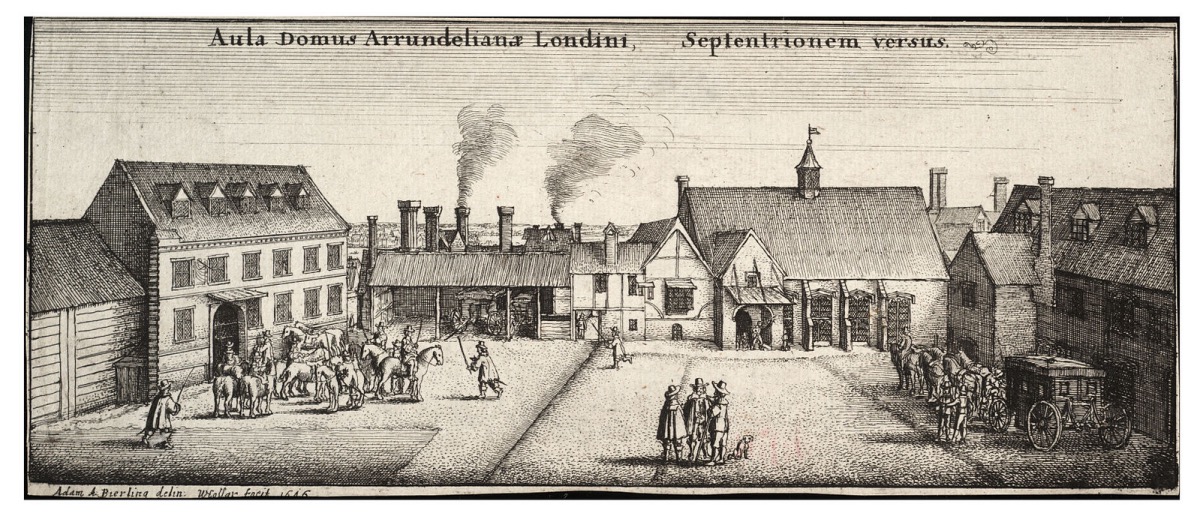
Arundel House, from the south, by Wenceslas Hollar. Via Wikimedia Commons.

One of a string of massive residences built along the Strand during the Middle Ages, Arundel House was previously the London townhouse of the Bishops of Bath and Wells (it was then known as ‘Bath Inn’ and Cardinal Thomas Wolsey was among those who resided here during this period).

Following the Dissolution, in 1539 King Henry VIII granted the property to William Fitzwilliam, Earl of Southampton (it was then known as Hampton Place). After reverting to the Crown on his death on 1542, it was subsequently given to Thomas Seymour, 1st Baron Seymour of Sudeley, a younger brother of Queen Jane Seymour, Henry VIII’s third wife, and known as ‘Seymour Place’. Then Princess Elizabeth (late Queen Elizabeth I) stayed at the property during this period (in fact, it’s said her alleged affair with Thomas Seymour took place here).

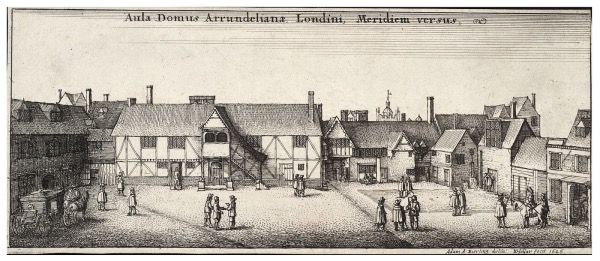
Arundel House, from the south, by Wenceslas Hollar. Via Wikimedia Commons.

Seymour significantly remodelled the property, before in 1549, he was executed for treason. The house was subsequently sold to Henry Fitz Alan, 12th Earl of Arundel, for slightly more than £40. He was succeeded by his grandson, Philip Howard, but he was tried for treason and died in the Tower of London in 1595. In 1603, the house was granted to Charles, Earl of Nottingham, but his possession was short-lived.

Just four years later it was repurchased by the Howard family – in particular Philip’s son, Thomas Howard, 14th Earl of Arundel – who had been restored to the earldom.

Howard, who was also the 4th Earl of Surrey, housed his famous collection of sculptures, known as the ‘Arundel Marbles’, here (much of his collection, described as England’s first great art collection, is now in Oxford’s Ashmolean Museum).

During this period, guests included Inigo Jones (who designed a number of updates to the property) and artist Wenceslas Hollar who resided in an apartment (in fact, it’s believed he drew his famous view of London, published in 1647, while on the roof).

Howard, known as the “Collector Earl”, died in Italy in 1646. Following his death, the property was used as a garrison and later, during the Commonwealth, used as a place to receive important guests

It was restored to Thomas’ grandson, Henry Howard, 6th Duke of Norfolk, following the Restoration. Following the Great Fire of London in 1666, for several years the property was used as the location for Royal Society meetings.

The house was demolished in the 1678. It’s commemorated today by the streets named Surrey, Howard, Norfolk and Arundel (and a late 19th century property on the corner of Arundel Street and Temple Place now bears its name).

10 sites of (historic) musical significance in London – 6. Royal Albert Hall… 

PICTURE: Raphael Tomi-Tricot/Unsplash

Arguably the grandest music venue in London, the Royal Albert Hall, named in memory of Queen Victoria’s husband Prince Albert, has been hosting musical events since it first hosted a concert in 1871.

The Grade I-listed hall, which has a seating capacity of more than 5,000 and which did suffer from acoustic problems for many years (until mushroom-shaped fibreglass acoustic diffusers were hung from the ceiling following tests in the late 1960s), has been the setting for some of the most important – and, in some cases, poignant – music events of the past 150 years, not just in London but the world at large.

Among some of the most memorable are the Titanic Band Memorial Concert – held on 24th May, 1912, just six weeks after the sinking of the iconic ship to remember the 1514 people who died with a particular focus on the eight musicians who played on as the stricken vessal sank, the ‘Great Pop Prom’ of 15th September, 1963 – only one of a handful of occasions when The Beatles and Rolling Stones played on the same stage, and Pink Floyd’s gig of 26th June, 1969 – coming at the end of a UK tour, the on-stage antics saw the band banned (it was short-lived, however, they returned just a few years later in 1973).

Other musical figures to have taken to the stage here include everyone from composers Richard Wagner, John Philip Sousa, and Benjamin Britten to the Von Trapp family, jazz greats Billie Holiday and Ella Fitzgerald, and the likes of Shirley Bassey, Bob Dylan and Elton John – a veritable musical who’s who of the past 150 years. The venue also hosted the 13th Eurovision Song Contest in 1968.

Of course, Royal Albert Hall is famous for The Proms, an annual festival of classical music which was first performed here in 1941 after the venue where it had been held since 1895 – the Queen’s Hall on Langham Place – was lost to an incendiary bomb during World War II.

Prom stands for ‘Promenade Concert’,  a phrase which originally referred to the outdoor concerts in London’s pleasure gardens during which the audience was free to walk around while the orchestra was playing (there are still standing areas during performances). The most famous night of the season is the ‘Last Night of the Proms’ which, broadcast by the BBC, features popular classics and ends with a series of patriotic tunes to stir the blood.

Famous Londoners – St John Houghton…

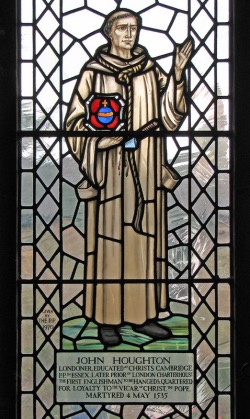
St John Houghton is remembered as the first Catholic Englishman to have been executed for refusing to take the oath prescribed by King Henry VIII’s Act of Supremacy.

Stained glass depicting St John Houghton in St Etheldreda’s Catholic Church in Ely. PICTURE: Lawrence OP (licensed under CC BY-NC 2.0)

Houghton was born around 1487 and is believed to have been educated at Cambridge, becoming ordained around 1511 before he entered the London Charterhouse in 1515 or 1516. By 1523, he held the position of sacristan and in 1528 that of procurator before, in 1531, he was transferred to Beauvale Priory in Nottinghamshire to serve as its prior.

But he returned to London in November that same year when he was unanimously elected Prior of the London Charterhouse. The following year was named Visitor of the English Province for the Carthusian Order.

When the King’s agents visited in April, 1534, requiring the community to take an oath as required under the 1534 Act of Succession (which excluded Katherine of Aragon’s daughter Mary in favour of Anne Boleyn’s daughter, Elizabeth), Houghton asked that the community be exempted.

Such a request was not looked upon kindly and Houghton, along with his procurator, Humphrey Middlemore, was arrested and taken to the Tower of London. Subsequently convinced that the oath was consistent with their Catholic faith by fellow clerics, the two returned to the Charterhouse in May, and there, in the presence of an armed force, the whole community eventually took the oath.

But in 1535, the community was again required to take an oath – this time recognising King Henry VIII as the Supreme Head of the Church of England as required by the 1534 Act of Supremacy. But Houghton, along with  the heads of the other two English Carthusian houses – Robert Lawrence, Prior of Beauvale, and Augustine Webster, Prior of Axholme – sought an audience with Thomas Cromwell and asked for an exemption. All three were sent to the Tower.

The three men were interrogated by Cromwell on 26th April and then, a few days later, were called before a special commission and sentenced to death.

Houghton was among five clerics – along with the other two Carthusian priors as well as Bridgettine monk Richard Reynolds and John Haile, the parish priest of Isleworth – who were dragged through the streets to Tyburn on 4th May. There, Houghton – wearing his religious habit – is said to have embraced his executioner as he recited the words of the 31st Psalm before he was the first to be hanged, drawn and quartered.

Catholic tradition says that when Houghton’s body was cut open to remove his heart, he said to have prayed: “O Jesus, what wouldst thou do with my heart?”

Pieces of Houghton’s body were then displayed around London – his head was displayed above London Bridge and his arm was nailed to the gate of the Charterhouse,

Houghton was beatified on 9th December, 1886, and canonised in 25th December, 1970. He is considered one of the 40 Catholic Martyrs of England and Wales, all of whom were executed between 1535 and 1679 during the English Reformation.

Lost London – The Holbein portrait of King Henry VIII’s family…

King Henry VIII; King Henry VII
by Hans Holbein the Younger
(ink and watercolour, circa 1536-1537
NPG 4027)
© National Portrait Gallery, London

Thankfully much copied (at least in part), this full length portrait of King Henry VIII, his third wife and parents was the work of Hans Holbein the Younger.

Holbein, appointed the king’s painter in 1536, was commissioned to create the work following the King’s marriage to Jane Seymour on 30th May, 1536, and completed it in 1537 (there’s some speculation it may have been commissioned in celebration of the birth of King Henry’s son, King Edward VI).

The mural featured the King standing in full splendour, although without typical symbols of royalty such as a crown or sceptre, as well as his wife Jane Seymour, and his parents, King Henry VII and Queen Elizabeth of York. They were all standing around a central pillar upon which are inscribed verses in Latin extolling the Tudor dynasty.

The work is understood to have been commissioned for one of the King’s more private chambers in the Palace of Whitehall which Henry had seized after the downfall of Cardinal Thomas Wolsey.

The portrait survived the reign of King Henry VIII but was destroyed in the fire which devastated the palace in 1698.

A full-sized cartoon of the left-hand side of the work which was completed by Holbein in preparation for its creation is held in the collection of the National Portrait Gallery (pictured right).

While there are numerous copies of the figure of King Henry VIII, the only complete copy of the mural is attributed to Remigius van Leemput who created it in 1667 – it can be seen at Hampton Court Palace.

10 sites of (historic) musical significance in London – 1. 25 (and 23) Brook Street, Mayfair…

OK, so we all know about the Abbey Road crossing and its connection with the Beatles, but where are some other sites of historic musical significance in London?

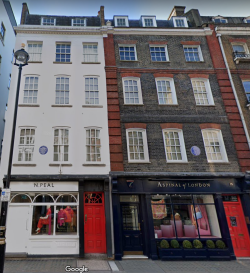
23 and 25 Brook Street, Mayfair. PICTURE: Google Maps.

First up, it’s the Mayfair home where 18th century composer George Frideric Handel lived from 1723 until his death in 1759 – and where he composed much of his best known work including masterpieces such as Zadok the Priest (1727, it was composed for the coronation of King George II), Israel in Egypt (1739), Messiah (1741), and Music for the Royal Fireworks (1749).

The German-born Handel, who settled permanently in London in 1712 (and who became a naturalised British citizen in 1727), was the first occupant of the terraced house located at what is now 25 Brook Street (but previously known as 57) which is now a museum dedicated to his life and work.

The property, which is today decorated as it would have been during early Georgian times, is thought to have been convenient for its proximity to be the theatres where his works works were performed and St James’s Palace, where he served as Composer of Music for the Chapel Royal.

A small room on the first floor is believed to be where Handel did most of his composing. He is also understood to have used the larger adjoining music room for rehearsing his works from the 1730s (possibly due to a lack of space at the venue where he mainly performed, the Covent Garden Theatre).

Handel died in the house on 14th April, 1759. The property, which subsequently was lived in by various people, became a museum dedicated to the composer in 2001.

Known for the first 15 years of its existence as the Handel House Museum, in 2016 it was expanded to include the upper floors of the adjoining home, 23 Brook Street, a flat which served as home to another musical great, Jimi Hendrix, in 1968-1969. The museum is now known as Handel & Hendrix in London.

Both properties have English Heritage Blue Plaques upon them. The first plaque were erected on Handel House in about 1870 by the Society of Arts and was replaced in 1952 and again in 2001, when his middle name was corrected to Frideric from Frederick. The plaque commemorating Hendrix’s residence in Number 23 was erected in 1997.

The museum is closed, with limited exceptions, until March, 2023, for a refurbishment project called the The Hallelujah Project. But you can head to the website to take a 3D virtual tour: https://handelhendrix.org.

A Moment in London’s History – The coronation of King George III and Queen Charlotte…

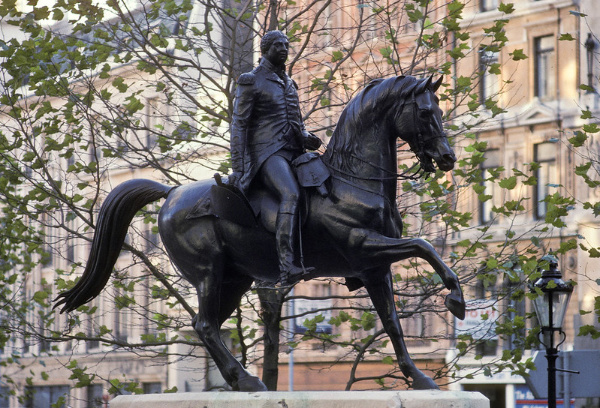
Equestrian statue of King George III in Cockspur Street. PICTURE: David Nicholls
(licensed under CC BY-NC 2.0)

This month marks 260 years since King George III and Charlotte of Mecklenburg-Strelitz were crowned King and Queen of the Kingdom of Great Britain at a ceremony at Westminster Abbey.

Only 23-years-old at the time, King George III had ascended to the throne before following the death of his grandfather, King George II, in October, 1760. He and his wife, then Princess Charlotte of Mecklenburg-Strelitz, had married in the Chapel Royal at St James’s Palace just two weeks prior to the coronation on 8th September, 1761 (they had met earlier the same day).

The royal couple started the day of the coronation – 22nd September – at St James’s Palace and were carried in sedan chairs to Westminster Hall, arriving at about 11am. They then processed on foot through crowds from the hall to Westminster Abbey (the crowds were said to be such that numerous carriages had collided with each other in the bid to reach the abbey). There, they proceeded to a special platform built in the abbey for the occasion.

Commencing at about 3pm, the coronation ceremony began. In an elaborate ceremony overseen by the Archbishop of Canterbury Thomas Secker, the new King was then crowned (Zadok the Priest, which George Frideric Handel had written for the coronation of King George II, was the anthem at the new king’s request). A simpler ceremony followed in which Charlotte was crowned Queen Consort.

The whole affair reportedly lasted more than six hours, so long that some guests are said to have tucked into snacks while watching.

A feast was subsequently held in Westminster Hall during which the King’s Champion, wearing full armour, rode into the hall and threw down a gauntlet challenging any who questioned the King’s legitimacy to step up (none did). During the feast, spectators in the galleries above let down baskets and handkerchiefs for their better placed friends below to fill with food.

The King and Queen departed the feat at about 10pm followed by guests. After they’d vacated the premises, the doors were then opened for the public to come in and to finish off the food.

Treasures of London – Traitor’s Gate…

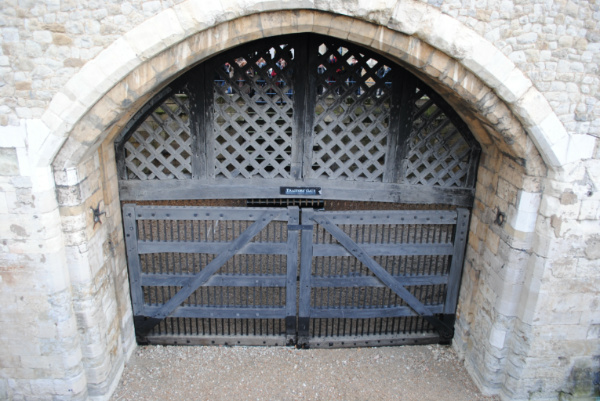
PICTURES: David Adams

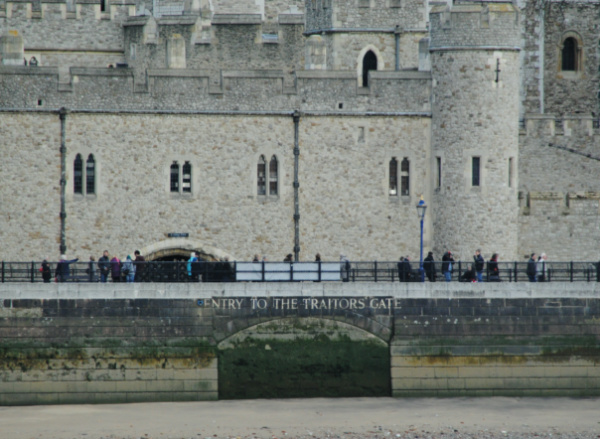
Built by King Edward I in the 13th century as a water gate to provide access from the Tower of London to the River Thames, the name ‘Traitor’s Gate’ came to be applied to this portal in Tudor times in relation to those accused of treason who were brought into the tower under its arch.

The double gateway is part of St Thomas’s Tower, which was designed by a Master James of St George, and behind it is a pool which was used to feed water to a cistern on the roof of the White Tower. While the gate was originally built to give access directly to the river, Traitor’s Gate now sits behind a wharf which runs along the river bank (and where can be seen the bricked up entrance says ‘Entry to the Traitor’s Gate’ – this was bricked up in the 19th century when embankment works were carried out)

Sir Thomas More, Sir Walter Raleigh and even the future Queen Elizabeth I (when a princess) were among those who were brought in by barge through the Traitor’s Gate (their journey would have led them under London Bridge where the heads of executed prisoners were on display). Whether Henry VIII’s disgraced Queen Anne Boleyn entered the tower through the gate remains a matter of some dispute.

This Week in London – Prince Albert’s papers online; behind the scenes at the London Transport Museum; and, the Marble Arch Mound’s light installation…

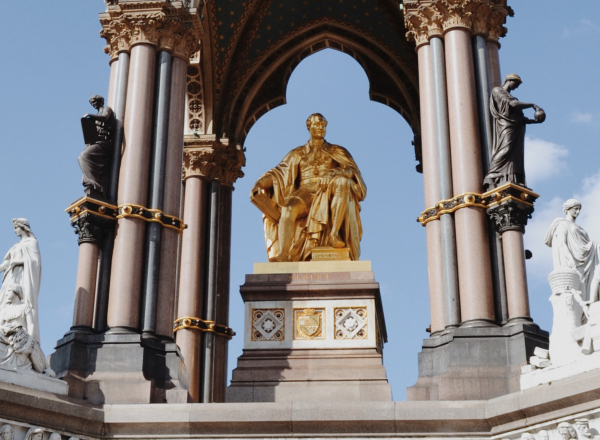
Statue of Prince Albert on the Albert Memorial, South Kensington. PICTURE: Amy-Leigh Barnard/Unsplash

• Some 5,000 papers and photographs relating to the life and legacy of Prince Albert, consort of Queen Victoria, have been published online. The move, which marks the completion of the Prince Albert Digitisation Project, means some 22,000 archival documents, prints and photographs from the Royal Archives, the Royal Collection and the Royal Commission for the Exhibition of 1851 are now publicly available, many for the first time, through the website Prince Albert: His Life and Legacy which was launched in mid-2019 to mark the 200th anniversary of the Prince’s death. The new items predominantly consist of the Prince’s private and official papers and correspondence as well as excerpts from Albert’s now lost diaries, spanning the years from 1841 to 1852. Highlights include a note he wrote to Victoria on October, 1858, which reads: “I declare that I have every confidence in you. A”; a letter from 10-year-old Princess Louise to her father from Swiss Cottage, the life-sized playhouse he had installed for his children at Osborne House on the Isle of Wight, in which she reports cooking and making “some wafers and schneemilch” (a type of Austrian pudding); and, an annotated list of candidates for the role of Master of the Household in which Albert lists why they are unsuitable with reasons including ‘too old’ and ‘too useful to the Navy’ and ‘bad temper’ and ‘French mistress’.

London Transport Museum are offering people the chance to go behind the scenes at its depot in Acton, West London, this weekend. The depot, which houses more than 320,000 objects from London’s transport history, will play host to a programme of events – ‘Underground Uncovered’ – which includes talks, vintage vehicle displays and family activities. Highlights include a talk by Siddy Holloway, a disused station history expert and co-presenter of the new Secrets of the London Underground TV series, the chance to try your hand at being a train operator in the Victoria Line driving cab, and the opportunity to watch a demonstration of restored London Underground signalling frames. The open days are being held from today until Sunday, 11am to 5pm. Admission charge applies. To book and see the full programme of events, see www.ltmuseum.co.uk/visit/depot/events.

W1 Curates and artist Anthony James’ light exhibition inside the Marble Arch Mound has opened to the public with free entry to what has been a somewhat controversial attraction to continue. James’ Lightfield installation involves a series of 12 cubed light sculptures in three rooms inside the mound through which visitors will make their way after first visiting the viewing platform on top. James, who has described the cubes as alluding to the “mycorrhizal nature of birch tree forests”, says it’s the first time his works have been displayed and viewed in such a “fully immersive way”. Visitors are asked to book an entry time at www.themarblearchmound.com.

Send all items for inclusion to exploringlondon@gmail.com.

Famous Londoners – Charles Cruft…

His surname now synonymous with the famous annual dog show, Charles Cruft is credited as taking the concept of dog shows to a whole new level.

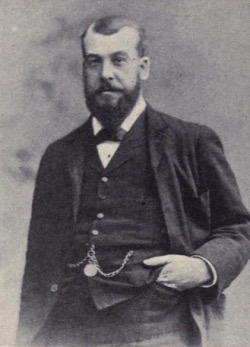
Charles Cruft (picture from From Dog shows and doggy people (1902) by Charles Henry Lane).

Cruft was born, thought to have been in Bloomsbury, on 28th June, 1852, and attended Ardingly College in Sussex, before initially following on in his father’s footsteps and working in the family jewellery business (while taking evening classes briefly at Birkbeck College).

But it was his next move, taking on the role of office boy in the Holborn shop of “dog cake” manufacturer James Spratt that brought him into the world of canines.

Cruft quickly moved into sales and then management at the firm and it was while on a trip to Europe that he was given the opportunity to run the dog show at the third World’s Fair in 1878 (he married Charlotte Hutchinson, with whom he had four children, the same year). Further offers to run shows followed and in 1886, he was approached to run a dog show for terriers in London by the Duchess of Newcastle.

The show – billed as the “the first great show of all kinds of terriers” – opened at the Royal Aquarium in Westminster on 10th March that year and further annual shows, expanding into other breeds, followed. In 1891, his name was added to the event with the “Cruft’s Greatest Dog Show” held at the Royal Agricultural Hall in Islington with 2,437 entries and 36 breeds.

So popular had the shows become that Queen Victoria and Russian Tsar were among the exhibitors (Cruft did also try his hand at cat shows in 1894 and 1895 but it was a short-lived venture).

By 1914, Cruft’s show had become the largest in the world and in 1936, when it celebrated its ‘Golden Jubilee’ (or 50th anniversary), there were more than 10,000 dogs entered.

Cruft, who had married his second wife Emma Isabel Hartshorn in 1894 following Charlotte’s death (they had no children together), died of a heart attack on 10th September, 1938. He was buried 11 days later in the western area of Highgate Cemetery (the tomb is now Grade II-listed). Tributes flowed in and apparently included comparisons to American showman PT Barnum.

Emma took over the running of the show following his death and since 1948, the show has been run by the Kennel Club. 

There’s a plaque on the home where he died in Highbury Grove in Highbury (other London residences included 325 Holloway Road).