London Pub Signs – The Gun…

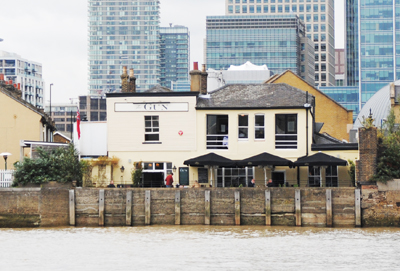
This Docklands pub – the site of which has hosted a public house for more than 250 years – is located in an area where iron foundries were once employed to produce cannons for the Royal Navy’s many ships of the line.

The-GunBut according to the pub’s website (and a plaque outside the building), the name comes from something much more specific – the cannon which was fired at celebrations surrounding the opening of the West India Import Docks in 1802.

And that’s not only historical link this Grade II-listed pub (seen here from the Thames) has with the navy. Heroic naval figure Vice Admiral Horatio Lord Nelson, who lived just up the road and was a frequent visitor to the docks, was apparently a regular at the pub where he was secretly meet with his mistress Lady Emma Hamilton (the room they met in is now called The River Room).

There’s also a history of smugglers operating out of the pub and a still present spyhole is said to have been used to watch for revenue officers.

In 2001 much of the interior of the pub was destroyed in a fire. It remained closed for three years before brothers Tom and Ed Martin bought the building and undertook a painstaking restoration in consultation with English Heritage, reopening the building’s doors in 2004.

As well as its historical associations, The Gun now boasts a couple of bars and dining rooms and  riverside terrace. During summer, the pub also opens a second terrace area under a Portuguese barbeque theme – A Grelha at the Gun.

For more on The Gun (located at 27 Coldharbour in the Docklands), see www.thegundocklands.com.

London Pub Signs – The Enterprise…

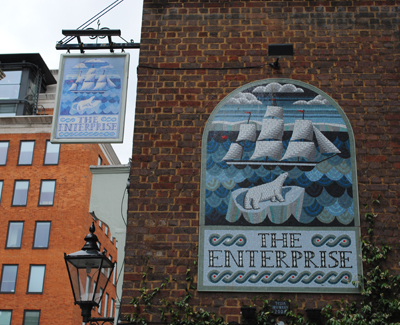
Not surprisingly, this Holborn pub is named after a ship – in the case a vessel that was sent to search for the doomed fourth expedition of Sir John Franklin in the Arctic.

Franklin’s expedition – which consisted of two ships, the HMS Erebus and HMS Terror – had departed England in 1845 with the aim of traveling through the last un-navigated section of the Northwest Passage. But the ships became icebound near King William Island off the coast of Canada and all 129 people, including Sir John, on the expedition were lost.

Pressure from Franklin’s wife, Lady Jane Franklin, and a reward offered by the Admiralty led to many attempts to find the lost expedition involving numerous ships. These included the HMS Enterprise which twice set off to find Franklin’s ships, failing in the attempt both times.

The lost expedition and the numerous attempts to find it captured public attention and The Enterprise in Holborn is one of a couple of pubs in London that bears the ship’s name.

While some human remains and parts of the ships from the Franklin Expedition were found in the years following, the exact fate of the crew on the lost expedition remains something of a mystery.

The pub in Red Lion Street features a wonderful mosaic on an external wall depicting the ship sailing past an iceberg on which stands a polar bear (pictured). The work Tessa Hunkin, it was installed in 2006.

For more on the Victorian era pub – much of which has been restored, see www.the-enterprise.co.uk.

London Pub Signs – Doggett’s Coat and Badge…

Perhaps not so much a sign as a pub name, the strangely monikered Doggett’s Coat and Badge in South Bank is named after a rowing race – said to be the oldest continuous sporting event in the country – in which apprentice waterman traditionally competed for a prize consisting of waterman’s coat and badge and named after Irish-born actor and theatre manager, Thomas Doggett.

The race – which is held in July and runs over a course of four miles and seven furlongs from London Bridge to Chelsea (the starting and finishing points were originally both marked by pubs called The Swan) – was first held in 1715 when it was first organised by Doggett who financed it up until his death in 1721 after which he left instructions in its will for it to be carried on by The Fishmongers’ Company (which it still is today).

While there’s a nice story that Doggett, who managed the Drury Lane Theatre and later the Haymarket Theatre and carving out a name for himself as a ‘wit’, started the race as thanks to Thames watermen for rescuing him when he fell off a watercraft while crossing the Thames, Doggett – a committed Whig – actually started the race to commemorate the ascension of King George I – the first ruler of the House of Hanover – on 1st August, 1714, following the death of Queen Anne.

This year’s race winner was Merlin Dwan (London Rowing Club) who beat four others to finish in 24 minutes, 28 seconds.

The pub, one of the Nicholson franchise, is located in a multiple storey modern building complex and sits along the course of the race in South Bank. It features a range of bars including Thomas Doggett’s Bar and the Riverside Bar as well as a dining room and other function rooms.

For more on the pub, see www.nicholsonspubs.co.uk/doggettscoatandbadgesouthbanklondon/. For more on the race (which we’ll be mentioning, along with more on Thomas Doggett, in more detail in upcoming posts), see www.DoggettsRace.org.uk.

London Pub Signs – The Lord Raglan…

Originally known as The Bush,  The Lord Raglan pub just to the north of St Paul’s was renamed in the mid 1800s to commemorate one of the heroes of the Battle of Waterloo – the 1st Baron Raglan (1788-1855).

Named the 1st Baron Raglan in 1852, the man previously known as Lord FitzRoy Somerset had lost his right arm at the Battle of Waterloo, fought between the Duke of Wellington and Napoleon on 18th June, 1815, in modern-day Belgium.

His name was subsequently adopted to to describe the ‘Raglan Sleeve’, a type of sleeve which extends as a single piece to the collar and a style which Lord Raglan was said to have favored after his arm was amputated.

Lord Raglan died in 1855 while Commander-in-Chief at the Crimean War. There is a blue plaque commemorating his role in this war on his former house in Stanhope Gate in Mayfair.

The site of the Lord Raglan tavern, 61 St Martin’s Le Grand, is said to be one of the oldest tavern sites in the city, originally dating from about 1779, and while the current building dates from 1855, the cellars are said to be much older and are said to incorporate parts of what was the Roman wall.

For more on the Lord Raglan, see the Taylor Walker website at www.taylor-walker.co.uk/pub/lord-raglan-st-pauls/c1779/.

London Pub Signs – Ye Olde Mitre Tavern…

This small pub, found down a laneway – Ely Court – off Ely Place in Holborn, is considered by many one of London’s hardest to find. The name – which describes a bishop’s headwear – comes from the fact that the building was built by Bishop Goodrich of Ely, who lived in nearby Ely House, for his retainers.

The original premises dated from 1546 but the current building on the site reportedly dates from about 1773 (about the date on which the bishop’s residence nearby was demolished). Interestingly, the pub was actually part of Cambridge – the city of Ely, and the Bishopric, being based there – which meant that the licensees once had to go to Cambridge for renewal.

In 1576, part of the property, along with a substantial part of the bishop’s estate, was leased to Sir Christopher Hatton, favorite of Queen Elizabeth I (and the man after whom nearby Hatton Garden is named – more on that another time), on order of the Queen herself.

Indeed the bar still houses the remains of a cherry tree behind glass. The tree is said to have marked the  border between Sir Christopher’s land and the Bishop’s land. Sir Christopher, incidentally, is said to have danced around it during a May Day celebration the Queen though this tale may simply by apocryphal.

Both Charles Dickens and Dr Johnson are said to have been customers here. The pub, which features dark  panelling on the walls, still evokes a sense of the past with its olde world furnishings and fittings (and absence of more modern fittings like blaring TVs). Great place to pass a few hours in on a chilly day!

For more on the pub, see http://yeoldemitreholburn.co.uk.

London Pub Signs – Tom Cribb…

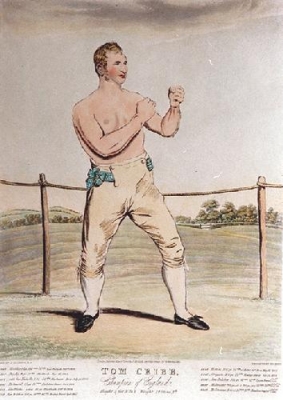
In keeping with the sporting theme, we decided to take a look at a pub that bears that name of a sportsman – in this case Tom Cribb, a celebrated early nineteenth century boxer.

Born in 1781, Cribb moved to London from his home in Gloucestershire at just the tender age of 13 and worked in various jobs including as a bellhanger and a porter on the wharves before in taking up the sport of bare knuckle boxing with his first public bout in 1805 (he was known as the ‘Black Diamond’ thanks to his previous work as a coal porter).

Further fights followed and Cribb’s skill was such that in 1809 he won the British title and the following year he fought American and former slave Tom Molineaux to become world champion, a feat he repeated the in 1811 by beating Molineaux again.

Cribb retired from boxing in 1812 and later became a publican, running a couple of different pubs before taking up the job the Union Arms, located at 26 Panton Street, in the West End. He did apparently marry and in 1821 was among the prize fighters who guarded the entrance to Westminster Hall on the day of King George IV’s coronation.

Forced to give up his pub to creditors to pay off gambling debts, he retired to Woolwich in 1839 and died there in 1848 – he was buried in St Mary’s Churchyard where there is a memorial to him.

The pub which now bears his name is located on the same site as the Union Arms, although it is numbered 36 due to a numbering change. Inside it features a boxing theme with photos of some of Britain’s greatest boxers adorning the wall.

For more, see www.shepherdneame.co.uk/pubs/london/tom-cribb.

For a book on Tom Cribb, try Tom Cribb: The Life of the Black Diamond.

PICTURE: Tom Cribb in an engraving published in 1842. Source – Wikipedia.

London Pub Signs – The Marquess of Anglesey

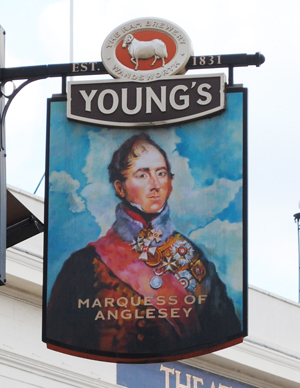
While it’s said there’s been a public house on this site since 1682, the name of the current premises on the corner of Bow and Russell Streets in Covent Garden came much later.

Originally two premises which have now merged together, the pub takes its name from Henry Paget, an 18th and 19th military man who was most famous for his role as cavalry commander at the Battle of Waterloo.

Paget, whose leg had to be amputated after the battle after he was struck by a cannon ball in the closing stages, was created Marquess of Anglesey just two weeks later in thanks for his service. He subsequently served in government roles after the battle, including as Lord High Steward of England and, (for the second time) as Lord Lieutenant of Ireland.

His private life was as colourful as his career – he had eight children by his first wife, Lady Caroline Villiers, before eloping with the Duke of Wellington’s sister in law, Lady Charlotte Cadogan, with whom he had a further 10 children.

For more on the pub, take a look at its website at www.themarquess.co.uk.

For a great book on London’s pubs, take a look at London’s Best Pubs: A Guide to London’s Most Interesting & Unusual Pubs.

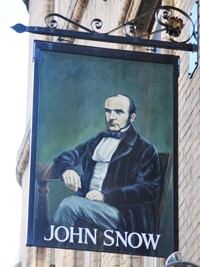
London Pub Signs – The John Snow

Located on the corner of Broadwick and Lexington Streets in Soho, this pub is named for the man who, through his meticulous research, was able to show that London’s cholera epidemic of 1854 was the result of a contaminated water supply.

A physician then working in London, John Snow didn’t believe in the current theory that diseases such as cholera were caused by bad air and instead, through a study looking at where those affected by the disease in 1854 lived and obtained their water, was able to pinpoint a water pump in what was then Broad Street (the ‘wick’ wasn’t added to the street’s name until the 1930s) as the original source.

The pump, which initially apparently stood just outside the pub, is now located down the street. A pink granite curbstone outside the side door of the John Snow pub and plaque on the pub wall mark where the pump formerly stood.

The building housing the pub dates from the 1870s and the pub was apparently initially called the Newcastle-upon-Tyne but this was formally changed to John Snow in May, 1955, to mark the centenary of Snow’s research into the 1854 epidemic.

For a terrific book about John Snow’s work, see Steven Johnson’s The Ghost Map: A Street, an Epidemic and the Hidden Power of Urban Networks.

London Pub Signs – The Old Dr Butler’s Head

Once one of a number of pubs named after King James I’s odd court physician, Dr William Butler, the pub is now the last in the city to bear his image on  a sign.

Bearing the sign of Dr Butler’s head apparently meant it was among an exclusive number of pubs which offered the good doctor’s ‘medicinal ale’. According to ‘Historic Food‘, this was apparently made by hanging a thin canvas bag containing senna, polypody of oak, agrimony, maidenhair and scurvy grass in a barrel of strong ale, making what some have said would result in a strong laxative.

One couldn’t be blamed for being somewhat sceptical without even knowing the ingredients – other ‘cures’ the good doctor came up with included dropping patients suffering nervous disorders through a trapdoor on London Bridge into the Thames and firing pistols near someone to ‘scare away’ their epilepsy.

The pub, located at 2 Mason’s Avenue off Coleman Street in Moorgate, is said to have been originally built in 1610 and had to be rebuilt after the Great Fire of London. It’s since been renovated several times.

For more on the pub, see www.shepherdneame.co.uk/pub/moorgate/old-doctor-butlers-head.aspx.

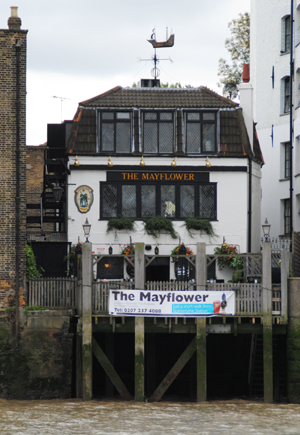
London Pub Signs – The Mayflower

Located on the Thames waterfront in Rotherhithe, The Mayflower’s history is intertwined with that of the more famous ship of the same name.

For it was from a quay near the pub (then named The Shippe) that in July, 1620, Captain Christopher Jones embarked upon the vessel, The Mayflower, and set sail for Southampton to load supplies before boarding the Pilgrim Fathers and making the journey to what is now the United States of America, landing in Plymouth, Massachusetts, on 21st December of that year.

Captain Jones was to return to Rotherhithe the following year and died shortly after. He and the ship’s co-owners are buried in an unmarked grave in the nearby churchyard of St Mary’s where a modern monument to Jones has been erected.

The pub, meanwhile, was rebuilt the following century – in 1780 – and renamed the Spread Eagle and Crown. It took on the name of Mayflower following a restoration in 1957, thanks to its associations with the historic voyage of The Mayflower.

Now part of the Greene King family of pubs, inside the building features oak beams and wooden panelling and boasts fine views of the Thames from an outside deck.

What’s in a name? Swiss Cottage…

Tucked away near St John’s Wood, to the north-west of the city, is the curiously named enclave of Swiss Cottage.

The origins of the name are fairly self-explanatory – the area is said to have been named for the tavern which, styled as a Swiss chalet, stands at its heart, by the junction of Finchley New Road and Avenue Road.

The first tavern on the site – called The Swiss Tavern and later named Ye Olde Swiss Cottage – is said to date from 1803-04 and stood on land formerly occupied by a toll house. The current building dates from the 1960s, however.

A nearby railway station took the name of Swiss Cottage when the trains first arrived in 1868 – it was later replaced by the Swiss Cottage underground station which now stands opposite.

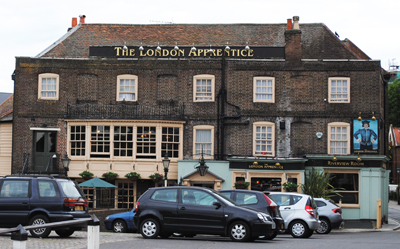
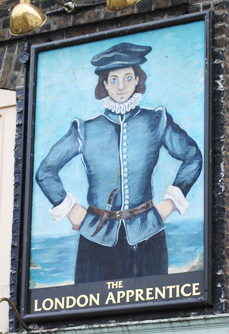
London Pub Signs – The London Apprentice

Sitting on the bank of the Thames at Old Isleworth in the city’s west stands The London Apprentice public house.

The pub’s licence dates back to at least 1731 and it has been associated with the likes of such luminaries as King Henry VIII (it’s suggested he met Catherine Howard here – she was later imprisoned in nearby Syon House), King Charles I and King Charles II (the latter apparently cavorted with his mistress, actress Nell Gwynne, here), as well as the ill-fated Lady Jane Grey and Lord Protector Oliver Cromwell.

Others whose names come up in reference to the pub include the ever-present author Charles Dickens (this is said to have been one his favorite pubs) and notorious highwayman Dick Turpin.

While there remain some doubts over its origins, the name of the pub – which stands opposite the small isle known as the Isleworth Ait – is said to stem from the fact that it was here that London apprentices, having faithfully served their masters, came to while away the hours in their downtime. They are said to have entertained themselves by playing about in decorated barges on the river.

There is said to be a tunnel, now blocked, which links the pub with the nearby All Saint’s Church – the story goes that this was used by smugglers to get their contraband into the pub’s cellars.

For more information or to pay a visit, see www.thelondonapprentice.co.uk.

London Pub Signs – The Queen’s Larder

In the first of an occasional series looking at the story behind some of London’s pub signs, we take a look at The Queen’s Larder in Queen Square, Bloomsbury.

The origins of the pub go back to the early 18th century – around 1710 – when there was known to be an alehouse on the site now occupied by the tavern. The story goes that as King George III (aka the ‘Mad King George’ depicted in the film of the same name) began to be affected by mental illness he was brought to a house in Queen Square where he stayed and was treated by a Dr Willis.

While he was undergoing this treatment – which was apparently initially successful, his wife Queen Charlotte rented an underground cellar below the alehouse and there stored some of the king’s favorite delicacies.

When a tavern was later built on the site, it was named The Queen’s Larder in honor of the role it had played in providing a storehouse for his treats.

The square itself contains a statue which was believed to be of Queen Anne – after whom the square was renamed (it had previously been known as Devonshire Square) – but it is now thought that the statue may in fact be of Queen Charlotte.