This Week in London – ‘Dress Codes’ at Kensington Palace; Edvard Munch portraits; St Patrick’s Day celebrations; and, women’s lives at Hampton Court…

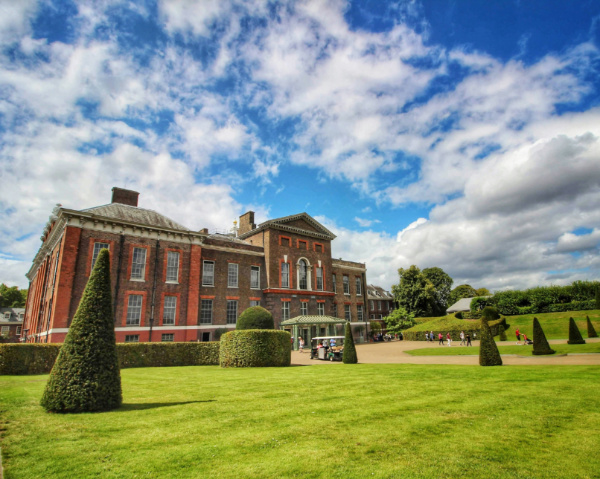
Kensington Palace. PICTURE: Martin Zenker/Unsplash

• Never-before-seen royal clothing is going on show at a new exhibition opening at Kensington Palace today. Dress Codes, which includes rarely seen highlights from the Royal Ceremonial Dress Collection, explores the codes and conventions of royal clothing, and the impact fashion can make “when boundaries are pushed and dress codes evolve”. Highlights include two matching Liberty print floral cotton dresses, worn in 1936 by Queen Elizabeth II (then Princess Elizabeth) and her younger sister Princess Margaret, a glittering red Bruce Oldfield gown worn by Diana, Princess of Wales, for a state visit to Saudi Arabia in 1987, and a Catherine Walker green silk velvet tuxedo-style dress which was shared with the world as one of 79 dresses famously auctioned to raise money for HIV/AIDS and cancer charities in 1997. There also two dresses worn by Princess Margaret which are going on show for the first time in the UK – a 1978 Thea Porter evening ensemble and a colourful green embroidered evening gown by the Filipino designer Jose Pitoy Moreno, worn in 1980. Other items include a never-before-displayed black mourning bodice worn by Queen Victoria. Runs until 30th November. Admission charges apply. For more, see www.hrp.org.uk/kensington-palace/whats-on/dress-codes.

• The first ever exhibition of Edvard Munch portraits opens at the National Portrait Gallery. The display, Edvard Munch Portraits, include Munch’s portraits of lawyer Thor Lütken and physicist Felix Auerbach as well as early family portraits such as Evening (1888) which shows his sister Laura on a family holiday and Andreas Munch Studying Anatomy (1886). Other works include The Brooch (1902) and full-length portraits of Jappe Nilssen, the painter Ludvig Karsten and writer Christian Gierløff – all from the group of men he called his ‘Lifeguards’ or ‘Guardians’. Runs until 15th June. Admission charge applies. For more, see www.npg.org.uk.
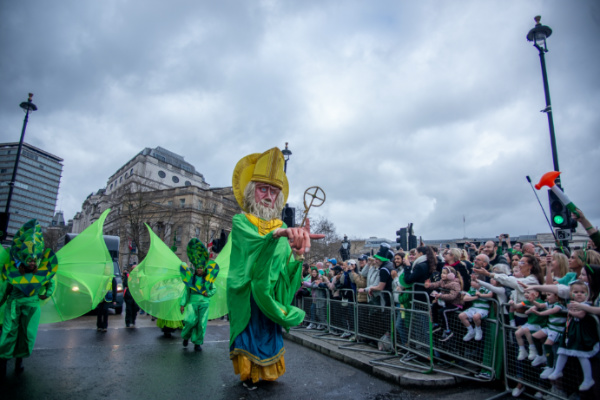
St Patrick’s Day in London in 2024. PICTURE: Loredana Sangiuliano/Shutterstock

• The St Patrick’s Day Parade and Festival returns to London this Sunday. Irish Paralympic gold medal winning cyclist Katie-George Dunlevy and Olympic gold medal winning boxer Kellie Harrington are serving as this year’s Grand Marshals of the parade which, with more than 50,000 participants, will feature floats, marching bands, and dance troupes. The parade kicks off at noon and will make its way from Hyde Park Corner past Piccadilly and Trafalgar Square and on to Whitehall. Meanwhile, Trafalgar Square will host an afternoon of entertainment hosted by Irish-Indian-Malaysian DJ and broadcaster Tara Kumar and featuring a wide range of family-friendly performances by the likes of Kíla, Irish Women in Harmony and Ragz-CV. Celebrity chef Anna Haugh will provide Irish cooking demonstrations and there will be an exhibition celebrating Ireland’s unsung women heroes as well as the chance to learn Irish dancing and a dedicated zone for kids with free creative workshops. For more, see https://www.london.gov.uk/events/st-patricks-day-2024.

• An audio-led exploration of Hampton Court Palace after dark kicks off next Wednesday to mark
International Women’s History Month.
Still The Hours uses a layered soundscape to guide visitors through the palace’s darkened halls as established actors including Kathryn Hunter (Harry Potter, Black Doves, Poor Things) and Miranda Richardson (Harry Potter, Good Omens, The Hours) can be heard alongside up-and-coming female voices to “weave a vivid tapestry” of women’s lives at the palace. The stories explored in the hour long presentation range from a suffragette to a mistress and a queen to a maid. Runs until 30th March. Admission charge applies (for ages 14+, under 16s must be accompanied by an adult). For more, see www.hrp.org.uk.

Send all items to exploringlondon@gmail.com

This Week in London – Marking Turner’s 250th; ‘Helios’ at the Painted Hall; Churchill in cartoons; and, Royal Parks’ new Elizabeth II garden wins grant…

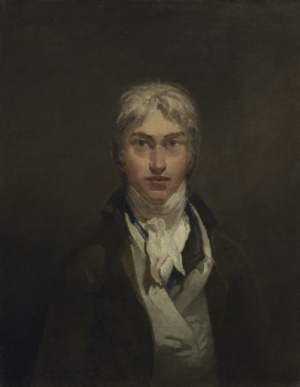
JMW Turner, Self-Portrait, c.1799
Image courtesy of Tate

• Cultural institutions across the UK have announced a year long celebration of renowned painter JMW Turner in honour of the 250th anniversary of his birth. Turner 250 includes more than 30 events with Turner’s birthday on 23rd April a particular focus. Events on the day include the opening of an exhibition of Turner’s rarely-seen images of wildlife at Turner’s House in Twickenham, and the opening of a newly refreshed room in Tate Britain’s Clore Gallery which will be home to a permanent free display of 100 works by the artist. More information will be forthcoming.

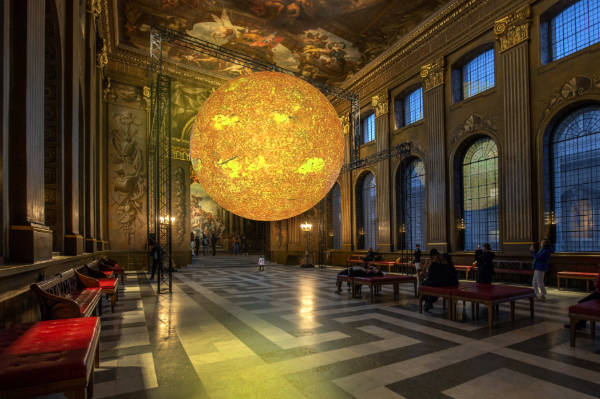
• Luke Jerram’s newest and most ambitious large scale artwork, Helios, is making its London premiere at the Old Royal Naval College. Co-commissioned by the Old Royal Naval College, this new seven-metre celestial artwork depicts the Sun in all its glory at a scale of 1:200 million. The imagery for the artwork has been compiled using photographs of the Sun provided by astrophotographer Dr Stuart Green (taken between May, 2018, to June, 2024) and NASA observations of the Sun along with guidance from solar scientist, Professor Lucie Green of University College London (UCL). The sculptural work is accompanied by a specially created surround sound composition created by acclaimed artists Duncan Speakman and Sarah Anderson. Runs from Saturday until 25th March. Admission charge applies. For more, see https://ornc.org/whats-on/helios/

Helios by Luke Jerram in the Painted Hall. PICTURE: Courtesy of the Old Royal Naval College.

• On Now: Churchill in Cartoons: Satirising a Statesman. The Imperial War Museum in Lambeth is marking the 150th anniversary of the birth of Sir Winston Churchill with this exhibition examining how Churchill is represented in political cartoons, both during his life and after. The display features 24 original artworks spanning the period from 1909 to 2003 and examines how these portrayals influenced public perception of the statesman, from his early career as an MP to the role he played in both World Wars, the “Wilderness Years” between and after he lost the 1945 General Election. Among the works are
a cartoon from Punch magazine in 1914 depicting Churchill supporting the Roman sea god Neptune with aircraft (representing the establishment of the Royal Naval Air Service), a 1941 David Low cartoon shows a cigar-smoking Churchill with US President Franklin D Roosevelt during their Atlantic Conference, and, a cartoon by US cartoonist Jim Berryman marking Churchill’s defeat in the 1945 election. The free exhibition closes on 23rd February. For more, see www.iwm.org.uk/events/churchill-in-cartoons-satirising-a-statesman.

• Royal Parks have been awarded a £450,000 grant to support the creation of a new, two-acre garden in The Regent’s Park. The garden, to be funded with the grant from the Garfield Weston Foundation, will commemorate the life and legacy of Queen Elizabeth II and will feature a circular pond enhancing wildlife habitats, a central promenade with an accessible platform over the pond, and a vibrant flower garden showcasing species which were significant to the late Queen, such as the specially bred Narcissus ‘Diamond Jubilee’ or Tulipa ‘Royal Celebration’. The new garden is set to open in 2026.

Send all items for inclusion to exploringlondon@gmail.com.

This Week in London – Queen Victoria’s Christmas childhood; Parmagianino’s Madonna and Child with Saints; and, Buckingham Palace winter tours…

• Step back in time at Kensington Palace this Christmas with an experience inspired by Queen’s Victoria’s childhood at the palace. Victoria’s Childhood Christmas features intricately designed installations – everything from trees hung with sugar ornaments and handmade paper decorations to bespoke illustrations and period-style gifts – as well as an exploration of how some of the traditions still celebrated today – such as arranging numerous Christmas trees on table tops and displaying unwrapped presents around them – can be traced back to the 1830s at Kensington Palace. There’s also a pop-up theatre set which captures the magic of Victoria’s winter trips to London opera houses and a festive-themed afternoon tea inspired by Princess Victoria’s Christmas traditions served in The Orangery. The experience, which is included in general admission, can be seen until 5th January. For more, see www.hrp.org.uk/kensington-palace/

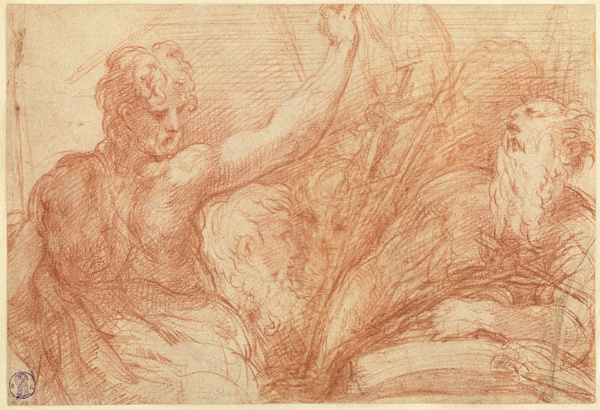
Parmigianino (1503–1540), ‘Studies of Saints John the Baptist and Jerome, a Crucifix and Various Heads’ (recto), about 1525–7; Red chalk on paper, 13.5 × 22.1 cm; The J. Paul Getty Museum, Los Angeles (87.GB.9); PICTURE: Courtesy of the Getty’s Open Content Program

• Parmigianino’s Madonna and Child with Saints (1526‒7) returns to display in The National Gallery for the first time in a decade in honour of the gallery’s 200th anniversary. The work, which is also known as The Vision of Saint Jerome, was presented to the gallery in 1826 and is being displayed with a selection of some of the most important preparatory drawings providing a rare opportunity to follow the artist’s creative process. The painting can be seen in Room 46 until 9th March. Entry is free. For more, see nationalgallery.org.uk.

• The Buckingham Palace State Rooms are open for one hour tours on select dates throughout winter. Led by an expert guide, the tours, which have a maximum of 30 people, include a complimentary guide. For more, see https://www.rct.uk/whatson

Send all items to exploringlondon@gmail.com
What’s in a name?…Honor Oak

Yes, this small south London district, located to the south of Peckham, was actually named for an oak.

In this case it was an oak which stood atop the 90 metre high One Tree Hill – the last in a line of hills which stretch north from Croydon.

The replanted oak. PICTURE: Doyle of London (licensed under CC BY-SA 4.0)

There’s a couple of possible explanations for the name – the first is that the oak in question once marked the southern boundary of the estates or “honour” of the 12th century Earls of Gloucester – hence ‘Honor Oak’.

The second is that Queen Elizabeth I apparently had a picnic with Sir Richard Bulkeley of Beaumaris under its branches on May Day, 1602. Hence again ‘Oak of Honor’ or ‘Honor Oak’.

Sadly, the original tree is gone – it was apparently hit by lightning in the 1880s – and a replacement, which can still be seen today, was subsequently planted nearby.

There’s a few stories surrounding the hill and its oak including that it was here that the Roman general Paulinus overcome Boudicca in 61AD. Another says that the highwayman Dick Turpin used it as a lookout.

Its height did see the hill put to use as a beacon by the Admiralty during the Napoleonic Wars and as a semaphore station by the East India Company. A beacon on top of the hill was erected to commemorate the Silver Jubilee of King George V in 1935 and subsequently used for celebrations including the coronation of Queen Elizabeth II and the Queen’s silver and golden jubilees.

There was also a gun emplacement built upon the hill during World War I.

The area around the hill was largely rural until the late 18th century. In 1809, the Croydon Canal Company constructed a canal which ran from Croydon north to New Cross and which included numerous locks. It was taken over almost 30 years later by the Croydon and London Railway for its new line (the current railway line, the stops on which include Honor Oak Park (opened in 1886), runs along the same course).

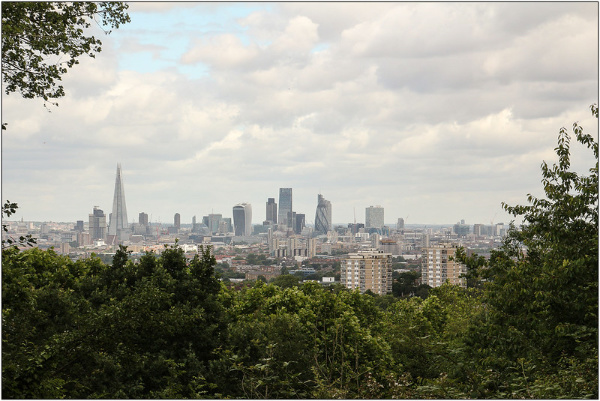
View from the top of One Tree Hill in 2016. PICTURE: Maureen Barlin (licensed under CC BY-NC-ND 2.0)

There was a bid to incorporate One Tree Hill into a golf course in the late 1800s but following a protest, this was halted and in 1905 the hill was acquired by the Camberwell Borough Council as public open space. It remains so today.

The Church of St Augustine was built to the designs of William Oakley on the hill’s east side in the late 19th century.

Famous residents in the streets around the hill have included Spike Milligan.

The Honor Oak Reservoir lies just to the north of the hill. It was constructed between 1901 and 1909 and was the largest brick built underground reservoir in the world. The roof of the still-in-use reservoir is grassed over and used as a golf course. A rather grand pumping station stands nearby.

10 towers with a history in London – 9. The Queen’s Tower, Imperial College London…

This free-standing, 287 foot-high tower is a survivor – it’s all that remains of the Imperial Institute.

Subscribe for just £3 a month to get access to all Exploring London’s stories – that’s less than the cost of a cup of coffee!

London Explained – Albertopolis…

An aerial view of the area known as Albertopolis. PICTURE: Andreas Praefcke/Public Domain

A nickname, connected to Prince Albert (beloved husband of Queen Victoria), which was given to an area of South Kensington centred on Exhibition Road which is packed with various cultural and educational institutions.

The land, which had been the Kensington Gore Estate, was purchased by the Royal Commission for the Exhibition of 1851 on the suggestion of Prince Albert using the profits made from the Great Exhibition which had been held just to the north in Hyde Park. His vision was for arts and science quarter which included schools, colleges and libraries as well as museums, exhibition rooms and spaces for events.

Among the buildings subsequently constructed upon it were those bearing Prince Albert’s name including Royal Albert Hall and the Victoria and Albert Museum along with the huge Albert Memorial.

Other institutions on the land include the Natural History Museum, Imperial College London, the Royal College of Music, the Royal College of Art, the Science Museum, the Royal Geographical Society and the since removed Royal Horticultural Society Gardens.

The area gained its nickname in the 1850s due to the Prince’s role in the Great Exhibition and its subsequent purchase and was seen to both celebrate, but also by some, to satirise him. It fell out of use after the Prince’s death in 1861 but was subsequently revived in the 1960s and since to bring attention to buildings in the area threatened with demolition.

A pedestrian subway under Exhibition Road runs north from South Kensington Station and gives access to the museums (when it was built in 1885, a toll of one penny was charged to use it).

10 towers with a history in London – 8. The Bell Tower…

We return to the Tower of London this week to look at the history of another of its storied towers.

Support out work and subscribe for just £3 a month for full access to the site.

10 towers with a history in London – 3. Victoria Tower…

Located at the south-western end of the Houses of Parliament, the rather grand Victoria Tower was built as part of Sir Charles Barry’s 19th century redevelopment of the site in the Gothic Perpendicular style.

We invite you to support our work and subscribe for just £3 a month to gain access to all our coverage!

10 towers with a history in London – 1. The Bloody Tower…

The Bloody Tower (centre, with the gateway) at the Tower of London. PICTURE: David Adams

Carrying rather a gruesome name, this rectangular-shaped tower sits over a gate leading from outer ward into the inner ward in the Tower of London.

The tower, which once controlled the watergate before the outer walls were constructed, was originally known as the Garden Tower due to its location adjoining the Tower Lieutenant’s Garden.

To see the rest of this post (and all of our coverage), subscribe for just £3 a month. This small contribution – less than the cost of a cup of coffee – will help us continue and grow our coverage. We appreciate your support!

Treasures of London – The Abraham Tapestries, Hampton Court Palace…

Hanging in the Tudor Great Hall at Hampton Court Palace, this series of 10 huge tapestries are believed to have been commissioned by King Henry VIII and were first hung in the hall in 1546.

To see the rest of this post (and all of our coverage), subscribe for just £3 a month. This small contribution – less than the cost of a cup of coffee – will help us continue and grow our coverage. We appreciate your support!

This Week in London – ‘The Tudor World’ explored; ‘Crossing Borders’ at the Horniman; and, TfL deal at the Painted Hall…

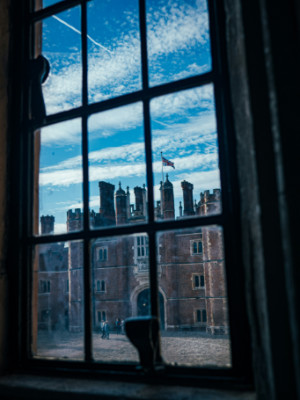
Looking out a window at Hampton Court Palace. PICTURE: Greg Willson/Unsplash

• The oldest surviving rooms at Hampton Court Palace – the Wolsey Rooms which King Henry VIII and Thomas Wolsey once used – are the location of a new display opening today exploring the early years of Henry VIII’s reign and the lives of the ‘ordinary’ men and women who shaped the Tudor dynasty. The Tudor World has, at its centre, rare surviving paintings from the Royal Collection including The Embarkation of Dover – depicting the Tudor navy – and The Field of Cloth of Gold which details Henry VIII’s summit with King Francis I of France in 1520. Also on show is a gold ring believed to have belonged to the Boleyn family, a brightly coloured silk hat linked to King Henry VIII, Wolsey’s portable sundial, a wooden chest used to hide religious contraband by Catholic priests during the reign of Queen Elizabeth I, and, an original Tudor chain pump used to help empty the Hampton Court cesspool. Among the stories of “ordinary” Tudor people being shared is that of Anne Harris, Henry VIII’s personal laundry woman who washed the bandages for his leg ulcers and, Jacques Francis, a free-diver from West Africa who was involved in the expedition to salvage guns from the sunken Mary Rose and who later became one of the first Black African voices heard in an English court, when he was called to testify in a case concerning his employer, Paulo Corsi. Included in palace admission. For more, see www.hrp.org.uk/hampton-court-palace/.

• Crossing Borders, a day of free activities, performances and workshops run by local newly arrived people, will be held at the Horniman Museum Gardens in Forest Hill this Saturday. The day will feature arts and crafts workshops led by IRMO, dance performances by Miski Ayllu and the Honduran Folkloric Pride Group, the chance to learn circus skills with young people from Da’aro Youth Project and South London Refugee Association, and the opportunity to make kites with Southwark Day Centre for Asylum Seekers. The free event runs from 11am to 4pm. For more, see https://www.horniman.ac.uk/event/crossing-borders/.

• Transport for London customers can save 30 per cent on entry to the Painted Hall at the Old Royal Naval College when using the TfL network until 17th November. Simply show customers show your TfL journey on the day of your visit via the TfL Oyster and Contactless app and receive the discount, taking the adult entry price, when booked online to just £11.55. For bookings, head to https://londonblog.tfl.gov.uk/2022/07/27/in-the-city/.

Send all items for inclusion to exploringlondon@gmail.com.

10 significant (and historic) London trees…9. The Fulham Palace Oak…

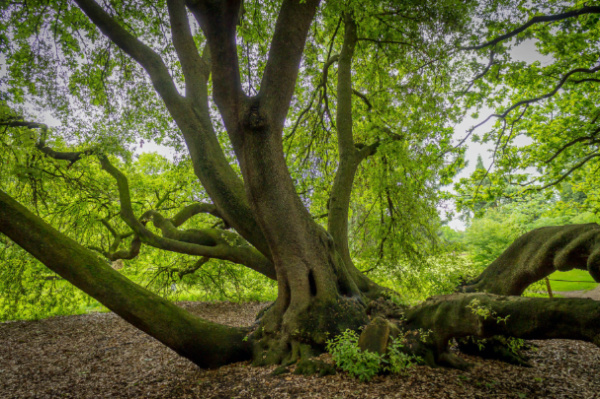
PICTURE: DavidRBadger (licensed under CC BY-NC-SA 2.0)

Said to be the oldest of its species in the UK (and a contender for the oldest tree in London), this holm oak (Quercus ilex), also known as a holly leaved oak, is believed to be more than 500-years-old.

The site was the home of senior clergy for much longer – Waldhere, the Bishop of London, first bought the site in 704 AD. And over the years, Fulham Palace and its gardens have evolved significantly with some of the current structures dating from Tudor times.

The Bishops of London left the palace in 1973 and it’s now managed under a trust which was established in 2011.

It’s possible this immense evergreen oak, which is native to the Mediterranean region, was among a number planted in the mid-16th century during the tenure of Bishop Edmund Grindal (about 1553 to 1559).

Bishop Grindal is known to have had a keen interest in the garden and who is credited with introducing the tamarisk tree to England and growing grapes which were sent to Queen Elizabeth I.

It’s also possible the tree was planted during the later tenure of Bishop John Aylmer (1576 to 1594).

The oak, which was coppiced many years ago extending its life, is among the original 41 trees awarded “Great Tree” status in 1988.

WHERE: Fulham Palace Gardens, Bishop’s Avenue, Fulham (nearest Tube station is Putney Bridge); WHEN: 10.30am – 5pm daily; COST: Free; WEBSITE: https://www.fulhampalace.org

10 significant (and historic) London trees…5. Black mulberry trees, Middle Temple Gardens…

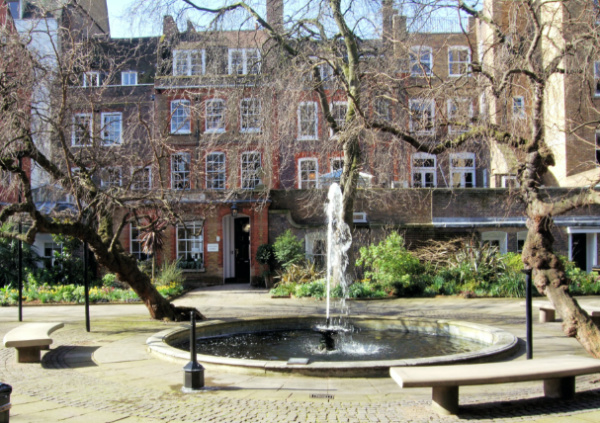
The two gnarled mulberry trees on either side of the fountain. PICTURE: Jim Linwood (licensed under CC BY 2.0)

While there’s been gardens here dating back possibly as far as the middle of the 12th century when the Templars established a preceptory here, these two trees have a more recent historic (and royal) link.

The gnarled black mulberrys (Morus nigra) in the Fountain Court were planted here on 20th June, 1887, to commemorate the Golden Jubilee of Queen Victoria.

There were actually four mulberry trees planted to mark the occasion – which was celebrated with a grand dinner in the nearby Middle Temple Hall – but these two trees are the only survivors, the other two having been removed in the 1970s.

Both trees are these days leaning on supports.

Lost London – Locket’s…

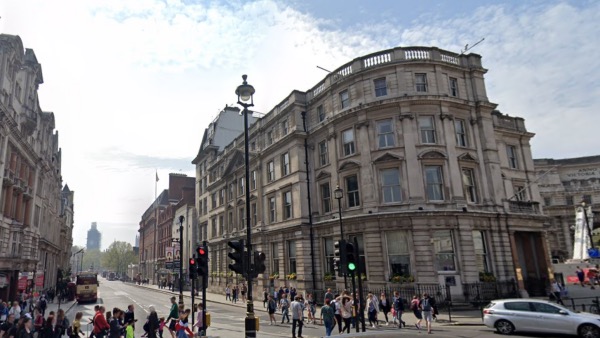
Looking down Whitehall from where the Charing Cross stood today. Locket’s stood on the right. PICTURE: Courtesy of Google Maps.

A famous “ordinary” where meals could be obtained at preset prices, Locket’s was founded by Adam Locket just south of Charing Cross in the 17th century.

A popular meeting place after attending the theatre, the establishment was known for the quality of its food. It was frequented by the well-to-do as well as dramatists like Sir George Etherege (who apparently didn’t pay his bill).

Following Adam Locket’s death in about 1688, he was succeeded by his son Edward who ran it until about 1702. It survived through the reign of Queen Anne but contemporary references – it had been mentioned by writers such as John Vanbrugh and William Congreve – became increasingly scanty and then disappeared altogether after her death in 1714.

Drummond’s Bank later occupied the site where Locket’s had stood.

10 significant (and historic) London trees…1. Queen Elizabeth’s Oak, Greenwich…

Spring is upon us, so we thought it an appropriate time to consider some of London’s greatest natural assets – its trees. But, as well as being significant for their environmental impact, each of these trees (or, in some cases, the remains of them), are significant for historic reasons (we’ve previously mentioned a couple including what’s believed to be the oldest tree and the unusual – and sadly now deceased – Hardy Tree).

PICTURE: Steve Daniels (licensed under CC BY-SA 2.0)

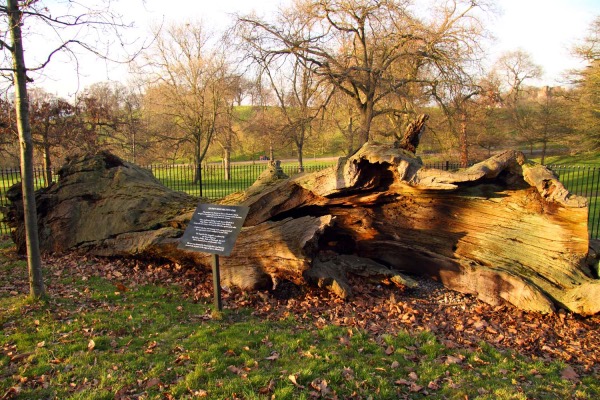
First up, it’s the tree known as Queen Elizabeth’s Oak in Greenwich. Thought to date from possibly as far back as the late 13th century, this tree survived until the 19th century before its carcass finally fell to the ground during a storm in 1991. It has lain in Greenwich Park ever since.

The tree, which is located at the end of what is now Lover’s Walk close to the Maze Hill Gate, was located in the grounds of Greenwich Palace (also known as the Palace of Placentia) and was there when King Henry VIII resided at the palace.

In fact, it’s said that he and Anne Boleyn danced around the oak while courting, and (and here’s where the name comes from) that Elizabeth, their daughter (and later Queen Elizabeth I), picnicked under its canopy (some accounts suggest she actually picnicked in the tree’s hollow – but still then upright – trunk).

Following the creation of what is now Greenwich Park, the hollow tree was apparently used as a prison for those caught illicitly on the grounds. They were secured behind a heavy wooden door fitted to the trunk (a park keeper’s lodge was built nearby in the 17th century; it was demolished in the 1850s).

The tree, one of 3,000 in the park, had died in the 19th century and was reduced to an eight metre high stump, partly supported by ivy, when it was blown over by the storm in June, 1991.

A replacement oak, which was donated by the Greenwich Historical Society was planted nearby by the Duke of Edinburgh on 3rd December, 1992, to mark Queen Elizabeth II’s 40 years on the throne.

A ring analysis carried out on the tree found in 2014 it dated back to at least 1569 but with the core missing a precise date of germination couldn’t be found. Estimates, however, place the date of germination to the last 13th or early 14th century. The analysis placed the tree’s death to between 1827 and 1842.

The tree is marked with a plaque and both it and the new tree are surrounded by an iron railing.

WHERE: Queen Elizabeth Oak, Greenwich Park (nearest DLR station is Greenwich); WHEN: 6am to 8pm daily; COST: Free; WEBSITE: https://www.royalparks.org.uk/visit/parks/greenwich-park.

This is an expanded version of a post first made in 2017.

Famous Londoners – Princess Sophia Duleep Singh…

A suffragette and women’s right’s campaigner, Princess Sophia Jindan Alexandrovna Duleep Singh was the daughter of the deposed Maharaja Sir Duleep Singh, last Sikh emperor of Punjab, and god-daughter of Queen Victoria and is known for having leveraged her position to advocate for the rights of others.

Princess Sophia Duleep Singh selling subscriptions for the ‘Suffragette’ newspaper outside Hampton Court in London in about 1913. PICTURE: Via Wikipedia/Public Domain.

Singh was born on 8th August, 1876, at a house in Belgravia, the third daughter of the Maharajah and his German-born first wife, Bamba Müller. The fifth of six children, she was named Sophia for her maternal grandmother, a formerly enslaved woman from Ethiopia who married a wealthy German banker, and Alexandrovna in tribute to her godmother, Queen Victoria.

Following his forced abdication, the Maharaja had travelled to England as a boy in 1854 where he lived on an annual government pension of £25,000. Having later married Bamba in Cairo, he returned to England where in 1863 he purchased Elvedon Hall in Suffolk (which he later rebuilt). Sophia subsequently spent her childhood there.

But after the breakdown of her parents’ marriage (after which her father remarried before being exiled to Paris where he campaigned for a return to India until his death in 1889) and the death of her mother in 1887 from typhoid (she had contracted the disease but survived), Sophia and her siblings were placed in the care of Arthur Craigie Oliphant – chosen by Queen Victoria to be guardian – first at their home in Folkestone and then in Brighton.

After finishing her education at a girls school in Brighton, Sophia and her sisters sisters Bamba and Catherine embarked upon a six-month tour of Holland, Germany, Greece, Italy, and Egypt.

Sophia, who had inherited some of her father’s fortune, was given Faraday House – part of the Hampton Court estate – as a grace-and-favour apartment by Queen Victoria in 1896 (along with an annual grant to maintain the property and a key to Hampton Court Palace where she could walk her dogs).

The princess took a keen interest in dogs – she was a member of the Ladies’ Kennel Association and showed her dogs on several occasions – as well in music, photography and fashion. She also supported Indians in London, particularly those in the Sikh community, and travelled to India a number of occasions.

Princess Sophia is known for her work in the women’s suffrage movement and was an active member of the Women’s Social and Political Union. She was present in Parliament Square ion 18th November, 1910, when more than 300 suffragettes including Emmeline Pankhurst gathered and demanded to see the Prime Minister HH Asquith and, having refused to disperse when he refused to see them, were met with a violent response by police. The day, which resulted in injuries to more than 200 women including two who died of them, became known as Black Friday.

Sophia was also, perhaps more importantly in terms of public impact, a member of the Women’s Tax Reform League and refused to pay fines on a couple of occasions, protesting that taxation without representation was “tyranny” (with the result that some of her jewels were confiscated and auctioned off).

The Blue Plaque on Faraday House. PICTURE: Spudgun67 (licensed under CC BY-SA 4.0)

During World War I, Princess Sophia – as well as being part of a 10,000-strong march calling for the establishment of a female volunteer force – was involved in fundraising for organisations such as the Red Cross and in support of Indian soldiers and also worked as a nurse at the Brighton Pavilion and other hospitals where Indian soldiers were recovering.

During World War II, Sophia moved to Penn, Buckinghamshire, with her sister Catherine, and took in evacuee children from London.

Having never married, Princess Sophia died in her sleep in Penn on 22nd August, 1948. A full band played Wagner’s Funeral March at her cremation and her ashes were taken to India for burial.

Sophia’s name and image are among those on the plinth of the statue of Millicent Fawcett in Parliament Square. In 2023, an English Heritage Blue Plaque was unveiled on Faraday House in Richmond.

Sources: Historic Royal Palaces; Oxford Dictionary of National Biography; BBC.

10 atmospheric ruins in London – 6. Tudor and medieval remains at Eltham Palace…

Once a medieval royal palace, Eltham Palace in London’s east was transformed into a 1930s house which incorporates the medieval great hall.

Tudor ruins in the garden of Eltham Palace (with the home behind). PICTURE: Peter Gasston (licensed under CC BY-NC-ND 2.0)

But there are also some other remains of the former medieval palace on the site – including the footings of the palace’s west range incorporating royal apartments used in the Tudor era.

These included separate apartments for the king and queen as well as a gallery where the king could walk in inclement weather.

The ruins feature diamond-patterned brickwork (pictured), part of the west range which was built during the reign of Queen Elizabeth I in the 1580s.

There are also the remains of a tower of yellow brick, which possibly dates from the 14th century when, prior to the site being a royal palace, it was rebuilt as a manor house by Anthony Bek, Bishop of Durham (it was Bek who gave the manor to the future Edward II in 1305).

These days the ruins lie within the home’s magnificent gardens, recreated to show how they might hav. Alongside the remains of the west range (and the medieval great hall which dates from the reign of King Edward IV and is largely intact), are the remains of a late 15th century bridge over a medieval moat, at the south end of which are the remains of a gatehouse.

There’s also an oak pedestrian bridge, supported by medieval brick and foundations which once formed part of the main southern entrance to the palace.

WHERE: Eltham Palace, Court Yard, Eltham, Greenwich (nearest train station is Mottingham); WHEN: 10am to 4pm Wednesday to Sunday; COST (advance online tickets): £14.50 adults/£8.60 children/£12.70 concessions/£37.60 family (can include a donation/English Heritage members free); WEBSITE: www.english-heritage.org.uk/visit/places/eltham-palace-and-gardens/.

Where’s London’s oldest…roundabout?

PICTURE: Matt Brown (licensed under CC BY 2.0)

London’s oldest roundabout is said to be located in Southwark at the intersection of Borough, Westminster Bridge, Waterloo, London and Blackfriars Roads.

St George’s Circus was built in 1771 (during the reign of King George III) and designed by Robert Mylne as a grand southern entrance to London with radiating roads leading to three bridges over the Thames: London Bridge, Westminster Bridge and Blackfriars Bridge.

Mylne also designed the obelisk which still stands in the centre of the circus. As well as showing the date on which it was erected, the obelisk also records distances to Palace Yard in Westminster, Fleet Street, and London Bridge. Gas lamps were placed at each corner to illuminate the intersection.

The now Grade II*-listed obelisk has a rather interesting history in itself. Having stood at the roundabout for more than a century, in about 1897 it was relocated to Geraldine Mary Harmsworth Park outside the Imperial War Museum on Lambeth Road to make way for a clocktower designed to mark Queen Victoria’s Diamond Jubilee.

The clocktower itself, however, was removed in the 1930s to help with traffic flow. It wasn’t until 1998 that the obelisk was moved back to its original site (now minus the oil lamps).

Interestingly, an Act of Parliament passed in 1812 specifies that all buildings on the intersection must be located 240 feet from the obelisk (the reason, apparently, for curved facades on some of the surrounding buildings).

10 London locations related to Sir Christopher Wren…1. The Old Court House, Hampton Court Palace Green…

This year marks the 300th anniversary of the death of Sir Christopher Wren (25th February, 1723), whose designs helped to transform post-Great Fire London.

In a new series we’re looking at 10 locations which help tell Wren’s story but while we’ve previously runs numerous articles focused on the many buildings he designed, in this series the focus is more on his personal life.

First up, it’s one of the most well-known properties related to Wren’s life – the home in which he spent the latter years after his life just outside Hampton Court Palace.

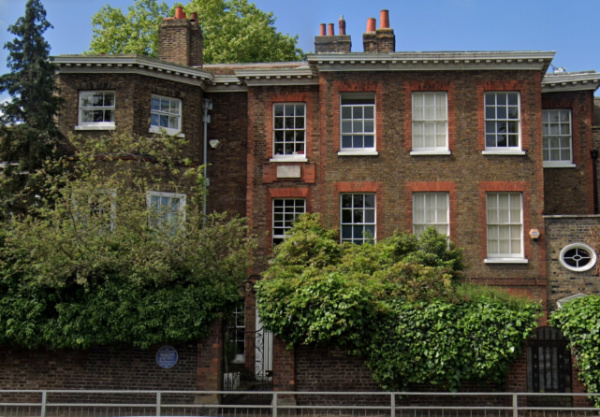
Known as the Old Court House, Wren first came to live in the house after he was appointed Surveyor-General to King Charles II in 1669. His post brought with it lodgings at the royal palaces and at Hampton Court Palace, it was the Old Court House (the property had been built for in 1536 as a wood and plaster house; Wren’s immediate predecessor in the office, Sir John Denham, had rebuilt it partly in brick).

Then in 1708, Queen Anne granted him a 50-year lease on the property, apparently at least partly in lieu of overdue fees he was owed for the building of St Paul’s Cathedral. It’s also believed that the Queen had granted the lease on condition that Wren repair or rebuilt the property.

Wren, who had hitherto only lived intermittently at the property (presumably while working on Hampton Court Palace on the orders of King William III and Queen Mary II), made some major alterations to the property from 1710 onwards (it’s suggested this was done to the designs of Wren’s assistant William Dickinson).

He came to live here on a more permanent basis after he retired from the Office of Works in 1718 and remained here until his death in 1723 (although he didn’t die here – more on that later).

It’s said Wren, whose time as the Royal Surveyor-General spanned the reigns of six monarchs, spent his time here “free from worldly affairs”, choosing to and pass his days ‘in contemplation and studies”.

It was subsequently the home of Wren’s son Christopher (1645-1747) and his grandson Stephen (b 1772). It remained a grace and favour house associated with Hampton Court Palace until 1958.

The Grade II* brown and red brick property, which was combined with the house next door in the early 19th century and them divided off in 1960, is now in private ownership and there’s an English Heritage Blue Plaque on the outside wall mentioning Wren’s residence.

10 historic vessels in London’s Thames…8. MV Havengore….

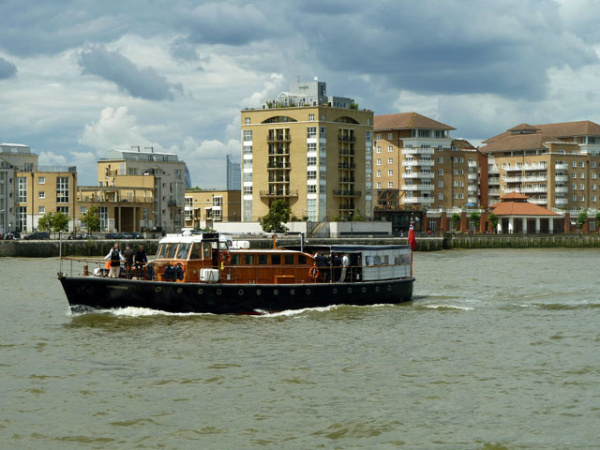
The MV Havengore. PICTURE: Robin Webster (licensed under CC BY-SA 2.0)

Still plying the waters of the Thames, the MV Havengore is perhaps most famous for having carried the coffin of Sir Winston Churchill on the River Thames as part of his state funeral in 1965.

The MV Havengore – named for a low-lying island off the coast of Essex – was originally constructed as a hydrographic survey launch for the Port of London Authority in 1956. As the PLA’s principal survey vessel and flagship, she was moored at Gravesend and tasked with recording changes to Thames bed and estuary. She became the first survey vessel in the UK to have a computer to record survey data.

The highpoint of her during her almost 40 years of service with the PLA came on 30th January, 1965, when she transported the body of Churchill from Tower Pier to Festival Pier. On the journey, she was saluted by flight of 16 fighter jets while dock cranes were made to bow as she passed (there’s a plaque on board commemorating her role in the funeral).

But the almost 26 metre long vessel also participated in other historic events including the river pageant to celebrate the Queen Elizabeth II’s Silver Jubilee in 1977 and, more recently, the flotilla formed to celebrate the Queen’s Diamond Jubilee in 2012 as well as the Thames tribute to the Queen’s long reign in 2015 and the Queen’s 90th birthday parade in 2016.

The MV Havengore was withdrawn from service in 1995 and sold after which she underwent restoration and refitting at the Chatham Historic Dockyard. The vessel was then used to provide excursions for underprivileged children on the Medway.

Sold again in 2006, she has subsequently undergone further restoration work. The MV Havengore is these days used for a range of ceremonial, corporate and private events. When not on the river, she is berthed at St Katharine Docks. The vessel was listed, as of May this year, as being up for sale.