The next two entries in Exploring London’s 100 most popular posts countdown…
60. 10 (more) curious London memorials…3. William Wallace Memorial…
The next two entries in Exploring London’s 100 most popular posts countdown…
60. 10 (more) curious London memorials…3. William Wallace Memorial…
We’ve reached the end of our series on disease-related memorials in London. But, before we jump into the next Wednesday series, here’s a recap…
2. Commemorating the monks who died in the Black Death…
3. The Lambeth cholera epidemic memorial…
8. Former site of the Hospital for Tropical Diseases…
Thomas Hodgkin was a physician, pathologist and reformer whose name is now associated with Hodgkin lymphoma, a malignant disease of lymph tissue.
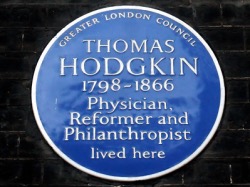 Born in Pentonville in what is now central London, Hodgkin (1798-1866), who trained at St Thomas’s and Guy’s Medical School and the University of Edinburgh, went on to work at Guy’s – where he built up a reputation as a pathologist – and later heading teaching staff at St Thomas’s (after it had split from Guy’s).
He first described the disease that bears his name in a paper in 1832 but it wasn’t until 33 years later, thanks to the rediscovery of the disease by Samuel Wilks, that it was named for him.
A Quaker, Hodgkin was also involved in the movement to abolish slavery and also raised concerns about the impact of the West on Indigenous culture. He died while on a trip to Palestine in 1866 and is buried in Jaffa.
Hodgkin is commemorated with an English Heritage Blue Plaque on his former home at 35 Bedford Square in Bloomsbury. Interestingly the house also bears a plaque to another giant of the medical field – Thomas Wakley, the founder of The Lancet.
The plaque commemorating Hodgkin was erected by the Greater London Council in 1985.
The next two entries in Exploring London’s 100 most popular posts countdown…
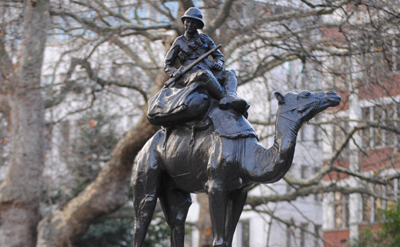 It’s common to associate war memorials with the commemoration of those who died in combat. But disease, too, is a major killer of soldiers in a time of war yet few memorials explicitly mention disease as cause of death.
One which does do so, however, is the Imperial Camel Corps Memorial in Victoria Embankment Gardens.
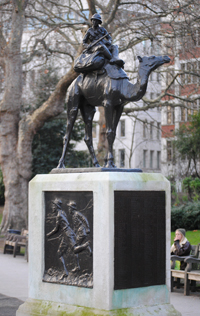 The memorial, which features a bronze figure riding a camel atop a stone plinth has a number of inscriptions and plaques recording the corps’ engagements during World War I and the names of the fallen.
Among them is an inscription which reads “To the glorious and immortal memory of the officers, NCO‘s and men of the Imperial Camel Corps – British, Australian, New Zealand, Indian, who fell in action or died of wounds and disease in Egypt, Sinai and Palestine, 1916 -1917-1918.”
Disease was a significant killer in World War I – it’s estimated that some 113,000 British and Dominion soldiers died of disease – but the number was far fewer than those who died in combat or from wounds, a figure which equates to at least 585,000 (not including the tens of thousands of missing).
Yet, medical advances meant disease was far less a killer than in previous wars – it’s said that in the American Civil War, for example, as many as two-thirds of those who died were the result of various diseases.
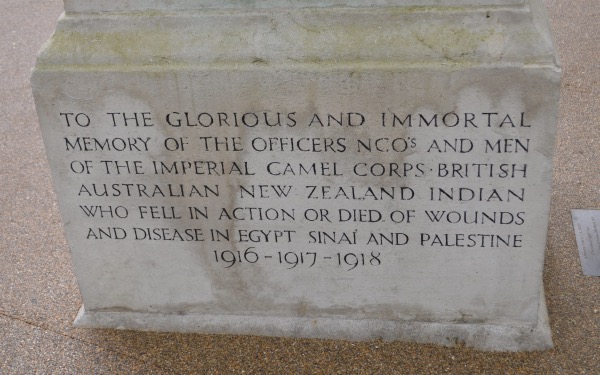
The Imperial Camel Corps, which grew to four battalions including two Australian, one British and one New Zealander before it was disbanded after the end of the in 1919, suffered some 246 casualties during World War I – we don’t have a breakdown for how many of those deaths were attributable to disease.
The Grade II-listed memorial, which was sculpted by Major Cecil Brown – himself a veteran of the Corps, was unveiled in July, 1921, in the presence of both the Australian and New Zealand Prime Ministers.
PICTURES: Top and right – David Adams/Below – Matt Brown (licensed under CC BY 2.0)
The next two entries in Exploring London’s 100 most popular posts countdown…
A blue plaque on a building in Euston marks one of the former sites of the Hospital for Tropical Diseases – a short-lived episode in the life of a hospital which started life aboard a ship on the Thames.
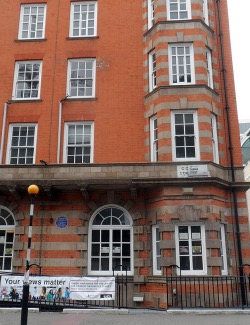 The hospital, the idea for which originated with the Seamen’s Hospital Society and was funded by public subscription, was founded in 1821 aboard the former naval ship, the HMS Grampus for the relief of ill seamen with none less than King George IV himself as patron.
It was moved aboard the HMS Dreadnought in 1831 and then to the HMS Caledonia, renamed the Dreadnought, in 1857, before finally moving into a section of the Royal Greenwich Hospital in 1870 which in turn became known as the Dreadnought Hospital.
In 1919 the hospital moved to the Endsleigh Palace Hotel at the corner of Endsleigh Gardens and Gordon Street in Euston which was at the time being used as a hospital by the Red Cross. There it was joined by the School of Tropical Medicine which had been founded at the Albert Dock Seamen’s Hospital in 1899 (although this merged with the School of Hygiene in the 1920s and moved out).
It only remained there, however, until the start of World War II when it was temporarily relocated back at the Dreadnought Hospital where it remained for the war’s duration.
After the war – with the hotel damaged during then Blitz, the hospital relocated to 23 Devonshire Street in Marylebone before, in 1951 it became part of the National Health Service and moved into the then vacant St Pancras Hospital as part of the University College of London Hospital group.
It remained located there until 1998 when it moved to new purpose-built premises in Capper Street in Bloomsbury and then in 2004 made the move to its current location in the University College Hospital Tower in Euston Road. The hospital remains the only dedicated institution of its kind within the NHS.
The plaque on the Gordon Street property (the blue dot seen in the image above) was erected by the Seamen’s Hospital Society.
PICTURE: Right – Spudgun67 (licensed under CC BY-SA 4.0/image cropped)
The next two entries in Exploring London’s 100 most popular posts countdown…
66. Lost London – The Mermaid Tavern…
65. 10 subterranean sites in London – 4. St Paul’s Cathedral Crypt…
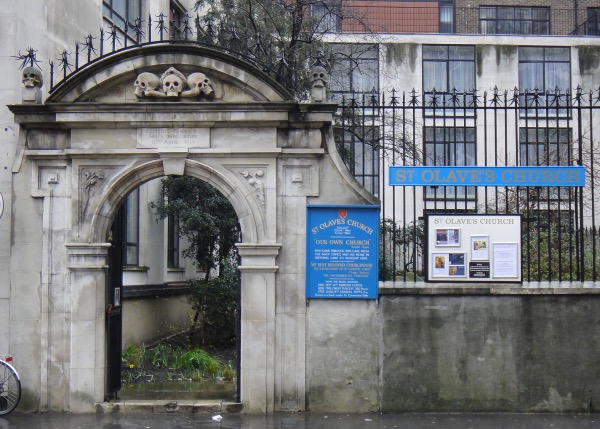
It is estimated to have killed as many as 100,000 Londoners yet, presumably at least partly due to there fact it was overshadowed by the Great Fire of the following year, there are no grand memorials to the victims of the Great Plague of 1665 in London.
It does, however, get a brief mention on the board outside the church of St Olave Hart Street on the corner of Hart Street and Seething Lane. Recording a few facts about the church’s history from the burial register, it lists “1665 (The Great Plague) 365 names”. (It also lists Mother Goose as buried here in 1586 – but that’s for another time).
Victims of the plague were buried at numerous sites around London – including in the churchyard of St Giles-in-the-Fields and, as recently uncovered during construction of the Crossrail project, in the Bedlam burial ground (there’s a great interactive map of London’s reputed plague pit locations on Historic UK).
Yet, despite this, there remains a dearth of public memorials commemorating those who died.
PICTURE: The Seething Lane entrance of St Olave Hart Street with the blue board and its mention of the Great Plague of 1665 (Dirk Ingo Franke (licensed under CC BY-SA 3.0))
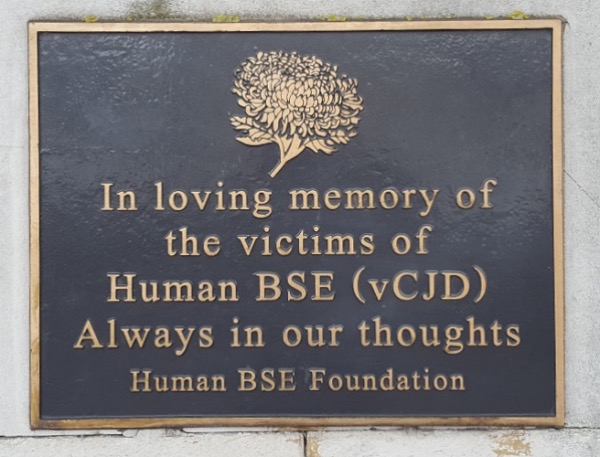
Located on the Albert Embankment outside St Thomas’ Hospital just to the south of Westminster Bridge, is a small plaque commemorating the victims of Human BSE (bovine spongiform encephalopathy), sometimes referred to as the human form of ‘Mad Cow Disease’.
The memorial, which was erected by the now defunct Human BSE Foundation, reads: “In loving memory of the victims of Human BSE (vCJD). Always in our thoughts.” There’s also an image of a chrysanthemum, a flower sometimes placed on graves to honour the dead.
It was reported in March, 2010, that since 1990, 168 people have died from Human BSE, also known as vCJD (variant Creutzfeldt–Jakob disease).
There has in recent years been a push to relocate the plaque from its position on the Albert Embankment to a more prominent place.
PICTURE: (licensed under CC BY-SA 4.0)
The next two entries in our countdown…
68. A Moment in London’s History – Peace Day Parade, 1919…
67. 10 (more) fictional character addresses in London – 2. 27a Wimpole Street…
This English Heritage Blue Plaque marks the property in Cavendish Square, Westminster, where Sir Ronald Ross, a key figure in the battle against malaria, lived for a period.
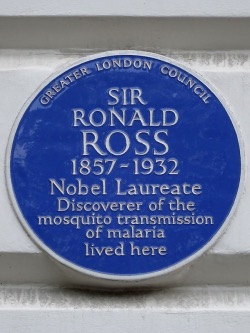 The Indian-born Ross received the 1902 Nobel Prize for Physiology or Medicine for his efforts in discovering, while working for the Indian Medical Service in 1897, how malaria is transmitted by mosquitoes. The find opened the way for combatting the disease.
Having trained in London, Ross worked for the Indian Medical Service for 25 years before joining the faculty of Liverpool School of Tropical Medicine. He went on to hold the post of professor and chair in Tropical Sanitation at Liverpool University.
He held various other posts – including consultant physician to the War Office and consultant to the Ministry of Pensions – before, in 1926, he became director-in-chief of the Ross Institute and Hospital for Tropical Diseases, an institution established in Putney Heath and named after him.
He held this position until his death in 1932 and was buried in the Putney Vale Cemetery nearby.
The plaque on the property at 18 Cavendish Square, where Ross lived when establishing his institute, was installed in 1985 by the Greater London Council. Ross’ name, along with 23 others (including Edward Jenner) can also be seen on a frieze on the London School of Hygiene & Tropical Medicine, in honour of his contributions to public health.
While the impact of malaria has been dramatically curtailed around the world thanks to various interventions, the disease still kills hundreds of thousands. In 2018 alone, it was reported that 405,000 people, mostly young children in sub-Saharan Africa, died of malaria.
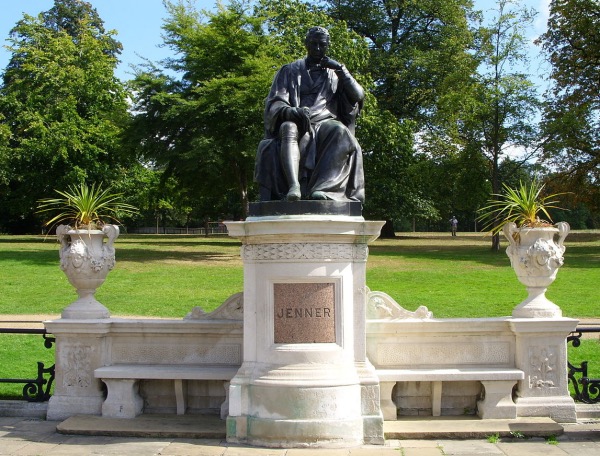
Located in the Italian Garden in Kensington Gardens, this statue commemorates Edward Jenner, the Gloucestershire-born doctor credited with the development of the modern vaccine for smallpox.
Smallpox is estimated to have killed some 400,000 people each year in the 18th century. Jenner, who trained in London in the early 1770s, had heard that having cowpox protected milkmaids from getting smallpox inoculated a healthy child, eight-year-old James Phipps (the son of his gardener), with cowpox and, injecting him with smallpox two months later, was able to show the boy was immune to smallpox (although the ethics of Jenner’s experiment still remain a matter of considerable debate).
The bronze statue, which depicts Jenner seated, was the work of Royal Academician William Calder Marshall. Funded through international subscription, it was originally was unveiled by Prince Albert in 1858 in Trafalgar Square. It was moved to the Italian Garden in 1862, apparently after pressure from anti-vaxxers.
A bronze plaque laid in the ground in front of the statue describes Jenner, who is sometimes hailed as the “Father of Immunology”, as a “country doctor who benefited mankind”.
Smallpox, which is believed to have killed some 300 million people in the 20th century alone, was declared to have been eradicated worldwide by the 33rd World Health Assembly in May, 1980, with the last reported case in Somalia in 1977.
Recent years have seen a push to have the statue returned to Trafalgar Square.
PICTURE: Iridescenti (licensed under CC BY-SA 3.0)
The next two entries in our countdown…
70. 10 of the most memorable (and historic) views of London – 8. View from Point Hill, Greenwich…
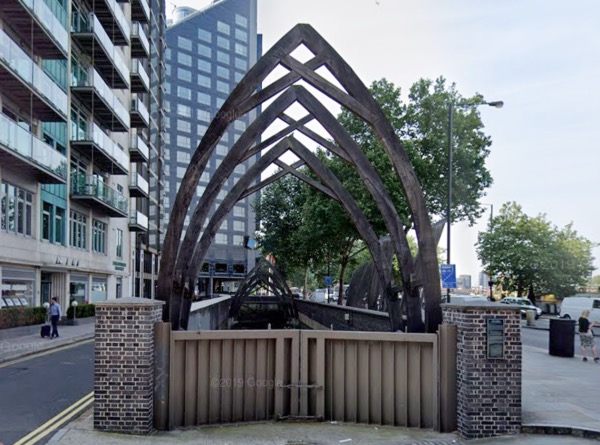
Located at White Hart Dock on Albert Embankment in Lambeth is a plaque with a rather lengthy inscription commemorating residents who died in the cholera epidemic of 1848-49.
More than 1,500 inhabitants of this waterfront district died in the outbreak first reported in September, 1848. The River Thames was believed the cause – with people drinking the river water due to lack of alternatives – and the absence of sanitation in the area and close living conditions were seen as exacerbating factors.
The plaque records that the first victim was recorded as John Murphy, a 22-year-old unemployed labourer who lived at of 26 Lower Fore Street. He fell ill on 30 September, 1848, and died the following morning.
The inscription also states that at least 1,618 Lambeth waterfront residents perished in the outbreak and and were buried in unmarked graves in the burial ground in Lambeth High Street, now the Lambeth Recreation Ground. However, the plaque adds that “it is likely many victims were unrecorded and the death toll was much higher.”
The plaque also features the text of a letter to the editor written concerning the cholera outbreak which had waned by autumn 1849.
The plaque, the text of which was written by Amanda J Thomas – author of two books on the subject of cholera in the Victorian era, was erected on a public artwork commemorating the former White Hart Dock in 2010.
PICTURE: White Hart Dock with the plaque on the right-hand side (via Google Maps).

While there are plague columns and crosses commemorating those who died in plagues during the Middle Ages in other parts of the UK and Europe, London oddly doesn’t have a grand monument. But there are some smaller monuments to be found for those who really look.
A poignant one to just a few of the thousands who died in London of the “Black Death” (a particularly severe form of bubonic plague) between 1348 and early 1350s can be found in Westminster Abbey’s cloisters.
A large black marble stone set in the floor, it is inscribed with a statement recording that, according to the Victorian-era Dean, Arthur Penrhyn Stanley, the remains of 26 monks of Westminster who died in the Black Death of 1348 lie beneath it.
But the story isn’t so simple. The original stone – which had indeed been put in place by Dean Stanley with the inscription “Beneath this stone are supposed to be interred twenty six monks of Westminster who died of the Black Death in 1348” – was lifted to be recut in 1972 and it was found that there were, in fact, no bones beneath it – just one coffin which belonged to a Henrietta Pulteney who died in 1808.
It has been suggested that the bones may have been moved when new pipework was laid in the cloister in the 1750s and that the bones may have been reburied in the cloister garth (the grassed area at the centre of the cloister ‘courtyard’) due to the fact that a number of skeletons had been found here in the 19th century.
The current inscription – “Dean Stanley records that beneath this stone are interred twenty-six monks of Westminster who died in the Black Death in 1348” – was added in the 1970s.
Interestingly, there is another plague victim buried nearby – Abbot Simon de Bircheston, who only held the post for five years before he died during the Black Death in 1349, was buried in the east cloister. His name and dates were cut on a white stone in 1922 but the original epitaph was apparently more elaborate, reading: “Simon de Bircheston, venerable abbot, deservedly stands pre-eminent, with an everlasting name. Now, fortified by the prayers of the brethren, may he, with the kindly fathers, flourish in felicity before God”.
PICTURE: Kevan (licensed under CC BY 2.0)
The next two entries in our countdown…
72. 10 sites of significance in Jane Austen’s London – Redux…

With 2020 to be sadly remembered as the year of COVID-19 (and St Paul’s plans to commemorate those who have died in a permanent memorial in the cathedral), we thought we’d take a look memorials and monuments related to disease outbreaks of the past.
First up is a pump in Soho, a replica of the original Broad Street hand pump which lay at the centre of a cholera outbreak in 1854. Its commemorates the efforts of Dr John Snow, whose work in mapping the course of the outbreak lead to him identifying the pump as the source of the outbreak with the well beneath contaminated by human waste from an old cesspit.
The Yorkshire-born doctor’s work, which subsequently led him to have the pump handle removed and thus prevent further spread of the disease, was a breakthrough in preventing the spread of cholera by showing the source was contaminated water (many people had previously thought was spread through the air, the so-called “miasma theory”).
The replica pump was installed in what is now Broadwick Street, just outside The John Snow pub, in 1992 at the behest of the John Snow Society and Westminster Council. It was removed in 2015 as the area was redeveloped and was then re-installed – along with an explanatory plaque – in 2018.
It stands alongside a red granite block in the pavement which is said to mark the exact spot where the original pump was located (there’s another plaque mentioning that on the pub).
There’s also a blue plaque on the pub commemorating Snow’s work to determine cholera was a water-born disease which was erected by the Royal Society of Chemistry in 2008.
PICTURE: The memorial pump with the John Snow pub behind and the Royal Society of Chemistry blue plaque (Matt Brown/licensed under CC BY 2.0)
The next two in our countdown of Exploring London’s 100 most popular posts…
The next two entries in our countdown are:
76. Where’s London’s oldest…public clock (with a minute hand)?

