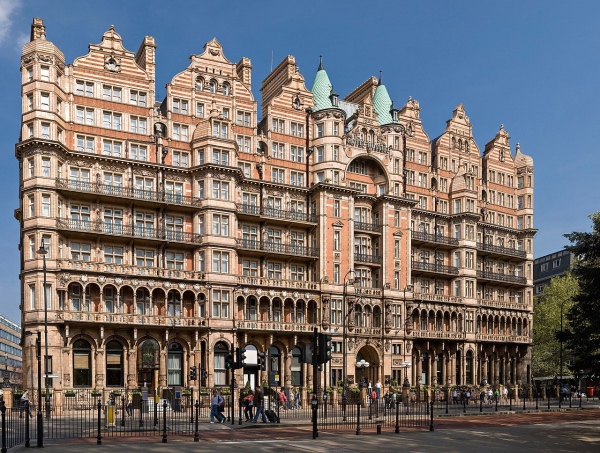
10 historic London hotels…8. The Dorchester…

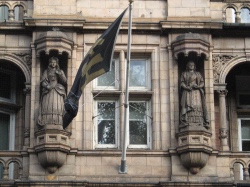
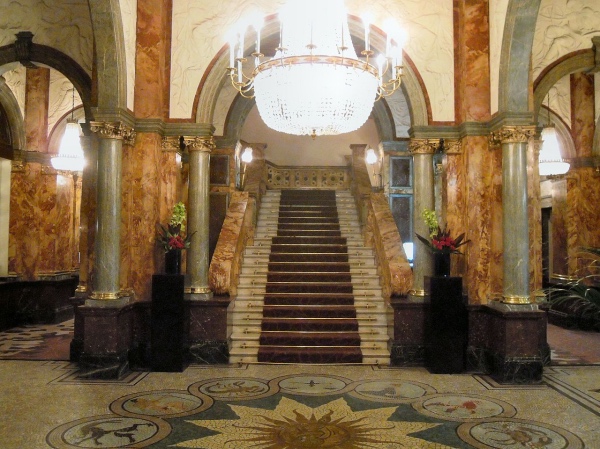
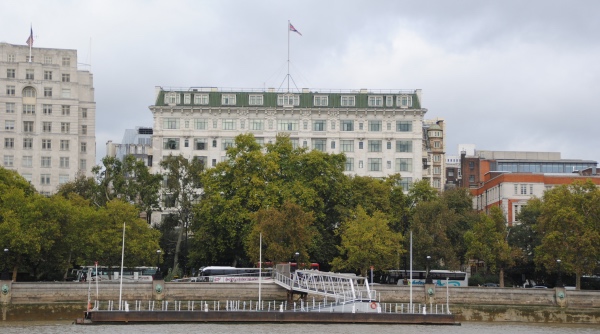
This five star luxury Mayfair hotel opened in 1931 and quickly established a reputation for luxuriousness.

Located at 35 Park Lane on the site of what was formerly the London residence of the Earl of Dorchester (and later a mansion built for millionaire RS Holford), the hotel was the dream of Sir Robert McAlpine who bought the site in partnership with Gordon Hotels in 1929 for £500,000 and vowed to create a luxury hotel that would “rank as the finest in Europe”.

Engineer Sir Owen Williams initially oversaw the building’s design but a falling out saw architect William Curtis Green take over the project (meaning while the structural frame was Sir Owen’s work, the elevations are largely the work of Green). A quarter of the building was constructed underground.

When the 10 storey modernistic building was opened on 18th April, 1931, by Lady Violet Astor, it featured luxurious rooms and suites (with, apparently, the deepest baths of any hotel in London), a ballroom built to accommodate 1,000, an Oriental Restaurant and, of course, the Dorchester Bar (it was here the ‘Dorchester of London’ cocktail was invented).

The Dorchester survived World War II with only minor damage (its basement served as an air-raid shelter). In fact, during World War II, such was the reputation of its reinforced concrete structure, that UK Cabinet members including Lord Halifax stayed here while US General Dwight D Eisenhower planned the D-Day invasion from his suite – now the Eisenhower Suite – during World War II.

In the 1950s, stage set designer Oliver Messel revamped various aspects of the hotel including designing some suites in an extension in Deanery Street (the Oliver Messel Suite is named for him).

The hotel has hosted its share of the rich and famous – Prince Philip hosted his bachelor party in the hotel’s Park Suite on the eve of his wedding to Queen Elizabeth II in 1947 (the Queen, meanwhile, had dined there the day before the engagement was announced), and actors Richard Burton and Elizabeth Taylor used the hotel as something of a “second home”.

Other notable figures who have stayed at the hotel include writers Cecil Day-Lewis and Somerset Maugham, painter Sir Alfred Munnings, director Alfred Hitchcock and film stars Gloria Swanson, Marlene Dietrich, Danny Kaye and James Mason as well as Tom Cruise, Meg Ryan and Nicole Kidman.

The Dorchester was listed as a Grade II building in 1981 and, having been sold by the McAlpine family to a consortium headed by the Sultan of Brunei in the mid-1970s, it was purchased outright by the Sultan of Brunei in the Eighties (and later transferred ownership to the Brunei Investment Agency).

The hotel was completely renovated between 1988 and 1990 and was again refurbished in 2002.

Facilities today at the hotel – alongside the 250 rooms and suites – include numerous restaurants and bars such as the three Michelin star Alain Ducasse at The Dorchester, China Tang, The Spatisserie and The Grill at the Dorchester, as well as The Bar at the Dorchester and The Promenade where afternoon tea is served. There’s also a spa.

Today The Dorchester is the flagship of the Dorchester Collection of hotels which also includes 45 Park Lane, Cowarth Park in Ascot, The Beverly Hills Hotel and The Hotel Bel-Air in LA, the Hotel Eden in Rome, Le Meurice and Hotel Plaza Athenee in Paris and the Hotel Principe di Savoia in Milan.

Out the front of the hotel is a London Plane tree which was named one of the “great trees of London” in 1997.

For more, see https://www.dorchestercollection.com/en/london/the-dorchester/.

PICTURE: || UggBoy♥UggGirl || PHOTO || WORLD || TRAVEL || (licensed under CC BY 2.0/image cropped)

10 historic London hotels…7. The Grosvenor House Hotel (JW Marriott Grosvenor House London)…


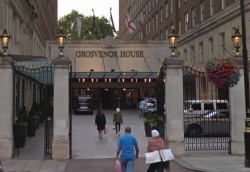
Built on the site of what was Grosvenor House in Park Lane – London residence of the Dukes of Westminster, the Grosvenor House Hotel opened in 1929 but wasn’t completed until the 1950s.

The Mayfair hotel was conceived and constructed on the orders of commercial speculator Albert Octavius Edwards and was designed by Wimperis, Simpson and Guthrie with luxury in mind (Sir Edwin Lutyens was responsible for the external elevations).

Originally designed as two apartment blocks, it was apparently only when the first block was completed that it was decided the second north block would be a hotel. It opened on 14th May, 1929, with an event described as “outstanding”.

Along with some 472 rooms – it was the first hotel in London to feature en suite bathrooms which came with running ice-cold water in each, its facilities included The Great Room, originally an ice-skating rink where then Princess Elizabeth (later Queen Elizabeth II) learned to ice skate which Edwards decided in the 1930s to convert into one of the largest banqueting spaces in Europe.

It was subsequently the scene of many awards evening and charity events including Queen Charlotte’s Ball as well as BBC broadcasts (the Beatles are among those who have performed there). The hotel was also the first in London to have a swimming pool.

The hotel, which only suffered minor damager during the Blitz, saw service during World War II. The Great Room was initially home to the Officers’ Sunday Club and later as one of the largest US officers’ mess. During the war, the premises hosted everyone from Charles de Gaulle and King Haakon of Norway as well as US generals Dwight D Eisenhower and George S Paton.

The hotel actually has strong American connections from the get go – American methods were used during construction to speed things along – and its restaurant was noted for swerving American-style food. Among other Americans who have stayed there include Douglas Fairbanks, Jr, Orson Welles, Jackie Onassis, Henry Kissinger, Sammy Davis, Jr, and Madeline Albright.

The actual construction of the hotel continued into the 1950s when permission was given to demolish a house at 35 Park Street (located next door to the hotel) following the death of its owner – Bruno, Baron Schroder, and a 92 bedroom extension to the hotel was built. It was officially opened by Peter Thorneycroft, Chancellor of the Exchequer, in 1957.

The hotel, which was acquired by Trust Houses in 1963, underwent several changes of ownership in more recent years and following an extensive renovation in the Noughties, it reopened in September, 2008 as a JW Marriott hotel.

It was reportedly announced late last year that Qatari-owned Katara Hospitality was buying the hotel from Indian conglomerate Sahara India Pariwar, which has owned the hotel since 2010, for an undisclosed sum.

For more, see www.LondonGrosvenorHouse.co.uk.

PICTURES: Park Lane facades and entrance in Park Street. Courtesy of Google Maps.

10 historic London hotels…6. The Midland Grand Hotel (The St Pancras Renaissance London)

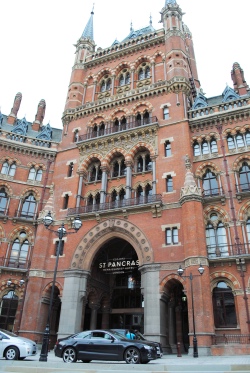
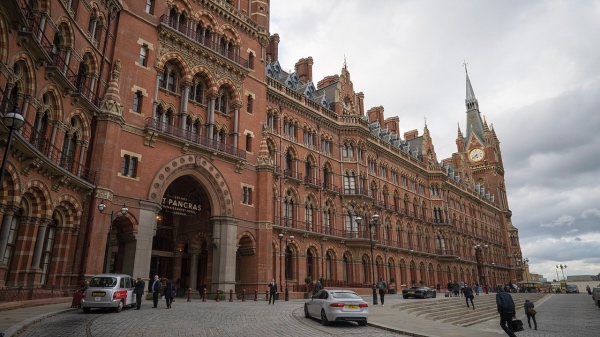
Another of the opulent Victorian hotels built at London’s railway termini, the Midland Grand Hotel was designed by Sir George Gilbert Scott in an ornate High Gothic style.

Scott’s design for the new hotel – which was to be built adjoining the railway station and would form its southern facade on Euston Road – was selected over 10 other submissions to win an 1865 competition run by the Midland Railway Company.

Scott was apparently reluctantly involved – he only entered the competition after pressure from one of the company’s directors despite apparently previously refusing to get involved with the project prior to that.

His expensive – and expansive – design (apparently resembling his rejected plans for government offices in Whitehall) included an 82 metre high clock tower at the east end of the more than 170 metre long facade and a 76 metre high tower at the west end (it also originally had an extra floor that wasn’t included in the final building).

The luxurious property – considered from the outset one of London’s best hotels, it cost whopping £438,000 – featured some 300 bedrooms, a grand double staircase, curved dining room and mod-cons like water-driven lifts (it was the first private building to boost these and one remained in place until 1958), an electric bell calling system and flushing toilets.

Staff communicated via a system of speaking tubes and wary of fires after the Palace of Westminster burned down, a “fireproof floor”. The property also boasted the first ladies’ smoking room in London in 1873 and, in 1899, the first revolving door in Britain was installed at the entrance.

Decorative details in the best guest rooms, meanwhile, included Axminster carpets, carved marble fireplaces, 18 foot high ceilings, and vast windows. En suite bathrooms, however, were not included.

The hotel’s east wing opened on 5th May, 1873, but it wasn’t completed until spring of 1876. One Herr Etzesberger, formerly of the Victorian Hotel in Venice, was apparently appointed general manager.

Guests included music hall singer and comedian Marie Lloyd, Jesse Boot (of Boots chemists fame), railroad and shipping entrepreneur Cornelius Vanderbilt and George Pullman (of the Pullman sleeping car fame).

The hotel was taken over by the London, Midland and Scottish Railway in 1922. It closed in 1935 thanks to its now outdated and expensive-to-maintain facilities and, despite innovations like a Moroccan coffee house and in-house orchestra.

Renamed St Pancras Chambers, the building was subsequently used as railway company offices. It survived the Blitz and attempts to have it demolished thanks to a high profile campaign led by poet Sir John Betjeman, architectural historian Nikolaus Pevsner and the Victorian Society and in 1967 the hotel and St Pancras station were given Grade I-listed status.

British Rail continued using it as offices but in the 1980s the building was deemed unsafe and closed. It was restored in the 1990s and in 2004, permission was given for it to be redeveloped into a new hotel – the same period during which the station was being redeveloped into one of the largest rail termini in Europe in order to accommodate cross-channel trains.

This project saw the main public rooms of the old Midland Grand Hotel kept and restored as well as some bedrooms while the former driveway for taxes was converted into the new lobby and a new bedroom wing constructed. The upper floors of the original building, meanwhile, were converted into 68 apartments.

The five star, 245 room St Pancras Renaissance Hotel opened on 14th March, 2011, to guests but the formal opening took place on 5th May that year – exactly 138 days after it first opened its doors.

Facilities at the property today, part of the Marriott group, include The Chambers Club, The Booking Office Bar & Restaurant, MI + ME, The Marcus Wareing-designed Gilbert Scott Restaurant, the Hansom Lounge – where afternoon tea is served, and George’s Bar. There’s also a spa and leisure club and pool and meeting facilities.

The premises has appeared in films including the The Secret GardenRichard III, Batman Begins, Bridget Jones’ Diary and Harry Potter and the Chamber of Secrets. It also served as the backdrop for the Spice Girls video clip, Wannabee.

For more, see www.stpancraslondon.com.

PICTURE: Top – LepoRello (licenced under CC BY-SA 3.0);  Right – David Adams; Below – Jwslubbock (licenced under CC BY-SA 3.0).

10 historic London hotels…5. The Great Western Hotel (Hilton London Paddington)…


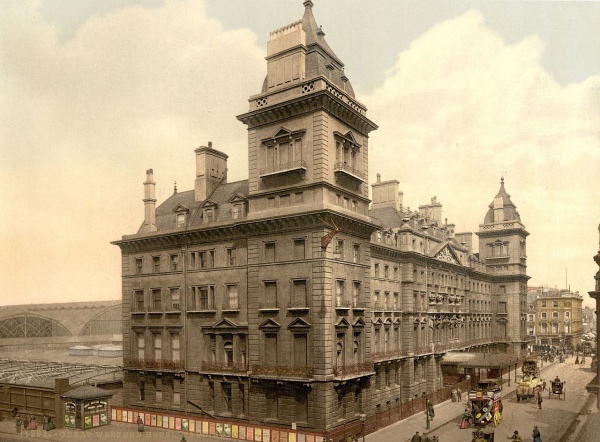
This grand Victorian hotel – originally known as the Great Western Royal Hotel – was among the first large hotels constructed in London in proximity to railway termini – in this case Paddington Station.

Located 146 Praed Street, it was constructed in the 1850s to the designs of Philip Charles Hardwick and apparently cost some £60,000. The interior was designed in the Louis XIV style and the building as a whole was built with the intention of rivalling the great hotels of Europe.

Isambard Kingdom Brunel, who conceived the project to provide accommodation for people travelling on the Great Western Railway to Bristol and the West Country (and so managed to convince the directors of the GWR to invest), was the hotel’s first managing director.

The now Grade II-listed hotel was officially opened on 9th June, 1854, by Prince Albert and, apparently, the King of Portugal.

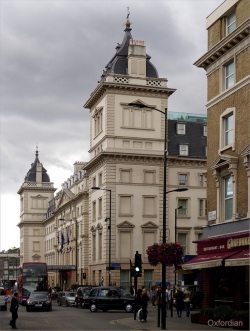
The main block, which effectively forms the facade of the railway station behind it, is book-ended by two towers which are said to house two storey bedrooms.

It boasts a sculpted pediment above the main entrance which was designed by John Thomas and features allegorical figures representing peace, plenty, industry and science.

The railway company took over the hotel late in the 19th century and in 1907 it was apparently updated with electric lighting, telephones and a pneumatic messaging service.

Much of the original ornamentation was lost when it was extensively modernised and extended in the 1930s in the art deco style under the eye of architect Percy Emerson Culverhouse.

The hotel was sold off as part of the privatisation of the railways in 1983 and reopened as part of the Hilton hotel chain in 2001. It remains part of that chain today.

For more, see www.hilton.co.uk/paddington.

PICTURES: The Great Western old and new – Top – via Wikipedia; Right -Oxfordian (licensed under CC BY-ND 2.0); 


10 historic London hotels…4. The Langham Hotel…

This sprawling London hotel in Portland Place – just past the top end of Regent Street – has spent much of its life as a hotel but was also once part of the BBC.

Built in 1863-65 to the plans of John Giles and James Murray, the £300,000 Langham Hotel – claimed as Europe’s first “grand hotel” – was deliberately designed to be on a scale and with a level of magnificence the city had not yet seen.

Spread over 10 floors – including those below ground – and designed in the style of an Italian palace, it boasted 600 rooms including numerous suites and featured mod-cons including the city’s first hydraulic lifts (electric lighting and air-conditioning would follow).

Features included its celebrated Palm Court, said to be the birthplace of the traditional afternoon tea.

It opened in a rather spectacular celebration on 10th June, 1865, with more than 2,000 guests including the Prince of Wales (later King Edward VII).

It soon gained a reputation among the rich and influential. Along with exiled members of European royal families including the Emperor Napoleon III of France and exiled Ethiopian Emperor Haile Selassie, those who stayed here included the likes of American writer Mark Twain, Italian conductor Arturo Toscanini, Czech composer Antonin Dvorak, explorer Henry Morton Stanley and romantic novelist Ouida.

Charles Dickens believed there was no better place for dinner parties and Sir Arthur Conan Doyle, another guest, used it as a setting in his Sherlock Holmes novels.

Its proximity to All Soul’s in Langham Place – the scene of many a fashionable wedding – saw it host many wedding receptions and the servants at Langham were led in prayers each morning by a clergyman from the church.

It was also popular with international musicians and artists thanks to the location of Queen’s Hall nearby.

The Langham declined in popularity during the two World Wars as the social centre of London moved west. Having served as a first aid and military post during World War II, it was badly damaged during the Blitz with much destruction caused when its massive water tank ruptured.

After the war, the BBC bought the hotel and used it for offices, studios and the BBC Club.

The BBC sold the building in the mid-Eighties and in 1991 after a £100 million renovation, it reopened as the Langham Hilton Hotel with Diana, Princess of Wales, a regular visitor.

It was sold again in 1995 and extended and refurbished. It again underwent a five year, £80 million, refurbishment in the mid 2000s, reopening in 2009.

The five star Langham – now the flagship of a group of hotels, celebrated its 150th anniversary in 2015 with the opening of the Regent Wing as well as The Sterling Suite, a luxurious six bedroom suite, and a new Langham Club Lounge.

Now a Grade II-listed building, it contains some 380 suites and rooms as well as The Grand Ballroom, the aforementioned Palm Court, restaurants including Roux at The Landau and Artesian, a British tavern, The Wigmore, and a spa.

It has appeared in numerous films, including the 1995 James Bond film, GoldenEye, in which it doubled for a hotel in St Petersburg. It also features a City of Westminster Green Plaque commemorating a meeting there between Oscar Wilde, Conan Doyle and Joseph Marshall Stoddart who commissioned the two writers to write stories for his magazine.

For more, see www.langhamhotels.com/en/the-langham/london.

PICTURE: Top – Sheep”R”Us (licensed under CC BY-NC-ND 2.0); Right – David Adams

Correction – this is actually number four in our special series, not three!

10 historic London hotels…3. Claridge’s…

This five star Mayfair establishment owes its origins and name to William Claridge, possibly a former butler, and his wife Marianne, who took over management of a small hotel at 51 Brook Street in 1853.

In 1854, they purchased the adjoining Mivart’s Hotel, first established in 1812, and substantially expanded the premises. It apparently combined the two names – Mivart’s and Claridge’s – for a short time before the reference to Mivart’s was dropped.

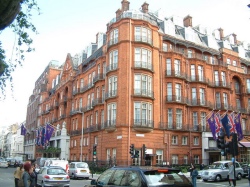
The hotel, which stands on the corner with Davies Street, was bought by Richard D’Oyly Carte (owner of The Savoy) in 1893 and subsequently rebuilt in red brick to the designs of CW Stephens (of Harrods fame) with interiors by Sir Ernest George and the inclusion of modern amenities including en suite bathrooms and lifts. The hotel, which is now Grade II-listed, reopened in 1898, with some 203 rooms and suites.

It was extended in the late 1920s with the addition of 80 new rooms and a ballroom while the lobby was redesigned by art deco pioneer Oswald Milne (much of that decoration, including work by Basil Ionides, remains).

The hotel’s reputation as a place to stay among the well-to-do was given a significant boost when Empress Eugenie, wife of French Emperor Napoleon III stayed in 1860 and entertained Queen Victoria and Prince Albert.

It was also favoured by exiled royals during World War II including King Peter II and Queen Alexandria of Yugoslavia all staying here. In fact, their son, Crown Prince Alexander II, was born in suite 212 in 1945 (now named the Prince Alexander Suite).

The story goes that Prime Minister Winston Churchill declared the suite Yugoslav territory for a day (although evidence supporting the story about Churchill’s involvement is apparently scarce). It’s also said that a spadeful of dirt from Yugoslavia was placed under the bed so the Crown Prince could literally be born on Yugoslav soil (but there’s no mention of this aspect of the story on Crown Prince Alexander II’s official website).

Churchill and Clementine stayed in a suite here on the sixth floor after the wartime PM’s unexpected defeat in the general election of 1945.

Other luminaries to have stayed here include American actors Cary Grant, Katharine (and Audrey) Hepburn, Yul Brynner and Bing Crosby (Spencer Tracey famously said he didn’t want to go to heaven when he died but to Claridge’s) as well as director Alfred Hitchcock, Aristotle and Jackie Onassis, and, more recently, everyone from Mick Jagger and Madonna to Brad Pitt and Tom Cruise. Kate Moss celebrated her 30th birthday here.

And, of course, royals including the late Queen Mother, Queen Elizabeth II and Prince Phillip have all been regular diners.

The hotel, which underwent a major restoration from 1996 and saw 25 new suites designed by David Linley opened in 2012, is now part of the Maybourne Hotel Group, having parted ways with the Savoy Hotel in the mid-noughties.

Current facilities include the restaurant Fera at Claridge’s (this opened in 2014 after the closure of Gordon Ramsay at Claridge’s in 2013) as well as The Foyer & Reading Room (where afternoon tea is served), The Fumoir cocktail bar, Claridge’s Bar and a health club and spa.

The Claridge’s Christmas Tree is a much anticipated part of London’s festive season, with recent years seeing a different world-renowned designer taking on the task of decorating it, including the likes of John Galliano, Domenico Dolce and Stefano Gabbana, and Christopher Bailey of Burberry.

The hotel was the subject of a three part documentary, Inside Claridges, in December, 2012.

For more, see www.claridges.co.uk.

PICTURE: Tim Westcott (licensed under CC BY-SA 2.0)


10 historic London hotels…2. The Savoy…


The first purpose-built luxury hotel built in Britain (and often referred to as London’s “most famous” hotel), The Savoy opened its doors on 6th August, 1889.

Located on the river side of the Strand on the site of what had been the medieval Savoy Palace (its most famous resident was John of Gaunt), the hotel was built by theatre impresario Richard D’Oyly Carte using profits made from his staging of Gilbert and Sullivan operas, some of which were performed in the neighbouring Savoy Theatre.
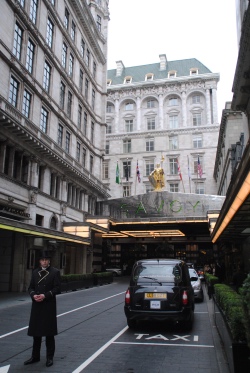
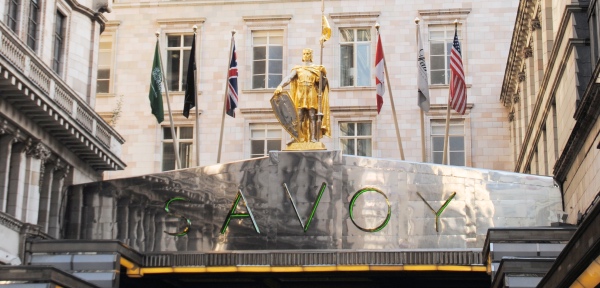
The now Grade II-listed building, which apparently had no overall architect in its initial design process, exuded opulence and its interiors included the latest in modern amenities such as electric lighting and lifts, en suite bathrooms in most of the guest rooms and constant cold and hot running water.

César Ritz, who would later rise to fame as the owner of The Ritz Hotel in Paris and then London (see our recent post), was hired as the manager and Auguste Escoffier as the chef. Together they oversaw the introduction of a new, unprecedented level of hotel service which would set the standard for future enterprises. This included keeping a comprehensive index of guest’s tastes and preferences and saw Escoffier revolutionise the restaurant industry in the country with the creation of various “stations” in the kitchen (his pots and pans are apparently still at the hotel).

The hotel was expanded in 1903-04 under the eye of architect Thomas Edward Collcutt (the designer of Wigmore Hall) with new east and west wings and the main entrance was moved from the river side of the building to Savoy Court running off The Strand. The Front Hall is a survivor of this period while the Lancaster Ballroom dates from 1910.

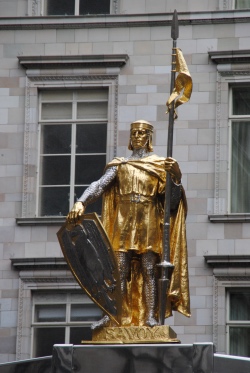
The hotel underwent further remodelling in the 1920s – it was during this period that the famous stainless steel sign over the Savoy Court entrance, designed by art deco architect Howard Robertson (later Sir Howard), was created (Savoy Court incidentally is the only street in the UK where traffic must keep to the right – more on that another time). The sign is topped with a gilt statue of Peter of Savoy, the uncle to King Henry III’s wife, Eleanor of Provence (pictured below). It was Peter who first built the Savoy Palace on the land where the hotel now stands. The sign, meanwhile, was created for the 1904 extension but placed here during the 1920s works.

Further modifications – including the introduction of air conditioning – followed in later decades. The hotel now boasts some 267 rooms and suites (the latter include the Royal Suite which spans the entire riverside of the fifth floor), many of which feature panoramic views of the River Thames.

Famous guests over the years have included royalty such as King Edward VII (when Prince of Wales) as well as more recent royals, French actress Sarah Bernhardt, Oscar Wilde, Charlie Chaplin, Sir Henry Irving and Sir Laurence Olivier. It’s also hosted a who’s who of Hollywood – everyone from Marilyn Monroe and Judy Garland to Frank Sinatra, Humphrey Bogart and John Wayne – and US President Harry S Truman.

Others associated with the hotel include opera singer Dame Nellie Melba – the dessert known as a Peach Melba was created here in her honour, and artist Claude Monet, who painted Waterloo Bridge from a position on one of the balconies.
Among other significant events to take place within its walls was a 1905 “Gondola Party” hosted by American millionaire George A Kessler which saw the central courtyard flooded as part of a recreation of Venice with guests dining on an enormous gondola and entertainment featuring singer Enrico Caruso.

In 1953, to mark the coronation of Queen Elizabeth II, the hotel hosted a ball attended by 1,400 of the rich and famous with special touches including 16 Yeoman Warders from the Tower of London who lined the entrance staircase.

Films shot here include Kipps (1921), based on a HG Wells novel (Wells was in attendance during the filming), The French Lieutenant’s Woman (1981) and Notting Hill (1999).

The Savoy remained in the Carte family until it was bought by an American private equity house in 1998 and eventually sold, in the mid-2000s, to become part of Fairmont Hotels and Resorts of Canada.

Closed in late 2007 for a complete renovation (the cost of which has been put at £220 million), it reopened in October, 2010. Among restaurants and bars now in the premises are the Thames Foyer restaurant – hosted in a glass atrium, it’s where afternoon tea is taken, the American Bar – described as the oldest cocktail bar in Britain, the Beaufort Bar, and the restaurant Kaspar’s.

The latter is named after the hotel’s oldest “employee” – Kaspar the Cat. Carved in 1927 by Basil Ionides, the cat was created to act as a 14th guest in the private dining rooms when 13 guests were present, a figure which was considered unlucky and which, tradition held, meant the first person to leave the table would one the first to die.

Its origins go back to 1898 when a wealthy South African by the name of Woolf Joel apparently scoffed at the idea of 13 being an unlucky number at the table and volunteered to leave it first. He was shot dead back in South Africa just a few week’s later. In the wake of his death, management at the hotel decreed that any table of 13 would be joined by a staff member.

But this was only a short-term solution – not only there was there the privacy of diners to consider, the fact staff would be a person down when this was required was a problem. So when Ionides redecorated the private dining room ‘Pinafore’ in the 1920s, he created the cat, complete with napkin, to fulfil the role of the 14th diner. And so he has ever since. Kaspar, the subject of a children’s book written by Michael Morpugo in 2008, can these days be found in Kaspar’s or, when not working, in the Front Hall.

For more, see www.thesavoylondon.com
Happy New Year! (and the conclusion to our most popular (new) posts countdown for 2018)…

2019 is upon us so we at Exploring London would like to take the opportunity to wish all our readers a very Happy New Year! We look forward to bringing you fascinating new stories about London’s history and culture in the year to come.

Meanwhile, here are the two most popular (new) posts of 2018…

2. Treasures of London – The Great Hall at Eltham Palace…

1. A Moment in London’s History – The execution of the George, Duke of Clarence…

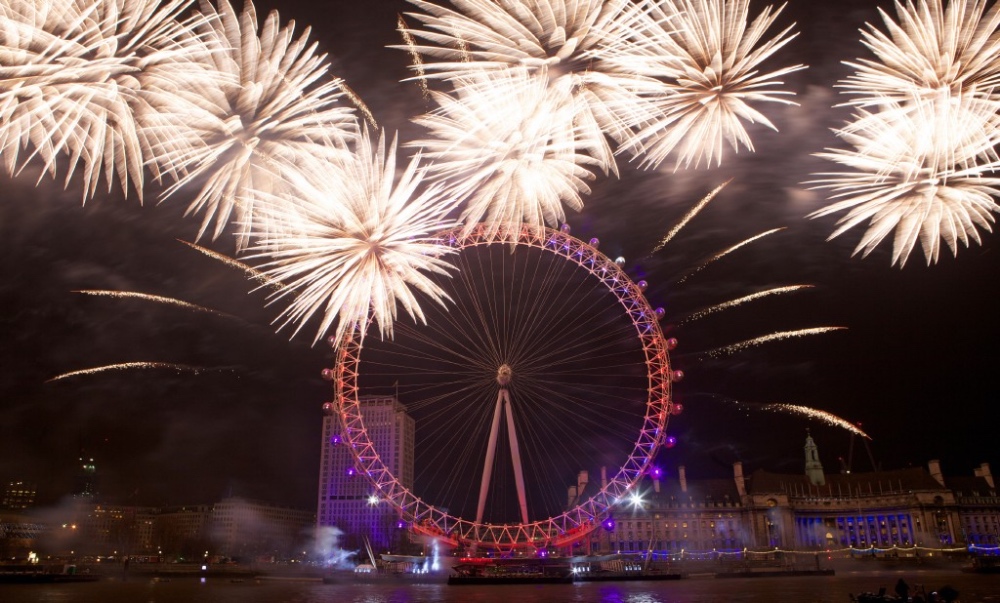
PICTURE: © ENGLAND’S HISTORIC CITIES (New Year’s Eve fireworks from 2014).

10 most popular (new) posts of 2018…Numbers 4 and 3…

The next two posts on our annual countdown…

4. LondonLife – Still waters at Hampstead Heath…

3. Lost London – Jacob’s Island…


10 most popular (new) posts of 2018…Numbers 6 and 5…

The next two on our countdown of most popular (new) posts for 2018…

6. 10 islands in the Thames – 3. Brentford Ait…

5. LondonLife – Victorian London in photographs…

10 most popular (new) posts of 2018…Numbers 8 and 7…

The next two on our countdown of most popular (new) posts for 2018…

8. 10 islands in the Thames – 1. Chiswick Eyot…

7. Where’s London’s oldest…umbrella shop?

10 most popular (new) posts of 2018…Numbers 10 and 9…

And so we’ve reached the end of another year on Exploring London. As always, we counting down our 10 most popular new posts for the year, starting with numbers nine and 10 (and they both come from the same special Wednesday series on Thames islands)…

9. 10 islands in the Thames – 10. Garrick’s Ait…

10. 10 islands in the Thames – 6. Glover’s Island…


10 historic London hotels…1. The Ritz Hotel…

This Piccadilly institution was constructed from 1904 to 1906 and takes its name from Swiss hotelier César Ritz.

It was constructed on the site of a former coaching inn for the Blackpool Building and Vendor Company – it was the first steel-framed building in London – and designed by Mewés and Davis, the architects of the Paris Ritz. And even though Ritz himself was apparently actually retired at the time, it was built according to his specifications.

The exterior facade features Norwegian granite and Portland stone and boasts an arcade on Piccadilly which deliberately evokes the Rue de Rivoli in Paris. The interior, the work of Waring and Gillow, is designed in the style of Louis XVI and was designed to be opulent with all rooms featuring a working fireplace.

Public spaces include the Palm Court – famous for its traditional afternoon teas –  and a Michelin-starred restaurant with floor to ceiling windows overlooking Green Park. Other features include the Rivoli Bar, designed in 2001 by Tessa Kennedy to resemble the bar in the Orient Express, and the basement Ritz Club, a private casino.

The now Grade II*-listed hotel was officially opened by Ritz himself on 24th May, 1906, and was soon adopted by the rich and famous – the patronage of the Prince of Wales (future King Edward VIII) after the death of King Edward VII was one key reason for its success.

Actor Charlie Chaplin, who apparently had to have 40 police hold back the crowd to enter the hotel, is also a name famously associated with it as is that of Russian prima ballerina Anna Pavlova who performed here.

The Aga Khan and Paul Getty both had suites, and playwright Noel Coward and Queen Elizabeth, The Queen Mother, regularly dined here while Tallulah Bankhead famously sipped champagne from a slipper in the bar. The Marie Antoinette Suite was also famously the location of a conference between Winston Churchill, Dwight Eisenhower and Charles de Gaulle during World War II.

The hotel also featured in 1999 film Notting Hill, starring Hugh Grant and Julia Roberts, and in the more recent TV drama Downton Abbey.

The five star hotel underwent a major 10 year refurbishment after it was acquired by the Barclay brothers in 1995. The complex these days includes the adjoining 18th century property William Kent House (designed, of course, by William Kent).

In 2001, the hotel was awarded the first Royal Warrant for Banqueting and Catering Services. Other boasts these days include being the only UK hotel to have a certified tea sommelier (among teas served is the hotel’s own Ritz Royal Blend).

For more, see www.theritzlondon.com.

Famous Londoners – Mary Shelley…

This year marks 200 years since the publication of Mary Shelley’s book, Frankenstein: or, The Modern Prometheus, so it’s timely to have a look at the life of this famous Londoner.

Shelley was born on 30th August, 1797, in Somers Town, London, to feminist philosopher Mary Wollstonecraft and political philosopher, novelist and journalist William Godwin. Her mother died soon after her birth, leaving her upbringing to Godwin (and his second wife Mary Jane Clairmont who apparently didn’t get on with Mary).

While she received little formal education, she was tutored in a range of subjects – everything from literature to art, French and Latin – by her father and visiting tutors. Godwin described her as having a great desire for knowledge.

She first met her future husband, the Romantic poet Percy Bysshe Shelley, while still a teenager. Shelley, who was estranged from his wife, had struck up a friendship with her father and was subsequently a regular visitor to their house.

Mary and Percy began secretly meeting each other at Mary Wollstonecraft’s grave in St Pancras Churchyard and then on 28th June, 1814, the couple eloped to France, taking Mary’s step-sister Claire Clairmont with them but leaving Shelley’s pregnant wife behind.

They went on to Paris and then, through war-ravaged France, to Switzerland. At Lucerne, however, a lack of money forced them to turn back and they returned to London where Mary’s father refused to have anything to do with her.

Now pregnant, Mary and Shelley moved into lodgings with Claire in Somers Town and later in Nelson Square where they were known for entertaining his friends. Shelley’s wife, meanwhile, gave birth to his son – something that must have been hard for Mary – and it is believed that he was also a lover of Mary’s step-sister Claire.

Mary gave birth to her first child, a daughter, on 22nd February, 1815, but she died just 12 days later. That same year, the death of Shelley’s grandfather brought himself considerable wealth and with their financial situation now relieved, in August, 1815, they moved to Bishopgate, in Windsor Great Park. In January, 1816, Mary gave birth to her second child, a son, William.

In May, 1816, the couple travelled with their son William and Mary’s step-sister Claire to Geneva in Switzerland where they hoped to improve Percy’s health. It was during the time they spent there that a ghost-writing contest in June, 1818, led her to write what would be the basis of the novel Frankenstein – credited with introducing genre of science fiction into English literature.

Returning to England, the Shelley’s took up residence in Bath (Clairmont was pregnant by Lord Byron and they wanted to keep this from the Godwins). Harriet Shelley, Percy’s estranged wife, drowned herself in the Thames on 9th November and it was following that, that on 30th December, Mary and Percy married at St Mildred’s Church in London with Mary’s father and step-mother as witnesses.

In March, 1817, the Shelley’s took up residence in Marlow where Mary gave birth to second daughter, Clara Everina Shelley, on 2nd September. Then in March, 1818, the family – along with Claire Clairmont and her daughter – travelled to Italy where it was hoped the warmer climate would help Shelley, who had been diagnosed with pulmonary disease.

There they lived at various addresses and were in Venice when Clara died of dysentery on 24th September, 1818. They traveled to Rome in April the following year and there, on 7th June, William died of malaria, leaving the couple devastated.

Their fourth child and only surviving child, Percy Florence Shelley, was born in Florence on 12th November. Their Italian sojourn continued for the next couple of years until, on 8th July, 1822, Percy Shelley and his friend Edward Williams were drowned in a squall in the Gulf of Spezia.

Determined to show she could write and look after her son, Mary Shelley returned to England in mid-1823 and lived in The Strand with her father and stepmother until in the summer of 1824 she moved to Kentish Town. Her novel, The Last Man, was published in 1826 followed by The Fortunes of Perkin Warbeck (1830), Lodore (1835), and Falkner (1837) as well as working on numerous other writing projects.

Shelley never remarried although she was linked to various men romantically including American actor John Howard Payne whose offer of marriage she rejected.

After her son Percy left university in 1841, he came to live with her and between 1840 and 1842 Shelley travelled to various locations in Europe with her son. Sir Timothy Shelley, Percy Bysshe Shelley’s father, died in 1844 with the result that Shelley and her son were now financially independent.

Percy married Jane Gibson St John in 1848 and Mary lived her son and daughter-in-law, splitting their times between the ancestral Shelley home – Field Place in Sussex – and Chester Square in London as well as accompanying them on their travels overseas.

Shelley suffered considerable illness in the last years of her life – including debilitating headaches and bouts of paralysis in her body – before on 1st February, 1851, she died at the age of 53 from a suspected brain tumour at the Chester Square property.

She had asked to be buried with her mother and father, but Percy and Jane instead buried her at St Peter’s Church in Bournemouth closer to their home. In order to fulfill her wishes, they had the bodies of her parents exhumed from St Pancras graveyard and reburied with her.

Despite gaining respect as a writer in her own lifetime, Shelley’s reputation in the literary arts was overshadowed by that of Percy’s after her death. But in more recent decades her overall writing career has come to be more closely examined and applauded.

If you missed it, for more on Mary Shelley’s links with London, see our special series 10 sites from Mary Shelley’s London.

PICTURE: Mary Shelley by Richard Rothwell (oil on canvas, exhibited 1840/NPG 1235). © National Portrait Gallery, London (licensed under CC BY-NC-ND 3.0)

10 sites from Mary Shelley’s London…A recap…

We’ve come to the end of our series on significant London sites related to Mary Shelley – in honour of the 200th anniversary of the publication of Frankenstein – so it’s time for a quick recap before launching our next Wednesday series…

1. Somers Town…

2. St Pancras Old Churchyard…

3. Marchmont Street, Somers Town…

4. Church of St Mildred, Bread Street

5. The Temple of the Muses, Finsbury Square…

6. St Giles-in-the-Fields…

7. Charles and Mary Lamb’s house…

8. Chester Square…

9. A lock of Mary Shelley’s hair…

10. Memorials to Percy Bysshe Shelley…


10 sites from Mary Shelley’s London…10. Memorials to Percy Bysshe Shelley…

And so we come to the final in our series looking at London sites which tell part of the story of Mary Shelley, writer of Frankenstein, the book which this year marks its 200th anniversary. Of course, one of the most influential figures in her life was her husband, poet Percy Bysshe Shelley, so to finish the series, we’re taking a quick look at three sites memorialising him in London…

1.  Poland Street, Soho. Shelley lived at number 15 after he was expelled from Oxford University in 1811 for publishing a pamphlet on atheism. He wasn’t here long – in August he eloped with Harriet Westbrook, then just 16, to Scotland. The building, which stands on the corner with Noel Street, features an English Heritage Blue Plaque and there’s a massive mural on its side, Ode to the West Wind, which takes its name from a poem he wrote in 1819. It was painted by Louise Vines in 1989. PICTURE: Google Maps.

2. Broadwick Street, Soho. The impressive Spirit of Soho mural on the corner with Carnaby Street was created in 1991 and restored in 2006. It features the images of numerous famous figures from the district’s history. As well as the likes of Casanova and Marx, Shelley also features – located a couple of people to the right of Casanova (here seen in red) at the base of the mural’s central panel. PICTURE: Dun.can (image cropped; licensed under CC BY 2.0)

3. Westminster Abbey. There’s no memorial to Mary Shelley in Westminster Abbey but in Poet’s Corner – located in the South Transept – you will find a small memorial to her husband. The joint memorial (which also commemorates John Keats) was designed by sculptor Frank Dobson and unveiled in 1954 by then Poet Laureate John Masefield. It simply features two plaques – one bearing the name Shelley and the other Keats with their birth and death years – linked by a “swag of flowers” attached to a lyre at the top of each plaque.

And that brings and end to our series on Mary Shelley’s London (although, of course there are still more sites associated with Shelley to explore!) . We’ll recap the series next week before launching our next Wednesday special series…

10 sites from Mary Shelley’s London…9. A lock of Mary Shelley’s hair…

One of the more curious items related to Mary Shelley in London is a lock of her hair which is in the collection of the British Library. 

The lock of hair is contained in the decorative lining of a book of letters and other material along with a lock of her husband Percy Bysshe Shelley’s hair which once belonged to Claire Clairmont, Shelley’s step-sister.

Percy’s hair was originally enclosed within a wrapper upon which Clairmont had written “The Poet Shelley’s Hair” – it is presumed to have been cut off following his death by drowning in 1822.

The rear lining of the same book contains material said to be from the ashes of Percy collected by Edward Trelawny from the beach near Viareggio where Percy was cremated.

Other Mary Shelley-related items in the British Library include a letter written by Percy to Mary (then Godwin) on 16th December, 1816, following the death of his first wife, Harriet, and a frontispeace from an 1831 edition of Frankenstein, or The Modern Prometheus.

For more on Mary Shelley and the British Library, see www.bl.uk/people/mary-shelley.

PICTURE: Public domain (via British Library).

10 sites from Mary Shelley’s London…8. Chester Square…

One of the still standing properties most associated with Mary Shelley in London (hence the English Heritage Blue Plaque), Shelley lived in this home at 24 Chester Square, on the square’s north-west side, from 1846 until her death in 1851.

Mary moved here for the last few years of her life after her son Percy (a child she had with now deceased husband Percy Bysshe Shelley) had come into a substantial inheritance following the death of his grandfather in 1844.

During this period, she spent her time between this house which had been relatively recently built by Thomas Cubitt, and the Shelley’s ancestral home at Field Place, Sussex, where her son Percy Florence and his wife Jane lived.

Shelley was 53 when she died here on 1st February, 1851, of a suspected brain tumour. She had apparently asked to be buried with her parents in the graveyard of St Pancras Old Church but instead was buried at St Peter’s Church in Bournemouth close to her son’s new home in Boscombe. Her son had her parents exhumed and buried with her there.

The Blue Plaque was installed on this property in 2003 and unveiled by her biographer Miranda Seymour.

PICTURE: Spudgun67 (licensed under CC BY-SA 4.0).


10 sites from Mary Shelley’s London…7. Charles and Mary Lamb’s house…

Renowned sibling writers Charles and Mary Lamb lived in a property at 64 Duncan Terrace in Islington from 1823-27 and, their visitors there apparently included Mary Shelley.

Shelley had returned to London in 1823 after the death of her husband Percy Bysshe Shelley who had drowned along with two other men off the coast of Italy in July the previous year.

Back in London, Shelley lived in various properties as far afield as Kentish Town – many of which are no longer extant. But one home she was known to have visited after her return (which is still standing) was that of the Lambs.

Charles, part of the literary circle which included Samuel Taylor Coleridge and William Wordsworth, described the property – Colebrook Cottage – as a “white house with six good rooms”. Now Grade II-listed, it dates from the 18th century.

The New River once ran close by  – so close, in fact, that one guest, believed to be the blind poet George Dyer, walked into the river after leaving the house and had to be rescued by Lamb. The river is now covered.

The property features an English Heritage Blue Plaque (although in this case, it’s actually brown), commemorating Lamb’s stay here.

PICTURE: Spudgun67 (licensed under CC BY 2.0).


10 sites from Mary Shelley’s London…6. St Giles-in-the-Fields…

It was in this church in St Giles High Street in the West End that another significant event took place for Mary Shelley – her son William and daughter Clara Everina were baptised here on 9th March, 1818, just a couple of months after Frankenstein was first anonymously published.

The baptism took place just before Mary and her now husband, the poet Percy Bysshe Shelley, departed once again for the continent, apparently this time with no intention of returning.

In fact, the Shelleys attended three baptisms at the church that day – along with William (nicknamed “Willmouse”) and Clara, those undergoing baptism also included Allegra (at first called Alba), the daughter of Mary’s step-sister Claire Clairmont and the poet Lord Byron.

In fact, part of the group’s reason for going to Europe, along with Percy’s debts, ill-health and fears over the custody of their children, was to take Allegra to her father, Lord Byron.

The officiating churchman was said to be one Charles McCarthy.

The current font, which dates from 1810, in the church is presumably that in which they were baptised. It was installed well after the now Grade I-listed Palladian church, which is sometimes known as the “Poet’s Church”, was consecrated in 1733 (it is the third said to have been built on the site since the start of the 12th century).

PICTURE: Prioryman (licensed under CC BY-SA 4.0)