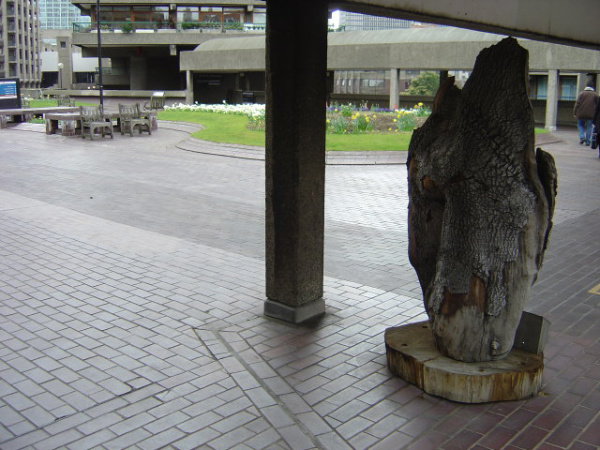
Standing on a Barbican walkway is the remnant of a tree believed to be at least 500-years-old which fell during a storm January, 1990.
The now hollowed-out stub of the beech tree (Fagus Sylvatica) had previously been located in the woodland known as Burnham Beeches, in Buckinghamshire – a woodland which was purchased by the City of London Corporation in 1880.
But what apparently sets this tree out from the others at Burnham Beeches is that it is believed famed German composer Felix Mendelssohn Bartholdy (1808-1847) used to sit under its then leafy branches while staying nearby during his several visits to England.
He is said to have done so to gain inspiration for his compositions and among the works he is said to have composed while here is some “incidental music” for A Midsummer Night’s Dream (although it has been suggested this might not actually be the exact tree under which he sat).
The tree and its plaque were installed in 1993 by the Barbican Horticultural Society and unveiled by conductor and composer Carl Davis.
There is now a replacement “Mendelssohn’s Tree” in Burnham Beeches which was planted in 2005.
WHERE: Barbican, off Aldersgate St (nearest Tube station is Barbican); WHEN: Anytime; COST: Free; WEBSITE: N/A.
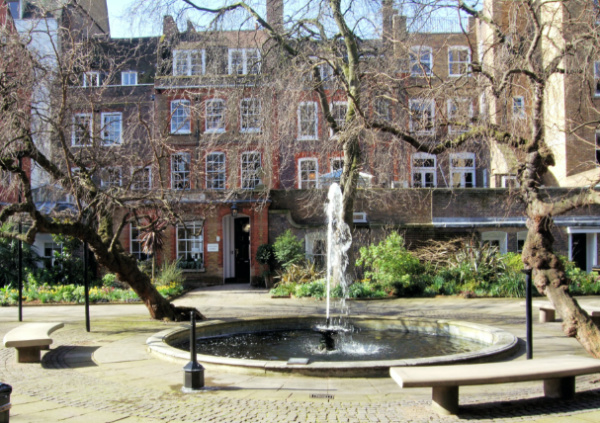
The two gnarled mulberry trees on either side of the fountain. PICTURE: Jim Linwood (licensed under CC BY 2.0)
While there’s been gardens here dating back possibly as far as the middle of the 12th century when the Templars established a preceptory here, these two trees have a more recent historic (and royal) link.
The gnarled black mulberrys (Morus nigra) in the Fountain Court were planted here on 20th June, 1887, to commemorate the Golden Jubilee of Queen Victoria.
There were actually four mulberry trees planted to mark the occasion – which was celebrated with a grand dinner in the nearby Middle Temple Hall – but these two trees are the only survivors, the other two having been removed in the 1970s.
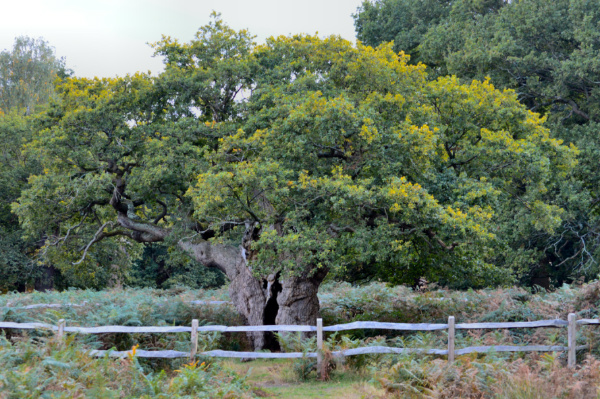
Estimated to be more than 750-years-old, the tree known as the Royal Oak is located near Pen Ponds and Richmond Gate.
This massive English oak (Quercus robur), which is hollow, doesn’t have any direct connections to royalty but it did survive the felling of trees which took place in Richmond Park and across the south-east of England so King Henry VIII’s navy could be built.
That may have been thanks to the King himself, who wisely passed a law to spare every 10th tree in the park for future seed.
While the park had been used by King Henry VIII as a hunting ground, it wasn’t until 1637 – during the reign of King Charles I – that it was first enclosed.
The tree, which is said to be one of 1,400 “veteran trees” in the park, was pollarded for several hundred years which helped create its shape – this is a method of pruning which removes the top-most branches to form a denser head (and creates wood which can be used for a variety of purposes).
Danson Mansion and the Charter Oak of Bexley. PICTURE: Brian Toward (Public Domain)
Located in Danson Park in Bexley, south-east London, this tree is another of those in London which has been awarded “Great Tree” status.
Estimated to be around 200-years-old, it was planted in what was originally the grounds of the Danson Mansion Estate.
Danson House, a Palladian villa, was built by Sir John Boyd in 1766 for his second wife Catherine Chapone and designed by Sir Robert Taylor, the architect who also designed the Bank of England.
The Charter Oak of Bexley’s name comes from the charter which changed Bexley from a Urban District Council to the Borough of Bexley. It was presented to the first municipal council by Lord Cornwallis underneath the oak in 1937.
The Charter Oak of Bexley in 2011. PICTURE: Brian Toward (Public Domain)
The oak’s significance is underlined by its presence on the Borough of Bexley’s coat-of-arms.
Visibly deteriorating, in 2017, “revolutionary geo-injector technology” was used to decompact the soil around the tree and feed its roots, successfully extending the tree’s life.
Said to be among the oldest still living trees in the City of London, the Cheapside Plane stands in what was once the churchyard of St Peter Cheap.
The church itself was destroyed in the Great Fire of London but how long this leafy tree, which stands more than 70 feet high, has occupied the site remains a matter of some conjecture.
A City of London tree trail puts the age of the tree – which stands at the corner of Wood Street and Cheapside – at 250 years (records held by the City say the tree was originally purchased for sixpence).
Over the years, this landmark tree – which has stood silent witness to everything from the 1854 cholera outbreak to the bombs of the Blitz – has garnered considerable attention appearing in various media, such as the Illustrated London News, and even, so say some, a 1797 poem by William Wordsworth (although some say the poem doesn’t refer to the tree at all).
The tree, which stands behind protective black iron railing, is the only one in the City of London listed among the “Great Trees of London” and planning laws protect it from over-development of the surrounding buildings.
Spring is upon us, so we thought it an appropriate time to consider some of London’s greatest natural assets – its trees. But, as well as being significant for their environmental impact, each of these trees (or, in some cases, the remains of them), are significant for historic reasons (we’ve previously mentioned a couple including what’s believed to be the oldest tree and the unusual – and sadly now deceased – Hardy Tree).
PICTURE: Steve Daniels (licensed under CC BY-SA 2.0)
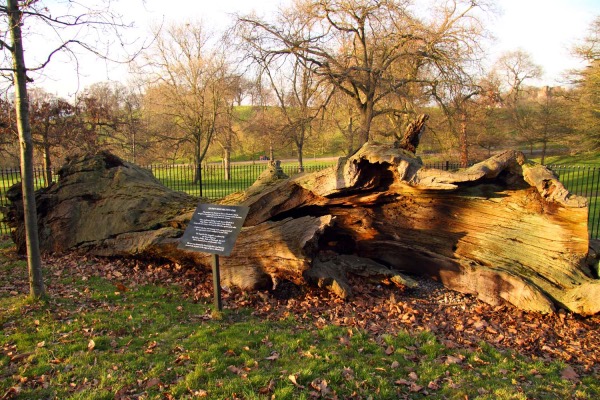
First up, it’s the tree known as Queen Elizabeth’s Oak in Greenwich. Thought to date from possibly as far back as the late 13th century, this tree survived until the 19th century before its carcass finally fell to the ground during a storm in 1991. It has lain in Greenwich Park ever since.
The tree, which is located at the end of what is now Lover’s Walk close to the Maze Hill Gate, was located in the grounds of Greenwich Palace (also known as the Palace of Placentia) and was there when King Henry VIII resided at the palace.
In fact, it’s said that he and Anne Boleyn danced around the oak while courting, and (and here’s where the name comes from) that Elizabeth, their daughter (and later Queen Elizabeth I), picnicked under its canopy (some accounts suggest she actually picnicked in the tree’s hollow – but still then upright – trunk).
Following the creation of what is now Greenwich Park, the hollow tree was apparently used as a prison for those caught illicitly on the grounds. They were secured behind a heavy wooden door fitted to the trunk (a park keeper’s lodge was built nearby in the 17th century; it was demolished in the 1850s).
The tree, one of 3,000 in the park, had died in the 19th century and was reduced to an eight metre high stump, partly supported by ivy, when it was blown over by the storm in June, 1991.
A replacement oak, which was donated by the Greenwich Historical Society was planted nearby by the Duke of Edinburgh on 3rd December, 1992, to mark Queen Elizabeth II’s 40 years on the throne.
A ring analysis carried out on the tree found in 2014 it dated back to at least 1569 but with the core missing a precise date of germination couldn’t be found. Estimates, however, place the date of germination to the last 13th or early 14th century. The analysis placed the tree’s death to between 1827 and 1842.
The tree is marked with a plaque and both it and the new tree are surrounded by an iron railing.
Located in Bromley Palace Park – once the home of the Bishops of Rochester and now the grounds of the Bromley Civic Centre – is what appears to be the remains of a medieval church or building.
But the “ruins” actually only date from the Victorian era and were created as a folly for the first private owner of the house.
The ruins, which are Grade II-listed, consists of a brick turret which features a rounded arched window in the Norman style with some raised zig-zag decoration above it and an arched arrow squint. The arch rests upon what is believed to actually be early medieval capitals with a late 12th century column on the left.
The folly, located at the south-western corner of the bishop’s palace grounds, was created in about 1865 on the orders of merchant Coles Child, who bought the house in 1845, and may have been created, along with other garden features, by the company of James Pulham.
Tradition says it was constructed from medieval remnants found in the moat of the bishop’s palace.
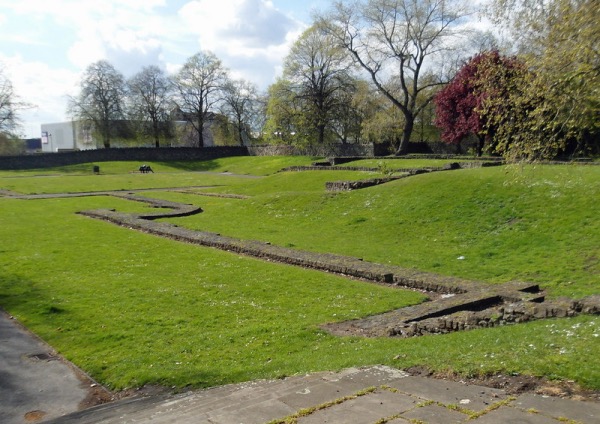
Footings of the abbey (these are modern with the real foundations below ground). PICTURE: diamond geezer (licensed under CC BY-NC-ND 2.0)
Once one of the most important nunneries in the country, Barking Abbey was originally established in the 7th century and existed for almost 900 years before its closure in 1539 during King Henry VIII’s Dissolution.
The abbey was founded by St Erkenwald (the Bishop of London between 675 and 693) for his sister St Ethelburga who was the first abbess.
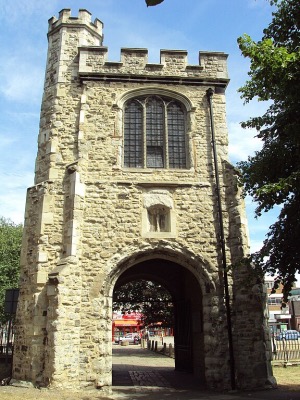
The Curfew Tower. PICTURE: Rept0n1x (licensed under CC BY-SA 3.0)
In the late 900s, St Dunstan, the Archbishop of Canterbury introduced the Rule of St Benedict at the nunnery.
King William the Conqueror stayed here after his coronation while famous abbesses included Mary Becket, the sister of St Thomas Becket, Archbishop of Canterbury, who was given the title in 1173 in reparation for the murder of her brother, as well as several royals including Queen Maud, wife of King Henry I, and Matilda, wife of King Stephen.
The nunnery gained wealth and prestige but this suffered somewhat as a result of floods in 1377 with some 720 acres of land permanently lost. It nonetheless remained one of the wealthiest in England and it’s said the abbess had precedence over all other abbesses in the country.
After the abbey was dissolved, some of the building materials were reused elsewhere and the site was later used as a farm and quarry.
Most of the buildings were demolished – today only the Curfew Tower, which dates from around 1460, remains. The Grade II*-listed tower contains the Chapel of the Holy Rood and now serves at the gateway to the nearby St Margaret’s Church.
Building footings also remain buried under the ground in what is known today as Abbey Green (the layout is marked today by modern additions). There’s a model of how the abbey once appeared inside the gateway.
Located within the outer walls of the Tower of London are the remains of some early 13th century fortifications built by King Henry III.
The foundations of Coldharbour Gate in the foreground beside the White Tower with the remnants of the Inmost Ward Wall beyond. PICTURE: Elizabethe (licensed under CC BY-NC-ND 2.0)
These include the foundations of Coldharbour Gate which once adjoined the south-west corner of the White Tower as well as the western wall of the Inmost Ward which ran down to the Wakefiekd Tower.
The gate was defended by two cylindrical turrets while the Inmost Ward Wall has arrow loops installed, allowing archers to fire down on attackers who had breached the outer fortifications.
The gate was later used as a prison. Alice Tankerville, who was charged with piracy on the River Thames, became one of the most famous prisoners housed there when, despite having apparently been chained to the wall, she escaped with the help of two guards in 1533 (she was recaptured just outside the Tower).
The gateway was demolished in about 1675 and lead from the roof taken to Greenwich where it was redeployed at the Royal Observatory.
Much of the wall was hidden away behind later buildings but was re-exposed after being bomb damaged during World War II.
Not much remains to be seen today but the foundations do evoke a sense of the royal palace in times past and serve as a reminder that the buildings we see at the Tower today are not all that has existed here.
Other ruins at the Tower of London include the remains of the Wardrobe Tower, which lies at the south-east corner of the White Tower. It is thought to have dated from 1190 and incorporates the base of a Roman bastion.
WHERE: Tower of London (nearest Tube station Tower Hill); WHEN: 9am to 5.30pm (last admission 3.30pm), Tuesday to Saturday; 10am to 5.30pm (last admission 3.30pm) Sunday to Monday; COST: £34.80 adults; £17.40 children 5 to 15 (family tickets available; discounts for online purchases/memberships); WEBSITE: www.hrp.org.uk/toweroflondon/.
PICTURE: Esther Dyson (licensed under CC BY-NC 2.0)
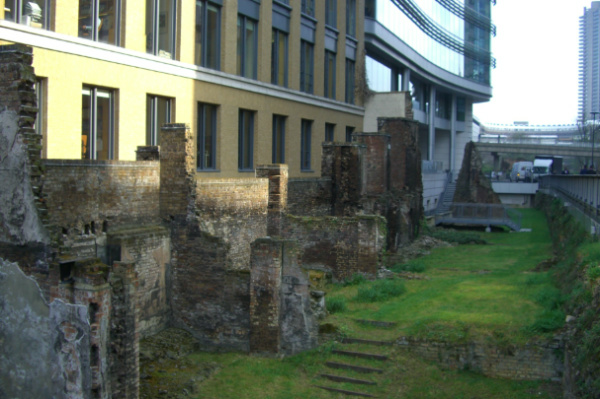
But there are several other stretches of the stone and brick wall left which evoke a sense of the structure it once was and the defensive role it played in protecting Londoners – among them is a substantial section of the wall located in Noble Street on the city’s western side.
The 80 metre long section of Roman and later medieval remains includes two internal turrets on what was the west side of the Roman Cripplegate fort (built between 120 and 150 AD) as well as a substantial bastion located at the southern end of the site.
The highest fragment of the Roman wall can be seen opposite Oat Lane, near the southern end of the site, while the highest section of the wall – which stands some 4.5 metres high and is mostly medieval – can be seen at the northern end of the site.
As well as reflecting the City’s Roman and medieval history, this section of wall also evokes a sense of the horrors of the Blitz.
Projecting eastward on the inside of the wall are party walls from World War II bomb-damaged and later demolished homes which once fronted onto Noble Street.
WHERE: Noble Street, London (nearest Tube stations are Barbican and Bank; WHEN: Anytime; COST: Free.
Once a medieval royal palace, Eltham Palace in London’s east was transformed into a 1930s house which incorporates the medieval great hall.
Tudor ruins in the garden of Eltham Palace (with the home behind). PICTURE: Peter Gasston (licensed under CC BY-NC-ND 2.0)
But there are also some other remains of the former medieval palace on the site – including the footings of the palace’s west range incorporating royal apartments used in the Tudor era.
These included separate apartments for the king and queen as well as a gallery where the king could walk in inclement weather.
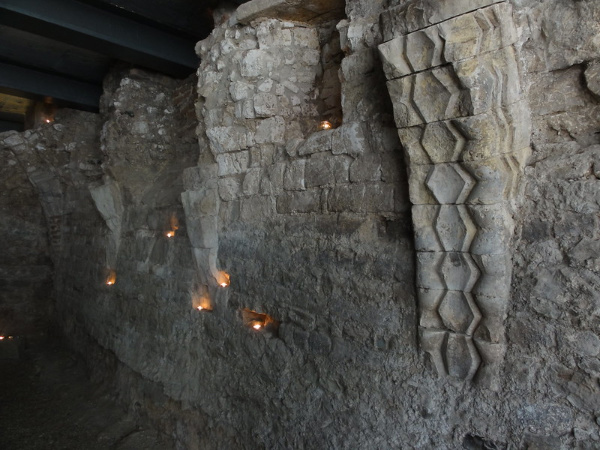
The ruins feature diamond-patterned brickwork (pictured), part of the west range which was built during the reign of Queen Elizabeth I in the 1580s.
There are also the remains of a tower of yellow brick, which possibly dates from the 14th century when, prior to the site being a royal palace, it was rebuilt as a manor house by Anthony Bek, Bishop of Durham (it was Bek who gave the manor to the future Edward II in 1305).
These days the ruins lie within the home’s magnificent gardens, recreated to show how they might hav. Alongside the remains of the west range (and the medieval great hall which dates from the reign of King Edward IV and is largely intact), are the remains of a late 15th century bridge over a medieval moat, at the south end of which are the remains of a gatehouse.
There’s also an oak pedestrian bridge, supported by medieval brick and foundations which once formed part of the main southern entrance to the palace.
WHERE: Eltham Palace, Court Yard, Eltham, Greenwich (nearest train station is Mottingham); WHEN: 10am to 4pm Wednesday to Sunday; COST (advance online tickets): £14.50 adults/£8.60 children/£12.70 concessions/£37.60 family (can include a donation/English Heritage members free); WEBSITE: www.english-heritage.org.uk/visit/places/eltham-palace-and-gardens/.
Located in at the junction of Mark Lane and Dunster Court in the City of London, All Hallows Staining was a medieval church which was mostly demolished in the late 19th century.
All Hallows Staining church tower as seen in July, 2022. PICTURE: Courtesy of Google Maps
These days only the lonely tower remains (above ground at least) as testament to building that once stood there and the lives that were impacted by it.
All Hallows Staining was originally built in the late 12th century and while the origins of its name are somewhat shrouded in mystery, there are a couple of theories.
One says it takes its name from the fact it was built in stone when other churches at the time were wooden (“staining” meaning “stone”) while another says it takes it names from the fact it was built on land belonging to the Manor of Staines.
Princess Elizabeth (later Elizabeth I) is said to have presented the church with new bell ropes after she was released after two months in the Tower of London in 1554 during the reign of her half-sister Queen Mary I (paying tribute to the sound they provided while she was in the Tower).
The church survived the Great Fire of London in 1666 but collapsed just five years later, its foundations apparently weakened by too many graves in the adjoining churchyard.
It was rebuilt in 1674-75 but largely demolished in 1870 when the parish was combined with St Olave Hart Street (and the proceeds were used to fund construction of All Hallows, Bow, in the East End).
Just the tower, parts of which date from the 12th century, remained. The property was bought by the Worshipful Company of Clothworkers. Underneath the adjacent yard they installed the remains of the 12th century crypt of the hermitage chapel of St James in the Wall (later known as Lambe’s Chapel) following the demolition of the chapel in the 1870s.
During World War II, when St Olave Hart Street was badly damaged in the Blitz, a temporary prefabricated church was erected on the site of All Hallows Staining which used the tower as its chancel. It was known as St Olave Mark Lane.
The church was Grade I listed in 1950. In 1957, Clothworkers had a hall for St Olave Hart Street constructed on part of the site of the former church.
The tower is usually able to be seen across a small yard from Mark Lane.
Located under glass beneath a modern square just to the north-east of the line of the City of London’s walls are the ruins of a medieval building which once held human bones.
Built on what had originally been a Roman burial ground, the medieval hospital known as St Mary Spital was constructed towards the end of the 12th century and a graveyard was located on the site for the burial of those who died there.
A small chapel was built on the site in about 1320, the crypt of which became a charnel house housing the bones of those remains disturbed when
The hospital, which had been run by Austin canons, was dissolved by King Henry VIII in 1539 and most of the bones removed. The crypt was later used as a house which was demolished around 1700 and later lost between the gardens of terraced houses.
The remains of the charnel house was discovered in the late 1990s during excavation works – complete with some 10,000 skeletons – and now lies under a glass floor in Bishop’s Square just to the west of Spitalfields Market (it can also be seen through a glass window in the basement level accessed via stairs in the square).
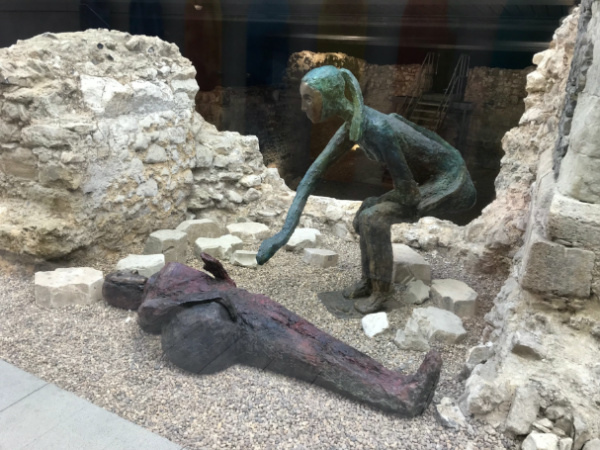
Two statues can be seen inside the ruins – a greenish figure crouching over a prone purple-red figure. Installed in 2014, they are the work of David Teager-Portman and are called Choosing the Losing Sideand The Last Explorer.
Spitalfields Chapel and Charnel House, Bishops Square, London, Spitalfields (nearest Tube station is Liverpool Street; nearest Overground is Liverpool Street and Shoreditch High Street).
Located in what is now today known as Scadbury Park in Chislehurst in London’s south-east, Scadbury Manor originally dated from at least the 13th century.
Originally the home of the de Scathbury family, it was purchased by London merchant Thomas Walsingham in 1424.
It was passed down through the family which had some rather famous members including Sir Francis Walsingham, who was principal secretary to Queen Elizabeth I (who it has been suggested visited the property), and another Thomas Walsingham who in the late 16th century was an MP and the patron of Sir Christopher Marlowe (he is known to have visited the estate just before his death in 1593).
In the 1730s, the moated manor passed into the hands of the Townshend family (the son of the Thomas Townshend who first inherited the property was also named Thomas and become 1st Viscount Sydney and is the person after whom the city of Sydney, Australia, was named).
The old manor house was demolished after passing to the Townshend in 1738, possibly due to falling into disrepair. It’s believed there may have had plans to rebuild but the site was left a ruin and the family moved into nearby Frognal House.
The estate passed through the family to Robert Marsham-Townshend, who in 1914 moved back to Scadbury from Frognal, taking over the farm bailiff’s house and extending it into a substantial family home. He also carried out excavations and repairs on the original manor.
During World War II – on 28th March, 1945 – the last V-1 flying bomb to cause damage landed on the Scadbury farmyard and demolished the medieval barn and surrounding buildings. The country house itself was eventually destroyed in a fire in 1976.
The estate – now 300 acres – was purchased by the London Borough of Bromley in 1983 and opened to the public as a nature reserve.
Some remains of the original manor are still present including the foundations of a brick detached kitchen, with the bases of two ovens, cellars and an undercroft. There are also the remains of a reconstructed manor house Hugh Marsham-Townshend built on the site of the original manor in the early 20th century using medieval timbers from nearby manor house.
The site of the manor house is not normally open to the public but can be seen from a nearby public footpath as well as on open days run by the Orpington and District Archaeological Society (ODAS).
Where: Scadbury Park, Old Perry Street, Chislehurst; WHEN: Opens at 7:30am on weekdays, 9am on weekends; closing times vary depending on the month; COST: Free; WEBSITE: https://www.scadbury-park.org.uk
This mid-18th century church in Woolwich was constructed to serve the soldiers of the Royal Artillery but was badly damaged when hit by a bomb during World War II.
View of the church apse with altar and mosaic. PICTURE: Kleon3 (licensed under CC BY-SA 4.0)
Designed by Thomas Henry Wyatt with the aid of his younger brother, Matthew Digby Wyatt, in the style of an Early Christian/Italian Romanesque basilica, the church was built between 1862 and 1863 on the orders of Lord Sidney Herbert, the Secretary of State for War.
It was among a number of buildings built to provide for the well-being of soldiers after a public outcry about their living conditions during the Crimean War.
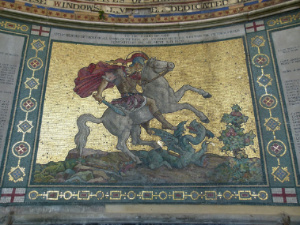
The interior featured lavish decoration including mosaics said to have been based on those found in Roman and Byzantine monuments in Ravenna, Italy. Those that survive at the church’s east end – which include one of St George and the Dragon and others featuring a peacock and phoenix – are believed to have been made in Venice in the workshop of Antonio Salviati.
A mosaic featuring St George and the Dragon. PICTURE: Kleon3 (licensed under CC BY-SA 4.0)
The mural of St George formed part of a memorial to the Royal Artillery’s Victoria Cross recipients located in the church and paid for through public subscription in 1915. The interior also featured five tall stained glass windows which served as memorials to fallen officers.
Plaques on the perimeter walls record the names of soldiers killed in military conflict or Royal Artillery servicemen who died of natural causes.
The church was visited by King George V and Queen Mary in 1928.
The church, which had survived a bombing in World War I, was largely destroyed on 13th July, 1944, when it was hit by a V1 flying bomb. Most of the interior was gutted in the fire that followed.
While plans to rebuild it after World War II were shelved, in 1970 it became a memorial garden with a roof placed over the church’s east end to protect the mosaics.
Services are still held in the Grade II-listed ruin, located opposite the Woolwich Barracks, and since 2018 it has been under the care of the Woolwich Garrison Church Trust.
WHERE: St George’s Garrison Church, A205 South Circular, Grand Depot Road, Woolwich (nearest DLR station is Woolwich Arsenal); WHEN: 10am to 1pm Sundays (October to March) and 10am to 4pm Sundays (April to September); COST: Free; WEBSITE: https://www.stgeorgeswoolwich.org.
Note that we’ve changed the title of this special series to allow us to explore a bit wider than the medieval period alone!
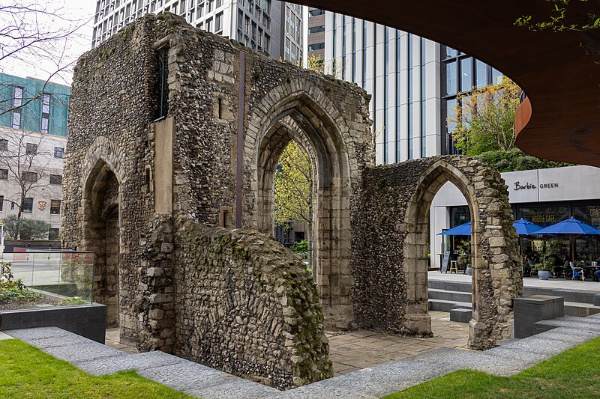
Ruins of St Alphege London Wall. PICTURE: The wub (licensed under CC BY-SA 4.0)
The ruins of this church – which now sit in a public garden – are actually the remains of the second church in the vicinity.
Dedicated to the murdered Archbishop of Canterbury (there’s a similarly named church in Greenwich), the first St Alphege (also known as St Alphege London Wall and St Alphege Cripplegate) dated from at least the 11th century but was closed and demolished during the Dissolution (the other part of its name comes from its location abutting London Wall).
The second church started life as the priory church of the nunnery of St Mary-within-Cripplegate which later became a hospital before it too was closed in the Dissolution.
The church, however, became the parish church and, subsequently repaired, it survived the Great Fire of 1666. Further repairs followed and a more comprehensive rebuilding in the 18th century (with the medieval tower retained).
But by 1900, parts of the church were in a poor state and after the church was damaged during an air raid in World War I, the parish was amalgamated with St Mary Aldermanbury (the combined parish was later united with St Giles Cripplegate) and it was eventually mostly demolished in the early 1920s.
The medieval tower remained but was gutted by fire in 1940. Its ruins were subsequently surrounded by a small public garden. Further restoration work was done as part of works to install a raised walkway in 2018-19.
The remains of the church – which include the tower and arches on three sides – are Grade II-listed and while it’s surrounded these days by modern office buildings, it remains a small piece of a bygone era.