Exploring London’s 10 most popular posts for 2011 – Numbers 2 and 1…

And so we come to it – the most popular posts on Exploring London this year – one of which is perhaps surprising, the other of which not!

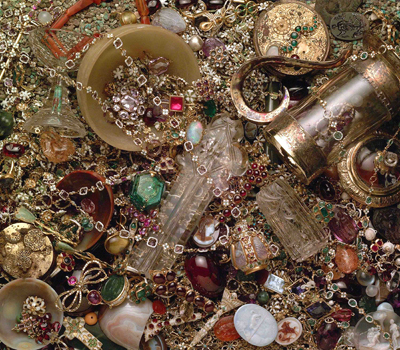
2. Treasures of London – The Cheapside Hoard: A look at the “greatest find of Jacobean and Elizabethan jewellery ever made”, much of which is now held at the Museum of London;

1. The Royal Wedding – Eight curious facts about Royal Weddings past and present: Perhaps not a surprising winner, given the worldwide interest in 2011’s Royal Wedding, this post looked at some of the stranger facts surrounding royal weddings in Britain in the relatively recent past.

And that brings our countdown to an end. Our usual coverage resumes next week…

Exploring London’s 10 most popular posts for 2011 – Numbers 6 and 5…

The countdown of our 10 most popular posts for 2011 continues with numbers six and five…

6. The Royal Wedding – A view from The Mall: Another Royal Wedding entry, this post from April was all about the glamour and excitement of the day itself as we joined the crowds lining The Mall;

5. Treasures of London – The Whispering Gallery, St Paul’s Cathedral: One of London’s star sights, the Whispering Gallery at St Paul’s has long held a fascination for visitors and Londoners alike.

Exploring London’s 10 most popular posts for 2011 – Numbers 10 and 9…

As we approach the end of the year, we’re taking a look back at our 10 most popular posts for 2011. We start the countdown with numbers 10 and 9…

10. LondonLife – The Royal Menageriein which, inspired by what was a new exhibition at the Tower of London, we take at the Royal Menagerie kept there by England’s monarchs for more than 600 years;

9. Treasures of London – Admiral Lord Nelson’s coat: part of a series looking at some of the many, many ‘treasures’ of London, this piece focused on the coat which Admiral Lord Nelson when he was fatally shot aboard the HMS Victory during the Battle of Trafalgar and which can now be seen at the National Maritime Museum in Greenwich (complete with bullet hole).

Stay tuned by numbers 8 and 7 tomorrow. We love to hear from you if there was a particular post that was your favorite. Leave your comment below…

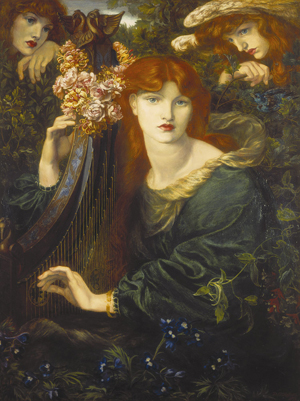
Treasures of London – La Ghirlandata

A sensual and vivid masterpiece, Dante Gabriel Rossetti’s La Ghirlandata, hangs in the main hall of the Guildhall Art Gallery at the heart of the city.

The portrait, which is alive with the imagery of sexual attraction including honeysuckle and roses around the top of the harp and the harp itself – representing music, a common metaphor for love, was one of several depicting women playing musical instruments painted by Rossetti in the early 1870s.

It was painted in oils in 1873 at Kelmscott Manor in Gloucestershire, a property part-owned by Rossetti and his friend William Morris. There Rossetti, a founder of the Pre-Raphelite Brotherhood, had come after having what has been described as a mental breakdown in 1872.

Morris was not at the property when the painting was made but his wife Jane, with whom Rossetti was in love and who was one of his key muses, was. The model, however, was Alexa Wilding while the angels bore the face of Jane’s young daughter May.

PICTURE: Courtesy of Guildhall Art Gallery, City of London

WHERE: Guildhall Art Gallery, Guildhall Yard (off Gresham Street) (nearest Tube stations are Bank, Mansion House, Moorgate and St Paul’s); WHEN: 10am to 5pm Monday to Saturday/12pm to 4pm Sunday (excluding some public holidays); COST: Free (fees may be charged for some temporary exhibitions); WEBSITE: www.guildhallartgallery.cityoflondon.gov.uk/gag/

Treasures of London – The London Stone

The London Stone was once considered to be one of the City’s most important relics with the very existence of the city depending on its survival. Yet, hidden away behind an iron grille set into the front of a building at 111 Cannon Street, the block of Clipsham limestone is these days all but forgotten, occupying an ignominious position opposite the gleaming new Cannon Street Station.

The stone’s origins lie shrouded in mystery but the legend, propagated in the 19th century, goes that it once formed part of an altar built by Trojan wanderer and founder of London, Brutus. Yet, according to the Museum of London, the saying often associated with the legend  – “So long as the Stone of Brutus is safe, so long will London flourish” – was apparently invented in 1862.

It has been suggested the stone, which is a Grade II* listed structure, may be a relic of the city of the Roman city of Londinium, although no-one seems to know for sure. The earliest mention of it was apparently around 1100 AD and it was subsequently associated with some of London’s most famous characters.

It is said that Jack Cade, leader of the 15th century Kentish rebellion, struck it with his sword after entering London in a symbolic gesture designed to reflect his taking control of the city and naming himself ‘Lord of London’. The poet William Blake is said to have believed it to be associated with druidism – perhaps it was part of an altar? – and even the great 17th century architect Christopher Wren had a view on it – he thought it was part of a Roman ruin after seeing its foundations.

One widely believed and circulated theory was that it was the stone from which all distances from London were measured during Roman times. Its heritage listing says it may have been a Roman milestone. It has also been suggested it is the base of an Anglo-Saxon waymarker or cross.

The stone was located in its current position after World War II. Since the 18th century it had been set into the wall of a Wren-designed church, St Swithin London Stone, which had stood on the site where the stone now sits but which was demolished in 1962 after being bombed in the Blitz. Prior to being moved to the church, the stone stood upright on the south side of Cannon Street. It was moved to the church after becoming a traffic hazard.

There has been talk in recent years of moving the stone to a better home but for the moment it remains behind the grill by the footpath.

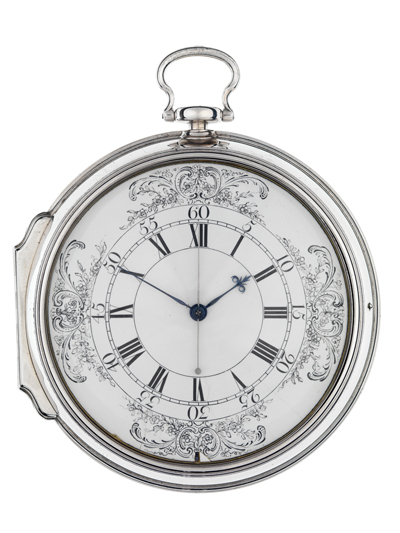
Treasures of London – Harrison’s timekeepers

A series of four marine timekeepers which eventually solved the ‘problem’ of longitude – revolutionising sea travel by allowing mariners to accurately locate their position – are housed at the Royal Observatory in Greenwich.

The three clocks and one watch were designed by John Harrison, a working class joiner from Lincolnshire who made it his life’s mission to design a device which would keep accurate time at sea.

Calculating longitude – an east-west position on the earth – is relatively simple. Because time moves forward one hour for every 15 degrees one travels in an eastward direction (or back an hour for every 15 degrees one travels westward), it’s possible to calculate a position by simply knowing the local time at two different places on earth.

The problem was that the pendulum clocks of the 1600s were affected by changes in temperature and humidity  and couldn’t keep accurate time on board a ship meaning that while a mariner might know the local time, he could not get an accurate measurement of time elsewhere to compare it to.

While mariners could use the ‘lunar distance method’ to measure longitude – this involved measuring the motion of the moon relative to the stars – it relied on clear skies and was not very accurate. So in 1714 the British Government announced it would award a prize of £20,000 to anyone who could come up with a solution to longitude which was accurate to within half a degree (or two minutes).

Clockmaker John Harrison was among those who took up the challenge (his somewhat tragic story is told in great detail in Dava Sobel’s terrific 1995 book Longitude: The True Story of a Lone Genius Who Solved the Greatest Scientific Problem of His Time). His first effort, known simply as H1, was constructed between 1730 to 1735 and, using a counterbalanced spring mechanism making it independent of gravity, was successfully tested on a voyage to Lisbon.

But Harrison wasn’t satisfied and began work on H2 in 1737 before, after realising its shortcomings three years later, starting work on another clock, H3, in 1740. He worked on this for 19 years but it failed to meet the accuracy requirements of the Board of Longitude which was charged with looking overseeing the awarding of the £20,000.

In 1753, Harrison asked a London watchmaker John Jefferys to create a watch to his designs, initially for his own personal use. But he soon discovered that with a few improvements, H4 – which looks like a large pocketwatch (see picture), could be the answer he was looking for.

In 1761 and 1764, Harrison’s son William took the watch on two voyages to the West Indies, yet, despite the fact that its accuracy was well within the requirements of the Board of Longitude, the board initially refused to pay up. After much wrangling Harrison was finally paid £10,000 but told that to obtain the other half of the money, he would have to create at least two more copies of H4.

Harrison went on to make one copy – H5 – while watchmaker Larcum Kendall, made another, K1, at the direction of the Longitude Board. When Harrison suggested that Kendall’s K1 could be considered the second of the two copies he was required to make, the board rejected the idea. Harrison then appealed directly to the king, George III, and finally to parliament before he was eventually awarded a further £8,750 in 1773.

Kendall’s watch, meanwhile, was taken by Captain James Cook on a three year voyage as far afield as Antarctica. It was a test which proved beyond all doubt the accuracy of the timekeepers. A year after Cook’s return in 1775, John Harrison died in his house in Red Lion Square on 24th March, 1776. It is not known whether he knew of the success of the timekeeper taken on Cook’s voyage.

Harrison’s four timekeepers are now housed at the Royal Observatory where the intriguing story of their creation is told.

WHERE: Royal Observatory, Blackheath Avenue, Greenwich (nearest DLR stations are that of Greenwich and Cutty Sark and it can also be reached by river – stop at Greenwich Pier); WHEN: 10am to 5pm (last admission 4.30pm) daily; COST: £7 adult/£5 concessions/free for children 15 and under (annual passes available – £10 an adult/£7.50 concessions) ; WEBSITE: www.nmm.ac.uk/places/royal-observatory/

PICTURE: Courtesy of the Royal Observatory, Greenwich

Treasures of London – Tower Bridge

Often confused with London Bridge, Tower Bridge stands as a testament to Victorian engineering ingenuity.

The bridge – a major restoration of which was completed in March this year – was officially opened on 30th June, 1894, by the Prince and Princess of Wales (later King Edward VII and Queen Alexandra) eight years after work on a new Thames crossing commenced, driven by the need for a bridge which was more accessible to people living in East London (at the time pedestrians and vehicles were facing considerable congestions, with some being forced to wait hours before crossing the Thames).

At the time of its completion, Tower Bridge (although not universally acclaimed at the time) was the most sophisticated and largest bascule bridge ever built – the word bascule comes from the French for ‘see-saw’ and refers to the action of the bridge when it swings open. The bascules, which took only a minute to open, were initially operated by a steam-powered hydraulic system although since 1976, they have been driven by oil and electricity.

The 293 feet tall structure was built from steel and clad in Portland stone and Cornish granite to ensure it blended with the nearby tower of London. It was built with two walkways joining to two great towers at a height of 110 feet. Initially open to the elements, these were conceived as a way for people to cross the bridge while the bascules were raised open but due to a lack of use, they were closed in 1910 (they were reopened in 1982 when the first permanent exhibition took up residence at the bridge).

These days as well as providing a thoroughfare across the river for pedestrians and vehicles (and still opening for larger boats and ships from time to time although 24 hours notice is required), the bridge – which, along with four other London bridges, is maintained by the Bridge House Estates trust, a charity whose roots go back to the 11th century – houses an exhibition which tells the story of its construction. The walkways provide wonderful views down the river.

Interestingly, the iconic colors of Tower Bridge only date from 1976 when the structure was painted red, white and blue for the Queen Elizabeth II’s Silver Jubilee. Before that, the bridge was painted a chocolate brown though it was originally a greenish blue color.

One of the most interesting stories associated with Tower Bridge is that of a bus driven by Albert Gunton. On the bridge when it started opening in December 1952, he had to make the bus jump the gap – at three foot wide – to avoid the bus toppling into the river below. Passengers only suffered minor injuries and Gunton was later awarded a bravery award for his actions.

A list of times when the bridge will be lifted (this happens around 1,000 times a year) is kept on the Tower Bridge website.

WHERE: The exhibition entrance is located at the north west tower of the bridge (nearest Tube stations are Tower Hill or London Bridge); WHEN: 10am to 6.30pm (last admission 5.30pm) daily until end of September, then 9.30am to 6pm (last admission 5pm) until March; COST: £6 an adult/£4.20 concessions/£2.50 children aged 5 to 15 (under fives are free)/£12.50 for a family; WEBSITE: www.towerbridge.org.uk

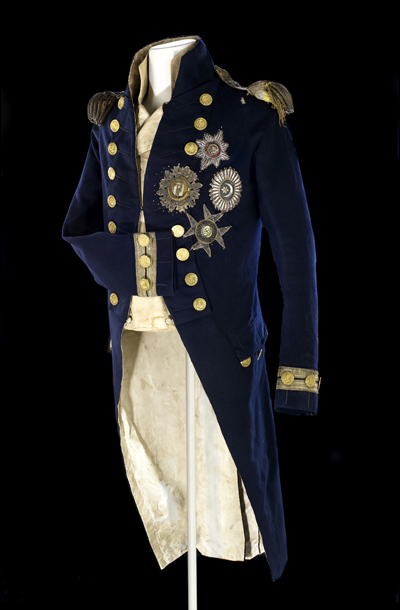
Treasures of London – Admiral Lord Nelson’s coat

It was roughly two hours into the Battle of Trafalgar on 21st October, 1805, about 1.15pm, that Great Britain’s most famous seaman, Admiral Horatio Lord Nelson, was fatally struck by a musket ball.

Fired by a marksmen in the rigging of the French ship Redoubtable, the musket ball struck him in the left shoulder as he stood on the deck of his flagship, HMS Victory.

Having fallen to his knees, he was spotted by the Victory‘s captain, Thomas Hardy, before he collapsed. Carried below the decks to the ship’s cockpit, it was there that he died (the Victory can still be visited at Portsmouth).

His damaged coat, meanwhile, was placed under the head of Midshipman George Augustus Westphal, who was being treated for his injuries nearby. Blood from the midshipman (late himself an admiral) stuck his hair to one of the epaulettes, part of which was was cut away and retained by his family as a memento.

The “undress jacket” was later returned to Nelson’s mistress, Emma Lady Hamilton, in accordance with his wishes. She later gave it to Joshua Jonathan Smith, Lord Mayor of London in 1810-1811, to as payment of a debt just prior to retiring to France in 1814. It was Prince Albert, the consort of Queen Victoria, who later purchased the coat for £150 from Smith’s widow and presented it to Greenwich Hospital in 1845.

The jacket can now be found in the National Maritime Museum in Greenwich (housed in a section of the former Naval College). Along with the fatal musket ball hole on the left shoulder, the tails and left sleeve of the jacket are stained with the blood of John Scott, Nelson’s secretary, who had died in the early moments of the battle on the spot where Nelson was later shot. It’s also possible to see where the epaulette was damaged during the treatment of Midshipman Westphal.

The front of the coat also features embroidered versions of the four orders of chivalry awarded to Nelson – these are the star of the Order of the Bath, the Order of the Crescent awarded by the Sultan of Turkey, the Order of St Ferdinand and of Merit awarded by Ferdinand IV of Naples, and the German Order of St Joachim. According to the National Maritime Museum, “Nelson habitually wore them on all his uniform coats”.

The coat’s right sleeve is positioned as Nelson would have worn it – in 1797 he had lost his right arm at the Battle of Santa Cruz de Tenerife.

PICTURE: Vice-admiral’s undress coat worn by Nelson (1758-1805) at the Battle of Trafalgar. There is a bullet hole on the left shoulder, close to the epaulette. (c) National Maritime Museum, Greenwich, London, Greenwich Hospital Collection.

WHERE: National Maritime Museum, Romney Road, Greenwich, (nearest DLR station is Cutty Sark or Greenwich mainline station); WHEN: Open 10am to 5pm daily; COST: Free; WEBSITE: www.nmm.ac.uk.

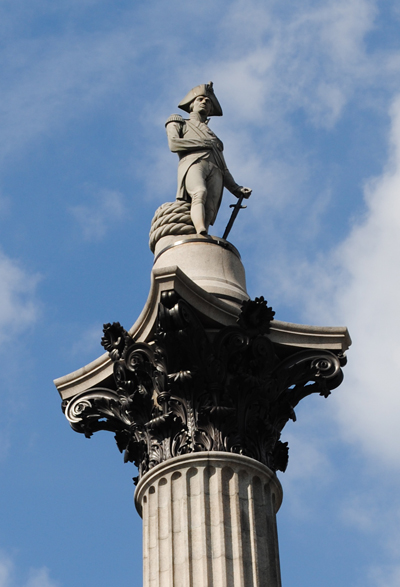
Treasures of London – Nelson’s Column

Towering over Trafalgar Square, Nelson’s Column was constructed in the 1840s to commemorate the man many believe to be Britain’s greatest naval hero, Admiral Lord Nelson.

Parliament started discussions on a monument commemorating Nelson only 10 years after his death at the Battle of Trafalgar in October 1805, but it wasn’t until 1838 that the Nelson Memorial Committee was finally formed and public subscriptions called for to raise funds for the monument.

The government agreed to provide the location and, following a controversial competition (which had to be run twice), William Railton’s designs showing a Corinthian column topped by a statue of Nelson (which it was stipulated had to be made by EH Bailey) with four lions at its base, was adopted.

The column was completed in 1843. It featured a bronze capital, made from old cannons taken from the Woolwich Arsenal and shaped in the form of acanthus leaves, and Bailey’s 5.5 metre (17 foot) tall statue of Nelson (made from Craigleith sandstone quarried in Scotland and donated by the Duke of Buccleuch). The four bronze identical lions, made by sculptor Sir Edwin Landseer and said to be modelled on a dead cat from a zoo, were not added until 1867.

On the column’s pedestal are four bronze relief panels showing Nelson’s four great victories – the Battle of Cape St Vincent, the Battle of the Nile, the Battle of Copenhagen and the Battle of Trafalgar, the scene of which depicts the admiral in the throes of dying (he was killed by a musket bullet fired from the French vessel Redoubtable and was carried below decks where he died). They were apparently made from French guns captured at each of the battles.

The Grade I-listed column, which cost £47,500 to build, was refurbished in a four month exercise costing £420,000 in 2006, during which it was discovered that it was actually 16 foot shorter than had previously been thought (its total height, to the tip of Nelson’s hat, is actually 169 feet instead of the 185 feet previously supposed). It had previously been refurbished in 1986 and in 1968. You can see a gallery of images taken during the most recent restoration here.

Interestingly, it is reported that just before Bailey’s statue was raised to the top of the column in 1843, 14 stonemasons who had worked on it during construction held a celebration dinner party on the plinth at the top.

Treasures of London – The Portuguese Centrepiece, Apsley House

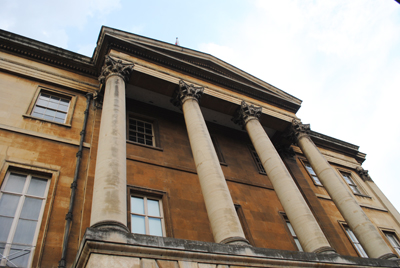
Having just been cleaned as part of a renovation of the State Dining Room at Apsley House (pictured) – the former London residence of Arthur Wellesley, the Duke of Wellington, the silver-gilt Portuguese Centrepiece  was presented as part of a complete service to the duke in 1816.

The gift of the Portuguese Regency Council, it was created in honor of the duke’s role in leading the armies of Spain, Britain and Portugal to victory over Napoleon’s forces in the Peninsular War of 1808-14.

The service, which consists of more than 1,000 pieces, was designed by Portuguese court artist Domingos Antonio de Sequeira who took three years to complete it with much of the work carried out in Sequeira’s house and neighbouring workshops. Subsequently damaged in the sea crossing to England, repairs had to be made before it was formally presented to the duke late in 1816.

The eight metre long centrepiece commemorates all the battles of the Peninsular War in which the allies were victorious. It was acquired for the nation in 1948 and is now permanently displayed on the duke’s original mahogany dining table, designed especially to support its weight.

WHERE: Apsley House, 149 Piccadilly, Hyde Park (nearest tube station is Hyde Park Corner); WHEN: 11am to 5pm Wednesday to Sunday (until 31st October); COST: £6.30 an adult/£5.70 concessions/£3.80 a child (English Heritage members free); WEBSITE: www.english-heritage.org.uk/daysout/properties/apsley-house/

Treasures of London – ‘The Ambassadors’

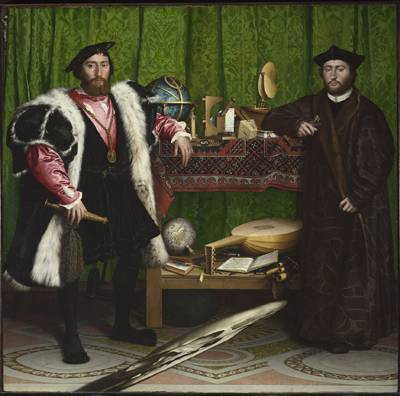
A stunning portrait on a grand scale, The Ambassadors depicts two influential figures from the 16th century – Jean de Dinteville, the then 29-year-old French ambassador to England and Georges de Selve, the then 25-year-old bishop of Lavaur and sometime French ambassador to the Emperor, the Venetian Republic and the Holy See.

The oil on oak work, which is housed in room four of the National Gallery and is also one of the images featured online as part of the Google Art Project, was painted by Hans Holbein the Younger in 1533 and is meant as a portrait to show the men’s power, learning and wealth – they are surrounded by objects which include celestial and terrestrial globes, a portable sundial, a lute (and its case), and books including one of hymns and another of arithmetic as well as richly decorated furnishings.

Yet there’s more to this painting than initially meets the eye – a closer look reveals a distorted skull in the foreground which, when viewed from the painting’s right-hand side comes into its proper perspective. A reflection on mortality perhaps?

And though no typically viewed as a religious work, there are also some striking religious overtones to this image including a broken string on the lyre – often seen as a Christian symbol of disharmony – and, partly hidden behind the curtain on the far left of the painting as you look at it, a crucifix hanging on the wall.

Holbein painted the work during his second stint in England while depicting life at the Tudor court. Among his most famous other images are one of King Henry VIII (held in the National Portrait Gallery) and another of Christina of Denmark (also in the National Gallery – painted to show Henry VIII the image of a potential future wife although the relationship never went any further than that).

PICTURE: Ng1314, Hans Holbein the Younger, Detail of Jean de Dinteville and George de Selve (‘The Ambassadors’), 1533 © The National Gallery, London.

WHERE: Room 4, National Gallery, Trafalgar Square (nearest tube stations Leicester Square and Charing Cross); WHEN: 10am to 6pm (Fridays 10am to 9pm); COST: Free; WEBSITE: www.nationalgallery.org.uk. The image is also available online as part of the Google Art Project here:www.googleartproject.com/museums/nationalgallery/the-ambassadors.

Treasures of London – The Whispering Gallery, St Paul’s Cathedral

Found 98 feet (30 metres) above the cathedral’s floor, the Whispering Gallery at London’s iconic St Paul’s Cathedral is an architectural marvel.

As with other “whispering galleries” found around the world, its construction is such that something whispered into the wall on one side of the gallery, which runs around the interior of the cathedral’s inner dome (part of the first ever ‘triple dome’), can be heard on the other side of the gallery, around 100 feet (30 metres) away.

The dome (pictured right), the design of which draws inspiration from that of St Peter’s Basilica in Vatican City, was constructed to the designs of Sir Christopher Wren. The cathedral, including the dome, was essentially completed in 1708.

As well as giving views down into the cathedral, the Whispering Gallery – a relatively easy climb of only 257 steps – also provides a close-up view of murals painted on the dome’s inner surface by Sir James Thornhill. Painted between 1715 and 1719, these depict images from St Paul’s life.

Two further galleries on the dome are also publicly accessible – the Stone Gallery, which stands 173 feet (53.4 metres) above the cathedral floor, and the Golden Gallery, which stands 280 feet (85.4 metres) above the cathedral floor and offers stunning views of the city as well as southward over the Thames. But be prepared for a long climb – 528 steps – up what are in places narrow, winding staircases.

The current ball and cross on top of the dome date from 1821 (these replaced those which had first topped the cathedral). Together they stand 23 feet (seven metres) high and weigh seven tonnes.

WHERE: St Paul’s Cathedral, St Paul’s Churchyard (nearest tube station is St Paul’s); WHEN: The galleries are open from 9.30am to 4.15pm, Monday to Saturday (small children must be accompanied by an adult)/Cathedral is open from 8.30am;  COST: £14.50 an adult/£13.50 concessions and students/£5.50 a child (6-18 years)/£34.50 a family of four; WEBSITE: www.stpauls.co.uk

Treasures of London – The Cheapside Hoard

It’s been described as the greatest find of Jacobean and Elizabethan jewellery ever made – an extraordinary cache of some 500 gemstones, jewellery and other related items found buried under the floor during the demolition of a building at 30-32 Cheapside on 18th June, 1912.

Now known as the Cheapside Hoard, it dates from the 16th and 17th centuries and includes neck chains, pendants, hat ornaments, cameos and rings – among the items is a gold watch set into a hinged case made from a Columbian emerald, a tiny bejewelled gold scent bottle, and an onyx cameo of Queen Elizabeth I.

Other items include unfinished ornaments and unmounted gemstones which have origins spanning the world – from Asia and Middle East to South America. While these give support to the idea that the hoard is part of a goldsmith’s reserve stock, mystery still surrounds why it was buried in the building (although Cheapside was known for its goldsmiths during the era which the hoard dates from).

The majority of the hoard is held at the Museum of London where some of the items are on display. Other items are at the British Museum and one, an enamelled gold chain, is at the Victoria & Albert Museum. The Museum of London is planning major exhibition of the hoard starting in late 2013. Stay tuned for more information.

WHERE: Museum of London, 150 London Wall (nearest tube station is Barbican, St Paul’s or Moorgate); WHEN: 10am to 6pm, Monday to Sunday; COST: Free; WEBSITE: www.museumoflondon.org.uk

PICTURE: Museum of London

Treasures of London – The ‘Old Lion’ Maidenhair Tree, Kew Gardens

Celebrated in the 2002 list of 50 “Great British Trees”, the Maidenhair Tree is one of a number at Kew Gardens known as an “Old Lion” – the name collectively given to the few remaining trees with a planting date of 1762.

The Gingko biloba or Maidenhair Tree was one of the first of its species to be planted in Britain and, along with the other ‘Old Lions’, was brought from the Twickenham estate of the Duke of Argyll in 1762.

It was planted in what was then a new five acre arboretum laid out by William Aiton, employed as the gardener at the first botanic garden at Kew (this was established in 1759 at the behest of Princess Augusta, wife of Frederick, Prince of Wales – who had died in 1751 – and mother of King George III, and John Stuart, 3rd Earl of Bute).

Originally located against the wall of the ‘Great Stove’ glasshouse to provide it with protection, the tree has stood alone since 1861 when the glasshouse was demolished. It can now be found adjacent to the Wisteria arch close to the Secluded Garden Conservatory. Several further Gingko trees were planted in the garden in 1773 under the direction of botanist Sir Joseph Banks.

The other four ‘Old Lions’ at Kew are a False Acacia (Robinia pseudoacacia), an Oriental Plane (Platanus orientalis), a Caucasian Elm (Zelkova carpinifolia), and a Pagoda Tree (Sophora japonica).

WHERE: Kew Gardens (nearest tube station is Kew Gardens); WHEN: 9.30am to 4.15pm daily (check closing times for glasshouses); COST: £13.90 adults; £11.90 concessions; children under 17 free; WEBSITE: www.kew.org.

Treasures of London – The Crown Jewels

No series on the treasures of London would be complete without a mention of the Crown Jewels, housed – except when being used – under tight security in the same place they’ve been since the early 1300s – the Tower of London.

The jewels, which are described as a ‘working collection’, include the coronation regalia and feature some 23,578 gems  – the Imperial State Crown alone boasts 2,868 diamonds, 273 pearls, 17 sapphires, 11 emeralds and five rubies.

The regalia itself is made up of the crowns of the sovereigns, consorts and Princes of Wales as well as sceptres, orbs, rings, swords, spurs, bracelets, robes, and the oldest piece, a 12th century anointing spoon.

It and three steel coronation swords are the only pieces to survive the destruction of all the pre-Civil War regalia in 1649-50, carried out at the behest of Oliver Cromwell following the execution of King Charles I (many of the earlier crown jewels, dating from the Anglo-Saxon period, had already been replaced in the early 13th century after items were lost while being taken across The Wash during the reign of King John in 1216).

Following Cromwell’s destruction, new regalia was made on the orders of King Charles II. Modelled on that of his father, it was used in the king’s coronation on 23rd April, 1661, and cost more than £12,000.

Today, St Edward’s Crown – with which the sovereign is crowned by the Archbishop of Canterbury – is the principal piece of the regalia. Other items include the Sovereign’s Sceptre, topped with 530 carat First Star of Africa – the largest flawless cut diamond in the world, Queen Victoria’s small diamond crown, and the Imperial Crown of India. There is also a crown made for Queen Elizabeth, the Queen Mother, for her 1937 coronation which features the famous Koh-i-Nur (‘Mountain of Light’) diamond.

Until 1303, the Crown Jewels had been housed at Westminster Abbey. Following a successful robbery that year, however (after which most items were recovered), they were moved to the Tower.

The most famous attempt to steal the Crown Jewels was made by an Irishman, Colonel Thomas Blood, in 1671. He and his gang had arranged to see the jewels (this could be done for a fee) but when they arrived, used a mallet to knock out the jewel keeper before stabbing him.

Colonel Blood had hidden King Charles II’s crown under his cloak, squashing its arches of in the process, while his companion Robert Perot had stuck the coronation orb down his breeches and Blood’s son was in the process of sawing the sceptre in half when the keeper’s son returned unexpectedly and raised the alarm.

Arrested, Blood got off rather lightly – King Charles II decided, apparently for some unknown reason, to pardon him. Security around the jewels, however, was tightened – iron bars were used instead of wooden ones and people were thenceforth forbidden from handling the jewels.

The Crown Jewels are now housed in the Jewel House at the Tower, built in 1967 in the west wing of the Waterloo Barracks, and guarded by the Yeomen Warders.

WHERE: Tower of London (nearest tube station Tower Hill); WHEN: 9am to 4.30pm, Tuesday to Saturday, 10am to 4.30pm Sunday to Monday (until 28th February); COST: £18.70 adults; £10.45 children under 15; £15.95 concessions; £51.70 for a family (prices, which include a voluntary donation, are valid until 28th February); WEBSITE: www.hrp.org.uk/toweroflondon/. For more on the Crown Jewels, see www.royal.gov.uk/MonarchUK/Symbols/TheCrownJewels.aspx or the Royal Collection website, http://bit.ly/i9FM3

Treasures of London – The Magna Carta

It’s regarded as one of the seminal documents of medieval England. First issued 15th June, 1215, the Magna Carta (“Great Charter”) was endorsed by England’s barons and King John at Runnymede near Windsor Castle and put limits in the power of the king by demanding he govern according to established feudal law.

The document was forced upon King John by rebellious barons after he broke away from established customs and imposed oppressive taxes and fines and seized the estates of nobles.

Its terms were immediately repudiated by the king, leading to further rebellion which ended when the king died on 18th October, 1216. Less than a month after the king’s death, the regent, William Marshal, issued a revised version of the document and a second revision almost exactly a year later. A further version was later issued by King Henry III and later confirmed by King Edward I.

Copies of the document were sent throughout the land in 1215. There is now a copy in the Lincoln Cathedral Archives and another in Salisbury Cathedral Chapter House while the British Library has two copies, both from the collection of Sir Robert Cotton, who died in 1631. One of the library’s two copies was burned in a fire 100 years after Sir Robert’s death and still bears fire damage.

The text of the Magna Carta is not abstract in nature but deals in detail with practical realities, covering issues ranging from what happens when a noble who holds land from the Crown dies through to who heirs may marry, standard measures of wine, ale and corn and the removal of foreign knights from the country.

Only three of the Magna Carta’s 63 clauses are still law: one guaranteeing the liberties of the English Church; another confirming the privileges of London and other towns; and a third, often viewed as a forerunner of clauses contained in documents such as American Bill of Rights and Universal Declaration of Human Rights, which states that no free man shall be imprisoned, dispossessed, outlawed or exiled without the lawful judgement of his equals or by the law of the land.

The legacy of the Magna Carta is not however in the individual rights it seeks to uphold but rather the principle that for the first time in English history, it elevates the law above all men, even the king.

WHERE: Sir John Ritblat Gallery: Treasures of the British Library: Magna Carta and associated documents, The British Library, 96 Euston Road (nearest tube station is Kings Cross St Pancras or Euston); WHEN: 9.30am to 6pm Monday, Wednesday, Thursday and Friday; closes 8pm Tuesday and 5pm Saturday; 11am to 5pm Sunday; COST: Entry is free; WEBSITE: www.bl.uk or for a detailed guide and virtual tour of the Magna Carta, see  www.bl.uk/treasures/magnacarta/index.html.

Treasures of London – The Sutton Hoo ship burial

Now housed in the British Museum (pictured), the artefacts discovered in a ship burial at Sutton Hoo near Woodbridge in Suffolk helped to shed new light on what life was like in Anglo-Saxon society.

The excavation at the Sutton Hoo site was carried out in 1939, just before World War II.  The finds were impressive and centred on a 27 metre long oak ship in the midst of which was constructed a burial chamber for a man of some significance along with his possessions.

The latter included his armour (the centrepiece of which is the spectacular and painstakingly reconstructed Sutton Hoo helmet complete with face mask), weapons such as a sword and spears, silverware and silver-mounted drinking horns and cups, clothes and other assorted items of wealth, including a purse with a ‘lid’ containing, among other things, Merovingian gold coins struck believed to have been struck between 595 and 640 AD.

While the remains found date to around the early seventh century, the man’s exact identity remains something of a mystery. But it is possible he may have been one of four Anglo-Saxon kings known to have been buried in the area.

WHERE: Room 41 at the British Museum, Great Russell Street (nearest tube is Tottenham Court Road, Holborn or Russell Square); WHEN: 10.30am-5.3opm daily; COST: Entry to the museum is free; WEBSITE: www.britishmuseum.org. (For more information on visiting the Sutton Hoo site in Suffolk, visit www.nationaltrust.org.uk/main/w-vh/w-visits/w-findaplace/w-suttonhoo)

Treasures of London – Cleopatra’s Needle

Sited relatively unobtrusively on the north bank of the Thames at Victoria Embankment, it’s easy to overlook this ancient Egyptian obelisk which was erected on its current site in 1878.

Although it’s commonly known as “Cleopatra’s Needle”, the red granite obelisk is in fact one of a pair originally constructed in the 15th century BC and placed in the Egyptian city of Heliopolis at the behest of Pharoah Thutmose III (the second one is now in New York’s Central Park and is also known by the name, Cleopatra’s Needle). The inscriptions were added later by Ramsses II. Both obelisks were subsequently moved to Alexandria and placed in a temple honoring Mark Antony. They later toppled over (and were covered in sand, which apparently helped with preservation).

The obelisk was given to the United Kingdom in 1819 by the grateful ruler of Egypt and Sudan, Mehemet Ali, in commemoration of British victories over the French at the Battle of the Nile and the Battle of Alexandria in 1801.

After the British government decided not to transport the obelisk to London due to the high expense, it remained in Alexandria until 1877 when Sir William James Erasmus Wilson contributed £10,000 toward the cost in an act of publicly-minded benevolence. After an eventful journey it which at one point it and the iron cylinder it was encased in – dubbed the Cleopatra – were declared sunk before being found again (tragically six crew drowned in the incident), it was finally erected in October 1878.

A time capsule is buried at the base of the obelisk which contains, among other things, a portrait of Queen Victoria, hairpins, copies of the Bible in several languages and a map of London. One of the two bronze sphinxes which these days guard the obelisk, meanwhile, still bears the scars of damage which took place in World War II when a bomb landed nearby.

Treasures of London – The Cosmati Pavement

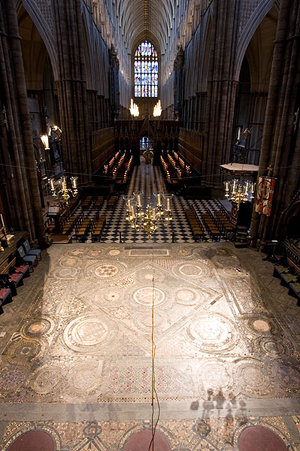
Hidden underneath carpet and a layer of grime for years, this unique medieval “carpet of stone” before the High Altar of Westminster Abbey can now be seen in all its glory, thanks to two years of restoration works.

Laid down in 1268 on the orders of King Henry III who, 23 years earlier had started rebuilding the abbey in the new Gothic style, it was created by a team of workmen from Rome headed by a man called Odoricus.

The decision to create the pavement was apparently taken after the Abbot of Westminster, Richard de Ware, visited the Pope, saw a newly made pavement in His Holiness’ summer residence, and thought it would be just the ticket for the abbey.

The pavement, described by one writer as a “prayer set in stone”, takes its name from ‘Cosmati’ work which describes the type of inlaid stone decoration used in its making (Cosmati work, in turn, was named after one of the families that specialised in it).

Made from rare marbles, gemstones and even glass (with some pieces recycled from earlier projects), the design is abstract. Unlike Roman and earlier medieval mosaic work which tended to feature stones cut into squares of equal sizes, it features stones of various colors and sizes cut into a range of different shapes which create a geometric pattern and is believed to symbolise the world, the universe and the end of both.

In this regard, the pavement also features three brass inscriptions, now damaged, which refer to the end of the world and suggest that at the time of its creation, there were 19,683 years left to go. The inscriptions, which also express the date of its making in a most unusual style, are a unique feature of the pavement and are not found on other Cosmati works.

The pavement has recently undergone a two year restoration program, now completed, which has removed the dirt and stains which had covered it – this was in part caused by the thick carpets which have covered it for the most of the 150 years.

WHERE: Westminster Abbey, Westminster (nearest Tube station is Westminster or St James’s Park); WHEN: Open to tourists everyday except Sunday  (times vary so check the website); COST: £15 an adult/£12 concessions/£6 schoolchildren (11-18 years), free for children aged under 11/£36 for a family (two adults, two children); WEBSITE: www.westminster-abbey.org

PICTURE: Copyright: Dean and Chapter of Westminster.

Treasures of London – The Great Vine at Hampton Court Palace

PICTURE: Historic Royal Palaces/newsteam.co.uk

In the first in a series looking at some of the treasures held in museums, galleries and other collections London along with some of the more unusual things you’ll find in the city, we’re heading out to the southwest of the city firstly to Hampton Court Palace and what is perhaps a lesser known treasure, the Great Vine.

Claimed to be the oldest and largest vine in the world, it was believed to have been planted by Lancelot ‘Capability’ Brown around 1768 and has prospered ever since, now being an astonished 12 foot (3.65 metres) around the base and boasting ‘rods’ of up to 120 metres in length.

The vine, which is housed in a purpose-built greenhouse in the gardens, still produces a whopping 22o to 32o kilograms (500 to 700 bunches) of black, sweet grapes annually (you can even buy the grapes in Hampton Court’s Garden Shop – they’ve been sold to the public since the 1930s), although this is well down on the 2,245 bunches of grapes picked in 1807.

WHERE: Hampton Court Palace, East Molesey, Surrey (nearest station is Hampton Court from Waterloo); WHEN: 10am to 6pm everyday (winter hours 10am to 4.30pm from 31st October to 26th March); COST: Adult £15.40, Concession £12.65, Child under 16 £7.70 (under fives free), family tickets, garden only tickets and online booking discounts available; WEBSITE: www.hrp.org.uk/HamptonCourtPalace/