Curious London memorials – 6. The Buxton Memorial Fountain

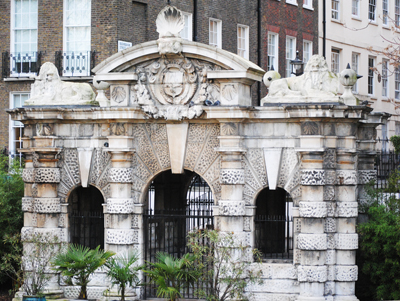
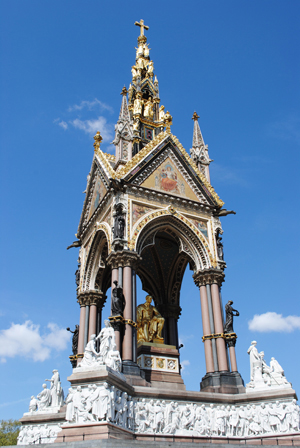
Standing in Victoria Tower Gardens at the southern end of the Houses of Parliament, not far from more high profile monuments such as Rodin’s The Burghers of Calais, is a memorial to those who fought for the emancipation of slaves.

The gothic memorial, designed by Samuel Sanders Tuelon, was erected in 1865 by MP Charles Buxton to commemorate the work of his father, Sir Thomas Fowell Buxton and his associates including William Wilberforce, Thomas Clarkson, Zachary Macaulay, Henry Brougham, and Dr Stephen Lushington – all of whom played important roles in the eventual passing of the 1833 Slavery Abolition Act.

Sir Thomas, a founding member of the Anti-Slavery Society along with Wilberforce and Clarkson, took over as leader of the abolitionist movement in parliament after Wilberforce retired in 1825.

The memorial, which looks a little like a smaller version of the Albert Memorial (without the figure within) and is actually a public drinking fountain, was originally erected in Parliament Square but was removed in 1949 and placed in its current location in 1957, marking the 150th anniversary of the 1807 Act which abolished the trans-Atlantic slave trade.

The memorial originally bore eight statues representing the rulers of Britain from the Roman era to Queen Victoria but these were long since stolen. It as restored by Royal Parks in the mid-Noughties and unveiled again on the 27th March, 2007, to commemorate the 200th anniversary of the same act.

PICTURE: © Giles Barnard

Daytripper – St Albans

An ancient town with a history of settlement that goes back to the Romans, St Albans is these days known not only for its Roman ruins but as the home of Britain’s longest cathedral (and one of the country’s oldest pubs!)

Settled by the Romans and known then as Verulamium, St Albans was Britain’s second largest Roman settlement after London. Destroyed in the Boadicean rebellion, of 60-61 AD, it was rebuilt but declined after the Romans withdrew in 410 before gradually regaining prominence in the later Saxon and then early medieval ages.

The town, which had been known by the Saxon name Verlamchester after the Romans left, was subsequently named St Albans after the Christian martyr Alban who was believed to be executed by the Romans sometime in the 3rd century for his faith and whose shrine was attracting increasing interest from pilgrims.

The town, which continued to attract pilgrims through the medieval period, subsequently played an important role during the Wars of the Roses – with two battle fought there – but wasn’t directly affected by the later English Civil War. These days, given its location only some 22 miles north of London, it’s easy to reach by car or rail.

As might be expected given it’s prominence during the Roman era, St Albans today boasts a plethora of Roman ruins including the excavated remains of a former theatre on the town’s outskirts (it suggested this could have had seating for as many as 7,000 spectators, most of the town’s then population) as well as what’s left of the Roman wall and an exposed hypocaust and mosaic floor now located in a purpose-built building in the middle of Verulamium Park. On the edge of the park, which covers much of what was the Roman town, there’s also a terrific museum (the Verulamium Museum) with artefacts from the period as well as reconstructed rooms.

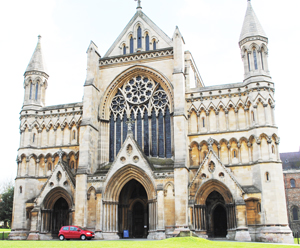
Towering over the town is another reminder of the city’s past – the Cathedral and Abbey Church of St Alban (pictured). Completed in about 1115, it has the longest nave of any cathedral in England and also hosts St Alban’s Shrine – a rare survivor dating from 1308, it still contains some of the martyr’s remains.

The only other piece of the abbey which survives from medieval times is the Great Gatehouse which dates from the 1360s and has served, among other things, as the town gaol. The grounds around the cathedral are these days pleasant parklands -among the graves is that of the former Archbishop of Canterbury (and former Bishop of St Albans), Robert Runcie.

Other medieval survivors in the town are the Clock Tower – built between 1403-1412, it’s one of only two “curfew towers” left in the country (you can now climb it for a great view of the surrounding area), and Ye Olde Fighting Cocks, believed by some to be England’s oldest surviving pub. Not far from here is Sopwell Nunnery, actually the remains of a Tudor mansion built in around 1560 by Sir Richard Lee on the site of what was a nunnery.

The town’s history is also on show in the Museum of St Albans which stands in Hatfield Road opposite the Marlborough Almshouses, built as a gift from Sarah, the 1st Duchess of Marlborough.

The tourist information centre, housed in the Georgian-era Town Hall, has a mini visitor guide which provides a walk through the town, taking in many of its historic sites – perfect if you’ve only got a day to spend there!

What’s in a name?…Covent Garden

Now a favored place for people-watching among Londoners and visitors alike, Covent Garden takes its name from the ‘Convent Garden’ which occupied the site in medieval times.

The ‘convent garden’, said to be a 40 acre kitchen garden, belonged to the Abbey or ‘Convent’ of St Peter in Westminster (Westminster Abbey was once the church of this religious foundation) which owned the site from the 13th century until 1548 when the land passed into control of King Henry VIII during the Great Dissolution.

He granted much of the land to John Russell, the 1st earl of Bedford, and it was the 4th earl, Francis Russell, who commissioned Inigo Jones to design a great public square. The new square featured grand houses along the northern and eastern sides and a church – St Paul’s (pictured right) – on the west while to the south, between the square and the Strand, stood the mansion of the Bedford family.

A fruit and vegetable market was licensed in 1670 but its growth – and the development of other squares offering a much greater level of privacy – led the wealthy who had originally occupied the houses to move elsewhere. The market, meanwhile, continued to grow and in the 1830s, the main market building which still stands there today was constructed.

Further buildings followed in the 1800s and the market continued to occupy the site until as recently as 1973 when it was finally moved out to Nine Elms and the area began a transformation into the shopping precinct it now is.

Treasures of London – The ‘Old Lion’ Maidenhair Tree, Kew Gardens

Celebrated in the 2002 list of 50 “Great British Trees”, the Maidenhair Tree is one of a number at Kew Gardens known as an “Old Lion” – the name collectively given to the few remaining trees with a planting date of 1762.

The Gingko biloba or Maidenhair Tree was one of the first of its species to be planted in Britain and, along with the other ‘Old Lions’, was brought from the Twickenham estate of the Duke of Argyll in 1762.

It was planted in what was then a new five acre arboretum laid out by William Aiton, employed as the gardener at the first botanic garden at Kew (this was established in 1759 at the behest of Princess Augusta, wife of Frederick, Prince of Wales – who had died in 1751 – and mother of King George III, and John Stuart, 3rd Earl of Bute).

Originally located against the wall of the ‘Great Stove’ glasshouse to provide it with protection, the tree has stood alone since 1861 when the glasshouse was demolished. It can now be found adjacent to the Wisteria arch close to the Secluded Garden Conservatory. Several further Gingko trees were planted in the garden in 1773 under the direction of botanist Sir Joseph Banks.

The other four ‘Old Lions’ at Kew are a False Acacia (Robinia pseudoacacia), an Oriental Plane (Platanus orientalis), a Caucasian Elm (Zelkova carpinifolia), and a Pagoda Tree (Sophora japonica).

WHERE: Kew Gardens (nearest tube station is Kew Gardens); WHEN: 9.30am to 4.15pm daily (check closing times for glasshouses); COST: £13.90 adults; £11.90 concessions; children under 17 free; WEBSITE: www.kew.org.

Around London – Year of the Rabbit celebrations; virtual art galleries; and, to the moon and back on ‘Boris bikes’

London will celebrate Chinese New Year this Sunday as it once again hosts the largest celebrations outside of Asia attracting some 250,000 people from around the globe. The event programme, which celebrates 2011 as the Year of the Rabbit, kicks off at 11am on the main stage in Trafalgar Square with firecrackers at noon, a Lion and Dragon performance at 1.10pm and dance and song during the afternoon culminating in a finale just before 6pm. There will also be a stage in Shaftesbury Avenue with performances throughout the day. Roads in the area will be closed for the event.

You no longer have to be in London to walk through the galleries of the Tate Britain or the National Gallery. Both institutions are among 17 around the world taking part in the Google Art Project which allows web surfers to virtually “walk” around the museum using the organisation’s Street View technology and turn 360 degrees to view the artworks in situ on the walls. The project also allows viewers to look through images of more than 1,000 artworks and, in addition, each institution has selected one artwork which then captured in “super high resolution” and then placed on line (Hans Holbein’s The Ambassadors‘ for the National Gallery, Chris Ofili’s No Woman, No Cry for the Tate). See www.googleartproject.com for more.

Cyclists have ridden the distance to the moon and back 13 times – 10 million kilometres – since the launch of Mayor Boris Johnson’s cycle scheme. Transport for London released figures this week showing riders have made more than 2.5 million journeys on the “Boris bikes” since the scheme was launched six months ago. The TfL has announced plans to expand the Barclays Cycle Hire scheme to new areas of east London including all of the Borough of Tower Hamlets, North Shoreditch, Bethnal Green, Bow, Canary Wharf, Mile End and Poplar by spring 2012. Almost 110,000 people are now signed up to the scheme. www.tfl.gov.uk.

The youngest Spitfire pilot in the Battle of Britain is to be granted the Freedom of the City of London in a special ceremony next month. Squadron Leader Geoffrey Wellum was awarded the Distinguished Flying Cross for his service in a front line squadron during the battle.

Curious London Memorials – 5. Eros (or the Shaftesbury Memorial Fountain)

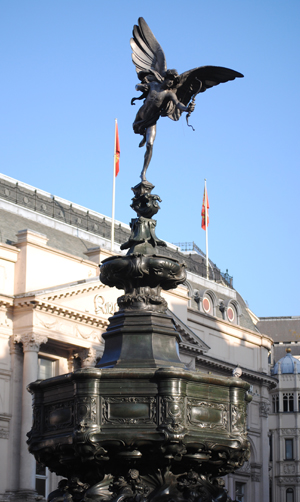
Situated in the heart of Piccadilly Circus, the Eros statue has become an icon of London. Yet few of those who cluster around this iconic figurine realise that the aluminium statue (a rarity in itself) is actually a memorial, not to mention that it wasn’t intended to represent Eros at all.

The monument – which also features a bronze fountain below – was erected in the late nineteenth century to commemorate Anthony Ashley-Cooper, the 7th Earl of Shaftesbury and a well-regarded Christian reformer and philanthropist of the Victorian era, and is formerly known as the Shaftesbury Memorial Fountain.

Designed by Alfred Gilbert and unveiled in 1893, the winged figure holding a bow was apparently actually intended to represent Eros’ brother, Anteros – a Greek god associated with selfless love as opposed to his brother Eros, who is associated with erotic love – and, according to some, bore the name The Angel of Christian Charity, which makes sense given the man whom it is intended to commemorate.

While the statue attracted controversy when it was first unveiled thanks not least to its nudity, it has stood in Piccadilly Circus ever since (or at least mostly ever since – there have been a couple of brief periods such as when it was moved while Piccadilly Underground station was built and during World War II when it was moved for safe-keeping). It was restored in the 1980s.

A copy of the fountain and statue by Gilbert was later placed in Liverpool’s Sefton Park.

LondonLife – Jonquils in Bow Lane

Jonquils add a splash of color on a grey day during a busy lunchhour in Bow Lane in the City. Bow Lane runs from Poultry down to the junction of Queen Victoria and Cannon Streets.

Where’s London’s oldest…underground line?

The city’s first underground line – and the first underground line in the world – was the Metropolitan Line, which opened in 1863 with the aim of helping to reduce London’s growing traffic congestion problem.

Running for three miles, the new railway, constructed by the Metropolitan Railway Company, ran for three miles under New Road, from Paddington to Farrington Street and took three years to build.

It was constructed using a technique known as “cut and cover” which involved digging a trench and building a tunnel inside before covering it back up.

Almost 40,000 passengers journeyed between Paddington and Farringdon on the day it opened, with the journey taking about 18 minutes.

The success of the new railway sparked a flurry of interest and in 1868, the first section of the District Line was opened, the same year the St John’s Wood Railway Company opened a line from Baker Street to Swiss Cottage.

Having grown substantially since it’s earliest days, today only six miles (9.7 kilometres) of the Metropolitan Line’s 41.5 miles (66.7) kilometres actually run underground.

The line now carries about 53 million passengers annually and 49 trains operate on it during peak periods.

Lost London – York Watergate

There’s several places along Victoria Embankment where it’s possible to see where the River Thames bank stood before the massive mid-19th century project to reclaim land. Not the least of them is located in the downstairs foyer to Somerset House, where looking through the glass floor, you can see the pebbles of the original riverbank.

Another is York Watergate, once the river entrance to the Duke of Buckingham’s London mansion, and now stranded some distance from the water in Victoria Embankment Gardens.

The mansion, known as York House, was originally located on the southside of the Strand. Originally built in the 13th century, it was later acquired by King Henry VIII and granted to the Archbishop of York, Nicholas Heath, in 1556 (hence its name). The house became the home of George Villiers, the first Duke of Buckingham and somewhat sycophantic favorite of King James I, in the early 1620s.

When the duke was stabbed to death in 1628, the property passed to his son, the second Duke of Buckingham (also George), who later sold it to a land developer. It was apparently as a condition of the sale that the streets there now include the duke’s full name – hence George Court, Villiers Street, Duke Street, the slightly ludicrous Of Alley, and Buckingham Street.

The impressive Italianate watergate, which stands below the junction of Buckingham Street and Watergate Walk just a short walk into the gardens from Embankment tube station, was designed by the irrepressible Inigo Jones and built in 1626. Though weathered, it still bears the coat of arms of the Duke of Buckingham on the front.

Around London – New fourth plinth sculptures announced; Australian Season at British Museum; and Kenwood House shows off gardens…

• Sculptures of a child on a rocking horse and a giant blue cockerel will occupy Trafalgar Square’s fourth plinth in 2012 and 2013 respectively, it was announced late last week. The Mayor of London, Boris Johnson, described the artworks as “witty and enigmatic creations”. The first proposed first sculpture, correctly titled Powerless Structures, Fig. 101, is the creation of Elmgreen & Dragset while the second, Hahn/Cock, is that of Katharina Fritsch. The plinth is currently occupied by Yinka Shonibare’s Nelson’s Ship in a Bottle. See www.fourthplinth.co.uk.

The British Museum has announced it will be holding a series of exhibitions and events focusing on Australia later this year. Highlights of Australian Season will include Australia Landscape: Kew at the British Museum (21st April to 16th October), an exhibition of prints and drawings dating from the ‘Angry Penguin’ school of the 1940s through to the rise of Aboriginal printmaking (Out of Australia: prints and drawings from Sidney Nolan to Rover Thomas, from 26th May to 11th September), and an exhibition focusing on indigenous Australian baskets (Baskets and belong: Indigenous Australian histories, 26th May to 29th August). See www.britishmuseum.org.

On Now: Kenwood House in Hampstead is hosting a new exhibition, The Gardens of English Heritage. The exhibition, which is based on the publication of the same name, features stunning images of some of the UK’s most impressive gardens.Runs until 3rd April. For more information, see www.english-heritage.org.uk/daysout/properties/kenwood-house/

Curious London Memorials – 4. The Suffragette Memorial

Tucked away in a corner of Christchurch Gardens, opposite New Scotland Yard in Victoria Street, St James, this memorial was only erected in 1970.

Designed to resemble an uncurling scroll, the bronzed glass fibre scroll – designed by Edwin Russell – was put there by the Suffragette Fellowship (a group which was founded in 1926 to commemorate the suffrage movement of the early 20th century) and dedicated to the “courage and perseverance of all those men and women who in the long struggle for votes for women, selflessly braved derision, opposition and ostracism, many enduring physical violence and suffering”.

The monument, which is located near Caxton Hall – a now-listed building opened as the Westminster Town Hall in 1883 and “historically associated with women’s suffrage meetings”, was unveiled by former campaigner and hunger-striker Lillian Lenton.

While we’re on the subject of women’s suffrage, we should also mention the memorial to the most prominent member of the early 20th century women’s suffrage movement, Emmeline Pankhurst (1857-1928). Located not far away in Victoria Tower Gardens, right under the shadow of Victoria Tower at the southern end of the Houses of Parliament, stands a 1930 statue of the suffrage leader, who was imprisoned for her stand.

The statue is accompanied by two bronze medallions – one commemorating Mrs Pankhurst’s daughter and suffragette, Dame Christabel Pankhurst (1880-1958), and the other showing the badge of the Women’s Social Political Union (WSPU).

It’s Burns Night…

It’s Burns Night so to celebrate we thought we’d take a very quick look at some of the more Scottish-related parts of London…

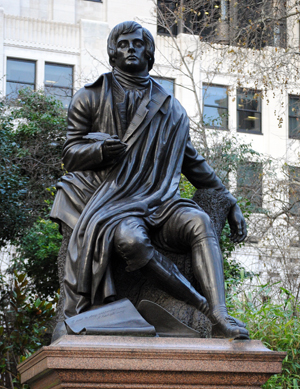
First up is the poet Robert Burns himself (picture right). A grand statue of the celebrated Scot, an 1884 bronze by John Steell, stands in Victoria Embankment Gardens.

The Scotland Office. Located in Dover House, Whitehall. The core of the building, designed by James Paine, was built in the 1750s and passed through several hands until it became the now defunct Scottish Office in 1885. It’s been home to the Scotland Office since 1999.

Crown Court Church in Covent Garden is the longest-established Church of Scotland church in England. The church’s origins go back to the early 1700s with a church on the current site since 1719. The current building dates from 1909.

St Columba’s in Knightsbridge. Another of  the eight churches within the Church of Scotland’s Presbytery of England, this church was rebuilt after the original was destroyed during the Blitz.

• Among the many places where you can celebrate Burns Night in London is the modern bar and restaurant Albannach in Trafalgar Square and, for those who prefer something more traditional, the Boisdale of Belgravia in Ecclestone Street, Belgravia (founded by the son of the 24th chief of Clanranald).

Any others you’d like to tell others about?

What’s in a name?…Isle of Dogs

Located in a great bend of the River Thames to the east of the City, the Isle of Dogs isn’t really an isle at all but a broad peninsula of land jutting out to the south of Poplar, opposite Greenwich.

Formerly known as Stepney Marsh, for centuries the area was protected by a great embankment and in the 13th and 14th centuries came to be home to a small agricultural community. After the embankment was breached, however, the area reverted to marshland and only came back into more intensive use with the opening of the West India and East India docks in the early 1800s (amalgamated in 1838) and Millwall Dock in the 1860s. The linking of these docks in the early 1900s apparently made the “isle” an island for the first time.

At the same time, the area also became noted for shipbuilding – among the vessels constructed here was Isambard Kingdom Brunel’s SS Great Eastern, the biggest ship ever built when launched in the late 1850s.

The population of the area rose thanks to the docks and by 1901 – following the development of Cubitt  Town, named for developer William Cubitt – the population had risen to 21,000. Heavily bombed in World War II, the isle saw a resurgence in the Fifties and Sixties but gradually declined in the following years as new shipping technologies made the docks obsolete. The last of the docks closed in 1980.

The area has since been redeveloped in a project initially driven by the London Docklands Development Corporation and is now in effect a city within a city, housing homes, apartments, retail precincts and office buildings – including One Canada Square, the highest tower in London, at Canary Wharf (the highest tower in London until recently surpassed by the currently-under-construction Shard in Southwark), linked to the rest of the city via the Docklands Light Railway (DLR).

But what about the name Isle of Dogs? One theory is that it was here King Henry VIII kept his hunting dogs (the earliest reference to the Isle of Dogs is apparently on a map dated 1588) while others suggest the name comes from dogs King Edward III kept there. Others have suggested the name is a corruption of ‘Isle of Ducks’, that the area is named for packs of dogs who roamed wild in the marshlands here or that it comes from the fact dead dogs washed up on banks of the Thames here. As for which is the truth? Take your pick.

Tower Hamlets, the local authority, offers a great free walk through the area which gives you a glimpse into its history. See http://bit.ly/dRzcP9.

Treasures of London – The Crown Jewels

No series on the treasures of London would be complete without a mention of the Crown Jewels, housed – except when being used – under tight security in the same place they’ve been since the early 1300s – the Tower of London.

The jewels, which are described as a ‘working collection’, include the coronation regalia and feature some 23,578 gems  – the Imperial State Crown alone boasts 2,868 diamonds, 273 pearls, 17 sapphires, 11 emeralds and five rubies.

The regalia itself is made up of the crowns of the sovereigns, consorts and Princes of Wales as well as sceptres, orbs, rings, swords, spurs, bracelets, robes, and the oldest piece, a 12th century anointing spoon.

It and three steel coronation swords are the only pieces to survive the destruction of all the pre-Civil War regalia in 1649-50, carried out at the behest of Oliver Cromwell following the execution of King Charles I (many of the earlier crown jewels, dating from the Anglo-Saxon period, had already been replaced in the early 13th century after items were lost while being taken across The Wash during the reign of King John in 1216).

Following Cromwell’s destruction, new regalia was made on the orders of King Charles II. Modelled on that of his father, it was used in the king’s coronation on 23rd April, 1661, and cost more than £12,000.

Today, St Edward’s Crown – with which the sovereign is crowned by the Archbishop of Canterbury – is the principal piece of the regalia. Other items include the Sovereign’s Sceptre, topped with 530 carat First Star of Africa – the largest flawless cut diamond in the world, Queen Victoria’s small diamond crown, and the Imperial Crown of India. There is also a crown made for Queen Elizabeth, the Queen Mother, for her 1937 coronation which features the famous Koh-i-Nur (‘Mountain of Light’) diamond.

Until 1303, the Crown Jewels had been housed at Westminster Abbey. Following a successful robbery that year, however (after which most items were recovered), they were moved to the Tower.

The most famous attempt to steal the Crown Jewels was made by an Irishman, Colonel Thomas Blood, in 1671. He and his gang had arranged to see the jewels (this could be done for a fee) but when they arrived, used a mallet to knock out the jewel keeper before stabbing him.

Colonel Blood had hidden King Charles II’s crown under his cloak, squashing its arches of in the process, while his companion Robert Perot had stuck the coronation orb down his breeches and Blood’s son was in the process of sawing the sceptre in half when the keeper’s son returned unexpectedly and raised the alarm.

Arrested, Blood got off rather lightly – King Charles II decided, apparently for some unknown reason, to pardon him. Security around the jewels, however, was tightened – iron bars were used instead of wooden ones and people were thenceforth forbidden from handling the jewels.

The Crown Jewels are now housed in the Jewel House at the Tower, built in 1967 in the west wing of the Waterloo Barracks, and guarded by the Yeomen Warders.

WHERE: Tower of London (nearest tube station Tower Hill); WHEN: 9am to 4.30pm, Tuesday to Saturday, 10am to 4.30pm Sunday to Monday (until 28th February); COST: £18.70 adults; £10.45 children under 15; £15.95 concessions; £51.70 for a family (prices, which include a voluntary donation, are valid until 28th February); WEBSITE: www.hrp.org.uk/toweroflondon/. For more on the Crown Jewels, see www.royal.gov.uk/MonarchUK/Symbols/TheCrownJewels.aspx or the Royal Collection website, http://bit.ly/i9FM3

Around London – Composer Herbert Howells honored; London Eye’s new name; and, the Natural History Museum’s new gallery…

Composer and teacher Herbert Howells has been commemorated with a blue plaque on his former home in Barnes, south west London. Known for composing “recognisably English” works, Howells is considered by man to be the last of the great English Romantic composers and is particularly remembered for this contributions to the Anglican liturgy. According to English Heritage, Howells lived at the house at 3 Beverley Close from 1946 until a few weeks before he died in 1983. For more on Howells, see www.howellstrust.org.uk.

The London Eye is to have a name change. Having started life as the Millennium Wheel (while still under construction), it was officially named the British Airways London Eye when it first opened in March 2000 and later renamed the Merlin Entertainments London Eye when the BA naming deal expired. Following a new deal, the wheel will be known as the EDF Energy London Eye from the end of this month.

On Now – The Natural History Museum’s new Images of Nature gallery opens tomorrow. The new permanent gallery showcases the museum’s collection of natural history artworks and includes works by bird illustrator, John Gerrard Keulemans, and botanical artist, Georg Ehret as well as a range of more modern-day creations such as a 3D scan of a shark’s head. The gallery also boasts a temporary annual exhibition with the first, a rotating collection of Chinese watercolors, featuring works by 19th century amateur naturalist John Reeves as well as contemporary works by the museum’s Shanghai-based artist-in-residence. Entry is free. See www.nhm.ac.uk.

Curious London Memorials – 3. Charing Cross

Another royalty-related memorial, the Charing Cross – located outside Charing Cross railway station – is actually an embellished Victorian replica of one of a series of medieval memorials the apparently heartbroken King Edward I had erected in memory of his wife, Eleanor of Castile.

The original cross, which was originally located in the south of Trafalgar Square at Charing, was one of 12 built between 1291 and 1294 to mark the nightly resting places of the Queen’s funeral procession as it made it way from Lincoln to Westminster Abbey where she was buried.

The Queen had died at Harby near Lincoln in 1290 while on her way to meet her husband in Scotland. The original monument was demolished in 1647 by Parliamentary order. A plaque on the site indicates it is the point from where all distances on road signs to London were measured.

Only three of the original 12 crosses still stand – at Waltham Cross, Northampton and Geddington – although some remnants of others can be seen. Another London cross – in Cheapside – was demolished in the mid 1600s.

The Victorian era replica outside Charing Cross station dates from 1865. It was unveiled last year following a five year restoration project.

Famous Londoners – Sherlock Holmes

The world’s most famous detective, Sherlock Holmes is one of London’s most widely known characters.

While Holmes’ early life is something of a mystery, it is known that he lived at his most famous address, 221B Baker Street, from 1881 until his retirement in the early 1900s (when he moved to Sussex and took up beekeeping). It was from there that he lived and worked along with his colleague, Dr John H. Watson (Dr Watson lived with Holmes at the address both prior to his marriage and following his wife’s death).

Baker Street is these days home to the Sherlock Holmes Museum where the rooms have been reconstructed as they would have been in Holmes’ day – including his famous study where you can sit in his chair by the fire – and filled with artefacts from his many cases (there is however some confusion over the address as the current location of 221B Baker Street is located in what was, prior to the 1930s, known as Upper Baker Street).

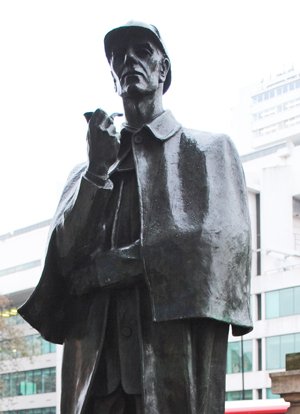
Nearby – just out the front of the Baker Street tube station – stands a statue of Holmes, commissioned by the Sherlock Holmes Society in 1999 and sculpted by John Doubleday (see picture).

Holmes has numerous associations with locations and buildings in London and while there’s far too many to mention here, there are a couple of addresses worth noting. Among them is:

• the Criterion Restaurant at 224 Piccadilly, site of Holmes’ and Watson’s first meeting on New Year’s Day, 1881 (there’s a commemorative wall plaque inside);

• the former site of Scotland Yard, headquarters of the metropolitan police, in the Westminster street now called Great Scotland Yard;

• the Sherlock Holmes pub, just off Northumberland Avenue near Craven Avenue – formerly known as the Northumberland Arms, it featured in the book The Hound of the Baskervilles and now contains a large collection of Sherlock Holmes memorabilia;

• the historic restaurant Simpson’s-in-the-Strand at 100 Strand, where Holmes and Watson dined;

• and, The Royal Opera House in Covent Garden – one of Holmes’ favorite ways to pass the time.

Holmes’ contribution to the art of detection has rippled across the globe and following the first recounting of his exploits in the 1887 book A Study in Scarlet, his deeds have provided the inspiration for countless books, films, and TV series.

LondonLife – 200th anniversary of Mexican independence marked in Westminster

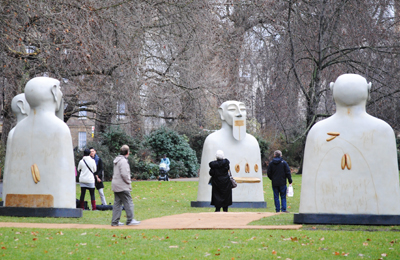
Curious onlookers examine a series of giant sculptures in Victoria Tower Gardens, next to the Houses of Parliament in Westminster. The work of Mexican artist Rivelino, ‘Nuestros Silencios’ (Our Silences), will be on display until 11th February. The 10 giant bronze busts each weigh over a ton and are being displayed in London as part of a European tour celebrating the bicentenary of Mexican independence and the centenary of the Mexican Revolution.

Around London – City’s history goes online; London’s oldest structure discovered?; and, my, how prices have changed…

• Four hundred years of London’s history is being put online as part of a new project on the City of Westminster’s website. The council is publishing a new picture depicting a different historical event from the city’s tumultuous history every day throughout 2011 under its A date with history project. The images, taken from the council’s archives, include photographs, engravings and sketchings. They include a black and white photo of queues of people waiting on Vauxhall Bridge to pay their final respects to King George V lying in state at Westminster Hall after his death on 20th January, 1936, another photograph showing the King and Queen with PM Winston Churchill inspecting damage to Buckingham Palace’s swimming pool following a raid during the Blitz in September, 1940, a hand-colored print depicting the execution of King Charles I on 30th January, 1649, and an engraving showing a comet passing by the spire of St Martin in the Field in 1744. It is the first time the images have been made freely available online. To see the images, head to www.westminster.gov.uk/archives/day-by-day.

What could be London’s oldest structure has been unearthed on the Thames foreshore. Six timber piles up to 0.3 metres in diameter have been discovered only metres from the MI6 headquarters in Vauxhall, part of what archaeologists believe is part of a prehistoric structure which stood on the river bank more than 6,000 years ago during the Mesolithic period when the river was lower. The find, made by a Thames Discovery Programme team, is only 600 metres away from a Bronze Age timber bridge or jetty dating from 1,500 BC which was discovered in 1993. The piles may be able to be seen from Vauxhall bridge during low tides between 10.25am on 22nd January and 11.15am on 23rd January.

Homes in London were purchased for an average price of £14,000 back in 1910, according to land tax valuations documents released online this week. Ancestry.co.uk has placed the London, England Land Tax Valuations 1910 – compiled as part of David Lloyd George’s 1910 Finance Act, known as the Domesday Survey – online to help people discover more about the financial situations of their ancestors. The documents put the value of the Bank of England at £110,000, the Old Bailey at £6,600, and Mansion House at a more impressive £992,000. The average value of property on Fleet Street was £25,000 (compared with £1.2 million today) while in Cannon Street, the average value was £20,000 (£2.2 million) and in Chancery Lane, the average value was just £11,000 (£1.1 million).

Curious London memorials – 2. The Albert Memorial

No list of London’s memorials could ever be complete without mentioning the extravagant Albert Memorial in Kensington Gardens.

Completed in 1876 at a cost of £120,000, the monument – officially known as the Prince Consort National Memorial – was commissioned by the Queen after Prince Albert died of typhoid in 1861. Queen Victoria, devastated at his loss and wanting a public memorial for Albert, invited seven leading architects to submit designs. In the end she chose the designs of Sir Gilbert Scott which featured an ornate canopy and spire standing to a height of 176 feet (54 metres) over a larger-than-life gilded bronze figure of Prince Albert sitting in regal splendour.

The resulting memorial – described “visual feast” – is an exemplar monument of the Victorian era’s Gothic Revival style. It highlights Albert’s role as a patron of the arts. Around the base of the podium is a frieze containing images of sculptors, composers, painters, architects and poets while at the four corners of the canopy are four clusters of statuetry relating to agriculture, commerce, engineering and manufacturing.

Further out, on the corners of the base, stand another four groups of statues – these relate to the continents of Europe, Asia, America and Africa. The canopy itself features mosaics and statues depicting historical figures associated with the arts as well as statues depicting the artistic and scientific disciplines, and angels and virtues.

The statue of Albert, sculpted by John Henry Foley, gazes benevolently towards Royal Albert Hall – another monument dedicated to the Prince Consort – and holds in its hand a catalogue of the Great Exhibition of 1851 (Albert was a key player in the exhibition’s organisation).

The monument, which was apparently used as a landmark by German bombers and Zeppelin pilots in World War I, underwent an extensive restoration in the 1990s which involved dismantling its entire upper half and then reassembling it.

While entry to the memorial is free, there are paid for tours available for those keen to find out more about the monument. For more information about the tours, see www.royalparks.org.uk/parks/kensington_gardens/tours/index.cfm.

WHERE: Kensington Gardens (nearest tube station is High Street Kensington or South Kensington); WHEN: Accessible when the park is open (6am to dusk) but it can be seen from Kensington Gore; COST: Entry is free (there are paid tours, see above); WEBSITE: Royal Parks has a page on its website, www.royalparks.org.uk/parks/kensington_gardens/tours/index.cfm.