10 atmospheric ruins in London – 4. Spitalfields Charnel House…

Located under glass beneath a modern square just to the north-east of the line of the City of London’s walls are the ruins of a medieval building which once held human bones.
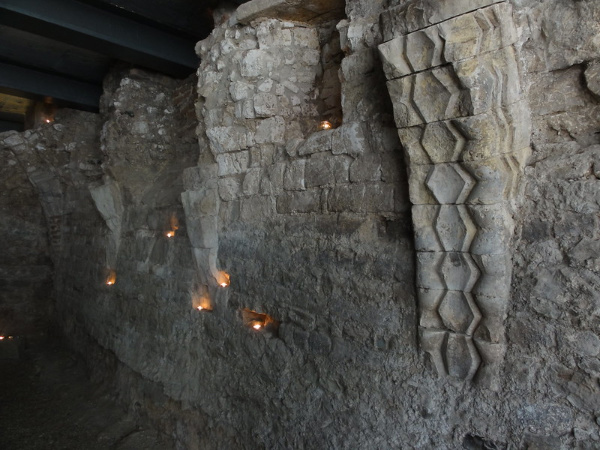
Charnel House detail. PICTURE: Ben Rimmer (licensed under CC BY-NC-ND 2.0)

Built on what had originally been a Roman burial ground, the medieval hospital known as St Mary Spital was constructed towards the end of the 12th century and a graveyard was located on the site for the burial of those who died there.

A small chapel was built on the site in about 1320, the crypt of which became a charnel house housing the bones of those remains disturbed when

The hospital, which had been run by Austin canons, was dissolved by King Henry VIII in 1539 and most of the bones removed. The crypt was later used as a house which was demolished around 1700 and later lost between the gardens of terraced houses.

The remains of the charnel house was discovered in the late 1990s during excavation works – complete with some 10,000 skeletons – and now lies under a glass floor in Bishop’s Square just to the west of Spitalfields Market (it can also be seen through a glass window in the basement level accessed via stairs in the square).
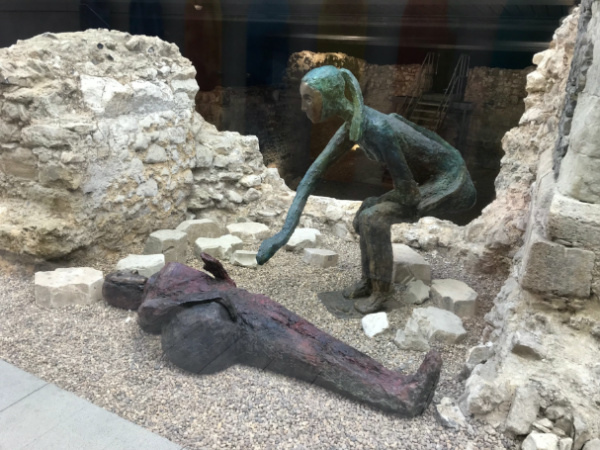
PICTURE: Matt Brown (licensed under CC BY 2.0)

Two statues can be seen inside the ruins – a greenish figure crouching over a prone purple-red figure. Installed in 2014, they are the work of David Teager-Portman and are called Choosing the Losing Side and The Last Explorer.

Spitalfields Chapel and Charnel House, Bishops Square, London, Spitalfields (nearest Tube station is Liverpool Street; nearest Overground is Liverpool Street and Shoreditch High Street).
LondonLife – New Overground lines named to reflect London’s history…

Each of London’s six Overground lines are for the first time being given a new name and colour by which they can be identified.

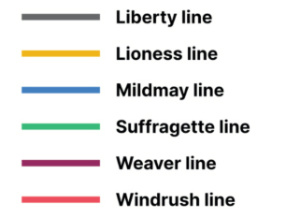
The Overground lines. GRAPHIC: Wiesenpinguin/Wikipedia (detail only)/Public Domain

The new names and colours – which include the Lioness line (yellow), Mildmay line (blue), Windrush line (red), Weaver line (maroon), Suffragette line (green) and Liberty line (Grey) – were chosen through engagement with customers, stakeholders, historians, industry experts and local communities, according to Transport for London.

Mayor of London, Sadiq Khan, described the move as a “hugely exciting moment, transforming how we think about London’s transport network”. 

“Giving each of the Overground lines distinct colours and identities will make it simpler and easier for passengers to get around. In re-imagining London’s tube map, we are also honouring and celebrating different parts of London’s unique local history and culture. 

Each of the new lines’ names reflects an aspect of the city’s culture and history. The Lioness line, which runs from Euston to Watford Junction through Wembly, honours the achievements and legacy of England women’s football team while the the Mildmay line, which runs from Stratford to Richmond/Clapham Junction through Dalston, honours a small charitable hospital in Shoreditch that played a pivotal role in the HIV/AIDS crisis in the 1980s and Windrush Line, which runs from Highbury & Islington to Clapham Junction/New Cross/Crystal Palace/West Croydon, honours the Windrush generation and runs through areas with strong ties to Caribbean communities today, such as Dalston Junction, Peckham Rye and West Croydon.

Meanwhile the The Weaver line, which runs from Liverpool Street to Cheshunt/Enfield Town/Chingford, runs through areasknown for their textile trade such as Liverpool Street, Spitalfields, Bethnal Green and Hackney, the Suffragette line, which runs from Gospel Oak to Barking Riverside, celebrates how the working-class movement in the East End fought for votes for woman and paved the way for women’s rights and ends at Barking, home of the longest surviving Suffragette Annie Huggett, who died at 103. The Liberty Line, which runs from Romford to Upminster, celebrates the freedom described as a “defining feature of London” and references the historical independence of the people of Havering, through which it runs.

For more on the new names and colours, see https://tfl.gov.uk/modes/london-overground/overground-line-naming?cid=naming-overground.

What’s in a name?…Basinghall Street…

Looking north up Basinghall Street from Gresham Street. The buildings on the left are part of the Guildhall complex. PICTURE: Google Maps

This City of London street, which sits on the eastern side of the Guildhall complex, is named for the wealthy Basing (or Bassing) family who had a hall here in the 13th century.

The street, which links Gresham Street in the south to Basinghall Avenue in the north, has been the site of numerous prominent buildings including the medieval hall of the Weaver’s Company (demolished in 1856, having replaced an earlier hall which burnt down in the Great Fire of London in 1666, the hall is now located in Gutter Lane), the Cooper’s Company (demolished in 1867, the hall is now located in Devonshire Square) and the Girdler’s Company (destroyed in the Blitz in 1940; the hall is now located in Basinghall Avenue).

It was also the location of the Sir Christopher Wren-designed Church of St Michael Bassishaw until 1899 after it was seriously damaged when the crypt was being cleared of human remains in line with the orders of City authorities. The parish with united with St Lawrence Jewry.

Famous denizens included the goldsmith, banker and civil engineer Sir Hugh Myddelton, most renowned for his design of the New River scheme to bring clean water to the City, who, according to The London Encyclopaedia, would sit in the doorway of his office and smoke his pipe while chatting with the likes of Sir Walter Raleigh.

The family also gave their name to the City of London’s Bassishaw Ward.

This Week in London – Billingsgate Market history explored; new landscapes at Dulwich; and, recovered gems on show…

The history of Billingsgate Market in the City of London is being explored in am exhibition at the City of London Heritage Gallery. Billingsgate Market at the Heritage Gallery features items including the Liber Horn, a compilation of charters, statutes, and customs made by Andrew Horn, chamberlain of the City of London from 1320-1328, in 1311 which is illustrated by small images of fish showing their importance to Londoners, a late 17th century petition by the fishermen protesting the landing of vessels loaded with salt and oranges, 19th century volumes recording the collection of tolls and detailing the licensing of porters, and 20th century photographs of the market at work. Free to view, the display, located in the Guildhall Art Gallery, can be seen until 16th May. For more, see www.thecityofldn.com/billingsgateexhibition

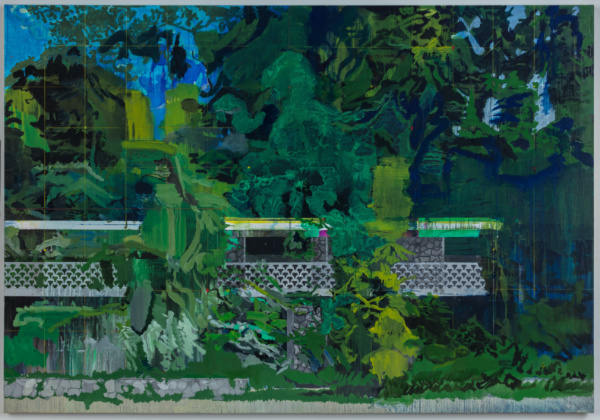
Hurvin Anderson, ‘Limestone Wall’ (2020) © Hurvin Anderson. Courtesy the artist and Thomas Dane Gallery. Photo: Richard Ivey

A major new exhibition featuring new interpretations of landscape art has opened at the Dulwich Picture Gallery. Soulscapes features more than 30 contemporary works spanning painting, photography, film, tapestry and collage by artists such as Hurvin Anderson, Phoebe Boswell, Njideka Akunyili Crosby, Kimathi Donkor, Isaac Julien, Marcia Michael, Mónica de Miranda and Alberta Whittle. Highlights include Anderson’s Limestone Wall (2020), Akunyili’s Cassava Garden (2015) and Donkor’s Idyl series (2016-2020). Runs until 2nd June. Admission charge applies. For more, see www.dulwichpicturegallery.org.uk.

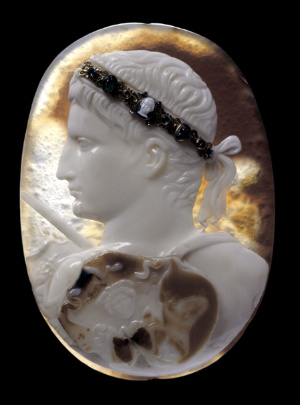
Blacas cameo depicting Augustus – Roman, AD 14–20 1867

A selection of gems recovered after news that around 2,000 objects from the British Museum’s collections were missing, stolen or damaged go on show at the museum from today. Rediscovering gems explores the significance of classical gems – used as seals, worn as jewellery or collected as objects of beauty in the ancient world – and the impression they have left throughout history. The gems are displayed in a typical 18th century gem cabinet, along with a collector’s equipment, in reflection of the huge interest in classical gems during the period. The display can be seen in Room 3 until 15th June. Admission is free. For more, see britishmuseum.org/exhibitions/rediscovering-gems.

Send all items to exploringlondon@gmail.com

10 atmospheric ruins in London – 3. Scadbury Manor…

The manor ruins in Scadbury Park. PICTURE: Ethan Doyle White (licensed under CC BY-SA 4.0)

Located in what is now today known as Scadbury Park in Chislehurst in London’s south-east, Scadbury Manor originally dated from at least the 13th century.

Originally the home of the de Scathbury family, it was purchased by London merchant  Thomas Walsingham in 1424.

It was passed down through the family which had some rather famous members including Sir Francis Walsingham, who was principal secretary to Queen Elizabeth I (who it has been suggested visited the property), and another Thomas Walsingham who in the late 16th century was an MP and the patron of Sir Christopher Marlowe (he is known to have visited the estate just before his death in 1593).

In the 1730s, the moated manor passed into the hands of the Townshend family (the son of the Thomas Townshend who first inherited the property was also named Thomas and become 1st Viscount Sydney and is the person after whom the city of Sydney, Australia, was named).

The old manor house was demolished after passing to the Townshend in 1738, possibly due to falling into disrepair. It’s believed there may have had plans to rebuild but the site was left a ruin and the family moved into nearby Frognal House.

The estate passed through the family to Robert Marsham-Townshend, who in 1914 moved back to Scadbury from Frognal, taking over the farm bailiff’s house and extending it into a substantial family home. He also carried out excavations and repairs on the original manor.

During World War II – on 28th March, 1945 – the last V-1 flying bomb to cause damage landed on the Scadbury farmyard and demolished the medieval barn and surrounding buildings. The country house itself was eventually destroyed in a fire in 1976.

The estate – now 300 acres – was purchased by the London Borough of Bromley in 1983 and opened to the public as a nature reserve.

Some remains of the original manor are still present including the foundations of a brick detached kitchen, with the bases of two ovens, cellars and an undercroft. There are also the remains of a reconstructed manor house Hugh Marsham-Townshend built on the site of the original manor in the early 20th century using medieval timbers from nearby manor house.

The site of the manor house is not normally open to the public but can be seen from a nearby public footpath as well as on open days run by the Orpington and District Archaeological Society (ODAS).

Where: Scadbury Park, Old Perry Street, Chislehurst; WHEN: Opens at 7:30am on weekdays, 9am on weekends; closing times vary depending on the month; COST: Free; WEBSITE: https://www.scadbury-park.org.uk

Where’s London’s oldest…roundabout?

PICTURE: Matt Brown (licensed under CC BY 2.0)

London’s oldest roundabout is said to be located in Southwark at the intersection of Borough, Westminster Bridge, Waterloo, London and Blackfriars Roads.

St George’s Circus was built in 1771 (during the reign of King George III) and designed by Robert Mylne as a grand southern entrance to London with radiating roads leading to three bridges over the Thames: London Bridge, Westminster Bridge and Blackfriars Bridge.

Mylne also designed the obelisk which still stands in the centre of the circus. As well as showing the date on which it was erected, the obelisk also records distances to Palace Yard in Westminster, Fleet Street, and London Bridge. Gas lamps were placed at each corner to illuminate the intersection.

The now Grade II*-listed obelisk has a rather interesting history in itself. Having stood at the roundabout for more than a century, in about 1897 it was relocated to Geraldine Mary Harmsworth Park outside the Imperial War Museum on Lambeth Road to make way for a clocktower designed to mark Queen Victoria’s Diamond Jubilee.

The clocktower itself, however, was removed in the 1930s to help with traffic flow. It wasn’t until 1998 that the obelisk was moved back to its original site (now minus the oil lamps).

Interestingly, an Act of Parliament passed in 1812 specifies that all buildings on the intersection must be located 240 feet from the obelisk (the reason, apparently, for curved facades on some of the surrounding buildings).

This Week in London – Notre Dame de Paris celebrated at the Abbey; remembering “great escapes” of World War II; and, ‘Wildlife Photographer of the Year’…

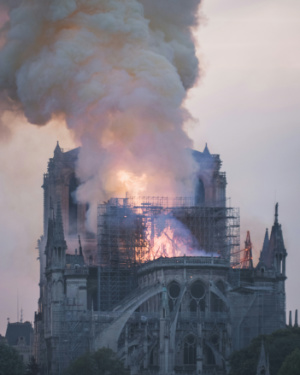
Notre Dame de Paris on fire in 2019. PICTURE: Nivenn Lanos/Unsplash

An immersive exhibition on the cathedral of Notre Dame de Paris, currently being restored following a devastating 2019 fire, opened at Westminster Abbey this week. Notre Dame de Paris, The Augmented Exhibition tells the story of the Gothic masterpiece from the 12th century to today and features a digital recreation of the cathedral by digital heritage specialists, Histovery, in collaboration with Rebuilding Notre-Dame de Paris. The exhibition is being held in the 13th century chapter house of the abbey with visitors, thanks to digital technology, able to witness firsthand the lavish wedding of King Henri IV, the coronation of Napoleon Bonaparte, and the 19th century construction of Notre-Dame’s iconic spire of Viollet-le-Duc. Runs until 1st June. Admission charge applies. For more, head here. The exhibition is part of a season of events at the abbey celebrating the bonds between the UK and France.

An new exhibition focused on the hundreds of thousands of people held captive during World War II has opened at the National Archives in Kew. Great Escapes: Remarkable Second World War Captives, tells the story of famous escape attempts such as the escape from Stalag Luft III known as “the Great Escape” (made famous in the film of the same name) and British officer Airey Neave’s escape from Colditz Castle dressed as a German soldiers well as stories of individuals seeking escape through art, music and finding love while being held. The exhibition is divided into three parts. The first explores the legal framework for the 1929 Geneva Convention governing prisoners and tells the story of MI9, a highly secret British Government agency established in 1939 to help military personnel evade and escape capture. Part two explores the stories from individual prisoners and internees under British, German, and Japanese authority during World War II while part three examines how prisoners were dealt with at the end of the war as well as how the experience of the conflict led to the Geneva Convention being rewritten in 1949. Runs until 21st July. Admission is free. For more, see www.nationalarchives.gov.uk/great-escapes/.

‘Ice Bed’ ©Nima Sarikhani, Wildlife Photographer of the Year People’s Choice Award winner.

An image of a young polar bear drifting to sleep on a bed carved into an iceberg has won the Wildlife Photographer of the Year People’s Choice Award. Nima Sarikhani’s Ice Bed, and the four finalist ‘Highly Commended’ images were selected from a shortlist of 25 images chosen by the Natural History Museum and an international judging panel from almost 50,000 images entered in the 59th Wildlife Photographer of the Year competition. The other finalists include Tzahi Finkelstein’s The Happy Turtle – a meeting between Balkan pond turtle and a northern banded groundling dragonfly, Daniel Dencescu’s Starling Murmuration - which captured the moment a starling murmuration formed the shape of a bird, Mark Boyd’s Shared Parenting in which two lionesses groom a cub in Kenya’s Maasai Mara, and, Audun Rikardsen’s Aurora Jellies which shows two moon jellyfish illuminated by the aurora borealis in a fjord in Norway. The five images can be seen both online and in the accompanying exhibition at the Natural History Museum until 30th June. Admission charge applies. For more, see www.nhm.ac.uk/wpy/peoples-choice.

Send all items to exploringlondon@gmail.com.

10 atmospheric ruins in London – 2. St George’s Garrison Church…

This mid-18th century church in Woolwich was constructed to serve the soldiers of the Royal Artillery but was badly damaged when hit by a bomb during World War II.

View of the church apse with altar and mosaic. PICTURE: Kleon3 (licensed under CC BY-SA 4.0)

Designed by Thomas Henry Wyatt with the aid of his younger brother, Matthew Digby Wyatt, in the style of an Early Christian/Italian Romanesque basilica, the church was built between 1862 and 1863 on the orders of Lord Sidney Herbert, the Secretary of State for War.

It was among a number of buildings built to provide for the well-being of soldiers after a public outcry about their living conditions during the Crimean War.

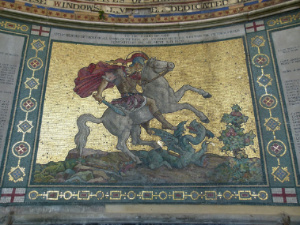
The interior featured lavish decoration including mosaics said to have been based on those found in Roman and Byzantine monuments in Ravenna, Italy. Those that survive at the church’s east end – which include one of St George and the Dragon and others featuring a peacock and phoenix – are believed to have been made in Venice in the workshop of Antonio Salviati.

A mosaic featuring St George and the Dragon. PICTURE: Kleon3 (licensed under CC BY-SA 4.0)

The mural of St George formed part of a memorial to the Royal Artillery’s Victoria Cross recipients located in the church and paid for through public subscription in 1915. The interior also featured five tall stained glass windows which served as memorials to fallen officers.

Plaques on the perimeter walls record the names of soldiers killed in military conflict or Royal Artillery servicemen who died of natural causes. 

The church was visited by King George V and Queen Mary in 1928.

The church, which had survived a bombing in World War I, was largely destroyed on 13th July, 1944, when it was hit by a V1 flying bomb. Most of the interior was gutted in the fire that followed.

While plans to rebuild it after World War II were shelved, in 1970 it became a memorial garden with a roof placed over the church’s east end to protect the mosaics.

Services are still held in the Grade II-listed ruin, located opposite the Woolwich Barracks, and since 2018 it has been under the care of the Woolwich Garrison Church Trust.

WHERE: St George’s Garrison Church, A205 South Circular, Grand Depot Road, Woolwich (nearest DLR station is Woolwich Arsenal); WHEN: 10am to 1pm Sundays (October to March) and 10am to 4pm Sundays (April to September); COST: Free; WEBSITE: https://www.stgeorgeswoolwich.org.

Note that we’ve changed the title of this special series to allow us to explore a bit wider than the medieval period alone!

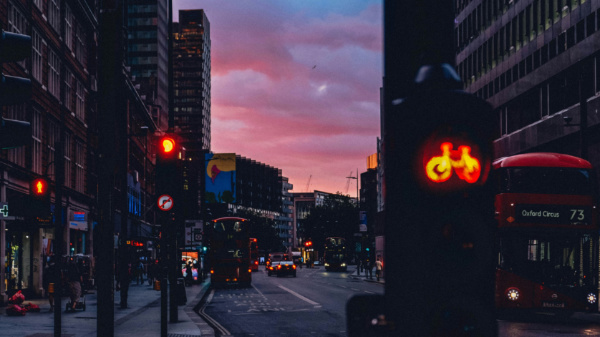
LondonLife – Sunset on Euston Road…

PICTURE: Henry Chen/Unsplash

This Week in London – Life in the Roman army explored; clockwork treasures from China; and, Kew Gardens’ Orchid Festival…

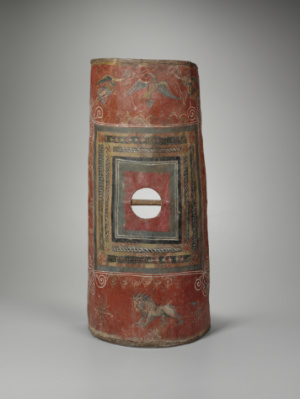
A major new exhibition on life as a Roman legionary opens at the British Museum today. Legion: Life in the Roman army shares stories of real legionaries and shows how the army was as much an “engine of social change” as it was a war machine. More than 200 objects, many of which are on display in the UK for the first time, are on show including the world’s only intact legionary shield, on loan from Yale (pictured), and the oldest and most complete classic Roman segmental body armour, found in Kalkriese, Germany, in 2018. There are also the remains of a soldier found at Herculaneum, reunited with his belt and equipment for the first time outside of Italy, as well as the Crosby Garrett mask helmet – found in Cumbria in 2010, and a unique dragon standard found in Germany. The exhibition, which can be seen in the Sainsbury Exhibitions Gallery until 23rd June, also features a specially designed Horrible Histories themed trail of the exhibition with interactive family stations. Admission charge applies. For more, see www.britishmuseum.org.

More than 20 mechanical clocks collected by Chinese emperors are being displayed together for the first time in the UK in a new exhibition opening today at the Science Museum. Among those on display in Zimingzhong 凝时聚珍Clockwork Treasures from China’s Forbidden City is the ‘Pagoda Zimingzhong’ which, was made in London in the 1700s during the Qing Dynasty in China, ‘Zimingzhong with Turbaned Figure’ which mixes imagery associated with China, Japan and India to present a generalised European view of an imagined East, and the Zimingzhong with mechanical lotus flowers’, which, when wound, reveals a flock of miniature birds swimming on a glistening pond as potted lotus flowers open. Runs until 2nd June. Visitors are invited to pay what they can to visit the exhibition, with a minimum ticket cost of £1 per person. For more, see www.sciencemuseum.org.uk/see-and-do/zimingzhong.

Kew Gardens’ Orchid Festival returns from this Saturday, this year drawing inspiration from the unique flora and fauna of Madagascar. The display features a specially commissioned film showcasing the beauty of Madagascar – the world’s fourth largest island – as well as themed floral displays and living installations in the Princess of Wales Conservatory. The latter include ‘Lovers Baobab’ on the waterlily pond, floral sculptures recreating some of Madagascar’s most iconic wildlife, including ring-tailed lemurs, chameleons and the aye-aye, the world’s largest nocturnal primate, and a small selection of Madagascan orchids including Angraecum sesquipedale (also known as Darwin’s orchid). Visitors will also hear Malagasy music composed by the Boriza Borothers and be able to purchase food made according to a range of authentic Malagasy recipes, thanks to a menu curated by Malagasy chef Lilia Andrianovy of Lilia’s Kitchen. Orchids After Hours will also return for this year’s festival. Runs until 3rd March. Admission charge applies. For more, see www.kew.org.

Send all items for inclusion to exploringlondon@gmail.com

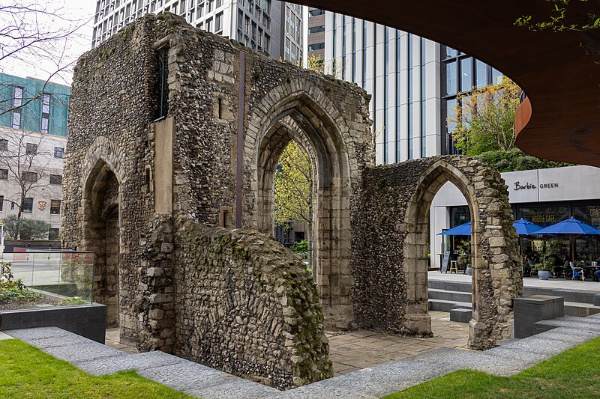
10 atmospheric ruins in London – 1. The Church of St Alphege London Wall…

Ruins of St Alphege London Wall. PICTURE: The wub (licensed under CC BY-SA 4.0)

The ruins of this church – which now sit in a public garden – are actually the remains of the second church in the vicinity.

Dedicated to the murdered Archbishop of Canterbury (there’s a similarly named church in Greenwich), the first St Alphege (also known as St Alphege London Wall and St Alphege Cripplegate) dated from at least the 11th century but was closed and demolished during the Dissolution (the other part of its name comes from its location abutting London Wall).

The second church started life as the priory church of the nunnery of St Mary-within-Cripplegate which later became a hospital before it too was closed in the Dissolution.

The church, however, became the parish church and, subsequently repaired, it survived the Great Fire of 1666. Further repairs followed and a more comprehensive rebuilding in the 18th century (with the medieval tower retained).

But by 1900, parts of the church were in a poor state and after the church was damaged during an air raid in World War I, the parish was amalgamated with St Mary Aldermanbury (the combined parish was later united with St Giles Cripplegate) and it was eventually mostly demolished in the early 1920s.

The medieval tower remained but was gutted by fire in 1940. Its ruins were subsequently surrounded by a small public garden. Further restoration work was done as part of works to install a raised walkway in 2018-19.

The remains of the church – which include the tower and arches on three sides – are Grade II-listed and while it’s surrounded these days by modern office buildings, it remains a small piece of a bygone era.

The gardens are free to visit.

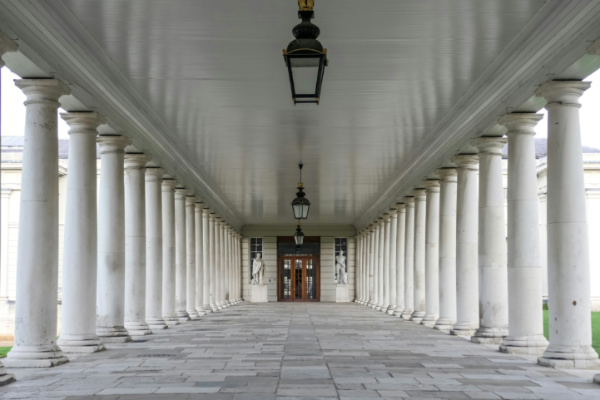
LondonLife – Greenwich colonnade…

PICTURE: Chikashi Miyamoto/Unsplash

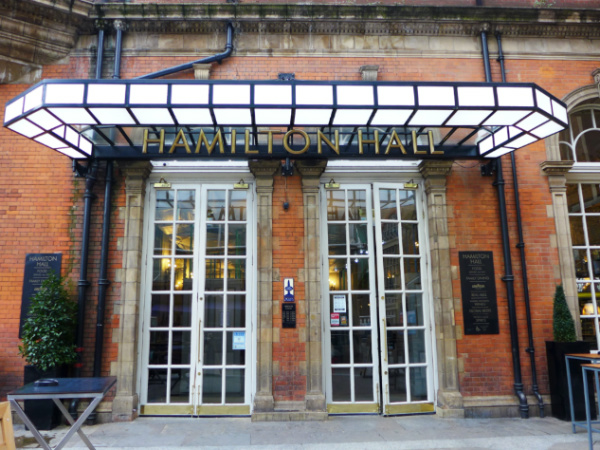
London pub signs – Hamilton Hall….

PICTURE: Ewan Munro (licensed under CC BY-SA 2.0)

This pub’s location on the street level concourse of Liverpool Street Station is a clue to the origins of its name.

The Hamilton refers to Lord Claud Hamilton, the chairman of the Great Eastern Railway Company, which originally built Liverpool Street Station (itself named after early 19th century Prime Minister, Lord Liverpool).

The pub itself is actually located in what was the ballroom of the Great Eastern Hotel which originally dates from the 1880s. The now II*-listed hotel – minus its ballroom – still exists in the same location, these days as Andaz London Liverpool Street, part of the Hyatt Group.

The pub features many of the ballroom’s original features and is partly decorated in the 18th century French style.

For more, see www.jdwetherspoon.com/pubs/all-pubs/england/london/hamilton-hall-city-of-london

LondonLife – Bethnal Green alleyway…

PICTURE: Iuliia Dutchak/Unsplash

This Week in London – Charles Holden’s university vision; Two-Tone at the Barbican; and celebrating Winston…

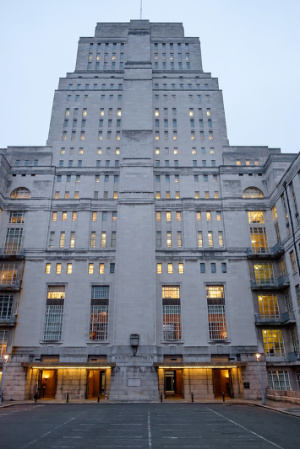
Senate House. PICTURE: Tim Abbott (licensed under CC BY-NC-ND 2.0)

A new exhibition celebrating the vision architect Charles Holden had for the design of the University of London – including the iconic Senate House – has opened at the venue. Holden had a hand in designing some 48 Tube stations and 55 Broadway – London’s first skyscraper - before in 1931 being appointed to develop the university’s Bloomsbury estate, including its headquarters. While the master plan was never completed (only the Senate House and its library were finished), it provides a fascinating insight into a part of London that could have been. Charles Holden’s Master Plan: Building the Bloomsbury Campus tells the story of institution’s design through architectural models, archival documents, photo albums, and other mixed media. The display in the Chancellor’s Hall Lobby on the first floor of the Senate House runs until 17th March. Entry is free. For more, see www.london.ac.uk/news-events/events/charles-holdens-master-plan-building-bloomsbury-campus.

A new exhibition tracing the origins and influence of the popular British music genre known as two-tone has opened at the Barbican Music Library. Two-tone, which is also known as ‘ska-rock’ or ‘ska revival’ and which had its heyday in the late 1970s and early 1980s, fused traditional Jamaican ska, rocksteady, and reggae music with elements of punk rock and new wave music. Its name comes from record label 2 Tone Records which was founded in 1978 by Jerry Dammers from The Specials, one of the most popular Two-tone bands of the time. The display – From the Caribbean to Coventry: Plotting the Rise of Two Tone – features band memorabilia as well as clothing, literature, art, photographs, and fan contributions, and explores how Caribbean immigration influenced UK youth culture. Runs until 25th May. Admission is free. For more, see https://fromthecaribbean2coventry.co.uk.

FURTHER AFIELD: Sir Winston’s family home – Chartwell in Kent – is hosting a new outdoor photography exhibition to mark what would have been his 150th birthday which features some of most spectacular birthday cakes. Press interest into Churchill’s birthday extravaganza – and in particular the cakes – was considerable and historic photographs from TopFoto have now been colourised for the first time, bringing the baking creations vividly to life. The images can be seen until 25th February. For more, see www.nationaltrust.org.uk/visit/kent/chartwell.

Send all items for inclusion to exploringlondon@gmail.com

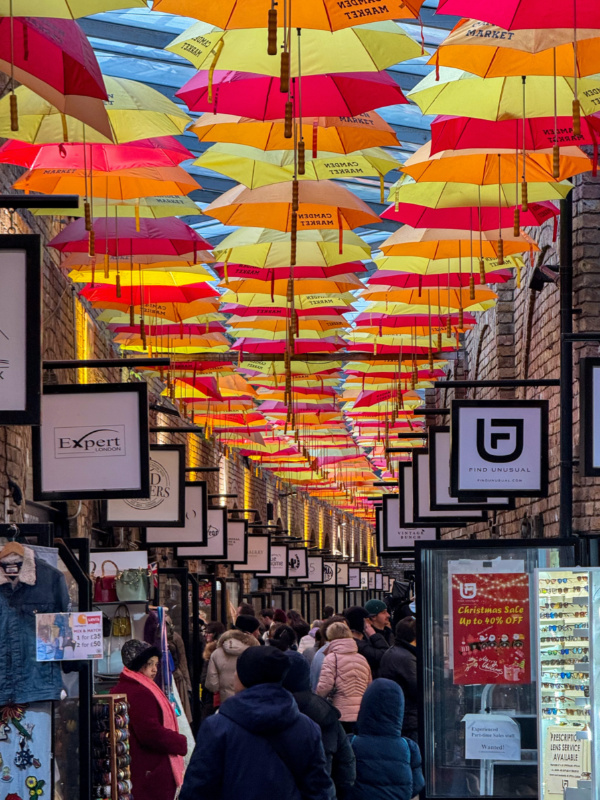
LondonLife – Camden Market…

PICTURE: Mayank Gupta/Unsplash

LondonLife – City illuminations…

The intersection of Northumberland Avenue and Whitehall Place. PICTURE: Ashley Main/Unsplash

Famous Londoners – John Stow…

Sixteenth century historian John Stow wrote numerous chronicles of English history but is mostly remembered for his landmark survey of London, a monumental work which has lead to him being informally given the title “founding father of London history”.

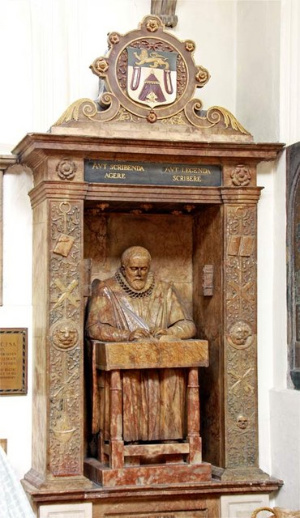
The monument depicting John Stow. PICTURE: John Salmon / St Andrew Undershaft, St Mary Axe, EC2 – Wall monument of John Stow / CC BY-SA 2.0

Stow (sometimes written as Stowe) was born a Londoner in about 1525 in the parish of St Michael, Cornhill. He was the eldest of seven children of Thomas Stow, a tallow chandler, and his wife Elizabeth.

Nothing is known about Stow’s early education - whether he attended a grammar school or was self-taught – but he is known to have developed a deep knowledge of English history, culture and customs as well as of Latin.

He didn’t follow his father’s trade but instead became an apprentice tailor and in 1547 was named a freeman of the Merchant Taylors’ Company. He is said to have worked as a tailor in London for almost 30 years.

In 1560, he started on his best known work, A Survey of London, a detailed topographical survey of the City of London and its suburbs – it was eventually published in 1598 (a second, longer edition followed in 1603). But his first book, on the works of Geoffrey Chaucer, was published in 1561, and he went on to publish numerous editions of English chronicles.

Stow was in contact with many of the era’s leading antiquarians, including the likes of John Dee and William Camden, and he was an active member of the first Society of Antiquaries, established in about 1586.

He also attracted the patronage of some significant figures including the Archbishops of Canterbury Matthew Parker and John Whitgift and Robert Dudley, Earl of Leicester, and was well-known for his collection of manuscripts, the largest group of which is now within the Harley collection at the British Library.

Stow, whose work never made him a wealthy man and who, at times, was the subject of his acquaintances’ charity (although Barrett L Beer in an entry in the Oxford Dictionary of National Biography describes his pleas of poverty as “exaggerated”), married his wife Elizabeth sometime after 1549. They lived initially in Aldgate where his business was also based (and later moved to the Lime Street ward). The couple had three daughters, two of whom – Joan and Julyan – survived him.

Stow died on 5th April, 1605. He was buried in the church of St Andrew Undershaft and his wife commissioned a marble monument to commemorate him which depicts Stow seated at his desk. A commemorative service, organised by the Merchant Taylors Company, is still held in the church every three years during which the quill he writes with is regularly replaced in a sign of respect.

10 most popular (new) posts for 2023 – Numbers 2 and 1…

The final entries in our countdown…

2. What’s in a name?…Amen Corner…

1. What’s in a name?…Shoe Lane…

Happy New Year!

PICTURE: studio-fi/iStockphoto

Wishing all our readers a great start to 2024!