Wishing all our readers a great start to 2023!
And the final two in our annual countdown (drum roll please)…
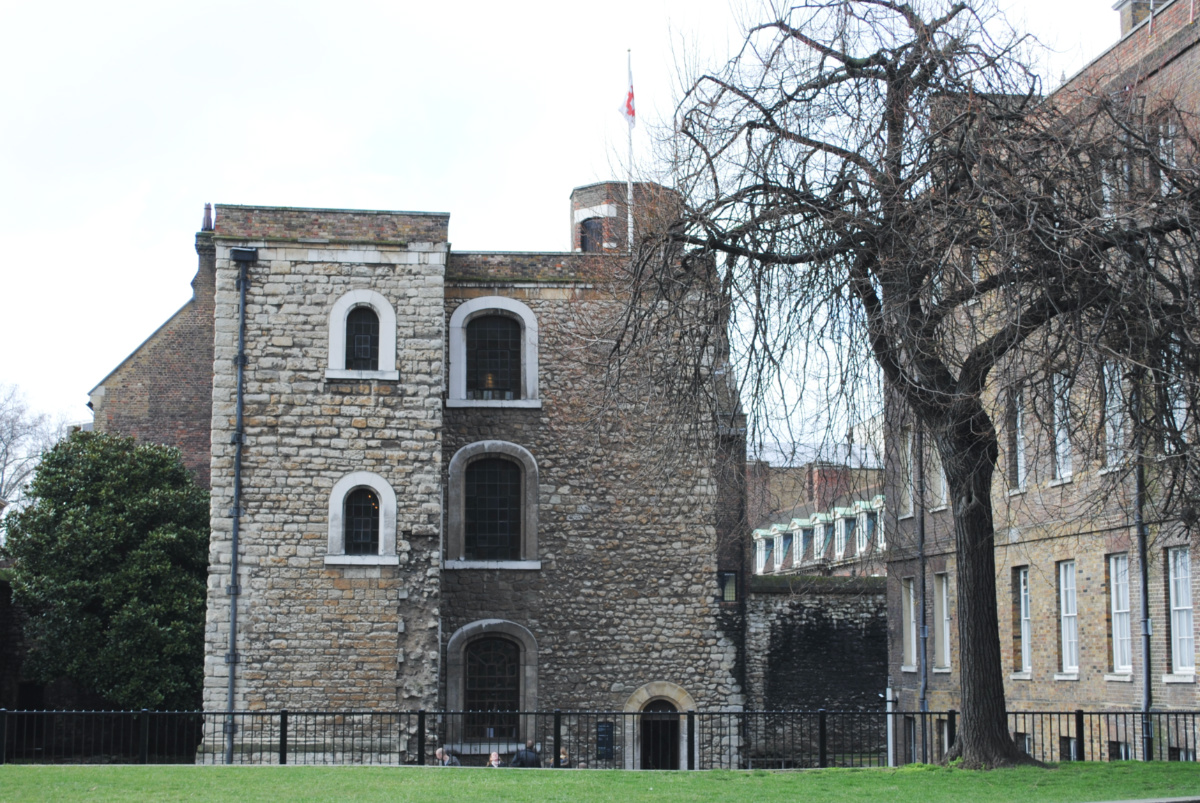
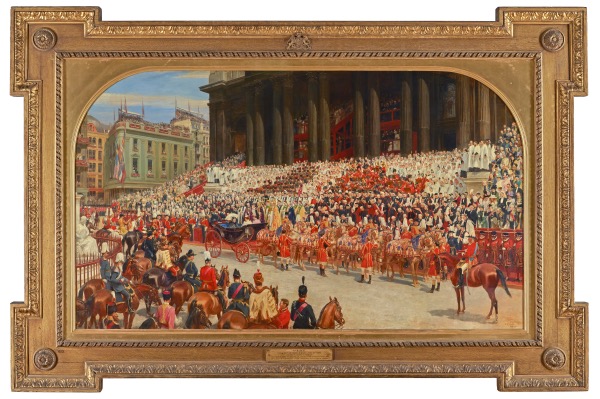
2. 10 historic stairways in London – 6. The Geometric Staircase, St Paul’s Cathedral…
It’s that time of year again – our annual countdown of our 10 most read posts for the year!
First up are numbers nine and ten…

We’ll be back next week with our annual most popular posts countdown…
Charles Dickens’ A Christmas Carol is forever linked to Christmas in London. So, with Christmas almost upon us, here’s a quick look at five locations mentioned or alluded to in the famous book…
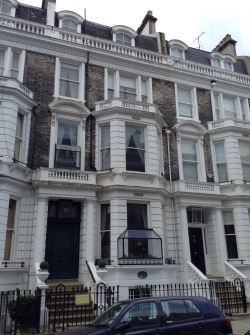
1. 16 Bayham Street, Camden Town. Bob Cratchit’s house is described as being in Camden Town but what’s interesting is that as a child Dickins’ himself lived here at this property. So whether or not it’s the actual address Dickens had in mind for Cratchit’s property, it’s certainly in the vicinity.

2. The Royal Exchange. Referenced in regard to Ebenezer Scrooge who did business there. The current building was still being completed when Dickens wrote A Christmas Carol in 1843 following a fire at the premises several years before. It was opened in 1844.
3. Simpsons Tavern. Scrooge is said to have taken his “melancholy dinner in his usual melancholy tavern” which has been suggested could refers to Simpsons. Located in Ball Court, the current premises opened in 1757. The George & Vulture in Michael’s Alley is also mentioned as a possibility.
4. Newman’s Court. Located near Cornhill (which is mentioned in the book as the site where Bob Cratchit goes on a slide after leaving Scrooge’s office), it’s been suggested more than once that while the location of Scrooge’s counting house is not specified in the text, a location in Newman’s Court would fit the bill.
5. Leadenhall Market. Following Scrooge’s transformation, he sends a boy out to buy a turkey- commentators suggest the poulterer the boy attends was located in Leadenhall Market which would have been a predecessor to the current building which dates from 1881.

• The Princess of Wales will host a Christmas carol service at Westminster Abbey today. The service, which will be attended by members of the Royal Family, will recognise the selfless efforts of individuals, families and communities across the UK as well as paying tribute to Queen Elizabeth II and the values she demonstrated at Christmas and throughout her life, including empathy, compassion and support for others. The service will be broadcast on ITV One in the UK on Christmas Eve. Meanwhile, a special Christmas episode of Westminster Abbey: Behind Closed Doors will be shown on Channel 5 next Wednesday, 21st December. For more, see My5: Westminster Abbey: Behind Closed Doors.
• An exhibition show-casing the work of photographer Peter Marlow, who has photographed all 42 Church of England cathedrals, can be seen at St Paul’s Cathedral. Commissioned in 2008 by Royal Mail to photograph six cathedrals – images of which were used on commemorative stamps marking the 300th anniversary of the completion of St Paul’s Cathedral, Marlow went on to continue taking pictures of cathedrals using just natural light. The display, which is touring all 42 cathedrals, can be found in the South Nave aisle until 26th January. Included in admission charge. For more, see www.stpauls.co.uk/whats-on/exhibition-peter-marlows-english-cathedral.
• On Now: Making Modernism. The first major UK exhibition devoted to women artists working in Germany in the early 20th century, this exhibition at the Royal Academy’s Gabrielle Jungels-Winkler Galleries includes 67 paintings and works on paper. The artists featured include Paula Modersohn-Becker, Käthe Kollwitz, Gabriele Münter and Marianne Werefkin, with additional works by Erma Bossi, Ottilie Reylaender and Jacoba van Heemskerck. Runs until 12th February. Admission charge applies. For more, see www.royalacademy.org.uk.
Send all items to exploringlondon@gmail.com


This year marks the 75th anniversary of the first Trafalgar Square Christmas Tree.
The native spruce has been a gift from the people of the city of Oslo – the capital of Norway – to the people of Britain since 1947, presented as a thank you for the support given Norway during World War II.
Special permission had to be given for the 40 foot high tree to be illuminated. The Ministry of Fuel decided to do so on the basis that “the lighting will not be for business purposes: the tree is classed as ‘a charitable gift’ – a goodwill gift to cheer London.”
A sizeable crowd gathered to witness the lights being turned on.
Among the official party was the Ambassador of Norway. He told the crowd that the tradition of a Norwegian Christmas Tree in London started when King Haakon VII was residing in London during World War II.
The ambassador said that each year during the king’s residency, the Norwegian Navy undertook an operation to bring a tree from Norway for the King so he could celebrate Christmas “looking on a Christmas tree grown on Norwegian soil”.
In 2016, UCL academic Ingrid A Medby described the annual presenting of the tree as a “diplomatic gesture”, “a token of gratitude” and a “symbol of geopolitical ties”.
This year’s 21 metre-high tree had its 500 lights illuminated on 1st December (the tree is traditionally lit on the first Thursday in December), It had been chopped down on 19th November in the Nordmarka forests near Oslo and travelled 1,000 miles by land and sea to reach Trafalgar Square.
Christmas cards have been a staple of Christmases (although a declining one these days) since at least as far back as 1843.
It was then that Sir Henry Cole, a civil servant, inventor and the first director of the Victoria & Albert Museum, came up with the idea of sending out a card bearing Christmas greetings to a large number of people as a means of coping with the substantial volume of correspondence he was receiving (and would have to send to greet family and friends at Christmas).
Sir Henry commissioned his friend, painter John Callcott Horsley, to design the card and an initial run of 1,000 cards were printed by Jobbins of Warwick Court in Holborn (a further thousands cards were printed in a second run).
Having sent the cards he required, Sir Henry sold the rest for a shilling each under his literary pseudonym of Felix Summerly from the premises of his publisher Joseph Cundall in Old Bond Street (the introduction of the uniform Penny Post in 1840 having made sending them affordable – Cole had been an important figure in its establishment as assistant to the idea’s main instigator Rowland Hill).
The card, which were hand-coloured by professional colourer Mason, depicts a family gathered for Christmas and imbibing wine with side panels depicting two acts of charity – “feeding the hungry” and “clothing the naked”. On it were printed the words “A Merry Christmas and a Happy New Year to You”.
The card was apparently controversial for its depiction of drinking wine (temperance advocates argued it promoted drunkenness) and particularly for its images of children drinking wine.
The idea didn’t also catch on immediately – the cost of a shilling was rather steep. But new designs soon began to appear in the following years and by the mid-1850s, the idea had finally taken hold.
WHERE: The Postal Museum, 15-20 Phoenix Place (nearest Tube stations are Farringdon, Russell Square, King’s Cross St Pancras and Chancery Lane); WHEN: 10am to 5pm Wednesday to Sunday (booking in advance suggested); COST: Adult £17/Young person (16-24) £12/Child (3-15) £10 (discounts apply for booking online/other ticket types available; WEBSITE: www.postalmuseum.org
• Following a restoration, early Renaissance artist Piero Della Francesca’s The Nativity has gone on display in The National Gallery in time for Christmas. The painting, created circa 1470, had been in the possession of Piero’s family until it came to London in the 1860s. Then in a poor condition, it was acquired by The National Gallery in 1874. It has now been restored by the gallery’s senior restorer Jill Dunkerton with panel work by Britta New in a process which has shed new light on the painting. This includes the understanding that while it was previously framed and displayed as an altarpiece, instead the work is now believed to have been a very grand, domestic painting which Piero may even have painted for himself. To complement this new interpretation, the gallery has been able to acquire a carved walnut frame, of almost exactly the correct dimensions, date and probable origin. You can see a video of the conservation process below. For more, see www.nationalgallery.org.uk.
• Marking the 100th anniversary of the discovery of Tutankhamun’s tomb in Egypt in November, 1922, the British Museum has opened a new display looking at the way the ancient Egyptian pharaoh was viewed, both by his contemporaries and by people today. The free Asahi Shimbun Display Tutankhamun Reimagined features artwork by contemporary Egyptian graffiti artist Ahmed Nofal alongside a statue of Tutankhamun which was discovered before his tomb was even found. Accompanying the display is a trail through the Egyptian Sculpture Gallery (Room 4) in which visitors can learn more about Tutankhamun and his times. Can be seen until 29th January. For more, see www.britishmuseum.org.
• Artist Luke Jerram – of Gaia fame – is returning to the Old Royal Naval College in Greenwich next week with his artwork Museum of the Moon. The large scale installation, which will hang in the Painted Hall, features NASA imagery of the lunar surface. Visitors are invited to lean back on daybeds to experience the installation which is accompanied by a surround sound composition by BAFTA-winning composer Dan Jones. Runs from Tuesday, 13th December, to 2nd February. Admission charge applies. For more, see https://ornc.org/whats-on/museum-of-the-moon/.
Send all items to exploringlondon@gmail.com.
Before kicking off a new series, here’s a recap of our last…
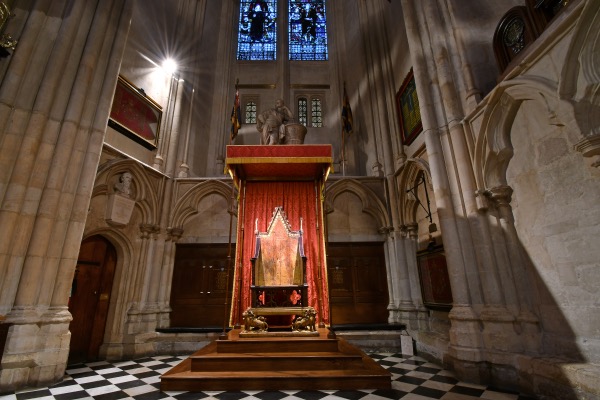
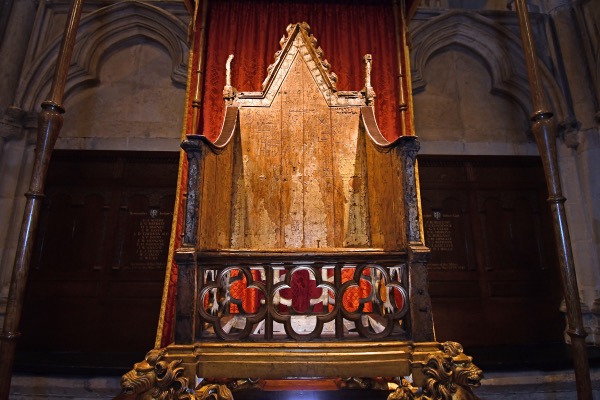
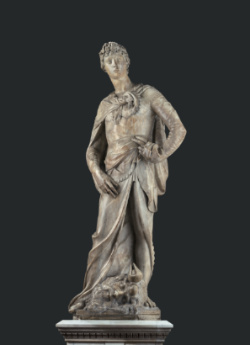
3. St Edward’s Chapel, Westminster Abbey…
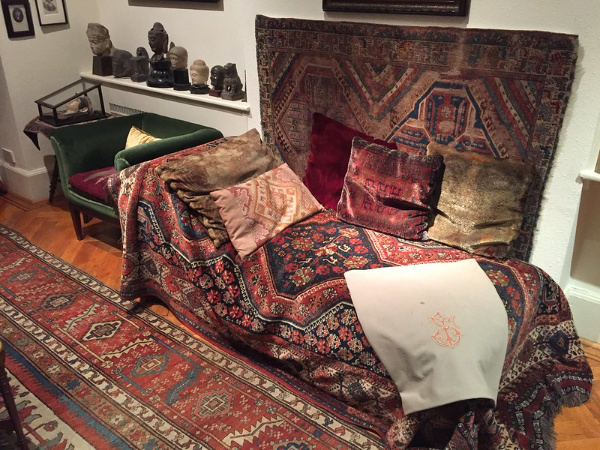
5. Henry VII’s Lady Chapel, Westminster Abbey…
Christmas is looming so here’s our first look at some of London’s Christmas light displays…


• Festive Fayre returns to Hampton Court Palace this weekend with visitors having the chance to do some Christmas shopping, sample some festive treats and enjoy live music. The festival, which runs from Friday to Sunday, takes place ahead of the launch of the palace’s Christmas light trail – Palace of Light – next Wednesday (7th December). Inspired by Henry VIII’s heraldic beasts, it features an array of installations, ranging from a sea-monster lurking in the Great Fountain Garden to polka-dot panther lanterns in the Wilderness. Created by the award-winning outdoor event producers Wild Rumpus, the light trail can be visited until 2nd January. For more, see www.hrp.org.uk/hampton-court-palace/.

Christmas tree installation, designed by Miss Sohee PICTURE: © Victoria and Albert Museum, London
• The V&A has unveiled its couture Christmas Tree installation for this year – a work by London-based Korean fashion designer Miss Sohee. On display in the Cromwell Road Grand Entrance, the installation reimagines the traditional Christmas tree as a three metre long couture gown, which combines Sohee’s signature style of vibrant silhouettes and intricate embroidery with religious statuary found around the museum. The installation can be seen until 5th January. For more, see www.vam.ac.uk.
• On Now – Tiny Traces: African & Asian Children at London’s Foundling Hospital. This exhibition at The Foundling Museum in Bloomsbury explores the newly discovered stories of African and Asian children in the care of the hospital in the 18th century, following the stories of more than a dozen children through personal items, physical artefacts, works of art and archival documents. In a parallel thread, works of art by artists including Zarina Bhimji, Hew Locke, Kehinde Wiley, Alexis Peskine, Deborah Roberts and Shanti Panchal form a dialogue with the historic narratives. Admission charge applies. Runs until 19th February. For more, see https://foundlingmuseum.org.uk.
Send all items to exploringlondon@gmail.com
• The Tower of London is getting into the festive spirit with a celebration of the Twelve Days of Christmas. Twelve installations have been installed at the Tower, each representing as different aspect of the fortress’s unique history – from nine wreaths representing “nine rowdy ravens” to five gold coins representing the Mint once housed there. There’s also the six Queens of King Henry VIII and three “lordly lions” – a reference to a gift presented to King Henry III and housed in a Lion Pit at the tower. Visitors will have the chance to collect a map at the start of their visit and follow a trail to find the installations at they explore the Tower. Christmas at the Tower of London runs daily until 3rd January. Admission charge applies. For more, see www.hrp.org.uk/tower-of-london/.
• The Museum of London is preparing to close its doors at its London Wall site as it moves to its new location in Smithfield and to celebrate it’s holding two free weekend festivals. The first, to be held this weekend, will feature family-friendly activities including arts and crafts, dance, face painting and theatrical performances while the second, to be held on the weekend of 3rd and 4th December (after which the museum will close), will feature a celebration of London’s music scene from the 70s to the present day with a DJ sets, a late night film festival and museum’s first ever 24 hour opening. Visitors on both weekends can also take part in London Biggest Table Football competition for a chance to win an England shirt signed by Harry Kane and to see the museum’s collection in a new light thanks to an illuminated display. For more on the festivals, see www.museumoflondon.org.uk/museum-london.
• Now On: Blood and Battle: Dissecting the life of William Beatty. The life and work of renowned 19th-century naval surgeon and physician, Sir William Beatty, is explored in this exhibition at the Old Royal Naval College in Greenwich. The display – which marks 200 years since Beatty, who had served as ship’s surgeon on HMS Victory during the Battle of Trafalgar (and who wore the musket ball that killed Nelson in a locket on his watch chain for the rest of his life afterwards) – took up the post of Physician to the Royal Hospital for Seamen – explores Beatty’s work as a ship’s surgeon, his time at Greenwich Hospital and how he was honoured by being knighted and appointed Physician Extraordinary to George IV and the Duke of Clarence (later William IV) as well as his outside interests including his involvement in developing the London – Greenwich Railway. Admission charge applies. For more, see https://ornc.org.
Send all items for inclusion to exploringlondon@gmail.com.

The oldest of London’s so-called ‘Magnificent Seven’ cemeteries established in the 19th century, Kensal Green is the burial place of a few members of the royal family dating from the Georgian and Victorian eras.
The ninth child and sixth son of King George III, Prince Augustus Frederick, the Duke of Sussex, died at Kensington Palace at the age of 70. In his will, he specifically requested he not have a state funeral and so was buried at Kensal Green on 4th May, 1843. His rather plain grey monument which is surrounded by concrete bollards, is located in front of the cemetery’s main chapel.
Opposite his grave is the tomb of his sister Princess Sophia, the 12th child of King George III. She, too, died at Kensington Palace – on 27th May, 1848 – and wished to be buried near her brother instead of at Windsor.
King George III’s grandson, Prince George, Duke of Cambridge, was also buried at Kensal Green. A military man (and ally of Queen Victoria), he served as commander-in-chief for 39 years before being forced to resign in 1895. He died in 1904 at Gloucester House, Piccadilly, in 1904 and was buried at Kensal Green with his wife the following day.
WHERE: Kensal Green Cemetery, Harrow Road, Queen’s Park (nearest Tube station is Kensal Green); WHEN: Monday to Saturday 9am to 5pm, Sundays 10am to 5pm; COST: Free: WEBSITE: www.kensalgreencemetery.com.