This Week in London – Charles I’s ‘Royal Collection’ on show; John Constable; and, 18th century satire…

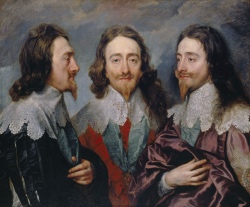
Anthony van Dyck, Charles I, 1635-6, Oil on canvas, 84.4 x 99.4 cm, RCIN 404420 Royal Collection Trust/© Her Majesty Queen Elizabeth II 2017

A landmark exhibition which reunites one of the most extraordinary art collections ever assembled opens in the main galleries of the Royal Academy of Arts in Piccadilly this Saturday. Presented in partnership with the Royal Collection Trust, Charles I: King and Collector features about 150 of the most important of the works collected by King Charles I during his reign, spanning the period from 1600 to 1649. They are among 1,500 paintings and 500 sculptures he collected  prior to his execution in 1649, after which the collection was offered for sale and dispersed across Europe. Many of the works were retrieved by King Charles II during the Restoration but others now form the core of collections at institutions such as the Musée du Louvre and the Museo Nacional del Prado. Among those on show in this exhibition, which includes more than 90 works borrowed from the Royal Collection, are several monumental portraits of the king and his family by Anthony van Dyck as well as the artist’s most celebrated portrait of the king, Charles I (‘Le Roi a la chasse’) (pictured), which returns to England for the first time since the 17th century. Other works include Peter Paul Rubens’ Minerva Protects Pax From Mars (‘Peace and War’) – this was commissioned by Charles and painted between 1629-30, Andrea Mantegna’s series, The Triumph of Caesar (c1484-92), and Titian’s Supper at Emmaus (c1530) while artists including Correggio, Tintoretto, Paolo Veronese, Albrecht Durer, Hans Holbein the Younger and Pieter Bruegel the Elder are also represented. The exhibition also shows off the celebrated Mortlake tapestries depicting Raphael’s Acts of the Apostles (c1631-40) and paintings, statuettes, miniatures and drawings once kept in the Cabinet at Whitehall Palace. Runs until 15th April. Admission charge applies. For more, see www.royalacademy.org.uk.

• John Constable’s oil sketch, Salisbury Cathedral from the Meadows, 1829–31, is one of 10 works which have gone on display at the Guildhall Art Gallery as part of its Victorian Landscapes exhibition. The painting takes centre-stage in the display in the gallery’s Temple Room; other works on show include John Brett’s Echoes of a Far-Off Storm (1890); Edward William Cooke’s Triassic Cliffs, Blue Anchor, North Somerset (1866), and Benjamin Williams Leader’s The Church at Betwys-y-Coed (1863). The paintings can be seen until early May. For more, follow this link.

Eighteenth century satire portrayed on ceramics and prints is the subject of a new free display at the British Museum. Pots with Attitude: British Satire on Ceramics, 1760-1830 features some 80 objects, some of which have not been on show for decades, including mugs and jugs (which make up the bulk of the items on show) as well as items like a cotton handkerchief printed with the “Peterloo Massacre” of 1819 and a rather grisly folding fan showing hidden profiles of executed French sovereigns (1794). Other objects show off copies of prints by satirists such as James Gillray and Charles Williams, with one of the latter’s showing a colossal Napoleon about to cross the Channel into England but prevented from doing so by a pint-sized, sword-carrying John Bull, who has sliced off his toes and is telling him, ‘Paws off, Pompey’ – the comment a reference to a lap-dog known as Pompey the Little who was the hero of a popular novel at the time. The display can be seen in Room 90a, Prints and Drawings Gallery, until 13th March. For more, see www.britishmuseum.org.

Send all items for inclusion to exploringlondon@gmail.com.

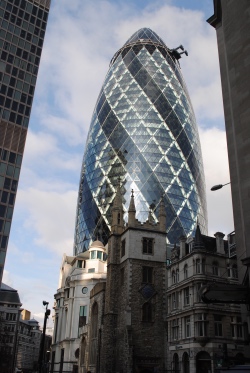
10 of London’s modern icons…2. 30 St Mary Axe (aka ‘The Gherkin’)

This rocket-ship shaped glass skyscraper made its mark on the City of London skyline in the early Noughties after plans to build a much taller building on the site were shelved.

The award-winning building stands on the site of what was the late Victorian-era Baltic Exchange which was extensively damaged by an IRA bomb which went off in the neighbouring street, St Mary Axe (for more on the origins of the street name, see our earlier post here), in 1992.

It was initially proposed that a 92 storey building, to be known as Millennium Tower, be built on the site – it would have been the tallest building in Europe. But the plan was shelved after both Heathrow and London City Airports objected to the interference it would have on flight paths while others pointed to the rather dramatic impact it would have on the City skyline.

The site was subsequently sold to reinsurance giant Swiss Re who then commissioned Sir Norman Foster (Foster + Partners) to design a building for its UK headquarters. The resulting 41 storey, 180 metre (591 foot) tall skyscraper – which features some 24,000 square metres of glass and was said to be the first environmentally sustainable skyscraper in London – was eventually completed in late 2003 and opened in 2004.

The glass dome which sits at the top of the building offers panoramic, 360 degree views of the surrounds and is said to be a reference to the glass dome that once sat over part of the ground floor of the Baltic Exchange.

Interestingly, the nickname for the building, The Gherkin, is actually an abbreviated form of a name first coined by some design critics  who described the building as an “erotic gherkin”, according to The Guardian. Some wags have also used the nickname ‘Towering Innuendo’ for the property.

PICTURES: Top – Samuel Zeller/Unsplash; Right – David Adams.


LondonLife – Lights at Piccadilly…

PICTURE: Clem Onojeghuo/Unsplash

Where’s London’s oldest…umbrella shop?

Established back in the early nineteenth century, James Smith & Sons Umbrellas is a West End institution in London and is certainly among the oldest, if not the oldest, surviving business established to sell umbrellas.

The original shop was founded by James Smith in Foubert’s Place, off Regent Street, in 1830 with the umbrellas made in a rear workshop and then sold at the front. The shop then moved to Saville Place but when this building had to be knocked down to make way for road widening, it moved to Burlington Street near Piccadilly Circus.

Business boomed following the invention of Samuel Fox’s lightweight steel frame umbrellas in 1851 and in 1867, a second shop was opened at 53 New Oxford Street (in Hazelwood House, where it remains today). The Burlington Street branch, meanwhile, continued to be operational until it was destroyed by a bomb in World War II, leaving just the shop in New Oxford Street.

The New Oxford Street shop still sells a plethora of types of umbrellas as well as made-to-measure walking sticks. Some of the umbrellas – which include antique and more contemporary models – are reportedly assembled on site.

In the shop you’ll also find a portrait of Jonas Hanway, said to be the first man who owned an umbrella in London. Being an early adopter of this imported fashion trend from France, he apparently attracted the ridicule of London society as well as that of coach drivers who saw the threat to their trade he represented. But history was on Hanway’s side and while the umbrella has survived the past couple of centuries, the coach as a means of transportation has not.

PICTURE: Top –  Jorge Royan/licensed under CC BY-SA 3.0/ Right – Ewan Munro/licensed under CC BY-SA 2.0

Lost London – The first Blackfriars Railway Bridge…


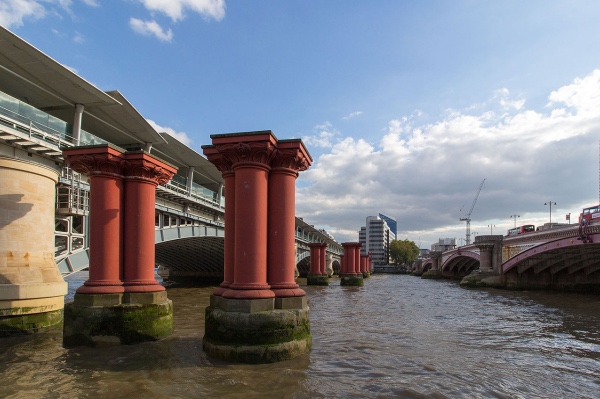
Two Blackfriars Bridges – a vehicle and pedestrian bridge, and a railway bridge – still span the River Thames from the City of London on the north bank to South Bank. But just beside the railway bridge stand some large red pylons – the remains of the first Blackfriars Railway Bridge. 

This bridge was built in 1864 to accommodate the London, Chatham and Dover Railway (LCDR) when it was extended north across the river to what was then named St Paul’s Station (at least until 1937 when it became Blackfriars Station).

The ornate bridge was designed by Joseph Cubitt but within 20 years of its being built, the second, still existing, railway bridge was constructed alongside it to provide more space for trains (the original bridge apparently only had four tracks).

The ornately decorated first bridge was supported on three rows of pylons – the third was incorporated into the second bridge (which is why we now only see two rows).

After 1923, when train services began to terminate at Waterloo Station on the south side of the river, the bridge was rarely used but it wasn’t until many years later, in 1985, that it was declared too weak to support the current crop of trains and removed.

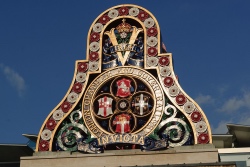
As well as the pylons, on the south side of the river can be seen a massive abutment of Portland stone featuring the ornate cast iron insignia of the former LCDR (above right). Grade II-listed, it was restored in about 1990.

PICTURES: Top – The wub/licensed under The wub; Right – SyndVer/licensed under CC BY-SA 4.0

This Week in London – Lumiere London, and London’s future imagined…

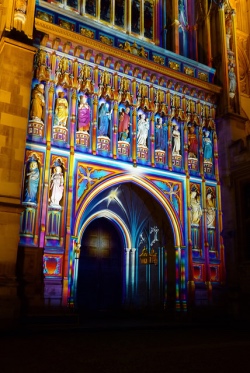
The annual festival of illumination known as Lumiere London returns to the capital for a second time from tonight with more than 50 installations lighting up streets, buildings and public spaces. London’s largest night-time festival, installations in this year’s free event – commissioned by the Mayor of London and produced by arts charity Artichoke – are clustered around six areas: King’s Cross, Fitzrovia, the West End, Mayfair, Westminster and Victoria, and South Bank and Waterloo. The installations include Lampounette – located in King’s Cross, it features giant office desk lamps, Entre les rangs – a field of thousands of flower-like reflectors in Lewis Cubitt Park, Nightlife – a luminous secret garden in Leicester Square which plays with the relationship between wild spaces and urban city life and spills out to include illuminated flamingoes flying over Chinatown, and Northern Lights – a recreation of the aurora borealis in Grosvenor Square, Mayfair. The facade of Westminster Abbey is also among the buildings to be lit up with artist Patrice Warrener commissioned to illuminate the Abbey’s West Towers and Great North Door with his work, The Light of the Spirit. There’s a free app to download and a map can be purchased online for download. For more, include a complete programme, head to www.visitlondon.com/lumiere. PICTURE: Westminster Abbey during Lumiere London last year (Paula Funnell/licensed under CC BY-NC-ND 2.0).

London’s future built form is up for discussion at a new exhibition opening at the Museum of London tomorrow. London Visions: Hypothetical scenarios of a future presents hypothetical concepts created by leading artists, architects and designers using video installations, architectural narratives and video games. Among the key works on display are: Flooded London – a series of images created by Squint/Opera depicting imaginary scenes of London in 2090 when rising seas have flooded the city; In the Robot Skies: A Drone Love Story – the world’s first narrative shot entirely by autonomous drones operating on autopilot, the film – directed by speculative architect Liam Young and written by Tim Maughan – looks at the possible future use of drones within London council estates; and, Endless Vertical City – a competition-winning design by SURE Architecture which envisions a skyscraper that could house the whole of London. The free display is on show until 15th April as part of City Now City Future, the year-long season of events exploring urban evolution in London and around the world. For more, see www.museumoflondon.org.uk/citynowcityfuture.

Send all items for inclusion to exploringlondon@gmail.com.
10 of London’s modern icons…1. Lloyd’s of London building

This iconic building – home to the venerable insurance firm Lloyd’s of London – stands on the former site of East India House on the corner of Lime and Leadenhall Streets in the City of London.

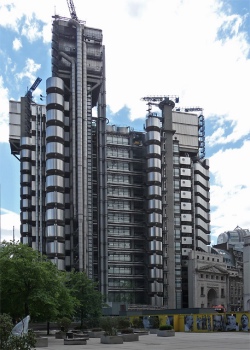
Designed by the Richard Rogers Partnership (now Roger Stirk Harbour + Partners) in conjunction with structural engineers Arup, this 12 storey building – which features galleries adjoining a series of towers located around a central, glass-topped atrium – was completed in 1986 after eight years of construction. The £75 million building was officially opened by Queen Elizabeth II.

The building, which was granted grade I-listed status in 2011 (making it the youngest building to receive the honour), used more than 33,000 cubic metres of concrete, 30,000 square metres of stainless steel cladding and 12,000 square metres of glass in its creation.

Among its most famous innovations is the location of services – including lifts, toilets and tubes containing wiring and plumbing – on the exterior of the building in an effort to maximise space inside (inviting comparisons with the Centre Pompidou in Paris, which Rogers was involved in the design of, along with Renzo Piano, prior to working on this building).

The building incorporates – in Leadenhall Street – part of the facade of the previous Lloyd’s building which had occupied the site since 1928 (the corporation had been founded in 1688 in Tower Street by Edward Lloyd and endured several moves before coming to its current home).

The 11th floor Committee Room incorporates the Adam Great Room, an adaptation of the original dining room from Bowood House in Wiltshire which was designed by Robert Adam for the 1st Earl of Shelbourne. It was purchased from Bowood in 1956 and incorporated into Lloyd’s former Heysham building before being moved into the current building.

Also present in the building, hanging from the Rostrum on the ground floor, is the famous Lutine Bell. It was recovered from the wreck of HMS Lutine – lost at sea with all hands and cargo in 1799 and, as a result, the subject of a claim against Lloyd’s which was paid in full – in 1859 and has since graced Lloyd’s underwriting rooms. While it was formerly rung to announce when news of an overdue ship arrived – once for a loss, twice for its safe return – these days it is only used on ceremonial occasions.

The building’s futuristic and iconic look meant it’s served as a location in numerous films including 2014’s Guardians of the Galaxy, Mamma Mia (2008) and The Ghost Writer (2010). It has also, in recent years, attracted climbers, leading Lloyd’s to seek an injunction to prevent such actions.

PICTURE: Stephen Richards/licensed under CC BY-SA 2.0

LondonLife – Alley flurries…

PICTURE: Clever Visuals/Unsplash

What’s in a name?…St Pancras…

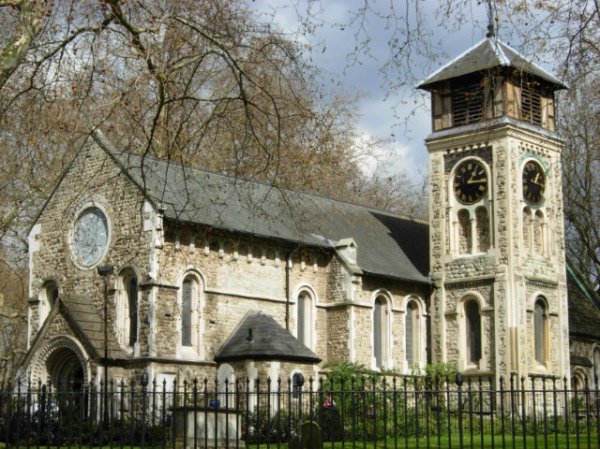
This name – now only usually used in reference to several buildings and landmarks around the Kings Cross area including churches, a road, hotel and railway stations – was originally that of a separate village.

The village was named for the church in its midst which had been dedicated to St Pancras. The church – which has been dated back to at least the Norman era – is said to have been built on one of the earliest sites of Christian worship in the UK and was dedicated to a Roman-era boy martyr, St Pancras (in Latin, St Pancratius).

Tradition holds that St Pancras was a citizen of Rome who converted to Christianity and was beheaded for his faith during the Diocletian persecution in the early 4th century when aged just 14. When Pope Gregory the Great sent St Augustine on his mission to England in the late 6th century, he sent relics of the saint with him, hence why many English churches are dedicated to St Pancras.

The village which had been based around the church was apparently largely abandoned in the Middle Ages – possibly due to flooding – and the area was only resettled in the late 18th century with the development of Camden Town and Somers Town.

While the church – now known as St Pancras Old Church – was restored in the mid-19th century, a new parish church – known as St Pancras New Church – which built about a kilometre away on Euston Road.

PICTURE: Stephen McKay/licensed under CC BY-SA 2.0.

This Week in London – Queen Elizabeth I’s letters; ‘used and abused’ books; Sir Mark Rylance at Westminster Abbey…

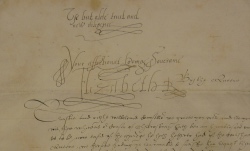
Forty-three letters written by Queen Elizabeth I and her senior advisors concerning the imprisonment of Mary, Queen of Scots, have been donated to the British Library. Many of the 43 letters were written to Sir Ralph Sadler, who held the Scottish Queen in custody at Tutbury Castle in Staffordshire between 1584-85 prior to her execution in 1587. Four of the letters are signed by Queen Elizabeth I and others are written in the hand of Chief Minister Lord Burghley and Secretary of State, Sir Francis Walsingham. The collection has been on loan to the library for a number of years but has now been gifted by the industrialist and philanthropist Mark Pigott to the American Trust for the British Library. The library plans to digitise the letters and make them available on its Digitised Manuscripts website.

The alteration of books through customisation, decoration or disguise is the subject of a new exhibition opening at the Guildhall Library on Monday. Books: Used and Abused shows how some books have been used as notepads or expanding files while others have become containers. A free ‘book surgery’ advice session will be held at the library on 22nd February for people to learn about their own ‘used and abused’ books and how to repair them. Runs until 9th March. Entry is free (booking required for the free advice session). For more, head here.

•  Sir Mark Rylance will bring the words of Shakespeare to life in six special performances at Westminster Abbey this April. All Places that the Eye of Heaven Visits will feature a cast of 23 actors from Shakespeare’s Globe performing extracts from some of the Bard’s most famous plays and poetry. The performances will occur over 26th to 28th April. Tickets go on sale on 29th January via the  Shakespeare’s Globe box office.

Send all items for inclusion to exploringlondon@gmail.com.
10 subterranean sites in London – A recap…

Recapping our recent Wednesday series. We kick off a new series next week…

10 subterranean sites in London – 1. The Greenwich Foot Tunnel…

10 subterranean sites in London – 2. The London Silver Vaults…

10 subterranean sites in London – 3. The Banqueting House undercroft…

10 subterranean sites in London – 4. St Paul’s Cathedral Crypt…

10 subterranean sites in London – 5. Whitefriars Priory crypt…

10 subterranean sites in London – 6. Guildhall crypts…

10 subterranean sites in London – 7. Alexander Pope’s Grotto…

10 subterranean sites in London – 8. Priory of St John of Jerusalem church crypt…

10 subterranean sites in London – 9. The Mail Rail…

10 subterranean sites in London – 10. Chislehurst Caves…

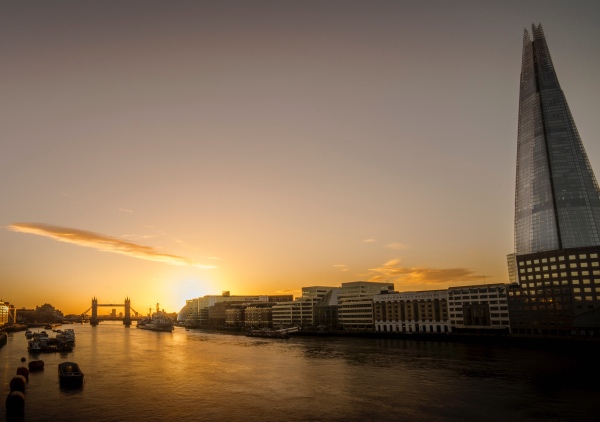
LondonLife – Dawn by The Shard…

PICTURE: Tom Coe/Unsplash

A Moment in London’s History – The great flood of 1928…

It was 90 years ago this month – 6th and 7th January, 1928 – that the River Thames flooded disastrously in what was the last major flood in central London.

Fourteen people are reported to have died and some 4,000 made homeless when the river burst its banks and spilled over the top of the Thames Embankment. Part of the Chelsea Embankment collapsed.

The flood – which was blamed on a range of factors including a sudden thaw upstream, heavy rain, a tidal surge and the impact of dredging – peaked at about 1.30am on 7th January at a height of 18 foot, three inches (5.56 metres) above ordnance datum.

The city saw extensive flooding on the City of London itself as well as in Southwark and as far upriver as Putney and Hammersmith and downriver in Greenwich and Woolwich as well as beyond.

Most of the deaths occurred when the embankment gave way near Lambeth Bridge and a wall of water swept through the slums on the Westminster side of the bridge with 10 people losing their lives.

Among the buildings flooded were the Tate Gallery at Millbank – where many works including some by JMW Turner were damaged, parts of the Houses of Parliament including Westminster Hall and the House of Commons, numerous Underground stations and Blackwall and Rotherhithe tunnels. The moat of the Tower of London, dry for 80 years, was filled.

While the flood waters receded by the end of the day, the damage took years to repair with many buildings in Millbank, the worst affected area, demolished. Embankments were raised in the wake of the flooding but it wasn’t until after the North Sea flood of 1953 that authorities took action to build the Thames Barrier (it was eventually completed in 1982).

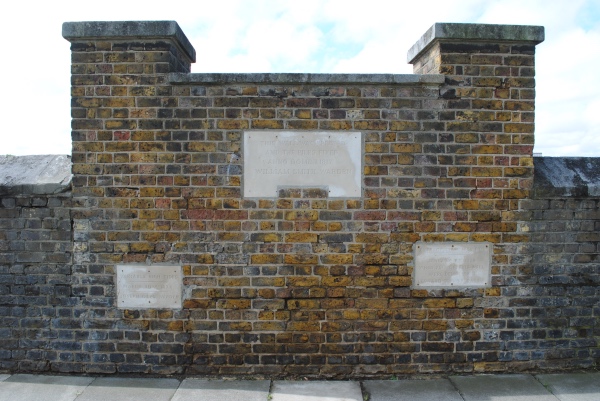
Above – A marker recording the height of the flood outside Trinity Hospital in Greenwich (the plaque below right records the details).

10 subterranean sites in London – 10. Chislehurst Caves…

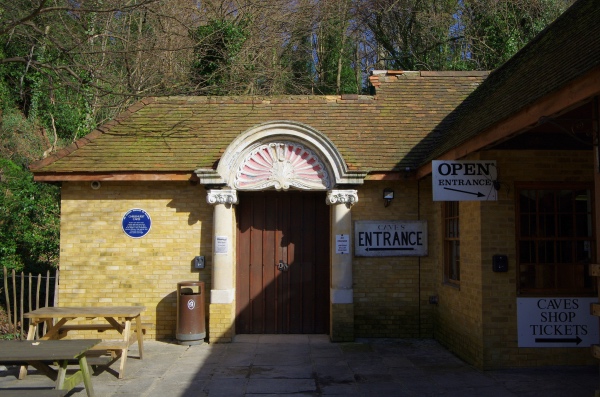
We finish our series on subterranean London with a visit to the Chislehurst Caves in the outer south-east.

The ‘caves’, located in Chislehurst in Kent, are actually 22 miles of man-made tunnels which were dug out in the search for chalk – used in lime-burning and brick-making – as well as, in later years, flint for use in tinder boxes and flintlock guns.

There’s considerable debate over the age of the caves but it’s claimed the earliest mention of the complex apparently dates back to the 13th century and they are believed to have been last worked in the 1830s. The three main sections of the caves are named after the Druids, Romans and Saxons in a reference to who some believed helped to create them.

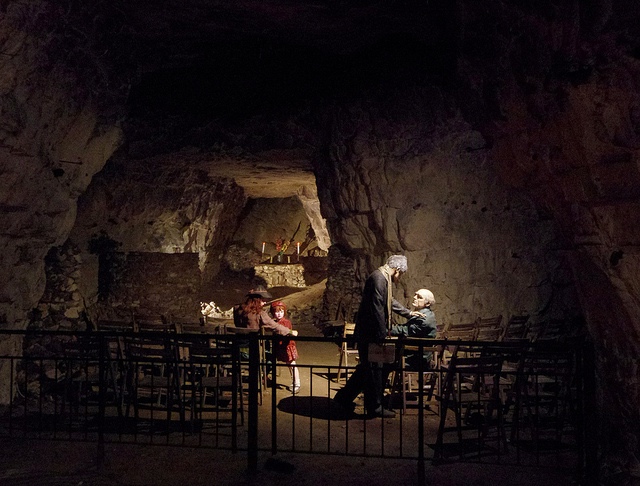
They were first opened to the public at the turn of the 20th century and have since been used for munitions storage (during World War I, to cater for overflow from the Woolwich Arsenal), mushroom growing, and, during World War II provided accommodations for some 15,000 people as one of the largest deep air-raid shelters in the country.

They also hosted music events in the 1960s when the likes of David Bowie, Jimi Hendrix, Led Zepplin and Pink Floyd were among those who performed there and have appeared in several episodes of Dr Who

These days the caves are visited only on lamplit, 45 minute guided tours, which take in about a mile of the tunnels.

WHERE: Chislehurst Caves, Caveside Close, Old Hill, Chislehurst, Kent (nearest railway station is at Chislehurst); WHEN: 10am to 4pm everyday during school holidays and Wednesday to Sunday outside those periods; COST: £6 an adult/£4 seniors and children aged three to 15 (children under three free); WEBSITE: chislehurst-caves.co.uk.

PICTURE: Above – the entrance; Below – a reconstruction of the church, part of the air-raid shelter (both images – David Edwards, licensed under CC BY -NC-ND 2.0)

LondonLife – Welcome to 2018!

PICTURE: Kafai Liu/Unsplash

Exploring London’s 10 most popular (new) posts of 2017 – Numbers 2 and 1…

We’ve finally reached numbers 1 and 2…

2. Lost London – The Mermaid Tavern…

1. 10 (more) fictional character addresses in London – 4. 138 Piccadilly…

Wishing all our readers a very happy and safe start to 2018. Our usual coverage resumes on Tuesday!

Exploring London’s 10 most popular (new) posts of 2017 – Numbers 4 and 3…

The countdown continues…

4. Lost London – Pasqua Rosee’s Coffee House…

3. Where’s London’s oldest…street sign?

Come back tomorrow for the two most popular posts…

Exploring London’s 10 most popular (new) posts of 2017 – Numbers 6 and 5…

The countdown continues…

6. 10 (more) fictional character addresses in London – 8. A square in Soho?…

5. What’s in a name?…Hanging Sword Alley…

Come back tomorrow for the next two…


Exploring London’s 10 most popular (new) posts of 2017 – Numbers 8 and 7…

The countdown continues…

8. 10 (more) fictional character addresses in London – 6. 9 Bywater Street, Chelsea…

7. 10 (more) fictional character addresses in London – 2. 27a Wimpole Street…

Come back tomorrow for the next two!

Exploring London’s 10 most popular (new) posts of 2017…

And so we begin our annual countdown of the 10 most popular (new) posts of the year, starting with number 10…

10. 10 (more) fictional character addresses in London – 3. 32 Brett Street, Soho…

9. 10 (more) fictional character addresses in London – 1. Fetter Lane, Old Jewry and Wapping…

Come back tomorrow for the next two!