Famous Londoners – US founding fathers…

The US is celebrating the 250th anniversary of the signing of the Declaration of Independence with celebrations taking place across the weekend just passed.

We thought it a good time to take a quick look at which of the seven founding fathers lived in London…
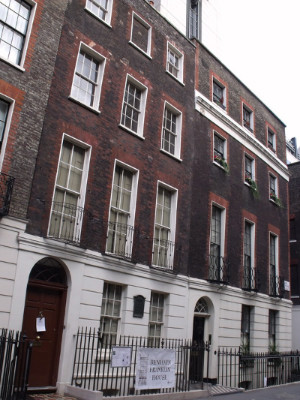
Benjamin Franklin House. PICTURE:
Elliott Brown (licensed under CC BY 2.0)

1. Benjamin Franklin. Franklin, perhaps the founding father most associated with London, lived in the city for two periods in his life. The first was when he was working as a printer’s apprentice between 1724-26 and the second was when he was representing the interests of the American colonies to the British Government from 1757 to 1775. It was during the latter period that he lived at 36 Craven Street – now a Grade I-listed property known as Benjamin Franklin House and the only remaining residence in the world still standing in which Franklin lived (and one which carried a fascinating past).

2. John Adams. Adams, who was to go on to succeed George Washington as president, lived in London between 1785 and 1788 in the role of first American Minister to Great Britain (actually to the Court of St James), charged by Congress with establishing trade and diplomatic contacts. He lived in a property at 9 Grosvenor Square in Mayfair, a location which remains connected to the US today, housing the US embassy and numerous US memorials. A plaque marks the location of the property.

3. John Jay. The first Chief Justice of the US Supreme Court, he lived in London from June to November, 1794, while, as an envoy of the first US President George Washington, he was negotiating the controversial Jay Treaty with the British Government which dealt with some of the lingering issues of the Revolutionary War.

4. Thomas Jefferson. To say Jefferson lived in London may be a stretch but he did visit for an extended period in March and April, 1786 when, serving as the American minister in France, he crossed the channel and spent a month-and-a-half largely based in the city with John Adams as trade treaties were being negotiated. During his visit he is known to have taken in the gardens at Chiswick House and the Royal Botanic Gardens in Kew (as well as some further afield such as at Blenheim Palace).

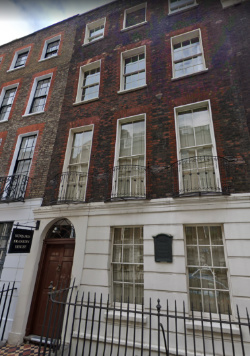
10 historic London homes that are now museums…1. Benjamin Franklin House…

London is replete with historic homes but only a few have become museums. In this series we want to look beyond the more famous ones – think of the Dickens Museum in Bloomsbury or of the John Soane Museum in Lincoln’s Inn Fields, to name two – to some of the lesser known homes that have became museums.

PICTURES: Courtesy of Google Maps

First up, it’s Benjamin Franklin House at 36 Craven Street. While the history of this Georgian terraced house goes back to 1730, Franklin himself is known to have lived in what was a lodging house for some 16 years from 1757 to 1775 (his wife Deborah had apparently refused to come and remained in Philadelphia).

Franklin, who had first lived in London in the mid-1720s while working as a trainee printer and stayed in various lodgings including in Lincoln’s Inn Fields, initially served as an agent for the Pennsylvania Assembly in London but, after a brief time back in Philadelphia, returned to London in 1764, this time as ambassador for the colonies in America. He left the property in 1775 to return to Philadelphia where, shortly after, on 4th July, 1776, he was among the signatories to the Declaration of Independence.

The four storey townhouse, which is the only surviving property lived in by Franklin left in the world, remained a lodging house up until World War II. It later served as the headquarters for the British Society for International Understanding.

The Friends of Benjamin Franklin House was founded by Mary, Countess of Bessborough in 1978 and in 1989 the government gave the friends the freehold to the land. The friends then undertook a major renovation and restoration project.

During the works some 1200 bones fragments – believed to be the remains of 15 people, at least six of them children – were found buried in the cellar. They were dated to about the time Franklin had been living there.

But, fear not, the bodies were not of Franklin’s doing. It is believed that William Hewson, an early anatomist and friend of Franklin (as well as being married to Polly, the daughter of the property’s landlady Margaret Stevenson), was responsible for the remains.

Hewson, who was among tenants at the property between 1770 and 1774, ran a small anatomy school here where he conducted secret dissections to avoid any legal complications. The bodies were thought to have been buried in the back garden which, when the property was expanded, later became part of the basement.

The Grade I-listed property – which contains many original features including the floorboards, ceilings and staircases – finally opened as a museum for the public in January, 2006.

These days, the history of the property – including its architecture and Franklin’s residency – can be explored through an ‘historical experience’ and ‘architectural tour’. There’s also a virtual tour available online recreating what the property may have looked like in Franklin’s time.

Among the artefacts on show in the house are Franklin’s leather wallet (inscribed with the Craven Street address and his name), a bust of Franklin dating from about 1800, and what is believed to be the property’s original door-knocker.

The house also features an English Heritage Blue Plaque – although the plaque, which was erected in 1914, is grey, not blue and rectangular, not circular.

WHERE: Benjamin Franklin House, 36 Craven Street, Westminster (nearest Tube stations are Embankment and Charing Cross); WHEN: Various times for tours – check the website for details; COST: Historical Experience – £9.50 adults/£8 concessions/free for under 12s; Architectural Tour – £7.50 adults/£6 concessions/free for under 12s; WEBSITE: https://benjaminfranklinhouse.org.