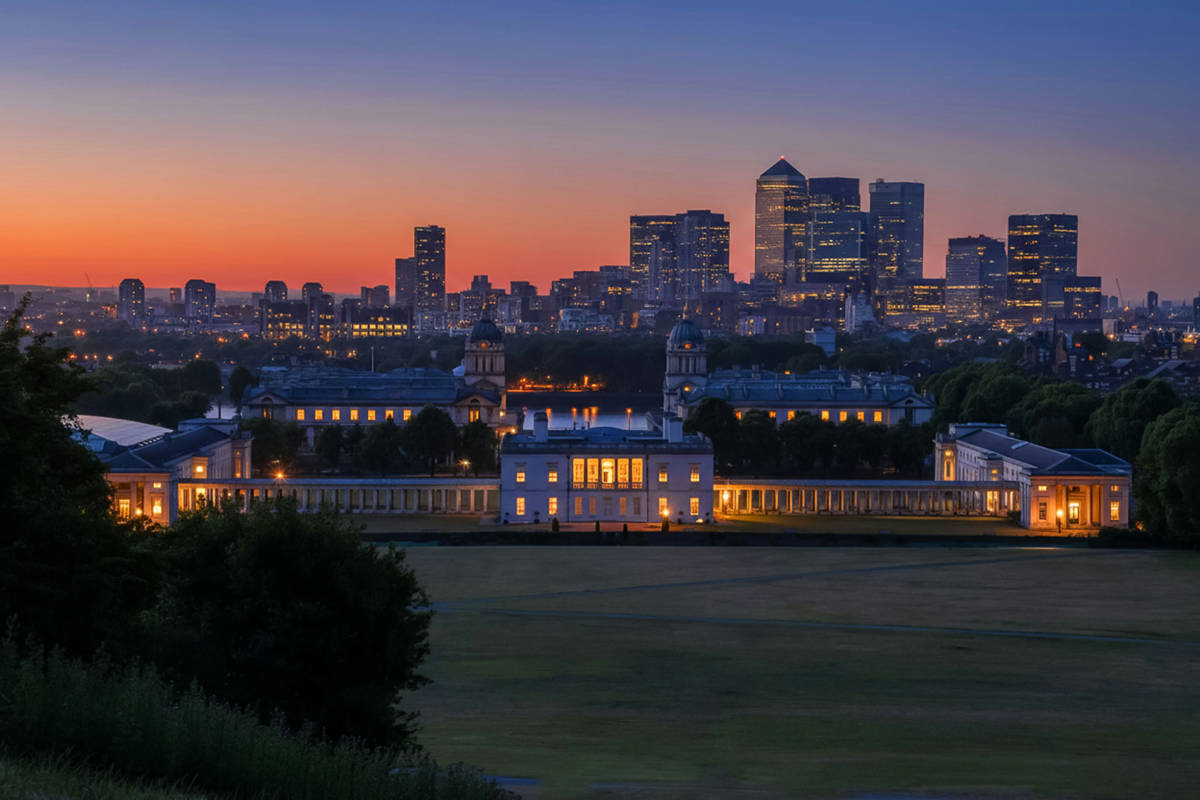
LondonLife – Greenwich overwatch…
The oldest riverside wet dock in London (and for many years the largest), the origins of the expansive Greenland Dock in Rotherhithe go back to the late 17th century.
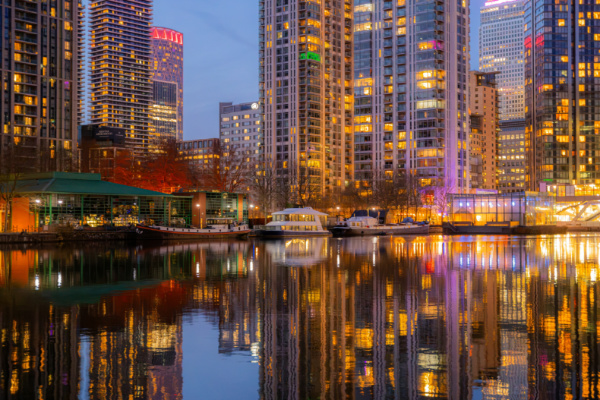
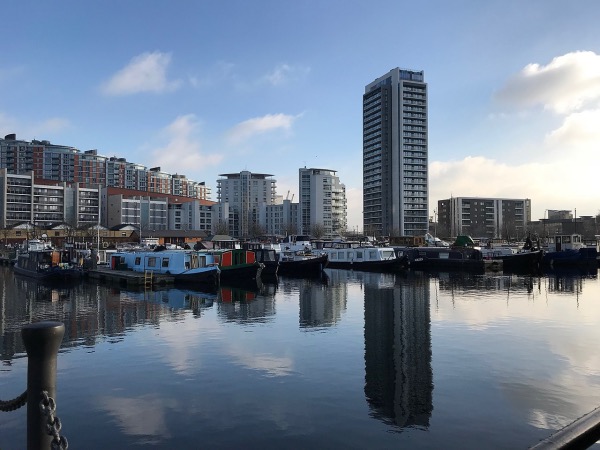
Though they no longer in evidence, this Thames-side East London district takes its name from the Black Poplar trees which were once abundant in the area.
The area was apparently fertile ground for the poplars thanks to the proximity of the Lea and Thames Rivers which created the moist soil the tree needs. There was still a poplar tree in the area until the mid-1980s.
The name goes back to the 14th century but Poplar wasn’t an independent parish until the 19th century (before which it was a hamlet of Stepney). Poplar is now part of the Borough of Tower Hamlets.
The medieval village of Poplar was centred on Poplar High Street and the East India Company, which built ships in Blackwall Yard, established a chapel and almshouses in Poplar.
The area expanded rapidly in the early 19th century thanks to the maritime industries that grew up here but by late that century this had diversified into other manufacturing and transport-related industries.
The area has long had a maritime association with ship fitting taking place in the area from the 15th century. Poplar was impacted by bombings during World War I and then devastated during the Blitz with about half the houses in the area damaged and the population dropping significantly as a result.
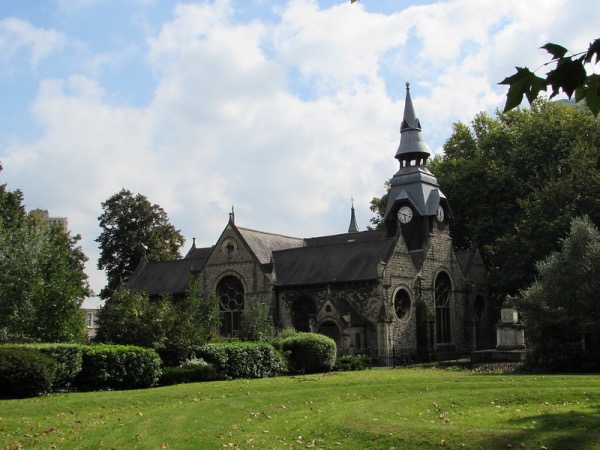
Landmark buildings include the old Poplar Town Hall, now a hotel, the Grade II*-listed St Matthias Old Church (originally the chapel built by the East India Company in 1654 and now a community centre), the Grade II-listed All Saints Church, dating from 1821-23, and the Museum of London Docklands at West India Quay.
The area also features considerable post-war housing including the Brutalist-style 26 storey Balfron Tower. In more recent years, with the development of the Docklands and the linking of the area to the city by the Docklands Light Railway, the area has continued to undergo regeneration.
The world’s only complete surviving Victorian steamship, the SS Robin is moored in east London, close to where it was built.
One of a pair of steam coasters (the other being Rook) built initially by Mackenzie, MacAlpine & Co at Orchard House Yard on Bow Creek (and then completed by London shipowner Robert Thomson) in 1890, the SS Robin was fitted out at East India Dock before being towed to Dundee to be fitted with her engine, boiler and auxiliary machinery at Gourlay Brothers & Co.
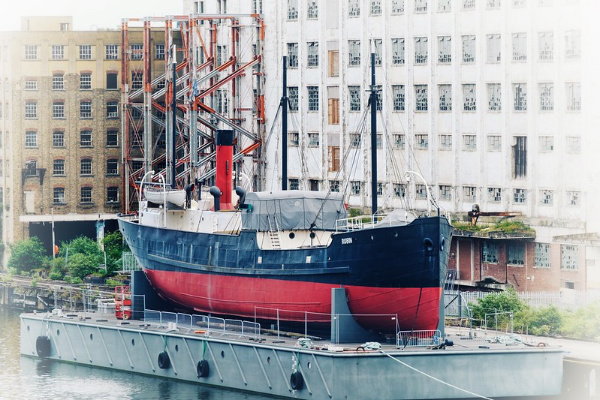
The SS Robin commenced her sailing career at Liverpool on 20th December, 1890, and spent the next decade carrying cargos – including grain, coal, and iron ore – between British ports as well as some in northern France. Early on – in 1892 – she was sold to Alexander Forrester Blackater of Glasgow and re-registered there.
In 1900, the Robin was sold to what would be the first of three Spanish owners and renamed the Maria. The ship would then spend the next 74 years working along the Spanish coast, carrying a range of cargos including iron and coal.
In 1974, only days after discharging her final cargo and about to be sold to Spanish ship breakers, the Maritime Trust purchased the ship.
Following a two restoration project at the Doust & Co shipyard in Rochester, Kent, and, once again named the Robin, she was subsequently moored in St Katharine Docks. The ship was moved to a new mooring at West India Quay in 1991 but fell into disrepair.
In 2000, David and Nishani Kampfner bought Robin for £1 with the idea of creating an educational centre and gallery. Two years later, in 2002, SS Robin Trust was created and volunteers subsequently began the work of restoring the coastal steamer.
From 2004 until 2007, the vessel was home to a gallery and workshops run by Kampfner to encourage creative thinking in children.
But the need for further refurbishment saw this come to an end and, financed by a £1.9 million loan from Crossrail and a £1 million grant from The Heritage Lottery Fund, in June, 2008, the Robin undertook her first sea journey in 35 years, travelling to Lowestoft for the much needed restoration works.
Once at Lowestoft, however, it was discovered the ship was too fragile to go to sea again and so a pontoon was created onto which the ship was lifted in 2010. Towed to Tilbury, the Robin underwent further refurbishment there until, in July, 2011, she returned to London.
Moored initially at the Royal Albert Dock, she is now located at Royal Victoria Dock (and can be seen from nearby viewing points). There are now plans to relocate her to Trinity Buoy Wharf and for further development as a museum ship.
For more information, head to http://ssrobin.com.

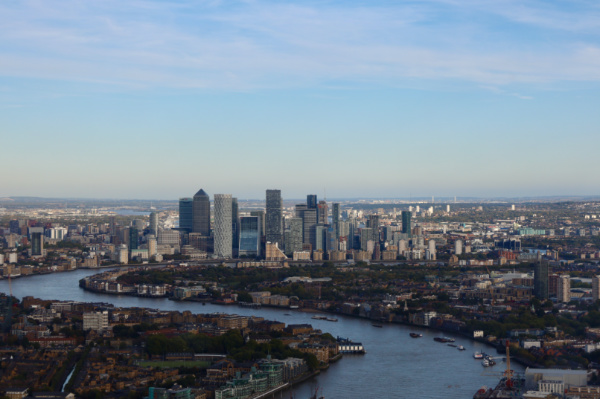
View of the Docklands from North Greenwich.

The Docklands reflected in The Thames.

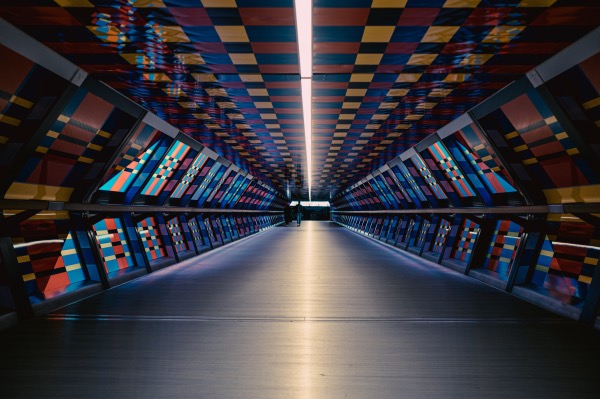
Adams Plaza Bridge, Canary Wharf, Docklands. The colourful crossing, which links Crossrail Place and One Canada Square, was created by artist Camille Walala as part of last year’s London Mural Festival. PICTURE: Samuel Regan-Assante/Unsplash

Cabot Square, Docklands. PICTURE: Tom Podmore/Unsplash
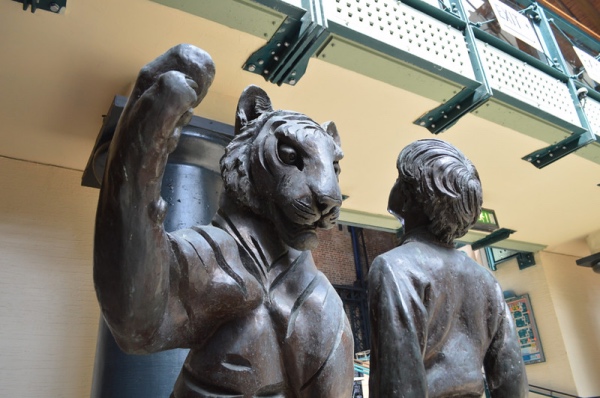
This bronze statue located at Tobacco Dock in Wapping commemorates an incident in 1857 in which a newly arrived Bengal tiger escaped from its wooden crate, terrorised the local population and absconded with a boy in its mouth.
The tiger, along with various other animals, had just arrived at a premises on Betts Street, just off the Ratcliffe Highway, which was owned by exotic animal trader Charles Jamrach, the man behind Jamrach’s Animal Emporium, when it made its break for freedom.
The boy, variously said to be seven, eight or nine-years-old, had apparently approached the tiger to pet it when the tiger took the boy by his jacket and carried him off in its mouth, presumably looking for a quiet place to consume its prey.
Jamrach followed, subsequently bailing up the tiger and, thrusting his cane into the big cat’s throat, forcing it to let go of the no-doubt terrified boy.
The tiger, which was guided back to its cage after the event, was subsequently sold for £300 to George Wombwell and went on to become a popular tourist attraction in his travelling menagerie.
Despite being relatively unharmed, the boy (variously described as seven, eight or nine, however, sued Jamrach and was awarded some £300 in damages – the same amount Jamrach had sold the animal for.
The statue is located near where the event happened by Tobacco Dock’s Pennington Street entrance.
PICTURE: Matt Brown (licensed under CC BY 2.0)
Located at the western end of West India Quay in Docklands, the Hibbert Gate is a smaller scale replica of an original gate that stood at the main entrance to the quay for more than 130 years.
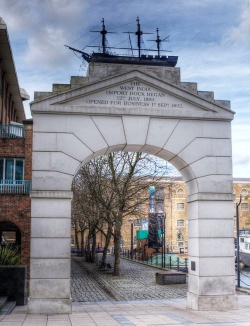 The gate was originally installed in 1803 and was topped with a model representing an East Indiaman, the Hibbert, which was named for George Hibbert, one of the principals of the West India Dock Company (and who apparently had a financial interest in the slave trade). The ship ran between London and the West Indies before later being used to transport convicts to Australia.
The gate, which became the emblem for West India Docks and was even incorporated into the Poplar Borough Council’s coat-of-arms, was removed in 1932 due to traffic measures. The model was initially preserved and moved to the Poplar Recreation Ground but vandalism and bomb damage saw it eventually fall apart.
The replica gate, commissioned by the Canary Wharf Group and topped with a replica model by artist Leo Stevenson, was installed in the year 2000, marking 200 years since the construction of the quay.
It was unveiled on 12th July by then Mayor of London, Ken Livingstone. Part of the signage accompanying the gate reads that it was meant to be “memorial to the man – the replica in no way represents support for slavery”.
PICTURE: Prioryman (Licensed under CC BY-SA 4.0/image cropped)
 PICTURE: Roman Fox/Unsplash.
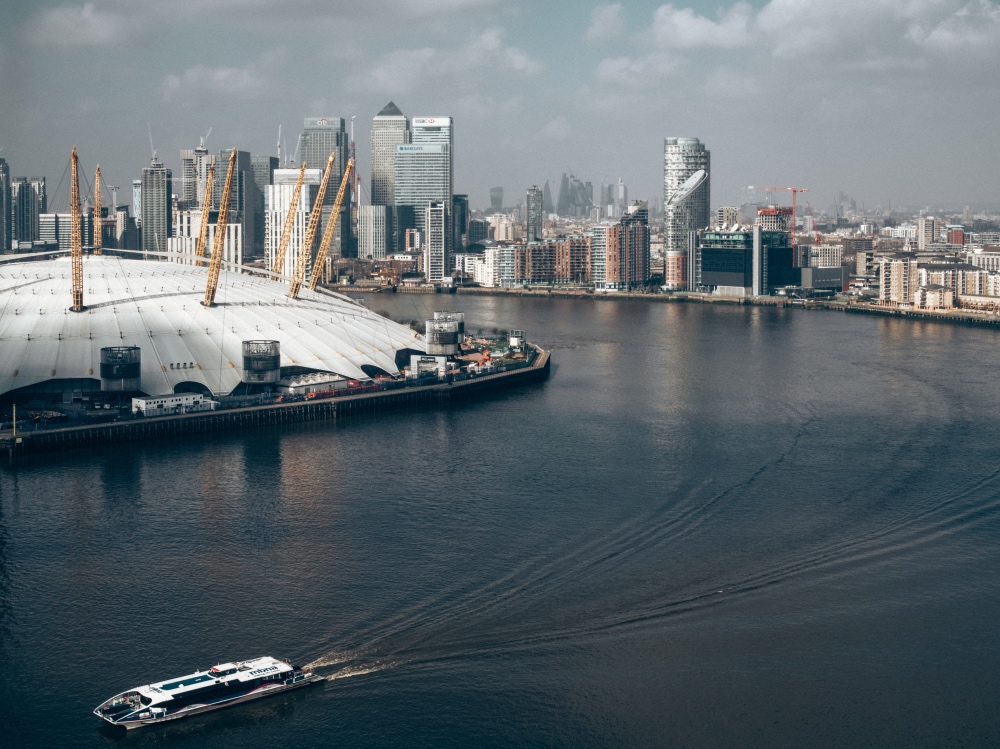
Looking across the O2 Arena towards the Docklands. PICTURE: Claus Grünstäudl/Unsplash
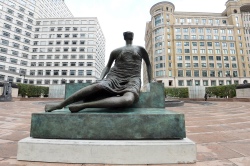 • A new exhibition charting the history of Henry Moore’s sculpture, Draped Seated Woman (known affectionately as Old Flo), has opened at Canary Wharf. Indomitable Spirit features traces the creation of the 2.5 metre high bronze sculpture in 1957-58, its placement in 1962 on the Stafford Estate in Stepney, and, in 1997, its removal to the Yorkshire Sculpture Park where it has spent the last 20 years before returning to the East End – this time Cabot Square – last year. It also explores the artist’s life, career and legacy and the reasons as to why Old Flo – part of an edition of six sculptures – became such an important feature in the East End. The exhibition can be seen in the lobby of One Canada Square until 6th April. Admission is free. For more, see www.canarywharf.com. PICTURE: Henry Moore’s ‘Draped Seated Woman’, Canary Wharf.
• The first of two Peter Pan-themed weekends kicks off at the Museum of London Docklands this Saturday. Adventures in Peter Pan’s Neverland features a series of interactive events film screenings and performances across the weekend with professional character actors leading workshops and re-enacting short scenes from the story. There will also be “sightings” of Captain Hook’s pirates and other characters and two screenings of the classic animated film Peter Pan each day. Money will be raised for Great Ormond Street Hospital Children’s Charity through donations on ticket sales and other fundraising activities during the event. Runs from 10.45am to 4pm this Saturday and Sunday and again on 3rd and 4th March. Tickets start at £4. For more, see www.museumoflondon.org.uk.
 • On Now: Winner-the-Pooh: Exploring a Classic. This exhibition at the V&A, which is closing on 8th April, features original drawings by EH Shepard – on show in the UK for the first time – created to illustrate AA Milne’s classic tale and, as well as examining Milne’s story-telling techniques and Shepard’s illustrative style, takes a look at the real people, relationships and inspirations behind the bear’s creation. Around 230 objects are featured in the display and as well as original manuscripts, illustrations, proofs and early editions, they include letters, photographs, cartoons, ceramics, fashion and video and audio clips, with the latter including a 1929 recording of Milne reading Winnie-the-Pooh). Other highlights include Milne’s Winnie-the-Pooh manuscript and pages from the manuscript of House at Pooh Corner as well as Shepard’s first character portraits of Winnie and Christopher Robin nursery tea set which was presented to then-Princess Elizabeth in 1928. Admission charge applies. For more see, www.vam.ac.uk/winniethepooh. PICTURE: Line block print, hand coloured by E.H. Shepard, 1970, © Egmont, reproduced with permission from the Shepard Trust
Send all items for inclusion to exploringlondon@gmail.com.
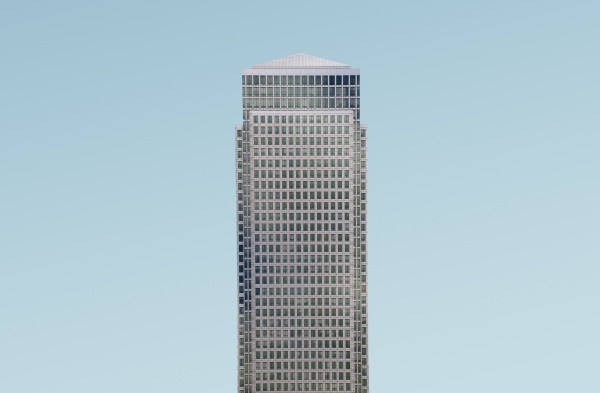 The second tallest building in the UK (and once, very briefly, the tallest building in Europe), Canary Wharf’s One Canada Tower is a symbol of London’s revamped Docklands.
The 50 storey skyscraper (there’s also three underground) was designed by Cesar Pelli and constructed between 1988 and 1991. Containing some 1.2 million square feet of office space making it the largest office building in the UK, it was officially opened on 26th August of the latter year by Prince Philip.
Often called the Canary Wharf tower, One Canada Tower was apparently the first skyscraper to be clad in stainless steel and was designed to reflect the sky. There’s an aircraft warning light on top which flashes some 57,600 times a day.
An office building with no public observation deck, current tenants include a range of financial institutions as well as other companies such as the Trinity Mirror Group, owner of several UK newspapers.
As with other newer skyscrapers in London, One Canada Tower has been seen in its share of movies including in 28 Weeks Later and Mission: Impossible – Ghost Protocol.

An institution linking the Isle of Dogs to Greenwich underneath the Thames for more than a century, the Greenwich Foot Tunnel was built to provide an alternative to a sometimes unreliable ferry service – thanks to weather – and was principally aimed at workers making their way from their homes in London’s south to docks and shipyards.
It was one of two tunnel crossings – the other being at Woolwich – which were lobbied for by Will Crooks, chair of the LCC’s bridges committee and later MP for Woolwich.
Designed by engineer Sir Alexander Binnie for the London County Council, the project – which reportedly cost some £127,000 – commenced in June, 1899, with the tunnel completed and opened, with very little fanfare (there was apparently no opening ceremony) on 4th August, 1902.
The design features a glass-topped dome at either end with steps spiralling downward (reported as 87 steps to the north and 100 to the south). Lifts were installed in 1904 and then upgraded in the 1990s and more recently in 2012. The tunnel itself. which is positioned at a depth of about 50 feet, is made of cast-iron and lined with 200,000 glazed white tiles. It measures 1,215 feet long with an internal diameter of nine feet.
The northern end of the tunnel was damaged by bombs during World War II and repairs include a thick steel and concrete lining that substantially reduce the interior size of the tunnel for a short distance.
The tunnel, which has its own friends group, is classed as a public highway and so as a matter of law is kept open 24 hours a day. Its depth means it remains a cool place even on a hot day.
WHERE: Greenwich Foot Tunnel (nearest DLR (northern end) is Island Gardens and (southern end) is Cutty Sark; WHEN: Always; COST: free; WEBSITE: www.royalgreenwich.gov.uk/info/200102/walking/693/foot_tunnels.
PICTURES: Top – James Stringer under licence CC BY-NC 2.0; and below – Neil Turner under licence CC BY-SA 2.0

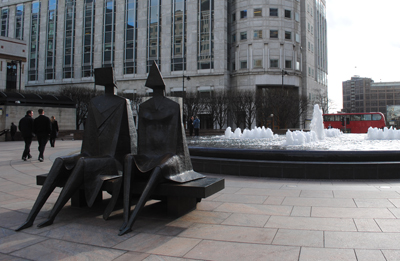
Couple on seat, Cabot Square, Canary Wharf. The much wondered at (who are the couple?; why do their heads have such odd shapes?) bronze sculpture is by Lynn Chadwick (2000).
No, Canary Wharf is not so named because it was the centre of London’s lucrative trade in canaries.
 Rather it received its name from the fact that it was at a quay here that ships from the Spanish Canary Islands and the Mediterranean landed laden with cargos of fruit.
The wharf, part of the West India Docks on the Isle of Dogs, was built in 1936 by Fruit Lines Limited and a warehouse the following year.
The area where the wharf was once located was redeveloped under a massive regeneration project starting in the late 1980s and is now one of London’s key financial districts, filled with modern, multi-storey office towers and home to the second-tallest tower in the UK, One Canada Square (seen above with the pyramid-shaped roof).
 Exploring London
