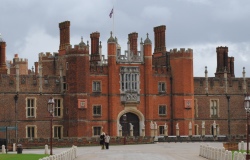
• Visitors to Hampton Court Palace will be transported back to 1906 from Saturday as the palace community prepares for Christmas. Christmas Present, Christmas Past features a range of activities from carol singing around the tree to telling ghost stories (and looking at the traditions behind them) as well as live culinary demonstrations in the kitchens showing the evolution of Christmas dinner as we know it today. Meanwhile, the Hampton Court Palace Festive Fayre returns next weekend (7th to 9th December) with more than 90 stalls set up in the palace courtyards selling mince pies, mulled wine and a host of other festive treats. And the palace’s ice-skating rink has returned to the Tudor West Front (and will be there until 6th January). Admission charges apply. For more, see www.hrpfoodfestivals.com.
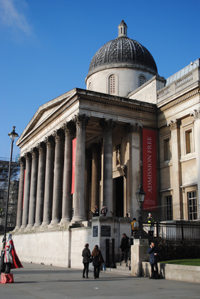
 • Sir Edwin Landseer’s dramatic work – The Monarch of the Glen – is at the centre of a new exhibition celebrating the connections between the 19th century artist and the National Gallery. “Coming home” to the Trafalgar Square-based institution for the first time in more than 160 years, the painting – arguably the most famous animal painting in the world – is one of 14 works included in a new free show opening today. Among paintings created to decorate the Palace of Westminster after fire devastated the building in 1834, Landseer’s (1802-1873) work was first exhibited at the Royal Academy in 1851, then housed in what is now the National Gallery building. It’s now on loan from the National Galleries of Scotland, which acquired the work in 2017. This is the first London showing since 1983. Other works in the display include Landseer’s Ecorche drawing of a dog’s leg (1821), as well as paintings and drawings connected with the famous lions Landseer designed for Trafalgar Square including a John Ballantyne portrait of the artist modelling the lions in his studio and a work by Queen Victoria, whom Landseer tutored in etching, entitled A pencil drawing of a stag after Landseer’s mural on the Dining Room wall at Ardverikie Shooting-lodge (1847). Can be seen in Room 1 until 3rd February. For more, see www.nationalgallery.org.uk. PICTURE: Edwin Landseer, ‘The Monarch of the Glen’ (about 1851), © National Galleries of Scotland
• More than 40 paintings created during the final year of World War I by artist Alfred Munnings (1878-1959) go on show at the National Army Museum in Chelsea tomorrow. Alfred Munnings: War Artist, 1918 shows his mastery of equine subjects as well as portraiture and landscapes. Munnings was commissioned by the Canadian War Memorials Fund as an official war artist to capture the fighting front and logistics behind the scenes and in early 1918 was embedded with the Canadian Expeditionary Force. The exhibition has been developed by the Canadian War Museum in partnership with The Munnings Art Museum and is supported but The Beaverbrook Canadian Foundation. Can be seen until 3rd March. Admission charge applies. For more, see www.nam.ac.uk.
Send all items for inclusion to exploringlondon@gmail.com.
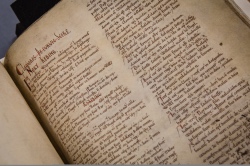






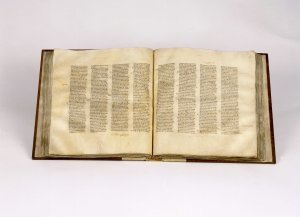 The first major exhibition to explore the history of Egypt after the pharaohs opens at the British Museum today. Egypt: Faith after the pharaohs spans 1,200 years of history – from 30 BC to 1171 AD – with 200 objects showing how Christian, Islamic and Jewish communities reinterpreted the pharaonic past of Egypt and interacted with each other. The exhibition opens with three significant examples of the Hebrew Bible, the Christian New Testament and the Islamic Qur’an – the texts include the New Testament part of the 4th century AD Codex Sinaiticus, the world’s oldest surviving Bible and the earliest complete copy of the New Testament, which is now part of the British Library’s collection. All three are juxtaposed with everyday stamps associated with each of the three religions in an illustration of the relationship between the institutional side of religion and its everyday practice, both key themes of the exhibition. Other exhibits include a pair of 6th-7th century door curtains featuring classical and Christian religious motifs, a 1st-2nd century statue of the Egyptian god Horus in Roman military costume, and a letter from the Roman Emperor Claudius (41-54 AD) concerning the cult of the divine emperor and the status of Jews in Alexandria. Admission charge applies. Runs until 7th February in Room 35. A programme of events accompanies the exhibition. For more, see