Wishing all our readers a very happy and safe Easter break!
Wishing all our readers a very happy and safe Easter break!
Happy New Year to all of Exploring London’s readers! Wishing you a great start to 2026.
Don’t forget to keep an eye out for our most read posts countdown of 2025 between Christmas and New Year!
Exploring London spoke to Dr Louise Devoy about her role at the observatory, her new book, Royal Observatory Greenwich: A History in Objects, and her “must-see” for those visiting the observatory…
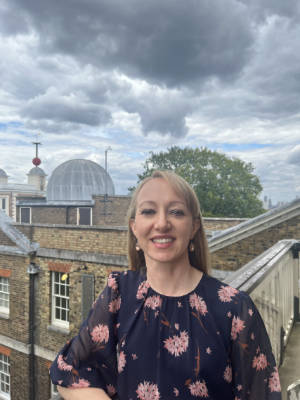
How long have you worked as senior curator at the Royal Observatory Greenwich and what was your pathway into the job?
“I’ve been working here for 12 years now and it’s been quite a journey! I originally studied physics with astrophysics at the University of Leicester and intended to continue with scientific research but my ideas changed after an inspirational internship working at a museum in the US. I really enjoyed learning about the history of astronomy – how our ideas have changed over time and the incredible stories of the people who were involved – and I continued my studies in the history of science. I’ve since worked at the Science Museum and British Museum and came here in 2013.”
Have you always been interested in astronomy?
“Yes, I have vivid memories of building a space rocket in primary school from cereal packets and yogurt pots that quite literally fired my imagination! I’ve still got The Night Sky Ladybird book that I bought and later in my teens my parents kindly bought me a telescope so I could learn more about practical astronomy. I don’t have much time for stargazing these days but I’ve recently purchased a compact smart telescope that you can put in your hand luggage and I’m looking forward to taking it on my travels.”
What does your job at the Royal Observatory entail?
“My job consists of two main parts; one based on research and one focused on communication. As a curator, I’m responsible for doing research on our collections, identifying objects for display and collaborating with researchers from other museums and observatories. Once I’ve done the detective work, I like to share these ideas and stories with our visitors through displays, talks and writing books and articles.”
What’s your favourite part of the day at the Observatory?
“For me, I enjoy seeing the sunset as I’m leaving the office, especially as the lights start to come on across London and you get a great view of the city from our hilltop location. It also makes me smile that sunset means going home for me, whereas for Greenwich astronomers in the past, it would have been the start of their working ‘day’!”

What prompted the writing of the book?
“It’s difficult to say but I definitely remember working on this during lockdown in 2020 and being inspired by similar books such as Neil MacGregor’s A History of the World in 100 Objects. Most books about the history of the Royal Observatory focus on the story of longitude, John Harrison’s marine timekeepers and Greenwich Mean Time (GMT) but I wanted to show how the Observatory has a much broader, richer history that encompasses many more people, subjects, stories and objects.
How did you decide which objects to feature in the book?
“I knew that we would be celebrating our 350th anniversary in 2025 and so I decided to choose objects that spanned the full chronology from 1675. I also wanted to expand the scope beyond the well-known clocks and telescopes to include books, paintings, manuscripts, watercolours, and even items of clothing previously worn by the Astronomer Royal and his family. In addition, I selected a few mystery objects to give me a good excuse to dig into the archives and piece together their stories.”
Do you have a favourite among them?
“I really like the story of the hole punch from the 1840s because it’s indicative of the paperwork and number-crunching that is an important but often overlooked aspect of astronomy. Once astronomers have done their observations, they have to apply mathematical corrections (‘reductions’) to account for atmospheric effects that might affect the results. It’s very tedious, repetitive work that was traditionally done by teenage boys known as ‘computers’. The seventh Astronomer Royal, George Biddell Airy (1801–1892) tried to make the process more efficient and less prone to errors by creating a template known as a ‘skeleton form’. The system worked well but generated vast amounts of paper, leading Airy to design a hole punch to organise the work. He was so proud of his idea that he encouraged other observatories to do the same and that’s why you’ll find another example of this hole punch over 8,000 miles away at the South African Astronomical Observatory in Cape Town. Airy invented his hole punch several decades before the standard office hole punch was patented, making our gadget one of the oldest in the world!”
What did you learn during the process of writing the book that you didn’t already know about the history of the Royal Observatory?
“The story of the secret binocular testing during the First World War really surprised me. The Observatory had already been involved in testing chronometers – portable, accurate timekeepers for navigation at sea – since the 1820s but the binocular testing was a new task. For security reasons, it was not mentioned in the Observatory’s Annual Reports and remained an unknown story for decades. I was intrigued by a one-line mention to it in the archives and dug a little further to uncover the full facts.”
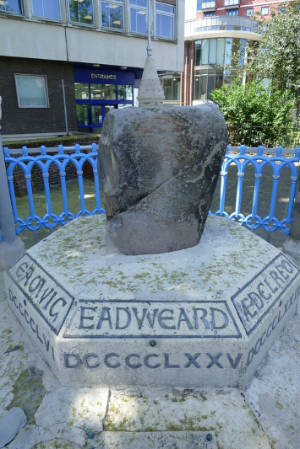
This month marks the 1,100th anniversary of the coronation of the Saxon King Aethelstan, so we thought it fitting to recall the place of his coronation, believed to be the Coronation Stone at the heart of the south-west London Royal Borough of Kingston upon Thames.
Located outside the Guildhall, the now Grade I-listed stone is an ancient block of sarsen stone which was originally at a chapel, believed to have been wooden, on the edge of the town’s market place (close to the site of All Saints Church which originally dates from the 12th century).
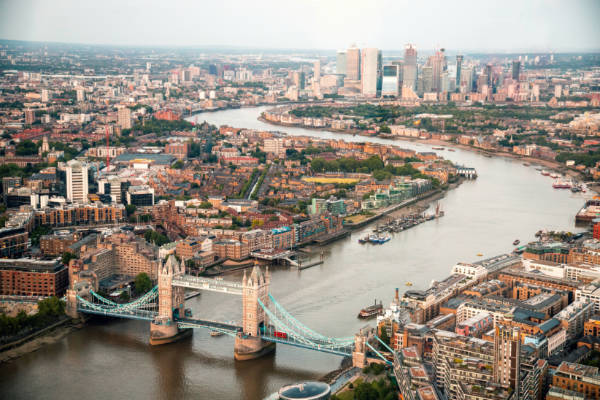
• It’s September and that means Totally Thames – London’s annual month-long festival centred on the famous waterway – is underway. This year’s festival includes a packed programme of events which this weekend include the St Katharine Docks Classic Boat Festival, the Kingston River Cultures Festival, a mud-larking exhibition held in the ancient Roman amphitheatre under Guildhall Yard and a Victorian family day out at Crossness Pumping Station. Other highlights include a foreshore archaeology walk at Deptford (14th September), guided tours of the HMS Wellington (20th September), the month-long exhibition of winners and runners-up from the annual Thames Lens photography competition on the Riverside Walkway on the north bank near Millennium Bridge, and, of course, the annual Great River Race (on Saturday, 20th September). For more, head to https://thamesfestivaltrust.org/whats-on/.
• The contribution of Black Londoners is again being celebrated this weekend as Black On The Square returns to Trafalgar Square. The free, family-friendly festival, now in its third year features live music, dance, food and workshops and this year includes a focus on London’s nightlife under the theme ‘Intergenerate’ recognising Black Londoners’ contribution to electronic culture and night life and featuring Garage music producer and DJ Wookie. There will also be a series of stalls offering foods ranging from Caribbean classics to West African vegan bites and artisanal goods including jewellery, art, books, homeware and fashion with the ‘Accra to London’ stall offering a range of items influenced by Ghana’s capital city, Accra, a highlight. Runs from 12pm to 6pm on Saturday. For more, see https://www.london.gov.uk/events/black-square-2025.
• The Great West Road and the Thames have served as key routes into London since Roman times and they’re now the subject of a new exhibition at the Barbican Library. Rivers and Roads features the work of Brentford-based painter Helena Butler, who paints in a semi abstract style to capture the landscape and the feelings and images the local scenery inspires, and ceramic artist Anna Butler, who has produced a series in response to Alfred Noyes’ beloved poem The Shining Streets of London. Admission is free. Runs until 29th September. For more, see www.cityoflondon.gov.uk/events/rivers-and-roads-art-exhibition
Send all items for inclusion to exploringlondon@gmail.com.
There are a number of “city farms” in London and one of the largest is Mudchute Park and Farm on the Isle of Dogs.
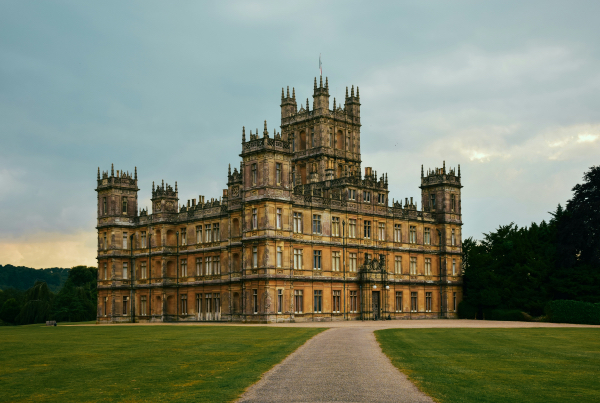
• Downton Abbey has popped up in London. With the final Downton Abbey movie, Downton Abbey: The Grand Finale next month, Bonhams auction house are auctioning off some iconic props, costumes and set pieces from across the series and is accompanying it with a preview exhibition which is open to the public. Among the items up for sale in Downton Abbey: The Auction are everything from a 1925 Sunbeam saloon car and various dresses and costumes including Lady Mary Crawley’s wedding dress (as worn by Michelle Dockery) to a George III oak dresser (seen in the Servant’s Hall in season 1), a silver pocket watch worn by Mr Carson (played by Jim Carter) and an autographed script from episode one, season one. The display can be seen at Bonham’s salesroom at 101 New Bond Street until 16th September. Admission is free but bookings are essential. For more head to https://www.eventbrite.co.uk/e/downton-abbey-the-auction-tickets-1555891024939
• A new evening market opens in Rupert Street, Soho, tomorrow night. The market – said to be the city’s first evening market – will be open from Mondays to Saturdays between 3pm and 10pm and will feature different themes on different days including artisan food on Wednesdays, world street food on Thursdays, vintage clothing on Fridays, and arts, crafts and jewellery on Saturday. Monday and Tuesday will be a general market. For more, see https://www.westminster.gov.uk/licensing/markets-and-street-trading/markets-westminster/rupert-street-w1.
• On Now: Virtual Beauty. This exhibition at Somerset House explores the impact of digital culture and technologies on the traditional definitions of beauty today. It features the work of more than 20 artists with highlights including ORLAN’s Omniprésence (1993), a groundbreaking performance in which the artist live-streamed her own facial aesthetic surgery, and Amalia Ulman’s Excellences & Perfections, a powerful commentary on the authenticity of social media personas. There are also AI-generated portraits by Minnie Atairu, Ben Cullen Williams, and Isamaya Ffrench, and Harriet Davey, Frederik Heyman, and Andrew Thomas Huang explore digital self-expression and the creation of avatars beyond human boundaries. Not suitable for under 15s. Admission is pay what you can. Runs until 28th September. For more, see https://www.somersethouse.org.uk/whats-on/virtual-beauty.
Send all items to exploringlondon@gmail.com
We start a new series looking at places to encounter (at a distance, for some), London’s wildfire and we start by heading west to Richmond Park.
The only woman prisoner recorded as having escaped from the Tower of London, Alice Tankerville was accused, along with her common-law husband John Wolfe, of committing piracy in 1533.

It was alleged that Tankerville had lured two wealthy Italian merchants into a wherry out in the Thames where her accomplices – including Wolfe and two men disguised as watermen – had robbed and murdered them. They were also accused of burgling a home near St Benet Gracechurch where the two men had been staying.
Despite apparently having attempted to seek sanctuary in a special precinct near Westminster Abbey, the couple were arrested, charged with piracy and murder among other things, and, following a trial neither apparently attended, found guilty.
Taken to the Tower of London in 1534 (Wolfe had done a previous stint there for the theft of 366 gold crowns from a ship berthed at the Hanseatic League’s Steelyard but had eventually been released due to a lack of evidence), Alice is said to have been imprisoned in Coldharbour Gate.
Alice wasn’t done yet, however. On 23rd March that year, she managed to escape, apparently with the aid of gaoler John Bawde who provided her with ropes and a key.
It was a short-lived liberation – believed to have been wearing man’s clothes, she and Bawde were arrested trying to reach waiting horses on a road just outside the Tower (it’s worth noting that not only was Alice the only women prisoner to ever escape the Tower of London, she was also the only escapee during the reign of King Henry VIII).
Both she and Wolfe were subsequently executed and due to the nature of their crime, their execution took place on the Thames.
They were hanged in chains in the Thames near the site of their crime and, before a small flotilla of boats filled with sight-seers come to witness the event, were slowly drowned as the tide rose. Their bodies were then left hanging on the spot as a warning to others.

This City of London street runs north-south from the junction of Newgate Street, Holborn Viaduct and Old Bailey to West Smithfield. Its name comes from those who once travelled along it.
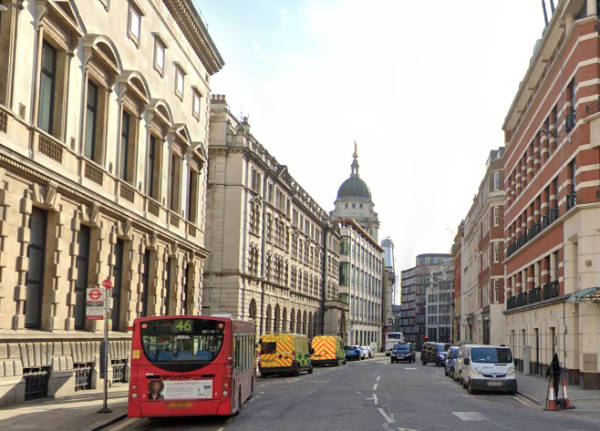
An alternative name for the street during earlier ages was Knightrider Street which kind of gives the game away – yes, the name comes from the armoured knights who would ride along the street in their way to compete in tournaments held at Smithfield. It’s suggested that gilt spurs may have later been made here to capitalise on the passing trade.
The street is said to have been the location where King Richard II met with the leaders of the Peasant’s Revolt who had camped at Smithfield. And where, when the meeting deteriorated, the then-Lord Mayor of London William Walworth, ending up stabbing the peasant leader Wat Tyler who he later captured and had beheaded.
St Bartholomew’s Hospital can be found on the east side of the street. On the west side, at the junction with Cock Lane is located Pye Corner with its famous statue of a golden boy (said to be the place where the Great Fire of London was finally stopped).
There’s also a former watch house on the west side which features a monument to the essayist late 18th century and 19th century Charles Lamb – the monument says he attended a Bluecoat school here for seven years. The church of St Sepulchre-without-Newgate stands at the southern end with the Viaduct Tavern on the opposite side of the road.
The street did formerly give its name to the small prison known as the Giltspur Street Compter which stood here from 1791 to 1853. A prison for debtors, it stood at the street’s south end (the location is now marked with a City of London blue plaque).
The first V2 rocket to strike London hit Chiswick in west London in September, 1944.
It’s one of the most iconic London traditions – the ceremonial changing of the guard outside Buckingham Palace.
Elite guards have served the monarch since the reign of King Henry VII – he made the Royal Body Guard a permanent institution – and Guards Regiments, among the oldest units in the British Army, were first raised in 1656 to protect King Charles II who was then living in exile in Bruges in modern Belgium.
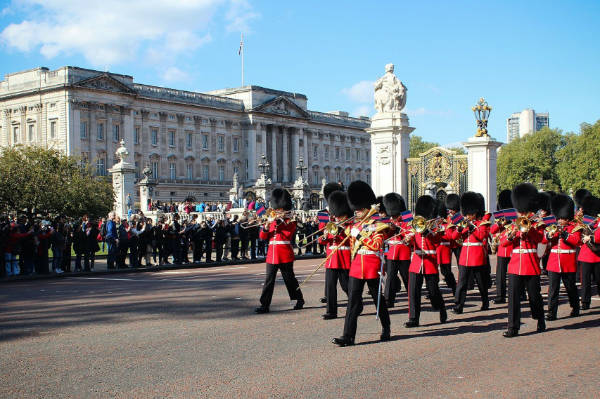
The Changing of the Guard ceremony originally took place at the (now long-gone) Palace of Whitehall. But when the court moved to St James’s Palace in 1698, the ceremony went with them. And then, when Queen Victoria moved to Buckingham Palace in 1837, a detachment of guards was sent to guard the palace (with the Queen’s Guard also still guarding St James’s, a situation which continues today).
The main ceremonial Changing of the Guard today takes place at Buckingham Palace. It involves the Old Guard (those currently on duty, including the detachment from St James’s Palace) forming up in front of the palace and being relieved by the New Guard which has marched from Wellington Barracks, off Birdcage Walk, with a band which plays New Guard’s Regimental Slow March as it advances towards the Old Guard.
Both the Old and New Guard carry regimental flags, known as “Colours”. The guard duties are traditionally served by one of the five regiments of foot guards (part of the Household Division) which include the Welsh Guards, Grenadier Guards, Coldstream Guards, Scots Guards, Irish Guards.
But regiments from Commonwealth nations and those from the Royal Navy or Royal Air Force also perform the duty from time to time.
The Changing of the Guard currently takes place on Monday, Wednesday and Friday from 11am. The ceremony lasts about 45 minutes.
On days when the ceremony isn’t performed, the guard is still inspected by the Captain at 3pm except on Sunday when the flag (Colour) is incorporated into the ceremony, then known as the Sunday Parade, which takes place at 11am.
For more, see www.householddivision.org.uk/changing-the-guard-overview.
Usually Treasures of London focuses on an object held in a museum or gallery or an outdoor feature such as sculpture or memorial but in honour of its 200th birthday this year, today we’re taking a look at the Royal Mews at Buckingham Palace.
Here are some facts about the Mews which you may not know…
Craven Cottage, home of Fulham FC on the bank of the River Thames in west London, is the city’s oldest football stadium.

The site has been home to the club since 1896, having previously been based at a range of grounds. It took two years to prepare the ground for play including constructing a changing room building.
The first match was played at the ground on 10th October, 1896 (Fulham beat Minerva 4-0 in the Middlesex Senior Cup).
Initially the ground was surrounded with terracing only – this changed in 1903 when the first stand was built on the north side of the ground. Providing seating for 1,200 spectators, it was affectionately known as the ‘Rabbit Hutch’.
The stand didn’t last long. Just 18 months later, it was condemned as dangerous by municipal officials and had to be pulled down.
In January, 1905, it was reported that the club had gained a 99-year lease on the ground. Work on a new stand, 5,000-seat, started just four months later to be designed by Archibald Leitch with steelwork provided by Clyde Structural Iron Company. Known as the Stevenage Road Stand (with a brick facade on the road), it opened on 2nd September that year.

Leitch also designed the Cottage Pavillion, located at the south-east corner of the ground, which was used for change rooms and by the club’s administration.
In 1907, the club hosted the first full international match when, in March, 1907, England and Wales drew 1-1.
While the club regularly saw crowds of up to 40,000 in the lead-up to World War II, a record was set in 1938 at a game between Fulham and Millwall when the crowd numbered just shy of 50,000.
These days there are four stands: the Grade II-listed Johnny Haynes Stand on the east side of the ground (it was renamed in 2005 in honour of the club legend who also has a statue at the ground); the Riverside Stand on the west side (redeveloped in recent years); the Hammersmith End stand (located to the north of the ground, traditionally its home end); and, the Putney End stand (located at the south end).
The Cottage Pavilion, the balcony of which is from where player’s families have traditionally watched games, remains in the south-east corner.
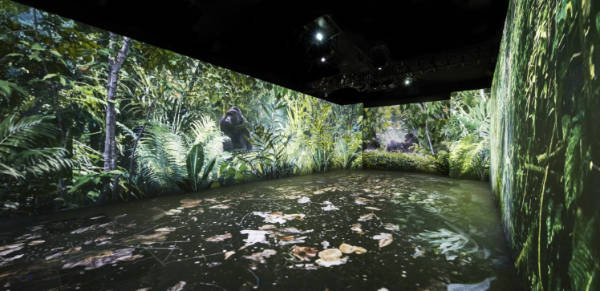
• Our Story with David Attenborough – the first ever immersive experience at the Natural History Museum – opens its doors today. Created by Open Planet Studios, the 50 minute experience in the Jerwood Gallery features animations, projections, real-world footage and full 360 degree immersion as Sir David draws on his life of exploration to tell the story of humanity and the planet on which we live. The experience is taking bookings until 18th January, 2026. Admission charge applies. For more, see www.nhm.ac.uk/visit/exhibitions/our-story-with-david-attenborough.
• The Royal Academy’s 257th Summer Exhibition opened this week. Co-ordinated by internationally acclaimed architect and Royal Academician Farshid Moussavi in conjunction with the Summer Exhibition Committee, this year’s display of art and architecture explores the theme of ‘Dialogues’. Among the works on show is a six metre high installation of ostrich feathers and steel chain by British artist Alice Channer, a 4.5 metre high and seven metre wide wall made from deconstructed matchboxes by Brazilian artist Antonio Tarsis, and installation of textile carcasses by Argentine-American artist Tamara Kostianovsky. Meanwhile, the Annenberg Courtyard hosts a large scale installation by Royal Academician Ryan Gander which features five three metre diameter inflatable balls inscribed with absurd questions developed with children in a representation of the “inquisitiveness of children who ask what grown-up minds often dismiss as nonsensical or illogical”. Runs until 17th August. Admission charge applies. For more, see royalacademy.org.uk.
• The London Transport Museum has launched an appeal for £30,000 to help complete the restoration of three 1930s Q stock Underground carriages. The funds will be used to re-upholster the seats of two of the Underground cars in moquette – the durable, woollen seating material used in upholstery on public transport all over the world. Q stock trains first entered service on the District line in November, 1938, and were retired from service in 1971. The restoration of the three carriages – which aims to restore them to operational condition – has mainly been carried out at the London Transport Museum Depot in Acton, west London. Donations can be made on London Transport Museum’s website: www.ltmuseum.co.uk/make-donation?campaign=qstock
Send all items for inclusion to exploringlondon@gmail.com.
 Exploring London