This Week in London – Queen Elizabeth II’s fashion archive on show; London Transport Museum Depot’s open days; and, wartime London in art…

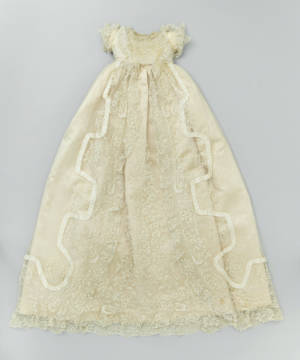
Janet Sutherland, the royal christening robe, 1841. © Royal Collection Enterprises Limited 2026 | Royal Collection Trust.

A christening robe, first worn by Queen Victoria’s eldest child, Princess Victoria, at her christening in 1841, and subsequently by 61 other royal babies including Queen Elizabeth II, is one of the stars of a new exhibition opening at The King’s Gallery in Buckingham Palace tomorrow. Queen Elizabeth II: Her Life in Style features around 200 items from Queen Elizabeth II’s fashion archive – the largest exhibition of her clothing ever staged. Other highlights include a Norman Hartnell apple-green gown worn by the Queen a state banquet given for President Eisenhower at the British Embassy in Washington, DC, in 1957; a crinoline-skirted blue gown and matching bolero jacket worn by the late Queen for her sister Princess Margaret’s wedding in 1960; and, perhaps more surprisingly, a clear plastic raincoat made by Hardy Amies in the 1960s. The latter is just one example of late Queen’s private, off-duty wardrobe which is also included in the show. Other examples include a Harris tweed jacket and Balmoral Tartan skirt, designed by Norman Hartnell and worn in the 1950 and a green coat made by Angela Kelly. The exhibition runs until 18th October. Admission charge applies. For more, see www.rct.uk.

• Celebrate 120 years of the Bakerloo and Piccadilly Lines and 70 years of the Routemaster bus at a London Transport Museum Depot open day. The first to be held this year, the four open days at the Acton Town facility, will allow visitors to discover the more than 320,000 objects not on display at the museum’s Covent Garden site including the chance to climb aboard historic train stock dating from 1927 and 1938, get a close-up look at the pioneering RM1 and RM2 buses, and explore everything from rare signalling equipment to models, maps, station architecture and posters. A programme of talks is also taking place across the weekend along with activities for kids, heritage demonstrations, displays and stalls. The days run from today – 9th April – through to Sunday (12th April). Admission charges apply. For more, see www.ltmuseum.co.uk/whats-on/depot-open-days/icons-london.

On Now: Beauty and Destruction: Wartime London in Art. This free exhibition at IWM London tells the story of London during World War II and features more than 45 paintings and drawings as well as photographs, films, objects and oral histories. Works include some by well-known artists such as Eliot Hodgkin, Graham
Sutherland, Henry Carr, Evelyn Dunbar, Duncan Grant and Edward Ardizzone as well as lesser known figures, many of whom were employed by the War Artists’ Advisory Committee. The works are presented under four themes -Travel, Thames, Street and Shelter – and highlights include Frances MacDonald’s Sketch for ‘London Docks’ (1944), John Edgar Platt’s Wartime traffic on the River Thames (1942) and fireman artist Leonard Rosoman’s The Houses of Parliament on Fire, May 1941 (1941) – which captures the last night of the Blitz. Other works in the display are Duncan Grant’s painting of that iconic symbol of wartime resistance, St Paul’s Cathedral, Henry Carr’s St Clement Dane’s Church on Fire after being Bombed (1941), Evelyn Gibbs’ WVS Clothing Exchange (1943) and Evelyn Dunbar’s Convalescent Nurses Making Camouflage Nets (1941). The display can be seen until 1st November. For more, see www.iwm.org.uk/events/beauty-and-destruction-wartime-london-in-art.

Send all items for inclusion to exploringlondon@gmail.com.

This Week in London – The glamour of the Edwardian Royals; tulips at Hampton Court; and, Cartier jewels at the V&A…

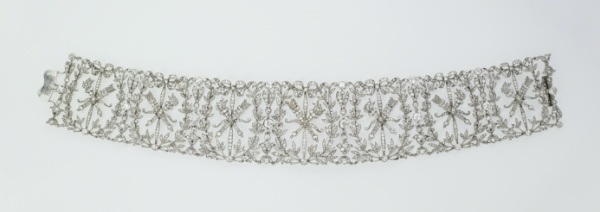
Attributed to R. & S. Garrard, ‘Love Trophy’ Collar, 1901
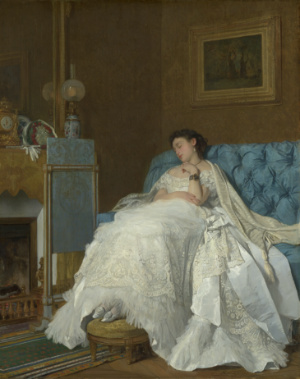
Charles Baugniet, ‘After the Ball’: a Lady in a Ballgown Asleep on a Sofa, c1860–67

The glamour and opulence of the Edwardian era – and the two royal couples that exemplified it – is the subject of a new exhibition opening at The King’s Gallery at Buckingham Palace tomorrow. The Edwardians: Age of Elegance takes an in-depth look at the lives of King Edward VII and Queen Alexandra, and King George V and Queen Mary, exploring not only their family interactions but their glittering social circles, travel adventures and, of course, the royal events they attended. More than 300 items are on display in the exhibition – almost half on show for the first time – with highlights including Queen Mary’s ‘Love Trophy’ Collar necklace which is on display for the first time, a Cartier crystal pencil case set with diamonds and rubies, and, a blue enamel Fabergé cigarette case featuring a diamond-encrusted snake biting its own tail which was given to King Edward VII in 1908 by his favourite mistress as a symbol of eternal love. There’s also a never-before-seen photograph of Edward wearing fancy-dress as a knight of the Order of Malta as he attended a ball celebrating Queen Victoria’s 1897 Diamond Jubilee, a previously unseen study of Sleeping Beauty by the Pre-Raphaelite artist Sir Edward Burne-Jones, and, Charles Baugniet’s After the Ball which is on show for the first time in more than a century. Runs until 23rd November. Admission charge applies. For more, see www.rct.uk.

More than 100,000 tulip bulbs are springing to life at Hampton Court Palace for its annual Tulip Festival. The display includes an installation of 10,000 tulips in the palace’s Fountain Court, floating tulip bowls in the Great Fountain, a vintage horse cart spilling tulips in the Clock Court, free-style planting, inspired by the tulip fields of the Netherlands, in the Kitchen Garden and rare, historic and specialist varieties of tulips in the Lower Orangery. There will be daily “tulip talks” in the palace’s wine cellar exploring the history of the flower and how Queen Mary II introduced them to the palace. Runs from Friday until 5th May. Included in general admission. For more, see www.hrp.org.uk.

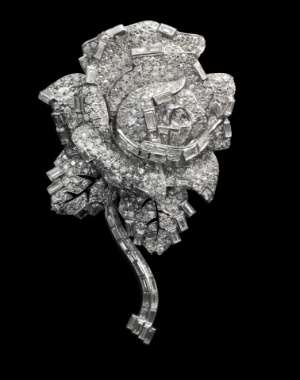
Rose clip brooch, Cartier London, 1938. Diamonds and platinum. Vincent Wulveryck, Collection Cartier © Cartier

The first major exhibition in 30 years dedicated to Cartier jewels and watches opens at the V&A this Saturday. Cartier, which is being held in The Sainsbury Gallery, charts the rise of the globally recognised jewellery house and how it became known as “the jeweller of kings and the king of jewellers”. The display features more than 350 objects with highlights including the Williamson Diamond brooch which was commissioned by Queen Elizabeth II in 1953 and which features the rare 23.6 carat pink Williamson diamond; the Scroll Tiara commissioned in 1902 and worn to the coronation of Elizabeth II and later by Rihanna on the cover of W magazine in 2016; Grace Kelly’s engagement ring (1956) that she wore in her final film High Society; Mexican film star María Félix’s snake necklace (1968); and, a selection of Cartier timepieces that embody its pioneering approach to watchmaking, including the Crash wristwatch, designed by Cartier London (1967). The exhibition runs until 16th November. Admission charge applies. For more, see vam.ac.uk/exhibitions/cartier.

Send all items to exploringlondon@gmail.com.

This Week in London – Medieval women at the British Library; Renaissance drawings at The King’s Gallery; and, ‘Duo’ in the Painted Hall…

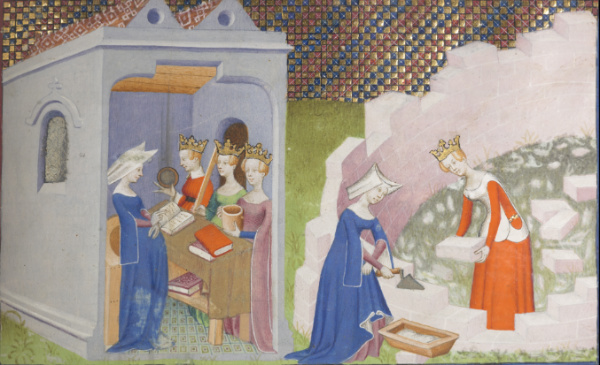
Christine de Pizan, The Book of the City of Ladies (Add Harley MS 4431, f. 290r). © British Library

The lives of medieval women are the subject of a new exhibition at the British Library. Medieval Women: In Their Own Words features more than 140 objects with highlights including a letter bearing the earliest known signature of Joan of Arc which has never before been displayed outside France, a manuscript made in the early 15th century under the personal supervision of Christine de Pizan – the first professional women author in Europe, a 12th   century ivory carving which belonged to Sybilla of Flanders, and, the oldest surviving Valentine’s Day letter, sent by Margery Brews in 1477. There’s also the book Behinat Olam Mantua, published between 1476 and 1480 by Estellina Conat who was the first recorded woman to print a book in Hebrew, the only surviving copy of the earliest known autobiography in English, The Book of Margery Kempe, which was probably written around 1438, a 15th century birthing girdle and the largest hoard of medieval gold coins ever discovered in Britain which was probably gathered as a result of Margaret of Anjou’s fundraising efforts in support of the Lancastrian side in the Wars of the Roses. The display is a multi-sensory experience which, as well as the objects on show, features scent installations, films, music and interactive digital technologies. The exhibition, which is accompanied by a programme of events, can be seen until 2nd March. Admission charge applies. For more, see www.bl.uk.

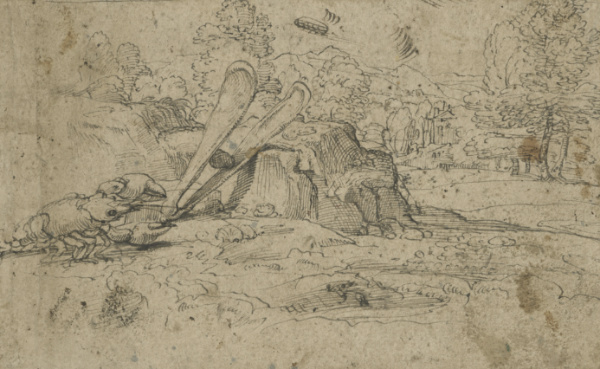
Annibale Carracci, ‘A landscape with a lobster’, c1590. © Royal Collection Enterprises Limited 2024 | Royal Collection Trust

An exhibition of the widest range of drawings from the Italian Renaissance ever to be shown in the UK opens at The King’s Gallery in Buckingham Palace on Friday. Drawing the Italian Renaissance features more than 160 works by more than 80 artists including Leonardo da Vinci, Michelangelo, Raphael and Titian. The works are all drawn from the Royal Collection and more than 30 are on display for the first time while a further 12 have never been shown in the UK. Highlights include Raphael’s The Three Graces in red chalk (c1517-18), Fra Angelico’s The bust of a cleric (c1447-50), a chalk study of an ostrich attributed to Titian (c1550), Leonardo da Vinci’s A costume study for a masque (c1517-18), Michelangelo’s The Virgin and Child with the young Baptist (c1532), and works by lesser-known artists such as Paolo Farinati’s 1590 study of three mythological figures under an arch. Admission charge applies. Can be seen until 9th March. For more, head to www.rct.uk/collection/exhibitions/drawing-the-italian-renaissance/the-kings-gallery-buckingham-palace

Melek Zeynep Bulut’s postponed installation Duo can be seen in the Painted Hall at the Old Royal Naval College in Greenwich – but only until Sunday. Presented in partnership with the London Design Festival, Duo is a suspended installation which explores the concepts of duality and interaction. Admission charge applies. For more, see https://ornc.org/whats-on/ldf/.

Send all items for inclusion to exploringlondon@gmail.com