This Week in London – Lord Mayor’s Show marks 800 years; Dutch masters and Thomas Rowlandson at Queen’s Gallery; and, Alexander Calder on show at Tate…

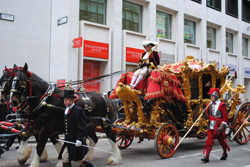
Lord-Mayor's-ShowThe Lord Mayor’s Show will mark its 800th anniversary on Saturday as the newly elected Jeffrey Mountevans – the 688th Lord Mayor of the City of London – makes his way through the City to Westminster to swear loyalty to the Crown. The procession of 7,000 people, some 180 horses and 140 vehicles will set off on its way along a three-and-a-half mile route at 11am, starting at Mansion House and traveling down Cheapside to pause at St Paul’s Cathedral (which is open for free all day) before heading on via Ludgate Hill and Fleet Street to the Royal Courts of Justice before returning the City via Queen Victoria Street from 1.10pm. In a special nod to the 800th anniversary, the famous bells of St Mary-le-Bow will ring out a special 800-change at noon. The day will conclude with fireworks over the River Thames kicking off at 5.15pm (for the best view head down to the riverside between Waterloo and Blackfriars Bridges, either on Victoria Embankment or on the South Bank). The show’s origins go back to 1215 when, in exchange for a Royal Charter granting the City of London the right to elect its own mayor, King John insisted the newly elected mayor travelled to Westminster each year to swear loyalty to the Crown. For more (including a map to print out), see https://lordmayorsshow.london. PICTURE: From a previous show.

Vermeer’s The Music Lesson is among 27 of the finest 17th and 18th century Dutch paintings in the Royal Collection which will go on display in a new exhibition at the Queen’s Gallery at Buckingham Palace from tomorrow. Masters of the Everyday: Dutch Artists in the Age of Vermeer also features works by the likes of Gerrit Dou, Pieter de Hooch and Jan Steen, all produced during what is known as the Dutch ‘Golden Age’. The exhibition is being shown alongside another display – High Spirits: The Comic Art of Thomas Rowlandson – which will focus on the work of 18th and early 19th century caricaturist Thomas Rowlandson. Around 100 of Rowlandson’s works feature in the display with highlights including The Two Kings of Terror featuring Napoleon and Death sitting face-to-face after Napoleon’s defeat at Leipzig in 1813, The Devonshire, or Most Approved Method of Securing Votes depicting Georgiana, Duchess of Devonshire, kissing a butcher (it was claimed she had claimed kisses for votes in the Westminster election of 1784), and A York Address to the Whale. Caught lately off Gravesend in which the Duke of York thanks a whale for distracting attention from accusations that his mistress was paid by army officers to secure promotions from the Duke. Admission charge applies. Both exhibitions run until 14th February, 2015. For more, see www.royalcollection.org.uk.

The first major UK exhibition of the works of kinetic sculpture pioneer Alexander Calder opened at the Tate Modern this week. Alexander Calder: Performing Sculpture features more than 100 of the ground-breaking 20th century artist’s works which trace how Calder turned sculpture from the idea of a static object to a continually changing work to be experienced in real time. Works on show include figurative wire portraits of artists – Joan Miró and Fernand Léger (both 1930), works exploring the idea of forms in space – Red Panel, White Panel and Snake and the Cross (1936), motorised mobiles such as Black Frame and A Universe (1934), and chiming mobiles such as Red Gongs (1950) and Streetcar (1951). It closes with the large scale Black Widow (c.1948), shown for the first time ever outside Brazil. Runs until 3rd April. Admission charge applies. For more, see www.tate.org.uk.

Send all items for inclusion to exploringlondon@gmail.com.
 

This Week in London – Gallery of Japanese art reopens; Botticini’s Assumption back on show; Bonfire Night; and, celebrating wildlife photography…

A Hello Kitty! rice cooker, a selection of mobile phones designed by Naoto Fukasawa and a group of kimono from the 1920s and 1930s are among recent acquisitions on show in the V&A’s Toshiba Gallery of Japanese Art which reopened to the public following a refurbishment this week. The gallery, which first opened at the South Kensington premises in 1986 and was the first major gallery of Japanese art in the UK, now has about 550 items on show including 30 or so recent acquisitions. Spanning the period from the sixth century to the present day, the display features swords and armour, lacquer, ceramics, cloisonné enamels, textiles and dress, inro and netsuke, painting, prints and illustrated books. They include everything from modern objects such as the first ever portable stereo Walkman designed and manufactured by Sony in 1979 and a pair of gravity-defying shoes designed by Noritaka Tatehana through to historic items such as the Mazarin Chest, made in Kyoto around 1640, a late 17th century six fold screen depicting the Nakamura-za Kabuki theatre in Edo (Tokyo), and a group of high quality cloisonné enamels dating from 1880 to 1910. Admission to the gallery is free. For more, see www.vam.ac.uk.

Francesco Botticini’s monumental Palmieri Altarpiece is at the centre of a new exhibition, Visions of Paradise: Botticini’s Palmieri Altarpiece, which opened in the National Gallery off Trafalgar Square yesterday. The altarpiece, depicting the Assumption of the Virgin, was completed in about 1477 for the funerary chapel of Matteo Palmieri (1406-1475) in the church of San Pier Maggiore in Florence, Italy. The exhibition, based on years of research, explores Palmieri’s life with special attention to his friendship with the Medici rulers of Florence and the King of Naples and his creative collaborations with Botticini including both the altarpiece and Palmieri’s epic poem of 1465, Citta di Vita (City of Life) –  which he had Bottinci provide illustrations for. Along with the altarpiece panel (which has been off display since 2011), the exhibition features around 30 works including paintings, sculpture, drawings, prints and manuscripts as well as a polyptych by Jacopo di Cione and his workshop made for the high altar of the same church in which Botticini’s altarpiece sat – Florence’s San Pier Maggiore. The polyptych includes a painted representation of the church and was later moved to the same chapel as Botticini’s Assumption. The exhibition is being held in the Sunley Room until 14th February. Admission is free. See www.nationalgallery.org.uk for more.

Bonfire Night will be celebrated across the UK tonight as we “Remember, remember, the fifth of November” and burn effigies of “the guy” (Guy Fawkes) (for more on the background, see our earlier story here). Find your local bonfire event in London via Visit London or Time Out.

On Now: Wildlife Photographer of the Year. This annual exhibition at the Natural History Museum features works selected out of the more than 42,000 entries to this year’s awards including the winning image, Tale of two foxes, taken by Canadian amateur photographer Don Gutoski at Cape Churchill in Canada. Other images on show include Fighting ruffs which won 14-year-old Ondrej Pelánek from the Czech Republic the Young Wildlife Photographer of the Year award. The exhibition at the museum in South Kensington runs until 10th April next year. Admission charge applies. Entries for next year’s competition open in December. For more, see www nhm.ac.uk.

Send all items for inclusion to exploringlondon@gmail.com.

This Week in London – Life after the pharaohs in Egypt; Days of the Dead; horrible histories at two royal palaces; and Dickin and Gombrich honoured with Blue Plaques…

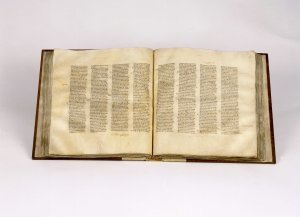
 •untitled 276.tif The first major exhibition to explore the history of Egypt after the pharaohs opens at the British Museum today. Egypt: Faith after the pharaohs spans 1,200 years of history – from 30 BC to 1171 AD – with 200 objects showing how Christian, Islamic and Jewish communities reinterpreted the pharaonic past of Egypt and interacted with each other. The exhibition opens with three significant examples of the Hebrew Bible, the Christian New Testament and the Islamic Qur’an – the texts include the New Testament part of the 4th century AD Codex Sinaiticus, the world’s oldest surviving Bible and the earliest complete copy of the New Testament, which is now part of the British Library’s collection. All three are juxtaposed with everyday stamps associated with each of the three religions in an illustration of the relationship between the institutional side of religion and its everyday practice, both key themes of the exhibition. Other exhibits include a pair of 6th-7th century door curtains featuring classical and Christian religious motifs, a 1st-2nd century statue of the Egyptian god Horus in Roman military costume, and a letter from the Roman Emperor Claudius (41-54 AD) concerning the cult of the divine emperor and the status of Jews in Alexandria. Admission charge applies. Runs until 7th February in Room 35. A programme of events accompanies the exhibition. For more, see www.britishmuseum.org/egypt. PICTURE: Codex Sinaiticus, open at John 5:6-6:23. Image courtesy of the British Library.
Still at the British Museum and a free four day festival of art, performance, storytelling and talks kicks off on Friday night to mark the Mexican tradition of the Days of the Dead. The annual celebration, which draws on both native and Catholic beliefs, is held on 1st and 2nd November and sees families gather to remember relatives and friends who have died. The festival, which is being conducted in association with the Mexican Government, includes a Friday evening event, a weekend of family activities featuring storytelling, films, music and dance, and a study day  on Monday featuring lectures, gallery talks and activities. The museum will feature elaborate decorations by Mexican artists – including Betsabeé Romero – throughout the festival with a particular focus on the Great Court and Forecourt. Events – which run from 30th October to 2nd November – are free. For more, see www.britishmuseum.org/dotd.

Horrible histories indeed! Hampton Court Palace and Kensington Palace are both hosting ghost tours from this weekend. The tours focus on some of the more grisly aspects of the history of the palaces with tours at Hampton Court featuring a visit to a shallow grave which was only uncovered in 1870 and those at Kensington Palace encountering the gruesome details of King William III’s fatal horse-riding accident and Queen Caroline’s horrific final hours. Admission charges apply. For more details, head to www.hrp.org.uk.

Animal welfare campaigner Maria Dickin (1870-1951) and art historian EH Gombrich (1909-2001) have been honoured with English Heritage Blue Plaques. The plaque commemorating Dickin – founder of the People’s Dispensary for Sick Animals (PDSA) and of the PDSA Dickin medal, awarded to animals associated with the armed forces or civil defence who have shown conspicuous gallantry and devotion to duty – has been placed on the Hackney house at 41 Cassland Road where she was born and spent the first few years of her life. Meanwhile the plaque to Gombrich was placed on the house at 19 Briardale Gardens in Hampstead where he lived for almost 50 years, from shortly after publication of his seminal work The Story of Art to his death in 2001. For more see www.english-heritage.org.uk/visit/blue-plaques/.

Send all items for inclusion to exploringlondon@gmail.com.

This Week in London – World’s oldest clock and watch collection moves to the Science Museum; commemorating Agincourt; and, black experiences in war at the Imperial War Museum…

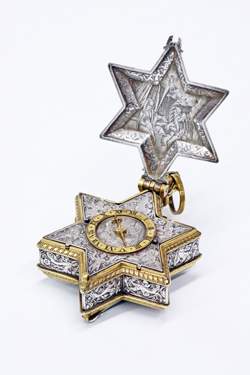
Star-clockThe world’s oldest clock and watch collection can be seen at its new home at the Science Museum in South Kensington from tomorrow. The Clockmaker’s Museum, which was established in 1814 and has previously been housed at City of London Corporation’s Guildhall, has taken up permanent residence in the Science Museum. Assembled by the Worshipful Company of Clockmakers – founded in 1631 – the collection features some 600 watches, 80 clocks and 25 marine timekeepers spanning the period from the 15th century to today. Highlights among the collection include: a year duration long case clock made by Daniel Quare of London (c. 1647-1724); a star-form watch (pictured) by David Ramsay, first master of the Clockmaker’s Company; the 5th marine timekeeper completed in 1770 by John Harrison (winner in 1714 of the Longitude Prize); a timekeeper used by Captain George Vancouver on his 18th century voyage around the Canadian island that bears his name; a watch used to carry accurate time from Greenwich Observatory around London; and, a wristwatch worn by Sir Edmund Hillary when he summited Mount Everest in 1953. The collection complements that already held by the Science Museum in its ‘Measuring Time’ gallery – this includes the third oldest clock in the world (dating from 1392, it’s on loan from Well’s Cathedral) and a 1,500-year-old Byzantine sundial-calendar, the second oldest geared mechanism known to have survived. Entry is free. For more, see www.sciencemuseum.org.uk/clocks. PICTURE: The Worshipful Company of Clockmakers.

Westminster Abbey is kicking off its commemorations of the 600th anniversary of the Battle of Agincourt by opening Henry V’s chantry chapel in Westminster Abbey to a selected few on Saturday night, the eve of the battle’s anniversary. The chapel, which is above the king’s tomb at the east end of the abbey, will be seen by the winners of a public ballot which opened in September. It has never before been officially opened for public tours. The chapel is one of the smallest of the abbey’s chapels. It is occasionally used for services but, measuring just seven by three metres, is not usually open to the public because of size and access issues. Meanwhile the abbey will hold a special service of commemoration on 29th October in partnership with charity Agincourt600 and on 28th October, will host a one day conference for Henry V enthusiasts entitled Beyond Agincourt: The Funerary Achievements of Henry V. For more, see www.westminster-abbey.org/events/agincourt.

• The role the black community played at home and on the fighting front during conflicts from World War I onward is the focus of a programme of free events and tours as Imperial War Museums marks Black History Month during October. IWM London in Lambeth will host a special screening of two documentary films – Burma Boy and Eddie Noble: A Charmed Life – telling the stories of African and Caribbean mean who served in World War II on 25th October. IWM London will also feature a series of interactive talks from historians revealing what it was like for black servicemen during both world wars from this Saturday until Sunday, 1st November. For more, see www.iwm.org.uk.

Send all items for inclusion to exploringlondon@gmail.com.

This Week in London – A look inside The Crime Museum; Goya at The National Gallery; and, Africa on the Square…

Objects and evidence from some of the UK’s most notorious crimes including the ‘Acid Bath Murder’ of 1949, the ‘Great Train Robbery’ of 1963 and the ‘Millennium Dome Diamond Heist’ of 2000 will go on show at the Museum of London from Saturday. Created with the support of the Metropolitan Police Service and the Mayor’s Office for Policing and Crime, The Crime Museum Uncovered exhibition features never-before-seen objects from the Metropolitan Police’s Crime Museum as it takes visitors through a series of real cases and tackles some of key challenges of policing in London – everything from terrorism and espionage through to counterfeiting and narcotics. The Crime Museum, which is now housed inside New Scotland Yard, was established in the mid-1870s as a teaching tool for police. Its Visitor’s Book contains some high profile names including that of King George V, Sir Arthur Conan Doyle – creator of Sherlock Holmes, illusionist Harry Houdini and comedians Stan Laurel and Oliver Hardy. Runs until 10th April. Admission charge applies. For more, see www.museumoflondon.org.uk.

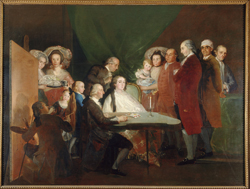
GoyaAlmost half of Goya’s surviving portraits are on show in The National Gallery in an exhibition which opened yesterday. Goya: The Portraits features more than 60 of the celebrated Spanish artist’s surviving portraits, borrowed from public and private collections around the world. Highlights include the Duchess of Alba (a 1797 work depicting one of Goya’s patrons which has only left the US once before), the immense group portrait The Family of the Infante Don Luis De Borbon (pictured), the never-seen-in-public work Don Valentin Bellvis de Moncada y Pizzaro, the rarely exhibited Countess-Duchess Benavente, and the recently conserved 1798 portrait Francisco de Saavedra, exhibited for the first time in 50 years alongside a pendant painted the same year of Gaspar Melchor de Jovellanos. There are also works of royals including Charles IV in Hunting Dress and more personal works such as self portraits and paintings of his family members. Runs until 10th January in the Sainsbury Wing near Trafalgar Square. Admission charge applies. For more, see www.nationalgallery.org.uk. PICTURE: © Fondazione Magnani Rocca, Parma, Italy.

Black History Month is being celebrated in Trafalgar Square this Saturday in Africa on the Square, a programme of events inspired by the traditions and cultures of the continent.  The line-up includes a musicians and singers, acrobats, dancers, a fashion show and a market selling African-themed products as well as a host of activities for families, from hair braiding and face painting to mosaics and batik making. There will also be a talent show giving aspiring performances aged between 16 and 25 the chance to perform in front of a live audience. The free event runs between noon and 6pm. For more, see www.london.gov.uk/africa.

Send all items for inclusion to exploringlondon@gmail.com.

This Week in London – Indian textiles at the V&A; a “typical London street” on show; and, Nobel laureate given Blue Plaque…

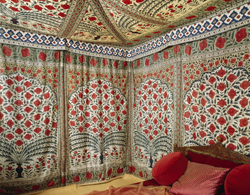
Tipus_Tent_c_National_Trust_ImagesA spectacular tent used by the Tipu Sultan, ruler of the 18th century Kingdom of Mysore (pictured), is among highlights in an exhibition exploring the “incomparably rich world” of handmade textiles from India which opens at the V&A in South Kensington on Saturday. Part of the V&A’s India Festival marking the 25th anniversary of the opening of the museum’s Nehru Gallery, The Fabric of India has exhibits ranging from the earliest known Indian textile fragments (dating from the 3rd century) through to contemporary fashions. Among the around 200 handmade objects – which include everything from ancient ceremonial banners and sacred temple hangings to modern saris and bandanna handkerchiefs – are a Hindu narrative cloth depicting avatars of Vishnu dating from about 1570, an 18th century crucifixion scene made for an Armenian Christian church in south-east India, block-printed ceremonial textiles from Gujarat – made in the 14th century for the Indonesian market, bed-hangings originally belonging to the Austrian Prince Eugene (1663-1736), and a selection of clothing made using Khadi, a cloth which Mahatma Gandhi promoted using in the 1930s when he asked people to make the fabric as a symbol of resistance to colonial rule. Admission charges apply. Runs until 10th January. For more see, www.vam.ac.uk/fabricofindia. PICTURE: © National Trust Images.

Westbury Road in Bounds Green, Haringey, is the subject of a new photographic and art exhibit which opened at the Geffrye Museum in Shoreditch this week. A Street Seen: The Residents of Westbury Road is a collaborative exhibition featuring the works of photographer Andrew Buurman and artist Gabriela Schutz as they document the homes, gardens and residents of what is described as a “typical London street”. The display includes a six metre long panoramic drawing of Victorian houses by Schutz and a series of photographs depicting residents in their back gardens taken over a two year period by Buurman. Runs until 3rd April. For more, see www.geffrye-museum.org.uk.

One of the founding fathers of sports medicine, Nobel Prize winner AV Hill, has been honoured with an English Heritage blue plaque unveiled at his former home in Highgate in London’s north last month. Hill, as well as being noted for his work in the field of physiology, was also an independent MP during World War II and a humanitarian who is credited with helping more than 900 academics – including 18 Nobel laureates – escape persecution by the Nazis. He lived at the property at 16 Bishopswood Road for 44 years, between 1923 and 1967, 10 years before his death. For more on blue plaques, see www.english-heritage.org.uk/visit/blue-plaques/.

Send all items for inclusion to exploringlondon@gmail.com.


This Week in London – Celts at the British Museum; the Fallen Woman at the Foundling; and Ai Weiwei…

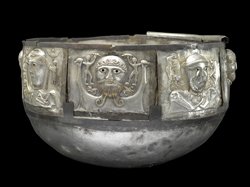
Gundestrup_Whole-ImageThe story of the Celts and their culture is being explored in a new exhibition which opens at the British Museum in Bloomsbury today. Celts: Art and Identity, being run in partnership with National Museums Scotland, is the first British exhibition on the Celts in 40 years. Highlights of the display include a hoard of four gold torcs found at Blair Drummond in Stirling in 2009, Christian artefacts including iron handbells used to call people to prayer, elaborately illustrated Gospels, carved stone crosses and, a gilded bronze processional cross which, dating from 700-800 AD and coming from Tully Lough in Ireland, will be on show for the first time in Britain. Also present will be the Gundestrup cauldron, which dates from 100 BC-1 AD and comes from Denmark (pictured), London artefacts such as the Waterloo helmet and Battersea shield, and works created more recently which reflect on an often mythical Celtic past such as George Henry and Edward Atkinson Homel’s 1890 painting The Druids: Bringing in the Mistletoe. Runs until 31st January in the Sainsbury Exhibition Gallery (Room 30). Admission charge applies. For more, see www.britishmuseum.org. PICTURE: © The National Museum of Denmark.

A new exhibition exploring the myth and reality of the ‘fallen woman’ in Victorian Britain opens at the Foundling Museum in Bloomsbury tomorrow. The Fallen Woman features works by artists including Dante Gabriel Rossetti, Richard Redgrave, George Frederic Watts and George Cruikshank, displayed alongside stereoscopes and depictions of the fallen woman in the era’s popular media. It also looks at the petitions of women applying to the Foundling Hospital, bringing to life the real ‘fallen women’ of the period through a specially-commissioned sound installation by artist and musician Steve Lewinson. The exhibition runs until 3rd January. Admission charge applies. For more, see www.foundlingmuseum.org.uk.

The London Transport Museum’s Depot in Acton hosts its autumn open days this weekend. The day includes the chance to see the original printing blocks used for the Johnston font – London Transport’s iconic typeface, expert talks on transport vehicles, a chance to see how the moquette – the seat covering on the tube – is made and film screenings from the LTM archive. From 11am to 5pm Saturday and Sunday. Admission charge applies. For more, see www.ltmuseum.co.uk.

The Worshipful Company of Woolmen will be holding their annual  sheep drive across London bridge this Sunday. The event, free to watch, kicks off at 10am and runs until 5pm. For more, see www.woolmen.com.

• On Now: Ai Weiwei. This landmark exhibition at the Royal Academy of Arts in Piccadilly celebrates the work of Honorary Royal Academician and leading Chinese artist Ai Weiwei with significant works from 1993 onwards and new, site specific installations. Among the key exhibits is Straight (2008-12), a body of work related to the Sichuan earthquake of 2008, fabricated from 90 tonnes of bent and twisted rebar which was collected by the artist and straightened by hand. Runs until 13th December.  Admission charge applies. For more, see www.royalacademy.org.uk.

Send all items for inclusion to exploringlondon@gmail.com.

This Week in London – The Waterloo Cartoon on show; see inside a former Huguenot’s home; and, Royal Parks’ harvest festivals…

A monumental Victorian-era drawing of the Battle of Waterloo has gone on display in London for the first time since 1972. The Waterloo Cartoon, more formally known as The Meeting of Wellington and Blucher after the Battle of Waterloo, measures more than 13 metres long and three metres high. A preparatory drawing for a wall painting which still exists in the House of Lords’ Royal Gallery, it took artist Daniel Maclise more than a year to complete in 1858-59 and was based on eye-witness accounts (the artist even recruited Queen Victoria and Prince Albert to use their German contacts to gather information from Prussian officers present on the day). Long considered a masterpiece, it was bought by the Royal Academy in 1870 – the year of Maclise’s death – and was on show at Burlington House until the 1920s. It has been in storage for much of last century and, newly restored following a grant from Arts Council England, has now gone on display to mark the 200th anniversary of the Battle of Waterloo. The newly conserved drawing is the focus of a new exhibition – Daniel Maclise: The Waterloo Cartoon, which opened at the Royal Academy in Piccadilly yesterday (between May and August, it was on show as part of a Waterloo exhibition at the Royal Armouries in Leeds). Runs until 3rd January. Admission charge applies. For more, see www.royalacademy.org.uk.

There’s a rare chance to see inside a former Huguenot merchant’s house dating from 1719 in Spitalfields this weekend. The property at 19 Princelet Street was the home of the Ogier family, who had come to London escaping persecution in France and worked in the silk weaving trade. It was later subdivided into lodgings and workshops with later occupants following a range of trades and professionals while a synagogue was opened in the garden in 1869. The site – which the Spitalfields Centre charity hopes to establish as a museum of immigration – is not generally open to the public but will be open this Saturday and Sunday – from 2pm to 6pm. Entry is free (but donations would be welcome) and there may be queues so its suggested you arrive early. For more, see www.19princeletstreet.org.uk.

Watch a bee keeping demonstrations, help dig up some potatoes and introduce the children to some farm animals. The Kensington Gardens’ Harvest Festival will be held this Sunday, between 11am and 4pm, and will also include a range of children’ activities, experts from the Royal Parks Guild on hand to answer your questions about food growing and complimentary hot and cold drinks available throughout the day while stocks last. It’s the first of three harvest festivals to be held in Royal Parks this month with Greenwich Park set to host its inaugural harvest festival on 13th September (11am to 4pm) and The Regent’s Park Allotment Garden to host one on 19th September (11am to 5pm). For more, see www.royalparks.org.uk.

Send all items for inclusion to exploringlondon@gmail.com.

This Week in London – Animals in the British Library; Gladiators at Guildhall; and celebrating “pocket parks”…

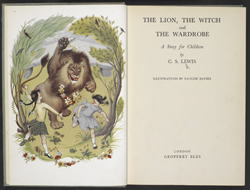
title-page-1950-cs-lewis-the-lion-the-witch-and-the-wardrobe-copyright-cs-lewis-pteFrom Peter Rabbit to Aesop’s Fables, animals and their appearance in some of the classics of literature are the subject of a new exhibition which opened at the British Library in St Pancras yesterday. Animal Tales explores the role animals have played in traditional tales around the world along with their importance in the development of children’s literature, and their use in allegorical stories such as CS Lewis’ The Lion, the Witch and the Wardrobe as well as literary transformations between man and beast (this last in a nod to the fact it’s the centenary of Franz Kafka’s The Metamorphosis). Highlights in the exhibition include one of the first children’s picture books – the 1659 edition of Comenius’ Orbis sensualism pictus, an 18th century woodblock edition of Wu Cheng’en’s Journey to the West, and a soundscape installation drawn from the library’s world leading collection of natural history recordings along with other animal tales from the sound archive. The exhibition, which runs until 1st November, will be accompanied by a series of events. Entry is free (and the display includes a children’s reading area and a family trail brochure). For more, see www.bl.uk. PICTURE: The title page from the 1950 London edition of CS Lewis’ The Lion, the witch and the wardrobe. © CS Lewis Pte Ltd.

Gladiators will battle it out on the former site of London’s open air Roman amphitheatre in Guildhall Yard this weekend. The shows – which will recreate what gladiatorial games were like in Roman Londinium – will be presided over by an emperor with the crowd asked to pick its side. The ticketed event, being put on by the Museum of London, takes place Friday night from 7pm to 8pm and on Saturday and Sunday, from noon to 1pm and between 3pm and 4pm. Admission charges apply. To book, see www.museumoflondon.org.uk.

A new International Visitors Victim Service has been launched in London to specifically help foreign nationals affected by crime in the city. The first of its kind in the UK, the service, which has been established by the Metropolitan Police working with independent charity Victim Support and embassies, already operates across the five central London boroughs and is now available through a mobile police kiosk located in the West End’s “impact zone”, an area which spans Leicester Square and Piccadilly Circus (alternatively they can contact the International Visitor Advocates by calling 0207 259 2424 or visit the West End Central Police Station at 27 Savile Row.

The Mayor of London, Boris Johnson, has celebrated the creation of 100 new pocket parks across London’s 26 boroughs in a scheme which is now being adopted by other locations across the country. The parks range from a rain garden in Vauxhall to a dinosaur playground in Hornsey and have seen more than 25 hectares of community land converted into enhanced green areas. A free exhibition is running at City Hall until 28th August which focuses on the stories of 11 people involved in the creation of the parks. For more on London’s “great outdoors”, you can see an interactive map at www.london.gov.uk/outdoors.

Send all items for inclusion to exploringlondon@gmail.com.

This Week in London – Virtual reality at the British Museum; British Library’s Grade I listing; and, Deptford’s cardboard tower…

Get an up close and in-depth look at the Bronze Age as virtual reality comes to the British Museum this weekend. For the first time, families including children aged 13 or over will be able to wear Samsung Gear VR devices to virtually explore a Bronze Age site designed by Soluis Heritage which features objects from the museum’s collections. They will also be able to enter an “immersive fulldome” where they can explore a virtual reality world featuring a Bronze Age roundhouse and objects. The event will take place in the Samsung Digital Discovery Centre on Saturday and Sunday. For more, see www.britishmuseum.org.

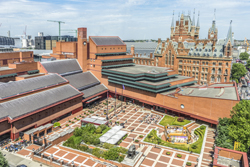
british-library-aerial-shotThe British Library at St Pancras has been given Grade I heritage status, joining the top 2.5 per cent of listed buildings in England. Designed by architect Sir Colin St John Wilson and his partner MJ Long and completed in the late Nineties, the library is the largest public building to have been built in the UK in the 20th century. At the heart of the library is the King’s Library tower which houses the library of George III as well as the Treasures Gallery where national treasures such as the Magna Carta, Lindisfarne Gospels and original Beatles lyrics are displayed. The library was listed along with seven other libraries in England, all of which have been given Grade II status. Meanwhile the record-breaking exhibition Magna Carta: Law, Liberty, Legacy has entered its final month before closing on 1st September. The display features two of the four surviving Magna Cartas as well as the US Declaration of Independence and Bill of Rights – in the UK for the first time – and more than 200 objects including medieval manuscripts, artworks, 800-year-old garments and esoterica such as King John’s teeth and thumb bone. Admission charge applies. For more, see www.bl.uk/magna-carta. PICTURE: Tony Antoniou/British Library.

Help build The People’s Tower in Douglas Square in Deptford, south east London, this weekend. French artist Olivier Grossetete has been invited by the Albany to build the tower – with your help – out of cardboard boxes. Tower assembly takes place between 10am and 3pm on Saturday and then between 11am and 5pm on Sunday, there will be free live music and family entertainment in the Albany Garden as the tower is finished and then knocked down. No booking is required. For more, check out www.thealbany.org.uk.

Send all items for inclusion to exploringlondon@gmail.com.

This Week in London – London Festival of Architecture’s ‘Work in Progress’; objects and sestudes at the Foundling Museum; and, sculpting Sir Tim Berners-Lee…

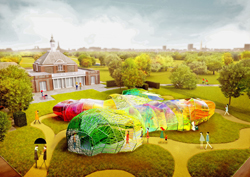
SerpentineThe month-long London Festival of Architecture is underway with this year’s theme ‘Work in Progress’. Highlights of this year’s programme – which includes 220 exhibitions, installations, talks and tours – include a discussion at this year’s Serpentine Gallery (pictured) by architects SelgasCano, access to development sites including Olympic Park, Goodman’s Fields, and Nine Elms, a London Transport Museum tour of London’s first skyscraper, an installation exploring the role of coffee shop as workspace by the Not to Scale Collective, and a Routemaster tour of the West End. For more, including a downloadable PDF of the programme, see www.londonfestivalofarchitecture.org.

A series of  26 ‘sestudes’ – texts exactly 62 words long – are being displayed along with the objects that inspired them in a new exhibition, 26 Pairs of Eyes, at The Foundling Museum in Bloomsbury. The sestudes have been written by the likes of former Poet Laureate Sir Andrew Motion in a bid cast new light on the objects, which are all from the museum’s collection and which range from a pencil which once belonged to Hospital Secretary John Brownlow to George Frideric Handel’s will. The display, which opens today, is on show until 6th September. Meanwhile the museum is also hosting another exhibition, Lines of Beauty, which explores the tradition of decorative plasterwork including the restored Rococo splendour of the hospital’s Court Room (donated by William Wilton in the 1740s and saved when the Foundling Hospital building was demolished in the 1920s). Admission charges apply. For more, see www.foundlingmuseum.org.uk.

A new portrait of the inventor of the World Wide Web, Sir Tim Berners-Lee, has been unveiled at the National Portrait Gallery. The work of Sean Henry, the painted bronze sculpture depicts a two-thirds life size Berners-Lee carrying the leather rucksack in which he keeps his laptop. It was commissioned to mark Sir Tim’s 60th birthday and is the gallery’s first commissioned portrait sculpture for seven years. On display in Room 40. Admission is free. For more, see www.npg.org.uk.

Send all items for inclusion to exploringlondon@gmail.com.