Once the biggest hotel in Europe, the opulent Hotel Cecil opened in 1896 on a prominent site overlooking the Thames. But it only survived for little more than three decades.
London
10 historic London docks…8. St Saviour’s Dock…
Located in an inlet where the River Neckinger enters the Thames just to the east of Tower Bridge, this dock has been used since the early middle ages.
Subscribe for just £3 a month to see all of Exploring London’s content – and support our work.
This Week in London – The glamour of the Edwardian Royals; tulips at Hampton Court; and, Cartier jewels at the V&A…
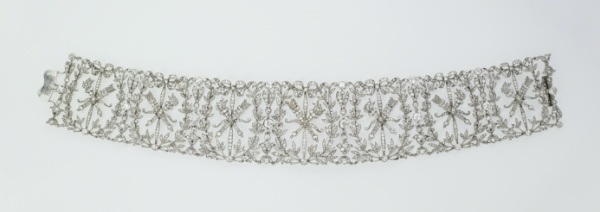
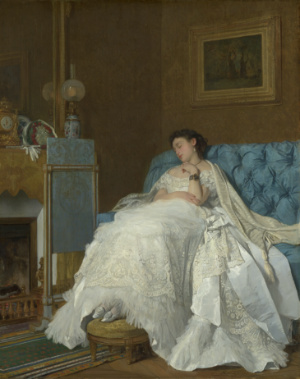
• The glamour and opulence of the Edwardian era – and the two royal couples that exemplified it – is the subject of a new exhibition opening at The King’s Gallery at Buckingham Palace tomorrow. The Edwardians: Age of Elegance takes an in-depth look at the lives of King Edward VII and Queen Alexandra, and King George V and Queen Mary, exploring not only their family interactions but their glittering social circles, travel adventures and, of course, the royal events they attended. More than 300 items are on display in the exhibition – almost half on show for the first time – with highlights including Queen Mary’s ‘Love Trophy’ Collar necklace which is on display for the first time, a Cartier crystal pencil case set with diamonds and rubies, and, a blue enamel Fabergé cigarette case featuring a diamond-encrusted snake biting its own tail which was given to King Edward VII in 1908 by his favourite mistress as a symbol of eternal love. There’s also a never-before-seen photograph of Edward wearing fancy-dress as a knight of the Order of Malta as he attended a ball celebrating Queen Victoria’s 1897 Diamond Jubilee, a previously unseen study of Sleeping Beauty by the Pre-Raphaelite artist Sir Edward Burne-Jones, and, Charles Baugniet’s After the Ball which is on show for the first time in more than a century. Runs until 23rd November. Admission charge applies. For more, see www.rct.uk.
• More than 100,000 tulip bulbs are springing to life at Hampton Court Palace for its annual Tulip Festival. The display includes an installation of 10,000 tulips in the palace’s Fountain Court, floating tulip bowls in the Great Fountain, a vintage horse cart spilling tulips in the Clock Court, free-style planting, inspired by the tulip fields of the Netherlands, in the Kitchen Garden and rare, historic and specialist varieties of tulips in the Lower Orangery. There will be daily “tulip talks” in the palace’s wine cellar exploring the history of the flower and how Queen Mary II introduced them to the palace. Runs from Friday until 5th May. Included in general admission. For more, see www.hrp.org.uk.
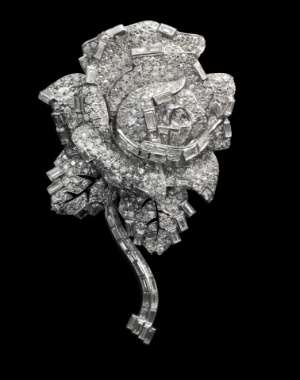
• The first major exhibition in 30 years dedicated to Cartier jewels and watches opens at the V&A this Saturday. Cartier, which is being held in The Sainsbury Gallery, charts the rise of the globally recognised jewellery house and how it became known as “the jeweller of kings and the king of jewellers”. The display features more than 350 objects with highlights including the Williamson Diamond brooch which was commissioned by Queen Elizabeth II in 1953 and which features the rare 23.6 carat pink Williamson diamond; the Scroll Tiara commissioned in 1902 and worn to the coronation of Elizabeth II and later by Rihanna on the cover of W magazine in 2016; Grace Kelly’s engagement ring (1956) that she wore in her final film High Society; Mexican film star María Félix’s snake necklace (1968); and, a selection of Cartier timepieces that embody its pioneering approach to watchmaking, including the Crash wristwatch, designed by Cartier London (1967). The exhibition runs until 16th November. Admission charge applies. For more, see vam.ac.uk/exhibitions/cartier.
Send all items to exploringlondon@gmail.com.
10 historic London docks…5. The London Docks…
Once the largest enclosed docks in the world, the London Docks were constructed in Wapping in the early 19th century.
Subscribe for just £3 a month to access all of Exploring London’s content.
This Week in London – Mudlarking finds celebrated; MI5 reveals its secrets; and, fixing the broken planet at the Natural History Museum…
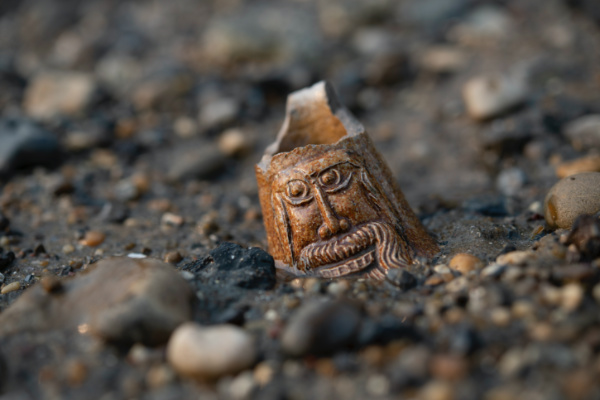
© Alessio Checconi /London Museum.
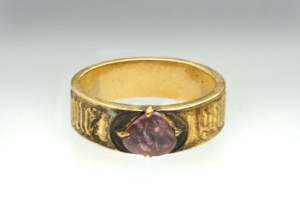
• The first major exhibition on mudlarking opens at the Museum of London Docklands tomorrow. Secrets of the Thames: Mudlarking London’s lost treasures features some of the fascinating finds made along the Thames foreshore – from a Tudor head-dress and a medieval gold ring to an an elaborately decorated Viking era dagger and a pair of 18th century false teeth. While mudlarking was historically an activity of the poor, often children, during the 19th century, it has evolved into a popular hobby for some (albeir permits are required) and in recent years led to some spectacular finds. Others among the more than 350 objects on show include a 16th century ivory sundial, the nationally significant Iron Age Battersea Shield, a pair of medieval spectacles, 16th century wig curlers, and a Roman badge decorated with a phallus. The exhibition also features the installation, The Moon by artist Luke Jerram, which highlights the role the moon and tides play in creating the unique conditions for mudlarks to explore the river’s banks. Admission charge applies. Runs until 1st March next year. For more, see www.londonmuseum.org.uk/whats-on/secrets-thames/.
• The hidden world of MI5 is being revealed in a new exhibition opening at the National Archives in Kew on Saturday. MI5: Official Secrets features original case files, photographs and papers alongside equipment used by spies and spy-catchers during the organisation’s 115 year history. Among the items on show are first-hand account of Kim Philby’s confession in 1963, papers related to the past activities of Cambridge spy Anthony Blunt, M15’s first camera – a pocket-sized ‘Ensignette’ made by Houghton Ltd from 1910, evidence that led to German spy Josef Jakobs being the last person executed at the Tower of London, and, advanced radio equipment found buried in the garden of Soviet spies Helen and Peter Kroger in the 1960s. The exhibition also features video insights from former MI5 directors general, intelligence experts including Professor Christopher Andrew – author of MI5’s official history, and Baroness May, former Prime Minister and one of Britain’s longest serving Home Secretaries. The exhibition is free to visit and runs until 28th September. For more, see https://www.nationalarchives.gov.uk/mi5-official-secrets/.
• The first new permanent gallery at the Natural History Museum – Fixing Our Broken Planet – opens today. The new gallery brings together pioneering research from the museum’s scientists with advice from environmentalists and young changemakers on how to better care for the planet and its future and aims to be a “definitive destination for those looking to explore the threats to our natural world whilst discovering where solutions can be found”. Visitors will come face-to-face with more than 250 specimens including a Sumatran rhinoceros, parasitic worms and whale’s earwax; each telling an important story about our fragile relationship with the natural world and will also see research showing how fungi is used to fertilise crops, how bacteria can be harnessed to extract copper from mine waste, how bison are helping to engineer forests in the UK to store more carbon and how vital DNA analysis on mosquitos is being used to fight mosquito-borne diseases, such as malaria. The new display is located in the restored original 1881 Waterhouse building. The gallery is free to visit. For more, see www.nhm.ac.uk.
• Send all items to exploringlondon@gmail.com
10 historic London docks…4. West India Docks…
A complex of three docks located on the Isle of Dogs, the West India Docks were founded more than 200 years ago and in recent decades have been redeveloped as the financial centre of Canary Wharf.
Subscribe to see all our content for just £3 a month!
This Week in London – Royal garments; Victor Hugo’s drawings; and, British Black music…
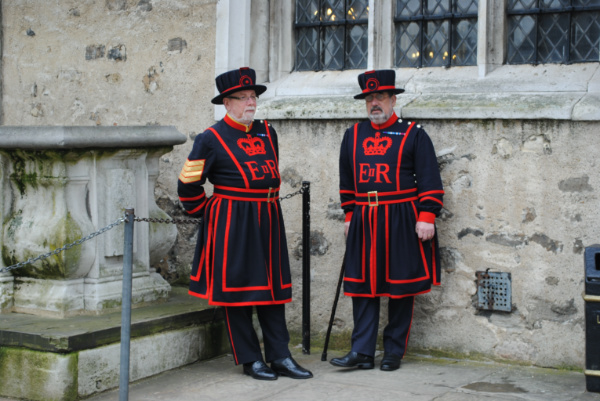
• Almost 200 garments from the Royal Ceremonial Dress Collection are able to be explored online thanks to a new collaboration between Historic Royal Palaces, which looks after six royal palaces including Hampton Court Palace and the Tower of London, and Google Arts & Culture. Drawing on ultra-high-resolution photography and 3D scanning, the garments – which include everything from ceremonial uniforms such as those worn by Yeoman Warders and a rare Bristow hat which may have been worn by King Henry VIII to Queen Victoria’s silk shoes, a waistcoat worn by King George III and a dress worn by the future Queen Elizabeth II in 1927 when she was just 18-months-old – can now be viewed in unprecedented detail (a billion pixels per image) without the risk of the damage which can occur thanks to light, humidity, and handling. The Royal Ceremonial Dress Collection comprises over 10,000 pieces of historic dress and related materials spanning the period from the 16th century to the present day and features garments worn by monarchs and key historical figures, including, as well as the aforementioned, Prince Albert, Princess Margaret, and Diana, Princess of Wales. To see the items, head to goo.gle/royalwardrobe.
• Author, politician and artist Victor Hugo’s rarely seen works on paper have gone on show at the Royal Academy of Arts. Astonishing Things: The Drawings of Victor Hugo features around 70 works drawn from European collections and follows his preoccupation with drawing from early caricatures and travel drawings to later landscapes and abstract works. Arranged across four sections, the works on show include everything from Mushroom (1850) – which depicts a giant anthropomorphic toadstool, some of his many works depicting castles such as The cheerful castle (c 1847), and drawings that Hugo created in tandem with writing his 1866 novel The Toilers of the Sea, set in Guernsey in the years following the Napoleonic Wars, as well some relating to his most famous work, Les Misérables. The exhibition, being held in the Jillian and Arthur M Sackler Wing of Galleries, can be seen until 19th June. Admission charge applies. For more, see royalacademy.org.uk.
• A “ground-breaking” exhibition showing the outsized impact British Black music has had on the world stage over the past 100 years has opened at the Barbican Music Library. Black Sound London highlights artists who created their own platforms, audiences, and spaces, often without mainstream support and spans genres including jazz, lovers’ rock, jungle, grime, and drill. Among the objects on show are vintage mixtapes, iconic magazine covers, and fly-posted walls. Runs until 19th July. For more, see www.cityoflondon.gov.uk/services/libraries/barbican-music-library.
Send all items for inclusion to exploringlondon@gmail.com.
10 historic London docks…2. St Katharine Docks…
Located just to the east of the Tower of London, St Katharine Docks were opened in 1828 following the demolition of more than 1,000 houses along with a brewery and what was left of the medieval St Katharine’s Hospital.
Subscribe for just £3 a month to access all our content!
What’s in a name?…Pentonville…
This north London district owes its name to the family estate on which it was developed.
The district, one of the first planned residential developments in London, was developed in the early 1770s along what was known as New Road. It can be found to the north of Clerkenwell with King’s Cross to the west and Angel to the east.
Set within rolling fields, it was named for the family who owned the land which it was developed – that of Henry Penton, a Lord of the Admiralty, whose family, who hailed from Winchester, had owned the land for a couple of generations. The suffix “ville” was added to give the land sales appeal (a move which proved less popular after the rise of Napoleon thanks to its associated with French).
The new suburb was laid out mostly in a grid pattern on Islington Hill with the first street, named Penton Street, was completed in 1773. Building of further streets continued sporadically over the ensuing decades until the 1840s.
A church – St James Pentonville – was built halfway up the hill on Pentonville Road; it survived until its demolition in 1984. The burial grounds now form a public park – the Joseph Grimaldi Park (named for the clown who is buried within it). Other notable burials include Henry Penton.
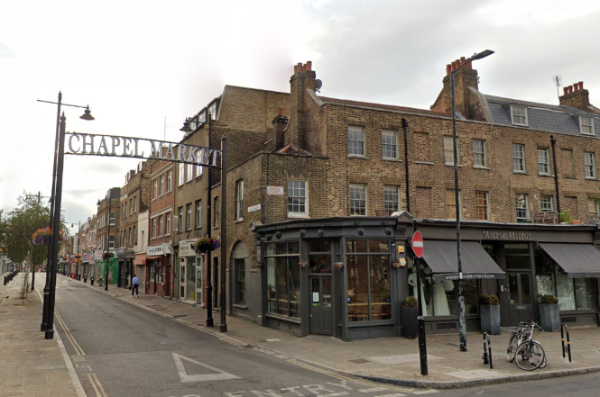
Chapel Market was built as a residential street in 1790 but gradually transformed into a market and shops (it still contains some original properties).
Other landmarks include St Silas Church, Pentonville, which opened in 1863 and still stands in Risinghill Street, and the Church of St Mark the Evangelist, which opened in Myddleton Square in 1855, and was demolished in 1970.
Initially a fashionable place to live, this led to the term ‘Pentonville’ being used to describe an area beyond its original boundaries (Charles Dickens was apparently guilty of doing this). But its reputation began to fade during the mid-19th century as some homes were converted into businesses and others became boarding houses and tenements. By the turn of the century it was one of London’s poorest districts.
The area was partly redeveloped with council housing during the period between the two world wars – this was continued to a greater degree after World War II.
Incorporated into the London Borough of Finsbury in 1899, Pentonville became part of the London Borough of Islington in 1965 (there was Pentonville ward in the borough until 1978).
Famous residents have included philospher and economist John Stuart Mill (born at 13 Rodney Street in 1806) and Vladimir Lenin, who lived with his wife at 30 Holford Square just off Pentonville Road briefly in 1902-03.
Pentonville Road, formerly part of New Road, shares the name and a number of other streets also feature related names including, of course, the aforementioned Penton Street. Interestingly, the (in)famous HM Prison Pentonville, is not located in the area but in Caledonian Road in Barnsbury, some distance to the north.
Of course, Pentonville (in the form of Pentonville Road) can also be found in the pale blue section of properties on the Monopoly board.
10 historic London docks…1. Billingsgate…
While the oldest dock or harbour in London is found at Queenhithe, we thought we’d take a look at 10 other historic docks.
First up, it’s Billingsgate, which, along with Queenhithe, was one of London’s earliest docks or harbours.
Subscribe for £3 a month to get access to all of Exploring London’s content…
10 London mysteries…10. Who was Jack the Ripper?
Linked to the brutal slayings of at least five women in the later half of 1888, the identity of Jack the Ripper is London’s most infamous mystery and one which continues to fuel speculation – and make headlines – more than 130 years later.
Subscribe for just £3 a month to gain access to all Exploring London’s content…
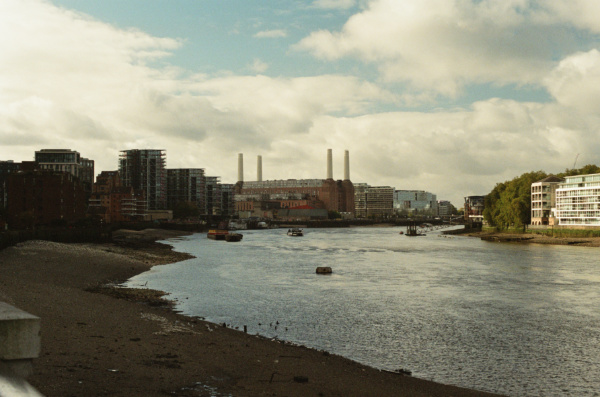
LondonLife – Low tide…
This Week in London – The Charles Dickens Museum celebrates 100 years; activist Olive Morris commemorated; and, ‘The Story of Soldier Magazine’…
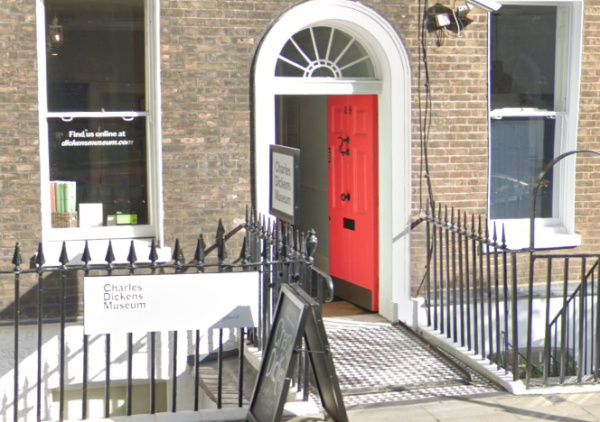
• The Charles Dickens Museum, located in the author’s former home at 48 Doughty Street in Bloomsbury, is marking its centenary this year, and to celebrate the occasion, it’s holding a special exhibition of highlights from its collection. The museum, which first opened its doors on 9th June, 1925, has brought together everything from Dickens’ hairbrush, walking stick and only surviving suit through to portraits and photographs made during his lifetime as well as original manuscripts, letters to his family and friends and rare first editions. The exhibition runs on 29th June. Admission charge applies. For more, see https://dickensmuseum.com/.
• Housing rights campaigner and activist Olive Morris has been commemorated with an English Heritage Blue Plaque in Brixton. Jamaican-born Morris (1952-1979), who dedicated her life to helping the oppressed and exploited, hosted Black women’s study groups and lived as a squatter at the three storey property at 121 Ralston Road in the 1970s. She was a significant figure in the British Black Panther movement, co-founded the Brixton Black Women’s Group and the Organization of Women of African and Asian Descent in 1978, and was one of the “Old Bailey three” who were acquitted after being prosecuted over a protest outside the Old Bailey, winning the right to a fair representation of Black people on the jury during the court proceedings. For more, see www.english-heritage.org.uk/visit/blue-plaques/.
• Soldier magazine, the official magazine of the British Army, is marking its 80th anniversary with an exhibition ay the National Army Museum. The Story of Soldier Magazine charts the publication’s history from March, 1945, when it was launched by Field Marshal Bernard Law Montgomery, through the role it’s played in covering every major conflict since as well as the issues shaping military life. Runs until 6th July. Admission is free. For more, see https://www.nam.ac.uk.
Send all items for inclusion to exploringlondon@gmail.com.
10 London mysteries – 8. The Ceremony of the Rendering of the Quit Rents…
Every year an ancient ceremony takes place in the City of London which, thanks to the passing of time, has become somewhat shrouded in mystery.
Subscribe for just £3 a month to read all of Exploring London’s content…
This Week in London – Peru’s orchids celebrated at Kew; Brazilian Modernism at the Royal Academy; and a tribute to The Clash’s Joe Strummer…
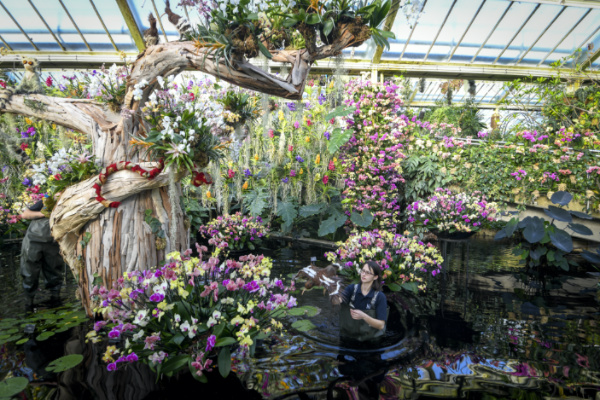
• Kew Garden’s iconic orchid festival returns this Saturday with a Peruvian twist. The gardens’ 29th orchid festival explores some of the 3,000 species of orchids found in Peru’s varied landscapes. Inside the Princess of Wales Conservatory will be a floral recreation of the scenery of Peru including a cornucopia sitting on a grass island in the central pond which was inspired by Lake Titicaca and, in a smaller pond, floral parihuanas (flamingoes) stand proud in front of the iconic Machu Picchu. The display also includes the world’s largest bromeliad – Puya raimondii (commonly known as the Queen of the Andes) – which will be shown alongside floral sculptures inspired by the plant. The country’s diverse wildlife, meanwhile, is celebrated with an orchid aviary that brings to life the diverse bird populations of Peru, and visitors are welcomed by an alpaca bedecked in orchids. Visitors can also wander under a starry night sky adorned with dazzling allium flower heads, which will be recycled from Kew’s outdoor garden displays. There is also large-scale photography taken by celebrated Peruvian photographer Mariano Vivanco and new artworks created for the exhibition of Lima-born artist Gisella Stapleton. Runs until 2nd March. Admission charge applies (advance booking required). For more, see www.kew.org.
• The diversity of 20th century Brazilian art is being celebrated in a new exhibition which opened at the Royal Academy this week. Brasil! Brasil! The Birth of Modernism features more than 130 works by 10 important Brazilian artists and spans the period from the 1910s to the 1970s. The artists include pioneers of Brazilian modernism such as Anita Malfatti, Vicente do Rego Monteiro, Jewish Lithuanian emigré Lasar Segall, Candido Portinari and Tarsilo do Amaral as well as self-taught artists such as Alfredo Volpu, Djaniro da Motta e Silva, Rupert Valentim, Geraldo de Barros, and the artist and architect Flávio de Carvalho. The exhibition also features a section dedicated to the historic Exhibition of Modern Brazilian Paintings, which took place at the Royal Academy in 1944 and was the first exhibition of modern Brazilian art in the UK. Runs until 21st April. Admission charge applies. For more, see www.royalacademy.org.uk.
• A “legacy stone” commemorating the former residence of musician and former lead singer of The Clash, Joe Strummer, has been unveiled in North Paddington. The stone was installed in the newly refurbished Maida Hill Market on the corner of Walterton Road, a location where Strummer, who died in 2002, squatted during the 1970s ( in fact, his address of 101 Walterton Road inspired the name for the band the 101ers). The stone is inscribed with lyrics sung by Strummer in the song Clampdown from The Clash’s 1979 album London Calling including “the future is unwritten” and “No man born with a living soul can be working for the clampdown”. The stone was installed as part of Westminster City Council project to revitalise the market and Market Hill Area.
Send items to exploringlondon@gmail.com for inclusion.
London pub signs – The Ship Tavern, Holborn…
This Holborn pub apparently has a history dating back to 1549.
It is believed to have been established to cater to farm labourers working in nearby Lincoln’s Inn Fields.
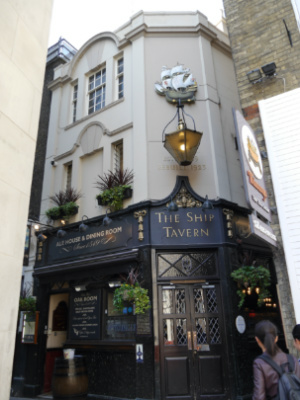
Its name, however, is said to be related to its proximity to the now-underground River Fleet which runs through Holborn and linked the area with the River Thames. It’s said that the pub’s clientele soon included dock workers and that it may have even had connections to smuggling and pirates. It was apparently these connections that gave the pub the name it still has today.
These days tucked down a narrow alleyway at 12 Gate Street in a building dating from 1923 (apparently considerably bigger than the original), the pub, which features wood panelled walls and leaded windows, has a storied history.
Having been established during the reign of King Edward VI, the pub is known to have provided a space for banned Catholic worship (complete with spotters to warn if officials were seen in the area and hiding places for the priests should the officials decide to raid the premises).
Indeed, the pub would have also served those who attended executions of Catholics such as Robert Morton and Hugh More who were executed in 1588 in the nearby Lincoln’s Inn Fields (other executions there included that of Anthony Babington, executed in 1586 after being convicted of plotting against Queen Elizabeth I, and Lord Russell, executed in 1683 for his involvement in the Rye House Plot).
Other clientele, meanwhile, may have come from the nearby thoroughfare of Whetstone Park which was once notorious for gambling houses and other illicit behaviours.
The Ship also has Freemason connections, being officially consecrated as a Masonic Lodge in 1736 by the then-Grand Master, the Earl of Antrim.
Famous figures said to have been associated with this pub include Richard “Trusty Dick” Penderell, who aided Charles I’s escape after the Battle of Worcester in September, 1651, the antiquarian John Bagford, the French diplomat and spy Chevalier d’Eon who lived both as a man and, later in life, as a woman, and John Smeaton, the builder of a lighthouse once located at Eddystone in Cornwell. It’s even been suggested Shakespeare visited.
There’s also said to be a number supernatural clients at the pub with mysterious figures seen sitting at tables and glasses being moved around (it’s been suggested some of these relate to the persecution of Catholics on the site).
For more, visit theshiptavern.co.uk.
10 London mysteries – 6. The disappearance of Edward V and his brother Richard…
The disappearance of King Edward V and his brother, Richard, Duke of York, after being last seen in the Tower of London is one of London’s most famous mysteries. And while it’s one we’ve written about before, we thought we’d take a look at the recent announcement that new evidence had been found in the matter.
Subscribe to Exploring London for just £3 a month to access all of our articles…
This Week in London – New artworks on the Tube network; Boulle clocks at the Wallace Collection; and, see extinct-in-the-wild doves at London Zoo…
• Transport for London has announced it will be unveiling four major new artworks on the Tube network this year as part of its Art on the Underground programme which this year celebrates its 25th anniversary. The works include Saved by the Whale’s Tail, Saved by Art, a large-scale piece by artist Ahmet Öğüt in collaboration with New Contemporaries In Art which, to be unveiled at Stratford Underground station in March, explores the role art plays in everyday life. There’s also a new artwork by Hungarian-born American artist Agnes Denes which will be featured in a new pocket Tube map, a new audio work produced by artist and composer Rory Pilgrim with the Mayor of London’s Culture and Community Spaces at Risk (CCSaR) programme which will be heard at Waterloo Station in June and July, and, a new mural by Rudy Loewe which will be unveiled at Brixton Tube station in November. For more on Art on the Underground, see https://art.tfl.gov.uk.
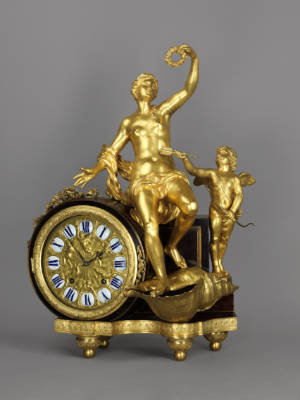
• On Now: Keeping Time: Clocks by Boulle. This exhibition at the Wallace Collection in Manchester Square explores the art and science of timekeeping through a display of five pieces created by André-Charles Boulle (1642–1732). Boulle, the most famous cabinetmaker working for the court of the Sun King, Louis XIV (1638–1715), ended up giving his name to a style that featured elaborate veneer designs incorporating turtleshell, brass and other materials. The objects on show in the Housekeeper’s Room include a monumental wardrobe from 1715 that encloses a clock; two mantel clocks, one from around 1715 featuring Venus and Cupid, and another, from a decade later, with the figure of Father Time; as well as two pedestal clocks. A complementary display in the museum’s Billiard Room brings together two artworks as it explores the concept of time – The Dance to the Music of Time (about 1634-6) by Nicolas Poussin in which the Four Seasons dance to the song of Father Time, the composition of their rhythmic bodies echoing the workings of a clock movement, and The Borghese Dancers (1597–1656), where five female figures masquerade as the Hours, attendants to the goddesses of the Dawn and Moon. Runs until 2nd March. Free admission. For more, see www.wallacecollection.org.

• London Zoo has welcomed three new Socorro doves as part of a global effort to breed and reintroduce them to the wild. The three doves, which moved from Portugal’s Lagos Zoo at the end of 2024, have joined six other Socorro doves at the zoo. The species, which is extinct in the wild, is endemic to the tiny Socorro Island off the coast of Mexico and the Socorro Dove Project, an international initiative, is working to reintroduce the species to the island by 2030. The Socorro doves can be seen in Blackburn Pavilion, London Zoo’s historic tropical birdhouse, which is also home to the endangered Sumatran laughingthrush, the critically endangered Bali starling and the critically endangered blue-crowned laughingthrush. For more, see www.londonzoo.org.
Send all items for collection to exploringlondon@gmail.com.
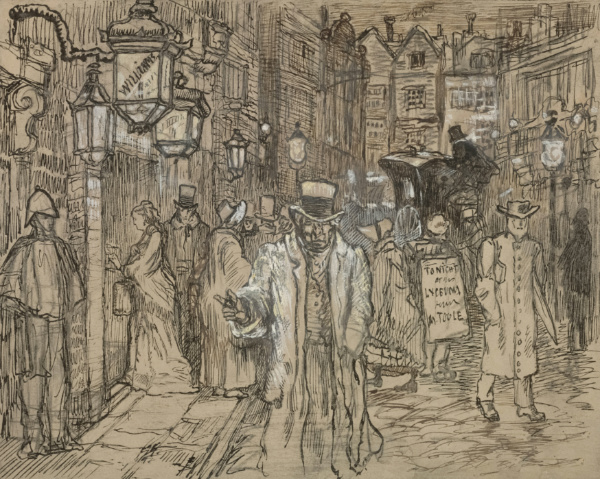
LondonLife – London, 1879…
This Week in London – Natural History Museum scientists name new species; Ketna Patel at the Heath Robinson Museum; and, David Hoffman’s images of the East End…
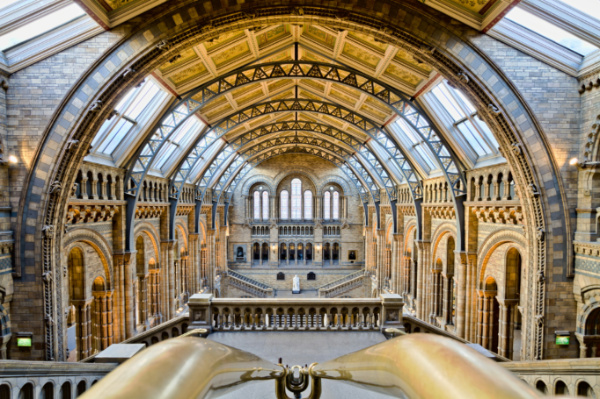
• A snake named after actor Leonardo DiCaprio, fossilised dung named after the author of Winnie the Pooh and a piranha named after Sauron, the evil Lord of the Rings figure, are among 190 new species named by London’s Natural History Museum scientists in 2024. The Anguiculus dicaprioi, or DiCaprio’s Himalayan snake, was named after DiCaprio while Alococopros milnei is a fossilised dung named after AA Milne in recognition of Winnie the Pooh (get it?) and a vegetarian piranha, or pacu, was named Myloplus sauron due to its resemblance to JRR Tolkien’s Eye of Sauron. Other newly named species included a new dinosaur from the Isle of Wight, now known as Comptonatus chasei, which was named for fossil hunter, Nick Chase, and a new species of pterosaur which was named Ceoptera evansae. For more on the museum, see www.nhm.ac.uk.
• The work of British-Indian artist Ketna Patel is the subject of a new exhibition at the Heath Robinson Museum. REMIXOLOGY: The Art of Cultural Storytelling by Ketna Patel invites audiences to
“reflect on how identity is shaped – by ourselves and by society” and celebrates what is described as her “signature approach” to her work which involves remixing diverse cultural influences into something new. The display can be seen at the Pinner museum until 8th February. Museum admission charge applies. For more, see www.heathrobinsonmuseum.org.
• Now on: Endurance & Joy in the East End: The photography of David Hoffman. This exhibition, hosted by the Museum of the Home, features the work of one of the leading “photographers of protest” in the UK and spans a 10 year period starting in 1973 when Hoffman lived in a squat in Fieldgate Mansions and documented issues seen in Whitechapel including homelessness, racism and the rise of protest. Running until 30th March, it can be seen in the Undercroft at 136 Kingsland Road. For more, see www.museumofthehome.org.uk/whats-on/exhibitions-and-installations/endurance-and-joy-david-hoffman/
Send all items for inclusion to exploringlondon@gmail.com.
 Exploring London