This Week in London – ‘The World of Tim Burton’; Halloween at Hampton Court, the Tower, and Kew Gardens; and, Diwali celebrations…

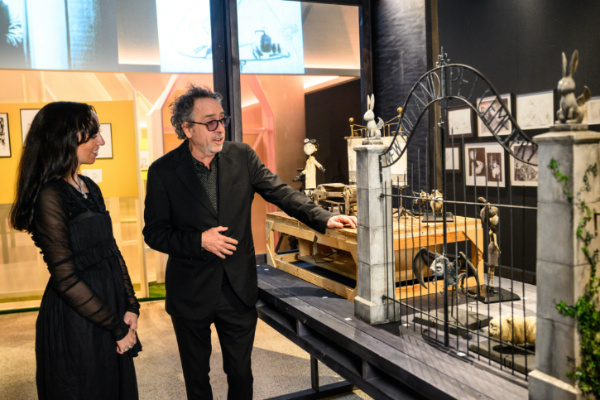
Tim Burton and curator Maria McLintock visit ‘The World of Tim Burton’ , on 23rd October. PICTURE: Matt Crossick/PA Media A (courtesy of the Design Museum)
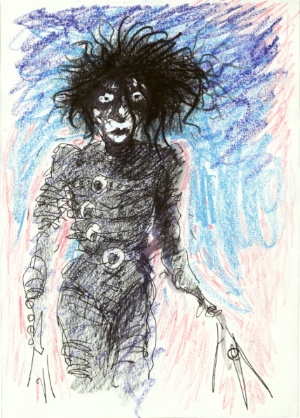
Tim Burton, Untitled (Edward Scissorhands), 1990. EDWARD SCISSORHANDS ©1990. 20th Century Studios, Inc. All Rights Reserved.

The fantastical world of celebrated film-maker Tim Burton is on display in a touring exhibition opening at the Design Museum on Friday. The World of Tim Burton, making its final stop after a decade-long world tour, showcases his 50 years of creative output and looks at not only his role as film-maker but as illustrator, painter, photographer and author. Drawn from Tim Burton’s personal archive as well as film studio collections and other private holdings, the more than 600 objects include film props, drawings, paintings, photographs, sketchbooks, moving-image works, sculptural installations, set and costume design. Highlights include the Catwoman suit from 1992’s Batman Returns, Wednesday Addams’ viral Rave’N dance dress from the recent Netflix series and the Edward Scissorhands costume worn by actor Johnny Depp in the 1990 film. There’s also early drawings of the Martians from Mars Attacks! (1996), the Mad Hatter from Alice in Wonderland (2010), and Emily in Tim Burton’s Corpse Bride (2005) and a specially created cinema experience which gives voice to some of Burton’s key collaborators and is being shown in a bespoke art-deco space reminiscent of the theatres Burton frequented as a child growing up in Hollywood. Runs until 21st April. Admission charge applies. For more, see https://designmuseum.org/exhibitions/the-world-of-tim-burton.

Hampton Court Palace and the Tower of London are marking Halloween with a series of spine-tingling events which delve into the mysterious past of the royal residences. From Saturday, visitors to Hampton Court Palace can, among other things, discover the ‘Alchemist’s Apothecary’ and meet the ghost of a long-departed alchemist, venture into the ‘Spider’s Lair’ in the depths of the palace’s wine cellar, catch a glimpse the frantic ghost of Catherine Howard in the Haunted Gallery, and encounter the spirit of Sybil Penn, a former nurse to Henry VIII’s son Edward, who has haunted the palace hallways ever since her tomb was disturbed. At the the Tower of London, meanwhile, the grounds have been transformed, hosting everything from a haunted chess game on the South Lawn to a glimpse into the tower’s astronomical past, complete with celestial maps and scientific instruments. Events take place until 3rd November. Admission charge applies. For more, see www.hrp.org.uk/hampton-court-palace/ or www.hrp.org.uk/tower-of-london/.

The first Halloween-themed light trail has opened at Kew Gardens with eerie illuminated trees, ghoulish installations and fire performers. Visitors can wander through an illuminated spiders web or discover a neon Carnivorous Tree feeding on unsuspecting skeletons by choosing one of three sessions to attend (daylight, twilight and moonlight) with things getting scarier as the evening progresses. Runs until 3rd November. Admission charge applies. For more, see www.kew.org/kew-gardens/whats-on/halloween-at-kew.

Diwali is being celebrated on Trafalgar Square this Sunday in a free, family-friendly festival. Delivered in partnership with the volunteer-led Diwali in London committee, the event – which showcases the culture of London’s Hindu, Sikh and Jain communities – features a programme of dance, music, activities and food. Highlights include dance workshops, sari and turban tying and the new Bhajan singing space where groups will perform throughout the day. The day runs from 1pm to 7pm. For more, see www.london.gov.uk/events/diwali-square-2024.

Send all items to exploringlondon@gmail.com

10 towers with a history in London – 10. The ‘Lollard’s Tower’, Lambeth Palace…

This 15th century tower can be found at the north-west corner of Lambeth Palace, London residence of the Archbishop of Canterbury.

Subscribe for just £3 a month to gain access to all our stories – that’s less than the price of a cup of coffee!

Treasures of London – 10 Downing Street’s original door…

Now found in the Churchill War Rooms, the original black door from the Prime Minister’s residence at 10 Downing Street dates from the 1770s.

Subscribe for just £3 a month to gain access to all Exploring London’s content.

10 towers with a history in London – 9. The Queen’s Tower, Imperial College London…

This free-standing, 287 foot-high tower is a survivor – it’s all that remains of the Imperial Institute.

Subscribe for just £3 a month to get access to all Exploring London’s stories – that’s less than the cost of a cup of coffee!

London Explained – Albertopolis…

An aerial view of the area known as Albertopolis. PICTURE: Andreas Praefcke/Public Domain

A nickname, connected to Prince Albert (beloved husband of Queen Victoria), which was given to an area of South Kensington centred on Exhibition Road which is packed with various cultural and educational institutions.

The land, which had been the Kensington Gore Estate, was purchased by the Royal Commission for the Exhibition of 1851 on the suggestion of Prince Albert using the profits made from the Great Exhibition which had been held just to the north in Hyde Park. His vision was for arts and science quarter which included schools, colleges and libraries as well as museums, exhibition rooms and spaces for events.

Among the buildings subsequently constructed upon it were those bearing Prince Albert’s name including Royal Albert Hall and the Victoria and Albert Museum along with the huge Albert Memorial.

Other institutions on the land include the Natural History Museum, Imperial College London, the Royal College of Music, the Royal College of Art, the Science Museum, the Royal Geographical Society and the since removed Royal Horticultural Society Gardens.

The area gained its nickname in the 1850s due to the Prince’s role in the Great Exhibition and its subsequent purchase and was seen to both celebrate, but also by some, to satirise him. It fell out of use after the Prince’s death in 1861 but was subsequently revived in the 1960s and since to bring attention to buildings in the area threatened with demolition.

A pedestrian subway under Exhibition Road runs north from South Kensington Station and gives access to the museums (when it was built in 1885, a toll of one penny was charged to use it).

10 towers with a history in London – 8. The Bell Tower…

We return to the Tower of London this week to look at the history of another of its storied towers.

Support out work and subscribe for just £3 a month for full access to the site.

This Week in London – Silk Road treasures; a new Lord Mayor of London; and, reassessing the UK’s early Emo scene…

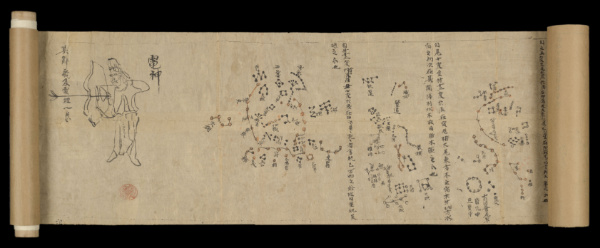
Dunhuang Star Chart 649 – 700 CE – Or.8210/S.3326 © British Library Board

The world’s earliest complete printed book with a date, the earliest known manuscript atlas of the night sky and the earliest surviving historical document in Tibetan are among treasures on show in a new exhibition at the British Library. A Silk Road Oasis: Life in Ancient Dunhuang features more than 50 manuscripts, printed documents and pictorial works including many which were sealed in the so-called ‘Library Cave’ in the Buddhist Mogao cave complex near the oasis town of Dunhuang in Gansu province, China, for almost 900 years before they were rediscovered in 1900. Highlights in the display include the Diamond Sutra (868 AD) – the world’s earliest complete printed book with a date, the Dunhuang star chart (649-700) – the earliest known manuscript atlas of the night sky (pictured), and the Old Tibetan Annals (641-761) – the earliest surviving historical document in Tibetan. On public display for the first time is a rubbing of the Stele of Sulaiman – a carved stone slab that was erected in the caves in 1348, a copy of the Diamond Sutra written in the scribe’s own blood (considered by Buddhists to be an act of powerful sincerity), and one of the most important and complete manuscripts among the Old Uyghur Manichaean texts, the Xuastuanift. There is also a 9th century manuscript fragment about the prophet Zoroaster or Zarathustra (believed to be nearly 400 years older than any other surviving Zoroastrian scripture) and the longest surviving manuscript text in the Old Turkic script, a Turkic omen text known as the Irk Bitig or Book of Omens (930 or 942). The exhibition, which explores Silk Road interactions through a case of characters including a scribe, merchant and Buddhist nun, runs until 23rd February and is accompanied by a programme of events. Admission charge applies. For more, see https://silkroad.seetickets.com/timeslots/filter/a-silk-road-oasis-life-in-ancient-dunhuang

Alderman Alastair King has been elected the 696th Lord Mayor of London. King, who succeeds Lord Mayor Professor Michael Mainelli, takes office on 8th November for a one year term with the annual Lord Mayor’s Show, which takes place the following day, his first public event. “It is a tremendous honour to be elected as the 696th Lord Mayor of the City of London,” the Lord Mayor-elect, whose role will see him serving as a global ambassador for the UK financial and professional services industry, said. “London remains the world’s leading financial centre, but global competition is fierce. We have the expertise and talent to thrive, yet we must do more to unlock growth, equip people to innovate, and harness the remarkable dynamic diversity that makes the City exceptional.”

An “unfiltered” look at the early Emo scene in the UK is the subject of a new exhibition at the Barbican Music Library. I’m Not Okay (An Emo Retrospective), a collaboration between the library and the Museum of Youth Culture (MOYC), features personal photos taken on early digital and phone cameras and focuses on the first-generation Emo scene (2004-2009), a time when bands such as My Chemical Romance, Fall Out Boy, and Finch were “hugely influential”.  Jamie Brett, creative director at the MOYC said the Emo scene “resonated deeply with teens who wanted to express their angst, doubts, insecurity, and sense of feeling and being different, and channelled their collective melancholy into a transatlantic subculture”. The exhibition, which is free to enter, can be seen until 15th January. For more, see www.cityoflondon.gov.uk/services/libraries/barbican-music-library.

Send all items for inclusion to exploringlondon@gmail.com.

10 towers with a history in London – 7. Tower of the former Church of St Mary-at-Lambeth…

Part of the deconsecrated Church of St Mary-at-Lambeth – now the home of the Garden Museum, is a tower which was first built in the 14th century.

Support our work and subscribe for just £3 a month to see all of Exploring London’s content

LondonLife – The Fourth Plinth readorned…

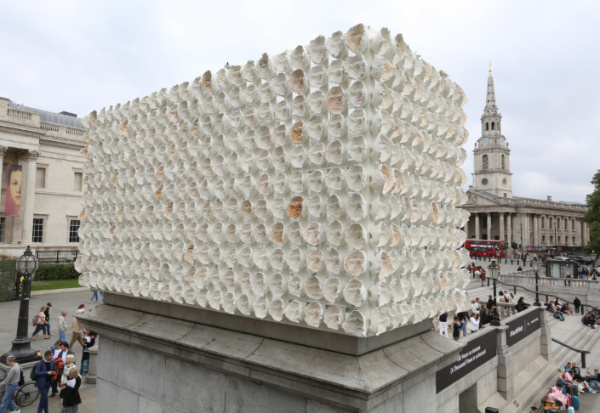
Mil Veces un Instante’ by Teresa Margolles. PICTURE: © James O Jenkins
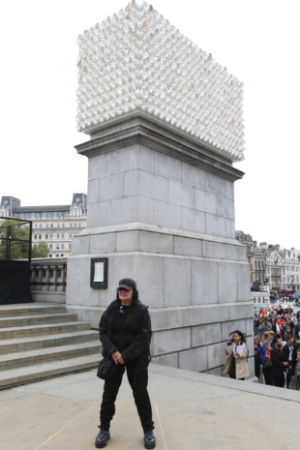
Teresa Margolles with ‘Mil Veces un Instante’ PICTURE: © James O Jenkins

The 15th commission in Mayor of London’s Fourth Plinth programme has been unveiled in Trafalgar Square.

Artist Teresa Margolles’ Mil Veces un Instante (A thousand times an Instant) is made up of plaster casts of the faces of 726 trans, non-binary, and gender non-conforming people which were made in Mexico City and Juárez, Mexico; and London. 

The casts – which Margolles spent more than 1,000 hours making – were created by applying plaster directly onto the faces of participants, meaning the plaster is infused with their hair and skin cells.

The next artworks to grace the Fourth Plinth will be Tschabalala Self’s Lady in Blue – a bronze work patinated with Lapis Lazuli blue which will be installed in 2026 – and Andra Ursuţa’s Untitled – a shrouded equestrian statue which will be installed from 2028.

Mil Veces un Instante replaced Samson Kambalu’s Antelope which had been on the Fourth Plinth since 2022.

For more on the Fourth Plinth programme, head to https://www.london.gov.uk/programmes-strategies/arts-and-culture/current-culture-projects/fourth-plinth-trafalgar-square. You can also download the free arts and culture app Bloomberg Connects.

A Moment in London’s History…London Mithraeum refound…

It was on 18th September, 1954 – 70 years ago this month – that archaeologists working on a site in central London discovered one of the greatest archaeological finds in London of the 20th century – a head of Mithras in the remains of a mid-3rd century Roman temple.

Support our work and subscribe for just £3 a month to get full access to our stories.

10 towers with a history in London – 6. Westminster Cathedral campanile…

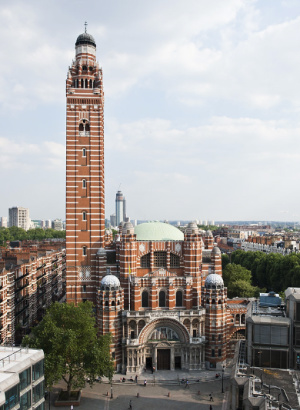
A well-known landmark in Westminster, the distinctive striped brick and stone campanile of Westminster Cathedral stands 284 feet or 64 metres high.

PICTURE: Catholic Church England and Wales © Mazur/catholicnews.org.uk (licensed under CC BY-NC-ND 2.0)

Building of a Roman Catholic cathedral in Westminster – what would be the largest in England and Wales – was the vision of Cardinal Herbert Vaughan. Construction started in 1895 and was complete eight years later. The campanile was the final part of the building’s structure to be completed.

Conscious that the Gothic Westminster Abbey only a short distance away, architect John Francis Bentley instead designed the cathedral in a neo-Byzantine style and the plans originally included two campanili or bell towers which may have been influenced by those in Venice (it was Cardinal Vaughn who famously said one campanile would be enough for him resulting in just one being built).

The 30 foot square dome-topped tower, like the rest of the building, was constructed of stripes of red brick and Portland stone which reflected existing residential buildings nearby.

Formally known as St Edward’s Tower, it contains the 55cwt St Edward’s Bell (named after St Edward the Confessor) which was a gift of Gwendoline, the Duchess of Norfolk, in 1910. It was cast at the Whitechapel Foundry and bears the inscription, “While the sound of this bell travels through the clouds, may the bands of angels pray for those assembled in thy church. St Edward, pray for England.”

Carved stone eagles surround the apex of the tower – a reference to St John the Evangelist (apparently patron saint of the architect) and the cross on top of the cupola is said to contain a fragment of the True Cross discovered by the Empress Helena in 326 AD.

The campanile famously appears at the end of Alfred Hitchcock’s 1940 thriller, Foreign Correspondent, in a scene in which the bad guy is thrown from the top.

The campanile, which has a lift to the top, is open to the public. Viewing balconies on all four sides of the tower provide 360 degree views of the surrounding city including over the stunning domes of the cathedral itself.

WHERE: The Campanile, Westminster Cathedral (nearest Tube stations are Victoria and St James’s Park); WHEN: 11am to 3:30pm Fridays, Saturdays and Sundays; COST; £6 adults; £12 families (two adults and up to four children); £3 concessions (aged 60+); WEBSITE: https://westminstercathedral.org.uk/tower-viewing-gallery-reopens/

10 towers with a history in London – 5. St Augustine’s Tower, Hackney…

This tower – said to be the oldest building in Hackney – is all that remains of a 16th century church and, as a local symbol, appears on the London Borough of Hackney’s coat-of-arms.

Support our work and subscribe for just £3 a month – less than the price of a cup of coffee – to see all of Exploring London’s content.

This Week in London – The Olympics on the big screen; new portraits at the National Portrait Gallery; and, Charles Dickens’ pets…

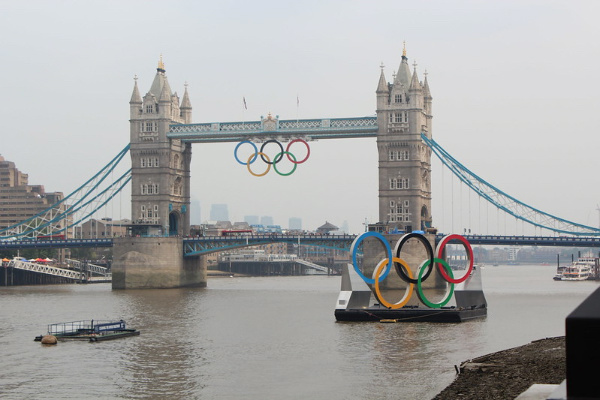
Memories of 2012. This year the Games are in Paris but there’s plenty of places to watch on a big screen in London. PICTURE: Peter Burgess (licensed under CC BY 2.0)

• The Olympics are in full swing across the Channel in Paris and to ensure you don’t miss any of the action, big screens are showing the coverage across London. Among them are official Team GB Fanzones – there’s a list of locations on the Team GB website here. Other locations include Lyric Square in Hammersmith, Bishops Square in Spitalfields, the Old Royal Naval College grounds in Greenwich and by the Thames at London Bridge as part of the Summer by the River festival.

• New portraits of human rights campaigner Peter Tatchell and singer Sam Smith have gone on display at the National Portrait Gallery as part of its History Makers Display. The full-length portrait of Tatchell, which has been acquired by the gallery, was painted by artist Sarah Jane Moon to coincide with his 70th birthday on 25th January, 2022, and is the first portrait of Tatchell to enter the gallery’s collection.. Meanwhile, titled Gloria, the portrait of five-time Grammy Award winner Smith is the work of artistic duo Pierre Commoy and Gilles Blanchard and was created in 2023. It’s on loan from the singer. For more, see www.npg.org.uk.

• On Now: Faithful Companions: Charles Dickens & his Pets. This exhibition at the Charles Dickens Museum in Bloomsbury takes a look at the many pets – dogs, ravens, goldfinches, and cats – that lived in the home of Charles Dickens, exploring the stories of the likes of Grip the raven and Timber the dog as well as those of animals made famous in his novels. The display includes hand-written letters, family photo albums and artworks. Runs until 12th January next year. Admission charge applies. For more, head to https://dickensmuseum.com/blogs/all-events/faithful-companions-charles-dickens-his-pets.

Send all items for inclusion to exploringlondon@gmail.com

A Moment in London’s History – The first bananas go on sale…

It’s widely reported that the first banana went on sale in London in the mid-17th century but there is evidence bananas had been in the capital well before that date.

Subscribe for full access for just £3 a month.

This week in London – Re-live the ‘Golden Age of Piracy’; getting below the surface of the Thames; a look inside East London houses through time; and, a new public garden in the City…

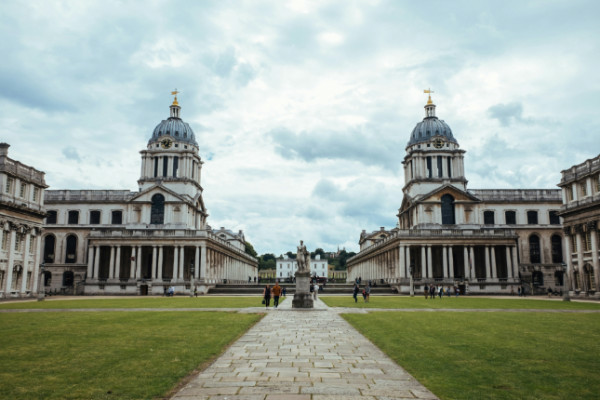
The Old Royal Naval College in Greenwich. PICTURE: Robert Bye/Unsplash

• ‘The Golden Age of Piracy’ will come to life in a living history weekend this Saturday and Sunday at the Old Royal Naval College in Greenwich. With the focus on the period between 1650 and 1720 (when more than 5,000 pirates were said to have been active), visitors will learn how to separate pirate fact from fiction, enjoy songs of the sea, witness sword and cutlass fights, and hear the tale of a real 18th-century mutiny. Each day culminates with a demonstration of the firepower of pirates and marines in the arena on the lawns overlooking the River Thames. There’s also the opportunity to wander through the pirate encampment and learn about the clothes and weapons of the period, listen to some love music and sample food from the Taste of History period kitchen. Runs from 11am to 4pm on Saturday and Sunday. Admission charge applies. For more, see https://ornc.org/whats-on/golden-age-of-piracy/.

The world of sound below the surface of the River Thames is the subject of a new contemporary art installation at the Natural History Museum which opens tomorrow. The River, composed by Norwegian sound artist Jana Winderen in collaboration with spatial audio expert Tony Myatt, uses underwater audio recordings to immerse visitors in a 360 degree audio composition which spans the river from the source by Kemble through central London and on to the sprawling estuary leading into the North Sea. The River is free to visit. Bookings, to ensure entry, can be made at https://www.nhm.ac.uk/visit.html.

One of the new rooms at the Museum of the Home – a Jewish tenement flat from 1913. PICTURE: Courtesy of the Museum of the Home.

Seven new and reimagined period rooms reflecting the stories of our East London community, past, present and future, have been unveiled at the Museum of the Home in Shoreditch. Thanks to the Real Rooms project, the expanded ‘Rooms Through Time: 1878-2049’ now includes a Jewish tenement flat from 1913, an Irish couple’s house in the 1950s, LGBTQ+ renters sharing an ex-council home in the 2005, a British-Vietnamese home in 2024, and the Innovo Room of the Future, which explores real homes amid challenges such as the climate crisis and technological advances. The scope of the existing 1870s Parlour and Front Room in 1976 have also both been expanded. Entry to the permanent display is free. For more, see https://www.museumofthehome.org.uk.

A new public garden has been opened at the intersection of Cheapside and New Change in the City of London. Formerly known as the Sunken Garden, the area has undergone a transformation and now features benches created from 150-year-old-plus granite stones salvaged from the Thames River Wall and recycled timber from fallen London Plane trees. There’s also new permeable paving which lets rain drain freely into the ground and stores it for trees to use later, reducing pressure on the sewer system while new plant species have been selected with local wildlife in mind.

Send all items for inclusion to exploringlondon@gmail.com.

10 towers with a history in London – 1. The Bloody Tower…

The Bloody Tower (centre, with the gateway) at the Tower of London. PICTURE: David Adams

Carrying rather a gruesome name, this rectangular-shaped tower sits over a gate leading from outer ward into the inner ward in the Tower of London.

The tower, which once controlled the watergate before the outer walls were constructed, was originally known as the Garden Tower due to its location adjoining the Tower Lieutenant’s Garden.

To see the rest of this post (and all of our coverage), subscribe for just £3 a month. This small contribution – less than the cost of a cup of coffee – will help us continue and grow our coverage. We appreciate your support!

Treasures of London – The Abraham Tapestries, Hampton Court Palace…

Hanging in the Tudor Great Hall at Hampton Court Palace, this series of 10 huge tapestries are believed to have been commissioned by King Henry VIII and were first hung in the hall in 1546.

To see the rest of this post (and all of our coverage), subscribe for just £3 a month. This small contribution – less than the cost of a cup of coffee – will help us continue and grow our coverage. We appreciate your support!

LondonLife – ‘Fern the Diplodicus’ takes up new post at the Natural History Museum…

‘Fern the Diplodicus’ has been unveiled at the Natural History Museum this morning, the latest addition to its transformed gardens which open to public on Thursday.

The cast of Fern the Diplodocus arrives at the Natural History Museum. PICTURE: © The Trustees of the Natural History Museum, London

The bronze cast of the museum’s moved loved figure takes pride of place in the new Evolution Garden, which, along with the Nature Discovery Garden, sit within five acres of green space surrounding the South Kensington museum.

The Evolution Garden provides the opportunity to explore the 2.7 billion history of the planet and, as well as Fern, features a canyon clad in ancient Scottish stone, and a second dinosaur, Hypsiophodon.

The cast of Hypsiophodon in the garden. PICTURE: © The Trustees of the Natural History Museum, London

The Nature Discovery Garden showcases different wildlife habitats in the UK’s urban spaces – complete with the frogs, newts, dragonflies and mandarin ducks that are already living there – and features a nw Nature Activity Centre which combines scientific facilities with a hub for school workshops and family activities.

For more, see www.nhm.ac.uk/visit/galleries-and-museum-map/our-gardens.html

London Explained – Royal Peculiars…

A Royal Peculiar is a Church of England parish that is exempt from the jurisdiction of the church diocese or province in which it sits and instead answers directly to the monarch.

The concept of the Royal Peculiar first began to emerge in Anglo-Saxon times and was developed over the following centuries.

Subscribe for just £3 a month get access

Lost London – St Benet Fink…

This unusually named church dates back to at least the 13th century and stood on what is now Threadneedle Street.

St Benet is a contraction of St Benedict (he who founded monastic communities in Italy in the 6th century) and this was once of four City churches dedicated to the saint before 1666. The word ‘Fink’, meanwhile, is a corruption of Finch and apparently referred to Robert Finch (or Fink) who paid for a rebuild of the church in the 13th century.

‘The Church of St Benet Fink’ (1839), seen in The Churches of London by George Godwin (1839).

The medieval rectangular church was among those destroyed in the Great Fire of 1666. Rebuilding commenced soon after, thanks in part to a £1,000 donation from a Catholic George Holman (he was rewarded with two pews and a place in the vault). The church was completed in 1675 apparently for a cost at just over £4,000.

Designed by Sir Christopher Wren, the church – due to the irregular shape of the site after the City decided to widen Threadneedle Street, was rebuilt on a decagonal plan, over which sat a dome, with a tower at the west end topped by a bell cage over which sat a ball and cross (apparently this latter feature was unique for a Wren church).

The church survived until the mid-18th century when the Corporation of London petitioned Parliament for permission to demolish the tower of St Benet Fink in order make way for an expanded Royal Exchange (which had burned down in 1838).

Following the demolition of the tower (over which there were some protests), a new entrance was cut into the west wall of the church but it proved less than ideal and the City of London was granted permission to knock down the rest of the church which took place in 1846.

The parish was merged with that of St Peter le Poer. Proceeds of the sale of the site were used to build St Benet Fink Church, Tottenham.

The furniture was sold off and paintings of Moses and Aaron that had formed part of the altarpiece are now in the chapel of Emanuel School in Battersea.

Famous associations include John Henry Newman, the future Catholic cardinal, who was baptised in the church on 9th April, 1801.

An office block now occupies the site. A City of London blue plaque marks the site.