PICTURE: Jack Finnigan/Unsplash
PICTURE: Jack Finnigan/Unsplash
PICTURE: Clem Onojeghuo/Unsplash
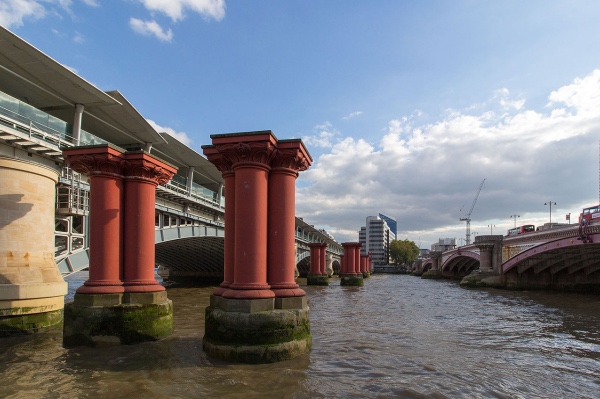
Two Blackfriars Bridges – a vehicle and pedestrian bridge, and a railway bridge – still span the River Thames from the City of London on the north bank to South Bank. But just beside the railway bridge stand some large red pylons – the remains of the first Blackfriars Railway Bridge.
This bridge was built in 1864 to accommodate the London, Chatham and Dover Railway (LCDR) when it was extended north across the river to what was then named St Paul’s Station (at least until 1937 when it became Blackfriars Station).
 The ornate bridge was designed by Joseph Cubitt but within 20 years of its being built, the second, still existing, railway bridge was constructed alongside it to provide more space for trains (the original bridge apparently only had four tracks).
The ornately decorated first bridge was supported on three rows of pylons – the third was incorporated into the second bridge (which is why we now only see two rows).
After 1923, when train services began to terminate at Waterloo Station on the south side of the river, the bridge was rarely used but it wasn’t until many years later, in 1985, that it was declared too weak to support the current crop of trains and removed.
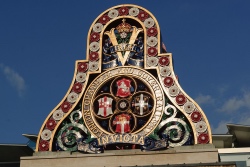
As well as the pylons, on the south side of the river can be seen a massive abutment of Portland stone featuring the ornate cast iron insignia of the former LCDR (above right). Grade II-listed, it was restored in about 1990.
PICTURES: Top – The wub/licensed under The wub; Right – SyndVer/licensed under CC BY-SA 4.0

PICTURE: Clever Visuals/Unsplash
PICTURE: Kafai Liu/Unsplash
The countdown continues…
4. Lost London – Pasqua Rosee’s Coffee House…
3. Where’s London’s oldest…street sign?
Come back tomorrow for the two most popular posts…
The countdown continues…
6. 10 (more) fictional character addresses in London – 8. A square in Soho?…
5. What’s in a name?…Hanging Sword Alley…
Come back tomorrow for the next two…

Reflections at Trafalgar Square. PICTURE: Raphaël Chekroun (licensed under CC BY-ND 2.0).

Carnaby Street ‘Carnival’. PICTURE: Kevin Oliver (licensed under CC BY-NC-ND 2.0) (image cropped).

Flying high in the West End. PICTURE: Maureen Barlin (licensed under CC BY-NC-ND 2.0).

Thrills at Winter Wonderland in Hyde Park. PICTURE: Kevin Oliver (licensed under CC BY-NC-ND 2.0).
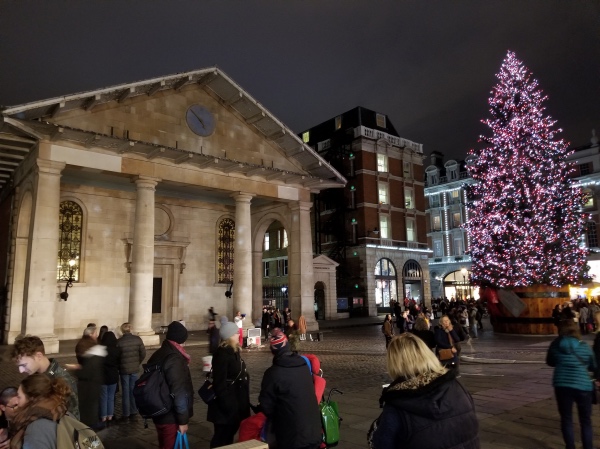
Outside St Paul’s at Covent Garden. PICTURE: Kevin Oliver (licensed under CC BY-NC-ND 2.0).
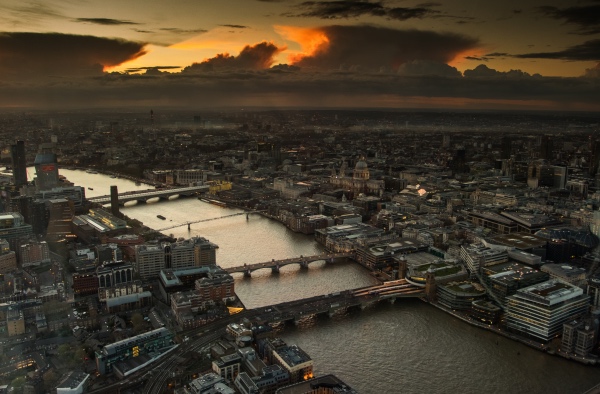
London from The Shard. PICTURE: Genevieve Perron-Migneron/Unsplash
PICTURE: Rene Böhmer/Unsplash
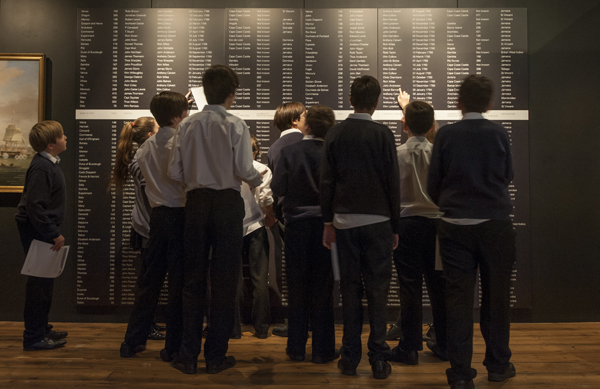
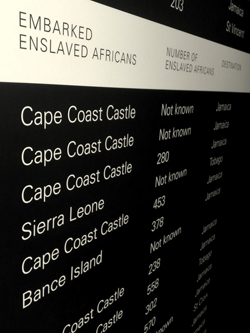 Wednesday marked the International Day for the Remembrance of the Slave Trade and its Abolition, so we thought it an appropriate week to feature one of the most moving displays in the Museum of London Docklands’ ‘London, Sugar and Slavery’ gallery.
The permanent gallery, which opened the museum at West India Quay in 2007 to mark the bicentenary of abolition of the trans-Atlantic slave trade, features a wall bearing a list of the many ships that sailed from London to trade in enslaved Africans over what was just a 10 year period.
In what was known as the ‘Triangular Trade’, the ships on leaving London would sail to West Africa where they would bought enslaved Africans before travelling to the Caribbean to sell them and fill their ships with sugar before returning to London.
Among details recorded on the wall are not only the name of each ship, but the captains, owners and destinations of the ships as well as the number of enslaved Africans carried (but not their names; these were not recorded).
A sad record of a shameful time.
WHERE: ‘London, Sugar and Slavery’ Gallery, Museum of London Docklands, No 1 Warehouse, West India Quay (nearest DLR is West India Quay); WHEN: 10am to 6pm daily; COST: Free; WEBSITE: www.museumoflondon.org.uk/museum-london-docklands
PICTURE: Top – © Museum of London; Below – J D Mack/Flickr/CC BY-ND 2.0
PICTURE: Gordon Williams/Unsplash
PICTURE: designerpoint/Pixabay

Thinking of all those affected by the London Bridge/Borough Market attack. PICTURE: http://www.freeimages.com
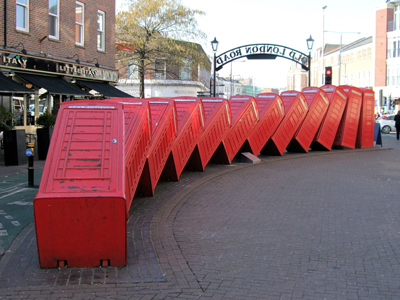 This sculpture by London-based Scottish artist David Mach can be found in Kingston upon Thames in south-west London. It depicts 12 K6 red phone boxes falling onto one another like a row of dominoes and was commissioned from the Royal Academician by the Royal Borough of Kingston upon Thames in 1988. Unveiled the following year, it was renovated in 2001. There’s been talk in the past of it being removed (and of the end phone being connected, so it works) but the iconic sculpture remains in situ near the Old London Road gateway (and unconnected). PICTURE: Jim Linwood/CC BY-SA 2.0 (image cropped)
 Fictional British spy George Smiley featured in some eight books written by acclaimed author John Le Carré (sometimes as the main protagonist, sometimes as a side character) and is about to appear in a ninth, A Legacy of Spies, which comes out in September.
And that’s not to mention his appearance on small screens and large where he’s been portrayed by everyone from James Mason and Sir Alec Guinness to Denholm Elliott and Gary Oldman.
In the books, Smiley and his wife, Lady Ann, lived at a number 9 Bywater Street in Chelsea – which is an actual address, just off King’s Road (pictured with the red door). The Georgian townhouse was appropriately used to depict his home in the 1979 BBC series of Tinker Tailor Soldier Spy although, interestingly, while number nine’s exterior was used, it was apparently number 10, next door – pictured here with the blue door – which provided the interiors.
Le Carré, who was living just over the Thames in Battersea at the time of Smiley’s creation, has reportedly said he chose the location because his literary agent lived nearby (although there is apparently a little fuzziness on whether this is the case) and the mother of one his pupils from Eton (Le Carré – actually David John Moore Cornwell – taught at Eton for two years before he joined MI5 in 1958) lived in the street.
But perhaps the best literary reason is the fact that Bywater Street, despite the name, is actually a cul-de-sac which adds to the difficulty of anyone trying to spy on Smiley. A wise choice for a spy’s residence, in other words.
Other locations associated with George Smiley in London include The Circus, the secret London intelligence HQ where Smiley and his fellow intelligence operatives worked, which was located in an office block in Cambridge Circus, on the corner of Charing Cross Road and Shaftesbury Avenue.
PICTURE: Google Maps
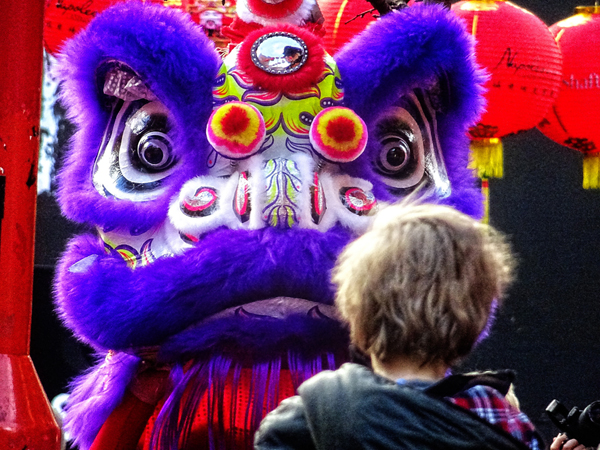
A scene from Chinese New Year celebrations heralding the Year of the Rooster held in central London last weekend. PICTURE: Garry Knight/Flickr/CC BY 2.0
Lemuel Gulliver, the ‘hero’ of Jonathan Swift’s 1726 book, Gulliver’s Travels, wasn’t a native Londoner but moved to the city for work and lived in several different locations before embarking on his famous voyage to the land of Lilliput.
 According to the book, the Nottinghamshire-born Gulliver studied at Emanuel College (sic) in Cambridge before he was apprenticed to London surgeon known as James Bates after which he spent a couple of years studying in the Dutch town of Leiden (spelt Leydon in the book).
Returning to England briefly, he spent the next few years voyaging to the “Levant” before returning to London where he “took part of a small house in Old Jewry” (Old Jewry lies in the City of London runs between Poultry and Gresham Street) and married Mary Burton, daughter of a Newgate Street hosier.
His master Bates dying, however, a couple of years later and with a failing business, he took up the position of surgeon on two different ships and it was when he eventually returned to London that he moved to Fetter Lane – which runs north from Fleet Street – and then from there to Wapping where hoping to retire from the sea and “get business (presumably he meant medical cases) among the sailors”.
But it was not to be and so, in 1699, Mr Gulliver set off on the voyage accounted in the famous book.
The name Fetter Lane, incidentally, has nothing to do with fetters (ie chains) – see our earlier post for more. And it’s also worth noting that the author, Jonathan Swift, also visited and lived in London at various times of his career – we’ll take a more in depth look at his experiences in a later post.
PICTURE: Lemuel Gulliver, depicted in a first edition of Gulliver’s Travels/Wikipedia.

Trafalgar Square at Christmas. PICTURE: London & Partners

A gasometer built in 1886 as part of the South Metropolitan Gas Company’s East Greenwich works.
PICTURE: Sérgio Rola/Unsplash

