
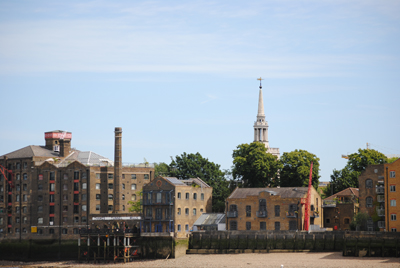
Pictured is the south bank of the Thames showing the buildings of the former Thames Tunnel Mills (now converted to residences). The tower of the Church of St Mary the Virgin is in the background – the church dates from 1716 and was designed by John James, an associate of Sir Christopher Wren.
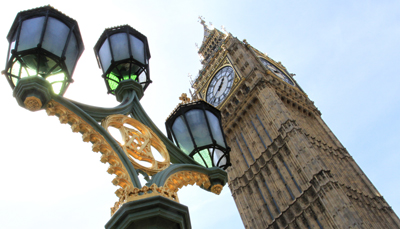
The Clock Tower of the Houses of Parliament, home to Big Ben. For more on it, see our earlier posts on the Palace of Westminster, the Clock Tower and Big Ben. PICTURE: Tony Kerrigan.
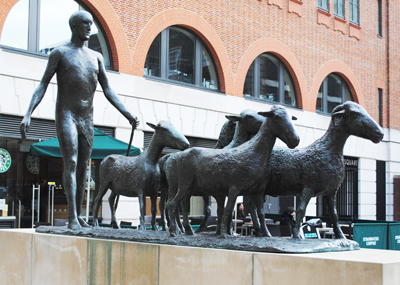
A small flock of sheep made their way across London Bridge this week as the Freemen of the City of London exercised their ancient prerogative to drive sheep over the span. A reported 600 Freemen from the City’s 110 livery companies took part in the annual drive along with a score of sheep – all in an effort to raise for the Lord Mayor’s Appeal. There’s a permanent reminder of the tradition of driving sheep in the heart of the City in Paternoster Square near St Paul’s Cathedral where Dame Elisabeth Frink’s bronze sculpture of Shepherd and Sheep can be found (pictured above).
 A memorial to Admiral Arthur Phillip, described as the “father of modern Australia”, was unveiled in Westminster Abbey back in July. Admiral Phillip (1738-1814) commanded the ‘First Fleet’ which left the UK in 1787, transporting convicts and military to the new colony Phillip founded as New South Wales. Prince Phillip, the Duke of Edinburgh, attended the memorial’s dedication service on 9th July which was conducted by the Dean of Westminster, Dr John Hall, who credited Admiral Phillip – a “modest, yet world-class seaman, linguist and patriot”- with laying the foundations “on which was developed the Commonwealth of Australia”. Among other dignitaries who attended was Dame Marie Bashir, the Governor of the Australian state of New South Wales, who described Admiral Phillip as “enlightened, far-sighted and indeed humane” and paid tribute to his attempts to actively foster harmonious relations with the Aboriginal people. Carved from Sydney sandstone, the memorial is set in the floor of the nave of the minster close to memorials of David Livingstone, Thomas Cochrane and Isaac Newton. The memorial stone is among a number of projects around Britain instigated by the Britain-Australia Society to mark the bicentenary year of Admiral Phillip’s death. For more on the abbey, see www.westminster-abbey.org. PICTURE: Andrew Dunsmore/Westminster Abbey.
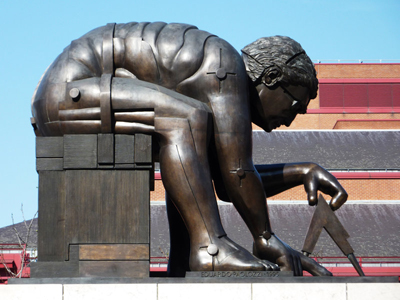
Eduardo Paolozzi’s 1995 statue of Isaac Newton which stands on the British Library’s piazza in King’s Cross has been granted a ‘voice’ as part of a new project called Talking Statues. Visitors who swipe their smartphones on a nearby tag will receive a call from the famous scientist – voiced by Simon Beale Russell – as part of the initiative which is being spear-headed by Sing London. It is one of 35 different statues across London and Manchester which will be brought to life by a range of public identities. Among the other statues in London which have been brought to life are Samuel Johnson’s cat Hodge in Gough Square (voiced by Nicholas Parsons) and Dick Whittington’s Cat in Islington (Helen Lederer), John Wilkes in Fetter Lane (Jeremy Paxman), the Unknown Soldier at Paddington Station (Patrick Stewart) and Sherlock Holmes outside Baker Street Underground (Anthony Horowitz). The British Library and Sing London are also holding a competition to give William Shakespeare a voice by writing a monologue for the statue in the library’s entrance hall which will then be read by an as yet unannounced actor. Entries close 17th October. For more, visit www.talkingstatues.co.uk.
PICTURE: British Library
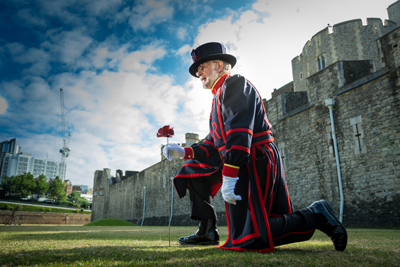
More than 800,000 ceramic poppies are being “planted” in the moat of the Tower of London to commemorate the centenary of World War I.
The work of ceramic artist Paul Cummins, Blood Swept Lands and Seas of Red will grow throughout the summer until, by Armistice Day, 888,246 ceramic poppies are ‘planted’ in the dry moat, each one representing a British or colonial military fatality during the war.
The first poppy was planted by Yeoman Warder Crawford Butler back in July (pictured) and the work was officially “unveiled” today – 100 years since the first full day of Britain’s involvement in the war.
More than 8,000 volunteers will be involved in planting the poppies which can be purchased for £25 with 10 per cent from each poppy plus all net proceeds shared equally among six service charities: the Confederation of Service Charities (COBSEO), Combat Stress, Coming Home, Help for Heroes, Royal British Legion and SSAFA (formerly the Soldiers, Sailors, Airmen and Families Association).
Starting today, the public will also be able to witness the daily twilight reading of a roll of honour featuring the names of 180 serving military killed during the World War I from Tower Hill terrace. The reading will be followed by the bugler playing the Last Post. Members of the public can nominate a name for the roll of honour.
For more, see poppies.hrp.org.uk. PICTURE: Photo: © Richard Lea-Hair/Historical Royal Palaces
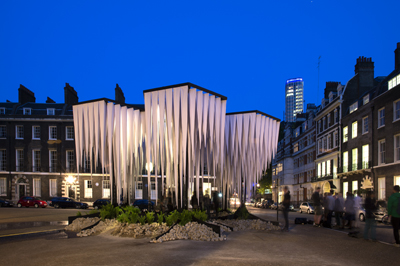
Rainforest by GUN Architects, located in Bedford Square in Bloomsbury outside the offices of the Architectural Association, has been one of the highlights of the London Festival of Architecture, now into its final week. The five metre high tree-like structures, created by the German-Chilean architectural practice, feature fabric stalactites which drip water into pools below. As well as installations like Rainforest, the festival features debates, exhibitions, film screenings, walks, cycle rides, open studios and family events which focus on the importance of architecture and design under this year’s central theme of ‘capital’. The festival runs until 30th June. For more details and a full programme of events still to run, see www.londonfestivalofarchitecture.org.
PICTURE: © Valerie Bennett

Crowds lined the banks of The Thames last weekend as Her Majesty’s Watermen rowed from Hampton Court Palace to the Tower of London in the annual “Tudor Pull”. The palace-to-palace rowing event on Sunday kicked off around 10am with a ceremony at Hampton Court during which the ‘Stela’ – an ancient piece of medieval water pipe made from a hollowed-out tree trunk which symbolises the power of The Thames – is passed to the watermen who then took it up river to the Tower in the royal barge Gloriana. The barge, which was accompanied by a fleet of other traditional rowing craft, stopped at several locations along the journey, before it arrived at the Tower in Sunday afternoon where the ‘Stela’ was presented to the Governor. The event is also said to commemorate the sinking in 1256 of Queen Eleanor’s royal barge under old London Bridge. For more on the Historic Royal Palaces in London, head to www.hrp.org.uk.
PICTURE: Courtesy of Historic Royal Palaces.
Our new special series will kick off next week!
 Angular rooftops stacked one upon the other in Chelsea in London’s west.
 The Brompton Road tube station, which closed in 1934 after being made redundant following the opening of other stations, sold for a reported £53 million over the weekend. The former Piccadilly Line station, located between South Kensington and Knightsbridge stations, opened in 1906 and was designed by architect Leslie Green for the Great Northern, Piccadilly and Brompton Railway. It was used as a command centre for anti-aircraft guns during World War II and the story goes was where Nazi Rudolf Hess was interrogated after being captured in 1941. Owned up until the sale by the Ministry of Defence, it was most recently used as a training centre for air cadets and naval reservists. It will reportedly be converted into residential flats.
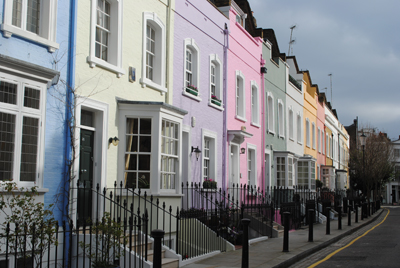
Colourful terraced homes located in Bywater Street, a pretty cul-de-sac just off King’s Road, in Chelsea. Incidentally, number 9, was the fictional home of spy George Smiley in John le Carré’s Tinker Tailor Soldier Spy. Number 10 as used as the home in the BBC TV series of the same name dating from 1979.
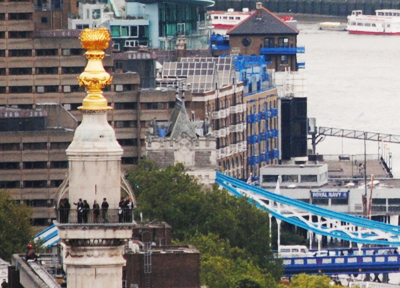
View of the top of the Monument from the top of St Paul’s Cathedral. For more on the history of The Monument, see our earlier post here.
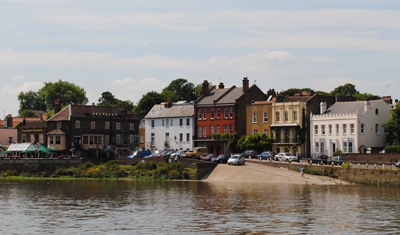
The riverside community of Old Isleworth on the bank of the River Thames in London’s west (as taken from the opposite bank). In the left of the frame is the London Apprentice pub (see our earlier story on it here). We’ll resume our special series – 10 (more) curious London memorials – next week.
 Exploring London
