What’s in a name?…Old Street…

The name of this mile-long street is fairy self-explanatory – lying on the route of an old Roman, or possibly even pre-Roman, route, it was part of an “old” road which ran from London to the north of England.
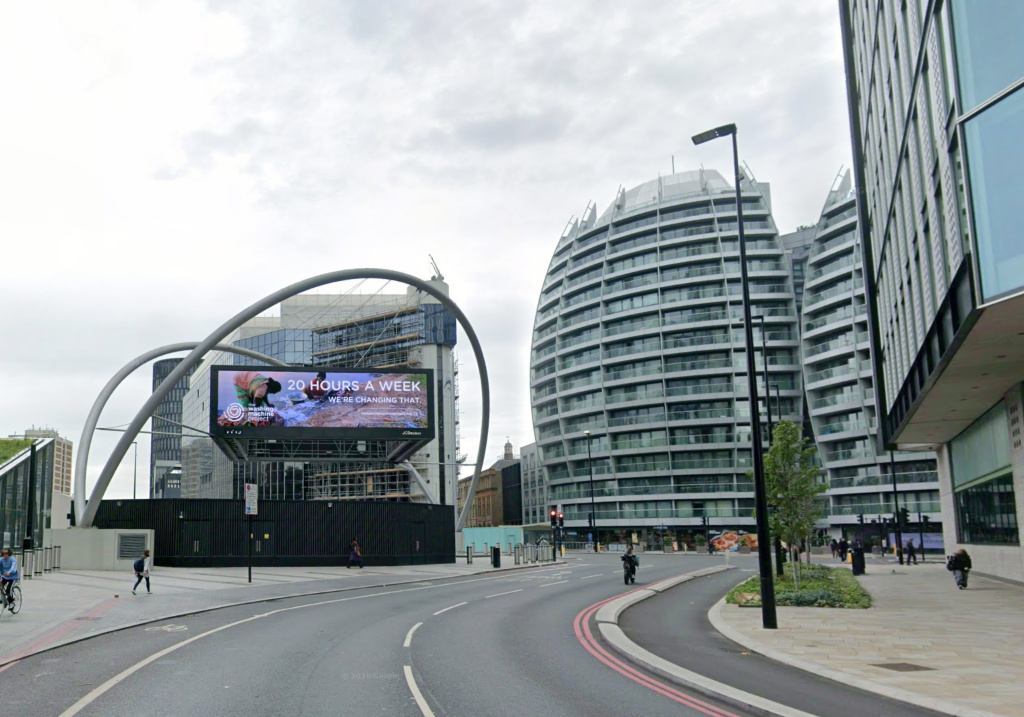
Looking east on Old Street towards the Old Street Roundabout in September, 2025. PICTURE: Courtesy of Google Maps.

The street now runs north-east from Goswell Road (it becomes Clerkenwell Road to the west) to Shoreditch High Street. It was apparently first recorded as Ealdestrate as far back as 1200.

Landmarks on the street include St Luke’s Church, built in 1727-33 and designed by John James and Nicholas Hawksmoor in their role as the Surveyors for the Commissioners for Building Fifty New Churches. It was converted for use of the London Symphony Orchestra in 2003 and now houses the galleried auditorium Jerwood Hall.

Shoreditch Town Hall, which originally dates from the 1860s and sits at the eastern end of the street, was the site of the inquest into the murder of Mary Kelly, the last victim of Jack the Ripper, in 1888. By the mid 20th century it was being used to host boxing matches and is now an arts, events and community space.

A Tube station bears the street’s name. It opened in 1901 and was rebuilt in 1925.

The Old Street Roundabout, at the junction with City Road (and with no actual roundabout any longer; it was removed in the early 2020s), is known as ‘Silicon Roundabout’ thanks to the area being known for technology industry start-ups.

A shopping complex under the roundabout is named after St Agnes Well, an ancient well believed to have been located nearby.

Old Street has also become known for its street art, including works by Banksy. Two 2004 works – depicting a rat and a TV being thrown out a window – are preserved on the exterior of the art’otel London Hoxton.
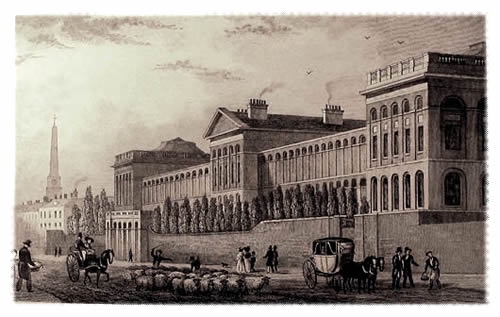
Lost London – St Luke’s Hospital for Lunatics, Old Street…

A monumental-sized building on Old Street in the City of London, St Luke’s Hospital for Lunatics was founded in 1751 to treat the poor who suffered from mental illnesses.

The new hospital – which was built partly through concerns about abuses patients suffered at the more famous Royal Bethlehem Hospital (Bedlam) – was initially located on a site in Moorfields which had been formerly occupied by a foundry. But in 1786 it moved to the purpose-built palatial premises in Old Street where it remained until 1916.

The new building, which was designed by George Dance after an competition for its design apparently failed to find a suitable candidate, had a 150 metre long street frontage with a central entrance and male wards on one side and female wards on the other.

The building contained some 300 individual cells – each had a small window, but no heating. There were gardens located behind it and in the basement were cold water baths used to treat patients.

The hospital building was enlarged in the 1840s when infirmaries and a chapel were added.

By the 1860s, the hospital appears to have abandoned its target market of the poor – the 150 or so patients were then described as being of “middle class”.

In 1916, the patients were transferred to other institutions – the charity running the hospital set up a ward in Middlesex Hospital – or sent home and the buildings were acquired by the Bank of England.

The premises was used to print banknotes until the 1950s and the building, which had been damaged during World War I, was eventually demolished in 1963.

The archive of St Luke’s have been digitised and are held by the Wellcome Library.