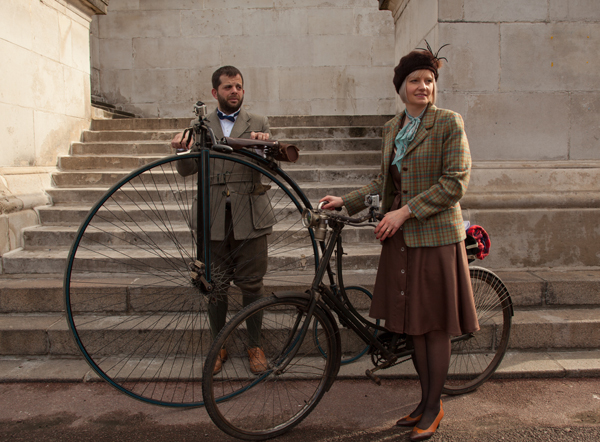
 The Tweed Run London celebrated its fifth anniversary last Saturday with more than 500 taking part in the rather unusual annual event in which participants combine their passion for British fashion with their love for cycling. Among those taking part (entry was via a lottery system) on bikes of all shapes and sizes were people from as far afield as The Netherlands, Korea, Russia, Australia, Japan and even Afghanistan. The two hour ride took in Marylebone High Street, Savile Row, Regent Street, Piccadilly Circus and the Houses of Parliament before finishing at Trafalgar Square. The ride has been copied by other cities around the world including, Tokyo, Toronto and St Petersburg. For more on the Tweed Run, see www.tweedrun.com. PICTURE: Selim Korycki, Tweed Run LLP.
Regent Street
Famous Londoners – John Nash…
Arguably the greatest architect of Regency London, John Nash’s imprint can still be seen in numerous sites around the city, from the master-planning of Regent’s Park and Regent Street to the beautiful buildings of All Soul’s Church in Langham Place and Marble Arch on the edge of Hyde Park.
Born the son of a Welsh millwright in Lambeth, London, on 18th January, 1752, Nash – who went on to work in a range of different architectural styles – trained as a draughtsman under the tutelage of architect Sir Robert Taylor and in 1777 established his own business as a builder and surveyor.
 But he certainly didn’t meet with immediate success and, following failure as a building speculator (he built properties in Bloomsbury Square and Great Russell Street but failed to make enough money from the venture – there’s a blue plaque on one of the houses, which he lived in, at 66 Great Russell Street), was declared bankrupt in 1783.
Meanwhile, his personal life was also in turmoil during these years – in 1775 he had married, Jane Kerr, the daughter of a Surrey surgeon, but separated from her in the early 1780s after various troubles including her eventually apparently having a child with a Welshman named Charles Charles, who is said to have died in prison after he was jailed for adultery.
Brought down by his misfortune, in the mid 1780s Nash moved to Carmarthen in Wales where he had family. Taking up work here, by the late 1780s he was designing prisons – the first was at Carmarthen – and worked on a number of other prominent buildings including St David’s Cathedral and various country houses.
Rising to prominence in Carmarthen society, by 1797, however, Nash was again working in London, initially in partnership with the renowned landscape architect Humphrey Repton with whom he had formed a business relationship some years earlier (although the partnership had soured over finances by 1800).
He built a substantial home at 29 Dover Street in Mayfair and in 1798, his first wife presumably dead, he married his second wife, Mary Anne Bradley, and soon started work on building a Gothic-inspired residence for them, known as East Cowes Castle, on the Isle of Wight. It was completed in 1802 but enlarged some years later.
Nash designed numerous country properties in the early 19th century, inspired by everything from castles to Italianate architecture, both in England and Ireland and soon came to the attention of the Prince Regent, the future King George IV (there was a rumour his wife was one of the prince’s discarded mistresses).
In 1806 he was officially made Deputy Surveyor General in the Office of Woods and Forests – the office which managed the Crown estate, and from 1815 on, he largely worked for the prince alone. Among the major London commissions from his royal patron were the design of Regent Street (he and his wife moved into number 14 in 1823) and the development of Regent’s Park on land formerly known as Marylebone Park and surrounding housing estates (for more on The Regent’s Park, see our earlier entry here). He also redeveloped St James’s Park.
In 1815, he was commissioned to develop the Prince Regent’s Marine Pavilion in Brighton and by 1822 had transformed the building into the spectacular Royal Pavilion which can be visited there today.
Nash was also involved in the development of The Regent’s Canal – which linked the Grand Union Canal in London’s west to the River Thames in London’s east and was completed in 1820 – and built many of the grand villas which still line it (for more on Regent’s Canal, see our earlier entry here).
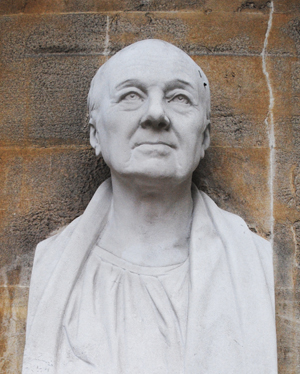
Becoming an official architect to the Office of Works in 1813 (an appointment which only ended in 1832, three years before his death), Nash went on to design churches – including All Soul’s in Langham Place (he’s depicted above in a bust at the church) – as well as West End theatres including the Haymarket Theatre and the Royal Opera House (which burnt down in 1867) as well as the adjacent Royal Opera Arcade and residences including Carlton House Terrace and Clarence House (for more on this, see our earlier entry here).
Other major commissions included the redevelopment of Buckingham Palace (parts of the current building are his work but the main facade isn’t – for more on the palace history, see our earlier entry here) and the Royal Mews, and the creation of Marble Arch, originally envisaged as the main gateway to the palace (see our earlier entry here). Nash also designed a conservatory for Kew Gardens.
Nash’s close relationship with the Prince Regent (who become King George IV on 29th January, 1820), meant that when the king died in 1830, he found himself on the outer (and his reputation took many years to recover thanks to his association with the unpopular king). With no knighthood forthcoming for his efforts (unlike many of his contemporaries) and the chance of further work unlikely (his work on Buckingham Palace had been left unfinished due to concerns over rising costs), Nash retired to his house on the Isle of Wight.
He died there on 13th May, 1835, and was buried in the churchyard at St James’s Church in East Cowes. He was survived by his wife who, having settled his debts, retired to Hampstead.
For an in-depth study of Nash, try Geoffrey Tyack’s book, John Nash: Architect of the Picturesque
Around London – Crown Jewels polished for Diamond Jubilee; Diana’s dresses at Kensington Palace; a plaque for Ziggy Stardust; and At Home with the World…
• A revamped Crown Jewels display opens today at the Tower of London to mark the Diamond Jubilee of Queen Elizabeth II. The new display features graphics, music and newly restored film footage and will focus on the coronation ceremony as its central theme, exploring how the regalia are used in the ceremony. The regalia – which includes some of the most extraordinary diamonds in the world such as the Star of Africa and Koh-i-Nur – is being displayed in the order in which it is used at the coronation ceremony. The Crown Jewels have been on show to the public at the Tower of London since at least 1661 after they were remade for King Charles II’s coronation. The previous collection had been largely destroyed in the Civil War although some pieces survived including a gilt silver spoon probably made for King Henry II or King Richard I (the “Lionheart”). For more information, see www.hrp.org.uk/TowerOfLondon/.
• Five dresses worn by Diana, Princess of Wales, have gone on display at Kensington Palace which re-opened to the public this week following a £12 million overhaul. The five dresses include a black silk taffeta gown (designed by Emanuel) which Diana wore to a fundraising event at the Goldsmith’s Hall in 1981 – her first official engagement with Prince Charles as well as a formal dinner dress of ivory silk (Catherine Walker) created for a State Banquet for the King and Queen of Malaysia in 1993 and a black ribbed silk shift evening dress (Gianni Versace) worn to the London premiere of Apollo 13 in Hammersmith in 1995. For more on the revamp of the palace see our earlier post. Or visit www.hrp.org.uk/KensingtonPalace/.
• A plaque commemorating the site where the iconic image for the cover of David Bowie’s 1972 album The Rise and Fall of Ziggy Stardust and the Spiders of Mars was photographed has been unveiled in the West End. The plaque at the somewhat innocuous site at 23 Heddon Street, just off Regent Street, was installed by the Crown Estate and unveiled this week by Gary Kemp of Spandau Ballet. The image for the album cover was shot by the late photographer Brian Ward who managed to persuade Bowie to step outside the ‘studio’ space he had rented upstairs despite the fact it was a cold, wet January night.
• On Now: At Home with the World. This exhibition at the Geoffrye Museum explores the cosmopolitan nature of London’s homes over the past 400 years and looks at how diverse cultures have helped shaped the homes – covering everything from Chinese porcelain and the tea craze of the 1700s to the use of Islamic and Indian patterns in the 1800s, the popularity of Scandinavian and American design in the 1900s and the globalism of today. The period rooms on show at the museum have been reinterpreted to highlight the international influences. This is one of a series of Stories of the World: London exhibitions taking place across the city which are exploring four aspects of life – home, identity, journeys and place – as part of the London 2012 Cultural Olympiad program. Runs until 9th September. Entry is free. For more, see www.geffrye-museum.org.uk.
LondonLife: Those Christmas Lights (part two)…
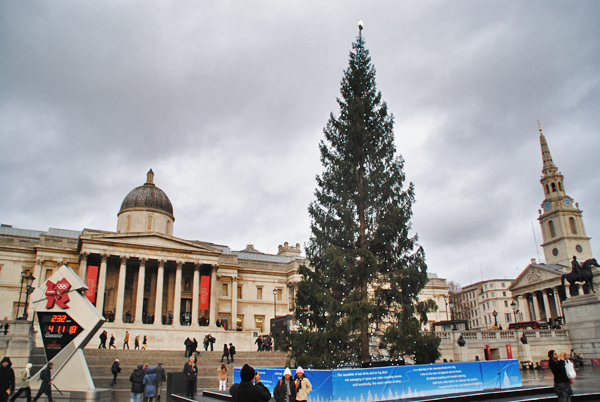
The Trafalgar Square Christmas Tree – donated by the people of Oslo each year since 1947 as a thanks for the support Britain gave to Norway during World War II. On the left is the Olympic countdown clock.

A giant hedge-like reindeer outside Covent Garden, a market since at least the 1600s but once the site of a large kitchen garden for the monks of the Convent of St Peter, Westminster (see our earlier post for more).
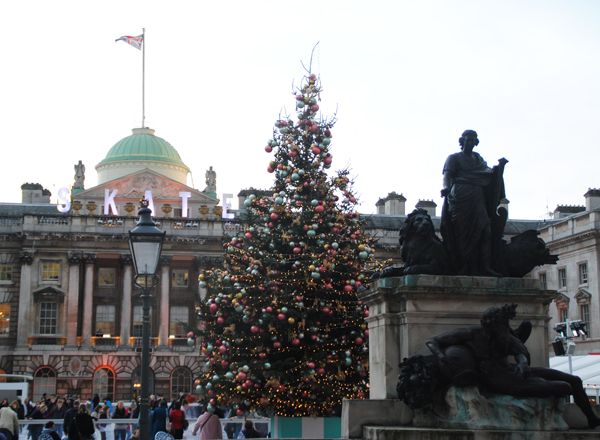
Christmas tree near the ice-skating rink at Somerset House, now an arts and cultural centre but originally built on the site of a Tudor palace in the late 1770s as a home for three “learned societies” – the Royal Academy of Arts, the Royal Society, and the Society of Antiquaries – as well as government offices (including the Navy Board).
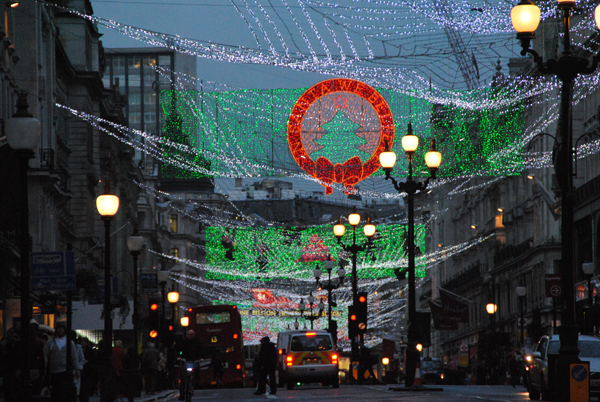
Christmas lights in Regent Street, one of the city’s premier shopping streets, in the West End. It’s current shape was designed by architect John Nash in the early 19th century.
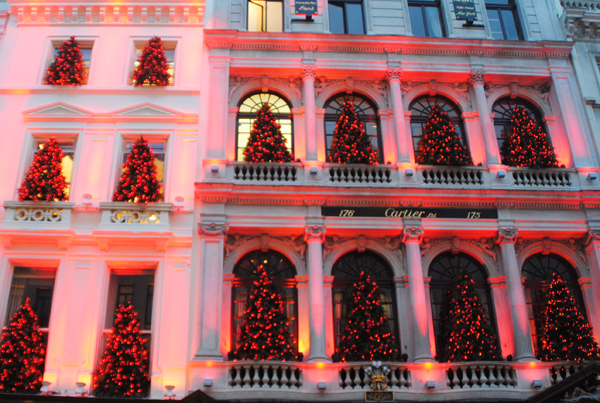
Christmas decorations on the exterior of Cartier in Old Bond Street, Mayfair. The area takes its name from the May Fair once held there and is now one of the most expensive areas within London (see our earlier post for more).
Looking for a book about London? See The Exploring London Little List of Books for Christmas…
The Royal Parks – 5. The Regent’s Park
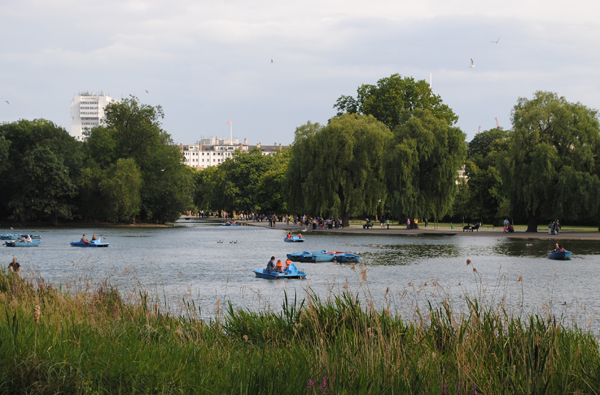 A former hunting chase, The Regent’s Park in London’s north-west was extensively developed in the 19th century and remains a good – if not complete – example of a Regency landscape.
As with many of London’s Royal Parks, Regent’s Park (it’s formal name is actually The Regent’s Park but we’ll shorten it for our purposes here) once served as King Henry VIII’s hunting grounds – he seized the park, then known as Marylebone Park Fields after the nearby village and boasting thick woods as well as more open forests, from the Abbey of Barking in 1538.
Used by royalty for the next 50 years, it remained largely unaltered until after the Civil War when, between 1649 and 1660, the Commonwealth ordered many of the trees to be chopped down to pay debts. It was restored to royal ownership with the restoration of the monarchy but, with hunting falling out of fashion, was then leased out to tenant farmers.
It was John Nash who created the park that we know and love today. Friend of the Prince Regent (later King George IV), he was among a number of architects who responded to the Prince Regent’s calls for the creation of a new design featuring a palace for himself.
Nash’s original designs included a round park featuring a lake and canal and surrounded by as many as 56 villas and a palatial summer home for the Prince Regent which would be linked to his other home at St James’s by a processional road.
But only eight of the villas were ever built and only two of them – St John’s Lodge and The Holme – remain (both are private residences but part of the lodge’s gardens are open to the public) while the plans for the Prince Regent’s palace were put on hold when he turned his attention to developing Buckingham Palace instead. The canal, meanwhile, was moved to the park’s northern boundary where it still stands today (see our earlier entry on Regent’s Canal) while the processional route Nash had proposed became Regent Street.
While the park was initially only for the exclusive use of residents and what Royal Park’s call the ‘carriage set’, in 1835, the eastern part of the park was opened to the public for two days a week. Other sections of what is now included in the park, including Primrose Hill, were opened later.
Meanwhile, the fact most of the villas had never been built had left a large amount of free space and so both the Zoological Society and the Royal Botanic Society moved in – the latter laying out what is the Inner Circle with lawns and a lake of its own. Another society to operate in the park was the Royal Toxophilite Society which introduced archery there.
Not much has changed since but for the creation of Queen Mary’s Gardens in the 1930s – these were laid out on the space formally occupied by the Royal Botanic Society which had decided not to renew its lease. The Open Air Theatre performances, which are still held in the gardens today, started at about the same time. The park was damaged by bombing during World War II but has been fully restored.
Other facilities now in the 166 hectare (410 acre) park include a sports facility known as The Hub as well as several cafes, tennis courts and boat hire. The London Zoo, of course, also remains there.
WHERE: The Regent’s Park (nearest tube station is Regent’s Park); WHEN: 5am to at least 4pm (closing times vary depending on the month); COST: Free entry; WEBSITE: www.royalparks.gov.uk/The-Regents-Park.aspx
Around London – London celebrates on the Thames; a fashionable night in London; and, heritage trains in Amersham…
• London will this weekend celebrate the 15th annual Thames Festival, billed as the city’s “largest free festival”. The two day event includes a giant shipwreck sculpture outside City Hall (created with the aid of students from 100 London schools), barge races and a parade of more than 100 boats on the Thames, a wide array of musical and street performances (these include a mass choir of 700 school children and a performance in which the HMS Belfast is used as a percussion instrument) and an illuminated Night Carnival culminating in fireworks. More than 800,000 people are expected to attend the event which takes place at a range of venues stretching from the London Eye to Tower Bridge. Other highlights include the annual Feast on the Bridge on Saturday during which Southwark Bridge will be closed to traffic, Korean Taekwondo displays, a food market and an exclusive cruise on the Thames hosted by the likes of historian David Starkey and the creators of cult children’s character Rastamouse. River boat operators, meanwhile, are offering 2-for-1 tickets for the weekend to help people make the most of the festival. For more information on the festival, see www.thamesfestival.org. For more on the 2 for 1 tickets, see www.tfl.gov.uk/river.
• Regent Street and surrounds will be buzzing tonight with more than 40 shops, bars and restaurants taking part in Vogue Fashion’s Night Out. The event, which is running for its third year in London, will see many stores remaining opening until 11pm and feature special events and promotions. The night is part of a series of nights being held in countries across the globe – from Russia to Brazil, Australia to Spain. For more information, see http://fashions-night-out.vogue.co.uk.
• An art deco Tube train dating from 1938 and the Sarah Siddons, the last operational ex-Metropolitan Railway electric locomotive will be running between Harrow-on-the-Hill, Rickmansworth and Amersham this Sunday as part of the Amersham Old Town’s Heritage Day. Other activities include a best dressed competition showcasing retro fashions, a free heritage bus service, including rides on the Routemaster RM1, street performances including a Punch and Judy show and clowns, and “object handling sessions” at the Amersham Museum. For more information, see the London Transport Museum’s website here.
What’s in a name?…Mayfair
Still the address to have in London, the origins of the name Mayfair are just as they appear – this area to the west of the City was named for the annual May Fair which was held at what is now the trendy (and picturesque) cafe precinct of Shepherd Market during the late 17th and early 18th centuries.
 The two week long annual fair was established by King James II as a cattle market on what was then known as Brookfield Market in the 1680s. Attracting other pleasure-related activities, it soon became known for its licentiousness and, having survived Queen Anne’s attempts to have it banned, was eventually stopped in the mid-1700s. Edward Shepherd, who today gives his name to the area on which Brookfield Market once stood, was an architect and developer who subsequently redeveloped the site.
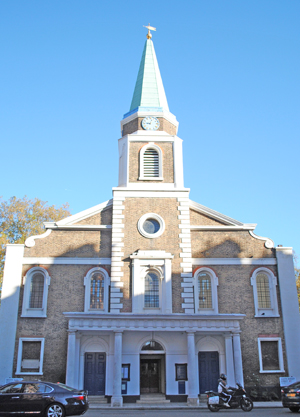
These days Mayfair is generally taken to encompass an area bordered by Hyde Park to the west, Oxford Street to the north, Piccadilly to the south and Regent Street to the east. The area’s development really took off in the century following the mid 1600s (landowners included the Grosvenor family – whose name is reflected in landmarks like London’s third largest square Grosvenor Square and Grosvenor Chapel (pictured) – as well as the Berkeleys and Burlingtons) and it became a favored residential location among the wealthy – indeed, it was this very gentrification which indirectly put an end to the fair.
Today, as well as being known for high end residential real estate, it’s one of London’s most expensive shopping precincts. Landmark buildings in the area today include the hulking bulk of the US Embassy at the western end of Grosvenor Square, the Royal Academy of Arts in Piccadilly, the Handel House Museum (located in what was the home of composer George Frideric Handel), shopping arcades such as the Burlington and Royal Arcades, and various luxury hotels like Claridge’s and The Dorchester in Park Lane.
Around London – West End’s VIP day; National Curry Week; Kenwood House to close for repairs; and Horatio’s handwriting…
• Oxford Street and Regent Street in London’s West End will be closed to cars and buses this Saturday (27th November) as part of the sixth annual West End VIP Day. The day, which is sponsored by American Express, will also bring singers, entertainers and celebrities hit the streets as they fundraise for the Starlight Children’s Foundation. Other entertainment will include a seven foot climbing wall on Regent Street, giant TV screens, fair ground style rides and the chance to climb inside a lifesize snow globe. Runs from 9am to 10pm. For more information, see www.westendlondon.com/vip.
• This week was National Curry Week, so to celebrate, we thought we’d tell you about London’s oldest curryhouse (in fact it’s said to be the oldest in the UK). Veeraswamy was founded in 1926 at its current location of 99 Regent Street (entry via Swallow Street) by, according to the restaurant’s website, “the great grandson of an English General, and an Indian princess”. Customers are said to have included Indira Gandhi, Charlie Chaplin, King Hussein of Jordan and Marlon Brando. See www.nationaleatingoutweek.com or www.veeraswamy.com.
• Kenwood House in Hampstead, north London, is set to undergo major repair and conservation works meaning the house will be closed to the public from early summer 2012 for just over a year. The grounds will remain open. The current house was designed by Robert Adam and built over the period of 1762 to 1779 for William Murray, 1st Earl of Mansfield and the Lord Chief Justice. It now houses a collection of paintings bequeathed to the nation in 1927 by Edward Cecil Guinness, 1st Earl of Iveagh, which includes works by Rembrandt, Vermeer, Gainsborough and Turner. For more information, see www.english-heritage.org.uk/daysout/properties/kenwood-house/.
• On now: Compare Horatio Nelson’s handwriting before and after he lost his right arm in battle at a special showing of two of his letters at the Wellcome Collection tomorrow night (26th November). The letters are part of Hands: Amazing Appendages, a one night only show. There will also be the chance to try out some nail art, try out some surgeon’s tools and hear talks and see performances. Admission is free (but some talks and performances will be tickets – tickets available on the night only from 7pm). See www.wellcomecollection.org/whats-on/events/hands.aspx.
What’s in a name? – Soho
The first in an occasional series looking behind some of London’s place names. To kick it off, we’re taking a look at the origins of the name of the inner metropolitan suburb of Soho.
The name was apparently taken from a hunting cry – ‘So Ho’ and is believed to have been first used to describe this area of London in the 1600s (the cry was also later used as a rallying cry by the James Scott, the Duke of Monmouth’s men when he tried to overthrow James II at the Battle of Sedgemoor in 1685).
The area was used as grazing lands before becoming part of Henry VIII’s hunting grounds and then in the later 1600s started to undergo development, becoming known as a refuge for immigrants from Greece and France (the French Protestant Church on Soho Square is indicative of the diverse population who have lived there).
It later morphed into a somewhat seedy and bohemian entertainment district and became home to some big name writers, artists, intellectuals and musicians. Over the years, famous residents have included everyone from Karl Marx to poet William Blake.
These days, while elements of entertainment industry remain – in particular the film industry as well as some seedier establishments – the area, bordered by Oxford and Regent Streets, Charing Cross Road and Piccadilly Circus to the south, is also home to large numbers of trendy cafes, pubs and restaurants and still boasts a healthy nightlife.
 Exploring London