Located close to the River Thames, Richmond Lodge was a royal hunting lodge before becoming a favoured residence for Hanoverian royals for several decades in the 18th century.
River Thames
LondonLife – City lights…
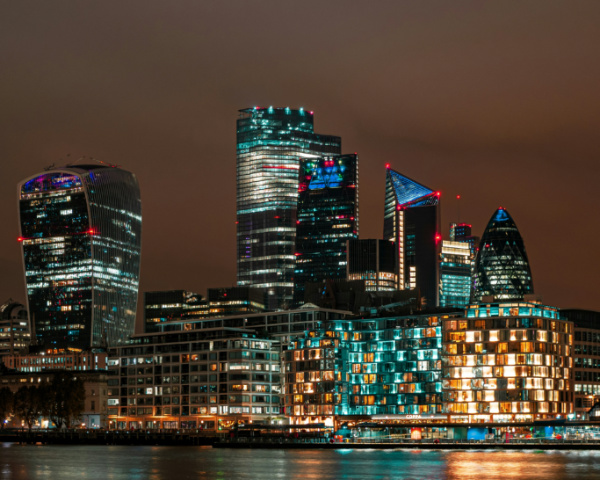
LondonLife – View from the river…
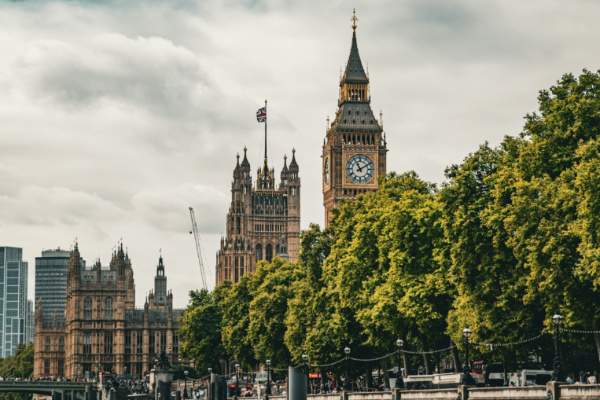
Looking south towards the Houses of Parliament from the River Thames.
LondonLife – Chelsea bridge…
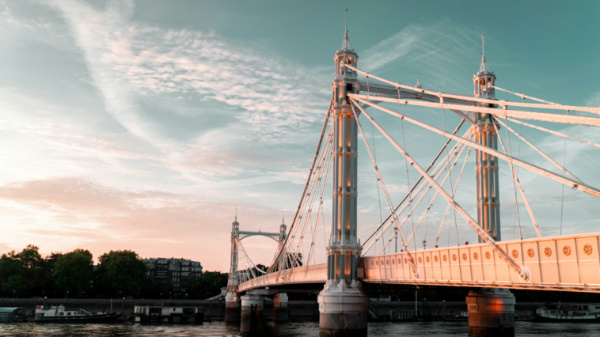
The Albert Bridge in Chelsea which dates from 1873 with subsequent modifications made in the 1880s.
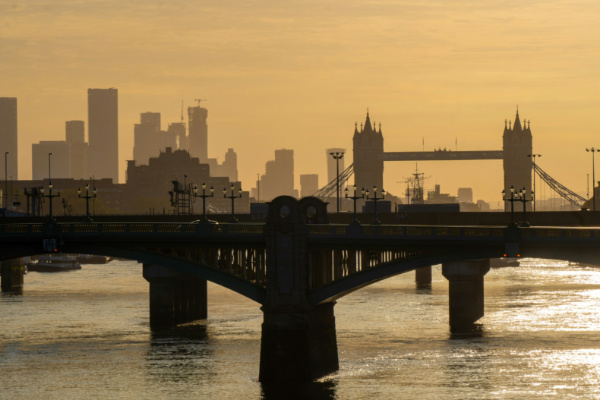
LondonLife – Crossings…
Lost London – Nonsuch House, London Bridge…
Once located at the southern end of London Bridge, Nonsuch House is the earliest documented prefabricated building.
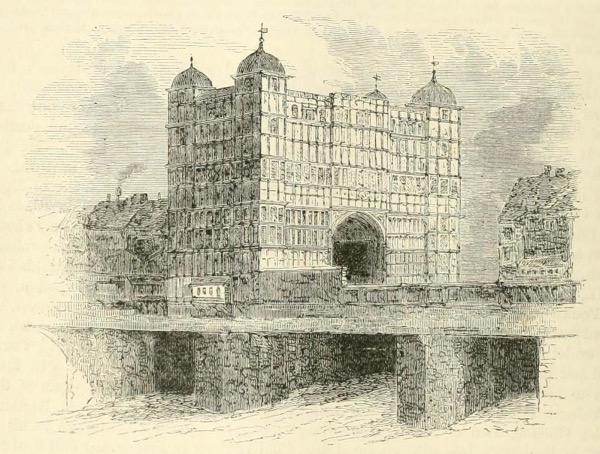
Originally constructed in what is now The Netherlands, it was shipped to London in pieces – each individually marked – in 1578 with the reassembly completed the following year.
The four storey building, which was said to have been constructed using wooden pegs and no nails, featured an arched tunnel through the middle through which bridge traffic would pass.
The main facade faced toward Southwark and there were towers at each of the four corners, topped with onion domes. The east and west sides of the building, which protruded beyond the bridge out over the Thames were elaborately carved.
The northern facade of the building abutted other properties while the southern side had a clear space in front over which a drawbridge is believed to have been located (it could be raised to allow larger ships through).
The name may have referenced King Henry VIII’s Nonsuch Palace, located near Ewell in Surrey, and was said to refer to the fact there was no such building as splendid.
The property was demolished along with the other buildings on the bridge in about 1757.
LondonLife – Westminster traffic…

This Week in London – Bartholomew Fair revival; ‘Totally Thames’; ‘Black on the Square’; and, Art of London’s third season…
• A recreation of Bartholomew Fair featuring more than 30 free events kicks off in the City of London today. The programme kicks off with RESURGAM, a vertical dance performance on St Paul’s Cathedral with other highlights including immersive theatrical circus performance Dinner for All, Follow Me Into by imitating the dog – a series of projections that weaves through the City, and, Carnesky’s Showwomxn Spectacular, a street show featuring a cast of circus, variety and rare skilled women performers. There’s also al fresco dining at locations across the City of London and creative workshops on Saturdays. The Bartholomew fair, which ran from the 12th century until 1855, started as a cloth market but evolved to become the City’s pre-eminent event, attracting people from across the country and beyond. The revival runs until 16th September. For the full programme of events, see www.thecityofldn.com/bartholomew-fair/

• Totally Thames, London’s month-long celebration of its river kicks off on Friday. Events this year include an exhibition at London Bridge Station celebrating London’s bridges by photographer Henry Reichhold and another looking at medieval artefacts recovered by mudlarks at St Paul’s Cathedral, walks exploring the history of everywhere from Rotherhithe to Twickenham and the Royal Docks (as a well as a walk on which you’ll meet six medieval women in Southwark), ‘Wren by River’ – a tour on Uber Boat By Clippers Thames featuring an introduction to Wren’s London legacy from the perspective of the river (be quick, this takes place on 1st September), and art installations including the Saltley Geyser, a 30 metre high plume of water in the Royal Docks created by David Cotterrell. And, of course, the St Katharine Docks Class Boat Festival on the weekend of 9th and 10th September and the The Great River Race on 16th September. For the full programme of events, see https://thamesfestivaltrust.org.
• Black on the Square, a new “showcase of Black culture and creativity”, takes place in Trafalgar Square this Saturday. The one day family-friendly festival will feature art, fashion and musical performances including jazz, spoken word, freestyle rap and soul as well as DJ sets from the likes of Touching Bass, Art Beyond the Shell, MOBO Unsung, Shortee Blitz, BXKS, The Spit Game UK. There will also be vendors representing a range of Black-owned businesses, including Caribbean and African food, as well as artisan goods ranging from customised accessories to handmade homeware and gifts. The festival kicks off at noon and runs until 6pm. For more, see https://www.london.gov.uk/events/black-square-2023.
• Art of London has launched its third annual season featuring everything from gallery late openings to photography exhibitions and public art displays. Events, which run though until October, include: ‘Art Reframed’ which, developed in partnership with the recently reopened National Portrait Gallery, showcases the gallery’s most iconic portraits of everyone from Olivia Colman to Elton John and William Shakespeare on 52 giant colourful cubes across Coventry Street and Irving Street; photographs by artist Ray Burmiston showcased on the Piccadilly Lights; and, ‘Art After Dark’ in which galleries across the West End open their doors for late night viewings. For the full programme, head to artoflondon.co.uk/seasons/season.
Send all items to exploringlondon@gmail.com
London Explained – The Pool of London…
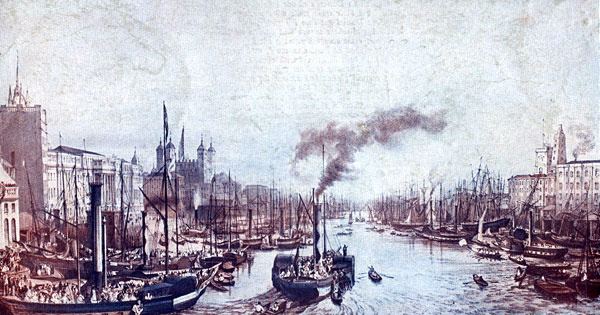
A stretch of the River Thames which spans the area from London Bridge to below Limehouse, the Pool of London was the highest part of the river navigable by tall-masted ships (thanks to the them not being able to pass under London Bridge).
The term originally referred to the stretch of the river at Billingsgate in the City of London which was where all imports had to be delivered for inspection by customs officers (hence these wharves were given the name ‘legal quays’).
But as trade expanded and reached its peak in the 18th and 19th centuries, so too did the stretch referred to as the “Pool of London”. It came to be divided into two sections – the Upper Pool, which stretches from London Bridge to Cherry Garden Pier in Bermondsey (and is bisected by Tower Bridge), and the Lower Pool, which stretched from the latter pier to Limekiln Creek.
The Upper Pool’s north bank includes the Tower of London, the old Billingsgate Market and the entrance to St Katharine’s Dock while the south bank features Hay’s Wharf and the HMS Belfast. The Lower Pool’s north bank includes the entrance to Limehouse Cut as well as Regent’s Canal and Execution Docks while below it runs the Thames and Rotherhithe Tunnels.
LondonLife – View across the Thames…
10 historic vessels in London’s Thames…9. PS ‘Waverley’…
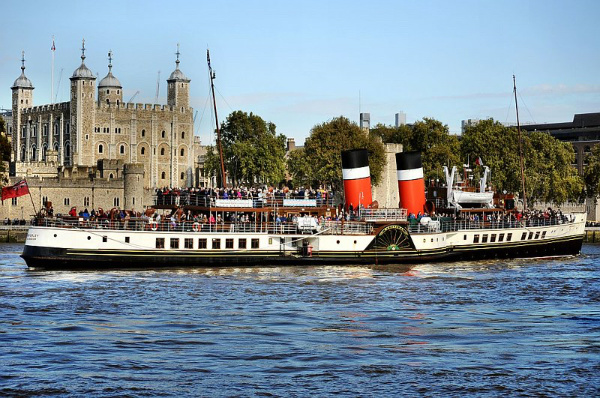
A visitor rather than a permanent resident in London’s Thames, the Waverley is described as the world’s last seagoing paddle steamer.
The Waverley, which returns to London on 22nd September for a short season lasting into early October, was the last paddle steamer to be built for use on the River Clyde in Scotland and launched on 2nd October, 1946.
Named after Sir Walter Scott’s famous novel, her maiden voyage – on 16th June the following year – saw the Waverley cruise along what was to be her primary route for the next few years up Loch Long and Loch Goil to the villages of Lochgoilhead and Arrochar.
In 1952, the Waverley joined the British Railways Caledonian Steam Packet Co Clyde coast fleet, a role she remained until the company’s end in 1972. Briefly subsequently part of Caledonian MacBrayne’s fleet offering Clyde cruises and ferry duties, she was withdrawn from service in September, 1973, and in November the following year was “sold” for £1 to the Waverley Steam Navigation Co Ltd, which had been formed by the Paddle Steamer Preservation Society.
Following restoration work, the Waverley made her first visit south of the Scottish border to Liverpool and North Wales to celebrate the centenary of Llandudno Pier. Further visits south followed and in April, 1978, she sailed along the Thames for the first time.
From 1981 to 1983, the Waverley completed an annual circumnavigation of Great Britain and in 1985 visited the Isle of Man and Ireland for the first time.
A substantial refit and rebuild took place in the early 2000s returning the ship to her original 1947 livery, and in 2019 she was withdrawn from service so new boilers could be installed before being returned to service in 2020, offering excursions around the coast.
During its London season, the Waverley departs from Tower Pier and travels under Tower Bridge.
For the Waverley‘s timetable and booking information, head to https://waverleyexcursions.co.uk.
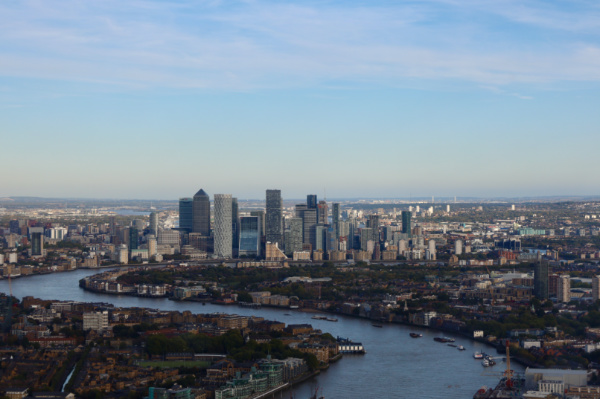
LondonLife – Winding river…
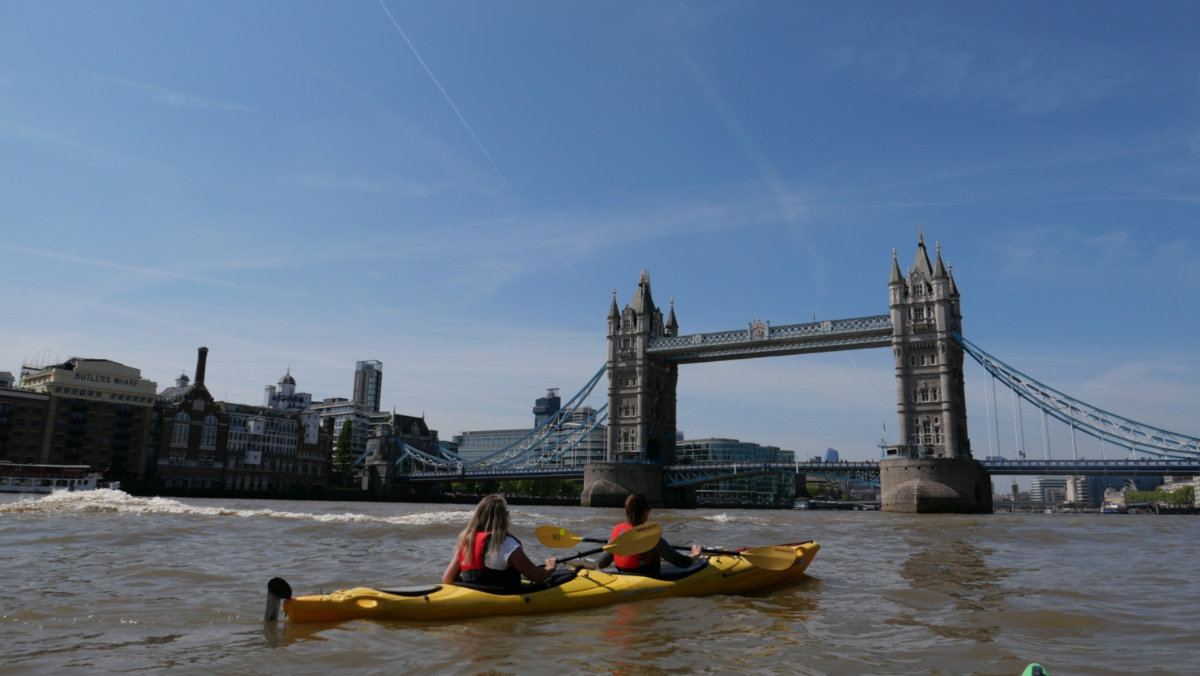
LondonLife – Thames paddling…
10 historic vessels in London’s Thames…5. ‘Cutty Sark’…
Almost destroyed in a May, 2007, fire, the Cutty Sark, the world’s last surviving 19th century tea clipper, is now a major international tourist attraction (although no longer in the Thames but on a dry dock beside the river).
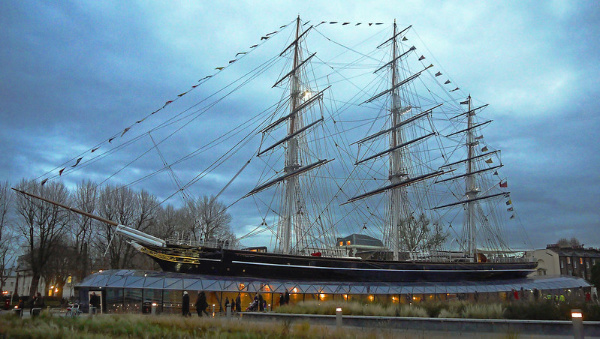
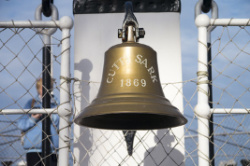
The Cutty Sark was built in Dumbarton, Scotland, in 1869, for shipping company Willis & Sons.
Designed by Hercules Linton specifically for the China tea trade (meaning with speed in mind), she cost some £16,150 and featured some 32,000 square feet of sails, a staggering 11 miles of rigging with a main mast standing 153 feet high and a hull sheathed in a copper and zinc alloy to prevent damage.
Her name was taken from a Robert Burns poem, Tam o’ Shanter, in which a witch is given the nick-name Cutty-sark because of the short undergarment – in 18th century Scots, a “cutty-sark” or “little shirt” – that she wore (the vessel’s figurehead is a representation of the witch).
On her maiden voyage, the Cutty Sark departed from London on 15th February, 1870, bound for Shanghai and carrying a general cargo including wine, spirits and beer and manufactured goods. Reaching its destination on 31st May, it then returned to London, arriving on 13th October laden with 1,305,812 lbs of tea.
It subsequently made another seven trips to China, collecting its last tea cargo in 1877. Unable to source further tea cargoes, the ship was then used to transport different cargoes to various destinations around the world including everything from coal and gunpowder, to jute, whiskey and buffalo horns.
There was a tragic episode aboard the ship in 1880 when the First Mate Sidney Smith killed seaman John Francis. Smith was confined by Captain James Wallace then helped him escape at Anger in Indonesia. The crew refused to work as a result and Wallace decided to continue the voyage with just six apprentices and four tradesmen but when the ship was becalmed in the Java Sea for three days, he committed suicide by jumping overboard. Wallaces was replaced by William Bruce but a later inquiry suspended him from service because of his incompetence.
While it was never the fastest ship on the tea trade (although it came close on return journey from Shanghai before a rudder mishap in 1872), it did establish itself between the mid-1880s and early 1890s as the fastest ship in the wool trade.
But with steamships starting to dominate the wool trade, in 1895, the Cutty Sark was sold to Portuguese firm J Ferreira & Co and, renamed the Ferreira, spent the next 20 years transporting cargoes between ports including Oporto, Rio, New Orleans and Lisbon.
Damaged during a storm in 1916, the clipper was subsequently converted into a barquentine in Cape Town, South Africa, and then sold in 1920 to Wilfred Dowman, a retired windjammer skipper and owner of the training ship Lady of Avenel.
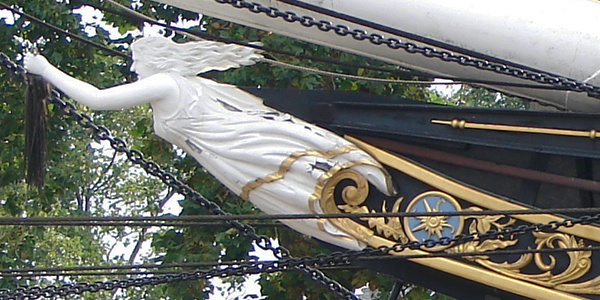
Her former name now restored, Dowman set about restoring the ship – now docked at Falmouth in Cornwell – back to being a tea clipper and using her as a cadet training ship.
Following Dowman’s death in 1936, the Cutty Sark was given to the Incorporated Thames Nautical Training College, Greenhithe, Kent, where she was used as an auxiliary vessel for the cadet training ship HMS Worcester.
The Cutty Sark was sent to London and moored in the Thames for the 1951 Festival of Britain before returning to Greenhithe.
The deteriorating state of the ship led to the formation of The Cutty Sark Society and in a ceremony held just before the coronation of Queen Elizabeth II, Prince Philip, patron of the society, took possession of the ship on its behalf.
In December, 1954, the ship was towed to a specially constructed dry dock at Greenwich and after three years of restoration work was opened to the public by Queen Elizabeth II in 1957.
The ship has remained there ever since. In November 2006, the ship’s rig was dismantled in preparation for a restoration project but a fire broke out aboard the ship on 21st May, 2007, and almost destroyed it.
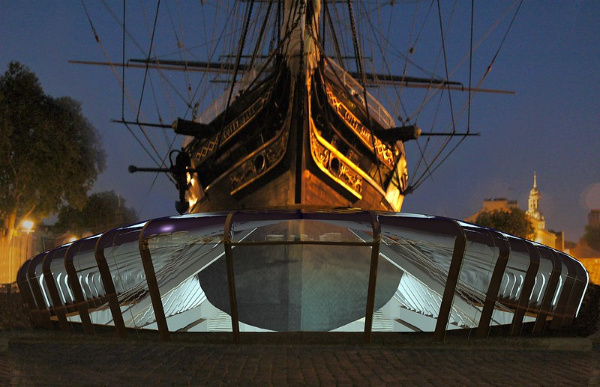
Following a major restoration and development project which saw the lower part of the ship, from the waterline down, encased in glass, it was officially reopened by Queen Elizabeth II and Prince Philip on 25th April, 2012. It is now under the operational management of Royal Museums Greenwich.
WHERE: The Cutty Sark, King William Walk, Greenwich (nearest DLR is Cutty Sark; nearest overground stations are Greenwich and Maze Hill); WHEN: Daily 10am to 5pm; COST: £18 adults; £9 children; WEBSITE: www.rmg.co.uk/cuttysark.
LondonLife – On the Thames shore…
10 historic vessels in London’s Thames…3. SS Robin…
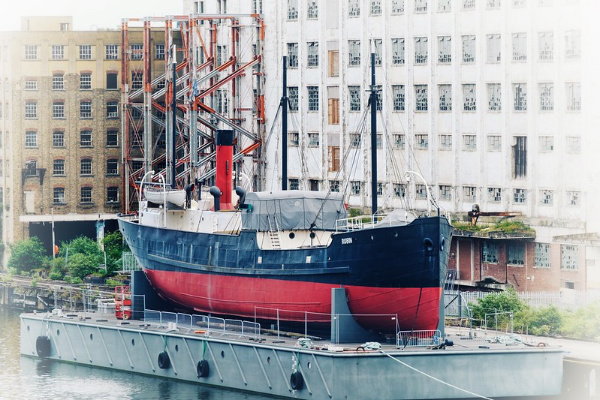
The world’s only complete surviving Victorian steamship, the SS Robin is moored in east London, close to where it was built.
One of a pair of steam coasters (the other being Rook) built initially by Mackenzie, MacAlpine & Co at Orchard House Yard on Bow Creek (and then completed by London shipowner Robert Thomson) in 1890, the SS Robin was fitted out at East India Dock before being towed to Dundee to be fitted with her engine, boiler and auxiliary machinery at Gourlay Brothers & Co.
The SS Robin commenced her sailing career at Liverpool on 20th December, 1890, and spent the next decade carrying cargos – including grain, coal, and iron ore – between British ports as well as some in northern France. Early on – in 1892 – she was sold to Alexander Forrester Blackater of Glasgow and re-registered there.
In 1900, the Robin was sold to what would be the first of three Spanish owners and renamed the Maria. The ship would then spend the next 74 years working along the Spanish coast, carrying a range of cargos including iron and coal.
In 1974, only days after discharging her final cargo and about to be sold to Spanish ship breakers, the Maritime Trust purchased the ship.
Following a two restoration project at the Doust & Co shipyard in Rochester, Kent, and, once again named the Robin, she was subsequently moored in St Katharine Docks. The ship was moved to a new mooring at West India Quay in 1991 but fell into disrepair.
In 2000, David and Nishani Kampfner bought Robin for £1 with the idea of creating an educational centre and gallery. Two years later, in 2002, SS Robin Trust was created and volunteers subsequently began the work of restoring the coastal steamer.
From 2004 until 2007, the vessel was home to a gallery and workshops run by Kampfner to encourage creative thinking in children.
But the need for further refurbishment saw this come to an end and, financed by a £1.9 million loan from Crossrail and a £1 million grant from The Heritage Lottery Fund, in June, 2008, the Robin undertook her first sea journey in 35 years, travelling to Lowestoft for the much needed restoration works.
Once at Lowestoft, however, it was discovered the ship was too fragile to go to sea again and so a pontoon was created onto which the ship was lifted in 2010. Towed to Tilbury, the Robin underwent further refurbishment there until, in July, 2011, she returned to London.
Moored initially at the Royal Albert Dock, she is now located at Royal Victoria Dock (and can be seen from nearby viewing points). There are now plans to relocate her to Trinity Buoy Wharf and for further development as a museum ship.
For more information, head to http://ssrobin.com.
LondonLife – Eye view…
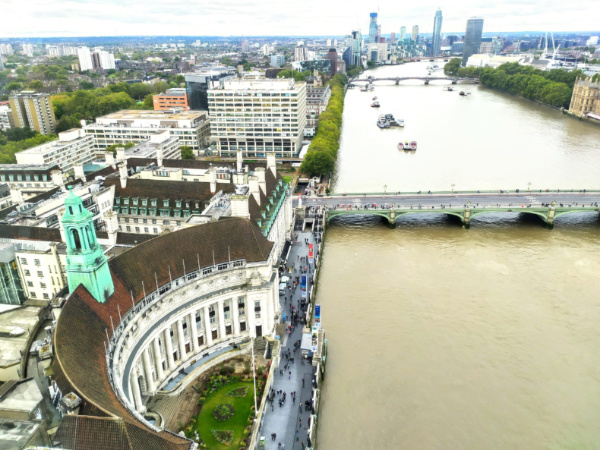
Looking south from the London Eye down the River Thames over County Hall and Westminster Bridge.
This Week in London – Month-long Thames celebration kicks off; glass vessels saved after Beirut’s port explosion; and, Chiswick House…in LEGO…
• Totally Thames – London’s month-long celebration of its river – kicks off Friday with a programme featuring more than 100 events across a range of locations. Highlights this year include Reflections, an illuminated flotilla of more than 150 boats that will process down the Thames to mark the Queen’s Platinum Jubilee on 24th September; River of Hope, an installation of 200 silk flags created by young people across the UK and Commonwealth at the National Maritime Museum; and, of course, the Great River Race, London’s great river marathon on 10th September involving some 330 boats and crews from across the world. There’s also talks, walks, exhibitions and art and, of course, the chance to meet some mudlarks. For more, including the full programme of events, see https://thamesfestivaltrust.org.

American University of Beirut, Lebanon
• Eight ancient glass vessels, newly conserved after being damaged in the 2020 Beirut port explosion, have gone on show at the British Museum. Painstakingly pieced back together and conserved at the conservation laboratories at the British Museum, the vessels were among 72 from the Roman, Byzantine and Islamic periods which were damaged when a case fell over in Beirut’s AUB Museum. Six of the vessels at the British Museum date from the 1st century BC, a period which saw glass production revolutionised in Lebanon, while two others date to the late Byzantine – early Islamic periods, and may have been imported to Lebanon from neighbouring glass manufacturing centres in Syria or Egypt. The vessels can be seen in Room 3 as part of the Asahi Shimbun Display Shattered glass of Beirut until 23rd October before their return to Lebanon in late Autumn. For more, see www.britishmuseum.org.
• Chiswick House LEGO model. A brick model of Chiswick House is on show at the property in London’s west. The model, which uses 50,000 bricks and took two years to build, illustrates the dramatic architectural changes that Chiswick House has undergone in its 300-year history including the addition of two wings which were demolished in the late 18th century. On show until 31st October. Admission charge applies. For more, see https://chiswickhouseandgardens.org.uk/event/chiswick-house-lego-brick-model/.
Send all items to exploringlondon@gmail for inclusion.
London Explained – Mudlarks…

Spotted along the Thames foreshore when the tide is low, the term ‘mudlark’ is used to describe someone who scavenges for lost or discarded objects in the mud along the Thames river banks.
In the 18th and 19th century, mudlarks were among London’s poorest who eked out a living by selling items – lumps of coal, pieces of rope, precious metals – found on the river’s banks. They were often the young or the elderly and the working conditions, which included navigating through the raw sewage and other noxious waste which ended up on the foreshore, were horrendous.
Victorian journalist Henry Mayhew, who writes in his seminal and expansive series of reports – London Labour and the London Poor – described how mudlarks were so-named because of their need at times to wade up to their waists in mud to retrieve items.
By the 20th century, the practice appears to have somewhat died out. But in more recent years, the term mudlark has been applied to hobbyists, including those using metal detectors, to search along the Thames foreshore during the hours when the tides allow. Since the mid-1970s, The Society of Thames Mudlarks has provided some organisational structure for those involved but membership in this body is limited.
A permit from the Port of London Authority is required for modern mudlarking. As the authority’s website states: “Anyone searching the tidal Thames foreshore from Teddington to the Thames Barrier – in any way for any reason – must hold a current and relevant foreshore permit from the Port of London Authority. This includes all searching, metal detecting, ‘beachcombing’, scraping and digging”.
Finds of potential archaeological interest must be reported to the Museum of London (and human remains, of course, to police). Mudlarks are also encourage to report finds to the Portable Antiquities Scheme.
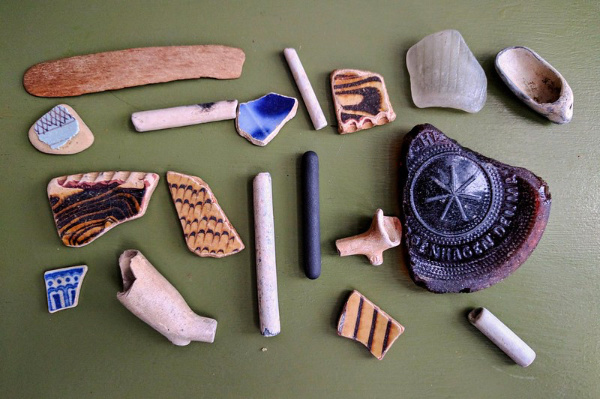
Objects found include everything from clay pipes, bits of pottery, buttons, bones and pins through to more precious items such as coins, rings and even daggers and swords.
Lara Maiklem, author of the 2019 book Mudlarking: Lost and Found on the River Thames, is among the most well-known of the modern mudlarks. As detailed in his book, her finds have included everything from a Roman amphora stopper to medieval roof tiles, a bearded man from a late 16th century Bellarmine jug and an 18th century shoe pattern.
Where’s London’s oldest…(still operational) ferry service?
There’s a couple of contenders for this title – the ferry service at Woolwich and that at Hampton.
Ferry services linking the north bank of the Thames at Woolwich North to the south bank at Woolwich have operated on the Thames since at least the 14th century.
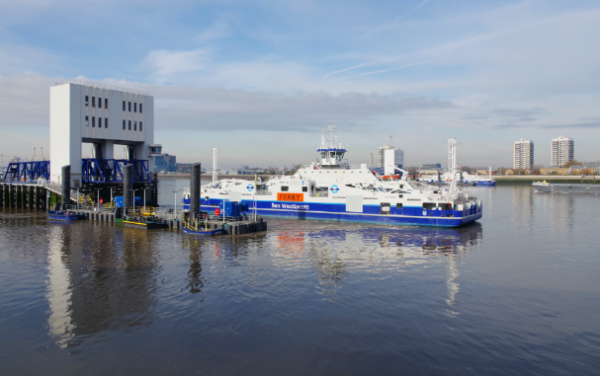
While they were previously commercial operations, in 1889 a free passenger and vehicle ferry service started operation. By the early 1960s increasing demand saw the paddle steamers retired and the ferry service upgraded to a roll-on/roll-off model. The Woolwich Ferry service, which has been run by numerous authorities over the past century, is currently run by Transport for London.
Another contender for the title of London’s oldest (still operational) ferry service is the Hampton Ferry, a pedestrian service, which operates on the Thames about a mile west of Hampton Court Bridge between Hampton on the north bank and Hurst Park, Molesey, the south bank.
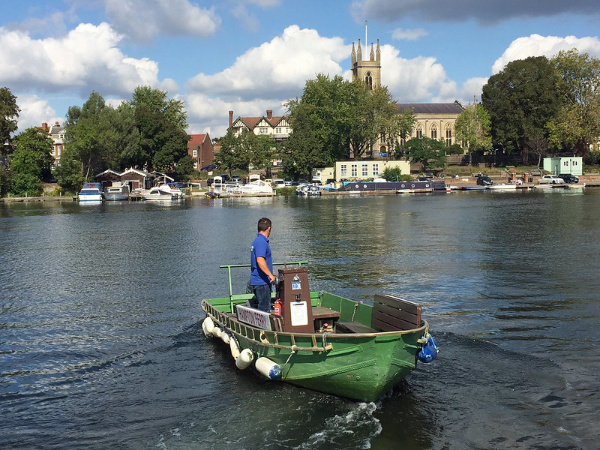
The ferry service, which was first used by fishermen and agricultural workers, dates back to 1514 and was incorporated by statute, making it one of the oldest British companies. The ferry, which costs £2 for a single crossing, operates seasonally from April to October.
 Exploring London