• Jock McFadyen’s large-scale Tube paintings have come together in a new exhibition opening at the Guildhall Art Gallery on Friday. Jock McFadyen with Jem Finer: Underground (and Surface) revisits McFadyen’s Underground series from the late 1990s and also features a layered soundscape by The Pogues’ Jem Finer which were composed from field recordings on the Northern and Central lines. Admission is by Pay What You Can. Runs until 20th September, 2026. For more, see www.cityoflondon.gov.uk/events/underground-and-surface-exhibition.
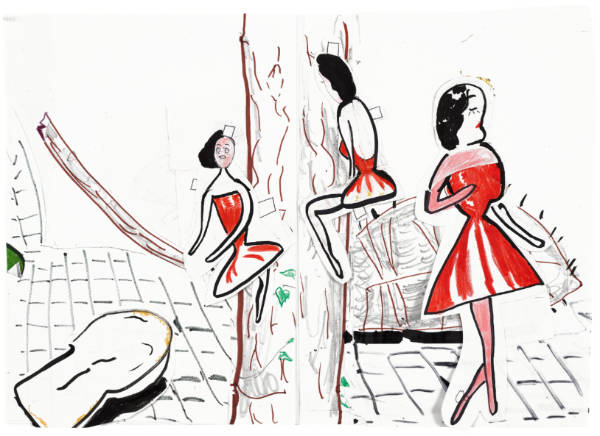
• The largest survey to date of celebrated British artist and Royal Academician Rose Wylie opens at the Royal Academy on Saturday. Rose Wylie: The Picture Comes First features more than 90 works, including Wylie’s most iconic, alongside new paintings and drawings. Works on show include those depicting memories of
family life and bombing raids in London during World War II such as Wing Tips and Blue Doodlebugs (2022/23), Room Project (2002-3) – Wylie’s first major series to receive significant critical acclaim, works on paper such as Bottom Teeth, Self-Portrait (2016), and works from the series Film Notes. It concludes with four large monochromatic paintings of animals in ginger, black, blue and red made directly by the artist onto the canvas using her hands. Runs in the Main Galleries until 19th April. Admission charge applies. For more, see www.royalacademy.org.uk/exhibition/rose-wylie.
• A life-sized wooden galleon has arrived in Kensington Gardens where it will become the centrepiece of the Diana, Princess of Wales Memorial Playground when it reopens this summer. The ship has been manufactured in Frasdorf, Germany, and is predominately made from mountain larch wood drawn from sustainably managed forests in the Bavarian Alps. It’s part of a £3 million renewal of the free-to-enter playground, which is inspired by the adventures of Peter Pan. For more, see www.royalparks.org.uk/visit/parks/kensington-gardens/diana-memorial-playground.
• Further Afield – Historic Duxford: Air Crew Room, Pilot’s Briefing Room and Pilots Locker Room. Three newly transformed historic rooms opened at IWM Duxford just south of Cambridge late last year, each of which contains newly acquired objects and interactive elements. The air crew room, located beside the Battle of Britain Hangar, tells the stories of the US 8th Air Force and RAF Bomber Command through personal objects belonging to former pilots and crew. They include false identity papers and the diary of American fighter pilot Lonnie Moseley of Duxford’s 78th Fighter Group who was forced to bail out of his P-47 Thunderbolt over France in 1944 and took shelter with a local French farmer’s family until returning to England. Nearby in the pilot’s briefing room, meanwhile, visitors can enjoy an audio-visual recreation of a real-life briefing given on D-Day in which they can sit among their ‘fellow pilots’. And in the pilot’s locker room, the everyday life of pilots who were stationed at Duxford in 1940 is explored including with interactive elements such as the opportunity to try on replica uniforms and see lockers containing recreated details of some of the pilots such as a conversation between 19 Squadron’s George ‘Grumpy’ Unwin and 302 (Polish) Squadron’s Julian Kowalski. The rooms can be visited with standard admission. For more, see www.iwm.org.uk/visits/iwm-duxford.
Send all items from inclusion to exploringlondon@gmail.com.


 Exploring London