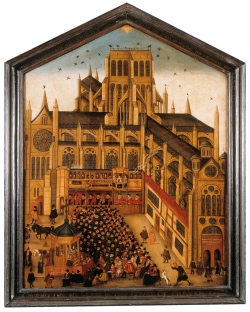
 • An exhibition charting the changing architecture of London opens at the Guildhall Art Gallery on Friday. Architecture of London features more than 80 works by more than 60 artists and spans the period from the 17th century to the present day. The display is arranged thematically and starts with views of London before exploring the city’s continuous transformation – including its rebuilding after World War II, moving on to portrayals of everyday London and finishing with a focus on architectural details that help form the rich tapestry of the city’s built form. Highlights include a rare Jacobean view of London – Old St Paul’s Diptych (1616), Canaletto’s London Seen Through an Arch of Westminster Bridge (1747), David Ghilchik’s Out of the Ruins at Cripplegate (1962), Richard IB Walker’s London from Cromwell Tower, Barbican (1977), and works by Spencer Gore, Lucian Freud, and Frank Auerbach as well as Brendan Neiland’s Broadgate Reflections (1989) and Simon Ling’s paintings of East London. The exhibition, runs until 1st December, is being accompanied by a series of talks as well as a ‘Late View’ on 27th September. Admission charge applies.
The display forms part of the City of London Corporation’s outdoor public events programme, Fantastic Feats: the building of London, which celebrates London’s long-standing history of architectural and engineering firsts and looks at how these innovations have contributed to improving the lives of Londoners over the centuries. Another of the projects taking place under the Fantastic Feats umbrella is Illuminated River, an unprecedented light artwork by American architect Leo Villarreal and London-based Lifschutz Davidson Sandilands that will be installed on up to 15 of London’s bridges with the first four bridges – London, Cannon, Southwark, and Millennium – to be lit up this summer. Architectural drawings and visualisations of the project will be on show at Guildhall from Friday until 1st September sitting alongside paintings of the Thames from the gallery’s collection which have been selected by Villareal. Admission is free applies. For more on either exhibition and Fantastic Feats, follow this link. PICTURED: One of the panels from the Old St Paul’s Diptych by John Gypkin (1616) – Society of Antiquaries of London.
• A mass flight display will take place over the historic Duxford airfield in Cambridge next week as part of commemorations surrounding the 75th anniversary of the D-Day landings. On 4th and 5th June, IWM Duxford will host the Daks over Duxford event, featuring the greatest number of Douglas C-47 Skytrain aircraft – also known as Dakotas – in one location since World War II as well as mass parachute jumps and flight displays. The event will also feature a mass flight display over Duxford as aircraft head off for Normandy where parachute landings will take place on 6th June in a recreation of the original D-Day landings. Duxford is located less than 50 miles from central London. Admission charges apply. For more see www.iwm.org.uk/daks-over-duxford.
• The first major retrospective of the work of British painter Frank Bowling opens at the Tate Britain on Friday. Frank Bowling will span the artist’s entire six decade career and will feature early works like Cover Girl (1966) – seen for the first time in the UK since it was painted, 10 of his celebrated ‘Map Paintings’ including Who’s Afraid of Barney Newman (1968) and Polish Rebecca (1971), examples of his ‘Poured Paintings’, sculptural works like his Great Thames paintings, and Sacha Jason Guyana Dreams (1989), a work inspired by the artist’s first visit to his birth country of Guyana with his son Sacha. Runs until 26th August. Admission charge applies. For more, see www.tate.org.uk.
Send all items for inclusion to exploringlondon@gmail.com.
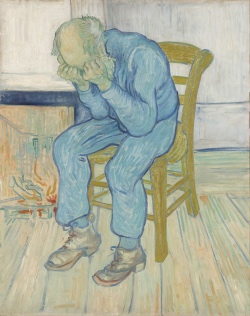 • The first exhibition to examine the work of Dutch artist Vincent van Gogh through his relationship with Britain has opened at Tate Britain this week. Van Gogh and Britain includes more than 40 works by the artist including L’Arlésienne (1890), Starry Night on the Rhone (1888), and Sunflowers (1888). The exhibition will also feature later works by Van Gogh including two he painted while in the Saint-Paul asylum – At Eternity’s Gate (1890 – pictured) and Prisoners Exercising (1890). The exhibition shows how Van Gogh, who lived in London between 1873 and 1876 working as a trainee art dealer, responded to works by artists like John Constable and John Everett Millais and his love of British writers like William Shakespeare, Christina Rossetti and, particularly, Charles Dickens (L’Arlésienne features one of Dickens’ favourite books in the foreground). The show runs until 11th August and is being accompanied by a series of talks and other events. Admission charge applies. For more, see





 Exploring London