Vikings at the British Museum; World War I portraits; and, Ruin Lust…

RoskildeThe Vikings come to the British Museum from today with the first major exhibition in more than 30 years. Vikings: life and legend, the first exhibition to be held in the new Sainsbury Exhibition Gallery, was developed with the National Museum of Denmark and the Staatliche Museen zu Berlin (National Museums in Berlin) and looks at the Viking period from the late 8th century to the early 11th century. Featuring many new archaeological discoveries and objects never seen before in the UK alongside items from the British Museum’s own collection, the exhibition is centred on the surviving timbers of a 37 metre long Viking warship excavated from the banks of the Roskilde fjord in Denmark (pictured). Other items include skeletons recently excavated from a mass grave of executed Vikings in Dorset, the Vale of York Hoard (discovered in 2007) and a stunning hoard of silver from Gnezdovo in Russia. A unique live broadcast event presented by historian Michael Wood taking cinema audiences around the exhibition will be shown in cinemas across the nation on 24th April. Admission charge applies. Runs until 22nd June. For more, see www.britishmuseum.org/whats_on/exhibitions/vikings.aspx. PICTURE: Copyright of the National Museum of Denmark. 

The commemorations of the World War I centenary have commenced at the National Portrait Gallery with The Great War in Portraits. The first of a four year programme of events and displays at the gallery, the exhibition features iconic portraits of figures such as Winston Churchill, Kaiser Wilhelm, Siegfried Sassoon and Wilfred Owen as well as major art works by the likes of Lovis Corinth, Max Beckmann, and Kirchner, whose painting Selbstbildnis als Soldat (Self-portrait as a Soldier) is featured, and Harold Gillies’ photographs of facially injured soldiers from the Royal College of Surgeons. Among the highlights are Jacob Epstein’s The Rock Drill, a contrasting pair of British and German films about the Battle of the Somme, and a press photograph of Gavrilo Princip, the student who sparked the flames of war when he assassinated Archduke Franz Ferdinand. Elsewhere among the 80 works on display are portraits of war heroes such as VC winners are contrasted with those of soldiers disfigured by war, POWs and those shot for cowardice. Admission is free. Runs until 15th June. For more, see www.npg.org.uk/whatson/firstworldwarcentenary/exhibition.php.

Our fascination with ruins is the subject of a new exhibition which opened this week at Tate Britain. Including more than 100 works from the likes of JMW Turner, John Constable, John Martin, Eduardo Paolozzi, Rachel Whiteread and Tacita Dean, Ruin Lust examines the craze for ruins that overtook creative types in the eighteenth century and the subsequent revisiting – and at times mocking – of this fascination by later figures. Works on show include Turner’s Tintern Abbey: The Crossing and Chancel, Looking towards the East Window 1794, Constable’s Sketch for ‘Hadleigh Castle’ c 1828-9, Graham Sutherland’s Devastation series 1940-1 – showing the aftermath of the Blitz, Jon Savage’s images of London in the late 1970s, and Whitehead’s Demolished – B: Clapton Park Estate 1996, showing the demolition of Hackney tower blocks. Runs until 18th May. Admission charge applies. For more, see www.tate.org.uk/whats-on/tate-britain/exhibition/ruin-lust.

Where is it? #73…

Where-is-it--#73

Can you identify where in London this picture was taken and what it’s of? If you think you can, leave a comment below. We’ll reveal the answer early next week. Good luck!

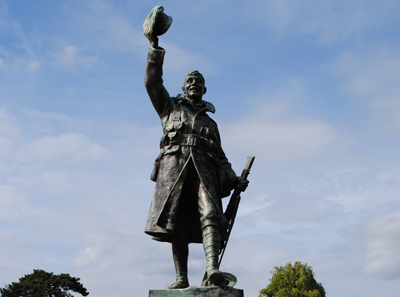
This is actually a picture of the Twickenham War Memorial, commemorating those who died in World War I and World War II. The bronze figure, the work of Mortimer Brown, sits in Twickenham’s Radnor Gardens, once the site of a house owned by the Earl of Radnor which sits on the bank of the River Thames. The memorial was recently restored following a campaign by the Friends of Radnor Gardens after one of its bronze plaques was stolen.

Around London – The Georgians at the British Library; wartime artist on show; Regent Street’s Christmas lights; Westminster’s new organ; and, celebrating success at the NPG…

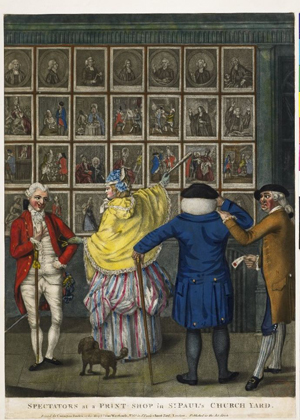
The-GeorgiansThe Georgians are under the spotlight in a new exhibition opening at the British Library tomorrow. Georgians Revealed: Life, Style and the Making of Modern Britain explores the ways in which the Georgian world influenced pop culture in Britain today, everything from fashion and theatre-going to our obsessions with celebrity scandals. The display features more than 200 artefacts from the library’s collection and includes Jeremy Bentham’s violin, Joseph van Aken’s An English Family at Tea, rare books and magazines, and illustrations and designs of landmark building’s such as Sir John Soane’s home (and now museum) in Lincoln’s Inn Fields. The exhibition, which is accompanied by a series of events (see the library website for details) comes ahead of the 300th anniversary of the accession of King George I next year. Runs until 11th March. Admission charge applies. Meanwhile, to mark the exhibition, the library has joined with Cityscapes in launching a new Georgian garden installation on the library’s piazza. Titled Georgeobelisk, the six metre high installation, will remain on the piazza for five months. A tribute to the four King Georges, it also serves as a reminder that it was also during the Georgian era that the British love of gardening was cultivated. For more, see  www.bl.uk/whatson/exhibitions/georgiansrevealed/index.html. PICTURE: Spectators at a Print shop in St Paul’s churchyard © British Museum.

Painting normally housed in “Britain’s answer to the Sistine Chapel” go on display in Somerset House today. The artworks, described as the “crowning achievement” of wartime artist Stanley Spencer, usually grace the walls of Sandham Memorial Chapel but are on display in London while the National Trust carries out restoration work at the Berkshire property. Spencer painted the works – which combine realism and visions from his imagination and were completed in 1932 – after serving as a hospital orderly during World War I.  The free display – Stanley Spencer: Heaven in a Hell of War – can be seen until 26th January. For more, see www.somersethouse.org.uk.

Regent Street’s Christmas lights – a preview of the upcoming DreamWorks film Mr Peabody and Sherman – will be turned on this Saturday night. Actor Ty Burrell, director Rob Minkoff and singer Leona Lewis will have the task of switching on the lights at about 7.15 pm while performers will include Passenger, Eliza Doolittle and former Spice Girls Emma Bunton and Melanie C. The event will be hosted by radio presenters Bunton and Jamie Theakston. The street will be traffic free all day and from 3pm to 7pm, Regent Street retailers will be showcasing fashions on a catwalk located just North of New Burlington Street. Programmes will be available from information points on the day.

A new organ was dedicated in Westminster Abbey’s Lady Chapel on Tuesday. The organ was commissioned by the Lord Mayor of London, Roger Gifford, as a gift to the Queen to mark the 60th anniversary of her coronation in 1953. The Queen agreed the organ, which had briefly resided at the Lord Mayor’s residence the Mansion House, should be installed permanently in the Lady Chapel, built by King Henry VII. The new organ was dedicated by the Earl of Wessex. For more, see www.westminster-abbey.org.

Now On: Achievement: New Photographs 2011-2013. Inspiring Britons at the peak of their professions are the subject of an exhibition running at the National Portrait Gallery. The display of recently acquired and previously un-exhibited photographs depict the likes of writer and presenter Charlie Brooker (by Chris Floyd), actress Gina McKee (Mark Harrison) and Skyfall director Sam Mendes (Anderson & Low). Admission is free. Runs until 5th January in Room 37a. For more, see www.npg.org.uk.

10 (more) curious London memorials…2. Animals in War Memorial…

Animals-in-War

This week we take a look at another of London’s war-related memorials but unlike the vast majority, this one, as its name says, commemorates animals, not humans.

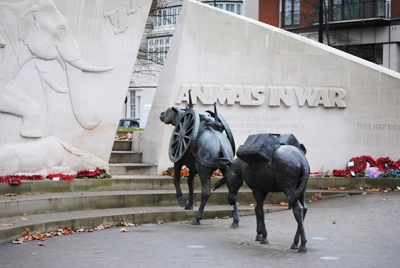
Located in the middle of Park Lane near the intersection with Upper Brook Street on the eastern side of Hyde Park, the memorial is dedicated “to all the animals that served and died alongside British and Allied Forces in wars and campaigns throughout time”. Another inscription on the memorial reads “They had no choice”.

A further dedication at the memorial pays tribute to the “millions” of animals who have died in wars. “From the pigeon to the elephant, they all played a vital role in every region of the world in the cause of human freedom,” it says. “Their contribution must never be forgotten.” It’s been said that as many as eight million horses were killed in World War I alone.

It features a couple of bronze pack mules making their way through a gap in a curved, 58 foot wide Portland stone wall – themselves carrying reliefs of various animals including an elephant, horses, camels and pigeons – while on the other side is a bronze horse and a dog, looking ahead.

The memorial is the work of Somerset-based sculptor David Backhouse and was unveiled by Princess Anne in November 2004, the 90th anniversary of the outbreak of World War I. It was apparently inspired by Jilly Cooper’s book, Animals in War, and commissioned by the Imperial War Museum. It was paid for by £2 million in public donations.

For more, check out www.animalsinwar.org.uk.

Where is it?…#49

The latest in the series in which we ask you to identify where in London this picture was taken and what it’s of. If you think you can identify this picture, leave a comment below. We’ll reveal the answer early next week. Good luck!

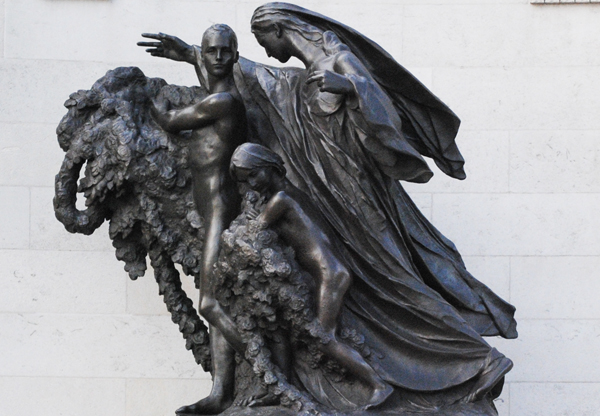
Sunday was Remembrance Day, so we thought it appropriate to have a war memorial as last week’s Where is it? This memorial, located at Victoria Embankment on the north bank of the Thames, is the Anglo-Belgian War Memorial, given in 1920 as a gift to Britain by the people of Belgium as a thank you for their help in providing a refuge in England during World War I. The work of celebrated Belgian sculptor Victor Rosseau, it features three bronze figures – a Belgian mother, a boy and a girl, the latter two carrying garlands – and although you can’t see it in this picture, there’s two figures behind them on the Portland stone surround representing ‘honour’ and ‘liberty’.