PICTURE: Magda V/Unsplash
PICTURE: Magda V/Unsplash
The next two entries in our countdown…
72. 10 sites of significance in Jane Austen’s London – Redux…

With 2020 to be sadly remembered as the year of COVID-19 (and St Paul’s plans to commemorate those who have died in a permanent memorial in the cathedral), we thought we’d take a look memorials and monuments related to disease outbreaks of the past.
First up is a pump in Soho, a replica of the original Broad Street hand pump which lay at the centre of a cholera outbreak in 1854. Its commemorates the efforts of Dr John Snow, whose work in mapping the course of the outbreak lead to him identifying the pump as the source of the outbreak with the well beneath contaminated by human waste from an old cesspit.
The Yorkshire-born doctor’s work, which subsequently led him to have the pump handle removed and thus prevent further spread of the disease, was a breakthrough in preventing the spread of cholera by showing the source was contaminated water (many people had previously thought was spread through the air, the so-called “miasma theory”).
The replica pump was installed in what is now Broadwick Street, just outside The John Snow pub, in 1992 at the behest of the John Snow Society and Westminster Council. It was removed in 2015 as the area was redeveloped and was then re-installed – along with an explanatory plaque – in 2018.
It stands alongside a red granite block in the pavement which is said to mark the exact spot where the original pump was located (there’s another plaque mentioning that on the pub).
There’s also a blue plaque on the pub commemorating Snow’s work to determine cholera was a water-born disease which was erected by the Royal Society of Chemistry in 2008.
PICTURE: The memorial pump with the John Snow pub behind and the Royal Society of Chemistry blue plaque (Matt Brown/licensed under CC BY 2.0)
PICTURE: Richard Laxa/Unsplash
The next two in our countdown of Exploring London’s 100 most popular posts…
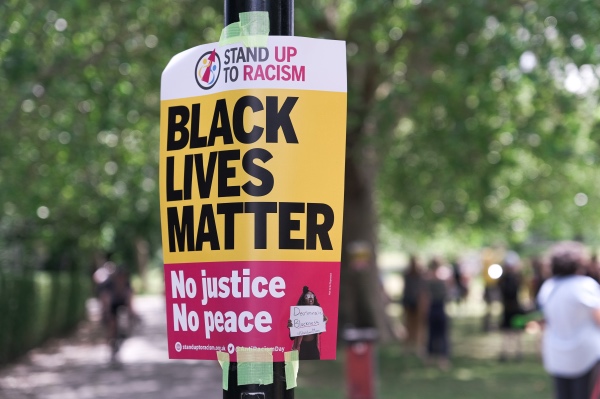
• A statue of slave owner Robert Milligan has been removed from its position outside of the Museum of London Docklands. The Canal and River Trust removed the statue this week in recognition of the “wishes of the community”. The move had the support of the museum which is one of only three museums in the UK to address the history of the transatlantic slave trade. “The Museum of London recognises that the monument is part of the ongoing problematic regime of white-washing history, which disregards the pain of those who are still wrestling with the remnants of the crimes Milligan committed against humanity…” the museum said in a statement issued earlier in the week. “Now more than ever at a time when Black Lives Matter is calling for an end to public monuments honouring slave owners, we advocate for the statue of Robert Milligan to be removed on the grounds of its historical links to colonial violence and exploitation.” Milligan was a prominent British slave owner who, by the time of his death in 1809, owned 526 slaves and two sugar plantations in Jamaica. The statue, the work of Sir Richard Westmacott, was moved to a position outside the museum in West India Quay in 1997. Earlier this week, the Mayor of London, Sadiq Khan, announced a new Commission for Diversity in the Public Realm which will review landmarks – including murals, street art, street names, statues and other memorials – across the city of London with a view to improving diversity in the public realm.
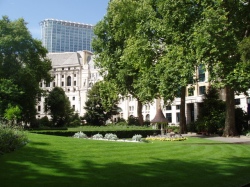 • The City of London Corporation has launched a competition to redesign the Grade II-listed gardens at Finsbury Circus. The two-stage competition aims to identity creative and sustainable design ideas in a bid to return Finsbury Circus Gardens to being a multifunctional public space with a pavilion as well as a “sanctuary” within the Square Mile. The corporation is seeking a joint bid from an architect and a landscape architect to deliver a new design for the reinstatement of Finsbury Circus Gardens and Pavilion. Some two-thirds of the Finsbury Circus Gardens, one of the oldest parks in the City, have been used by Crossrail for the past 10 years to provide access to a section of tunnel between Farringdon and Liverpool Street. The works required the removal of historic features like the bowling green and historic Grade II drinking fountain and these will now be reinstated into the new design. PICTURE: Looking across Finsbury Circus Gardens in 2006 (David Williams /licenced under CC BY-SA 2.0)
• Tickets for ZSL London Zoo have gone on sale ahead of its planned reopening next week. The zoo will reopen on Monday, 15th June, for the first time since its closure on Saturday, 21st March due to the coronavirus pandemic. The zoo, which is offering pre-allocated, timed entry slots, limited to just 2,000 visitors a day, says its taken numerous measures to ensure the safety of visitors. For more, head to www.zsl.org/zsl-london-zoo.
Send all items for inclusion to exploringlondon@gmail.com.
Once located on the north side of Cannon Street, St Swithin London Stone was first recorded in the 13th century, rebuilt after the Great Fire of London and finally demolished after being damaged in World War II.
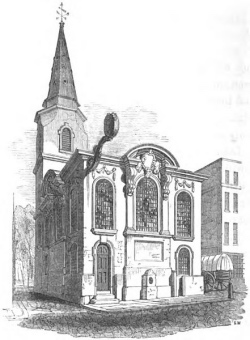 The church’s curious name comes its dedication to St Swithin, a ninth century bishop of Winchester, and the London Stone, a stone of curious origins which was originally located across the road and then moved across to eventually be placed inside an alcove in the south wall of the church in the 1820s (you can read more about it here).
The medieval church was rebuilt in 1405 thanks to the largesse of Sir John Hind, twice Lord Mayor of London, and had one of the first towers built specifically for the hanging of bells.
The church was famously also the final resting place of Catrin Glyndwr, daughter of Welsh leader Owain Glyndwr, who was taken hostage in 1409 and imprisoned in the Tower of London before dying in mysterious circumstances four years later. Other notable connections include one with John Dryden who married Lady Elizabeth Howard in the church in 1663.
The church was destroyed in the Great Fire of London. Now united with St Mary Bothaw, the church was rebuilt apparently using some of the original stones, to the designs of Sir Christopher Wren. Rectangular in shape, it featured a tower in the north-west corner and an octagonal dome.
The church, which also had an association with the Worshipful Company of Salters, was heavily damaged by bombing during the Blitz. United with St Stephen Walbrook in 1954, the ruined church was eventually demolished in 1962 (the pulpit is now at All Hallows by the Tower). There’s now a garden on the site which features a memorial to Catrin Glyndwr.
PICTURE: The Church of St Swithin, London Stone, as depicted in the 1839 book ‘The Churches of London’ by George Godwin. (public domain)

• The National Gallery has unveiled a new project which sees some of its most famous works represented as 360 degree light and sound “experiences”. KIMA: Colour in 360, the work of the Analema Group, uses colour data to transforms the works which include Van Gogh’s A Wheatfield, with Cypresses, Monet’s Water-Lilies, Setting Sun. While the first two works can be viewed online, a third – based on van Eyck’s The Arnolfini Portrait – will come later. The work was commissioned by new digital studio National Gallery X (or NGX) and is part of a digital events programme which, on 16th June, will also see the first of a series of one-night immersive events being held in collaboration with London’s media art platform Art in Flux. ‘ART IN FLUX @ NGX’ will present cutting-edge artwork exploring the boundaries between art and technology and feature the work pf pioneering media artists, researchers and academics. To see the first two works and for more about the programme head to www.nationalgallery.org.uk/whats-on/analema-at-ngx. PICTURE: KIMA: Colour Van Gogh © Analema Group. 2020.
Send all items to exploringlondon@gmail.com.
The next two entries in our countdown are:
76. Where’s London’s oldest…public clock (with a minute hand)?
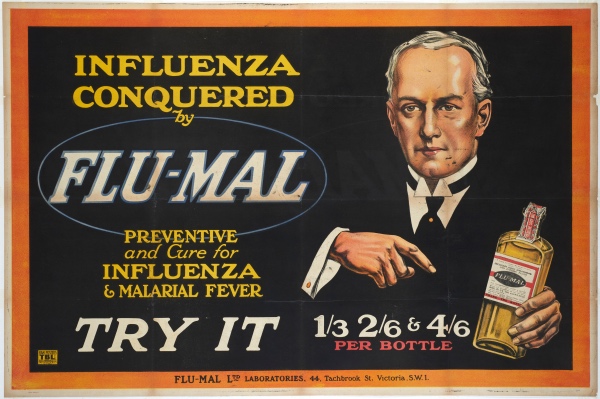
• The Museum of London is offering the chance to explore its previous exhibition, Disease X: London’s next epidemic?, online. The exhibition, which was first shown at the museum in between November, 2018, and March, 2019 to make the 100th anniversary of the second wave of the Spanish flu, draws on the museum’s collections as well as historical research and expert views to explore if the city was at risk from an unknown ‘Disease X’. Among the objects in the display are the mourning dress worn by Queen Victoria to mark the shock passing of her grandson Prince Albert Victor due to ‘Russian Flu’, a 17th century pomander used to waft away the foul vapors thought to cause diseases like the plague and a poster advertising ‘Flu-Mal’, a supposed cure for both influenza and malaria. To see the exhibition, head to https://virtualexhibitions.museumoflondon.org.uk/disease-x/. The online exhibition is part of the museum’s mission to bring online content to people at home while its doors are closed under the banner of the ‘Museum for London’. PICTURE: Influenza conquered by Flu-Mal. Advertising Poster © Museum of London.
• The V&A has launched a series of five films that take viewers on a behind-the-scenes tour of its exhibition Kimono: Kyoto to Catwalk. Curator Anna Jackson guides viewers through the exhibition spaces and provides personal insights into the making of the show, some of the star exhibits and the history of the kimono. The exhibition tracks the “sartorial and social significance” of the kimono from the 1660s to the present day in both Japan and elsewhere around the world and features international designer fashions and iconic costumes from films and performances. Highlights include a kimono created by Living National Treasure Kunihiko Moriguchi, the Alexander McQueen dress Björk wore on the cover of her album Homogenic, and original Star Wars costumes modelled on kimono by John Mollo. To watch, head here.
• The National Gallery has announced it has extended its landmark exhibition Titian: Love, Desire, Death which had been due to close on 14th June, having been open for just three days before lockdown measures were put in place. The gallery has also announced the exhibition Nicolaes Maes: Dutch Master of the Golden Age will also be extended while dates for upcoming exhibitions including Sin, Conversations with God: Copernicus by Jan Matejko, and The Credit Suisse Exhibition: Raphael have been pushed back. For more, see www.nationalgallery.org.uk.
Send all items to exploringlondon@gmail.com.
Before we move on, here’s a recap of our most recent Wednesday series…
4. The Strand Lane ‘Roman’ Baths…
We’ll kick off a new Wednesday series next week…
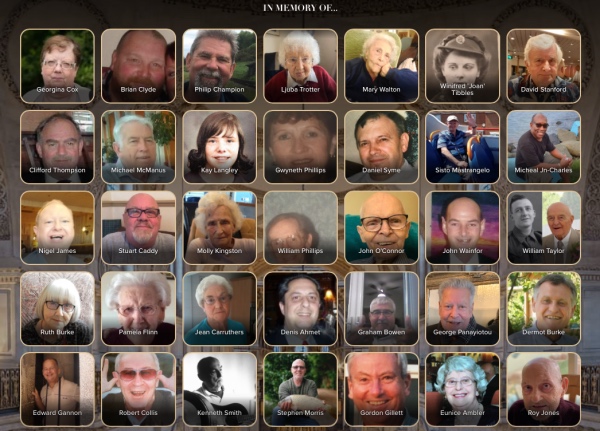
St Paul’s Cathedral has opened an online book of remembrance for people living in the UK who have died as a result of COVID-19. The Remember Me website is open to family, friends and carers of those who have died to submit, free-of-charge, the name, photograph and a short message in honour of the deceased. The book, which will remain open for as long as is required, will eventually be accompanied by a physical memorial which is planned for the cathedral’s north transept. The Very Revd David Ison, Dean of St Paul’s, said that for centuries, St Paul’s has been a place to remember the “personal and national impact of great tragedies”. “Remember Me is an opportunity to mourn every person we have lost to the effects of this terrible disease, an encouragement to offer compassion and support to those left behind, and an ongoing recognition of the impact of the pandemic on the UK.” The launch of the website last week – which has the support of Prince Charles – was accompanied by the release of a specially recorded piece of music featuring the choristers of St Paul’s, the Remember Me Anthem – Lift Thine Eyes (see below). PICTURE: Screenshot of the memorial website.
 • The RHS Chelsea Flower Show is on this week but, due to the coronavirus pandemic, this year it’s a virtual affair. That’s good news for those who might not have been able to attend in person thanks to the stream of video content that’s being posted on the RHS website including garden design tips and planting ideas, virtual garden tours, ‘how to’ demonstrations and meet the growers sessions. Among highlights are a video featuring Sarah Eberle, the most decorated female designer in Chelsea history showing you around her woodland garden, a “lockdown tour” of some of London’s public parks, BBC presenter and multi-gold medal winning designer Adam Frost showing you around his Lincolnshire garden, florist Nikki Tibbles showing you how to create a seasonal bouquet and an update on what the Chelsea Pensioners have been up to on their allotment. The show runs until 23rd May. To see what’s on offer, head to www.rhs.org.uk/shows-events/virtual-chelsea. PICTURE: The Florence Nightingale Garden – A Celebration of Modern Day Nursing/© Robert Myers.
• The National Gallery has taken some of its most famous works out onto the streets thanks to a partnership with digital outdoor screen provider, Ocean Outdoor. Seven of the gallery’s most well-known images – Van Gogh’s Sunflowers (1888) and A Wheatfield, with Cypresses (1889), Monet’s The Water-Lily Pond (1899), van Eyck’s The Arnolfini Portrait (1434), Seurat’s Bathers at Asnières (1884), Vigée Le Brun’s Self Portrait in a Straw Hat (1782) and Rousseau’s Surprised! (1891) – are being shown on Ocean Outdoor’s giant screens for two weeks in cities around the UK including London. Head to www.nationalgallery.org.uk for more free art, films, stories and activities.
• The Royal Collection Trust has announced it will not open the State Rooms at Buckingham Palace to the public this summer due to the coronavirus pandemic. But the collection and palaces can be explored online at www.rct.uk.
Send all items to exploringlondon@gmail.com.
Located just 13 miles south-east of London’s centre, this 338 acre woodland is a haven of tranquility.
Petts Wood (the name is also that of a suburb) is believed to take its name from 16th century master shipbuilder William Pett – its first known mention was in 1577 when the wood appeared in his will. Pett had used oaks from Petts Wood in his ship-building yards located at Deptford and Woolwich on the River Thames.
 The eastern part of Petts Wood – known as the Willett Memorial Wood – was given to the National Trust in 1927 in a bid to protect it from development while the remainder of the woodland, which had subsequently been purchased by Colonel Francis Edlmann and added to his neighbouring estate, Hawkwood, was donated 30 years later by Robert and Francesca Hall.
The Willett Memorial Wood is named for William Willett, leader of the movement which campaigned for recognition of British Summer Time (there’s a stone sundial memorial to him there). Willett lived nearby.
The western part of Pett’s Wood is known as the Edlmann Memorial Wood. It contains a stone memorial to the Halls and Colonel Edlmann which was unveiled in 1958.
The main house on the Hawkwood Estate and gardens, were acquired from Francesca Hall in 1975 with the proviso that farming would continue to preserve the area’s rural character.
There are a couple of marked walks around the woodlands. Among the activities which take part in the woodlands is the age-old practice of charcoal making. Made for barbecues, it’s sold in National Trust shops.
WHERE: Chislehurst (nearest train stations are Petts Wood, Chislehurst, and St Mary Cray); WHEN: Dawn to dusk; COST: Free; WEBSITE: www.nationaltrust.org.uk/petts-wood-and-hawkwood
PICTURES: Top and Right – Maureen Barlin (licensed under CC BY-NC-ND 2.0)

Looking east down Oxford Street from Oxford Circus. PICTURE: Joe Stubbs/Unsplash
The next two entries in our countdown are:
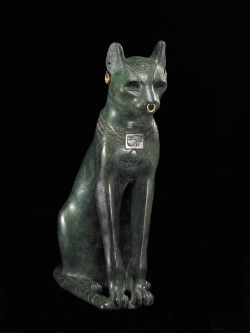 This stunning hollow bronze figure from ancient Egypt depicts the goddess Bastet in the form of a seated (domestic-sized) cat and dates from around 600 BC.
Its name comes from Irish-born military man Major Robert Grenville Gayer-Anderson, who was a keen collector of Egyptian sculpture, jewellery and pottery which he showcased as his Cairo home, now known as the Gayer-Anderson Museum. Gayer-Anderson donated the cat to the British Museum in 1939 (there’s a copy in the Gayer-Anderson Museum).
The 14 centimetre tall figure, which wears a silver protective pectoral and golden earrings and nose ring, was probably housed in a temple. The scarab beetle on the cat’s head and chest symbolises rebirth and the silver wedjat-eye on the pectoral was supposed to invoke protection and healing.
The cat, which a particularly fine example of a cat sculpture from the period, can usually be seen in the Egyptian sculpture gallery in Room 4 of the British Museum but given its closure because of the coronavirus pandemic, you may like to take a look at a 3D model of the cat which is on the museum’s website here.
PICTURE: © the Trustees of the British Museum
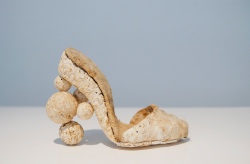 • Somerset House is releasing a new virtual tour of its exhibition Mushrooms: The Art, Design and Future of Fungi so people can explore the world of the mushroom and its role in the world’s survival from home. The exhibition, which will go live online on Monday to mark International Museum Day, features highlights including Beatrix Potter’s watercolours of mushrooms, conceptual artist Carsten Höller’s spinning, solar-powered mushrooms, a psychedelic film by Adham Faramawy, Seana Gavin’s hand-cut collages of mushroom-human hybrids and, shoes and shades made from mycelium, the fungal mass which lies beneath the earth under mushrooms. The exhibition will be released online on 18th May at www.somersethouse.org.uk. PICTURED: Kristen Peters, Mycoshoen, courtesy of the artist.
• The V&A are seeking homemade signs created during the coronavirus lockdown – everything from children’s rainbow signs to handwritten notes placed in public spaces – to add to its permanent collection. Noting the commonplace nature of such signs during the emergency, the V&A have said that “[w]hether they state temporary closure of a business, express messages of hope or critique, or raise awareness for a good cause, these signs have become a prominent way for us to communicate with the outside world during lockdown”. Through collecting the signs, the museum is aiming to “create and preserve a rich portrait of life under lockdown expressed through visual imagery.” Selected signs will be chosen to join the museum’s collections. Signs can be submitted to homemadesigns@vam.ac.uk while people are also encouraged to share signs they’ve come across on social media using #homemadesigns.
• The National Trust is asking people to write letters to its Director General Hilary McGrady, about their lockdown experiences in order to add a selection of them to its collection of historic letters. People are asked to write about what they have most missed since lockdown began and about what solace they may have drawn from nature, art, creativity and any forms of social contact. The National Trust is asking writers to scan or photograph their letter and email it to lettersfromlockdown@nationaltrust.org.uk or share it via the National Trust’s social media channels using @nationaltrust to ease pressure on the postal service. The Trust says it will request postal hard copies from selected authors at a later date.
Send all items for inclusion to exploringlondon@gmail.com

This iconic and unique Arts and Crafts home in Bexleyheath in London’s east was at the centre of the Pre-Raphaelite movement.
Commissioned by poet, designer and artist William Morris in 1859 – and built by his friend, architect Philip Webb (with whom Morris would co-found the The Society for the Protection of Ancient Buildings in 1877) – the L-shaped house was designed to be a home for Morris and his new wife Jane as well as a hub for the so-called “second wave” of Pre-Raphaelites.
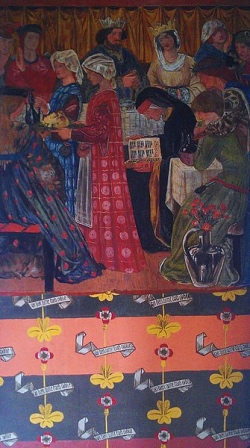 Described by Dante Gabriel Rossetti as “more a poem than a house”, the two storey red brick property (hence the name ‘Red House’) is characterised by elements of romanticised Gothic medieval design – including a steep gable roof, tall chimney stacks, oriel windows and stained glass – but also contains a very practical layout.
The Morrises moved in during June, 1860, and, inspired by medieval art and literature, commenced elaborately decorating the property in bold colours. The couple hung the walls with embroideries and pictures and commissioned Webb to design furnishing while others who helped with the interior decoration included Rossetti, Elizabeth Siddal and Edward Burne-Jones.
It was this communal response to the home’s design that is credited as leading to the founding of the decorative arts company Morris, Marshall, Faulkner & Co – often referred to as ‘The Firm’ – in 1861.
A plan to extend the property in the mid-1860s to add workshops as well as allow Burne-Jones and his family to live there was aborted after the then pregnant Georgiana Burne-Jones contracted scarlet fever, losing the child as a result.
Meanwhile, Morris – whose two daughters Jenny and May were born in the property – was apparently discovering the home’s short-comings – including its orientation away from the sun and its distance from London. He subsequently decided to move his family back to London and in 1866 sold the property, never returning to it again.
The house remained in private hands until it was acquired by the National Trust in 2003. Morris, meanwhile, went on to lease Kelmscott Manor in Oxfordshire with Rossetti and is buried in the nearby churchyard of St George’s Church.
The now Grade I-listed house, which still contains original features and furnishings, is surrounded by a garden which was designed to “clothe” the property and which, as well as being informed by Arts and Crafts principles, features a beautiful conical-roofed well-house. When open, there’s a cafe and second-hand bookshop on site.
The house has an English Heritage Blue Plaque commemorating Morris and Webb.
For more, visit www.nationaltrust.org.uk/red-house.
PICTURE: Top – The property with well house in the foreground (Steve Parkinson/ licensed under CC BY-NC-ND 2.0); Right – A mural in the drawing room designed by Edward Burne-Jones depicting the marriage feast of Sir Degrevant (Ethan Doyle White at English Wikipedia (licensed under CC BY-SA 3.0)
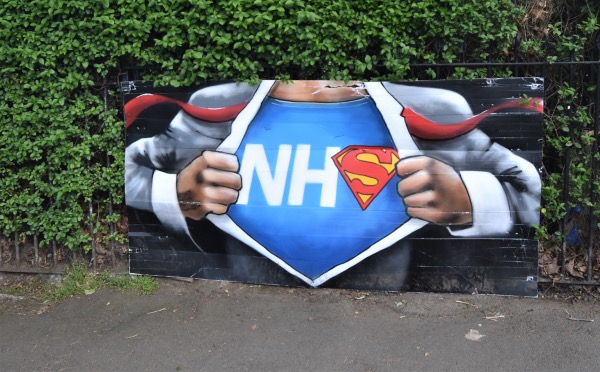
Seen in Brockley, south London. PICTURE: Loco Steve (licensed under CC BY-SA 2.0)

 Exploring London