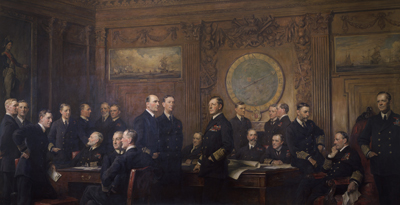
 Hidden away in storage for decades, this sizeable portrait of 22 senior navy figures of World War I has recently gone on public display at the National Portrait Gallery as part of the institution’s commemoration of the centenary of the outbreak of the Great War. The work of Sir Arthur Stockdale Cope, Naval Officers of World War I was painted in 1921 and had been in storage due to its “delicate condition”. Using £20,000 raised through a public appeal last year, the painting and its frame have recently gone five months of restoration work which has seen it restored to health. The painting was one of three commissioned by financier and public servant Sir Abraham Bailey in the aftermath of the war – both of the other two paintings, Sir James Guthrie’s Statesmen of World War I and John Singer Sargent’s General Officers of World War I are continuously on display in Room 30. Among those depicted in Cope’s work are Admirals Jellicoe and Beatty and Rear-Admiral Hood. The work, which measures more than five metres across, can be seen in Room 32 of the National Portrait Gallery, just off Trafalgar Square. Admission is free. For more, see www.npg.org.uk. PICTURE: © National Portrait Gallery, London
Areas of London
This Week in London – Norman Shaw’s drawings on display; Tower Bridge art; and, German medals from World War I…
• Drawings by the renowned Victorian-era British architect Norman Shaw (1831-1912) are the subject of a new display at the Royal Academy of Arts. Shaw’s building works included New Scotland Yard on Embankment and renovations and additions to the likes of Burlington House, home of the RA. The display Dream, Draw, Work will explore the materials, draughtsmanship and design practices of Shaw and his staff and many of the works in the display bear the marks of extensive handling. As well as the drawings, photographs of Shaw’s London buildings will be displayed in the Royal Academy’s Architecture Space. Opens in the Tennant Gallery tomorrow and runs until October 26. Entry is free. For more, see www.royalacademy.org.uk.
• An exhibition of artworks depicting Tower Bridge over its 120 year history opens at the Guildhall Art Gallery on Saturday. Tower Bridge: A Celebration of 120 Years includes paintings from the gallery’s permanent collection, contemporary interpretations and archive material. For more, follow this link.
• On Now: The other side of the medal: how Germany saw the First World War. This free display in Room 69a of the British Museum focuses on medals made by artists who lived and worked in Germany from 1914-1919. While smaller struck ‘medalets’ were mass produced, the larger cast medals – such as those featured in this display – were produced in smaller numbers and mostly cast in iron because bronze was required for shell casings. While some of the medals, unusually modernist in style, were used to influence opinion against Germany’s enemies, others provided what the museum describes as a “more universal criticism about the futility of war and waste of human life”. Among the motifs used was that of Death who can be seen killing soldiers and attacking ships or giant Zeppelin airships. The medals were not officially produced or sanctioned and attracted their fair share of controversy (one depicts the passenger ship Lusitania, sunk by a German U-boat in 1915, as laden with armaments). The display can be seen until 23rd November. For more, see www.britishmuseum.org.
Send all items of interest for inclusion to exploringlondon@gmail.com.
Lost London – The Steelyard…
The Thames-side property known as the Steelyard – the phrase comes from the Dutch-German word Stahlhof and relates either to a steel beam used for weighing goods or a courtyard where the goods were sold – was the main trading base of the Hanseatic League in London from the 13th century onward.
Located near where Walbrook flows out of the Thames on the north bank (the site is now at least partly covered by Cannon Street Station), the walled compound – which at some point housed as many as 400 people – was in some senses a mini city within a city complete with a hall, warehouses, a weighing house and counting houses as well as residences and a chapel.
While the community – which represented an alliance of towns and cities in northern Europe – was mentioned as far back as the late 1200s, it wasn’t until 1303 that King Edward I formerly confirmed the tax and customs concessions of the merchants (at some point, in return for privileges they were given, the group was charged with keeping up the maintenance of Bishopsgate).
The power of the trading post had grown substantially by the 15th century and the concessions the group had been granted meant there was inevitably considerable friction with English merchants. There was also some official friction and one example of it was when the Steelyard was closed temporarily in the 15th century when the Hanse cities were at war with England.
In 1598 Queen Elizabeth I took away the Steelyard’s trading privileges (after which the compound was apparently looted). It was subsequently allowed to reopen by King James I but never regained the prominence it had previously had.
Much of the compound was destroyed in the Great Fire of London but nonetheless, the Steelyard was rebuilt and continued to provide links between German cities and the English until the mid 1800s when the land was sold off and, in 1866, Cannon Street Station built on the site.
A couple of surviving objects from the Steelyard include a series of at least eight portraits of Hanse merchants painted by Hans Holbein the Younger and a stone model of the Hanseatic Arms which were placed over the gate into the compound can be seen at the Museum of London.
This Week in London – Woolly mammoths star at the NHM; the Ceremony of the Constable’s Dues; mummies at the British Museum; and, Rupert Potter’s photographs…
• The most complete woolly mammoth ever found is the star attraction at a new exhibition opening at the Natural History Museum tomorrow. Lyuba – a one month old mammoth – was found by a reindeer herder in Siberia in 2007 and was named after the reindeer herder’s wife. Thought to be 42,000-years-old, the young mammoth was thought to be healthy when it died and still has remnants of its mother’s milk in its stomach. It is the first time the mammoth – normally housed at the Shemanovsky Museum-Exhibition Complex in Salekhard, Russia, is being shown in Western Europe. Mammoths: Ice Age Giants will also feature life-sized models and skeletons of mammoths. Runs until 7th September. Admission charge applies. For more, see www.nhm.ac.uk.
• The German naval ship FGS Niedersachsen will take part in the Ceremony of the Constable’s Dues at the Tower of London tomorrow, having saluted the Tower with a gun salute yesterday – the first time a gun salute has taken place in honour of the ceremony in 40 years. The ceremony dates back to the 24th century and while past offerings have included barrels of rum, oysters, cockles and mussels, this year the Tower’s constable, General the Lord Dannatt, will be presented with a barrel of wine. The ceremony will see the ship’s Commander Kurt Leonards led his crew to the Tower’s West Gate where they will be challenged by the axe wielding Yeoman Gaoler before marching on to Tower Green to “present the dues” or deliver the wine, to the Constable. The ceremony takes place at noon. For more on the Tower, see www.hrp.org.uk/TowerOfLondon/.
• A new exhibition about ancient lives in Egypt and Sudan has kicks off at the British Museum today. Ancient lives, new discoveries will reveal new research about one of the museum’s most popular collections – that of ancient Egyptian and Sudanese mummies – and uses state-of-the-art technology to take you inside the mummy cases and bring you face-to-face with eight people who lived in the Nile Valley thousands of years ago. The selected mummies come from a period spanning 4,000 years, from the Predynastic period to the Christian era, and come from sites in both Egypt and Sudan. They include an adult male from Thebes mummified about 600 BC and a female singer called Tamut who lived in Thebes around 900 BC. The museum received its first mummy in 1756 and hasn’t unwrapped any of them relying on increasingly advanced technologies to see inside. The exhibition runs until 30th November. Admission charge applies. For more, see www.britishmuseum.org.
• On Now – The World of Rupert Potter: Photographs of Beatrix, Millais and Friends. The amateur photography of Rupert Potter, father of children’s author Beatrix Potter, is on show in his exhibition at the National Portrait Gallery. The display features selected works from the gallery’s extensive collection of his works including two new acquisitions which show Beatrix Potter on holidays both before and after her publishing success. Other photos depict the sitters and paintings of artist Sir John Everett Millais, who was a friend of Rupert Potter’s. The free exhibition runs until 16th November in Room 28. For more, see www.npg.org.uk.
Send all items of interest for inclusion to exploringlondon@gmail.com.
10 sites from Shakespearean London – 1. The Globe…
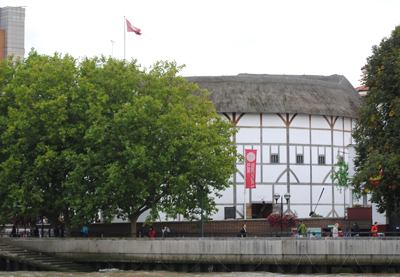 Mention William Shakespeare and London in the same breath and everyone immediately thinks of one building – the reconstructed Globe on Bankside. So we thought that to kick off our new series – being run in honour of the 450th anniversary of the playwright’s birth – we’d take a look at history of the iconic structure.
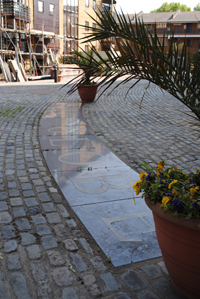 The original Globe Theatre, located a few hundred metres to the south, opened in 1599 as a home for the actors’ company known as the Lord Chamberlain’s Men (later renamed the King’s Men on the accession of King James I in 1603), of which Shakespeare was a member. Founded by James Burbage, this merry band was originally was housed at London’s first purpose-built playhouse Shoreditch before lease disputes led them to establish a new theatre in Southwark, close to the then existing theatre, The Rose.
Up and running by 1599 (Shakespeare was among four actors who bought a share in the property to help fund the new building which used timbers from the former Shoreditch theatre), the new theatre was used for 14 years until, during a performance of Henry VIII in 1613, wadding from a stage cannon ignited and the theatre burned to the ground. Rebuilt with a tiled roof, it remained the home of the company until it was closed down by the Puritan government in 1642 and demolished two years later.
You can see the original site of The Globe just in nearby Park Street. The shape of the structure is marked by a dark line embedded in the pavement (pictured).
The reconstructed building which stands proudly by the water today was the vision of the late American actor, director and producer, Sam Wanamaker. He founded the Shakespeare Globe Trust which, with the on-site assistance of Queen Elizabeth II, opened the theatre at its current site in 1997 (sadly, Wanamaker had died three-and-a-half-years previously).
The building’s design was drawn from sifting through what little historical evidence could be found including the findings of an archaeological dig at the original site, descriptions contained in Shakespeare’s plays (including the line from Henry V – “Or may we cram within this wooden ‘O’), and printed panoramas from the time, although it should be noted that much – particularly the design of the stage – is speculative.
Meanwhile the techniques used in the construction of the theatre were the subject of years of research and were in accord with those of the early 17th century and included using oak laths and staves to support lime plaster and then covering the walls in white lime wash while the roof was made of water reed thatch.
One of the best ways to see the theatre and make the most of the atmosphere is to see a play from a standing position in the pit!
WHERE: Globe Theatre Exhibition & Tour, Shakespeare’s Globe, 21 New Globe Walk (nearest Tube stations are Southwark and London Bridge); WHEN: Exhibition is open 9am to 5.30pm daily – tours run at various times, see website for details; COST: Exhibition and tour cost is £13.50 adults/£12 seniors/£11 students/£8 children (5-15 with children under five free)/£36 family of four; WEBSITE: www.shakespearesglobe.com.
London Pub Signs – The Anchor…
While the first official records of this Bankside pub only date from 1822, the pub’s history goes back much further. Like many pubs in London, nailing down its exact origins is tough but the story goes that it was named The Anchor by seventeenth century merchant Josiah Child.
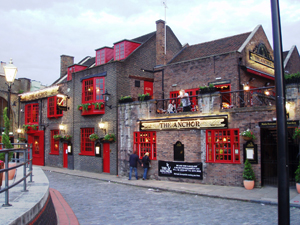 Child owned the brewhouse which had been established in 1616 by James Monger at a site known as Dead Man’s Place (close to where the original Globe Theatre had stood before burning down in 1613) and was also a merchant who supplied the navy with everything from masts and spars to stores and beer. Hence the name The Anchor.
It’s speculated that William Shakespeare himself might have had a drink here and it’s believed to be from this pub – “a little alehouse on Bankside” – that diarist Samuel Pepys witnessed the destructive power of the Great Fire of London in 1666.
Dr Samuel Johnson – apparently a close friend of later brewery owners, Henry and Hester Thrale – was among regular drinkers. Other patrons, according to the pub’s website, included the artist Joshua Reynolds, Irish poet Oliver Goldsmith, actor David Garrick and Irish statesmen Edmund Burke.
The pub was apparently rebuilt a couple of times after being destroyed by fire. The brewery, meanwhile, rose to become one of the largest in the world before it was finally demolished in 1981 leaving the pub, the brewery tap, still standing.
Refurbished in recent years, the pub today contains a room dedicated to The Clink prison, the Bishop of Winchester’s lock-up which was located in nearby Clink Street.
The waterside pub at 34 Park Street is now part of the Taylor Walker chain. You can find out more about it here.
PICTURE: Ewan Munro/Flickr
This Week in London – London’s World War I transport in focus; Museums at Night; and, Tony Hancock remembered…
• Opening tomorrow, a major exhibition at the London Transport Museum will take an in-depth look at the role transport played in London during World War I – from how London bus drivers took their vehicles to the front lines to the advance of women into the transport workforce for the first time and, of course, how Londoners fared under the deadly aerial attack of the Luftwaffe. Key among the objects on display as part of Goodbye Piccadilly at the Covent Garden site will be ‘Ole’ Bill’ – a 1911 bus on loan from the Imperial War Museum which was requisitioned for the front and, taking its name from Bruce Bairsfather’s popular cartoon character, featured regularly in Armistice Day parades until the 1960s. Other highlights include World War I recruitment posters, a 1914 female bus conductor’s uniform and a newly acquired piece of ‘trench art’ – a decorated Daimler bus steering wheel. Runs until 8th March. Admission charge applies. For more, see www.ltmuseum.co.uk.
• The annual Museums at Night event kicks off tonight and runs until Saturday night. Among the premises participating this year is the Hunterian Museum at the Royal College of Surgeons in Lincoln’s Inn Fields which is showing a selection of rarely seen materials from its archives, the Banqueting House in Whitehall, Keat’s House in Hampstead and the Petrie Museum of Egyptian Archaeology at University College London which is running a murder mystery event Friday night. Some events are ticketed and some have an admission charge so check out the website before you go. For more, see www.culture24.org.uk/places-to-go/museums-at-night.
• The late comedian Tony Hancock was honoured with an English Heritage Blue Plaque at his former home in South Kensington on Monday on what would have been his 90th birthday. Hancock, famous for Hancock’s Half Hour on radio and TV, lived on the fourth floor of a Grade II-listed building at 20 Queen’s Gate Place with his wife Cicely Romanis between 1952 and 1958. It was the longest time he lived at any property in London and coincided with the most creative and successful period of his career with the show first board cast on BBC radio in 1954 and also appearing on TV from 1956 onwards. Hancock died in 1968. For more, see www.english-heritage.org.uk/discover/blue-plaques/.
Send all items of interest for inclusion to exploringlondon@gmail.com.
Famous Londoners – Dido Elizabeth Belle…
Having had an extended May Bank Holiday, Exploring London returns with our usual coverage this week…
The subject of the new film Belle, the life of Georgian-era Dido Elizabeth Belle was nothing short of extraordinary.
 Born in 1761, Belle was the illegitimate daughter of Admiral Sir John Lindsay and Maria Belle, an African woman who had apparently been captured from a Spanish ship when Havana was captured from the Spanish in 1762 (Lindsay had captained a ship in the fight).
Baptised at St George’s Church, Bloomsbury, in 1766, Lindsay subsequently sent Dido to live with his uncle William Murray, the Earl of Mansfield – Lord Chief Justice of England and Wales. Initially residing at the family house in Bloomsbury Square and later at Kenwood House in Hampstead, she was raised alongside her orphaned cousin Lady Elizabeth Murray who was also in the earl’s care.
She spent some 30 years living at the property and while her status remains something of a mystery, it is thought she was treated more as a companion to Lady Murray than a servant – indeed her familiarity with Lady Murray did prove somewhat shocking to some. Her presence in the house also led to some criticism of Lord Mansfield’s judgements in cases related to slavery.
Following the Earl of Mansfield’s death in 1793, Belle – who has acted as his secretary later in his life – was awarded £500 outright and a £100 annuity and had her freedom confirmed in Mansfield’s will. In December that year she married a Frenchman and gentleman’s steward (possibly at Kenwood House), John Davinier, at St George’s Hanover Square, London. The couple are believed to have had at least three sons and lived in Pimlico before Belle’s death in 1804. She was buried in St George’s Fields and her remains were later moved when the area was redeveloped in the mid-20th century.
A turbaned Belle is famously depicted in a portrait with Lady Murray which now hangs in Scone Palace at Perth in Scotland (property of the current Earl of Mansfield). The portrait was formerly attributed to Johann Zoffany but it’s now generally accepted it was not created by him.
Belle, which stars Gugu Mbatha-Raw as Belle, opens in the UK next month.
Treasures of London – Apollo 10 command module…
 London isn’t particularly known for its association with the space program – at least, not that we know of – but the Science Museum in South Kensington gives you the chance to get up close and personal with a piece of NASA’s history.
Located in the Making the Modern World gallery is the Apollo 10 command module, on long-term loan from the Smithsonian in the US. Launched in May, 1969, it carried three astronauts – Tom Stafford, John Young and Gene Cernan – around the moon in what was a dress rehearsal for the Apollo 11 moon landing which followed in July that year.
Stafford and Cernan descended in the accompanying lunar module to within 14 kilometres of the moon’s surface before rejoining the command module. The command module had the call sign ‘Charlie Brown’ (named for the character created by Charles M Schulz) while the lunar module was ‘Snoopy’.
The command module travelled some 500,000 miles during its eight day mission and reached a speed in excess of 24,790 mph on its return to earth, faster than any crewed vehicle since. The module splashed down in the Pacific Ocean on 26th May and the crew were recovered by the USS Princeton.
WHERE: Science Museum, Exhibition Road, South Kensington (nearest Tube station South Kensington); WHEN: 10am to 6pm daily (7pm during school holidays); COST: free; WEBSITE: www.sciencemuseum.org.uk.
PICTURE: © Science Museum and the National Air and Space Museum, Smithsonian Institution
This Week in London – UK’s largest ever exhibition on comics; wedding dresses at the V&A; ‘La Dolce Vita’ at the Estorick; and, architecture and the Italian renaissance…
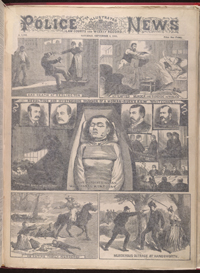 • The UK’s largest ever exhibition on comics opens at the British Library tomorrow. Comics Unmasked: Art and Anarchy in the UK examines the history of the comic book in the UK – from 19th century illustrated reports of Jack the Ripper to 1970s titles like 2000AD and Action and more recent works – and examines how they have been used to explore confronting subjects like violence, sexuality and drugs. Among the highlights is a specially commissioned work by Tank Girl and Gorillaz co-creator Jamie Hewlett and works by the likes of Neil Gaiman (Sandman), Alan Moore (Watchmen, V for Vendetta), Grant Morrison (Batman: Arkham Asylum) and Posy Simmonds (Tamara Drewe). Admission charge applies (and due to the graphic nature of some exhibits, the Library has issued a parental guidance warning for under 16s). Runs until 19th August. For more, see www.bl.uk/whatson/exhibitions/comics-unmasked/index.html. PICTURE: Jack the Ripper’s victims, Illustrated Police News, 1888 © British Library Board.
• The history of the white wedding dress goes under scrutiny at the V&A with its Wedding Dresses 1775-2014 exhibition opening on Saturday. The display includes more than 80 extravagant outfits from the museum’s collection – they include the Anna Valentine embroidered silk coat worn by The Duchess of Cornwall for the blessing of her marriage to The Prince of Wales in 2005, a purple Vivienne Westwood dress chosen by Dita von Teese for her wedding in 2005 and Dior outfits worn by Gwen Stefani and Gavin Rossdale on their wedding day in 2000. Some of the earliest examples in the chronological display including a silk satin court dress from 1775 and a ‘polonaise’ style brocade gown with straw bergere hat dating from 1780 lent by Chertsey Museum. The exhibition will also explore the growth of the wedding industry and the increasing media focus on wedding fashions. Admission charge applies. Runs until 15th March. For more, see www.vam.ac.uk.
• The golden era of Italian film during the 1950s and 1960s and the birth of celebrity culture – did you know the term paparazzi was coined in the 1960 Federico Fellini film La Dolce Vita? – are the subject of a new exhibition which opened at The Estorick Collection this week. The Years of La Dolce Vita features 80 photographs from the period depicting Italian movie stars and the Hollywood “royalty” like John Wayne, Charlton Heston, Lauren Bacall and Liz Taylor who were working in Italy at the time. Juxtaposed against Marcello Geppetti’s images of this “real-life dolce vita” are behind-the-scenes shots from the set of La Dolce Vita taken by cameraman Arturo Zavattini. Runs until 29th June. Admission charge applies. For more, see www.estorickcollection.com.
• The first British exhibition to explore the role of architecture in the Italian Renaissance opened at the National Gallery this week. Building the Picture: Architecture in Italian Renaissance Painting looks at the works of Italian masters such as Duccio, Botticelli and Crivelli with highlights including Sebastiano del Piombo’s The Judgment of Solomon – on display in London for the first time in 30 years – and Andrea del Verrochio’s The Ruskin Madonna. Five short films also form part of the display. Entry to the exhibition in the Sunley Room is free. Runs until September 21. For more information, see www.nationalgallery.org.uk.
Send all items of interest for inclusion to exploringlondon@gmail.com.
10 significant sites from Georgian London – 10. Wesley’s Chapel…
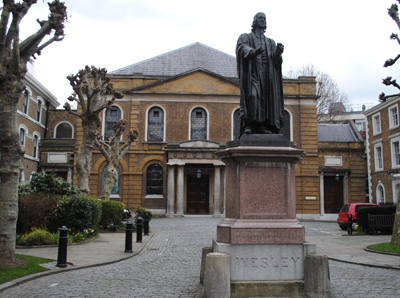 It’s a church with a difference for the final entry in our Georgian series. Known as the “Cathedral of Methodism”, the Grade I-listed chapel on City Road in the Borough of Islington was first opened in 1778 just over the road from Bunhill Fields graveyard and remains in use today.
Methodism’s founder, John Wesley, had already established a London base in a former cannon foundry close by known as the Foundery when the fact the lease was expiring and plans for residential development of the area led him to look elsewhere for a headquarters for the Methodism movement (which he still then considered part of the Anglican Church).
 Wesley approached the City of London for a new site and, following a massive fundraising effort, in April, 1777, the building’s foundation stone was laid. The architect for the new building was George Dance the Younger, then surveyor to the City of London, and the builder, a local preacher named Samuel Tooth.
The new chapel – which Wesley described as “perfectly neat, but not fine” – was opened on All Saints Day, 1778 – apparently Wesley spent the first 15 minutes of his sermon railing against the elaborate hats worn by female congregants.
The chapel last underwent a major restoration in the 1970s after it was found to be unsound and was reopened in 1978 in the presence of Queen Elizabeth II and the Duke of Edinburgh exactly 200 years after Wesley first opened it.
Inside the chapel – which features seats upon a gallery as well as the ground floor – features a ceiling said to have been the widest unsupported ceiling in England at the time it was built (the present one is a replica; the original had been damaged by fire in 1879).
The original pillars used in the chapel to support the gallery were ship’s masts from the naval dockyard at Deptford given as a gift from King George III – these were replaced during the centenary commemoration of Wesley’s death with pillars of French jasper in 1891 but a couple of originals can still be seen in the vestibule.
Memorials inside the chapel include those to John and Charles Wesley and early Methodists John Fletcher and Thomas Coke.
Next to the chapel is the house Wesley lived in during the last 11 years of his life (this can be visited – and we’ll cover it in more detail in a later post) and underneath it in the crypt is the Museum of Methodism – well worth a visit in its own right.
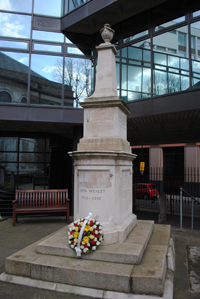
Wesley’s tomb (pictured) is located behind the east end of the church (accessed through the chapel) and outside the entrance to the chapel is a statue of Wesley. The grave of Susanna Wesley, mother of the Wesleys, can be found across the road in Bunhill Fields.
WHERE: Wesley’s Chapel, 49 City Road (nearest Tube station Old Street and Moorgate); WHEN: 10am to 4pm Monday to Saturday (services Sunday – check website for details); COST: free but donations welcome; WEBSITE: www.wesleyschapel.org.uk.
LondonLife – Celebrate Shakespeare with a cake…
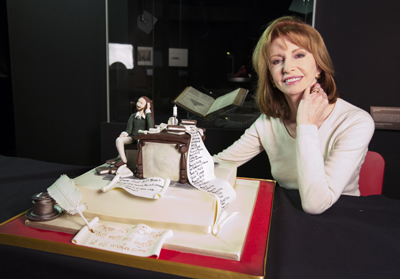
Time is running out for your entry into Cakespeare – the V&A’s competition to find the best Shakespeare-themed cake as part of the institution’s celebration of the 450th anniversary of William Shakespeare’s birth. The competition, which closes on 4th May, was launched earlier this month with an almost 15 kilogram cake created by Jane Asher Party Cakes (actress Jane Asher and the cake are pictured). A fruitcake, it features the playwright at work with a writing table and feature quill made from icing while a scroll lists the 36 plays in Shakespeare’s First Folio (which is on show in the V&A’s Theatre and Performance Galleries). To enter the competition, design, bake and decorate your cake celebrating Shakespeare and then upload an image of it to social media, tagged #Cakespeare. Oh, and the winner – selected by Asher and Geoff Marsh, director or the V&A’s department of theatre and performance – will receive a weekend for two in Stratford-upon-Avon complete with tickets to see the Royal Shakespeare Company. The V&A’s Shakespeare Festival runs until 4th May. For more, see www.vam.ac.uk. So enjoy your Shakespeare – and your cake…might be a way to take your mind off London’s transport woes! PICTURE: Victoria and Albert Museum, London.
What’s in a name?…Seven Dials…
 Standing at the junction of seven streets in London’s West End is a pillar topped with six – that’s right, six – sundials, giving the intersection and the surrounding area its name.
The layout of the area was originally designed by Thomas Neale, an MP and entrepreneur, in the early 1690s – it was part of the rebuilding of London after the Great Fire of 1666 – and initially had the pillar standing at the centre of six streets before it was later increased to seven. The streets which radiate out from the hub include Earlham, Mercer and Monmouth Streets and Shorts Gardens.
 While Neale, who designed the street layout to maximise street frontages and thus his return, had hoped the area would attract the well-to-do, it was not be and by the 19th century the area had become one of the cities most notorious slums, considered part of the infamous rookery of St Giles.
That has since changed and today the area is at the heart of a bustling commercial district, the streets which run off it housing stylish shops and offices.
The pillar itself apparently never had seven faces – there is the suggestion that the column itself was the seventh – and while the original column was removed in 1773, apparently by city authorities keen to rid the area of undesirables, it was replaced with a replica column in the late 1980s and unveiled by Queen Beatrix of The Netherlands to commemorate the tercentenary of the reign of King William III and Queen Mary II in June, 1989.
The original column, meanwhile, was apparently first acquired by an architect, James Paine, who kept it at his house in Surrey, before, in 1820, being taken to Weybridge where, in 1820, the column was re-erected as a memorial to Princess Frederica, Duchess of York (who had lived there). The dial-stone, meanwhile, was used as a mounting block before eventually being placed outside the Weybridge Library.
This Week in London – A rare chance to walk through a Thames tunnel; Matisse at the Tate; and, Spitting Image on show…
• It’s a rare chance to walk the historic Thames Tunnel between Wapping and Rotherhithe – the first tunnel ever dug under a navigable waterway. Transport for London and London Overground are offering the chance to purchase tickets to walk the tunnel – built by Marc Brunel, it’s now used by the London Overground – over the May Bank Holiday weekend on 24th to 26th May. Tickets, which cost £18 plus booking fee, go on sale today at 10am via the London Transport Museum in Covent Garden and are strictly limited (with no on the day admissions allowed). Proceeds from the day will go to the Railway Children’s Charity and the Brunel Museum. Also, worth noting is that the London Transport Museum is offering tours of its depot this Friday and Saturday. Admission charge applies. For more, see www.ltmuseum.co.uk.
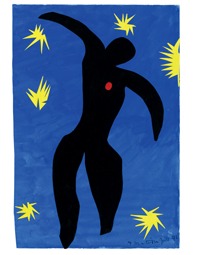 • The paper cut-outs of Henri Matisse are the focus of a landmark exhibition which opened at Tate Modern last week. Henri Matisse: The Cut-Outs features about 130 works created between 1937 and 1954 with many seen together for the first time. Highlights include maquettes featured in the 1947 book Jazz, The Snail and its sister work Memory of Oceania (both 1953) and the largest number of the Blue Nudes ever shown together. The display takes an in-depth look at the methods and materials Matisse used in the production of the cut-outs. Runs until 7th September (and keep an eye out for the accompanying film, Matisse: Live in cinemas). Admission charge applies. For more, see www.tate.org.uk. PICTURE: Henri Matisse, Icarus 1946, Maquette for plate VIII of the illustrated book Jazz 1947, Digital image: © Centre Pompidou, MNAM–CCI, Dist. RMN-Grand Palais / Jean-Claude Planchet, Artwork: © Succession Henri Matisse/DACS 2014.
• On Now: Spitting Image. This exhibition at the Cartoon Museum in Bloomsbury centres on the partnership of three dimensional artists Peter Fluck and Roger Law and their key role in the creation of what became known as Spitting Image. It features caricature drawings and photographs created for magazines in the 1970s and 1980s of the likes of Paul McCartney, Michael Jackson, Kate Moss, Saddam Hussein, Billy Connolly, Rupert Murdoch, Jo Brand and John Paul II as well as members of the Royal Family and politicians including Margaret Thatcher. Also present are some of the puppets used in the TV show which ran for 18 series between 1984 and 1996 – these include those of Thatcher, The Queen, Princess Diana and Mr Spock. Runs until 8th June (with selected late opening nights). Admission charge applies. For more, see www.cartoonmuseum.org.
Send all items of interest for inclusion to exploringlondon@gmail.com.
10 significant sites from Georgian London – 9. Dr Johnson’s House…
In contrast to some of the grand homes we’ve featured as part of this series (and there are many more that we haven’t, meaning we might have a future series solely dedicated to them!), comes the rather more humble City home of lexicographer and renowned wit Samuel Johnson.
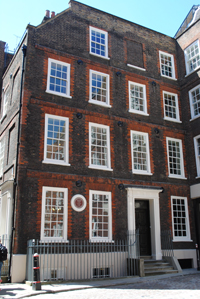 The brick townhouse at 17 Gough Square – which lies between Fleet Street and Holborn – was actually built in the late 17th century (before the Hanoverian accession) for wool merchant Richard Gough.
Johnson – who apparently had at least 17 different London residences – didn’t move in here as a tenant until 1748 and stayed for more than a decade until 1759 (seven years after the death of his wife – for more on Johnson, see our earlier ‘Famous Londoners’ post). It was during his tenancy here that he compiled his famous text, A Dictionary of the English Language. The first comprehensive English language dictionary, it was published in 1755.
The four level property, which is now a museum and has been set up as it was in Johnson’s day, was used by the writer as a residence as well as a workplace and the top floor garret is where six copyists worked transcribing the entries for the dictionary.
As well as the rather spectacular staircase, the property features furnishings from the period as well as portraits, prints and other Johnson-related memorabilia. There is a plaque which was placed on the exterior of the property by the Royal Society of Arts in 1876.
After Johnson vacated the premises, the property was used for various purposes including as a small hotel, B&B and a printer’s workshop. It had fallen into disrepair by the early twentieth century but was saved by MP Cecil Harmsworth who restored it and opened it to the public in 1914 (the small curator’s house was built after this). The house was damaged during World War II bombings – when it was used as a canteen by fireman – but survived. It is now operated by a charitable trust.
Outside the house in Gough Square is a statue of Johnson’s cat Hodge (see our earlier post here) and the property is only a short walk from the historic pub Ye Olde Cheshire Cheese (see our earlier post here).
WHERE: Dr Johnson’s House, 17 Gough Square (nearest Tube station Chancery Lane, Temple, Farringdon and Blackfriars); WHEN: 11am to 5.30pm (May to September); COST: £4.50 adults/£1.50 children (5-17 years)/£3.50 concession/£10 family; WEBSITE: www.drjohnsonshouse.org
LondonLife – Rooftops in Chelsea…
 Angular rooftops stacked one upon the other in Chelsea in London’s west.
This Week in London – Meet King George I this Easter; celebrating Shakespeare’s 450th; and feasting with St George in Trafalgar Square…
• Historic Royal Palaces are offering you the chance to meet King George I and explore the world in which he lived at his former real-life home of Hampton Court Palace this Easter weekend. A re-enactment marking the 300th anniversary of his accession will have the new Hanoverian king arrive by royal barge on the River Thames and will also include courtiers taking part in a “stately dance”, the King’s troupe of Hanoverian horses performing a “horse ballet” and a Georgian Army encampment with soldiers involved in firing displays. Visitors to the palace will also be able to see a new re-presentation of the Queen’s State Apartments which explores who the Hanoverians were, how they came to rule and their many and bitter family feuds. Runs from tomorrow (18th April) to 21st April. Admission charge applies. For more, see www.hrp.org.uk/HamptonCourtPalace/.
• The 450th anniversary of Shakespeare’s birth is being celebrated with a week of events at the Guildhall Library next week. Kicking off on Tuesday, 22nd April, and running until Friday, 25th April, events include talks – with subjects including ‘Shakespeare’s London Theatreland’ and ‘Imaging Shakespeare’s Indoor Theatre’, and a six hour complete reading of Shakespeare’s sonnets with readers including actor Damian Lewis, author Alan Hollinghurst and Lord Mayor of City of London Fiona Woolf as well as Shakespeare-themed walks around the City and Southwark, and the free Shakespeare in Print exhibition at the Library. For more, see www.cityoflondon.gov.uk/things-to-do/visiting-the-city/archives-and-city-history/guildhall-library/Pages/default.aspx. Meanwhile, the V&A is also holding a Shakespeare Festival, kicking off next Monday and running until 4th May. Highlights of the festival include screenings of some of the best theatre productions of Shakespeare in the last 20 years, live performances by actors and musicians and a series of debates and talks including the “interactive lecture” Marchpane to Mutton – A Taste of Shakespeare’s Time by food historian and artists Tasha Marks. There’s also a competition – Cakespeare – in which the public are invited to design, bake and decorate a Shakespeare-themed cake and share an image of it on social media (#Cakespeare) by 4th May with the winner to receive a weekend for two to Stratford-upon-Avon and tickets to the Royal Shakespeare Company. The festival is being complemented by a display in the Theatre and Performance Galleries, Shakespeare: Greatest Living Playwright which features the First Folio as its centrepiece. Admission is free. See www.vam.ac.uk for more.
• It might be two days ahead of the official saint’s day, but the Feast of St George will be celebrated in Trafalgar Square this Bank Holiday Monday with a banquet and guests including a five metre high interactive dragon. The festivities, hosted by Mayor of London Boris Johnson, will also include an English Farmers’ Market featuring 20 stalls, a kid’s marquee and traditional wooden garden games, harlequins on stilts, swing boats and circus lessons for children, a bandstand located in front of Nelson’s Column and a 12 foot tall Maypole. Runs from noon to 6pm. For more, see www.london.gov.uk/feast.
Send all items of interest for inclusion to exploringlondon@gmail.com.
10 significant sites from Georgian London – 8. Marble Hill House…
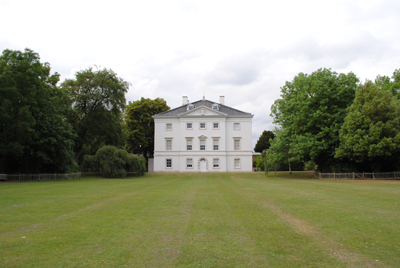 A Palladian villa located on the bank of the Thames between Richmond and Twickenham, Marble Hill House was built in the mid to late 172os for Henrietta Howard, mistress of King George II and later Countess of Suffolk.
The symmetrical property – seen as a model for later Georgian-era villas in both England and overseas – was constructed by Roger Morris. He, along with Henry Herbert – a friend of the countess and later the 9th Earl of Pembroke – was also involved in its design as was Colen Campbell, architect to the Prince of Wales and future King George II, who is believed to have drawn up the first sketch designs for the house.
As well as being familiar with the work of neo-Palladian Inigo Jones, Lord Herbert had travelled in Italy and there is it believed had directly encountered the works of sixteenth century Italian architect Andrea Palladio whose architecture the property emulated (see our earlier post on Chiswick House here).
Key rooms include the ‘great room’ – a perfect cube, this is the central room of the house and boasts a wealth of gilded carvings; the dining parlour which had hand-painted Chinese wallpaper; and, Lady Suffolk’s rather sparsely furnished but nonetheless impressive, bedchamber.
 Howard, who as well as being a mistress of King George II both before and after his accession to the throne in 1727, was a Woman of the Bedchamber to his wife, Queen Caroline of Ansbach, and, as a result, initially spent little time at the property (which coincidentally was built using money the King had given her while he was still Prince of Wales).
But after she become the Countess of Suffolk in 1731 when her estranged husband Charles Howard became 9th Earl of Suffolk after his brothers’ deaths, Lady Suffolk was appointed Mistress of the Robes, and following the death of her husband in 1733, retired from court.
In 1735 following the end of her intimate relationship with the King, she married a second time, this time happily, to George Berkeley, younger brother of the 3rd Earl of Berkeley and an MP. Together the new couple split their time between a house in Savile Row and Marble Hill. Her husband died in 1746 and Lady Suffolk, who had come to be considered a very “model of decorum”, died at Marble Hill in 1767.
Among the visitors who had spent time at the property were poet and neighbour Alexander Pope (responsible for the design of the grounds along with royal landscape gardener Charles Bridgeman), writer and satirist Jonathan Swift, and, in Lady Suffolk’s later years, Horace Walpole – son of PM Sir Robert Walpole and builder of the Gothic masterpiece Strawberry Hill.
Following Lady Suffolk’s death, later residents of the property included another Royal Mistress – Mrs Fitzherbert, mistress to the future King George IV, Swedenborgian Charles Augustus Tulk and Jonathan Peel, brother of Sir Robert Peel (you can read more about Sir Robert Peel here).
Following the latter’s death, the house stood empty for many years before publication of plans for a redevelopment by then owner William Cunard caused a public outcry which saw the property pass into the hands of the London County Council around the year 1900.
The house opened to the public as a tea room in 1903 and remained as such until the mid-1960s when, now in the hands of the Greater London Council, it underwent a major restoration project and was reopened as a museum. In 1996, the house – which now stands on 66 acres and can be seen in a much lauded view from Richmond Hill – came into the care of English Heritage.
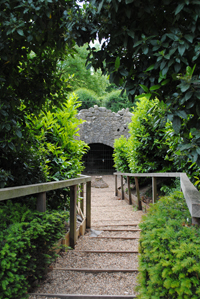
The grounds – Marble Hill Park – are open to the public for free and include a cafe located in the former coach house. Other features in the grounds include Lady Suffolk’s Grotto – pictured above – based on one at Pope’s residence nearby. It was restored after being rediscovered in the 1980s.
WHERE: Marble Hill House, Richmond Road, Twickenham (nearest Tub-e station is Richmond (1 miles) or train stations at St Margaret’s or Twickenham); WHEN: Various times Saturday and Sunday – entry to the house by guided tour only; COST: £5.90 adults/£3.50 children (5-15 years)/£5.30 concession/£15.30 family; WEBSITE: www.english-heritage.org.uk/daysout/properties/marble-hill-house/.
LondonLife – Pigeon collective at Embankment…

A flight of pigeons meet outside Embankment Tube Station.
A Moment in London’s History – The Battle of Barnet helps to secure the throne for King Edward IV (again)…
It was exactly 543 years ago today that the Battle of Barnet – one of the key battles of the Wars of the Roses – was fought near what was then the small town of Barnet but is now an area on Greater London’s outer northern fringe.
 King Edward IV, returning from exile in Burgundy after he was ousted by the Lancastrians, led an estimated 10,000 Yorkists in an engagement with some 15,000 Lancastrians (who backed King Henry VI) under the command of Richard Neville, 16th Earl of Warwick and known as the Kingmaker, who had previously supported the Yorkists (and before that the Lancastrians).
The forces met on 14th April, 1471, at around dawn but thick fog sewed confusion in the Lancastrian ranks with allies attacking each other and the army eventually fell apart amid cries of treachery. Warwick was killed in the battle as he attempted to flee.
The exact site of the battle remains something of an unknown although it is thought to span the community of Monken Hadley just to the north of Barnet itself (that is the area marked on the official English Heritage Register of Historic Battlefields).
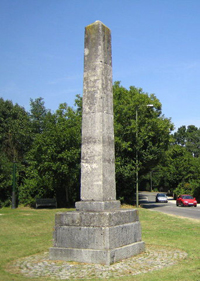
A stone monument to the battle, the Hadley Highstone, was erected in the 18th century and in the 1800s was moved to its current location at the junction of Kitts End Road with the Great North Road in Monken Hadley and was originally thought to have marked the spot on which Warwick died. The Battlefields Trust is currently developing a project to pin down the location further.
The battle was important because, along with the following Battle of Tewkesbury during which the Lancastrian heir Edward was killed (and the murder of King Henry VI shortly after), it secured the throne for King Edward IV for the next 14 years.
PICTURE: Nigel Cox/Wikipedia
 Exploring London