10 (lesser known) statues of English monarchs in London…7. Three Stuart Kings and a Queen… 

King Charles I (left) and his son King Charles II on what is now the south side of the gateway. PICTURE: haluk ermis (licensed under CC BY 2.0)

The equestrian statue of King Charles I at the top of Whitehall is one of London’s most well-known. But less well-known is the statue of the ill-fated King which can be found standing in a niche on the Temple Bar gateway, located at the entrance to Paternoster Square just outside of St Paul’s Cathedral.

Charles is not alone. Part of the gateway’s purpose was as a dynastic statement in support of the Stuarts so the grand portal also features statues of Charles’ father King James I, his mother Queen Anne of Denmark, and his son King Charles II. King James and Queen Anne can be found on the north side of the gateway (originally the east side) and the two Charles’ on the south side (originally the west side).

The design of the gateway, which originally stood at the intersection of Fleet Street and the Strand as a ceremonial entrance into the City of London, is believed to be the work of Sir Christopher Wren who was acting on the orders of King Charles II after the Great Fire of London.

Queen Anne of Denmark and King James I on the north side of the gateway. PICTURE: lizsmith (licensed under CC BY-NC-ND 2.0)

The statues, which cost a third of the total £1,500 spent on the gateway, are said to have been sculpted by one John Bushnell. They are depicted in Roman attire rather than the dress they would have worn during the period.

They were removed when the gateway was dismantled in 1878 and stored in a yard of Farringdon Road and when the gateway was re-erected at Lady Meux’s Hertfordshire estate at Theobold’s Park, they were placed back in their original locations. And they also accompanied the gateway back to the city when it was positioned its current location in 2004.

LondonLife – Superbloom at the Tower of London…

The Queen’s Garden, part of the Superbloom as seen near the Tower’s entrance on 22nd May. PICTURE: © Historic Royal Palaces
A Yeoman Warder in the transformed moat with Mehrdad Tafreshi’s swarm of insects. PICTURE: © Historic Royal Palaces

Twenty million seeds have been sown into the Tower of London’s moat to create a floral display known as ‘Superbloom’ as part of the celebrations surrounding Queen Elizabeth II’s Platinum Jubilee.

Paths, walkways and viewing points have been installed throughout and in a first at the Tower, a four lane slide has been installed to provide an unusual entrance to the display.

Those visiting the display – which features wildflowers such as red poppies, yellow corn marigolds and blue cornflowers as well as garden plants including sunflowers, cosmos and rudbeckias – will hear a score by Scottish composer Erland Cooper – Music for Growing Flowers – while other attractions include a willow sculpture by artist Spencer Jenkins and a swarm of intricate copper insects by sculptor Mehrdad Tafreshi.

The centrepiece of the display is the “Queen’s Garden” which has been installed by Grant Associates – the lead designers for the Superbloom project – in the Tower’s historic Bowling Green.

A willow sculpture by Spencer Jenkins. PICTURE: © Historic Royal Palaces

Inspired by the Queen’s Coronation gown, this garden features a combination of meadow flowers, topiary and summer-flowering perennials, bulbs and ornamental grasses and draws on the colours, shapes and motifs used by designer Norman Hartnell in the 1953 gown.

Rising above the garden are 12 cast glass forms by glass artist Max Jacquard which represent the national emblems featured in Hartnell’s design and in their centre sits a glass crown, a reminder of the Tower’s role as home of the Crown Jewels.

Tower Wharf, meanwhile, has been transformed into a food and drinks venue, with street food and bars from KERB and fine dining available riverside in ‘The Glass Rooms’. The flowers are expected to gradually bloom in June and will continue to evolve until September. For more, including how to purchase tickets, head here.

The slide entrance to the Superbloom as seen on 22nd May. PICTURE: © Historic Royal Palaces
Mehrdad Tafreshi’s swarm of insects as seen on 22nd May. PICTURE: © Historic Royal Palaces

Lost London – Westminster Abbey’s Sanctuary Tower…

The Middlesex Guildhall building, once site of the Sanctuary Tower. PICTURE: Cary Bass-Deschenes (licensed under CC BY-SA 2.0)

Located on the site now occupied by the Middlesex Guildhall, the Sanctuary Tower and Old Belfry was where fugitives of the law could seek refuge from those who pursued them.

The 13th century tower was located on the western side of Thorney Island upon which Westminster Abbey stood. Standing two stories high, it was a fortified structure with heavy oak doors.

The tower had some high profile (temporary) residents over the years of its existence. These included Elizabeth Woodville, Queen of King Edward IV, who twice had to take sanctuary in the abbey during the Wars of the Roses, Henry Holland, the Duke of Exeter, who claimed sanctuary after the Battle of Barnet (and was subsequently found drowned in the Thames), and Tudor Poet Laureate John Skelton who had to flee here after crossing Cardinal Thomas Wolsey (he is buried in nearby St Margaret’s Church, some claim he died in the tower).

While the practice of granting sanctuary was abolished by King James I in 1623, the tower wasn’t demolished in 1776.

The name of the building and practice of sanctuary is reflected in the name of the nearby street known as Broad Sanctuary and short drive before Westminster named The Sanctuary.

This Week in London – The Queen in wartime; Dippy returns; and, ‘Cancer Revolution’ at the Science Museum…

A new exhibition exploring the Queen’s role during wartime opens at IWM London in Lambeth tomorrow. Part of a suite of events at IWM venues celebrating the Queen Elizabeth II’s Platinum Jubilee, Crown and Conflict: Portraits of a Queen in Wartime features 18 images drawn from the museum’s image archive which chart the Queen’s experience of war – from growing up during World War II when she served in the Auxiliary Territorial Service to her role in carrying out important public duties involving the armed forces, including at the annual Service of Remembrance. Among newly digitised photographs included in the display are an image of the Queen dressed in overalls and cap while working on a vehicle during her time in the ATS, and another showing her with her father, King George VI, and mother, Queen Elizabeth, during a visit to airborne forces in 1944. IWM London is also launching a dedicated trail of historic objects spread across five gallery spaces which explores the Royal Family’s long-standing association with the British armed forces. Objects include a Princess Mary Gift Fund box which was sent to those serving at Christmas in 1914. Runs until 8th January. Admission charge applies. For more, see www.iwm.org.uk/events/queens-platinum-jubilee-iwm-london.

Dippy at the Natural History Museum. © Trustees of the Natural History Museum, London

• Dippy the dinosaur is back for a limited time at the Natural History Museum in South Kensington from tomorrow. A free, temporary exhibition – Dippy Returns: the nation’s favourite dinosaur – gives visitors the chance to get up close and personal with the 26 metre-long dinosaur which first went on display at the museum in 1905. The display comes at the end of a record-breaking tour of the UK in which Dippy was seen by more than two million people. Can be seen until 2nd January. To book tickets, head to www.nhm.ac.uk.

The first major exhibition to explore the history and future of cancer treatment and research opened at the Science Museum in South Kensington this week. Cancer Revolution: Science, innovation and hope features more than 100 objects including some never-before seen as well as information on cutting edge treatment and research, new artist commissions and installations, interactive exhibits and a breadth of personal stories. Runs until January, 2023. Admission is free but bookings required. For more, see www.sciencemuseum.org.uk/see-and-do/cancer-revolution-science-innovation-and-hope.

Send all items to exploringlondon@gmail.com for inclusion.

10 (lesser known) statues of English monarchs in London…6. King Edward the Confessor and King Henry III…

PICTURE: Davide Simonetti (licensed under CC BY-NC 2.0/image has been cropped and enhanced).

These two statues are listed together because they both appear on the exterior of the same building – The Sanctuary which stands next to Westminster Abbey.

Close-up of Henry III. PICTURE: Can Pac Swire (licensed under CC BY-NC 2.0/image has been cropped).

This Grade II-listed building, which contains a gateway to the Dean’s Yard, was designed by Sir George Gilbert Scott and built in Bath stone with slate roofs in the mid-1850s.

The statues, which stand in niches on the exterior of the turrets on either side of the gateway, have been identified as the two kings on London Remembers.

Their position at this location is not random. The king on the left, identified as Edward the Confessor, had St Peter’s Abbey rebuilt here in the mid 11th century (and was buried in it only a week after its consecration).

The king on the right, King Henry III, rebuilt the abbey church in the mid-13th century to provide a shrine to venerate Edward the Confessor and as a site for his own tomb.

The kings are apparently not the only monarchs adorning the building – two roundels below them depict Queen Victoria and Prince Albert.

LondonLife – Icons turn purple to celebrate Elizabeth Line opening…

Marble Arch lights up for the launch of the Elizabeth Line.. PICTURE: © TfL

Iconic London locations including Tower Bridge, The London Eye, and Marble Arch turned purple last night to mark the opening of the new Elizabeth Line today. Thousands of people are today expected to use the new Tube line which provides faster journeys between Paddington and Abbey Wood via 10 new stations using Class 345 trains that are more and than one-and-a-half times longer than a standard Tube train and able to carry 1,500 passengers. The line’s opening is the latest step in the £18.8 billion Crossrail project which is linking Reading, to the west of London, with Heathrow before travelling through central London to connect with Shenfield and Abbey Wood in the east. Sadiq Khan, the Mayor of London, said it was an “historic day”. “This is a huge moment, not just for London but the entire country – particularly in this special Jubilee year…This brand new line is the most significant addition to our transport network in decades.” Last week, the Queen and Prince Edward attended Paddington Station to mark the completion of the new line.

The London Eye illuminated. PICTURE: © TfL
Woolwich Town Hall lit up in purple. PICTURE: © TfL
A very excited first customer on the Elizabeth Line at its opening on 24th May. PICTURE: © TfL
HM Queen Elizabeth II, HRH Prince Edward Earl of Wessex, at unveiling of commemorative plaque at Paddington Station on 17th May. PICTURE: © TfL

This Week in London – Marble Hill revived; Harry Kane at the Museum of London; and, golden books at the British Library…

Marble Hill in London’s west reopens on Saturday following a restoration and the reinstatement of a lost pleasure garden. Once home to King George II’s mistress Henrietta Howard, Countess of Suffolk, Marble Hill is a rare example of a home built by and for a woman in Georgian England and is one of the last survivors of the many 18th century villas that once fronted the Thames in the area. Marble Hill was built as a country retreat from London’s crowds and among those entertained here were poet Alexander Pope, Horace Walpole, John Gay and Jonathan Swift. English Heritage has invested £3 million into a major transformation of the house and 66 acres of riverside parkland which also used a £5 million grant from The National Lottery Heritage Fund and The National Community Lottery Fund. This has included the reinstatement of a pleasure garden – an “Arcadian landscape” which was inspired by sketches made by Pope – with the opening up of previously inaccessible woodland areas, the reinstallation of paths and the replanting of avenues of trees that led from the house to the river. Howard’s ninepin bowling alley has been restored and an 18th-century garden grotto has been excavated and returned to its 18th-century appearance. Inside the house, English Heritage has re-instated the paint scheme that existed during Howard’s lifetime in several interior spaces, including the Great Room, conserved the fine collection of early Georgian paintings which includes portraits of Howard’s circle and re-created furniture including an intricate carved peacock motif table and luxurious crimson silk wall hangings in her dressing room. The new display has reframed Howar’s beyond being simply the King’s mistress by also exploring her abusive first marriage and the role deafness played in her life as well as her rise in Georgian society and the social circles she captivated. Entry to the house is free. For more, head to www.english-heritage.org.uk/visit/places/marble-hill-house/.

Harry Kane of England celebrates after scoring their side’s second goal during the UEFA Euro 2020 Championship Round of 16 match between England and Germany at Wembley Stadium on 29th June, 2021 in London, England. PICTURE: Catherine Ivill/Getty Images.

England football captain Harry Kane is the subject of a new exhibition opening at the Museum of London on Saturday. Harry Kane: I want to play football features sporting memorabilia including the shirt Kane, who grew up in Chingford, East London, wore on his debut for England where he scored against Lithuania just 79 seconds after coming on the pitch, Kane’s MBE which was awarded to him in March 2019 for ‘services to sport’ and the 2018 World Cup Golden Boot (Kane being one of only two British players to receive a Golden Boot at a World Cup competition, where he was named Man of the Match three times) as well as family photos. The display also includes a changing room space where visitors can listen to Kane’s pre-match playlist and an interactive area where visitors can learn more about who has inspired Harry and share their own hopes and dreams. A programme of activities for families and children will run alongside the free display. Runs until December. For more, see www.museumoflondon.org.uk.

The use of gold in embellishing and enhancing the written word across cultures, faiths and through time is the subject of a new exhibition opening at the British Library. Gold, which opens Friday, showcases some of the most luxurious illuminated manuscripts, gold-tooled books, sacred texts and scrolls from the British Library’s collection with objects on display including the Harley Golden Gospels, the Lotus Sutra and a treaty in Malayalam, beautifully inscribed on a long strip of gold itself. Admission charge applies. Runs until 2nd October. For more, see www.bl.uk.

Send all items to exploringlondon@gmail.com.

10 (lesser known) statues of English monarchs in London…5. Queen Elizabeth I at Westminster School…

Close-up of the statue of Queen Elizabeth II. PICTURE: Close-up of the statue of Queen Elizabeth II. PICTURE: Matt Brown (licensed under CC BY 2.0)

This rather unusual statue of Queen Elizabeth I is a relatively new addition – it was dedicated 12 years ago on what was the 450th anniversary of the refounding of Westminster School – more properly The Royal College of St Peter in Westminster – by the aforementioned Queen.

The larger-than-life statue, which can be found in Little Dean’s Yard, is the work of a former pupil, sculptor Matthew Spender.

It depicts the Queen in white Travertino Noce stone while her head, surrounded by a giant white ruff is gilded bronze with what was auburn hair. The unusual depiction has certainly attracted its share of detractors.

The statue, which was commissioned by the Westminster School Society, was unveiled by the Queen’s namesake, Queen Elizabeth II, on 21st May, 2010.

There’s a more famous – and more typical – statue of Queen Elizabeth I on the exterior of St Dunstan-in-the-West in Fleet Street and another on the exterior of Guildhall.

Guided tours of the school can be arranged during the school’s holidays. For more information, see www.westminster.org.uk/about/our-history/guided-tours/.

LondonLife – Scenes from the State Opening of Parliament…

Prince Charles and Camilla, Duchess of Cornwall, leave the State Opening of Parliament. PICTURE: Sgt Donald C Todd RLC Photographer/UK MOD © Crown copyright 2022

Queen Elizabeth II didn’t attend the State Opening of Parliament last Tuesday for the first time in almost 60 years with Prince Charles delivering the Queen’s Speech for the first time. In an event that’s all about pomp and pageantry, more than 500 soldiers and 125 military horses took part in a variety of ceremonial roles over the day.

Members of the Household Cavalry line the steps for the opening of State Parliament. PICTURE: Sgt Donald C Todd RLC Photographer/UK MOD © Crown copyright 2022.
The Band of the Scots Guards playing for the State Opening of Parliament. PICTURE: Sgt Donald C Todd RLC Photographer/UK MOD © Crown copyright 2022.

This Week in London – Charles Jennens at the Foundling Museum; Dr John Conolly’s Blue Plaque; and, Kyōsai at the Royal Academy…

The Foundling Museum. PICTURE: dvdbramhall (licensed under CC BY-NC-ND 2.0)

Charles Jennens, who is best-known as the librettist of Handel’s Messiah but was also a patron of the arts, scholar and educator, is the subject of a new exhibition opening at the Foundling Museum in Bloomsbury on Friday. Charles Jennens: Patron & Polymath features portraits, correspondence and printed documents reflecting the varied interests and achievements of this Georgian character. Jennens was a non-juror – meaning he supported the legitimacy of the deposed Catholic Stuarts – but was also a Protestant. His art collection was one of the best in Britain and his Palladian mansion, Gopsall Hall in Leicestershire, featured a music room with an organ built to Handel’s specifications. Admission charge applies. Runs until 16th October. For more, see https://foundlingmuseum.org.uk/event/charles-jennens-polymath/.

• Dr John Conolly, an early advocate of human treatments for people living with mental illness and the former Hanwell Asylum have been commemorated with an English Heritage Blue Plaque to mark Mental Health Awareness Week. The plaque has been placed on what was the left wing of the asylum and is now part of St Bernard’s Hospital. It was here that Conolly, who was appointed Resident Physician at the Middlesex County Pauper Lunatic Asylum in 1839 – then one of the biggest asylums in London, advocated a system of ‘non-restraint’ which, though initially seen as controversial, drew support from reformers and which by 1846 had been embraced as ruling orthodoxy by the then-new national Lunacy Commission. For more, see www.english-heritage.org.uk/visit/blue-plaques/.

On Now: The works of Kawanabe Kyōsai, the most popular Japanese painter of the late 19th century, are on show in the Royal Academy’s Gabrielle Jungels-Winkler Galleries. Kyōsai: The Israel Goldman Collection focuses largely on the art of sekiga or ‘spontaneous paintings’ which were produced at ‘calligraphy and painting parties’ (shogakai), often fuelled by prodigious amounts of saké. The display – the first monographic exhibition of Kyōsai’s work in the UK since 1993 – includes around 80 words, many of which have never been exhibited. Admission charge applies. Runs until 19th June. For more, see www.royalacademy.org.uk.

Send all items for inclusion to exploringlondon@gmail.com

10 (lesser known) statues of English monarchs in London…4. King Edward VII…

PICTURE: Nigel Chadwick (licensed under CC BY-SA 2.0)
PICTURE: Singh (licensed under CC BY-NC-ND 2.0)

It’s a rather incongruous place for a king. Standing outside the entrance to Tooting Broadway Underground Station is a large-than-life statue of King Edward VII, who ruled from 1901-1910.

Erected in 1911 after the King’s death, the statue is the work of Louis Fritz Roselieb (later Roslyn) and was funded through a public subscription.

The statue depicts the King in royal regalia holding a sceptre in his right hand with his left hand resting on his sword hilt. The plinth features bronze reliefs on either side depicting representations of ‘peace’ and ‘charity’.

Given Tooting Broadway Underground Station didn’t open until 1926, the statue wasn’t initially located in relation to it.

In fact, it was originally located on a traffic island a short distance from its current siting but was moved after the area was remodelled in 1994.

It isn’t, of course the only statue of King Edward VII in London – the more well known one can be found in Waterloo Place. It was unveiled by his son, King George V, in 1921.

LondonLife – Green spaces form part of ‘Green Canopy’ for Queen’s Platinum Jubilee…

Epping Forest. PICTURE: martin_vmorris (licensed under CC BY-SA 2.0)

City of London-managed open spaces Epping Forest, Burnham Beeches and Ashtead Common have been selected to be part of a nationwide network of 70 ancient woodlands to be dedicated to The Queen in celebration of the Platinum Jubilee. At almost 6,000 acres, Epping Forest is London and Essex’s largest green space and is known as the “green lungs” of London. Burnham Beeches, located in Buckinghamshire, is only a square mile in size but is described as a “New Forest in miniature” while Ashtead Common in Surrey’s 200 hectares of open public space is home to more 1,000 living ancient oak pollards. For more on The Queen’s Green Canopy initiative, see www.queensgreencanopy.org. For more on the City of London’s green spaces, see www.cityoflondon.gov.uk/things-to-do.

Burnham Beeches. PICTURE: synx508 (licensed under CC BY-NC 2.0)


Ashtead Common. PICTURE: Pollards Hill Cyclists (licensed under CC BY-NC 2.0)

Where’s London’s oldest…synagogue?

PICTURE: John Salmon (licensed under CC BY-SA 2.0)

Actually the oldest synagogue in continuous use in the entire UK, the Bevis Marks Synagogue in the City of London was built in 1701.


The synagogue entrance. PICTURE: Edwardx (licensed under CC BY-SA 3.0)

The synagogue has historical ties to the city’s Spanish and Portuguese Jewish community, known as Sephardic Jews, which first started meeting together in a small synagogue in Creechurch Lane in 1657 after it become possible for Jews to openly practice their religion under the rule of Lord Protector Oliver Cromwell.

Increasing numbers in the community soon meant a larger premises was required and a committee was formed which signed a contract with Quaker builder Joseph Avis in February, 1699, to build a larger premises (tradition holds that Avis returned the money he made on the job to the community, saying he would not profit from building a house of God). In June that same year, the community leased a tract of land at Plough Yard, Bevis Marks, on which the new building would be built. Construction commenced soon after.

The property’s design is said to emulate, at least in part, that of the 1675 Portuguese Synagogue of Amsterdam (it’s also thought the design was influenced by the works of Sir Christopher Wren). There’s also a story that the building included an oak beam from one of the Royal Navy’s ships presented by Queen Anne.

The rectangular building, which features three galleries inside, was eventually completed and dedicated in September, 1701.

The roof of the now Grade 1-listed building was replaced following a fire in 1738 and the synagogue only suffered minor damage during the Blitz. It also suffered some collateral damage from the IRA bombing in 1992 and the 1993 Bishopsgate bombing but remains mostly intact.

Sermons at Bevis Marks were in Portuguese until 1833 when they changed to English.

Features inside include an oak Renaissance-style ark containing the Torah scroll which, painted to resemble coloured Italian marble, is located at the centre of the eastern wall. There are also seven hanging brass candelabra which symbolise the seven days of the week. The largest, which hangs in the centre of the synagogue – represents the Sabbath and was donated by the community of the Great Synagogue of Amsterdam. There are also 10 large brass candlesticks representing the Ten Commandments. While the upright oak seats are said to “reflect the Puritanism of 17th century England”, the backless oak benches at the back are the original seats which were brought from the Creechurch Lane premises.

Twice Prime Minister Benjamin Disraeli’s 1804 birth is recorded in the register but after his father had a falling out with the synagogue officials, Disraeli was in 1817 baptised at St Andrew’s Holborn.

The synagogue is temporarily closed to visitors and tour groups. For more information, head to www.sephardi.org.uk/bevis-marks/visit-bevis-marks/.

This Week in London – Disney’s French influence; Eid in the Square; and, Sir Isaiah Berlin’s Blue Plaque…

Beauty and the Beast, 1991, Peter J Hall, Concept art, gouache, marker and ink on paper © Disney

• The connection between Disney’s animated films and French 18th-century art is explored in an exhibition at the Wallace Collection. Inspiring Walt Disney: The Animation of French Decorative Arts, which is being held in collaboration with New York’s Metropolitan Museum of Art, features more than 120 examples of production artwork and works on paper from the Walt Disney Animation Research Library and the Walt Disney Archives alongside approximately 30 18th-century artworks. The latter include Jean-Honoré Fragonard’s much-loved painting, The Swing (c1767), which provided inspiration for Disney films including Beauty and the Beast (1991), Tangled (2010) and Frozen (2013) and which is being showcased for the first time since its recent conservation. The exhibition, which was previously at the New York’s Metropolitan Museum of Art, can be seen until 16th October. Admission charge applies. For more, see www.wallacecollection.org.

• Eid in the Square returns to Trafalgar Square this Saturday for the first time since 2019. The day, held from noon to 6pm to mark the celebration that follows the end of Ramadan, features Islamic inspired art, culture and comedy on the main stage alongside a feast of food stalls from across the world. Performers include Baha Yetkin Sufi Ensemble, Nafees Ifran & Qalandar Qawwali Band, Dur Dur Band, Star Children’s Choir, spoken word poet Hussain Manawer, comedy sketch show favourites, ‘The Halalians’, Alif New Beginnings, and award-winning music producer Naughty Boy who will present his Naughty Boy Kitchen pop-up serving signature dishes fusing his British upbringing and Pakistani heritage. Other family-friendly activities being held on the day including calligraphy, storytelling, mehndi, face painting, and drama and poetry workshops, as well as a variety of sports activities including Muslim Girls Fencing and Sisterhood FC.

World renowned philosopher and historian of ideas, Sir Isaiah Berlin (1909-1997), was commemorated with an English Heritage Blue Plaque at his former Holland Park home. Berlin lived at 33 Upper Addison Gardens for nearly six-and-a-half years while attending St Paul’s School, then located in Hammersmith – a period he later referred to as “my golden childhood”. The house, which was purchased by his timber merchant father, was the family’s first permanent home in the UK following their arrival from Latvia. Berlin was also commemorated this week with a plaque on another of his former homes, this one in Hampstead. The Heath and Hampstead Society plaque was placed on the property at number 49 Hollycroft Avenue which was where Berlin’s family moved in October, 1928. While he left for Oxford University that same month, he spent much time there during his university vacations. Oxford was Berlin’s main base for the rest of his life. For more, see www.english-heritage.org.uk/visit/blue-plaques/.

Send all items to exploringlondon@gmail.com.

10 (lesser known) statues of English monarchs in London…3. King Harold Godwinson…

PICTURE: Matt Brown (licensed under CC BY 2.0)

Depicting the last crowned Anglo-Saxon king who famously died at the Battle of Hastings, this statue is located in a niche on the exterior of Waltham Abbey Church on the north-eastern outskirts of Greater London.

The life-sized statue was the work of Canadian-born, Dorset-based, sculptor Elizabeth Muntz and was erected in the 1960s.

King Harold, also known as King Harold II, not only rebuilt the abbey church (apparently after he was healed of paralysis on a pilgrimage to Waltham), the abbey is also a possible site for his grave.

The grave is marked by a memorial stone now located in the churchyard which was erected in 1960. The inscription says the stone marks the position of the former church’s high altar. King Harold is said to have been buried behind this in 1066 after he was killed, according to tradition, by a well-aimed arrow to the eye at the Battle of Hastings (the church was rebuilt in the 12th century which explains why the altar is now located outside).

There are alternate theories for his burial place including in Bosham, West Sussex.

PICTURE: Jim Linwood (licensed under CC BY 2.0)

This Week in London – Walter Sickert at the Tate; Philips Wouwerman revisited; and, Victorian physicist commemorated…

Walter Sickert, ‘Little Dot Hetherington at the Bedford Music Hall’ (1888) Private collection. Photo: James Mann

Britain’s biggest retrospective on the work of artist Walter Sickert (1860-1942) in almost 30 years opens at the Tate Britain in Millbank today. The exhibition features more than 150 of his works spanning the six decades of his career. They include paintings and drawings of music halls in London and Paris such as The Old Bedford (1894-5) and Théâtre de Montmartre (c1906) and an examination of key influencers upon his work such as American artist James Abbott McNeill Whistler whose A Shop (1884-90) is being shown with Sickert’s A Shop in Dieppe (1886-8) as well as Whistler’s 1895 portrait of Sickert. Other works on show include The Camden Town Murder (1908), Ennui (1914) and Off To the Pub (1911). Admission charge applies. Runs until 18th September. For more, see www.tate.org.uk/whats-on/tate-britain/walter-sickert.

A new exhibition at the Dulwich Picture Gallery explores the truth behind 18th century gossip suggesting 17th century Dutch artist Philips Wouwerman was a plagiarist. True Crime: The Case of Philips Wouwerman looks at claims the painter, who created more than 600 paintings over his career, stole the drawings of the dead artist Pieter van Laer and subsequently used them for his own works. The display features works by Wouwerman and Van Laer as well as expert testimony from the past and present. It’s the first in a series of displays – Unlocking Paintings – which have been devised by the recently appointed curator Helen Hillyard to present new perspectives on the Gallery’s collection. Can be seen until 21st August. For more, follow this link.

A self-taught Victorian physicist, Oliver Heaviside, has been commemorated with an English Heritage Blue Plaque at his former home in Camden Street. The property is where the young Victorian scientist, who had been left almost entirely deaf after suffering scarlet fever in childhood, continued with his self-education after leaving school at 16 and where he later worked on his ground-breaking interpretation of James Clerk Maxwell’s Treatise on Electricity and Magnetism. Heaviside played a key role in the development and advancement of electrical communications and was even name-checked in Cats where a line referring to “the Heaviside layer” is a reference to his discovery of a reflective layer in the upper atmosphere which allowed radio waves to be ‘bent’ around the earth. For more, see www.english-heritage.org.uk/visit/blue-plaques/.

Send all items for inclusion to exploringlondon@gmail.com.
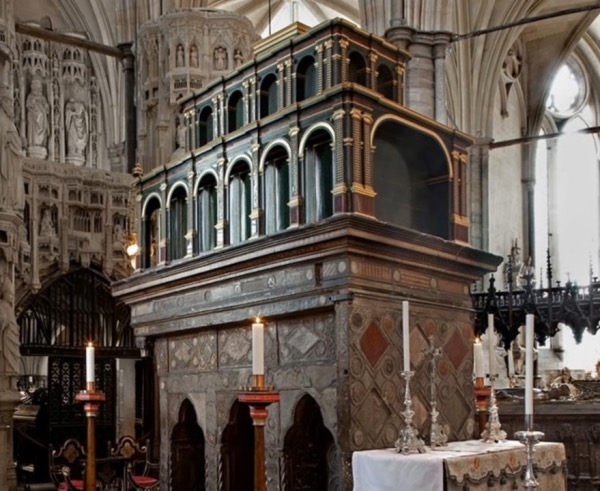
LondonLife – Hammersmith terrace…

PICTURE: Victor Huang/iStockphoto.

A row of terraced houses overlooking the Thames in Hammersmith.

This Week in London – Ukraine’s culture on show; spotlight on the news; St George’s Day; and, London Transport’s posters at the Depot…

Easter egg, a dove of peace, Ukraine, 1970-1980. © The Trustees of the British Museum.

• A free display on the cultural heritage of Ukraine has opened at the British Museum. Located in the museum’s ‘Collecting the world’ gallery, Ukraine: Culture in crisis features objects drawn from the museum’s collection including a 5,500-year-old painted storage jar, hand-coloured lithographs of a man and a woman in Ukrainian dress dating from about 1813, and, an Easter egg decorated with the dove of peace (pictured) dating from between 1970 and 1980. There are also objects from the Greek colony of Olbia established on the Black Sea between 600 and 300 BC including a black glazed, fluted amphora from southern Italy dating from between 300 and 250BC. For more, head to www.britishmuseum.org. To learn more about the protection of cultural heritage in Ukraine visit icom-poland.mini.icom.museum/icom-poland-appeal-help-us-help-ukraine.

The earliest surviving printed news report in Britain of the 1513 Battle of Flodden and an original BBC radio script of the D-Day landings are among exhibits at the British Library’s first major exhibition putting a spotlight on the role news plays in our society. Other exhibits on show at Breaking the News, which opens on Friday, include smashed hard drives used by The Guardian to store Edward Snowden’s hard files. The display explores what makes an event news and the meaning of a free press as well as the ethics involved in making the news, news objectivity and how the way we encounter news has evolved over five centuries of news publication in Britain. Runs until 21st August. Admission charge applies. For more, head to www.bl.uk/events/breaking-the-news.

St George’s Day celebrations return to Trafalgar Square this Saturday. The free family event, which runs from noon until 6pm, will feature live music by the likes of string quartet Bowjangles, hoedown collective Cut A Shine, brass band Das Brass and folk headliner James Riley & the Rooftop Assembly. There will also be appearances from St George with his Dragon, Divine stilt walkers and the Pearly Kings and Queens as well as a range of food stalls. Other family-oriented activities including The Knights Training School, the Storytorium, a dragon Selfie station, face painting, upcycled arts and crafts, and a games area.

The art and poster stores at the London Transport Museum’s Depot in Acton Town will be open to the public this weekend. The Art of the Poster Open Days, which run from today until Sunday, will give the public the chance to view some of the more than 30,000 posters in the depot’s collection and hear from expert guides about how posters have characterised London and its transport over the past century. There will also be talks from artists, curators and historians and visitors have the chance to design their own posters in creative workshops as well as, on Saturday and Sunday, riding the London Transport Miniature Railway. Timed tickets must be booked in advance. Admission charges apply. For bookings, head to www.ltmuseum.co.uk/whats-on/depot/art-poster.

Send all items for inclusion to exploringlondon@gmail.com.

LondonLife – Sunrise silhouette…

Richmond Park. PICTURE: Tom Mrazek/Unsplash
This Week in London – Tulips at Hampton Court; new Falklands-related displays at the IWM; and, a new garden for The Regent’s Park…

Hoping you have a wonderful Easter break.

PICTURE: © Historic Royal Palaces

Hampton Court Palace’s Tulip Festival – the largest of its kind in the UK – is returning following its successful inaugural year in 2021. From Friday until 2nd May (depending on flowering periods), the palace’s 60 acres of formal gardens are expected to be filled with rare, historic and specialist tulip varieties inspired by Queen Mary II’s famous 17th century collection which was once housed at the palace. Some 120,000 tulip bulbs of 60 different varieties have been planted, including breath-taking floating tulip vases located in the palace’s famous fountains, and floral displays which will fill the cobbled courtyards of Base Court and Clock Court. Visitors will be able to find out all about the links between the flower and the palace’s history with a dedicated Tulip Festival Guide. Included with admission. For more, head here.

New exhibits marking the 40th anniversary of the Falklands Conflict have gone on show at the Imperial War Museum in Lambeth. Among the new items on display are drawings by Linda Kitson, the first female artist commissioned by IWM to accompany troops into conflict, and images of the conflict – many of which have never been seen before – taken by photographer Paul RG Haley who covered it for Soldier Magazine. The museum is also exploring the story and legacy of the conflict through a digital programme of events including a series of short films and a new episode of the Conflict of Interest podcast featuring actor Katherine Parkinson. For more, see www.iwm.org.uk.

The Regent’s Park will soon boast a new 1.5 acre garden at its centre in honour of Queen Elizabeth II’s Platinum Jubilee. The new garden, to be created on the site of a former plant nursery near the Inner Circle, will include design features that reflect the Queen’s “love of trees and nature”. The Royal Parks will be committing £1 million to the project and will seek external funding and public donations. Designs for the new park will be shared as they are developed. Meanwhile, The Royal Parks have also announced they will be creating a new wood in Richmond Park as part of the Queen’s Green Canopy Initiative. The new woodland, which will be located adjacent to Ham Cross, will be planted with 70 large trees, each one to mark a year of Her Majesty’s reign.

Send all items to exploringlondon@gmail.com.