London Explained – Beefeaters…

A nickname for the Yeoman Warders of the Tower of London, its origins are somewhat obscure but apparently related to a penchant for beef and was presumably meant as an insult (hence they prefer being called by their proper title). It was apparently first used of the English population in general and is said to have first been applied to the Yeoman Warders in the second half of the 17th century.

A Yeoman Warder in everyday “undress” uniform. PICTURE: PRA (licensed under CC BY-SA 3.0/image cropped)

The Yeoman Warders of the Tower of London (not to be confused with the Yeomen Warders of The Guard, the Sovereign’s Bodyguard, who are also referred to as “beefeaters”), are charged with guarding of the Tower of London and its contents including the prisoners of state who were formerly held within its walls (the last was during World War II).

With a history dating back to the reign of King Henry VII and first present at the Tower during the reign of King Henry VIII, they were made extraordinary members of the Sovereign’s Bodyguard during the reign of King Edward VI in 1552 (meaning they wear scarlet livery and carry partizans on state occasions).

The Chief Yeoman Warder is their commander and second-in-command is a Yeomen Gaoler (who still carries an axe on state occasions). There are also three Sergeant Yeoman and a Yeoman Ravenmaster. A Yeoman Warder (along with a detachment of soldiers) carries out the Ceremony of the Keys every night – formally locking the Tower.

These days (drawing on innovations introduced by the Duke of Wellington when he was Constable of the Tower between 1826 and 1852), the Yeoman Warders must be warrant officers who have served at least 22 years (and have been awarded the long service and good conduct medal) in the British Army, Royal Air Force and Royal Marines.

The Yeoman Warders – and there were 38 (although we’re not sure how cutbacks due to COVID may affect this) – live within the Tower under the authority of the Resident Governor. They wear the red state dress uniform on state occasions and a dark blue “undress” uniform for everyday use. Moira Cameron became the first female Yeoman Warder in 2007.

As well as carrying out state duties, since Victorian times the Yeoman Warders have conducted towers of the Tower and assisted visitors with their inquiries.
Lost London – Bear Garden, Southwark

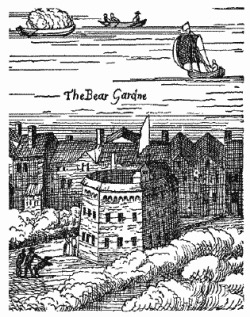
The Bear Garden as depicted in Visscher’s Map of London which was published in 1616 but represented the city as it was several years earlier.

The Bear Garden was among numerous structures built in Southwark during the Elizabethan era for public amusement: in this case the “amusement” being what we now see as the rather cruel activities of bear and bull baiting and other “sports” involving animals.

Built sometime prior to the 1560s, the Bear Garden (also written as Beargarden) itself was a polygonal wooden, donut-shaped structure, much like the theatres such as the Rose and Globe, where the activities took part on the floor in the middle while the audience sat around the donut’s ring.

While it’s known it was located in Bankside (among several other premises showing animal sports), its exact location continues to be a matter of debate (and it is thought to have moved location at least once).

The Bear Garden was patronised by royalty – Queen Elizabeth I apparently visited with the French and Spanish ambassador – but it was also marked by tragedy when part of the tiered seating collapsed in 1583, killing eight people and forcing the premises to close down for a brief period.

It was torn down in 1614 and replaced with the Hope Theatre with the intention of it serving as a dual purpose premises, providing both stage plays and animal sports like bear-baiting, but the latter eventually won out and it simply became known once again as the Bear Garden.

The Hope may have pulled down in the 1650s after animal sports were banned by the Puritans (the Commonwealth commander Thomas Pride was apparently responsible for putting down or shooting the last seven bears). Whether it was demolished or not, it was again in use after the Restoration – Samuel Pepys and John Evelyn both visited during this period – but the last mention of it was in the 1680s.

The street named Bear Gardens in modern Southwark stands today in the approximate area where the Bear Garden is generally thought to have been located.

This Week in London – Raphael Court to reopen at V&A; naming a Tower raven; and, Caroline Norton’s Blue Plaque…

The V&A has unveiled its refurbished Raphael Court – home to the world famous Raphael Cartoons – after a renovation last year to mark the 500th anniversary of the artist’s death. The gallery, which reopens to the public along with the rest of the museum on 19th May, transforms the way visitors will encounter the large scale cartoons on loan to the V&A from the Royal Collection. The new gallery features state-of-the-art LED lighting, acoustic panelling and bespoke furnishings. There are also high-resolution images of the cartoons which can be explored at the gallery as well as online. The cartoons were created by Raphael in 1513 after he was commissioned by Pope Leo X to create a set of 10 designs for a series of tapestries to hang in the the Sistine Chapel. Illustrating scenes from the lives of Saints Peter and Paul, each of the cartoons – which were sent to the workshop of merchant-weaver Pieter van Aelst in Brussels to be made into tapestries – measures around five metres wide and 3.5 metres high. Seven of them survive and were brought to Britain in the early 17th century by the Prince of Wales (later King Charles I). They were first lent to the South Kensington Museum – now the V&A – by Queen Victoria in 1865. For more, see vam.ac.uk/raphael-cartoons.

People across the globe are invited to help name a baby female raven, one of a pair born at the Tower of London during lockdown. Until 18th May, people are invited to vote for their favourite name on the Ravenmaster’s shortlist – from Matilda (the name of a medieval queen) to Florence (named for Florence Nightingale), Brontë (named for the writing family), Winifred (named for Winifred Maxwell, the Countess of Nithsdale, who plotted her husband Lord Nithsdale’s escape from the Tower in 1716 disguised as a woman) and Branwen (a figure from Celtic mythology). The poll can be found at http://bit.ly/NameOurRaven and the winning name will be announced as part of the reopening of the Tower on 19th May.

Nineteenth century women’s rights campaigner Caroline Norton has been commemorated with an English Heritage Blue Plaque. The plaque is located on a townhouse at 3 Chesterfield Street in Mayfair, the home from where Norton fought for the rights to own the proceeds of her own work as a writer. Her abusive marriage and subsequent separation from George Chapple Norton was one of the most highly publicised cases in 19th-century Britain. It led to Norton successfully lobbying for legal rights for married women and, as a result of her campaigning, mothers were eventually granted custody of children under seven (and access thereafter) in cases of divorce or separation. For more on Blue Plaques, see www.english-heritage.org.uk/visit/blue-plaques.

Send all items for inclusion to exploringlondon@gmail.com.

This Week in London – Well-being at Kew; Poussin wins credit for ‘The Triumph of Silenus’; and, Euston explored…

Kew Gardens have unveiled a new programme of well-being events with the aim of encouraging people to enjoy the outdoors after the COVID-19 lockdown. The events, all of which will be COVID-19 safe and follow government guidelines, including everything from forest bathing sessions in the Arboretum inspired by the Japanese art of Shinrin-yokuto, a rare chance to cycle through the gardens on an evening bike ride, pilates in the Nash Conservatory and yoga sessions in the Temperate House. Check the Kew website for dates and times and admission charges.

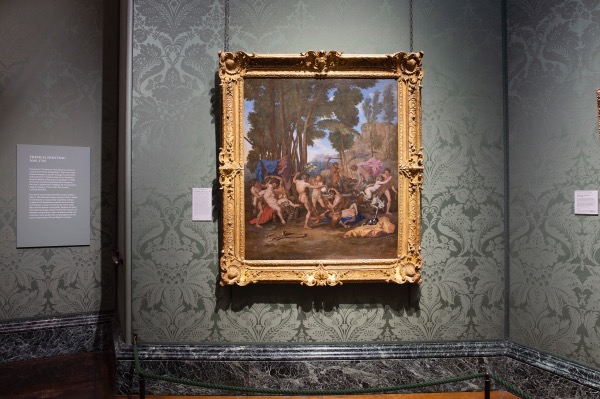
The Triumph of Silenus hanging in Room 29 at The National Gallery. PICTURE: © The National Gallery

• The creator of The Triumph of Silenus (c1637), which was one of the first paintings to enter the collection of The National Gallery when it did so in 1824, has been confirmed as 17th century French painter Nicolas Poussin. The painting had long been plagued by questions of authenticity but following recent conservation work and in-depth technical analysis, it has been confirmed as a work of Poussin. The confirmation means the gallery holds 14 works by Poussin, making it one of the world’s leading collections of paintings by him. Later this year, the picture will feature in a new exhibition, Poussin and the Dance.

• People will have the chance to see parts of Euston Station usually not accessible to the public on a new virtual tour announced by the London Transport Museum. The tour is part of the next season of ‘Hidden London’ virtual events with new dates also to be announced for tours of King William Street, Brompton Road, Holborn (Kingsway) and Aldwych. Meanwhile, the museum will recommence its ‘Secrets of Central London’ walking tour in the West End on 17th May. Charges apply. For more on the virtual tours and dates, head to www.ltmuseum.co.uk/hidden-london/virtual-tours.

Send all items for inclusion to exploringlondon@gmail.com.

10 London hills – 4. Parliament Hill…

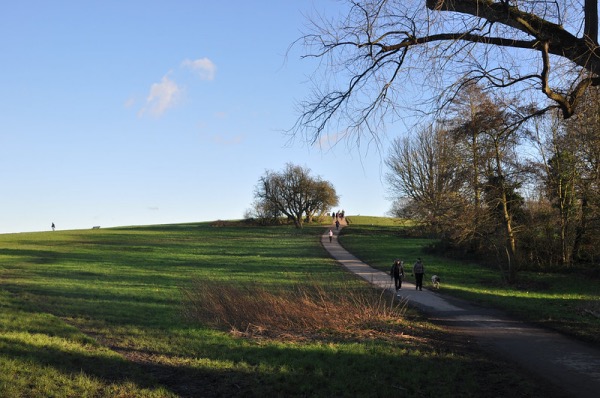
View up Parliament Hill. PICTURE: stevekeiretsu (licensed under CC BY-NC 2.0)

Located to the north-west of the city, Parliament Hill – with its elevation of 98 metres above sea level – offers expansive views of the city skyline including The Shard, St Paul’s Cathedral and the Houses of Parliament.

The hill, which can be found in the south-east of Hampstead Heath, was once part of the manor of Hampstead. It was apparently previously known as Traitor’s Hill – some believe it was so-named because it was from here that those involved in the (as it turned out, unsuccessful) Gunpowder Plot of 1605 were to gather to watch Parliament explode.

The current name may also come from that association, or the hill’s association with Parliamentarians who saw it as a defensive strongpoint during the English Civil War.

A tumulus on the north side of the hill, which some have believed to be the grave of Queen Boadicea, was excavated in the 1890s and is thought to be a Bronze Age burial mound.

The hill – which is known to have been a favourite of Romantic poets including Shelley, Keats and Coleridge – was acquired for the public in 1889.

Traditionally used for livestock grazing (and, according to some, having an ancient association with druids), it has also been a popular site for kite-flying. There’s various sporting facilities including a lido, located on the lower slopes of the hill as well as a monument called the Stone of Free Speech which was apparently previously used as a site for public meetings in the past.

The hill is managed by the City of London Corporation.

View from Parliament Hill. PICTURE: Magnus D (licensed under CC BY 2.0)

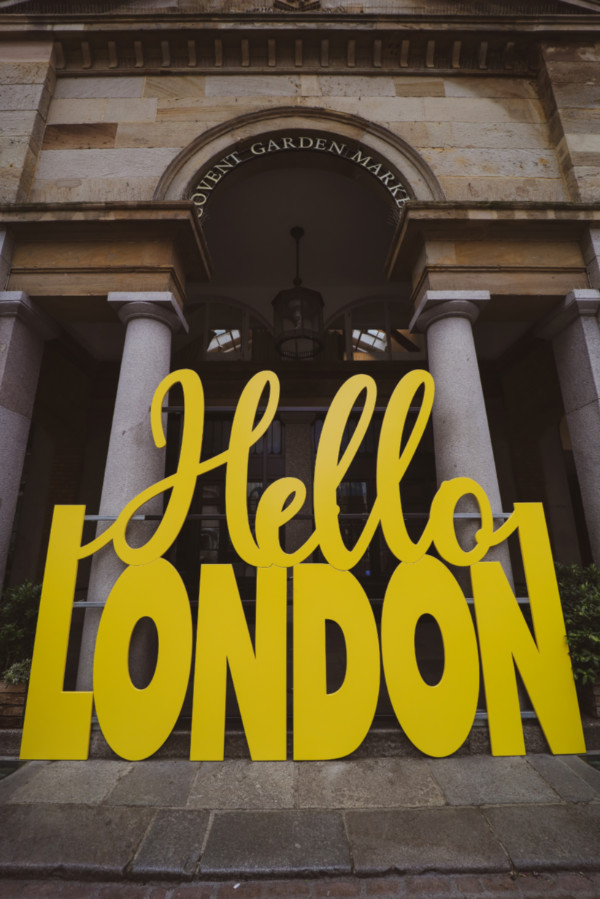
LondonLife – Covent Garden says hello…

PICTURE: Kevin Grieve/Unsplash

Where’s London’s oldest….(continuously used) cricket green?

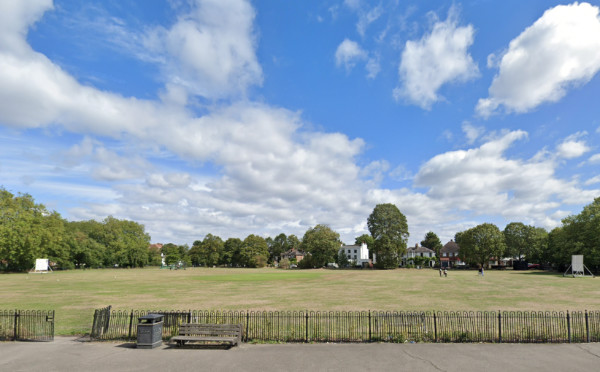
Mitcham Green. PICTURE: Google Maps

While Lord’s and The Oval may be more famous, the honour of being London’s oldest (still-in-use) cricket ground goes to a rather less-well-known ground in Mitcham, south London.

Once located in Surrey but now part of greater London, Mitcham Green has been the home of the Mitcham Cricket Club since 1685 (cricket was reportedly being played earlier elsewhere in London but the grounds haven’t survived).

There are reports that Lord Nelson was among those who came to watch a game here (he lived nearby) and in the 19th century, Mitcham Cricket Ground was used as a practise wicket by the visiting Australian team (the team would apparently stay at the aptly named pub The Cricketers, which formerly overlooked the green).

The ground is rather unusual for the fact that the club’s pavilion, which was built in 1904, lie on the other side of a road (the A323).

In July, 2002, the ground hosted a game between Mitcham and Hambledon, a Hampshire village which boasts a team founded about 100 years after Mitcham. Known as the Golden Jubilee Challenge Match, it was played in honour of the Golden Jubilee of Queen Elizabeth II and resulted in a draw.

Treasures of London – Hyde Park’s ‘Grand Entrance’…

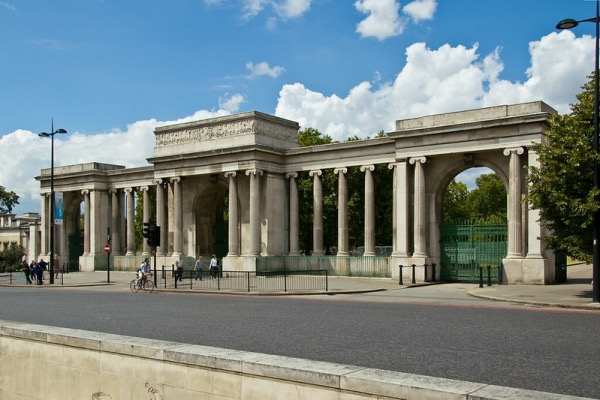
David Nicholls (licensed under CC BY-NC 2.0)

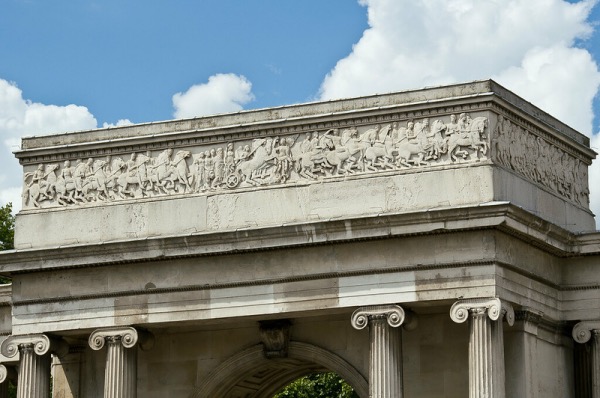
This ornate triple stone entrance in the south-east corner of Hyde Park (better known as Hyde Park Corner), was designed by Decimus Burton when he was just 25-years-old.

Made of Portland stone, the gate, also known as the ‘Apsley Gate’ (after the nearby home of the Duke of Wellington) or the ‘Hyde Park Screen’, was installed in the late 1820s and replaced a former tollgate.

Several designs were proposed in the late 18th century but it was only after work started to transform Buckingham Palace from a home into the grand building we know today that Burton, who was already working on designing a series of gates, lodges and railings around Hyde Park for the Office of Woods and Forests, was asked to design the screen alongside plans for a grand memorial arch to serve as an entrance to Green Park which would be located opposite.

Burton’s designs for the Hyde Park gateway were approved by none other than King George IV and it now stands true to his original design. Decorative elements in the gate include scroll-topped columns and friezes by John Henning which were copied from the Elgin Marbles. Burton also designed the classical-style lodge house just inside the gates.

Burton’s initial plans for the Green Park arch, however, were deemed not to be grand enough – after all, this would be one of the approaches to Buckingham Palace – and so he produced a second design which is now largely embodied in what became the Wellington Arch.

While the Hyde Park gateway originally stood in line with Wellington Arch, traffic management matters saw the latter moved to its current position in the 1880s, putting it out of alignment with the gateway.

Showing part of the frieze. PICTURE: David Nicholls (licensed under CC BY-NC 2.0)

This Week in London – Hampton Court Palace’s Tulip Festival, National Gallery acquires ‘Portrait of a Girl’, and, art at Canary Wharf…

Hampton Court Palace is hosting its first ever Tulip Festival. Featuring more than 100,000 bulbs placed throughout the formal gardens, the festival pays homage to the estate’s long history of tulip cultivation and, thanks to partnership with the Hortus Bulborum in the Netherlands, involves some types of tulip that have not been on show at the palace since the 17th century. First introduced to the British Isles in the 1630s, tulip planting at Hampton Court dates back to the reign of Queen Mary II. Ten different heritage and modern types have been planted across the gardens for the festival including Parrot, Triumph, Rembrandt and Darwin tulips. Visitors can undertake a self-guided trail which takes in both the palace’s courtyards – filled with ornate planters and flowers specially-selected to match the historic brickwork – and the gardens. Admission charge applies (tickets must be pre-booked). Runs until 3rd May. For more, see www.hrp.org.uk/hampton-court-palace/whats-on/tulip-festival-2021.

Isaack Luttichuys (1616–1673), Portrait of a Girl, about 1650 © The National Gallery, London

The National Gallery has acquired Portrait of a Girl (about 1650) by Isaack Luttichuys, the first work by the artist to enter a British public collection. Luttichuys, who name is pronounced ‘Lootickhouse’, was born in London to Dutch parents and spent his early life in England (where the family was known as Littlehouse, the literal English translation of the name). The artist later moved to Amsterdam where he enjoyed a highly successful career as a portrait painter until his death in 1673. The work was acquired from the estate of banker and philanthropist George Pinto under the Acceptance in Lieu scheme, administered by the Arts Council. 

Escape to faraway lands with a new art installation at Crossrail Place Roof Garden at Canary Wharf. Crossorelle is the work of artists Baker & Borowski, and features a design inspired by the Jardin Majorelle in Marrakech which fuses the Moroccan garden’s rich palette and art deco shapes with exotic flora. Free to visit, the display can be seen until 19th June. For more, see https://canarywharf.com/whats-on/crossorelle-roof-garden-mar-jun-2021/.

Send all items for inclusion to exploringlondon@gmail.com.

10 London hills – 3. Tower Hill…

The site of scaffold on Tower Hill. PICTURE: Bryan MacKinnon (licensed under CC BY-SA 3.0)

The last of the three hills at least partly within the walls of the old City of London is Tower Hill, located at the City’s eastern end.

Famed as a site of public execution, Tower Hill – which rises to almost 14 metres above sea level – was traditionally where traitors who had been imprisoned in the nearby Tower of London met their final moments.

More than 120 people have been executed on the site, everyone from Sir Simon de Burley, tutor to King Richard II, in 1388, through to Thomas Cromwell in in 1540 and a soldier arrested during the Gordon Riots of 1780.

These days the gallows and scaffold – and the crowds which accompanied them – are long gone, marked by a stone set in the pavement at the western end of Trinity Square.

The hill, which is just to the north of the Tower of London and takes its name from it, was historically part of the tower liberties – meaning authorities could ensure nothing was developed on it which would affect the defences of the fortress.

It is the site of one of the remaining sections of the Roman and medieval wall which once surrounded the City of London (the hill is located on both sides of the wall).

A Tube station, Tower Hill, which opened in 1884 (it was originally named Mark Lane and the name changed to Tower Hill in 1946; it relocated to the current site in 1967).

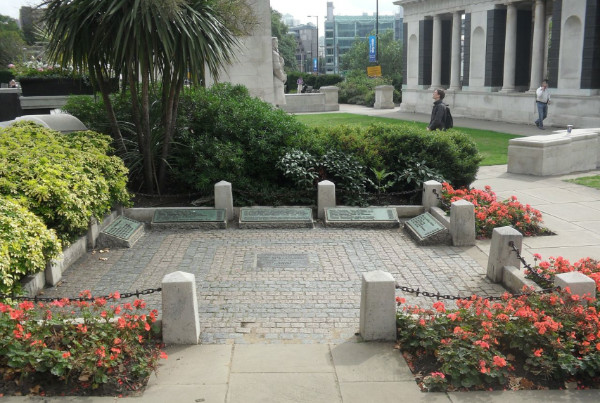
The hill is also home to the Tower Hill Memorial – a pair of memorials dedicated to the mercantile marines who died in World War I and World War II – set inside the public park known as Trinity Square Gardens.

LondonLife – The Shard under a mackerel sky…

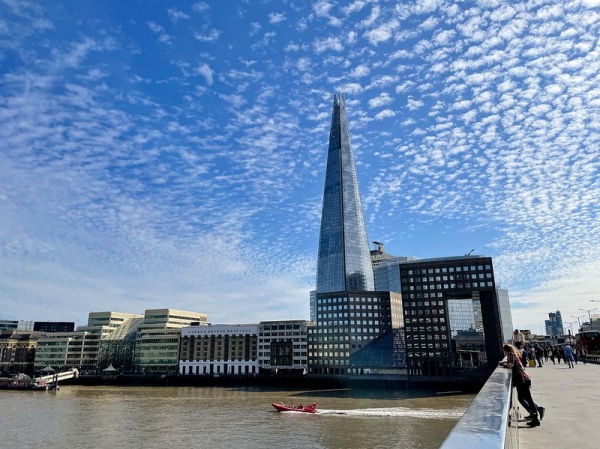
PICTURE: Bex Walton/licensed under CC BY 2.0)

A Moment in London’s History – Sir Robert Walpole becomes first ‘Prime Minister’…

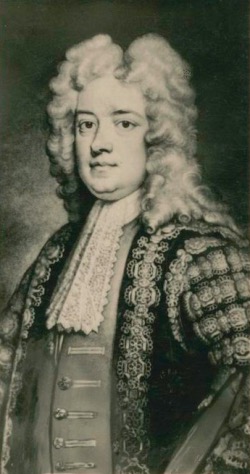
Portrait of Robert Walpole (1676-1745); probably a work of Godfrey Kneller (via Wikipedia).

This month – over the Easter weekend, in fact – marked the 300th anniversary of the date on which Sir Robert Walpole effectively became the first Prime Minister of the United Kingdom.

Walpole, who had entered Parliament as a Whig at the age of 25 in 1701, had had a tumultuous political career which had included rising quickly to the positions of Secretary at War and Treasury of the Navy before, having been targeted by his Tory opponents, spending six months in the Tower of London after he was found guilty of corruption.

The accession of King George I in 1714 was good news for the Whigs and the following year Walpole was appointed First Lord of the Treasury and Chancellor of the Exchequer in 1715. He resigned a couple of years later due to a party split but by 1720 he was once again man of influence, appointed to the Privy Council and made Paymaster General as well as Paymaster of the Forces.

The following year, on 3rd April, 1721, he was effectively elevated to the position of Prime Minister after being appointed First Lord of the Treasury, Chancellor of the Exchequer, and leader of the House of Commons.

Walpole remained at the head of the government until 1742 when he resigned after a motion of no confidence was moved against him. But it wasn’t all bad news, King George II subsequently elevated him to the House of Lords as the Earl of Orford.

Interesting, it was also King George II who offered Walpole the residence in Downing Street (Walpole only accepted on condition that it be a gift to the office of the First Lord of the Admiralty so he wasn’t liable for the cost of upkeep).

Walpole was the first of what has since been an unbroken line of 77 Prime Ministers (although only 55 people have held the office due to the multiple occasions on which individuals have served).

While the term was used informally to describe Walpole as far back as the 1730s (although in 1741 he denied he was the “sole and prime minister” in the House of Commons, thanks to the association of the term with foreign tyrannies), it wasn’t until the following century that it was used in Parliament (Benjamin Disraeli, was the first to sign an act using the title in 1878) and not until 1905 was the post of prime minister officially given recognition in the order of precedence.

10 London hills – 2. Cornhill…

Looking along the street named Cornhill from its western end with the Royal Exchange on the left. PICTURE: Teseum
(licensed under CC BY-NC 2.0)

The highest of the city’s three ancient hills (at 17.7 metres or 58 feet above sea level), it was on Cornhill that the first Romans settled following the invasion of 43AD and the later the site of the basilica.

In medieval times, a grain market was established on Cornhill which gave it the name it now bears.

Cornhill was also the location of a pillory (Daniel Defoe famously spent a day here in 1703 after writing a seditious pamphlet), stocks, and a prison known as the Tun where street walkers and lewd women were incarcerated.

Remembered in the name of the street which today runs from Bank junction to the western end of Leadenhall Street as well as being the name of one of London’s 25 wards, the hill is the site of several churches.

These include the aptly named St Michael Cornhill and St Peter-upon-Cornhill (said to be the oldest place of Christian worship in London) as well as the curiously named St Benet Fink (despite being rebuilt by Sir Christopher Wren after the Great Fire of 1666 this was eventually demolished in 1844 when the Royal Exchange was rebuilt).

The hill was also the location of The Standard, at the junction of Cornhill and Leadenhall Streets. Constructed in 1582, this was the first mechanically pumped public water supply in London. It was sometimes used as a point from where to measure distances out of London.

The area became famed for its coffee houses in the 16th to 19th centuries (Pasqua Rosée opened what is claimed to be London’s first in St Michael’s Alley in 1652) and as such was a financial centre. Much of Cornhill is now occupied by offices.

10 London hills – 1. Ludgate Hill…

Rome has its seven hills, Athens has the Acropolis and Paris – well, who can go past Montmatre? Yet, while hills may not be the first thing which come to mind when thinking of London, the city is home to numerous (low) peaks which have shaped the urban environment since ancient times (and some of which provide magnificent viewing points).

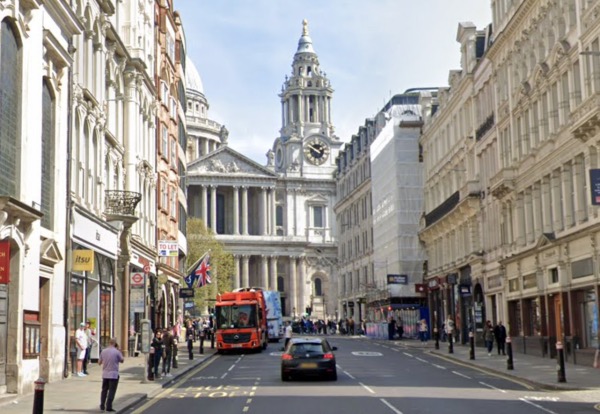
Looking up Ludgate Hill (the street) to where St Paul’s sits on top of Ludgate Hill. PICTURE: Google Maps.

First up, we’re looking at Ludgate Hill, located in the western end of the City of London. One of the three ancient hills within the City walls, Ludgate Hill, which is now the site of St Paul’s Cathedral, is believed in Roman times to have been the site of a temple dedicated to Diana.

The hill, which today rises just 17.6 metres above sea level (the highest point lying apparently just to the north of the cathedral), is named after the former city gateway of Ludgate which is, in turn, named after the mythical King Lud.

These days the hill’s name is also commemorated in a street – Ludgate Hill – which runs from Ludgate Circus at its western end to St Paul’s Churchyard at its eastern end. It was also formerly the name of a railway station which opened in the late 1860s but was closed in 1923.

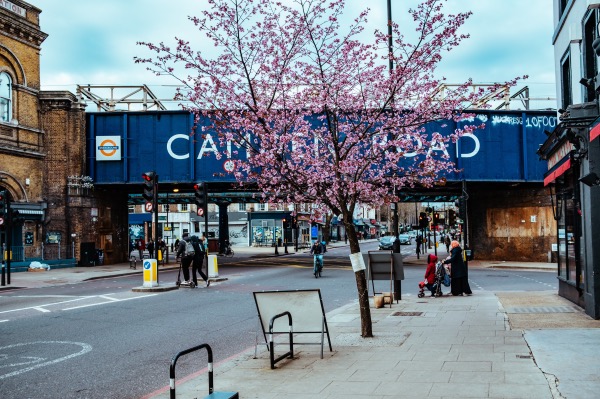
LondonLife – Blossom, Camden Road

PICTURE: Samuel Regan-Asante/Unsplash

10 London sites related to St Thomas Becket – A recap…

We’ve finished our series on London sites related to the story of Thomas Becket. Before we move on to our next special series, here’s a recap…

1. Cheapside…

2. Merton Priory…

3. Guildhall…

4. London churches…

5. The Tower of London…

6. Westminster Abbey…

7. Southwark…

8. St Thomas Becket memorial…

9. St Thomas’ Hospital…

10. The Pilgrim’s Way…

We’ll launch our new series next Wednesday.

LondonLife – A wall for remembrance…

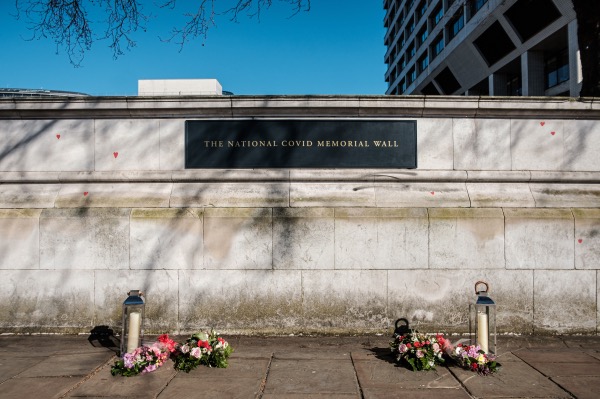
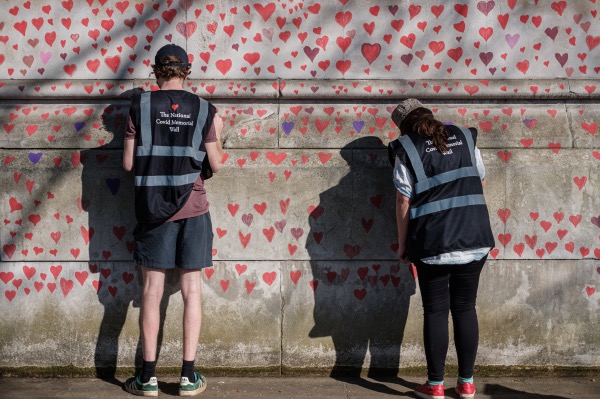
The National COVID Memorial Wall. PICTURES: Ehimetalor Akhere Unuabona/Unsplash

A memorial wall for the victims of the COVID-19 pandemic has been established on The Queen’s Walk outside St Thomas’ Hospital. Bereaved family and friends on Monday began to paint the first of tens of thousands of love hearts – representing those who have died of COVID-19 – on the wall which faces the Houses of Parliament across the Thames. The memorial, which is expected to stretch for hundreds of metres, is the work of the COVID-19 Bereaved Families for Justice group which has called for a public inquiry into how the government has handled the pandemic. Co-founder Matt Fowler, whose 56-year-old father, Ian, died last April, was the first to paint a heart on the wall on Monday. “This is an outpouring of love,” he reportedly said. “Each heart is individually hand-painted; utterly unique, just like the loved ones we’ve lost. And, like the scale of our collective loss, this memorial is going to be enormous.”

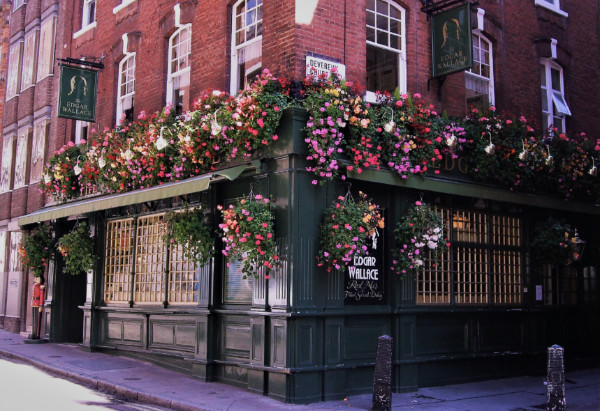
London Pub Signs – The Edgar Wallace…

The Edgar Wallace pub in 2018. PICTURE: Jim Linwood (licensed under CC BY 2.0)

Formerly named The Essex Head, this West End pub was established as far back as 1777.

Perhaps its greatest claim to fame (in its earliest incarnation, at least) was that it was the location where, in 1783, lexicographer Samuel Johnson and his friend and physician Richard Brocklesby established the Essex Head Club.

James Boswell was a member and the club apparently met at the pub three times a week as a favour to the landlord, Sam Greaves, a former servant of the Thrale family, friends of Johnson (who also lived with them for some years). It apparently lived on for some time even after Johnson’s death in 1784

The original name of the pub, located at the corner of Essex Street and Devereux Court in the Temple district, referred to Robert Devereaux, Earl of Essex and favourite of Queen Elizabeth I, whose London home, Essex House, was previously located nearby (the house was largely demolished in the 1670s).

The pub, meanwhile, took on its current name in 1975. It was done to commemorate the 100th anniversary of the birth of celebrated crime writer Edgar Wallace.

Wallace, who was known for wearing a trilby and apparently driving a yellow Rolls Royce (and whose claims to fame include initially drafting the screenplay for the film King Kong – he died before it was completed), is credited as being the inventor of the modern thriller novel.

While he was born in Greenwich, Wallace had spent his childhood in the area where the pub now stands (there’s also a plaque to him in Fleet Street commemorating the time he spent working as a reporter before he found fame as an author – we’ll being telling more of his story in an upcoming ‘Famous Londoners’).

Lost London – The Dome of Discovery…

The Skylon and the Dome of Discovery at the 1951 Festival of Britain PICTURE: Peter Benton (licensed under CC BY-SA 2.0/image cropped)

Built for the post-war Festival of Britain in 1951, the Dome of Discovery was a temporary exhibition building located in South Bank.

Designed by architect Ralph Tubbs, the dome was, with a diameter of 365 feet and a height of 93 feet, the largest in the world at the time. It was located next to the Skylon, another iconic structure built for the festival.

The prefabricated dome, which was made from aluminium and concrete, was filled with galleries which housed exhibitions around the overarching theme of discovery. The display was grouped under eight different sections including “the land”, “the sea”, “sky” and “outer space”. The dome also contained a 50 foot long mural on the theme of discovery by artist Keith Vaughan.

The dome was dismantled just 11 months after it was installed and sold for scrap metal (despite pleas from Tubbs and proposals for it to be relocated to places as diverse as Sao Paulo in Brazil and Coventry in England). Some of the metal was apparently made into souvenirs including commemorative paper knives.

This Week in London – Dennis & Gnasher at Kew; ‘Now Play This’; and, work starts on ‘Gateway to Soho’…

A Beano Studios product © DC Thomson Ltd (2021)

Characters from the popular Beano comic and TV series, Dennis & Gnasher: Unleashed! will be at Kew this Easter. Marking 70 years of Dennis, Dennis and Gnasher’s Big Bonanza at Kew will feature an exclusive giant 3D comic strip – the largest ever created by Beano – with the chance to take part in all sorts of tricks and jokes and, of course, learn about some of Kew’s plants including their slimy, sticky, smelly and deceptive powers. Runs from 31st March to 18th April. Admission charge applies. For more, see www.kew.org.

A four day “festival of experimental games”  kicks off today with a virtual programme featuring  interactive games, workshops, and conversations. Now Play This, part of the London Games Festival, explores the climate crisis through games and play, and features a discussion within games designer Hosni Auji’s Airplane Modesimulator, a live role-play simulation of UN climate change negotiations in World Climate Simulation and the new interactive design game Among Ripples whichoffers players the chance to experiment with building and maintaining their own lake ecosystem. The free online festival runs until Sunday, 28th March. It can be found at www.nowplaythis.net.

• Work has begun this week to create an open-air gallery in part of Soho as part of a £150 million project aimed at transforming Oxford Street and surrounds. The project will see Ramillies Street, Ramillies Place, Hills Place and a small section of Great Marlborough Street made into a ‘Gateway to Soho’ and the site of an annual ‘Photographers’ Gallery’ programme featuring light projections and large-scale art.

Send all items for inclusion to exploringlondon@gmail.com

  ​