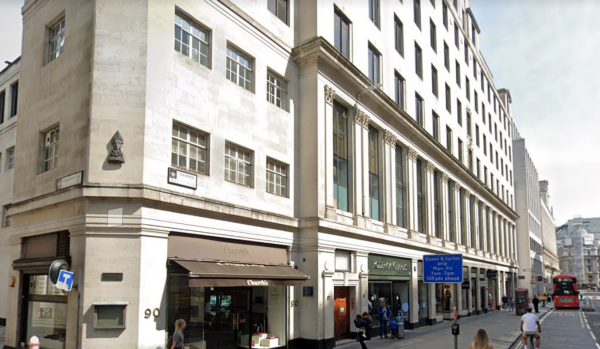
Looking east down Cheapside from the corner of Ironmonger’s Line (with the bust of St Thomas Becket visible in the left). PICTURE: Google Maps.
The 29thDecember, 2020, marked 850 years since the dramatic murder of then Archbishop of Canterbury, Thomas Becket, in Canterbury Cathedral.
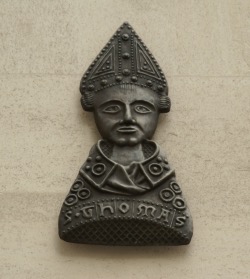
Metallic bust of St Thomas Becket on the wall at 90 Cheapside.PICTURE: Caroline (licensed under CC BY-NC-ND 2.0)
While many of the commemorations have been postponed due to the coronavirus pandemic, we’ve decided to push ahead with our series in commemoration of the martyred saint’s connections with London.
First up, it’s the famous City of London street of Cheapside – one of the main commercial streets in the medieval city – which was where, on 21st December, in what is generally believed to be the year 1120, he was born.
Becket was the son of Norman parents – his father, Gilbert, was a mercer (and served as a City sheriff) and his mother was named Matilda. He is believed to have had at least three sisters.
The location of what was a large residence – and the fact the family owned other property in the area – indicated they were relatively prosperous.
The property was next door to the church of St Mary Colechurch – lost in the Great Fire of London and not rebuilt – which was where St Thomas was baptised, apparently on the evening of his birth suggesting he may have initially been sickly. He was named after the Biblical St Thomas.
The site – which was later occupied by a hospital run by the Order of St Thomas of Acre – is marked with a small metallic bust of St Thomas attached to a wall on 90 Cheapside (on the corner with Ironmongers Lane) as well as a City of London blue plaque.
This month marks the 450th anniversary of the opening of London’s Royal Exchange, a complex created to act as a commercial centre in the City of London.
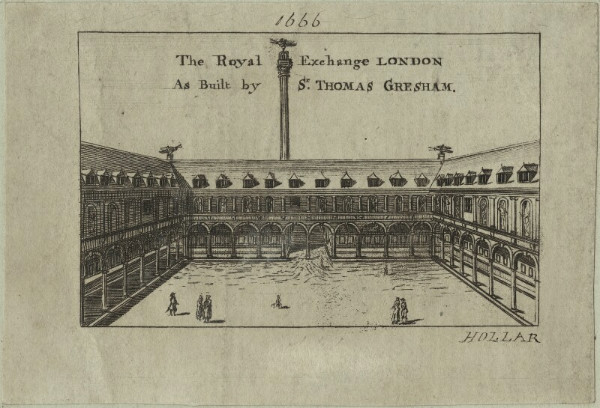
The exchange was built on the orders – and with the funds – of the merchant Sir Thomas Gresham at a site on the junction of Cornhill and Threadneedle streets which was – and still is – jointly owned by the City of London Corporation and the Worshipful Company of Mercers.
Drawing inspiration from the Antwerp Bourse, credited as the oldest financial exchange in the world (and where Sir Thomas had served as an agent of the crown), the Royal Exchange was built in ranges around a central courtyard and designed by an architect from Antwerp.
It was officially opened by Queen Elizabeth I on 23rd January, 1571. The Queen, who was lodging in Somerset House at the time, reportedly took a detailed look at the premises – which had apparently been completed a few years earlier.
At the close of her visit, she awarded the exchange the use of the word ‘Royal’ in its title (an honour announced by a herald and with the sound of a trumpet). She also granted it a license to sell alcohol and other luxury goods.
Earlier in the day, the Queen had dined at Sir Thomas’ own house in Bishopsgate. She was later to return to Somerset House.
Gresham’s original building – to which two floors of retail had been added in 1660, creating what is said to have been England’s first shopping mall – was sadly destroyed in the Great Fire of London in 1666.
It was replaced by a second complex, this time designed by Edward Jarman, in 1669, but this too succumbed to fire, this time on 10th January, 1838. The building which now stands on the site – and is now an upmarket retail centre – was designed by Sir William Tite and was opened by another Queen, Victoria, in 1844.
Gresham’s contribution is remembered by the building’s weathervane which features a golden grasshopper – an insect featured on Sir Thomas’ crest.
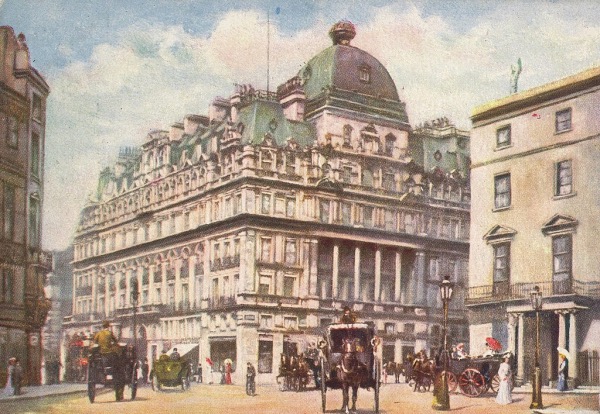
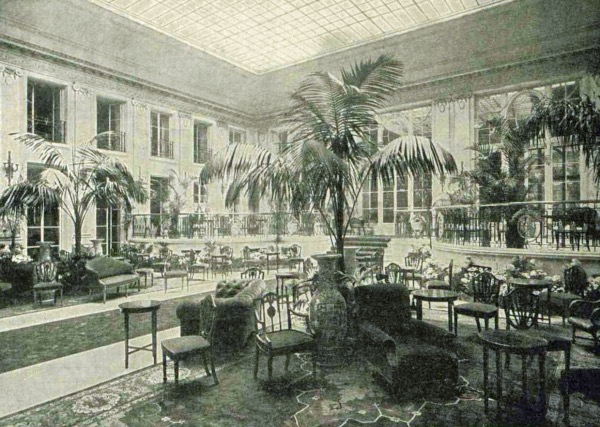
A luxury hotel built at the turn of the 20th century in the West End, the massive Carlton Hotel was part of an even larger redevelopment that included the (still standing) fourth version of Her Majesty’s Theatre (which provides a good idea of what the overall building looked like).
Located on the Crown estate on the corner of Pall Mall and Haymarket, the hotel was designed by CJ Phipps (who died before it was completed). Building started in 1896 and was completed by 1899.
Swiss hotelier César Ritz – who had been dismissed from his position as the manager of the Savoy Hotel in 1897 and subsequently successful opened his own establishment, the Hôtel Ritz, in Paris the following year – agreed to take a 72-year lease of the new hotel and a new company, The Carlton Hotel, Limited, was formed.
The building, which had interiors designed in the French Renaissance style, contained more than 300 guest rooms, all with telephones, including 72 suites which came with en suite bathrooms. There were also private dining and reception rooms for guests as well as reading and smoking rooms and a highly regarded Palm Court. And, of course, a restaurant in which Auguste Escoffier, who had left the Savoy under a cloud with Ritz, was employed as a head chef.
The Palm Court at The Carlton Hotel as featured in the Illustrated London News on 5th August, 1899.
The hotel, the upper floors of which contained private residences, was a hit and quickly threatened the status of the Savoy as the city’s most fashionable hotel. But in 1902, as the hotel was preparing to mark the coronation of King Edward VII, the king fell ill and the festivities were postponed indefinitely. Ritz suffered a nervous breakdown – apparently from the shock – and Escoffier was left in charge.
While its reputation was never again as high as it had been in the years immediately after opening, the Carlton Hotel remained profitable until World War II when it was heavily damaged during German bombing in 1940. Residential parts of the building were closed and in 1942 the remainder of the building was requisitioned by the British Government (with the exception of the American Bar and Grill Room which remained open).
The hotel never fully reopened, however, and, in 1949, the lease was sold to the New Zealand Government. The Carlton Hotel was demolished in 1957-58 and the New Zealand High Commission subsequently built on the site.
Among the hotel’s most famous clientele was Winston Churchill who was apparently dining in the restaurant with Lloyd George when World War I was declared.
Another famous association is commemorated by an English Heritage Blue Plaque which records the fact that Ho Chi Minh, founder of modern Vietnam, worked there as a cook in 1913 (when he was then known as Nguyen That Tanh).
There’s a story that Tanh, seeing how much food was being thrown away, asked Escoffier if he could give it to the poor, to which Escoffier told him to put aside his revolutionary ideas so he could teach him “the art of cooking, which will make you a great deal of money”. Tanh clearly choose another path.
This tradition is actually one which is no longer observed – but we thought it worth a mention to finish this short series.
The creation of temporary of ‘boy bishops’ was relatively widespread at greater churches in Middle Ages (and several other churches in London also observed the tradition apparently including Westminster Abbey).
At St Paul’s, it involved one of the choir boys being elected to be the ‘boy bishop’, usually on 6th December, for a role that would run through until Holy Innocents Day on 28th December.
Dressed in child-sized bishop’s robes, the ‘boy bishop’ performed various ceremonial duties throughout the season, culminating with them delivering a sermon and leading a procession through the city.
The tradition apparently became more raucous as time went on, so much so that eventually it was abolished during the Reformation by King Henry VIII, revived by his successor Queen Mary I, and then abolished again by Queen Elizabeth I.
Since then, the idea of a ‘boy bishop’ or ‘youth bishop’ has been revived in a somewhat updated form in certain cathedrals including those in Salisbury and Hereford.
While many establishments have been temporarily forced to close as a result of the coronavirus pandemic, we publish this piece in the hope you’ll be able to visit soon…
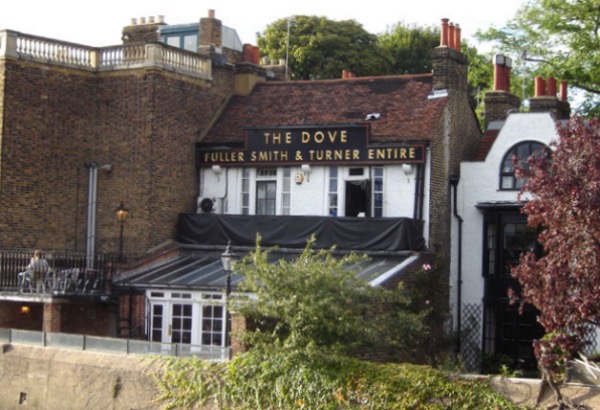
The Dove, Hammersmith, seen from the Thames. PICTURE: Tarquin Binary (public domain)
This storied Thames-side pub in London’s west apparently has associations with everyone from King Charles II to Arts and Crafts designer William Morris and author Graham Greeneand is known as a prime site to watch the annual Boat Race between Cambridge and Oxford universities.
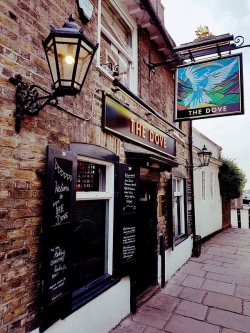
The Dove, Hammersmith. PICTURE: Michael Gwyther-Jones (licensed under CC BY 2.0)
The establishment, now Grade II-listed, at 19 Upper Mall is said to have a history dating back to the late mid 18th century and was originally founded as a coffee house.
The rooms within are fittingly small given the building’s age; in fact, the bar was once listed by Guinness World Records as the smallest bar room in the world.
The pub’s name apparently comes from the Biblical story of Noah’s Ark in which a dove is sent out after the great flood to find dry land and returns with an olive leaf in its beak indicating the receding waters (it’s also interesting to note that the pub was known for almost 100 years as ‘The Doves’ for many years – it has been said this was due to a sign-writer’s error which was only corrected in the last 1940s).
King Charles II is said to have met his mistress Nell Gwyn at this riverside location prior to its current incarnation. Others who have come to be associated with the pub itself – Morris and Greene aside – include American author Ernest Hemingway, Welsh poet Dylan Thomas and Scottish poet, playwright and lyricist James Thompson who is said to have written the words for his 1740 song, Rule, Britannia!, here.
Another association comes from Thomas James Cobden-Sanderson, founder of the Doves Bindery and the Doves Press, both of which he named after this pub. It’s also mentioned in the pages of Sir Alan Herbert’s 1930 popular novel, The Water Gipsies.
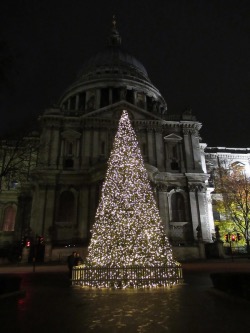
Christmas tree outside St Paul’s Cathedral. PICTURE: Alex Liivet (licensed under CC BY 2.0)
In what has been, and continues to be, such a hard year for so many, we at Exploring London hope you’re still able to celebrate Christmas in some form this year…
Meantime, here’s the next four in our countdown of the 100 most popular posts of all time…
London’s back under restrictions meaning doors to many of the city’s institutions are once again closed. So, for the moment, here’s the next two in our countdown…
Reportedly cancelled for this year, the boisterous Christmas Eve meat auction at Smithfield usually draws a considerable crowd eager to snag a bargain.
The origins of the tradition, which apparently started at least 30 years ago, stems from the fact that most of the market butchers take at least a week off over Christmas, generally not returning to their stalls until the new year.
As a result, they would auction off their remaining stock on Christmas Eve to those keen enough to brave the cold and come out.
There has been a market at Smithfield since the 12th century – the premises was rebuilt in the mid-19th century after being formally established by the 1860 Metropolitan Meat and Poultry Market Act.
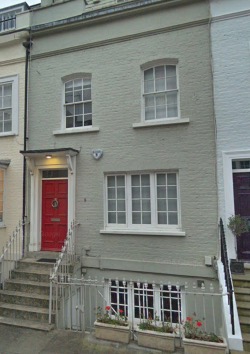
News this week that spy turned novelist John Le Carré has died at the age of 89. His family reportedly confirmed the author had died of pneumonia at the Royal Cornwall Hospital on Saturday night.Born as David Cornwall, Le Carré worked as an intelligence officer for the British Foreign Service and, drawing in his work, began writing Cold War spy thrillers under the pseudonym of Le Carré with his first, Call for the Dead, published in 1961. It was in this novel – Le Carré went on to write others – that his most famous character, George Smiley, made his first appearance. Initially a minor character, Smiley went on to become a star in three novels published in the 1970s, the most famous of which is Tinker Tailor Soldier Spy (Smiley’s last appearance was in a later book, 2017’s A Legacy of Spies). In tribute to Le Carré and George Smiley, pictured is 9 Bywater Street in Chelsea, the fictional home of Smiley (albeit a very real property!)
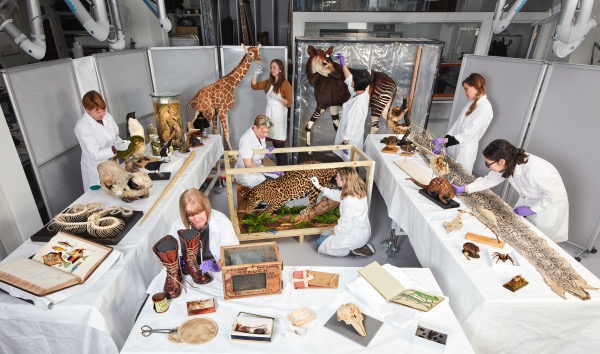
• The links between mythical and fictional creatures with animals of the natural world are explored in a new exhibition which opened at the Natural History Museum this week.Fantastic Beasts: The Wonder of Nature, a partnership between the museum, Warner Bros Consumer Products and the BBC Studios Natural History Unit, features some 120 exhibits including Dracorex Hogwartsia dinosaur – named in recognition of Harry Potter’s school, Hogwarts, along with a hoax mermaid, a 16th century map depicting sea monsters, and what was once believed to be a unicorn horn. There’s also the chance to learn more about the Galapagos marine iguana and the boneless hagfish as well as fictional creatures like the mooncalf and erumpent. Admission charge applies and pre-booking required. For more, see www.nhm.ac.uk.
Preparing for the Natural History Museum’s ‘Fantastic Beasts: The Wonder of Nature Conservation’ PICTURE: Trustees of the Natural History Museum
• Artworks depicting The Blitz are the subject of a new exhibition at the Churchill War Rooms.Art of the Blitz shines a new light on the experiences of ordinary people who lived through the Nazi air raids. The display includes works by Henry Moore, William Matvyn Wright, Eric Ravilious, Ernest Boye Uden, Mabel Hutchinson, Evelyn Gibbs, Evelyn Dunbar, and Leila Faithfull. Free with general admission ticket purchase, the display can be seen until 30th April. For more, see www.iwm.org.uk/events/wartime-london-art-of-the-blitz.
• Jan Gossaert’s 16th-century masterpiece The Adoration of the Kings is at the heart of a new immersive digital experience which launched at the National Gallery this week.Sensing the Unseen: Step into Gossaert’s ‘Adoration, which has been designed with social distancing in mind, starts with the voice of the African King Balthasar speaking to viewers before light and sound guide them to an individual pod where they can experience an interactive version of the painting. The experience can be seen in Room 1 until 28th February. Admission is free but pre-booking is required. Meanwhile, Father Christmas is making a special appearance at the National Gallery on the 12th and 13th December – and again on 17th to 23rd December – along with the chance to step into a ‘winter wonderland’ inspired by the iconic National Gallery painting A Winter Scene with Skaters near a Castle (about 1608–9) by Hendrick Avercamp (1585–1634). Admission charge applies and pre-booking required. For more, see www.nationalgallery.org.uk.
Send all items for inclusion to exploringlondon@gmail.com.
This tradition, the origins of which go back centuries, centres on a ceremony at the Royal Hospital Chelsea which involves the blessing and cutting of a ‘Christmas Cheese’ with a sword.
The origins of the tradition go back to 1692 when a local cheesemonger donated cheese to the Chelsea Pensioners – retired members of the British Army – for Christmas. Since 1959, it’s been organised by industry body Dairy UK and sees cheesemongers from across the UK donate cheeses to the hospital.
The ceremony involves the largest cheese among those donated being blessed and then cut with a sword by a selected pensioner. The cheese is then distributed to the pensioners at meal times in the run-up to Christmas.
This year a special COVID-safe ceremony was held and some 258 kilograms of cheese were donated to the hospital. The largest cheese – a 25 kilogram Montgomery Cheddar – was cut by Chelsea Pensioner George Reed who had a 25 year career in military as well as a career at the BBC.
As well as last year’s 60th anniversary ceremony aside, other milestones have taken place in 2016 – when Chelsea Pensioner Mary Johnston became the first woman to cut the ceremonial cheese – and in 2009, when two members of Territorial Army London Regiment bound for Afghanistan joined the ceremony for the first time.
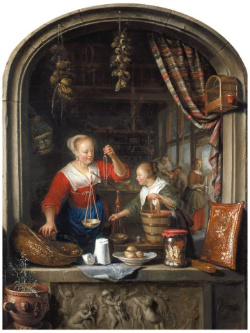
• World renowned artworks from Buckingham Palace’s Picture Gallery go on show at the Queen’s Gallery from tomorrow. Masterpieces from Buckingham Palace features 65 works by the likes of Titian, Rembrandt, Rubens, Vermeer, Van Dyck and Canaletto and, unlike in the tours of the State Rooms, visitors to the Queen’s Gallery will face the chance to enjoy the works close-up. The paintings on show include Johannes Vermeer’s The Music Lesson (early 1660s), Sir Peter Paul Rubens Milkmaids with Cattle in a Landscape, (c1617–18), Rembrandt’s The Shipbuilder and his Wife (1633), Canaletto’s The Bacino di San Marco on Ascension Day (c1733–4), Titian’s Madonna and Child in a Landscape with Tobias and the Angel (c1537) and Gerrit Dou’s The Grocer’s Shop (1672). The exhibition runs until January 2022. Advance booking is essential and admission charge applies. For more, seewww.rct.uk.
• The Museum of London is seeking to record the dreams of Londoners during the coronavirus pandemic in a new project with the Museum of Dreams at Western University in Canada.Guardians of Sleep represents the first time dreams as raw encounters and personal testimonies will be collected by a museum. Londoners are being asked to register their interest to take part by 15th January with conversations with members of the Dreams network – an international team of trained scholars from the psychosocial community, slated to be held over Zoom in February. Contributions will be considered for acquisition by the Museum of London as part of its ‘Collecting COVID’ project. To volunteer to participate in the study, or to find out more details, members of the public should contact info@museumofdreams.org.
• Abdus Salam, a Nobel Prize-winning theoretical physicist, has been honoured with a Blue Plaque at his former property in Putney. The red brick Edwardian house was the Pakistani scientist’s London base from 1957 until his death in 1996. It features a study where Salam would write while listening to long-playing records of Quranic verses and music by composers ranging from Strauss to Gilbert and Sullivan. Salam’s work on electroweak theory contributed to the discovery of the Higgs boson particle – the ‘God particle’ which gives everything mass, and he was also involved in improving the status of science in developing countries.The unveiling comes as English Heritage issues a call for the public to nominate more notable scientists from history for its Blue Plaque scheme in London with only around 15 per cent of the 950 plus blue plaques across the capital dedicated to scientists. For more, see www.english-heritage.org.uk/visit/blue-plaques/.
• A self-portrait series by late Gambian-British artist Khadija Saye can be seen at the British Library’s entrance hall from today.Khadija Saye: in this space we breathe features nine silk-screen prints and demonstrates Saye’s deep concern with “how trauma is embodied in the black experience” as well as her Gambian heritage and mixed-faith background. Saye, who died in 2017, photographed herself with cultural, religious and spiritual objects of significance both to her Christian mother and Muslim father and in African traditions of spirituality. The free display is on show until 2nd May. For more, see www.bl.uk.
Send all items for inclusion to exploringlondon@gmail.com.
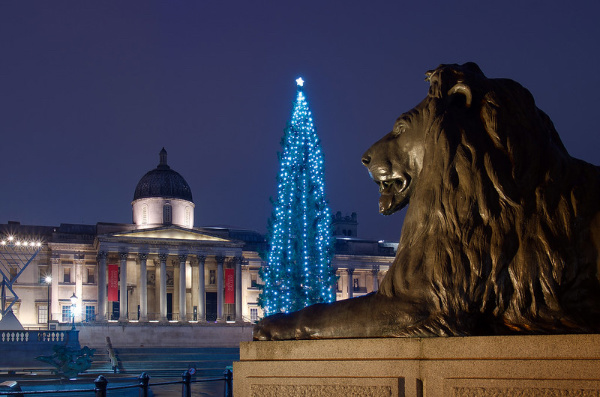
• The traditional Trafalgar Square tree lighting ceremony has gone virtual for the first time this year due to coronavirus restrictions. The online event, which will be held at 6pm on 3rd December via YouTube and Facebook, will include messages from the Lord Mayor of Westminster and the Mayor of Oslo as well as information on the history behind the gift of the tree, footage of its journey from the forests of Norway to London, and performances from the Salvation Army, the Poetry Society and the St Martin-in-the-Fields Choir. While the tree felling ceremony in Norway is usually attended by the Lord Mayor of Westminster, this year COVID restrictions meant he was represented by the British Ambassador to Norway, Richard Wood, who was joined by the Mayor of Oslo, Marianne Borgen, and school children from Maridalen school in Oslo, to witness the tree begin its journey to London. A Norwegian spruce has been given by the people of Oslo to the people of the UK in thanks for their support during World War II in the lead-up to every Christmas since 1947. Once the tree arrives in London, it is decorated with Christmas lights in a traditional Norwegian manner. For more on the tree, see westminster.gov.uk/trafalgar-square-christmas-tree.
• Eighteenth century anti-slavery campaigner Ottobah Cugoano – a former slave himself – has been honoured with an English Heritage Blue Plaque. The plaque is located at Schomberg House at 80–82 Pall Mall, the property where he was employed as a servant by artists Richard and Maria Cosway. It was while living here in the 1780’s that Cugoano wrote the book, Thoughts and Sentiments on the Evil and Wicked Traffic of the Slavery and Commerce of the Human Species, Humbly Submitted to the Inhabitants of Great-Britain, one of the first black-authored anti-slavery books to be published in Britain. The house was actually mentioned in the frontispiece of the 1787 edition of Thoughts and Sentiments as one of the places where copies of the book might be obtained. It is, says English Heritage, “evidence of the Cosways’ support for their servant’s endeavours as an author and a campaigner”. For more, see www.english-heritage.org.uk/visit/blue-plaques/.
• Somerset House is offering virtual tours of its exhibition Leila Alaoui: Rite of Passage. The exhibition is the first major retrospective of the work of Alaoui, a celebrated French-Moroccan photographer, video artist and activist who died in a terrorist attack at the age of 33 while working on a photography project promoting women’s rights in Burkina Faso in 2016. Guided by award-winning broadcaster and cultural commentator Ekow Eshun, the tour of the exhibition takes in three of the artist’s defining series – No Pasara, which documents the lives of North African migrants trying to reach Europe; Natreen (We Wait), which follows families trying to flee the Syrian conflict, and Les Marocains, which, inspired by Robert Frank’s The Americans, meets the many individuals who make up the multifaceted fabric of contemporary Morocco. The exhibition also includes an unfinished video project L’Ile du Diable (Devil’s Island) which Alaoui was working at the time of her death, featuring dispossessed migrant workers at the old Renault factory in Paris. The free tour can be accessed at www.somersethouse.org.uk/blog/virtual-tour-leila-alaoui-rite-passage.
Send all items for inclusion to exploringlondon@gmail.com.
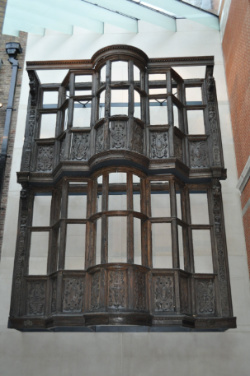
OK, so our last entry in this series isn’t a house, just a facade. But it is a significant and rare example of part of a pre-Great Fire timber-framed house in London which has been relocated.
PICTURE: tx K.B. Thommpson (licensed under CC BY 3.0)
The intricately detailed wooden facade, which can now be found in the V&A in South Kensington, was originally part of a three-and-half storey mansion which stood on the west side of Bishopsgate Without (that is, just outside the City of London’s walls).
It was built by Sir Paul Pindar, a wealthy merchant and diplomat who was knighted by King James I in 1620 (we’ll be featuring more of his story in an upcoming ‘Famous Londoners’ article).
He had purchased several properties in the street in 1597 and then incorporated these properties into a single mansion which also included a new section (of which the striking facade survives).
The house, which Shakespeare himself may well have walked past, was unusually large and sufficiently opulent that it served as the residence of Pietro Contarini, the Venetian ambassador, in 1617–18.
By 1660, it had been divided into smaller dwellings and, having survived the Great Fire of London, subsequently became a residence for the indigent. The front rooms on the ground floor, meanwhile, were turned into a tavern named the Sir Paul Pindar’s Head.
By the late 19th century, however, the nearby Liverpool Street Railway Station needed more room for expansion and, as a result, in 1890 the property was demolished to make space.
Part of the facade, however, was carefully dismantled (albeit some large sections, like the projecting carved window frames, were kept intact) and subsequently moved to the V&A where it was reassembled using carpenters’ marks on the wood.
The restored frontage (without the original glass and leading which was replaced in 1890) initially stood near the front of the museum but in the Noughties was delicately moved to where it now stands in the Medieval and Renaissance Galleries.
While the museum is currently closed as a result of coronavirus restrictions, we publish these details for when you can visit.Timed tickets can be booked for future dates here.
WHERE: Victoria and Albert Museum, Cromwell Road (nearest Tube stations are South Kensington and Gloucester Road); WHEN: Special – see above; COST: Free; WEBSITE: www.vam.ac.uk


 Exploring London
_(cropped).jpg)