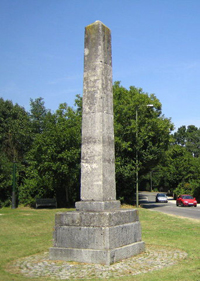
Part of the English Civil War, this battle – really no more than a skirmish – between the Royalists and the Parliamentarians which prevented the Royalists from attacking London which ultimately forced the Royalists to spend winter in Oxford.
Having taken Banbury and Oxford in the aftermath of the inconclusive Battle of Edgehill, a Royalist army had marched along the Thames Valley toward London.
On the 12th November, 1642, the Royalists had defeated two Parliamentarian regiments at Brentford to the west of the City of London. Under the command of Patrick Ruthven, Earl of Forth, but with King Charles I among them, the Royalists, who numbered some 12,000 men, then camped overnight at a site believed to be at or near the village of Turnham Green, now in west London.
Meanwhile, a Parliamentarian army under command of Robert Devereux, Earl of Essex, joined up with London militia under the command of Major General Philip Skippon at Chelsea Field. Numbering some 24,000, they advanced upon Turnham Green where the Royalists awaited them.
By 8am on the 13th, the two armies had formed lines running roughly north to south across Turnham Green, Chiswick Common Field and Acton Green with the Parliamentarian line stretching from the site of what is now Turnham Green Tube station to the grounds of Chiswick House and the Royalist lines stretching from south of Chiswick Park Tube station to the Great West Road.
Both lines apparently had infantry at the centre with cavalry on the flanks. Essex, attempting to outflank the Royalists, sent troops to high ground at Action but, concerned about splitting his army, soon withdrew them.
The battle them became something of a stalemate – Essex, not seeking to do any more than block the Royalist advance, was happy to wait while the Royalists, outnumbered, short of ammunition and said to have been unwilling to put the Londoners offside, did likewise.
Eventually, late in the afternoon, the Royalists withdrew westward and Essex, who was much criticised for it afterward, gave a half-hearted pursuit. King Charles I then ordered his army back up the Thames Valley to Oxford where they ended up passing the winter.
Less than 50 men in total are said to have died in the indecisive clash which, it can be argued, helped to ensure that the Civil War would go on for another four long years.
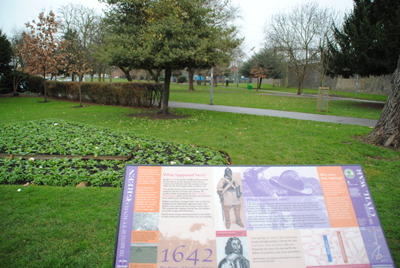
While much of the site of the skirmish has been built upon, glimpses of the open ground which once stood here can still be seen. There is an information panel about the battle opposite Turnham Green Tube station.
For more on the English Civil War, see Blair Worden’s The English Civil Wars: 1640-1660


 .
. A detailed picture of the inhabitants of Roman London, known as Londinium, has been created for the first time, the Museum of London announced this week. Detailed analysis of the DNA of four skeletons has revealed a culturally diverse population. The examined skeletons include that of a Roman woman (pictured left), likely to have been born in Britain with northern European ancestry, found buried with high status grave goods at Harper Road, Southwark, in 1979, and another of a man, whose DNA revealed connections to Eastern Europe and the Near East, who was found at London Wall in 1989 with injuries to his skull which suggest he may have been killed in the nearby amphitheatre before his head was dumped in a pit. The other two skeletons examined were found to be that of a blue-eyed teenaged girl found at Lant Street, Southwark, in 2003, believed to have been born in north Africa, whose ancestors lived in south-eastern Europe and west Eurasia, and that of an older man found at Mansell Street who was born in London and whose ancestry had links to Europe and north Africa. The examination – the first multi-disciplinary study of the inhabitants of a Roman city anywhere in the empire – also revealed that all four suffered from gum disease. Caroline McDonald, senior curator at the museum, said that while it has always been understood Roman London was a culturally diverse place, science was now “giving us certainty”. “People born in Londinium lived alongside people from across the Roman Empire exchanging ideas and cultures, much like the London we know today.” The four skeletons will form the basis of a new free display, Written in Bone, opening at the Museum of London on Friday. PICTURE: © Museum of London
 .
. • The largest exhibition ever mounted about the life of 17th century diarist Samuel Pepys opens at the National Maritime Museum in Greenwich tomorrow. Samuel Pepys: Plague, Fire, Revolution features more than 200 paintings and objects brought together from museums, galleries and private collections which explore the life of the famous diarist (depicted here in a bust outside the Guildhall Art Gallery) against the backdrop of the tumultuous events of Stuart London, from the execution London of King Charles I in 1649 through the Great Fire of London and the Glorious Revolution on 1688. Objects on show include the famous painting, Portrait of Charles II in Coronation Robes, objects connected to Pepys’ mistresses including one of his love letters to Louise de Kéroualle (aka ‘Fubbs’ or ‘chubby’) and other personal items such as a lute owned by Pepys. The exhibition is accompanied by a series of events including Pepys Show Late: Party like it’s 1669 (26th November) and a series of walks and talks. Admission charge applies. The exhibition runs until 28th March. For more, see
 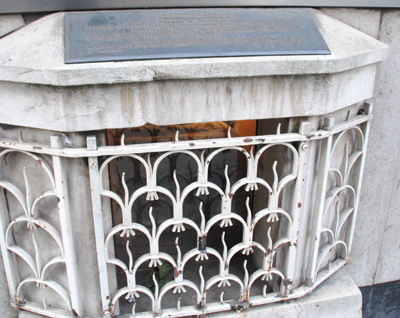 Little is known of Jack Cade until the former soldier from Kent led an uprising against the rule of King Henry VI during the Hundred Years War with France. And London was a key site of fighting during the uprising.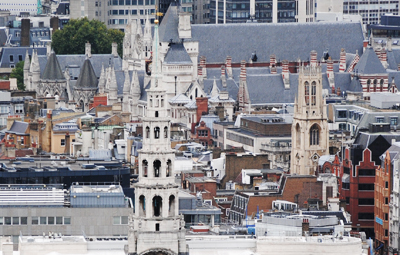

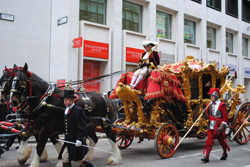 • The Lord Mayor’s Show will mark its 800th anniversary on Saturday as the newly elected Jeffrey Mountevans – the 688th Lord Mayor of the City of London – makes his way through the City to Westminster to swear loyalty to the Crown. The procession of 7,000 people, some 180 horses and 140 vehicles will set off on its way along a three-and-a-half mile route at 11am, starting at Mansion House and traveling down Cheapside to pause at St Paul’s Cathedral (which is open for free all day) before heading on via Ludgate Hill and Fleet Street to the Royal Courts of Justice before returning the City via Queen Victoria Street from 1.10pm. In a special nod to the 800th anniversary, the famous bells of St Mary-le-Bow will ring out a special 800-change at noon. The day will conclude with fireworks over the River Thames kicking off at 5.15pm (for the best view head down to the riverside between Waterloo and Blackfriars Bridges, either on Victoria Embankment or on the South Bank). The show’s origins go back to 1215 when, in exchange for a Royal Charter granting the City of London the right to elect its own mayor, King John insisted the newly elected mayor travelled to Westminster each year to swear loyalty to the Crown. For more (including a map to print out), see
 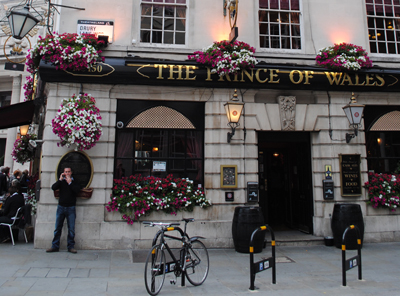 Another Drury Lane pub, the origins of this one go back to 1852 when it was established by Henry Wells on the site of what was once a potato warehouse.

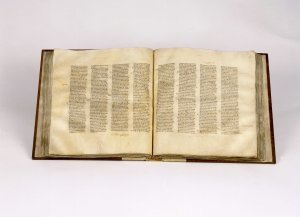 The first major exhibition to explore the history of Egypt after the pharaohs opens at the British Museum today. Egypt: Faith after the pharaohs spans 1,200 years of history – from 30 BC to 1171 AD – with 200 objects showing how Christian, Islamic and Jewish communities reinterpreted the pharaonic past of Egypt and interacted with each other. The exhibition opens with three significant examples of the Hebrew Bible, the Christian New Testament and the Islamic Qur’an – the texts include the New Testament part of the 4th century AD Codex Sinaiticus, the world’s oldest surviving Bible and the earliest complete copy of the New Testament, which is now part of the British Library’s collection. All three are juxtaposed with everyday stamps associated with each of the three religions in an illustration of the relationship between the institutional side of religion and its everyday practice, both key themes of the exhibition. Other exhibits include a pair of 6th-7th century door curtains featuring classical and Christian religious motifs, a 1st-2nd century statue of the Egyptian god Horus in Roman military costume, and a letter from the Roman Emperor Claudius (41-54 AD) concerning the cult of the divine emperor and the status of Jews in Alexandria. Admission charge applies. Runs until 7th February in Room 35. A programme of events accompanies the exhibition. For more, see