Before we move on to our next Wednesday series, here’s a recap…
Richmond
10 places to encounter London’s animal life…1. Deer in Richmond Park…
We start a new series looking at places to encounter (at a distance, for some), London’s wildfire and we start by heading west to Richmond Park.
Subscribe for just £3 a month to access all of Exploring London’s articles – and support our work!
Lost London – Richmond Lodge…
Located close to the River Thames, Richmond Lodge was a royal hunting lodge before becoming a favoured residence for Hanoverian royals for several decades in the 18th century.
Subscribe for just £3 a month – that’s less than the cost of a cup of coffee – to access all of Exploring London’s content!
10 significant (and historic) London trees – A recap…
We’ll kick off a new series next week, but, in the meantime, here’s a recap…
1. Queen Elizabeth’s Oak, Greenwich…
4. The Royal Oak, Richmond Park…
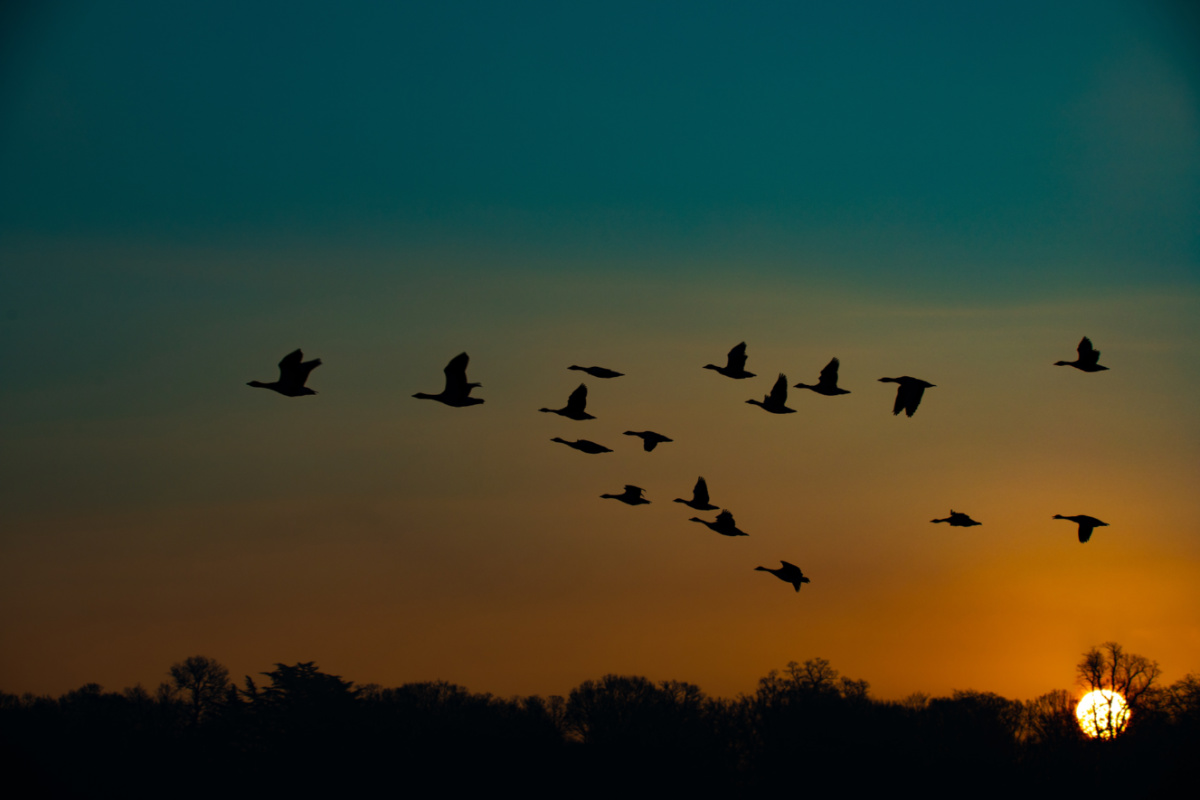
LondonLife – Taking flight…
This Week in London – ‘After Impressionism’; a new woodland for Richmond Park; and, a new exhibition at the Heath Robinson…
• Paintings and sculptures by artists including Cézanne, Van Gogh, Rodin, Picasso, Matisse, Klimt, Kandinsky and Mondrian opens at The National Gallery on Saturday. After Impressionism: Inventing Modern Art features more than 100 paintings and sculptures from museums and private collections around the world spanning the period between 1886 and 1914. Highlights include André Derain’s La Danse, Edgar Degas’s Dancers in the Foyer, Paul Cézanne’s Grandes Baigneuses, Edvard Munch’s The Death Bed, Paul Gauguin’s Vision of the Sermon, Camille Claudel’s Imploration / l’Implorante, and Lovis Corinth’s Nana, Female Nude. Admission charge applies. Runs until 13th August. For more, see www.nationalgallery.org.uk/exhibitions/after-impressionism-inventing-modern-art.
• Sir David Attenborough has planted an English oak tree to officially open the Platinum Jubilee Woodland, a new woodland in Richmond Park. The woodland has been created as part of The Queen’s Green Canopy initiative to celebrate and honour the late Queen Elizabeth II’s lifetime of service. Some 70 young trees have been planted in the woodland, including oak, Dutch elm-disease-resistant elm, small-leaved lime, and sweet chestnut trees, planted around a focal point which will later incorporate a seating area. Sir David’s tree is one of the last to be planted as part of The Queen’s Green Canopy initiative which concludes on 31st March. The project invited people from across the nation to plant trees in honour of Queen Elizabeth II to mark the Platinum Jubilee and benefit future generations. For more on the park, see www.royalparks.org.uk/parks/richmond-park.
• Illustrative works by William Heath Robinson, Charles Robinson and Thomas Health Robinson, many of which have not be exhibited before, are on show in a new exhibition at the Heath Robinson Museum in Pinner. The works, which come from the collection of Martin and Joanne Verden, include original drawings for Railway Ribaldry and William Heath Robinson’s How to… series of books. Admission charge applies. Runs until 21st May. For more, see www.heathrobinsonmuseum.org.
Send all items for inclusion to exploringlondon@gmail.com.
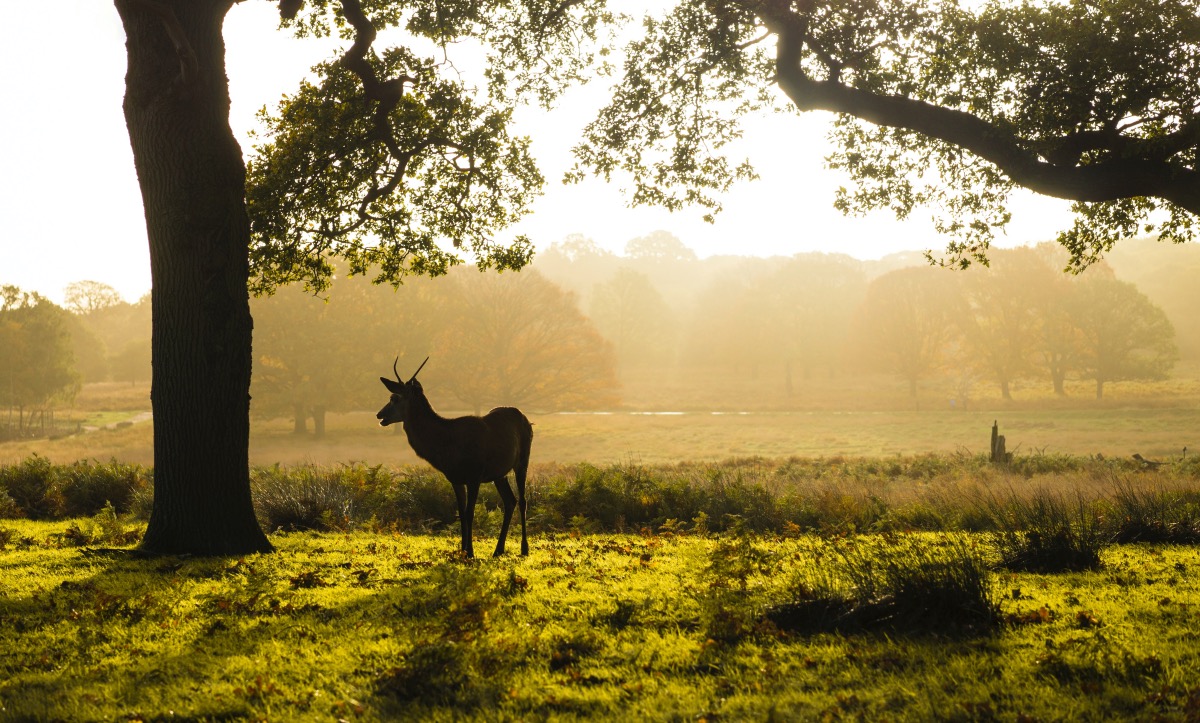
LondonLife – Sunrise silhouette…
London Explained – The Royal Parks…
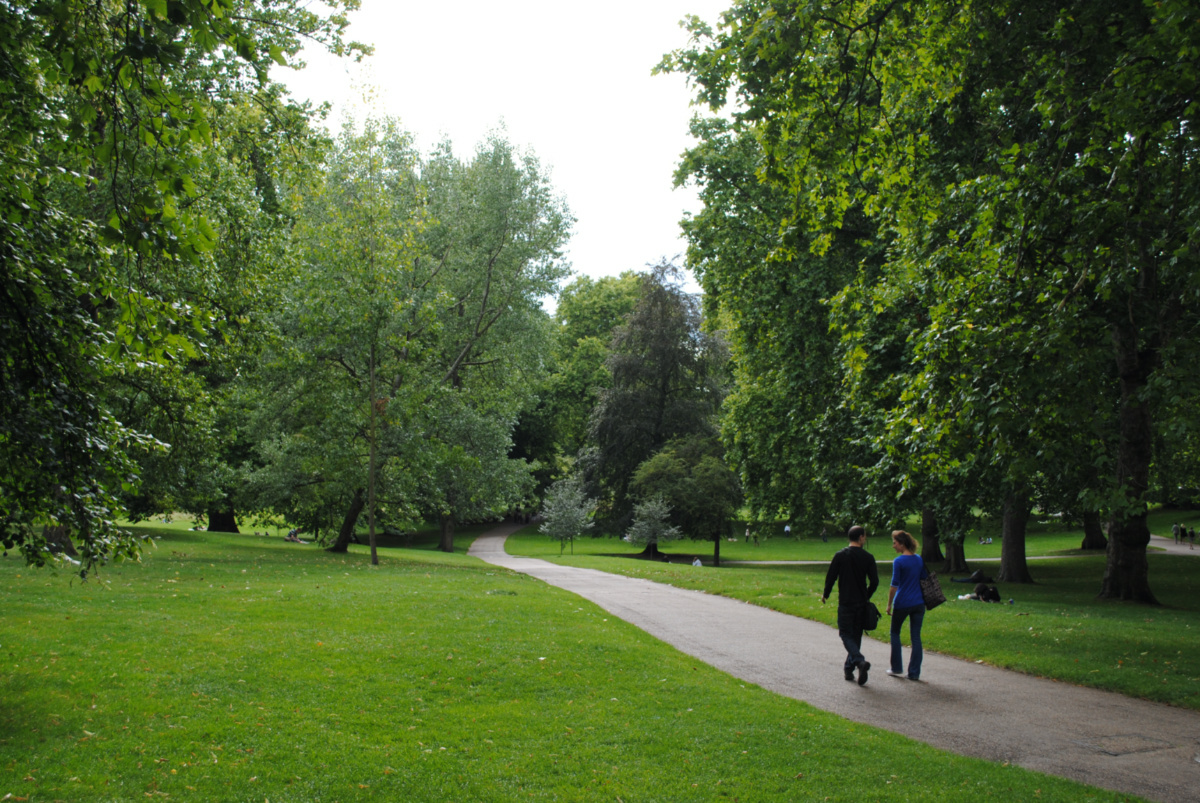
One of the most beautiful features of London are its Royal Parks.
The parks, which covers some 5,000 acres, are owned by the Crown and managed by a charity, The Royal Parks. They include eight of London’s largest open spaces – Hyde Park, The Green Park, Richmond Park, Greenwich Park, St James’s Park, Bushy Park, The Regent’s Park, and Kensington Gardens – as well as some other important open spaces such as Brompton Cemetery, Victoria Tower Gardens, Canning Green and Poet’s Corner.
All eight of the Royal Parks have historically been owned by the Crown with St James’s Park considered the oldest (while Greenwich Park is the oldest enclosed park).
Under an Act of Parliament passed in 1851, the Crown transferred management of the parks to the government. These powers were originally vested in the Commissioners of Works and later transferred to the Minister of Works in 1942. They now rest with the Secretary of State for Culture, Media and Sport.
The Royal Parks charity was created in 2017 when The Royal Parks Agency – a former executive agency of the Department for Culture, Media and Sport – and the Royal Parks Foundation came together. It is governed by a board led by chairman Loyd Grossman.
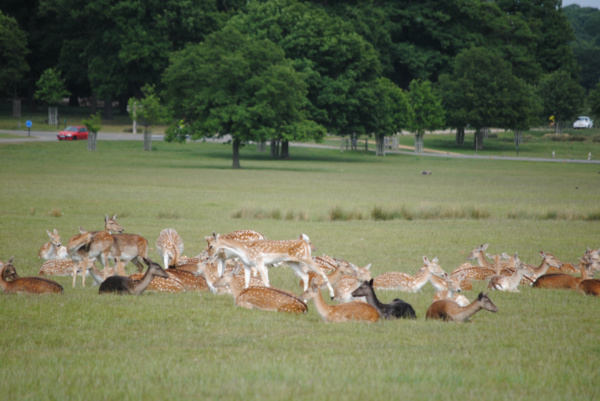
The largest of the eight Royal Parks is Richmond Park which covers some 2,500 acres in London’s south-west (it’s followed by Bushy Park which is just over 1,000 acres). The smallest of the parks is Green Park at just 40 acres.
Interestingly, Hampton Court Palace gardens, which are open to the public are not part of The Royal Parks but instead are under the care of Historic Royal Palaces.
Here’s one fact about each of the eight Royal Parks.
- Cardinal Thomas Wolsey gave Bushy Park to King Henry VIII in 1529 (along with Wolsey’s home, Hampton Court Palace).
- Green Park was initially known as Upper St James’s Park after it was enclosed by King Charles II in 1668.
- The Royal Observatory, designed by Sir Christopher Wren, is located in Greenwich Park.
- Hyde Park became the location of the first artificially lit highway in the country when King William III, who had moved his court to Kensington Palace and found his walk back to St James’s rather dangerous, had 300 oil lamps installed upon a route which later became known as Rotten Row.
- Queen Caroline, wife of George II, gave Kensington Gardens much of its present form when, in 1728, she oversaw the creation of the the Serpentine and the Long Water.
- Horse Guards Parade is considered part of St James’s Park.
- Architect John Nash designed a summer palace for the Prince Regent which was to be located in The Regent’s Park but was never built.
- Prime Minister Lord John Russell was given a home in Richmond Park (Pembroke Lodge) by Queen Victoria in 1847.
10 London hills – 10. Richmond Hill…
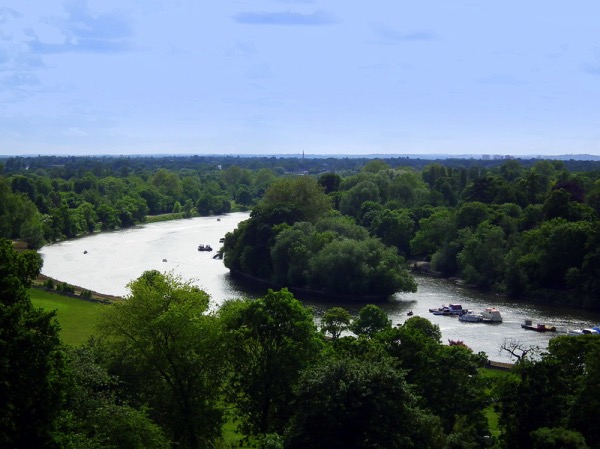
For the final in this series we head out west to Richmond Hill which takes its name from the palace which once stood nearby.
At the summit of the hill, which stands about 50 metres (165 feet) high, stands the gate to Richmond Park while the steeper western slopes drop down to Petersham Meadows by the River Thames.
What was the village of Richmond – now incorporated into greater London – sits partly on the slopes of the hill. It and the hill take their names from a palace, established here in the early 16th century by King Henry VII as a replacement for Sheen (Shene) Palace which had been destroyed in a fire in 1499. The King named the new building Richmond Palace, in honour of the earldom of Richmond in Yorkshire, one of his titles.
Richmond Hill is famed for its views – they include the only view in England protected by an Act of Parliament (passed in 1902). It looks to the south-west over Petersham to the Thames, taking in Glover’s Island, and reaching as far as Windsor and has been immortalised in works by the likes of artists JMW Turner and Sir Joshua Reynolds as well as by author Sir Walter Scott.
Richmond Hill features many fine 18th century homes including Wick House (built for Joshua Reynolds in 1771) and the westward slopes boast the Terrace Walk and Terrace Gardens, both of which are Grade II* listed, while the massive bulk of the former Royal Star and Garter Home for disabled ex-servicemen (now apartments) can be seen close to the summit.
Other famous residents on the hill have included Rolling Stones’ guitarist Ronnie Wood and actress Celia Johnson while scenes for the film, The Hours, were shot on The Terrace.

This Week in London – Nero at the British Museum; Stephen Hawking’s office to be recreated at the Science Museum; and, Blue Plaque for Indian engineer Ardaseer Cursetjee Wadia…
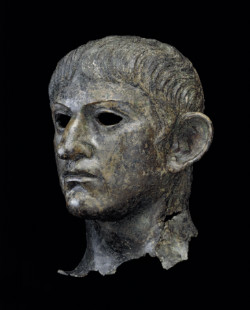
• A bronze head of the Roman Emperor Nero found in the River Alde in Suffolk – long wrongly identified as being that of the Emperor Claudius – and the Fenwick Hoard – which includes Roman coins, military armlets and jewellery – are among the star sights at a new exhibition on Nero at the British Museum. Nero: the man behind the myth is the first major exhibition in the UK which takes Rome’s fifth emperor as its subject. The display features more than 200 objects charting Nero’s rise to power and his actions during a period of profound social change and range from graffiti and sculptures to manuscripts and slave chains. Other highlights include gladiatorial weapons from Pompeii, a warped iron window grating burnt during the Great Fire of Rome of 64 AD, and frescoes and wall decorations which give some insight into the opulent palace he built after the fire. The exhibition, which opens today, runs until 24th October in the Sainsbury Exhibitions Gallery. Admission charge applies. For more, see www.britishmuseum.org/whats_on/exhibitions/nero/events.aspx.
• The office of late theoretical physicist Professor Stephen Hawking will be recreated at the Science Museum, it was announced this week. The contents of the office, which Hawking, the author of the best-selling A Brief History of Time, occupied at Cambridge’s department of applied mathematics and theoretical physics from 2002 until shortly before his death in 2018, includes reference books, blackboards, medals, a coffee maker and Star Trek mementoes as well as six of his wheelchairs and the innovative equipment he used to communicate. The museum, which reportedly initially plans to put the objects on display in 2022 and later recreate the office itself, has acquired the contents through the Acceptance in Lieu scheme, which allows families to offset tax (his archive will go to the Cambridge University Library under the same scheme).
• Nineteenth century civil engineer Ardaseer Cursetjee Wadia – the first Indian Fellow of the Royal Society – has been honoured with an English Heritage Blue Plaque at his former Richmond home. The plaque, which can be found on 55 Sheen Road – the villa Cursetjee and his British family moved to upon his retirement in 1868, was installed to mark the 180th anniversary of his election as a Fellow of the Royal Society. Cursetjee is considered the first modern engineer of India and was the first Indian at the East India Company to be placed in charge of Europeans. He was at the forefront of introducing technological innovations to Mumbai including gaslight, photography, electro-plating and the sewing machine. Cursetjee first visited London in 1839 and travelled regularly been Mumbai (formerly Bombay) and London until his retirement. For more, see www.english-heritage.org.uk/visit/blue-plaques.
Send all items for inclusion to exploringlondon@gmail.com.
Where’s London’s oldest…(still-in-use) bridge?
There’s several candidates for the title (and, of course, it depends on what exactly we mean). So here we go…
First up is the Clattern Bridge, which crosses the River Hogsmill (a small river which runs into the Thames), in Kingston upon Thames in the city’s south-west.
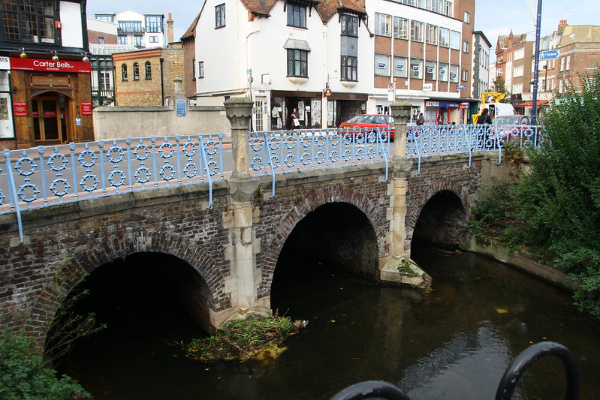
The earliest known reference to this three-arched bridge dates back to 1293 and the medieval name, ‘Clateryngbrugge’, is thought to refer to the sound horses’ hooves made as they clattered across.
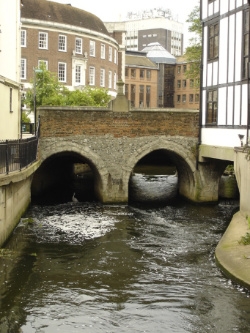 While the bridge (pictured above and right), which had replaced an earlier wooden Saxon bridge, was altered in the 18th and 19th centuries, its Historic England Grade I listing notes that it remains a “good example of a medieval multi-span bridge which survives well” and includes some “impressive medieval masonry”.
Second is another Grade I-listed bridge that doesn’t even cross a river but rather a moat at Eltham Palace in the city’s south-east.
The stone north bridge, now the main entrance to the palace, is described by English Heritage as “London’s oldest working bridge” – although it’s not as old as the Clattern Bridge.
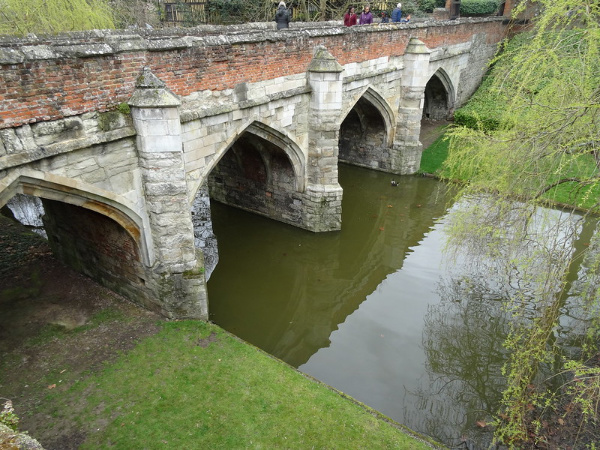
It was constructed in 1390 on the orders of King Richard II, replacing an earlier wooden bridge (it was apparently Geoffrey Chaucer – yes, that Geoffrey Chaucer – who supervised the building works as part of his job as Clerk of the Works to Eltham Palace).
The bridge features four arches, pointed cutwaters with chamfered tops on the outside and a red brick parapet on top.
Thirdly, is the Richmond Bridge which, although not in the same (medieval) league as the previous two, is the oldest bridge crossing the Thames.
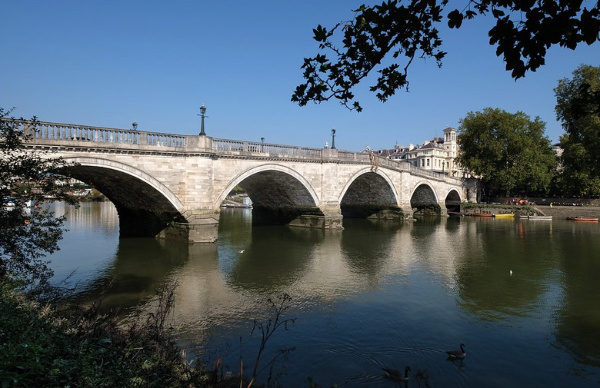
The now Grade I-listed structure was built between 1774 and 1777 as a replacement for a ferry crossing and while it was slightly altered in 1939-40, it remains substantially original.
PICTURE: Top – Clattern Bridge (Maureen Barlin/licensed under CC BY-NC-ND 2.0); Right – Julian Walker (licensed under CC BY-NC-ND 2.0); Middle – The bridge at Eltham Palace (John K Thorne/Public domain); Bottom – Richmond Bridge (Marc Barrot/licensed under CC BY-NC-ND 2.0)
Treasures of London – King Henry’s Mound…
Having recently been granted protection as a scheduled monument, the landscape feature known as King Henry’s Mound is located in Richmond Park in south-west London.
It is believed to be a prehistoric round barrow, possibly dating from between 2,400 and 1,500 BC – a period spanning the Late Neolithic to the Late Bronze Age.
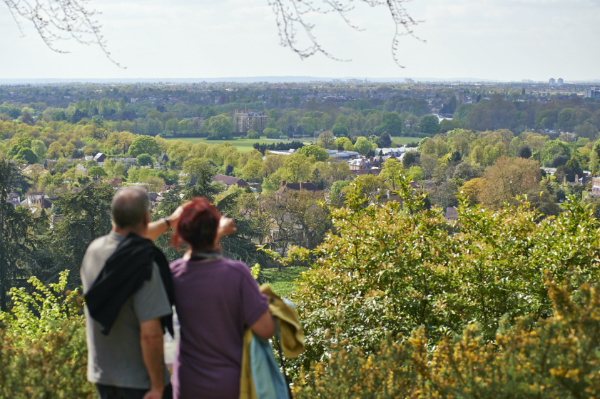
Its name, however, comes from the legend that King Henry VIII waited on top of the mound on 19th May, 1536, watching for a rocket to be launched from the Tower of London that would confirm his wife Anne Boleyn had been executed for treason (and so allow him to marry Jane Seymour).
The truth of that is unlikely – although it is possible to see St Paul’s Cathedral from the mound (it’s a view that is protected, as well as, to the west Windsor Castle and the Thames Valley), King Henry VIII was apparently in Wiltshire at the time.
The mound, however, was linked to kings as far back as 1630 when a map was published listing it as ‘Kings Standinge’, ‘standinge’ being a reference to a platform on which those not involved in a hunt could stand and watch.
Both King Henry VIII and his daughter Queen Elizabeth I are known to have hunted here – in fact, it was King Henry VIII’s father, King Henry VII, who built a royal palace at Richmond and named it after his estate in Yorkshire.
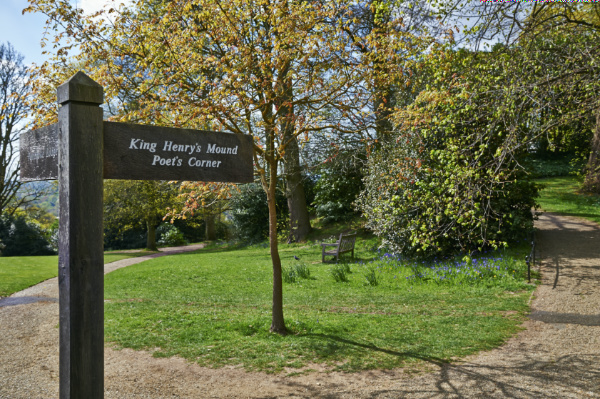
The mound was later incorporated into the gardens of Pembroke Lodge in the 19th century, during much of the latter half of which the property was home to Prime Minister Lord John Russell.
Today the Grade I-listed Richmond Park is managed by the Royal Parks.
For more on Richmond Park, head to www.royalparks.org.uk/parks/richmond-park.
PICTURES: The Royal Parks
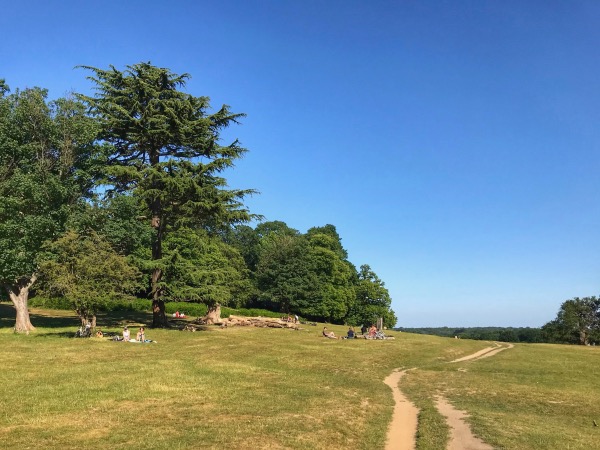
LondonLife – Summers day in Richmond Park…
PICTURE: Guillermo Bresciano/Unsplash
Famous Londoners – George Eliot…
Last month marked the 200th anniversary of the birth of leading English novelist George Eliot – actually the pen name of Mary Ann Evans.
Born in Warwickshire on 22nd November, 1819, Evans was the third child of Robert Evans, an estate manager, and Christiana Evans, daughter of a local mill owner.
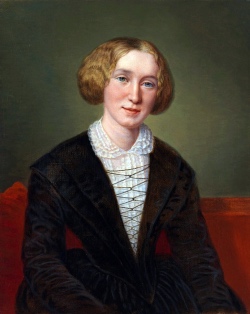
Described as a “voracious reader” from an early age, she was a boarder at various schools up until the age of 16 when, following the death of her mother, she returned home to act as housekeeper (she apparently continued her education in the library of Arbury Hall, the property her father managed).
In 1841, when her brother Isaac married and took over the family home, she moved with her father to Foleshill near Coventry. There, they met Charles and Cara Bray – Charles was a wealthy ribbon maker and religious free-thinker who used his wealth to establish schools and hospitals to help improve conditions of the poor.
Thanks to her friendship with the Brays, Evans came into contact at their house, Rosehill, with the likes of Welsh social reformer Robert Owen, Harriet Martineau, often described as the first female sociologist, and American essayist Ralph Waldo Emerson as well as German theologian David Friedrich Strauss and German philosopher Ludwig Feuerbach (in fact, her first major literary work was the completion of an English translation of Strauss’ The Life of Jesus Critically Examined and she also later translated Feuerbach’s The Essence of Christianity).
Evans, who was a devout evangelical Christian in her youth, lived with her father until his death in 1849. She had questioned her faith some years before but after she’d informed her father she would no longer go to church, they had reached a compromise under which she had been free to think as she wished as long as she continued to attend church.
Following her father’s death, Evans – now 30 – had visited Switzerland and, following her return to England, moved to London to pursue a career in writing.
In London, Evans initially stayed in the Strand home of radical publisher John Chapman, whom she’d met through the Brays. She eventually went on staff at his left-wing journal, The Westminster Review – becoming, in time, Chapman’s right-hand, the editor in fact if not in title, at publication by the time she left in 1854.
At that time she moved in with journalist George Henry Lewes, who had met her several years earlier. He was still married to Agnes Jervis, despite her having born to children to another man, and the new couple’s relationship caused a great scandal, leading many to shun Evans. The couple travelled together to Germany for research and thereafter Lewes and Evans apparently considered themselves married.
While she had stories published in magazines in the years earlier, her first novel, Adam Bede, was published under the pseudonym George Eliot in 1859 (she’d first used the pseudonym on a short story, The Sad Fortunes of the Reverend Amos Barton, published in 1857). Much acclaimed, the public interest surrounding the novel led Evans – who now called herself Marian Evans Lewes – to acknowledge the work as hers – a revelation which came as a shock to many given her unconventional private life but which, despite that, failed to dent the novel’s popularity.
Encouraged by Lewes, she wrote several novels over the next 15 years including The Mill on the Floss in 1860, Silas Marner in 1861, Romola in 1863, Felix Holt, the Radical in 1866 and her most acclaimed novel (sometimes described as the greatest English novel ever written), Middlemarch in 1871-72. Her final novel, Daniel Deronda, was published in 1876.
Celebrated for the depth of her characterisations and her descriptions of English rural life, she was recognised as the greatest English novelist of her time.
 The couple, meanwhile, lived in several properties in London – including one in Richmond, ‘Holly Lodge’ in Wimbledon Park Road, Wandsworth (it was the first property south of the Thames to be marked with an English Heritage Blue Plaque), and ‘The Priory’ near Regent’s Park in Marylebone.
Eliot’s success as a novelist saw the couple gradually gain social acceptance – in an indication that can be seen in that Charles Darwin, Aldous Huxley, Henry James and Frederic Leighton were all among those entertained at The Priory in the couple’s latter years together.
Lewes died in 1878 and two years later, on 16th May, 1880, Lewes married John Cross – a longstanding friend who was 20 years younger and who had provided comfort following the loss of her husband.
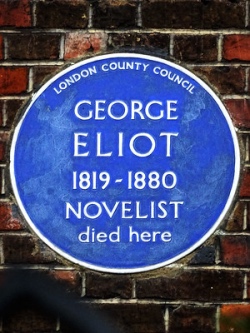
Following their honeymoon in Venice, the couple returned to London where they lived at a property in Cheyne Walk, Chelsea (an English Heritage Blue Plaque marks the property).
It was to be a short-lived marriage – soon after moving into their new home, Mary Ann (now) Cross fell ill with a throat infection and coupled with the kidney disease she had suffered for several years, she died on 22nd December of that year at age 61.
Eliot was buried in Highgate Cemetery beside Lewes. A memorial stone was erected in Westminster Abbey’s Poet’s Corner in 1980.
PICTURES: Top – George Eliot, replica by François D’Albert Durade, oil on canvas, 1850-1886, based on a work of 1850, 13 1/2 in. x 10 1/2 in. (343 mm x 267 mm), Purchased 1905, Primary Collection, NPG 1405; Below – The English Heritage Blue Plaque on the Cheyne Walk property (Spudgun67 (licensed under CC BY 2.0))
LondonLife – Ham House gets flowery…
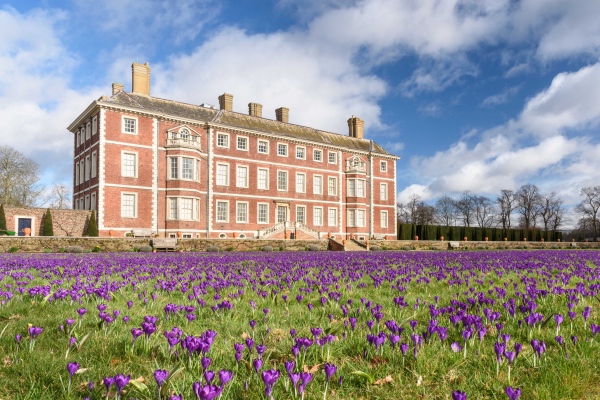
Part of the garden at the historic Thames-side mansion Ham House has been redesigned with the aim of bringing some new life to the manicured lawns. Rosie Fyles, head gardener at the 17th century property in Richmond – now in the care of the National Trust, has overseen the planting of a series of “plats” – each the size of a tennis court – with some 500,000 bulbs and wildflowers to create a “pageant of colour” from early spring and throughout summer. The plats have also been created with wildlife and diversity in mind, using naturalising bulbs to attract bees, butterflies and other pollinating insects. Fyles hopes the project will prove inspirational for home gardeners. “You can easily use pots, planters or a small area of border to create a pollinator-friendly bulb display over a few early spring months; in fact you can curate your own sequence of flowering from February to May at least,” she said. “We have used Crocus ‘Ruby Giant’, four types of species tulips (including bright red Tulipa linifolia) and Muscari latifolium to create a bright, deep blue carpet of colour.” For more, head to www.nationaltrust.org.uk/ham-house-and-garden. ALL PICTURES: National Trust/Chris Davies.


10 (lesser known) memorials to women in London – 8. Virginia Woolf…
Located in Tavistock Square in Bloomsbury, this bronze bust of writer and literary pioneer Virginia Woolf (1882-1941) was erected in 2004.
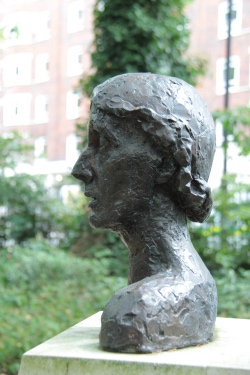 Commissioned by the Virginia Woolf Society of Great Britain, it is a copy of a bust of Woolf sculpted by Stephen Tomlin in 1931 (there is a 1953 version of the work, apparently the only 3D representation of Woolf taken from life, in the National Portrait Gallery) and was set on a Portland stone plinth designed by Stephen Barkway.
A plate on the plinth explains that Woolf, a central figure in the Bloomsbury group of writers and artists, lived from 1924 to 1939 in a house which once stood on the south side of Tavistock Square, the period when her greatest novels were written.
It also features a quote from Woolf concerning the writing of her novel To the Lighthouse – “Then one day walking round Tavistock Square I made up, as I sometimes make up my books, To the Lighthouse; in a great, apparently involuntary, rush.”
There are, incidentally, plans to erect a new life-sized, seated statue of Woolf at Richmond on the bank of the River Thames. Woolf and her husband Leonard lived for a time the riverside borough at Hogarth House (where they also ran their publishing company).
Mock-ups have been created by artist Laury Dizengremel and there is a funding appeal to raise £50,000 currently underway.
PICTURE: Maureen Barlin (licensed under CC BY-NC-ND 2.0)
10 islands in the Thames – 6. Glover’s Island…
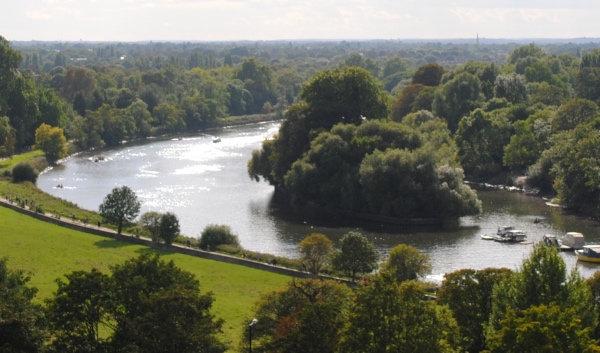
Originally known as Petersham Ait, this small island located in a stretch of river known as Horses Reach between Petersham and Twickenham was renamed Glover’s Island after it was bought by a Richmond-based waterman, Joseph Glover, in 1872.
Having originally paid the sum of £70 for it, in 1895 Glover advertised it for sale for the rather higher sum of £5,000. The Richmond Corporation was approached but declined to pay such a high sum and so a couple of years later Glover, apparently in a move designed to put pressure on the municipal authorities, put the island up for auction with the suggestion it could be sold to Pear’s Soap Company and a massive advertising billboard erected on it.
Amid concerns over the need to preserve the view from Richmond Hill from such an atrocity, efforts were made to raise public funds to purchase the island at auction but when the auction came around – in September, 1898 – only £50 had been raised.
It didn’t matter – the highest bid at the auction only reached £200, however, so Glover didn’t sell, nor did he accommodate a local resident who apparently subsequently offered £1,000 for the island (with the intention of passing it on to the Richmond Corporation). Instead, Glover withdrew it from sale.
Temporarily, it seems. Because in 1900, Richmond Hill resident – as well as businessman, art collector and philanthropist – Max Waechter, later Sir Max, bought the island for an undisclosed price and gave it to council with the condition that it never be developed.
It remains so to this day – the uninhabited, heavily wooded half acre island, which was raised to its present height using rubble excavated from London Tube tunnels in the 19th century, still provides a pleasant feature in the landscape for those looking out from Richmond Hill and, with the view now protected by an Act of Parliament, that’s not likely to change.
PICTURE: View from Richmond Hill of the Thames and Glover’s Island (David Adams)
10 islands in the Thames – 5. Corporation Island (and the Flowerpots)…
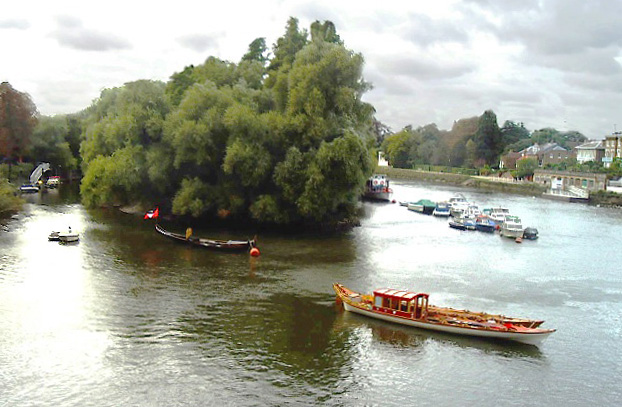
Located between Richmond Bridge and Richmond Rail Bridge (and part of the much taken-in view from the Richmond waterfront), this is another uninhabited Thames island which is frequented by herons.
Heavily wooded, tree species include various willows and black poplars. In the 1960s, the council approved the cutting down of plane trees on the island – the willows were planted subsequently.
The name presumably comes from the Richmond Corporation – that is the Municipal Borough of Richmond – which owned the island.
Downstream of Corporation Island – also known as Richmond Ait – lay two small islands called the Flowerpots.
PICTURE: David Kemp (licensed under CC BY-SA 2.0)
Recap – 10 of the most memorable (and historic) views of London
We have finished our series on 10 of the most memorable (and historic) views of London. And while there’s plenty of views we didn’t mention (we’ll be featuring more in an upcoming series at some point), we think we have captured 10 worth seeing. So, in case you missed any, here they are again…
1. View from St Paul’s Cathedral’s dome…
2. The city skyline from Primrose Hill…
3. View from General Wolfe, Greenwich…
4. View from King Henry’s Mound, Richmond Park…
5. View from the top of The Monument…
7. View of the Houses of Parliament from across the Thames…
8. View from Point Hill, Greenwich…
9. High level views from Tower Bridge…
10. View of Maritime Greenwich…
We’ll kick off our new special Wednesday series next week…
10 of the most memorable (and historic) views of London – 4. View from King Henry’s Mound, Richmond Park…
 Tradition holds that the spot where this officially protected view originates from – the prehistoric barrow known as King Henry’s Mound – was where King Henry VIII stood on 19th May, 1536, to watch for a rocket fired from the Tower of London.
The signal was to indicate that his former wife, Anne Boleyn, had been beheaded for treason and hence that he was now free to marry Jane Seymour.
Sadly, the story is seen as unlikely – the king was apparently in Wiltshire at the time.
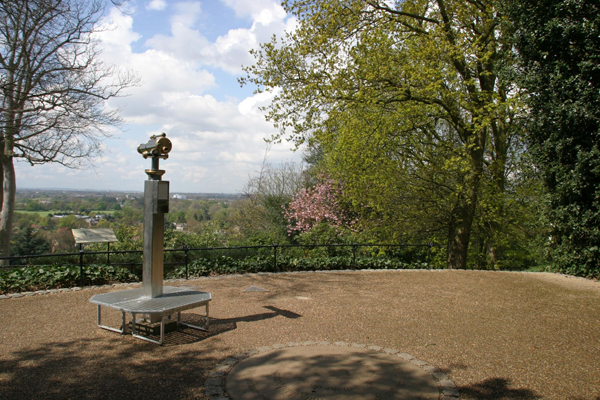
But it adds a nice nostalgia to this tree-framed view which looks across Richmond Park and areas south of the River Thames to the great dome of St Paul’s Cathedral.
The mound, which also offers views west over the Thames Valley towards Windsor, is believed to cover a burial chamber from the Bronze Age (it would have stood more prominently over the Thames Valley in those days) and was later used as a viewing position for hunting deer and falconry.
A permanent public telescope has been set up on the mound which since the 19th century has sat in Pembroke Lodge Garden (named for the Countess of Pembroke who lived in a cottage here between about 1788 and 1831).
The historic view made headlines last year over calls for London’s Mayor to step in and halt building work amid concerns that the 42-storey Manhattan Loft Gardens tower in Stratford, east London, could be seen in the view behind the cathedral dome.
WHERE: King Henry’s Mound, Richmond Park (nearest Tube station is Richmond); WHEN: 24 hour pedestrian access except during the deer cull in November and February; COST: Free entry; WEBSITE: www.royalparks.org.uk/parks/richmond-park
PICTURE: Royal Parks
 Exploring London