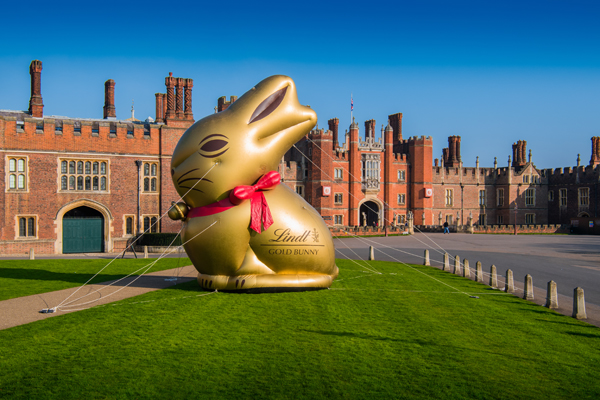
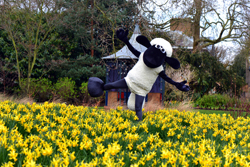
 • Join in the hunt for Lindt gold bunnies at Hampton Court Palace this Easter. The bunny hunt is just one of the many chocolate-related activities taking place at the palace over the Easter period – visitors can also explore the history of chocolate and discover how it was made in the palace’s 18th century ‘chocolate kitchen’ by Thomas Tosier, King George I’s private chocolate chef while attractions outside also include the reopened ‘Magic Garden’. An imaginative play garden first opened in spring last year, it invites visitors to explore the world of Tudor tournaments on what was the site of King Henry VIII’s former tiltyard. The Palace Lindt Gold Bunny Hunt runs until 17th April (the Magic Garden is open until 27th October). Admission charges apply. For more, see www.hrp.org.uk/hampton-court-palace/. PICTURE: Lindt & Sprungli (UK) Ltd.
• Joseph Dalton Hooker – dubbed the ‘king of Kew’ – is the subject of a new exhibition in The Shirley Sherwood Gallery of Botanical Art in Kew Gardens. Joseph Hooker: Putting plants in their place explores the life of the botanist, charting his travels to many parts of the world – including Antarctica and Mt Everest – and how he helped to transform Kew Gardens from a “rather run-down royal pleasure garden” into a world class scientific establishment. The exhibition features an array of drawings, photographs, artefacts and journals including 80 paintings by British botanical artists and an illustration of Mt Everest by Hooker, the earliest such work by a Westerner. Runs until 17th September. Admission charge applies. For more, see www.kew.org.
• On Now – The Private Made Public: The First Visitors. The first in a series of public events and exhibitions celebrating Dulwich Picture Gallery’s bicentenary year, this display features the first handbook to the gallery, a 1908 visitor book which includes the signatures of Vanessa and Clive Bell and Virginia Woolf, and James Stephanoff’s watercolour, The Viewing at Dulwich Picture Gallery, which depicts the gallery’s enfilade as it would have been in the 1830s. The exhibition also looks back at some of the gallery’s first visitors and features quotes from notable artists, writers and critics shown next to works in the permanent collection. Can be seen until 4th June. Admission charge applies. For more, see www.dulwichpicturegallery.org.uk.
Send all items for inclusion to exploringlondon@gmail.com.

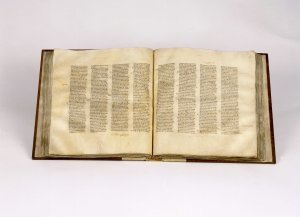 The first major exhibition to explore the history of Egypt after the pharaohs opens at the British Museum today. Egypt: Faith after the pharaohs spans 1,200 years of history – from 30 BC to 1171 AD – with 200 objects showing how Christian, Islamic and Jewish communities reinterpreted the pharaonic past of Egypt and interacted with each other. The exhibition opens with three significant examples of the Hebrew Bible, the Christian New Testament and the Islamic Qur’an – the texts include the New Testament part of the 4th century AD Codex Sinaiticus, the world’s oldest surviving Bible and the earliest complete copy of the New Testament, which is now part of the British Library’s collection. All three are juxtaposed with everyday stamps associated with each of the three religions in an illustration of the relationship between the institutional side of religion and its everyday practice, both key themes of the exhibition. Other exhibits include a pair of 6th-7th century door curtains featuring classical and Christian religious motifs, a 1st-2nd century statue of the Egyptian god Horus in Roman military costume, and a letter from the Roman Emperor Claudius (41-54 AD) concerning the cult of the divine emperor and the status of Jews in Alexandria. Admission charge applies. Runs until 7th February in Room 35. A programme of events accompanies the exhibition. For more, see


 Exploring London