Famous Londoners – Sir Arthur Conan Doyle…

Given our current Wednesday series, we thought it only fitting that we take a quick look at the life of Scottish-born Sir Arthur Conan Doyle, a physician and author most famous for his creation of fictional detective Sherlock Holmes.

Born in Edinburgh on 12 May, 1859, to a wealthy Irish-Catholic family, Doyle was educated at a Jesuit preparatory school in England before  undertaking a medical degree at the University of Edinburgh. It was there where he met his mentor, Dr Joseph Bell, a figure who at least partly inspired the creation of Holmes, and it was also during his time here that he first began writing – his first short story was The Mystery of Sasassa Valley. Having taken a voyage to the Arctic Circle in the post of ship’s surgeon and worked in Birmingham as a doctor’s assistant, he was awarded a medical degree in 1881 (he became MD in 1885).

His first job after graduation was aboard another ship – this time sailing to Africa – and after the voyage he settled back in England, briefly in Plymouth and then in Portsmouth where he opened his first medical practice. For the next few years, he continued  practising as a doctor while writing and in 1885 married his first wife Louisa Hawkins.

In 1886, he started writing A Study in Scarlet. Introducing Sherlock Holmes and Dr John Watson to the world,  it was eventually published in Beeton’s Christmas Annual in 1888. Doyle went on to write some 60 stories about Holmes over the ensuing years but also wrote other books including historical novels, fantasy and science-fiction stories (The Lost World), romances (The White Company), plays (including one about Sherlock Holmes), poetry and written works which reflected his interest in Spiritualism – an interest which had started while he was at university.

In 1890, having studied opthalmology in Vienna, he established a practice at 2 Upper Wimpole Street, Marylebone, London (the location lies only a short distance from his creation’s famous address at 221b Baker Street) and, with his family, took up residence in Montague Place and later at 12 Tennison Road in South Norwood (marked by a Blue Plaque). But with no patients, he spent his time writing, deciding to kill Holmes off in 1893 but subsequently bringing him back to life after a public outcry. He toured the US in 1894 (other countries he visited during his life included Australia) and later served as a surgeon in the Boer War (1899-1902), for which he was knighted in 1902.

Following the death of his first wife form tuberculosis in 1906 (with whom he had two children), Doyle married Jean Elizabeth Leckie in 1907. Moving to Windlesham in Sussex (it was here Doyle would live for the rest of his life while keeping a flat in London), they had three further children. Meanwhile his interest in Spiritualism continued to grow, particularly following the death of his son, Kingsley, in World War I.

His final 12 stories about Sherlock Holmes were published in 1928 in a compilation called The Casebook of Sherlock Holmes. The following year, despite poor health, he embarked on a Spirtualism tour on the continent but had to break it off and return home to Crowborough, East Sussex, in England. There he died on 7th July, 1930, leaving behind a literary legacy which has continued on unchecked. His grave can be found in Minstead Churchyard in New Forest.

For more on Sherlock Holmes, see our earlier posts Famous Londoners – Sherlock Holmes and 10 fictional character addresses in London – 1. 221b Baker Street….

Around London – Chinese masterpieces at the V&A; Iraq war photography; and, The Age of Glamour at the Cartoon Museum…

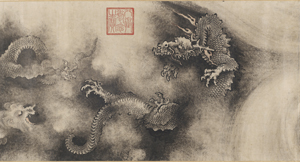
Chen_Rong_Nine_DragonsChinese masterpieces are the focus of a new exhibition opening at the V&A in South Kensington on Saturday. Masterpieces of Chinese Painting 700-1900 will feature more than 70 works including some of the earliest surviving Chinese paintings and many shown in Europe for the first time. Organised chronologically in six successive periods, the works in the display range from intimate works by monks to a 14-metre long scroll painting. As well as examining the tensions between tradition and innovation, the exhibition will look at the variety of settings for which the paintings were created – from tombs and temples to banners, portable handscrolls and hanging scrolls – and the materials used. The exhibition runs until 19th January. Admission charge applies. Meanwhile, from 2nd November, celebrated Chinese artist Xu Bing will transform the museum’s John  Madejeski Garden into an “ethereal Arcadia” inspired by the Chinese fable Tao Hua Yuan (The Peach Spring Blossom) in an installation to coincide with the exhibition. Runs until 2nd March. For more, see www.vam.ac.uk/chinesepainting. PICTURE: Nine Dragons (detail), Chen Rong (1244), © 2013 Museum of Fine Arts, Boston

A new exhibition of photography marking the 10th anniversary of the start of the second Iraq war opens today at the Imperial War Museum. Featuring the work of photographers Mike Moore, a former Fleet Street photographer who was the first press photographer to be officially embedded with the British Army, and Lee Craker, an American photographer who specialises in documentary photography, the exhibition examines the impact of the war on the Iraqi people and the US and British troops who served there.  The exhibit is the first photography show to be exhibited as part of the IWM Contemporary programme. Runs until 5th January. Meanwhile one of Britain’s leading contemporary photographers, Donovan Wylie, explores the effects of modern day military surveillance programs in a new exhibition, at the IWM, Vision as Power. The display includes five works. Runs until 21st April. Admission to both exhibitions is free. For more, see www.iwm.org.uk.

The Age of Glamour: RS Sherriffs’ Stars of Stage & Screen. This exhibition at the Cartoon Museum in Bloomsbury features the work of Sheriffs, whose caricatures of the likes of Charlie Chaplin, Greta Garbo and Douglas Fairbanks were published in magazines including Radio Times, London Calling and The Sketch. As well as individual portraits, the works include ensemble drawings such as one featuring Laurence Olivier and Peggy Ashcroft in Romeo and Juliette. Runs until Christmas Eve. Admission charge applies. For more, check out www.cartoonmuseum.org.

What’s in a name?…Gracechurch Street…

This central London thoroughfare runs through the heart of the City of London and has been a main thoroughfare since Roman times.

Gracechurch-StreetStretching from Eastcheap (near the Monument) to Leadenhall Street, the street runs over the site of what was Roman London’s forum and basilica (see our earlier post on the Roman buildings here).

The name, meanwhile, comes from the former medieval church of St Benet Gracechurch which was once located on the corner of Gracechurch and Fenchurch Streets.

The church, which was destroyed in the Great Fire of 1666 but rebuilt by Sir Christopher Wren before finally being demolished in 1876, was named for St Benedict (St Benet is a short form) while Gracechurch – which was used after the Great Fire – was a corruption of Grasschurch, a reference to it being located near a hay market (in fact, the church was also known as St Benet Grass). The street was also known as Gracious Street.

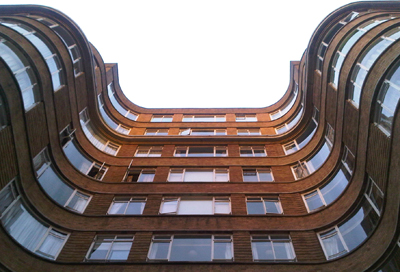
Landmarks along Gracechurch Street including the Leadenhall Market (see our earlier post here) and a 30s-inspired modern building of note which stands at number 20.

PICTURE: Looking down Gracechurch Street toward the Monument.

For more on London’s Wren churches, see John Christopher’s Wren’s City of London Churches.

Around London: Nelson and the Navy; Whistler at Dulwich; Eric Coates’ Blue Plaque; childrens’ books at BL…

A new permanent gallery looking at how the Royal Navy shaped individual lives and the course of British history over the 18th century opens at the National Maritime Museum in Greenwich on Monday 21st October, Trafalgar Day. Nelson, Navy, Nation charts a course from the Glorious Revolution of 1688 through to the defeat of Napoleon in 1815 and provides a setting for the museum’s many artefacts related to Vice-Admiral Lord Nelson. Among the 250 objects on display in the gallery are the uniform (with bullet hole) Nelson wore at the Battle of Trafalgar, artworks likes William Hogarth’s Captain Lord George Graham in his Cabin, a seven barreled volley gun and grim items like a surgeon’s tools including an amputation knife, bone saw and bullet forceps. There is also the last letter Nelson wrote to his daughter Horatia and mourning rings worn by close friends and family at his funeral. Entry to the new gallery is free. For more, see www.rmg.co.uk.

The first major exhibition dedicated to the American-born artist James Abbott McNeill Whistler’s time in London between 1859 and his death in 1903 opened at the Dulwich Picture Gallery this week. An American in London: Whistler and the Thames features paintings, etchings and drawings produced by the artist and more than 70 objects related to Whistler’s depiction of the Thames and Victorian London. Highlights include Nocturne: Blue and Gold – Old Battersea Bridge (1872/1873) and Brown and Silver: Old Battersea Bridge (1859-1863), the oil painting Wapping (1860-64) and the etching Rotherhithe (1860). There are also a series of portraits of Whistler and his patrons. Runs until 12th January. Admission charge applies. For more, see www.dulwichpicturegallery.org.uk.

Composer Eric Coates has been honoured with the unveiling of an English Heritage blue plaque outside his former home at Chiltern Court in Baker Street. Coates, who created “some of the best known and loved pieces of English light orchestral music”, lived in a flat at the property between 1930-39. For more, see www.english-heritage.org.uk/discover/blue-plaques/.

On Now: Picture This: Children’s Illustrated Classics. This exhibition in the Folio Society Gallery at the British Library takes a look at 10 of the most iconic children’s books of the 20th century – from Charlie and the Chocolate Factory to The Wind in the Willows, Paddington Bear, Peter Pan and Wendy, and The Iron Man as well as Just So Stories, The Hobbit, The Borrowers, The Secret Garden and The Railway Children. On display is at least four illustrated editions or artworks of each title with Quentin Blake, Michael Foreman, Peggy Fortnum and Lauren Child among the artists whose works are being shown. The exhibition also features five specially filmed interviews with four illustrators and Paddington Bear author Michael Bond. Runs until 26th January. Entry is free. For more, see www.bl.uk.

London Pub Signs – The Sutton Arms…

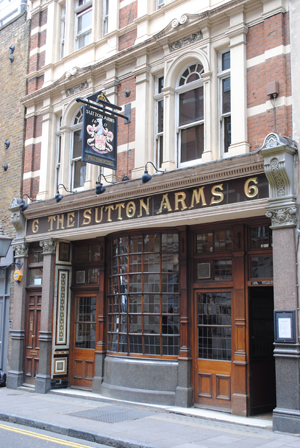
This pub, located just off Charterhouse Square near Barbican, has a distinctive barrel-shaped front window and a name that evokes a sense of the rich history of the area in which it stands.

The-Sutton-ArmsThe name of this pub at 6 Carthusian Street comes directly from Sir Thomas Sutton, a late 16th century/early 17th century businessman and moneylender who owned nearby land on which a Carthusian monastery once stood and who founded the Charterhouse School based at the site.

The monastery, which had been founded in 1371, was dissolved by King Henry VIII in the Dissolution of the Monasteries which took place in the first half of the 16th century – it was a nasty business with some of the monks executed at Tyburn.

The land was subsequently granted to Sir Edward North who built a mansion on the site which was subsequently sold to the fourth Duke of Norfolk. It was his son, Thomas Howard – the first Earl of Suffolk, who, in 1611, sold the property to Sir Thomas (and subsequently built the magnificent Audley End House in Essex with the funds).

Said to have been the “wealthiest commoner in England”, Sutton, who died that same year, used his wealth to endow a charitable foundation to both educate boys and care for elderly men.

The Charterhouse school later moved out to Surrey while elderly “brothers” are still housed at the original location today (for more on the Charterhouse, see our previous posts on King James I’s London and on 10 Historic London Squares).

Some of the glass in the  pub’s great barrel-shaped window was apparently replaced after a bomb knocked some of the original out during the Blitz.

Incidentally, there’s another pub of the same name only a few streets away in Great Sutton Street.

Lost London – St Paul’s Cross…

Paul's-Cross-Memorial

Located in the north-east corner of the churchyard of St Paul’s Cathedral, St Paul’s Cross – also known simply as Paul’s Cross – was a large free-standing cross which served as an open-air pulpit for at least 500 years.

The history of the Cross goes back to at least the 12th century and it long served as a public gathering place for Londoners to hear sermons or matters of public importance. King Henry III met Londoners here in 1259 so they could swear their allegiance, people like 15th century chaplain Richard Walker appeared here to plead guilty for crimes against the church (in his case to charges of sorcery) and it was here that William Tyndale’s testaments were burnt in the 16th century.

Pauls-Cross2Conversely, it was also from here that the English Reformation was preached (there’s a painting in the Houses of Parliament of King Edward VI listening to a sermon preached from the Cross by reformist Bishop Latimer). It has been said that if all the sermons preached here had been collected, they would effectively make a history of the Church of England.

While it was a simpler structure in its earlier years, in the late 15th century, the then Bishop of London, Thomas Kempe, ordered the construction of a ‘preaching station’ on the site. It was an elevated small wooden structure with a lead roof topped by a cross under which a preacher and a couple of others could stand.

The cross and pulpit were destroyed during the English Civil War in 1643.

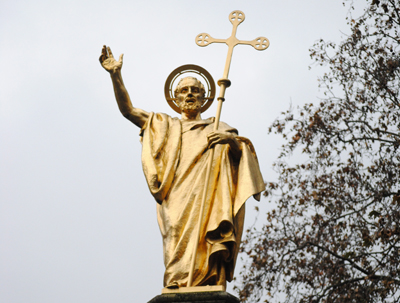
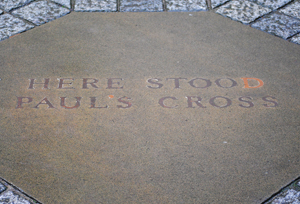
These days there’s a plaque marking the original site of the cross (above). In 1910, the St Paul’s Cross Memorial – a column topped with a gilt statue of St Paul designed by Sir Reginald Blomfield (pictured top), was installed nearby (as ordered by the will of HC Richards, according to a plaque on the site) and remains there today.

The Virtual Pauls Cross website, led by Professor John N Wall of North Carolina State University in the US, reconstructs what the site would have looked like when John Donne gave his Gunpowder Day sermon on 5th November, 1622.

Where’s London’s oldest…tea shop?

Twinings

Opened in the Strand in 1706, Thomas Twining’s tea shop can still be found there today.

Twining, a tea merchant whose family originally hailed from Gloucestershire, started selling tea from what had been a coffee house – Tom’s Coffee House – in an effort to tap into tea’s growing popularity. It had apparently been introduced to England by Catherine of Braganza, the Portuguese wife of King Charles II, soon after the Restoration.

Amid resistance from other coffee house owners and despite high taxes on tea, Twining’s venture succeeded, attracting a wealthy clientele which apparently included Jane Austen, thanks at least in part to its location on the border between the City of Westminster and the City of London.

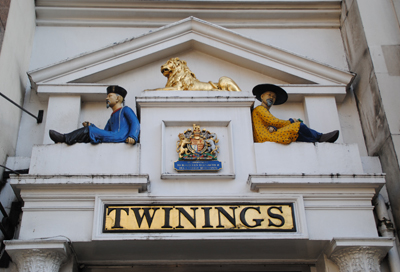
By 1717, Twining had purchased three houses adjacent to his coffee house and converted them into a shop which still stands today at number 216 Strand (the original Tom’s Coffee House was located behind this premises). He was soon selling more dry tea than wet at the sign of the “Golden Lyon”.

Following Thomas’ death in 1741, Twining’s son Daniel took over the business and by the mid-1700s, was exporting to America where he counted the Governor of Boston among his clients (but, apparently it was not Twining’s tea which was tossed into the sea at the Boston Tea Party).

It was Daniel’s son (and Thomas’ grandson), Richard Twining, who was successful in lobbying for the lowering of tea taxes and so paving the way for tea to become the commonly consumed drink it is today. It was also Richard who built the shop’s current entrance portal in 1787 incorporating the golden lion.

The Twinings shop today is the oldest in the City of Westminster while the company’s logo, which dates back to 1787, is the oldest commercial logo in continuous use.

Twinings, which since 1964 had been owned by Associated British Foods, was granted a Royal Warrant in 1837 by Queen Victoria.

For more, see www.twinings.co.uk.

Around London: Historic pearls at the V&A; ‘Big Brother’ house opening; aircraft pioneers honoured; and Jonathan Yeo at the NPG…

The_Rosebery_Tiara_QMA_Collection._Photo_c_SothebysA pearl-drop earring worn by King Charles I at his execution in 1649, pearl tiaras worn by European nobles and a pearl necklace given to Marilyn Monroe by Joe DiMaggio in 1954 are among the items on display as part of a new exhibition which opened at the V&A last Saturday. The V&A and Qatar Museums Authority exhibition traces the history of pearls from the early Roman Empire to now and features more than 200 pieces of jewellery and works of art. Other items on display include ‘Queen Mary II’ pearls dating from 1662-1664, a miniature portrait of Queen Charlotte wearing pearl jewellery and a set of buttons, finely enamelled and framed with pearls, worn by George III in 1780. There’s also the Dagmar necklace given to Princess Alexandra when she married the future King Edward VII in 1863. The exhibition is part of the Qatar UK 2013 Year of Culture. Admission charge applies. Runs until 19th January. For more, see www.vam.ac.uk. PICTURE: Lady Rosebery’s pearl and diamond tiara (1878) © Christie’s Images.

The Big Brother house – located in Elstree Studios in north London – opens to the public tomorrow and on Saturday as part of a partnership between Initial – an Endemol Company, Channel 5 and the National Trust. Some two million people tuned in to watch the final night of the show this summer leading one TV critic to describe the property as “the most important house in Britain”. The opening is being preceded by an Opening Gala featuring housemates past and present as well as celebrities – but that’s an invitation only event. Sadly, tickets for the opening are already sold out – for returns and your last chance of getting in, follow this link.

The UK’s first aircraft manufacturers – Horace, Eustace and Oswald Short – have been commemorated with an English Heritage blue plaque placed on their former workshop in Battersea. Unveiled this week by Jenny Body – the first female president of the Royal Aeronautical Society, the plaque can be found at the railway arches near Queen’s Circus where the brothers, who lived nearby in the Prince of Wales Mansions, worked on ballooning and first made the transition to aircraft construction. Among their firsts was the construction of the first British powered aircraft to complete a circular mile of flight and the creation of Britain’s first ever purpose-built aircraft factory (it was located on the Isle of Sheppey in Kent). For more, see www.english-heritage.org.uk/discover/blue-plaques/.

On Now: Jonathan Yeo Portraits. New and previously unseen works including a six foot high portrait of controversial artist Damien Hirst and a portrait of Kevin Spacey as King Richard III feature in this exhibition running at the National Portrait Gallery. Other subjects featured in the painted works include media mogul Rupert Murdoch, model Erin O’Connor, artist Grayson Perry and actor Sierra Miller. Runs until 5th January. Admission is free. For more, see www.npg.org.uk.

Lost London – St Dunstan in the East…

St-Dunstan-in-the-East

The ruins of this medieval church can still be found in the eastern end of the City of London and now play host to a rather delightful little park.

Originally built around 1,100 in the Gothic style, the church – which stands between St Dunstan’s Hill and Idol Lane (off Great Tower Street) was enlarged and repaired in ensuing centuries before suffering severe damage in the Great Fire of London in 1666. Not enough to destroy the church, however, and it was repaired in the late 1660s with a new steeple and tower designed by Sir Christopher Wren to fit with the existing structure, was added in the late 1690s. Inside were carvings by Grinling Gibbons.

St-Dunstan-in-the-East-smallBut by the early 19th century, however, the weight of the roof had pushed the walls dramatically out of line and, after an unsuccessful attempt to repair the church, it was decided to demolish it (with the exception of Wren’s tower) and rebuild.

Built in the Perpendicular style to the designs of David Laing, the new church reopened in 1821.

The church lasted for more than 100 years before it was again severely damaged, this time during the Blitz of 1941. Wren’s spire and tower thankfully remained but other than that it was a shell with only the north and south walls remaining.

The Anglican Church decided not to rebuild – the parish was incorporated into that of All Hallows by the Tower – and the City of London Corporation opted to turn the (now) Grade I-Iisted remains into a public park. It was opened in 1971 by the then Lord Mayor of London, Sir Peter Studd.

It remains there today, with beautiful climbing foliage – including many exotic plants – and a fountain in the nave. The tower, meanwhile, is used by a complementary medical centre.

A great place to pass a lunch hour!

Around London – Open House London; Yinka Shonibare at Greenwich; Bankside transformed; and Michael Peto at the NPG…

Tower 42_external It’s finally here. Open House London kicks off on Friday and with more than 800 buildings opening their doors, the only difficulty you’ll have this weekend will be choosing what you end up doing! This year’s theme is ‘celebrating architecture, people and place’ and among the highlights will be the opening of landmark structures like Battersea Power Station, Tower 42 (pictured), and the Gherkin (30 St Mary Axe) as well as 100 private homes, architects’ homes and “ground-breaking” housing developments and everything from the Shri Swaminarayan Temple in Brent to Horse Guards in Whitehall (certain buildings, like 10 Downing Street and The View from the Shard, are only open to people who won tickets in an earlier ballot). This year’s festivities also include a moonlit “culture crawl” through London on Friday night. If you haven’t ordered a hardcopy programme, you can check the listings online at www.openhouselondon.org. There’s also an Open House iPhone app available from the appstore.

A series of works by Yinka Shonibare – including some never before seen in the UK – went on display at Greenwich yesterday, thanks to Royal Museums Greenwich. The works, which explore notions of “Britishness, trade and empire, commemoration and national identity”, can be found inside and around buildings including the Queen’s House, National Maritime Museum and Royal Observatory and include Fake Death Pictures – a series of five vision of the death of naval hero Vice-Admiral Lord Nelson, Wind Sculpture – a gravity-defying object located on the Queen’s House lawn, Cheeky Little Astronomer – a specially commissioned sculpture located in the Flamsteed House at the Royal Observatory, and Nelson’s Ship in a Bottle – last seen on Trafalgar Square’s Fourth Plinth. Yinka Shonibare MBE at Greenwich, which is supported by a range of talks, debates and tours, runs until 23rd February. For more, see www.rmg.co.uk.

Bankside will be transformed this weekend as artists will be transforming disused hoardings and derelict buildings with original artworks as part of the Merge Festival. The work’s include Candy Chang’s Before I Die, Alex Chinnick’s Miner on the Moon, and Marcus Lyall and Mark Logue’s House of Pain. Until 20th October. For more on the festival celebrating Bankside, see www.mergefestival.co.uk.

On Now: Michael Peto Photographs: Mandela to McCartney. This new exhibition at the National Portrait Gallery just off Trafalgar Square features a previously unexhibited photo of Elizabeth Taylor and Richard Burton, taken at the beginning of their love affair. It’s one of 10 portraits taken by the late Hungarian-born photographer Michael Peto in London during the 1950s and 1960s – others feature Samuel Beckett, Jennie Lee, Paul McCartney and Ian McKellen. Admission is free. For more, see www.npg.org.uk.

10 (more) curious London memorials…8. The SOE Memorial…

SOE-bigTucked away on Albert Embankment just to the north of Lambeth Bridge, this moving memorial was only unveiled in 2009 and formally honours the under-cover agents who worked for the Allies behind enemy lines during World War II.

The plinth is topped with a larger-than-life bust of Londoner Violette Szabo, sculpted by London artist Karen Newman. Szabo, who here gazes out across the Thames, was tortured and executed after being captured by the Germans while on a mission behind enemy lines following the D-Day landings.

SOEThe daughter of a French mother and English father, Szabo grew up in South London and, when World War II broke out in 1939, volunteered to work as an undercover operative in France as member of the British Special Operations Executive (SOE).

She had successfully completed one mission and had returned to France for a second when she was discovered and sent to a prison camp where she was unsuccessfully tortured for information.

Posthumously awarded the George Cross and the Croix de Guerre, a plaque on the memorial says she was among the 117 SOE agents who did not survive their missions to France. As many as 407 SOE agents were sent on “sabotage missions” to occupied France to fight with the French resistance.

Surprisingly, this SOE Memorial was apparently the first public memorial to honour the work of the unit. Formed on the orders of PM Sir Winston Churchill, it consisted of agents from various countries who were devoted to the Allied cause. Its feats included a raid which destroyed a factory in the Telemark region of Norway where the Germans were trying to produce heavy water which is used in the creation of atomic bombs – an operation which receives a special mention on the memorial.

The memorial was officially unveiled by the Duke of Wellington on 4th October, 2009. One of the plaques on it states that the monument “is in honour of all the courageous S.O.E. Agents: those who did survive and those who did not survive their perilous missions”. “Their services were beyond the call of duty. In the pages of history their names are carved with pride.” Enough said.

For more on the history of women serving in the SOE, see Squadron Leader Beryl E Escott’s book The Heroines of SOE: F Section: Britain’s Secret Women in France.

London Pub Signs – Ye Olde Watling…

Ye-Olde-WatlingThis pub, located in the City, takes its name from the street upon which it stands – Watling Street.

The street, which is just 180 metres long, bears the same name as a great Roman road which ran all the way from Dover through London to the long gone Roman town of Viroconium (now known as Wroxeter in Shropshire).

The Roman road followed, to some extent, the route of an ancient Celtic pathway. But while the Celtic pathway crossed the Thames at Westminster, the Roman road, once the bridge was constructed, crossed at London Bridge and headed through London, apparently taking in this surviving piece.

The building itself – located on the intersection with Bow Lane – is said to have been constructed from old ship’s timbers by none other than Sir Christopher Wren in 1668. The upstairs rooms were said to have been used as a drawing office during the construction of Wren’s masterpiece, St Paul’s Cathedral. It may have also been used as  pub by the workmen building the cathedral – in fact it’s said to have been the first pub built after the Great Fire of 1666.

The pub is part of the Nicholson group. For more on it, check out www.nicholsonspubs.co.uk/yeoldewatlingwatlingstreetlondon.

PICTURE: Duncan Harris/Wikipedia

Around London – The Mayor’s Thames Festival; celebrating the Olympics and Paralympics legacy; and, Victorian revivalism at Guildhall…

A-Ship's-OperaThe Mayor’s Thames Festival kicks off tomorrow and runs for 10 days until 15th September. This year’s highlight’s include the day long A Ship’s Opera which culminates in a sound and light “spectacular” at Tower Bridge, large-scale artworks placed on boards along the river, an exhibition of more than 50 artworks inspired by the Diamond Jubilee Pageant along the Thames, a film celebrating the people who live and work on the river which will be shown for free on an outdoor screen, riverside choral performances, boat races – including the world’s slowest river race and the longest race on the Thames – and the Source to Sea River Relay in which a bottle of Thames water, filled at the Thames’ source, will be relayed by walkers, swimmers, rower and sailors for the entire length of the river. Most activities will be focused on the stretch of river between Lambeth Bridge and St Katharine Docks. For a full program of all events, check out www.thamesfestival.org.

Last year’s Olympics and Paralympics will be celebrated again in events taking place this weekend. On Saturday – a year since the Paralympic Games closed – disabled athletes and performers will descend on Queen Elizabeth Olympic Park for a day of celebration to mark National Paralympic Day. Part of the Mayor’s Liberty Festival, an annual showcase of deaf and disabled artists, highlights will include an aerial and sway performance – ‘The Limbless Knight’ – and the ‘Miracoco Luminarium’, an interactive light sculpture. The free day runs from noon to 8pm. For more information, see queenelizabetholympicpark.co.uk/events/2013/6/disability-sport (note that registration is required to watch paralympians in action in the newly reopened venue, the Copper Box). Meanwhile on Sunday, Hampstead Heath will host the annual Give it a Go! Olympic legacy festival. Kids will have the chance to take part in everything from penalty shootouts and street dance, boxing and fancy dress and circus workshops as well as martial arts and rugby sessions, and free tennis lessons. The day runs from 1pm to 5.45pm. For more, see www.cityoflondon.gov.uk/hampsteadheath.

• Victorian revivalism is under examination in a new exhibition at the City of London’s Guildhall Art Gallery. The multi-media, multi-sensory show Victoriana: The Art of Revival explores the work of contemporary artists inspired by the 19th century – including Yinka Shonibare, Grayson Perry and Paula Rego – and features graphic design, film, photography, ceramics, taxidermy, furniture, textiles and fine art. More than 70 works are included – among them is a piece created specially for the show, Paul St George’s ‘Geistlich Tube’ – and they’re grouped under four themes – the Neo-Victorian Identity, Time Travel, The Cute and the Curious, and The Reimagined Parlour. The exhibition opens on Saturday and runs until 8th December. Admission charge applies. For more, see www.cityoflondon.gov.uk/victoriana.

Famous Londoners – The Tower Ravens…

Ravens

OK, so they’re not people as such, but the ravens at the Tower of London are renowned the world over.

Known as the “Guardians of the Tower”, there are currently as many as eight ravens living at the tower, lodged in a space on the grass next to the Wakefield Tower.

Raven-pensLegend has it that there must be at least six ravens living at the Tower – should they leave, not only will the Tower fall but the kingdom as well (although we hasten to add that it’s been argued this tradition only started in the Victorian age and that there have been times when the numbers of ravens dropped below the required six, such as at the end of World War II when only one raven remained).

It was King Charles II who first ordered the ravens be protected – an order which must have upset Astronomer Royal John Flamsteed who complained after he found that the birds were interfering with the observation work he was carrying out from the Tower’s north-east turret. He later moved out to Greenwich.

The eight ravens who now live at the tower include Rocky, Merlin, Hugine and the latest additions Jubilee – given to the Tower last year to celebrate the Queen’s Diamond Jubilee – and Grip, named after Charles Dickens’ pet raven.

The birds are looked after by a team of four headed by the raven master, Chris Skaife, who each day feed them 170 grams (six ounces) of raw meat and special biscuits soaked in animal blood.

Not all ravens can cut the mustard to work at the Tower – one recent addition Pearl was apparently bullied by other ravens and had to be withdrawn. And while the birds have the feathers on one wing trimmed to stop them escaping to a new life on the wing, that hasn’t stopped some from doing so including Grog who took off in 1981 and was last seen outside an East End pub.

The oldest raven to ever live at the Tower was Jim Crow, who died at age of 44 in 1928.

WHERE: Tower of London (nearest Tube station Tower Hill); WHEN: 9am to 5.30pm, Tuesday to Saturday, 10am to 5.30pm Sunday to Monday; COST: £21.45 adults; £10.75 children under 15; £18.15 concessions; £57.20 for a family; WEBSITE: www.hrp.org.uk/toweroflondon/.  

Around London – The ‘Line of Kings’ has a makeover; London captured from St Paul’s; and, cycles at the Museum of London…

Line-of-Kings

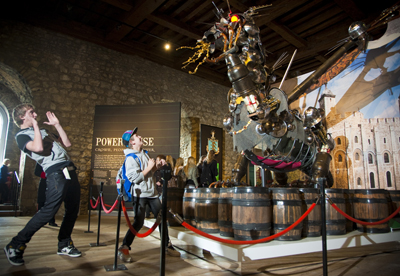
The Tower of London’s iconic exhibition, the Line of Kings, has had a makeover. Described as the “world’s longest running visitor attraction”, the Line of Kings features more than 500 objects including historic suits of armour – such as those worn by King Henry VIII, King Charles I and King James II – as well as life-sized wooden horses and individually carved king’s heads, many of which were made between 1685 and 1690. The exhibition was originally created following the Restoration in 1660 and was used as propaganda to promote the king’s rule (interestingly omitting queens and featuring only those deemed “good kings”). Rearranged and dispersed over the centuries, it’s been brought back together in the White Tower and reopened last month. Entry to the exhibition – a collaboration between Historic Royal Palaces and the Royal Armouries – is free as part of general admission to the Tower. For more, check out www.royalarmouries.org/line-of-kings. PICTURE: HRP/Newsteam

Four cameras mounted on top of St Paul’s Cathedral’s Golden Gallery have captured a 360 degree time lapse video of the capital. The video, which was shot in early July, captured 36 hours in the life of London and is the work of specialist photographer Henry Stuart who previously completed two projects from the Golden Gallery – a GigaPixel image of London and a Day Meets Night image. The latest project captured some 8,000 panoramic images. The time lapse video, which is set to Kyrie from Wolfgang Amadeus Mozart’s Missa in C major ‘Missa solemnis’ K337 being sung by the St Paul’s Cathedral Choir, can be found at http://visualise.com/videos/london-360-time-lapse-from-st-pauls-cathedral.

• On Now: London Cycles. This free exhibition at the Museum of London looks at cycling in the capital with highlights including 10 large scale portraits by Ugo Gattoni, bikes including an 1880s “boneshaker”, a penny farthing, an 1930s Enfield cycle and a ‘Boris’ bike as well as head cam footage from riders including from the annual Tweed Run bike. The free display runs until 22nd September. For more, see www.museumoflondon.org.uk.

10 (more) curious London memorials…4. ‘People of London’ Memorial…

People-of-London

Amid all the grand war-related memorials of London, this rather humble memorial sitting outside the north transept of St Paul’s Cathedral in St Paul’s Churchyard can easily be overlooked. 

Known as the Memorial to the Londoners killed in World War II Bombardments or simply as the ‘People of London’ memorial as it’s called on the sculptor’s website, it commemorates the 30,000 Londoners who were killed during the Blitz  (not to be confused with the National Firefighters’ Memorial, known informally to many as the Blitz Memorial, which sits opposite the cathedral’s south transept and commemorates firefighters who died during the Blitz).

People-of-London---smallThe round memorial was carved from a three tonne block of Irish limestone and is set into paving (it was initially very shiny).

The gilded inscription which runs around the outside reads “Remember before God the people of London 1939-1945” while on top, written in a spiral, is an inscription written by Sir Edward Marsh – “In war resolution, in defeat defiance, in victory magnanimity, in peace goodwill”, the text of which was used by Sir Winston Churchill in the frontispiece to his history, The Second World War.

Unveiled by the Queen Mother on 11th May, 1999, the memorial is the work of Richard Kindersley, whose other memorials include the Commonwealth Memorial on Constitution Hill.

Kindersley writes on his website, that the “position of the memorial adjacent to St Paul’s is most appropriate, as most people will remember the dramatic photograph of the Cathedral dome of the taken during a devastating attack in 1941.”

It was paid for by public funds raised following an appeal in the Evening Standard newspaper, launched in connection with the 50th anniversary of VE Day.

Around London – Radio Times celebrated at MoL; IWM reopens; and Lowry at the Tate…

A new exhibition marking the 90th anniversary of the iconic publication, Radio Times, opens at the Museum of London tomorrow (Friday). Cover Story: Radio Times at 90 features some of the magazines most famous covers depicting the likes of Tony Hancock, The Goon Show, Only Fools and Horses and Coronation Street, and charts the history of radio from the BBC’s first transmission to today’s multiple channels. As well as original artwork and photographs used in Radio Times, the display includes a special focus on Doctor Who with the chance for visitors to create their own Radio Times cover as they stand alongside a life-size Dalek. Other highlights include an original 1941 illuminated map used by the Luftwaffe which shows Radio Times‘ Waterlows printing plant in Park Royal alongside other targets. Radio Times was first published by the BBC in London on 29th September, 1923, and since 2011 has been owned by Immediate Media Co. The free exhibition runs until 3rd November. For more, check out www.museumoflondon.org.uk.

The Imperial War Museum has partially reopened this week. As well as the re-opening of its permanent galleries and exhibitions, the museum has launched a major new family-oriented exhibition Horrible Histories: Spies, a new art exhibition entitled Architecture of War and ‘IWM Contemporary’, a new programme showcasing significant works by leading artists in response to war and conflict. The museum will fully reopen in summer next year with the opening of new First World War Galleries. Horrible Histories: Spies, which runs until 4th January (admission charge applies), immerses visitors in the world of World War II spycraft with families able to uncover the techniques used by the most cunning spies. More on Architecture of War and IWM contemporary in upcoming posts. For more, see www.iwm.org.uk.

On Now: Lowry and the Painting of Modern Life. This exhibition at the Tate Britain represents the first to be held by a public London institution featuring  the works of LS Lowry since his death in 1976 and is the first to explore his connections with French art. Among works on display is a little known, untitled painting depicting a busy town square set against the backdrop of industrial Salford which was found on the back of the wooden panel on which Lowry painted his 1937 work The Mission Room. Others among the 90 works on display include Coming Out Of School (1927), The Pond (1950), Industrial Landscape (1955) and Hillside in Wales (1962) as well as Ancoats Hospital Outpatients Hall (1952), The Cripples (1949), Piccadilly Circus, London (1960) and Excavating Manchester (1932). Runs until 20th October. For more, see www.tate.org.uk.

10 (more) curious London memorials…2. Animals in War Memorial…

Animals-in-War

This week we take a look at another of London’s war-related memorials but unlike the vast majority, this one, as its name says, commemorates animals, not humans.

Located in the middle of Park Lane near the intersection with Upper Brook Street on the eastern side of Hyde Park, the memorial is dedicated “to all the animals that served and died alongside British and Allied Forces in wars and campaigns throughout time”. Another inscription on the memorial reads “They had no choice”.

A further dedication at the memorial pays tribute to the “millions” of animals who have died in wars. “From the pigeon to the elephant, they all played a vital role in every region of the world in the cause of human freedom,” it says. “Their contribution must never be forgotten.” It’s been said that as many as eight million horses were killed in World War I alone.

It features a couple of bronze pack mules making their way through a gap in a curved, 58 foot wide Portland stone wall – themselves carrying reliefs of various animals including an elephant, horses, camels and pigeons – while on the other side is a bronze horse and a dog, looking ahead.

The memorial is the work of Somerset-based sculptor David Backhouse and was unveiled by Princess Anne in November 2004, the 90th anniversary of the outbreak of World War I. It was apparently inspired by Jilly Cooper’s book, Animals in War, and commissioned by the Imperial War Museum. It was paid for by £2 million in public donations.

For more, check out www.animalsinwar.org.uk.

London Pub Signs – The Tipperary…

Built on land which once formed part of ‘White Friars’ (Carmelite) monastery, this Fleet Street institution is the latest incarnation in a string of pubs which have occupied the site since at least the early 17th century.

The-TipperaryA pub was built on the site in about 1605. Made of stone rather than wood (the stones apparently plundered from the monastery), the property – which stands over the top of what’s left of the River Fleet – survived the Great Fire of London in 1666.

While there seem to be a few competing versions of the pub’s history, it was apparently first named the Bolt-in-Tun (the sign of which showed a barrel pierced by a crossbow quarrel or bolt) and became a popular coaching inn (an alley opposite still bears the name Bolt Court). It was apparently later renamed The Boar’s Head.

The pub – located at 66 Fleet Street – was at some stage – the sign outside says in 1700, others suggest it was in the late 1800s – it was bought by Dublin-based brewery SG Mooney & Son (the Mooney name is still on the doorstep). It was after this purchase that it was transformed into what is claims was the first Irish pub outside of Ireland and, perhaps more importantly, the first pub outside Ireland to serve Guinness (first bottled and later draught).

The pub’s name was changed to the Tipperary after World War I when, as one story goes, returning Irish soldiers made it a favourite of theirs and christened it in honour of the song It’s A Long Way To Tipperary.

Bought by Greene King in the 1960s, the pub underwent a restoration which took it back to the style it would have been during Mooney’s days.

The pub apparently once featured a clock by renowned Fleet Street clockmaker Thomas Tompion, known as the “father of English clockmaking”. A replica now sits in the pub thanks to the original being stolen.

10 (more) curious London memorials…1. Kindertransport memorial

KindertransportWay back in 2011 we ran a series looking at some of London’s most curious memorials. We’ve decided to revisit that theme in our new special series.

To kick it off, we’re taking a look at a group memorial found just outside Liverpool Street Station and dedicated to the thousands of Jewish children who arrived in the UK as refugees over nine months in 1938 and 1939, having fled the Nazis in Europe after the anti-Semitic attacks of the Kristallnacht.

Called Kindertransport – The Arrival, the group of bronze statues representing children with their luggage having just stepped off a train at the station were unveiled in 2006 in Hope Square. A short stretch of railway tracks lays behind them.

The memorial is the work of Frank Meisler – himself a child who travelled on a Kindertransport train from Danzig – and bears an inscription: “Children of the Kindertransport. In gratitude to the people of Britain for saving the lives of 10,000 unaccompanied mainly Jewish children who fled from Nazi persecution in 1938 and 1939. ‘Whosoever rescues a single soul is credited as though they had saved the whole world.’ Talmud.”  It is dedicated by the Association of Jewish Refugees and the Central British Fund for Jewish World Relief.

Around the statue group are a series of blocks upon which is inscribed the names of the cities from which the children fled. They include the cities of Cologne, Hanover, Stuttgart, Frankfurt, Munich, Danzig, Breslau, Prague, Hamburg, Leipzig, Berlin and Vienna along with others.

The statue is one of four, all created by Meisler, which have been erected along the route the children took to reach safety. Others can be found at the main railway station Gdansk in Poland, Friedrichstraße railway station in Berlin, and another in Rotterdam, The Netherlands.

Hope Square also contains another plaque which dedicates the square to the children of the Kinderstransport “who found hope and safety in Britain through the gateway of Liverpool Street Station”.

In late June, an event was held in the St James’s Palace to mark the 75th anniversary of the Kindertransport.