Famous Londoners – Sir Hans Sloane

An Ulster-Scots born physician, scientist and avid collector, Sir Hans Sloane served as doctor to no less than three British monarchs during the 17th and 18th centuries and during his life amassed a vast collection of natural specimens and curiosities which after his death were used to form the core of the British Museum’s collection.

Born on 16th April, 1660, at Killyleagh in County Down, Ireland, Sir Hans was the son of Alexander Sloane, a “receiver-general of taxes” who originally hailed from Scotland.

Even as a young man, he developed a keen interest in the natural sciences. Having suffered from some ill-health which, at the age of 16 is said to have kept him confined to a room for a year, in 1679, at the age of 19, he moved to London where he studied chemistry at the Apothecaries Hall and botany at the Chelsea Physic Garden – a period during which he befriended the botanist John Ray and chemist Robert Boyle.

Four years later, he travelled through France where he received his Doctorate of Physics. On his subsequent return to London in 1685, he was made a Fellow of the Royal Society and in 1687 a Fellow of the Royal College of Physicians.

Given the chance to travel to Jamaica as physician to the new Governor, Christopher, the 2nd Duke of Albemarle, he only spent 15 months there (the Governor died soon after arrival). But it was an important period during which not only did he document and collect a vast amount of flora and fauna (bringing some 800 specimens back to London), he also came up with the idea of drinking chocolate with milk after witnessing locals drinking the dark chocolate with water but finding the mix made him “nauseous” (back in England, his concoction was first sold as a medicine and was later manufactured as a drink by Cadburys).

Having returned to London in 1689, he published the information he had gathered in Jamaica, and in 1693 he become secretary to the Royal Society.

In 1695 he married a Jamaican sugar planter’s widow, Elizabeth Langley Rose (with whom he had several children but of whom only two daughters, Sarah and Elizabeth, survived) and, thanks in part to an ongoing association with the duke’s widow, was able to set up a fashionable medical practice at 3 Bloomsbury Place on the northern end of Bloomsbury Square.

The house, not far from where the British Museum now stands, become something of an attraction in its own right, filled with objects and specimens he had collected on his travels as well as those – in some cases complete collections – given to him by others including friends and patients (in fact, he had to purchase the property next door, number four, to find room for them all – this property is now marked with a Blue Plaque).

The composer Handel is said to have been among those who visited the property and there is a delightful tale that says Sir Hans was outraged when Handel placed a buttered scone on one of his rare books.

With his services as a physician highly prized, in 1696, he was appointed physician to Queen Anne, the first of the three monarchs he would serve. In 1712-13, with his collection still growing, he purchased the Manor of Chelsea to help house it (four acres of which were leased to the Chelsea Physic Garden, which had been founded in 1673 with the idea of providing a training ground for apprentice apothecaries, in perpetuity).

He subsequently moved his collection out to this property and his connection with Chelsea is still celebrated in place names such as name Sloane Square (not to mention Sloane Street, Sloane Gardens, Hans Street, Hans Crescent, Hans Road and Hans Place). There is also a statue of the bewigged man in Duke of York Square (pictured), not far from Sloane Square – this is a 2007 copy of 1737 original by John Rysbrack, another (older) copy of which can be found in the Chelsea Physic Garden.

Following Queen Anne’s death in 1714, in 1716 Sir Hans was appointed physician to her successor, King George I (he was also created a baronet the same year, becoming the first medical practitioner to receive a hereditary title).

Three years later, in 1719, he become president of the Royal College of Physicians, an office he held for 16 years, and in 1727, he was appointed physician to King George II. The same year he succeeded Isaac Newton as president of the Royal Society, an office which he held until 1741.

In 1742, Sir Hans retired to his property in Chelsea.

By the time of his death on 11th January, 1753 at the ripe old age of 93, Sir Hans had collected more than 71,000 objects including books, manuscripts, drawings, coins and medals and plant specimens which he bequeathed to King George II in exchange for a payment of £20,000 to his executors.

Parliament agreed, following a lottery to raise the money, his collection went on to form the basis of the British Museum, first opened to the public in 1759 in Bloomsbury. It was also to form the basis of the museum’s later offshoot, the Natural History Museum at South Kensington.

Sir Hans was buried at Chelsea Old Church with his wife Elizabeth who died in 1724.
Around London – 250,000 British Library titles to be available online; summer in Bunhill Fields Burial Ground; funding for church and synagogue repairs; and, the British Museum takes a closer look at relics and reliquaries…

The British Library is to digitise 250,000 books and make them available on the internet under a deal with tech giant Google. The works, which are all out of copyright, date from between 1700 and 1870 and include printed books, pamphlets and periodicals. Among them are feminist pamphlets about the ill-fated French Queen Marie Antionette dating from 1791, blueprints of the first combustion engine-driven submarine dating from 1858, and a 1775 account which tells of a stuffed hippopotamus owned by the Prince of Orange. The works will all be available online via Google Books which has partnered with more than 40 libraries around the world. The project will include material published in a range of European languages and will focus on works not already freely available in digital form online. For more see www.bl.uk.

A series of events running under the banner of ‘Green Garden Lunchtimes’ will be held at the Bunhill Fields Burial Group (off City Road) in the City of London from next Monday until 1st July. The events include free yoga and tai chi classes, a bike repair workshop, a history tour from City Guides and a wildlife talk courtesy of the Natural History Museum. The Wren Clinic will also be providing free advice and treatments. Bunhill Fields is famous for its connections to the Nonconformists and contains the graves of writers William Blake, Daniel Defoe and John Bunyan. For dates and times, follow this link.

• Six churches and a synagogue in London have been granted £582,000 to carry out repair works under the Repair Grants for Places of Worship scheme. The grants, which are administered by English Heritage and funded by the Heritage Lottery Fund, include £199,000 for the Church of St Augustine in Honor Oak Park – an early example of the Gothic Revival in the Early English style, £122,000 for Christ Church in Christchurch Park, Sutton, and £111,000 for the Golders Green Synagogue in Barnet. The grants were part of £8 million worth of funding given to 67 of England’s most important Grade II listed churches, chapels and synagogues. For more, see www.hlf.org.uk.

On Now: Treasures of Heaven: saints, relics and devotion at the British Museum. The museum’s major summer exhibition looks at the spiritual and artistic significance of Christian relics and reliquaries in medieval Europe. Among the highlights are: an arm reliquary of St George, which was housed in the treasury of St Mark’s in Venice following its capture in the sack of Constantinople in 1204; the British Museum’s bejewelled Holy Thorn reliquary, dating from 1390-97 and said to contain a relic from the Crown of Thorns; and, a 12th century bust of St Baudime from France, which once contained a vial of the saint’s blood and is being seen for the first time in Britain. Other exhibits come from the Cleveland Museum of Art in Ohio and the Walters Art Museum in Baltimore as well as from the Vatican. Runs until 9th October. There is an admission charge. For more, see www.britishmuseum.org.

King James I’s London – 8. The New World

It was during the reign of King James I that the first permanent English settlement was made in what was then called the New World (and is now better known as the United States of America).

Named Jamestown (after the King) and located on Jamestown Island, it was the capital of the new Virginia Colony and was founded by the London Company.

The ‘discovery’ and settlement of the New World impacted London itself in various ways – here we look at a couple of related sites in London…

First up is Blackwall in East London, from where three small merchant ships of the Virginia Company of London sailed in 1606 under orders from King James I to bring back gold from the New World. The site is now marked by the First Settlers Monument, first unveiled in 1928 and then restored in 1999.

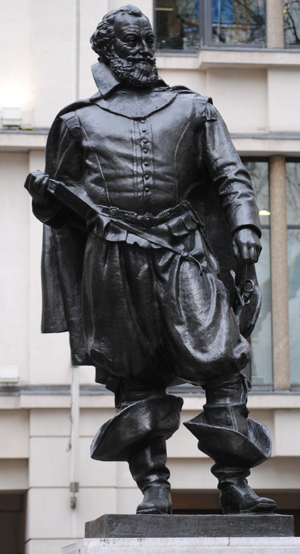
Among those who was on board the ships is Captain John Smith (he of Pocahontas fame) – a statue of him can be found in Bow Churchyard in the City (pictured right, it’s a replica of an original in Richmond, Virginia). Captain Smith was buried in St Sepulchre-without-Newgate, where there is a window commemorating him.

Next we turn to the former, now non-existent, property of John Tradescant and his son, also John Tradescant. Gardeners to the rich and famous and avid collectors of all sorts of artefacts, they are noted for having founded “The Ark” – a house in Lambeth, in they showed off a collection of curiosities that they had gathered on his trips (both were were widely travelled).

These included objects presented to by American colonists including John the Elder’s friend Captain John Smith and those collected by personally by John the Younger (he made several trips to the New World). Among them was the mantle of Powhattan, the father of Pocahontas.

The pair’s name lives on in Tradescant Road in Lambeth (it marks one side of the Tradescant estate). They are both buried at St Mary-at-Lambeth which now houses the Garden Museum.

LondonLife – Knollys Rose Ceremony

A London tradition which has its origins in the fourteenth century, the Knollys Rose Ceremony surrounds the presentation of a single red rose to the Lord Mayor of London at Mansion House.

The ceremony, which was held in the City yesterday, relates to a judgement of 1381 in which the fine was the annual payment of a single red rose.

The fine was levied after Lady Constance Knollys, the wife of prominent citizen Sir Robert Knollys, bought a property opposite her own in Seething Lane and then added a footbridge linking the two without first gaining planning permission (it’s suggested that she bought the property which had previously been used as a threshing ground because she was annoyed with the constant chaff in the air).

Following discovery of her breach, it was agreed that she would pay the annual ‘peppercorn rent’ of a single red rose from the new property’s garden to the Lord Mayor.

Lady Constance’s footbridge is long gone but the tradition of paying the annual rent was revived last century and is now presided over by the Company of Watermen and Lightermen of the River Thames.

The ceremony starts at the church of All Hallows by the Tower and then involves a procession to Seething Lane Gardens (a modern garden close to where the original may have been; the gardens were once the site of the Navy Office) where the Master of the Company of Watermen and Lightermen snips off a rose before heading on to Mansion House where it is presented to the Lord Mayor on a velvet altar cushion from All Hallows.

The ceremony usually takes place on the second Monday in June.

Where’s London’s oldest…public park?

Dating from the early 1600s, London’s oldest public park is Finsbury Circus Gardens, located just to the north of London Wall and east of Moorgate.

The now heritage-listed gardens were open as a public park from 1606 (and was originally known as Moor Fields – the moors were drained and gravel walks laid out in 1527 but it wasn’t until 1606 that the area was laid out with elm trees and benches).

The park wasn’t enclosed until 1815-17 when City of London surveyor William Montague laid the area out according to the designs of prominent London architect George Dance the Younger.

The gardens were acquired by the City of London Corporation in 1900 and in 1909 were replanned. The oval-shaped park, the largest of the City’s gardens, is these days home to the City of London Bowling Club, the only bowling club in the City (founded in 1924; the bowling green dates from the following year and the current pavilion from 1968).

During World War II a barrage balloon was anchored here to deter low level air raids. Among it’s other claims to fame is the Tudor era bat (apparently a forerunner of the modern cricket bat) found on the site in the 1980s and skulls which have also been found dating from the Roman period.

The gardens are currently partly closed due to the Crossrail development.

PICTURE: Wikipedia

Around London – Celebrating visits to the Royal Parks; pregnant cows at the British Library; and, lost tube art found…

Royal Parks are celebrating the 160th anniversary of the opening of London’s Royal Parks to the public with a season of events including Trooping the Color (St James’s Park, this weekend), BBC Proms in the Park (Hyde Park) and various sporting events being held in the lead-up to the London Olympics next year. Last month also saw the unveiled of a new permanent art project in Hyde Park commemorating the Great Exhibition of 1851. Organised by the Royal Commission for the Exhibition of 1851 in conjunction with Royal Parks, it marks the site where the exhibition was held. London’s Royal Parks were opened to the public in 1851 after the passing of the Crown Lands Act which transferred management of the parks to the government. For more, see www.royalparks.org.uk.

Who could pass up a chance to feel whether a cow is pregnant? The British Library will be hosting staff from The Royal Veterinary College on 28th June for a day of hands-on demonstrations including the chance to use haptic technology and “feel” whether a cow is pregnant as well as opportunity to create a virtual, touchable 3D model using interactive software. The demonstrations are part of the library’s Growing Knowledge Exhibition showcasing innovative research tools. Spaces are limited so get in quick. To book your place, visit http://cowlooseinthelibrary.eventbrite.com/%3C/a%3E

On Now – The Lost Collection. In conjunction with Transport for London’s Lost Property Office, KK Outlet in Hackney is running an exhibition of unclaimed art that was left on London’s tube, buses, overground trains and black cabs. The work by nameless artists includes drawings, painting and photographs and, in some cases, whole portfolios. Runs until 30th June (42 Hoxton Square). For more information, see www.kkoutlet.com

LondonLife – Chelsea Flower Show

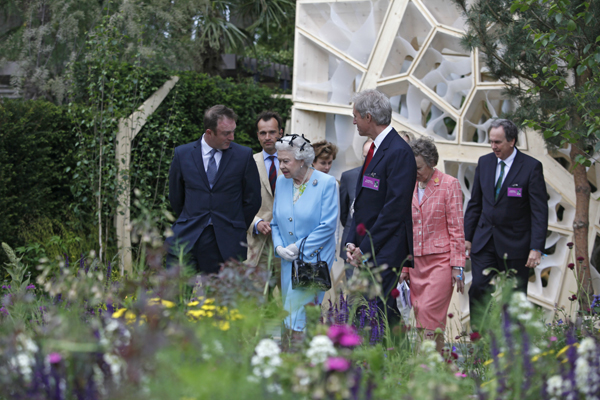
The Queen visits the Chelsea Flower Show. PICTURE: Courtesy Royal Horticultural Society.

More correctly known as the Royal Horticultural Society Great Spring Show, the history of the Chelsea Flower Show traces its origins back to the 1820s when the society, then known as the The Horticultural Society in London, held a series of “floral fetes” at the Duke of Devonshire’s estate in Chiswick.

The fortunes of the society were on the wane when, thanks in part to its then president, Prince Albert, it was reborn with a new charter and name – the Royal Horticultural Society – and a new garden in Kensington.

The first Great Spring Show was held there in 1862 and continued to be so for the next 26 years until, in 1888, the site of the show was moved to Temple Gardens near Embankment in central London.

It was subsequently held there until 1912. During this year, the show was cancelled and the Royal International Horticultural Exhibition held instead in the grounds of the Royal Hospital, Chelsea. So popular did this prove that the Great Spring Show was subsequently moved there. It’s been held almost every since with cancellations during World Wars I and II.

Today, the show – claimed to be “the world’s most famous gardening event” – attracts 157,000 visitors from around the world who view the exhibits of 600 companies including nurseries, florists and floral arranges. This year’s show, which has sold out, features 17 show gardens, 15 smaller gardens and 100 of nurseries and growers. It runs from today until Saturday.

For more information on the show, see www.rhs.org.uk/chelsea.

LondonLife – A squirrel plays among the tombstones of Bunhill Fields

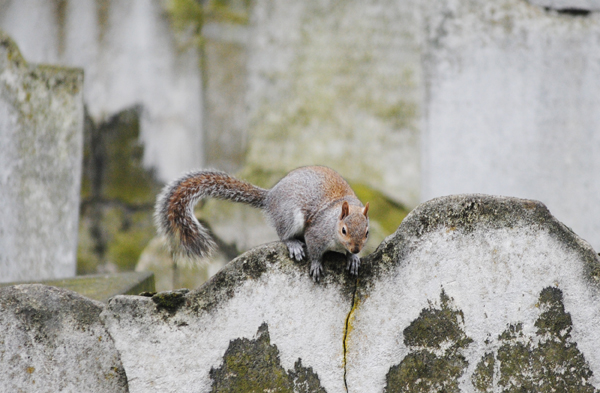
A squirrel spotted playing among the tombstones of Bunhill Fields Cemetery in the Borough of Islington. The Dissenters’ graveyard – burial place of the likes of writers John Bunyan and Daniel Defoe, artist and poet William Blake and Susanna Wesley, mother of Methodist founders John and Charles Wesley – was recently given a Grade I listing on the national Register of Parks and Gardens. For more information on the cemetery, see our previous post here.

Around London – Burial place of Bunyan, Defoe and Blake gets Grade I listing; Kew Gardens joins Streetview; and, Afghan treasures on show…

The London burial place of writers John Bunyan and Daniel Defoe and artist and poet William Blake has been recognised as one of the city’s most significant historic landscapes with a Grade I listing on the national Register of Parks and Gardens. The news, which was announced last month, also sees 75 tombs located within Bunhill Fields Cemetery individually listed. Bunhill, located between City Road and Bunhill Row, is one of 106 registered cemeteries in London (and now one of only seven Grade I listed cemeteries). It was established in 1660 and, thanks to its not being associated with Anglican place of worship, is viewed as the “pre-eminent graveyard for Nonconformists in England” . About 123,000 burials took place in its four acres before it was closed in 1869. The oldest monument is that of theologian Theophilus Gale, who died in 1678. As well as the tombs of Buynan, Defoe and Blake, others listed on the register include that of Dame Mary Page, who died in 1728 and whose tomb inscription talks of her stoicism in the face of 240 gallons of water being taken out of her prior to her death, and Joseph Denison, a banker who died in 1806 and was one of England’s wealthiest commoners at the time. The listing was made by the Department of Culture, Media and Sport following advice from English Heritage. For more on Bunhill Fields, follow this link

Kew Gardens has joined Google Streetview, meaning it’s now possible to navigate your way around the gardens from the comfort of your own home. More than 26 kilometres of paths and the interiors of some of the garden’s glasshouses – including the Palm House and the Temperate House – can now be seen on Streetview which offers 360 degree views. Professor Stephen Hopper, director at Kew, says the new technology is “bound to encourage people to visit us and experience Kew for themselves”. Follow this link to see the gardens on Streetview.

• On Now: Afghanistan’s heritage is on display in a newly opened exhibition at the British Museum. Afghanistan: Crossroads of the Ancient World showcases more than 200 objects from the National Museum of Afghanistan as well as some items from the British Museum and includes sculptures, ivory inlays once attached to furniture, Roman glassware and Egyptian stone tableware, and inlaid gold ornaments once worn by the area’s “nomadic elite”. The objects were found between 1937 and 1978 and were preserved thanks to officials who kept them out of harm’s way during the Soviet and Taliban eras. The museum announced this week that they would be joined by carved ivory fragments that were stolen from Afghanistan’s national museum in the early 1990s and only recently presented to the British Museum by a benefactor with the idea that they will eventually be returned to Kabul. The exhibition runs until 3rd July. There is an admission charge. For more information, see www.britishmuseum.org.

Treasures of London – The ‘Old Lion’ Maidenhair Tree, Kew Gardens

Celebrated in the 2002 list of 50 “Great British Trees”, the Maidenhair Tree is one of a number at Kew Gardens known as an “Old Lion” – the name collectively given to the few remaining trees with a planting date of 1762.

The Gingko biloba or Maidenhair Tree was one of the first of its species to be planted in Britain and, along with the other ‘Old Lions’, was brought from the Twickenham estate of the Duke of Argyll in 1762.

It was planted in what was then a new five acre arboretum laid out by William Aiton, employed as the gardener at the first botanic garden at Kew (this was established in 1759 at the behest of Princess Augusta, wife of Frederick, Prince of Wales – who had died in 1751 – and mother of King George III, and John Stuart, 3rd Earl of Bute).

Originally located against the wall of the ‘Great Stove’ glasshouse to provide it with protection, the tree has stood alone since 1861 when the glasshouse was demolished. It can now be found adjacent to the Wisteria arch close to the Secluded Garden Conservatory. Several further Gingko trees were planted in the garden in 1773 under the direction of botanist Sir Joseph Banks.

The other four ‘Old Lions’ at Kew are a False Acacia (Robinia pseudoacacia), an Oriental Plane (Platanus orientalis), a Caucasian Elm (Zelkova carpinifolia), and a Pagoda Tree (Sophora japonica).

WHERE: Kew Gardens (nearest tube station is Kew Gardens); WHEN: 9.30am to 4.15pm daily (check closing times for glasshouses); COST: £13.90 adults; £11.90 concessions; children under 17 free; WEBSITE: www.kew.org.

Lost London – York Watergate

There’s several places along Victoria Embankment where it’s possible to see where the River Thames bank stood before the massive mid-19th century project to reclaim land. Not the least of them is located in the downstairs foyer to Somerset House, where looking through the glass floor, you can see the pebbles of the original riverbank.

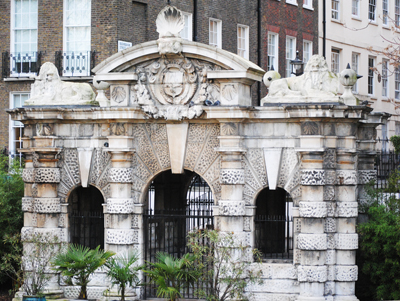
Another is York Watergate, once the river entrance to the Duke of Buckingham’s London mansion, and now stranded some distance from the water in Victoria Embankment Gardens.

The mansion, known as York House, was originally located on the southside of the Strand. Originally built in the 13th century, it was later acquired by King Henry VIII and granted to the Archbishop of York, Nicholas Heath, in 1556 (hence its name). The house became the home of George Villiers, the first Duke of Buckingham and somewhat sycophantic favorite of King James I, in the early 1620s.

When the duke was stabbed to death in 1628, the property passed to his son, the second Duke of Buckingham (also George), who later sold it to a land developer. It was apparently as a condition of the sale that the streets there now include the duke’s full name – hence George Court, Villiers Street, Duke Street, the slightly ludicrous Of Alley, and Buckingham Street.

The impressive Italianate watergate, which stands below the junction of Buckingham Street and Watergate Walk just a short walk into the gardens from Embankment tube station, was designed by the irrepressible Inigo Jones and built in 1626. Though weathered, it still bears the coat of arms of the Duke of Buckingham on the front.

Around London – The Magazine gets a new life, Lennon’s former home commemorated, and, The Titanic Exhibition

News this week that The Magazine building in Kensington Gardens – which dates from 1765 and was built to house munitions initially intended to help repel a Napoleonic invasion – is getting a new lease of life as an art gallery. The Royal Parks have awarded the Serpentine Gallery a contract to create a new art space – the Serpentine Sackler Gallery – in the building. Pritzker Prize architect Zada Hadid will oversee the renovation of the building which will be open in time for the Olympic Games in 2012. PICTURE: John Offenbach © The Royal Parks and Serpentine Gallery.

• A Blue Plaque commemorating singer, songwriter and one-time Beatle John Lennon’s stay in a house in Marylebone was unveiled last month. Yoko Ono unveiled the plaque at 34 Montagu Square, where she and John lived in the basement and ground floor flat in the latter half of 1968 when Lennon was working on The Beatles’ White Album. It was the first home the couple shared and, while Lennon lived at a number of London addresses between 1963 and 1971, of those that survive it is the home he occupied for the greatest period. Previous occupants included Ringo Starr, Paul McCartney and Jimi Hendrix.

• ON NOW: Titanic: The Artefact Exhibition will be held at the O2 from 5th November until 1st May. The exhibition traces the Titanic’s final journey, from Cherbourg on 10th April, 1912 to its sinking with the loss of 1,500 lives after striking an iceberg three days later. Featuring more than 200 artefacts from the ship, the exhibition includes recreated interiors from the ship. Tickets start at £13 for adults. For more information, see www.titaniclondon.co.uk.

10 sites in London you may not know about – 10. Highgate Cemetery

Cemeteries can often provide a fascinating insight into past lives and among the most prominent in London is Highgate Cemetery, located in the city’s north.

With the population of London growing rapidly in the early 1800s, the 17 acre Highgate cemetery was first opened in 1839 with the first burial taking place in May that year.

The cemetery quickly became one of London’s most fashionable and was extended by 20 acres before the opening in 1856 of a new cemetery to the east. These days both are open to tourists although the West Cemetery can only be explored on a guided tour, thanks at least partly to vandalism.

The atmospheric East Cemetery is primarily known for being the resting place of Karl Marx but also features the graves of authors George Eliot (Mary Ann Evans) and Douglas Adams, Australian painter Sidney Nolan and co-founder of Foyles – London’s famous Charing Cross bookstore – William Foyle.

Features at the West cemetery, meanwhile, include an avenue of Egyptian-style vaults and the vaults in an inner ring known as the Circle of Lebanon. Among those buried there are physicist Michael Faraday and the parents and brother of Charles Dickens.

The cemetery is now operated by a non-profit charity, the Friends of Highgate Cemetery.

WHERE: Swain’s Lane. Nearest tube is Archway; WHEN: Eastern Cemetery – daily from 10am (11am weekends) to 5pm (4pm between November and February), Western Cemetery – guided tours only (weekdays at 2pm with phone bookings required, weekends hourly from 11am to 4pm (3pm between November and February); COST: Eastern Cemetery – £3 adults/£2 students, Western Cemetery tours – £7 adults/£3 children aged 8-16; WEBSITE: www.highgate-cemetery.org

The Weekly Roundup

Each week, we’ll be bringing you a round-up of some of the news affecting historic and interesting places in London. So, to kick it off…

The gardens surrounding the neo-Palladian masterpiece Chiswick House have been reopened following a £12 million restoration. The 65 acres of gardens, known as the birthplace of the English Landscape Movement, were designed by Lord Burlington and William Kent in the 1720s and 1730s. They were created as a backdrop for the magnificent house Lord Burlington designed and had built on the west London property following a grand tour of Italy. The garden’s original vistas have been restored and statutory and garden buildings repaired – including a 19th century conservatory housing rare camellias. More than 1,600 trees have been planted – some of which were propagated from the original 18th century Lebanon cedars planted in the garden – and the Walled Gardens have also been restored (these will only be open to the public on special occasions). There’s also a new cafe designed by award-winning architects Caruso St John. ~ www.english-heritage.org.uk/chiswickhouse

Four new Blue Plaques have been unveiled in London. They include one for Sir William Nicholson (1872-1949), painter and printmaker (1 Pilgrim’s Lane, Hampstead); another for Charles Rolls (1877-1910), motoring and aviation pioneer (14/15 Conduit Street, Mayfair); Baron Carlo Marochetti (1805-1867), sculptor (34 Onslow Square, South Kensington); and, Wing Commander FFE Yeo-Thomas GC (1902-1964), secret agent (24-28 Queen Square, Holborn). ~ www.english-heritage.org.uk/blueplaques

On Now – Magnificent Maps: Power, Propaganda and Art. At the British Library (open daily, admission free, www.bl.uk/magnificentmaps/). The exhibition contains some 80 spectacular, mainly European, maps, dating from as far back as the Roman era, and explores how they have been employed for various purposes – as propaganda, works of art, teaching aids and indoctrination. Included in the exhibition are the world’s biggest and smallest atlases – the latter created for a doll’s house. Exhibition closes 19th September.