10 significant sites from Georgian London – 3. St Mary le Strand…

This oddly located church on the Strand is the work of acclaimed architect James Gibbs – the first public project he embarked upon after returning from Italy where he had trained.
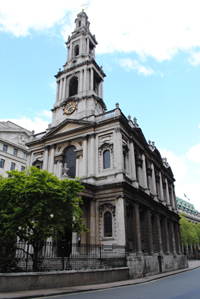
St-Mary-le-StrandWhile the history of St Mary le Strand goes at least back to the Middle Ages (and it initially stood just south of the current churches’ position on land currently occupied by Somerset House), the construction of the current church – the first of 50 built in London under a special commission aimed at, well, seeing more churches built in the capital to meet the needs of the growing population – began around 1715 (the foundation stone was laid on 25th February, the year after the accession of King George I.)

While building was briefly delayed by the Jacobite rising which broke out in 1715, the church was finally consecrated for use on 1st January, 1723.

Gibbs, who trained under a baroque master – a style which contrasted with the Palladian-style favoured by Lord Burlington and others, had apparently originally intended the church to be in the Italianate style with a campanile over the west end instead of the steeple  but this scheme also included a 250 foot high column surmounted by a statue of Queen Anne located to the west of the church which would celebrate the work of the commission (it’s also worth noting that the churches built by the committee – and they didn’t get close to building 50 – were known as “Queen Anne Churches” despite their construction taking place largely after her death).

However, plans for the column were abandoned on the queen’s death on 1st August, 1714, and instead Gibbs – a Roman Catholic who thanks to his supposed Jacobite sympathies apparently finished the project without pay, was ordered to use the stone which had been gathered to build the steeple and, thanks to that, amend his plans for the church into an oblong form rather than the square form he had initially intended. The work shows the influence of Sir Christopher Wren as well as churches in Italy.

The interior has been remodelled several times since its creation. The white and gold plastered ceiling was apparently inspired by the work of Italian sculptor and architect Luigi Fontana on two Roman churches and other features include paintings by American artist Mather Brown (these were put in place in 1785 and are located on panels on the side walls of the chancel – they were restored in 1994), while the crucifix behind the altar was presented by parishioners in 1893.

It the late 1800s, the London County Council proposed demolishing the church so it could widen the Strand for traffic but this plan was abandoned after an outcry led by artist Walter Crane (although the graveyard was removed).

Famous faces associated with the church include Charles Dickens’ parents, John and Elizabeth, who were married here in 1809, and there’s a story that during a secret visit to London in 1750, Bonnie Prince Charlie (Charles Edward Stuart) renounced the Roman Catholic Church by receiving Anglican communion here. The parish currently includes that of nearby St Clement Danes after the church was bombed in 1941 (it’s now central church of the Royal Air Force).

WHERE: St Mary le Strand, Strand (nearest tube stations are Temple, Covent Garden, Holborn, Charing Cross and Embankment); WHEN: Usually open 11am to 4pm from Tuesdays to Thursdays and 10am to 1pm Sundays; COST: free; WEBSITE: www.stmarylestrand.org.
LondonLife – Chocolate kitchens rediscovered at Hampton Court Palace…

Chocolate-kitchen

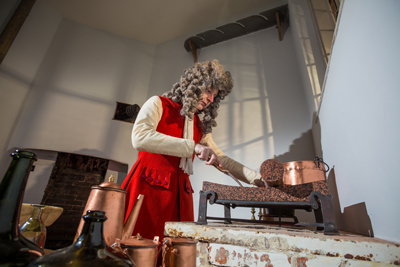
Once making chocolate for kings including William III, George I and George II, a special royal chocolate-making kitchen has opened at Hampton Court Palace – the only surviving example of its kind in the country. The opening – which is part of Historic Royal Palaces’ celebration of the 300th anniversary of the Hanoverian accession – comes after research identified the exact location of the kitchen which, having been used as a storeroom, was found in a “remarkably well preserved” state with original fittings such as the stove and furniture intact. Among those known to have worked in the kitchen is Thomas Tosier (pictured above), personal chocolatier to King George I, and it was in here he prepared special chocolate drinks. (Interestingly, Tosier’s wife Grace apparently traded on her husband’s royal association to promote her own chocolate house in Greenwich). A new display in the kitchen explores how the chocolate was made for the king and features copper cooking equipment and bespoke chocolate serving silverware, glassware and linens from the 18th century. The Royal Chocolate Kitchen will also play host to live Georgian chocolate making sessions. PICTURE: © Historic Royal Palaces/Richard Lea Hair.

WHERE: Hampton Court Palace, East Molesey, Surrey (nearest station is Hampton Court from Waterloo); WHEN: 10am to 4.30pm until 29th March after which it’s open to 6pm); COST: Adult £18.20, Concession £15.40, Child under 16 £9.10 (under fives free), family tickets, garden only tickets and online booking discounts available; WEBSITE:www.hrp.org.uk/HamptonCourtPalace/.

10 significant sites from Georgian London – 2. Burlington House…

Now the home of the Royal Academy of Arts, the origins of Burlington House on Piccadilly go back to the 1660s but it was Richard Boyle, the 3rd Earl of Burlington, who had the property reworked into the Palladian building it is today. 

It was Sir John Denham, Surveyor-General of the King’s Works for King Charles II, who first began building a red brick mansion on the site in the 1660s before he sold the still unfinished building to Richard Boyle, the 1st Earl of Burlington, in about 1667. He completed the house the following year.

Burlington-HouseThe property next underwent major changes during the minority of the 3rd Earl (also Richard Boyle, 1612-1698) – his mother, the 2nd Countess, Lady Juliana, had architect James Gibbs carry out some alterations including the addition of a semi-circular colonnade at the front of the house and reconfiguration of the main staircase.

But around 1717-1718, the 3rd Earl (1694-1753), who himself was something of an architect, commissioned architect Colen Campbell to take over from Gibbs. The property was then reworked to a Palladian design – particularly the southern front of the building and William Kent was summoned to redesign interiors – the surviving interior of the Saloon is credited as the first ‘Kentian’ interior in England.

Lord Burlington soon shifted his attention to Chiswick House (see our earlier post here), and on his death in 1753, the house passed to the Dukes of Devonshire before it was eventually purchased by the 4th Duke’s younger son, Lord George Cavendish, around 1812. He had some of the interiors reworked by Kent admirer Samuel Ware, keeping them sympathetic to the Palladian vision.  Four years after the purchase, Burlington Arcade was built along the western side of the premises.

In 1854, the property was sold to the British Government who initially intended demolishing the structure and using the site for the University of London but after strong opposition to the plan, it was occupied by the Royal Society, the Linnean Society and the Chemical Society while the Royal Academy – which had been founded by King George III in 1768 – took over the main block on a 999 year lease in 1867.

The building subsequently underwent further alterations – among them Sidney Smirke added a third floor to the main building – the Diploma Galleries – and the Main Galleries and the Art School on a garden to the north of the house. Later, three story ranges were raised around the courtyard and the three aforementioned learned societies moved into these and were later joined by the Geological Society of London, the Royal Astronomical Society and the Society of Antiquities.

The Royal Society left in 1968 and the British Academy moved in but this august institution moved out in 1998, leaving the building now home to the Royal Academy and the five learned societies, the Geological Society of London, the Linnean Society of London, the Royal Astronomical Society, the Society of Antiquaries of London, and the Royal Society of Chemistry.

More recent works at the property – the last survivor of four townhouses built along Piccadilly in the 1660s – have included a 1991 remodelling of the Diploma Galleries by Norman Foster – now known as The Sackler Wing of Galleries – and the restoration of the former state rooms including The Saloon, reopened as the John Madejski Fine Rooms.

WHERE: Royal Academy of Arts, Burlington House, Piccadilly (nearest Tube stations are Piccadilly Circus and Green Park);  WHEN: 10am to 6pm Saturday to Thursday/10am-10pm Friday (opening times for the John Madejski Fine Rooms may vary); COST: Varies depending on the exhibition (there are free guided tours of the John Madejski Fine Rooms – check the website for details); WEBSITE: www.royalacademy.org.uk

PICTURE: Installation by Ãlvaro Siza, part of the Sensing Spaces: Architecture Reimagined exhibition which runs until 6th April. Photo: Royal Academy of Arts. Photography: James Harris/Ãlvaro Siza 

10 significant sites from Georgian London – 1. Chiswick House…

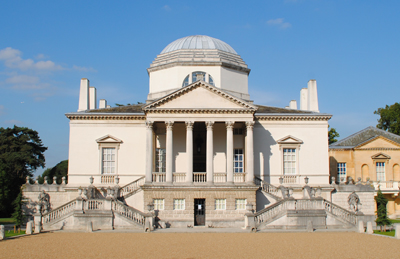
Chiswick-HouseAn icon of the Georgian era, Chiswick House in west London is one of the pre-eminent examples of neo-Palladian architecture in Britain and exemplifies the elegance of the time.

Designed by Richard Boyle, the third Earl of Burlington (1694-1753), the two storey, domed villa was inspired by what Lord Burlington had seen of ancient and sixteenth century architecture during his tours of Italy – in particular the work of Andrea Palladio – as well as the work of Palladio admirer, famed English architect Inigo Jones (his statue along with that of Palladio can be seen outside),

Chiswick-House2It was constructed in the 1720s, most likely between 1727 and 1729, on a site which had been purchased by the first Earl of Burlington (his grandfather) in 1682 and which was already occupied by a Jacobean-era house (this property, which the third Earl significantly renovated, was eventually pulled down in 1788). The interiors were designed by William Kent in collaboration with Burlington and feature luxurious rooms with velvet-covered walls such as the magnificently restored Blue Velvet Room.

The exact purpose of the property remains something of a mystery – it’s been suggested it was built to as a pavilion for private contemplation, grand entertainments and to house the Earl’s art collection and the fact it had no kitchen is supportive of such a conclusion. But there is evidence it was also used as a functioning house – the fact Lady Burlington died in her bedchamber in the premises in 1758 and the link which was eventually built by Lord Burlington between it and the older property on the estate are suggestive of this.

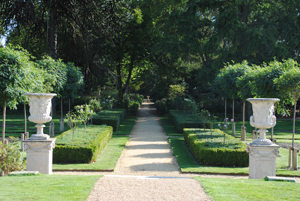
Chiswick-House3Whatever its purpose, the architectural and artistic masterpiece was complemented by formal gardens which Lord Burlington, again, along with the aid of Kent, extensively altered to create a highly planned but naturalistic-looking landscape. Known as the “birthplace of the English Landscape Movement”, the gardens have influenced everyone from ‘Capability’ Brown to the design of New York City’s Central Park.

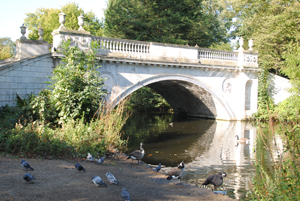
Following Lord Burlington’s death in 1753, the house passed into the hands of his grandson, the fifth Duke of Devonshire (his wife was the rather infamous Duchess Georgiana). He extended the house into a large mansion, adding new wings (these weren’t removed until the 1950s) and improved the gardens, adding the stone bridge (pictured) that still stands over the lake.

Upon the fifth Duke’s death in 1811, the house passed into the hands of the sixth Duke, known as the ‘Bachelor Duke’. He made considerable use of the property and guests included Tsar Alexander I of Russia, King Fredrick William III of Prussia, Queen Victoria and Prince Albert, and Tsar Nicholas I (again, of Russia). The Bachelor Duke also extended the grounds and brought a range of exotic animals into them, including an elephant, kangaroos and emus.

Upon his death in 1858, he left the property to his sister and after her death only four years later, it was subsequently let to some rather high-brow tenants including the Prince of Wales who received the Shah of Persia there in 1873,

The estate was eventually sold by the ninth Duke to the Middlesex County Council and after the war, gifted to the Minister of Works. In 1984, care for the house was transferred to English Heritage. The gardens are now owned by the London Borough of Hounslow.

Along with the Chiswick House and Gardens Trust, English Heritage recently completed a £12 million restoration of the gardens which, this year will host the fourth annual Camellia Festival next month. But this stunning property is well worth a visit any time of the year.

WHERE: Chiswick House, Burlington Lane, Chiswick (nearest Tube station is Turnham Green/nearest train station is Chiswick);  WHEN: 10am to 4pm Saturday and Sunday (until 31st March); COST: £5.90 adults/£3.50 children (5-15 years)/£5.30 concession/£15.30 family; WEBSITE: www.english-heritage.org.uk/daysout/properties/chiswick-house/ or www.chgt.org.uk.

This Week in London – Handel and the royals; David Bailey; and, redefining German art…

• A new exhibition exploring German-born George Frideric Handel and his association with the royal family opens at the Foundling Museum in Bloomsbury tomorrow to mark the 300th anniversary of the coronation of King George I. The museum says no composer has been more closely associated with the British monarchy than Handel, whose anthem Zadok the Priest has been performed at every coronation since King George II in 1727 and whose Water Music was performed on the River Thames during the Diamond Jubilee for Queen Elizabeth II in 2012. By George! Handel’s Music for Royal Occasions features treasures from the Gerald Coke Handel Collection and loans from the British Library, the National Portrait Gallery, the British Museum and Westminster Abbey. Runs until 18th May. For more, see www.foundlingmuseum.org.uk.

A landmark exhibition of David Bailey photographs opens at the National Portrait Gallery today. Bailey’s Stardust – one of the gallery’s largest scale photographic exhibitions, it occupies most of the gallery’s ground floor – features more than 250 portraits including a new portrait of Kate Moss and previously unseen images from Bailey’s travels to the Naga Hills in India in 2012. There’s also rooms devoted to portraits of the Rolling Stones and Catherine Bailey, images from Bailey’s trip to Papua New Guinea in 1974 and from east Africa which Bailey visited in 1985 in support of Band Aid. Admission charge applies. Runs until 1st June. For more, see www.npg.org.uk.

A new exhibition at the British Museum explores how six key artists redefined the notion of art in Germany in the Sixties and Seventies. Germany divided: Baselitz and his generation features some 90 works including some 45 by George Baselitz as well as works by Markus Lupertz, Blinky Palermo, AR Penck, Sigmar Polke and Gerhard Richter. Thirty-four of the works, including 17 by Baselitz, have been donated by Count Christian Duerckheim while a loan of some 60 additional works from the Duerckheim Collection makes up the rest of the exhibition. Runs in Room 90 until 31st August. For more, see www.britishmuseum.org.

Send all items of interest for inclusion to exploringlondon@gmail.com.

Famous Londoners – Jonathan Wild…

The self-styled “Thief-Taker General”, Jonathan Wild was one of the most famous figures of London’s underworld in the early 18th century, credited by some as being the city’s first organised crime boss.

Jonathan-WildBorn to a family in Wolverhampton, Wild – who had at some point undertaken an apprenticeship as a buckle-maker – was married and had a son when he first came to London as a servant in 1704 and although he returned to the city of his birth after being dismissed, he apparently abandoned his family and returned to the capital in 1708.

Little is known of the first couple of years he spent in London but records show he was arrested for debt in March 1710 and sent to Wood Street Compter where he quickly ensconced himself and was even awarded the “liberty of the gate” – meaning he could leave the prison at night to aid in the apprehension of thieves.

It was also during this period that he came under the influence of a prostitute Mary Milliner. Upon his release in 1712 – thanks to an Act of Parliament passed to help debtors – he lived with her as her husband (despite his earlier marriage – and hers) in Covent Garden.

Acting as her protector when she was on the street, Wild also branched into the business of being a fence or receiver of stolen goods and racketeering offences like extortion. In 1713, he joined Charles Hitchen to be his assistant. Hitchen, who had been suspended from his position as the City’s Under Marshal thanks to his practice of extorting thieves and their victims (it’s thought he may have taught Wild the craft), was then working as a thief-taker.

Wild apparently took to the new role with fervour for when Hitchen was reappointed to his post as Under Marshal, Wild parted from his company and continued his work as a thief-taker, opening his own office in the Blue Boar Tavern in Little Old Bailey.

Wild’s method of operation was simple enough – he would organise thieves to steal items and then, when it was announced that said items were stolen, claimed to have found them and would return them to the rightful owners for a “reward”. At the same time, he’d often also aid the police by bringing to justice thieves from rival gangs (including Hitchen’s, for they were now rivals) or those of his own gang who had crossed him – and in all his dealings manage to keep at arm’s length from the actual business of stealing and receiving.

By 1718, Wild – who wore a sword as a sign of his authority and had pretensions of being a “squire” – was calling himself the “Thief-Taker General of Great Britain and Ireland”. It’s said that more than 60 thieves were sent to the gallows on the back of his testimony including the prolific housebreaker (and jail escapee) Jack Sheppard and his associate Joseph “Blueskin” Blake (who almost succeeded in killing Wild while he was awaiting trial).

Wild’s pursuit of Sheppard was the beginning of his own downfall (although authorities had as early as 1717 passed an Act of Parliament aimed squarely at ending his criminal enterprise, it seemed to have had little effect, at least initially). Sheppard’s demise had been unpopular with the masses and the press of the day – and in February 1725, Wild himself was arrested for assisting in the jailbreak of one of his gang members. Other members of the gang turned against him and eventually, in May that same year, he was sentenced to death for the theft of lace.

Having unsuccessfully attempted to kill himself by drinking laudanum before his execution, Wild was hanged at Tyburn on 24th May before a large and raucous crowd which apparently included an 18-year-old Henry Fielding.

Wild was buried in secret in the churchyard of St Pancras Old Church next to his third wife (and one of his many lovers), Elizabeth Mann (she had died in 1718 and he apparently married another woman shortly after). His body was later reported to have been dug up and eventually, following the recovery of a body with a hairy chest from the Thames which was identified as being Wild’s, a skeleton said to have been his was donated to the Royal College of Surgeons (it’s now on display in the Hunterian Museum).

The subject of numerous articles, books and ballads, Wild’s story has been since told numerous times and for varying purposes. Among them are Daniel Defoe’s True and Genuine Account of the Life and Actions of the Late Jonathan Wild, published in 1725, Henry’s Fielding’s ironic The History of the Life of the Late Mr Jonathan Wild the Great (1743), and John Gay and John Rich’s The Beggar’s Opera (1728) which features the character Peachum, said to have been based on Wild.

PICTURE: From “Ticket to the Hanging of Jonathan Wild”/Wikimedia Commons

To read more about Jonathan Wild, see Gerald Howson’s Thief-taker General: The Rise and Fall of Jonathan Wild.

10 fictional character addresses in London – 1. 221b Baker Street…

221b-Baker-Street

Today we kick off our new Wednesday series with a look at some of the most famous addresses in London where fictional characters once lived. Most, if not all, of the addresses we’ll look at are not fictional in themselves – they do actually exist – but the characters said to have lived there owe their lives solely to the imaginations of their creators and the readers and audiences who have loved and admired them.

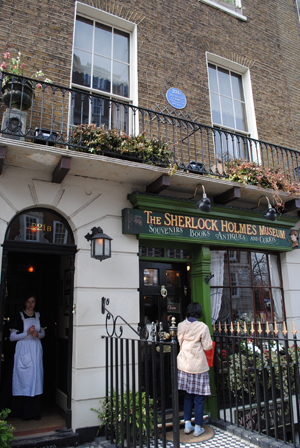
To kick it off, we take a quick look at what is certainly the most visited address of a fictional character in London – 221b Baker Street, the home of Sherlock Holmes and his associate Dr John Watson.

The-Sherlock-Holmes-MuseumWe’ve looked mentioned this Baker Street address in a couple of earlier posts – including a look at the origins of the naming of Baker Street and a piece on Sherlock Holmes himself.

So, to somewhat recap, the writer Sir Arthur Conan Doyle has Holmes and Watson living at this address from 1881 (it becomes their address in the first book featuring them – A Study in Scarlet, published in 1887) to 1904 when Holmes retired (Watson was not a continual presence here, moving in and out a couple of times).

What’s interesting is that the address now belongs to the Sherlock Holmes Museum, although in terms of the other numbers in the street, this is actually located between numbers 237 and 241 (in a street which was, prior to the 1930s, known as Upper Baker Street).

What is now number 221 is a 1930s art deco building formerly known as Abbey House (but this would have been 41 Upper Baker Street in 1887). It was the headquarters of Abbey National which had a long-running dispute with the museum over the right receive mail at the address 221b (since the closure of Abbey House in the early Noughties, the museum has received the mail).

It should be noted that there are also numerous other theories over the ‘real’ location of 221b Baker Street – in particular one which suggests the real address is opposite the former location of Camden House in Baker Street, thanks to a reference in The Empty House.

The museum, which is located in a house built in 1815, is set up as it was in Holmes’ day and contains his first floor study, filled with artefacts relating to the many cases he solved – including his famous pipe as well as his deerstalker hat, magnifying glass, violin, and the wicker chair which was used in Sidney Paget’s famous illustrations.

Other rooms include Dr Watson’s small second floor bedroom and the housekeeper Mrs Hudson’s room.

Worth noting is that there is also reconstruction of Holmes’ study at The Sherlock Holmes pub, located at 10-11 Northumberland Street in Westminster. This had been created for the Festival of Britain in 1951 by the Marylebone Borough Library and Abbey National and was located at Abbey House. For on this, check out the Westminister Libraries & Archives site.

WHERE: The Sherlock Holmes Museum, 221b Baker Street (nearest Tube station is Baker Street);  WHEN: 9.30am to 6pm daily; COST: £8 adults; £5 children (under 16); WEBSITE: www.sherlock-holmes.co.uk.

Where’s London’s oldest…tea shop?

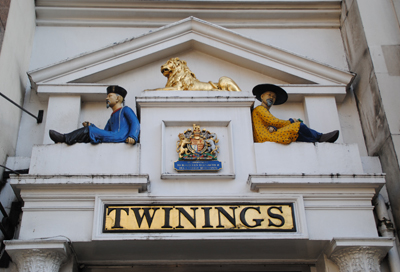
Twinings

Opened in the Strand in 1706, Thomas Twining’s tea shop can still be found there today.

Twining, a tea merchant whose family originally hailed from Gloucestershire, started selling tea from what had been a coffee house – Tom’s Coffee House – in an effort to tap into tea’s growing popularity. It had apparently been introduced to England by Catherine of Braganza, the Portuguese wife of King Charles II, soon after the Restoration.

Amid resistance from other coffee house owners and despite high taxes on tea, Twining’s venture succeeded, attracting a wealthy clientele which apparently included Jane Austen, thanks at least in part to its location on the border between the City of Westminster and the City of London.

By 1717, Twining had purchased three houses adjacent to his coffee house and converted them into a shop which still stands today at number 216 Strand (the original Tom’s Coffee House was located behind this premises). He was soon selling more dry tea than wet at the sign of the “Golden Lyon”.

Following Thomas’ death in 1741, Twining’s son Daniel took over the business and by the mid-1700s, was exporting to America where he counted the Governor of Boston among his clients (but, apparently it was not Twining’s tea which was tossed into the sea at the Boston Tea Party).

It was Daniel’s son (and Thomas’ grandson), Richard Twining, who was successful in lobbying for the lowering of tea taxes and so paving the way for tea to become the commonly consumed drink it is today. It was also Richard who built the shop’s current entrance portal in 1787 incorporating the golden lion.

The Twinings shop today is the oldest in the City of Westminster while the company’s logo, which dates back to 1787, is the oldest commercial logo in continuous use.

Twinings, which since 1964 had been owned by Associated British Foods, was granted a Royal Warrant in 1837 by Queen Victoria.

For more, see www.twinings.co.uk.

Famous Londoners – David Garrick…

Playwright. Actor. Theatre manager. David Garrick stands out as a towering figure of the theatrical world in the 18th century and is remembered, at least in part, for his friendship with the irrepressible lexicographer Samuel Johnson.

Born on 19th February, 1717, in Hereford to an army officer (with French Huguenot roots) as the third of five children, Garrick attended school in Lichfield, north of Birmingham, including, at the short-lived Edial Hall School where Dr Johnson himself taught Latin and Greek. It was during his youth that he first took an interest in the stage, appearing in George Farquhar’s The Recruiting Officer.

When the school closed due to lack of funds, Garrick accompanied Dr Johnson to London (they had become friends) and there he and his younger brother Peter established a wine business (Peter eventually went back to Lichfield to run part of the business from there). While the business wasn’t a great success, Garrick took to acting in amateur theatricals and eventually – according to Peter Thomson, writing in the Oxford Dictionary of National Biography – made his professional debut acting incognito in a pantomime in London in March, 1741, although Garrick apparently said placed his debut in Ipswich that summer when he was acting in Thomas Southerne’s Oroonoko, or the Royal Slave (meanwhile the first performance of one of his dramatic works – Lethe, or Aesop in the Shades – had taken place at Drury Lane the previous year).

His breakthrough role came later that year – in October – when he appeared in London on the stage of the unlicensed Goodman’s Fields Theatre in the title role of Richard III. Soon acclaimed by the likes of Alexander Pope and William Pitt as the greatest actor of his time, further roles followed at Goodman’s Fields and at the famous Drury Lane Theatre as well as in Dublin (where he started an ultimately ill-fated love affair with Irish actress Peg Woffington who returned with him to London where he continued acting at Drury Lane).

Having also performed for a season, at the rival Covent Garden Theatre, in April 1747, Garrick entered into a partnership with James Lacy for the ownership of the Drury Lane Theatre. The first performance was apparently by Garrick himself, reading Ode to Drury Lane Theatre, on dedicating a Building and erecting a Statue, to Shakespeare – a piece written by Dr Johnson.

It was two years later – on 22nd June, 1749 – that he married a German dancer Eva Marie Veigel. They lived at a house at 27 Southampton Street and Garrick’s increasing wealth led him to buy a country property in Hampton, today in south west London, in 1754 which became known as “Garrick’s Villa”. Considerably altered, the Grade I-listed property still stands there today (albeit having suffered extensive damage in a 2008 fire) along with the summerhouse he built to house his collection of Shakespearian memorabilia – known as Garrick’s Temple to Shakespeare, it’s open to the public over from April to October.

Meanwhile, as well as managing the theatre, Garrick continued acting and writing plays. In September, 1769, he staged the Shakespeare Jubilee in Stratford-upon-Avon, celebrating 200 years since the playwright’s birth – even though it was five years too late and was ultimately a bit of a disaster, he took his celebration of Shakespeare back to Drury Lane and there it was a huge success.

Garrick, who moved from Southampton Street into the newly built Adelphi Terrace in 1772, remained manager of Drury Lane until his retirement in 1776 during which time it became widely acknowledged as the country’s leading theatre. He died at home on 20th January, 1779. His wife outlived him by 43 years. The couple had no children. Garrick was subsequently interred in Poet’s Corner, Westminster Abbey – the first actor to receive the honour.

Garrick’s legacy was enormous – not only is he famed for bringing a new ‘realistic’ style to the profession he so loved, he set new standards in the arts of public relations and was also an instrumental figure in having Shakespeare recognised as England’s national icon. Legend goes that he was also the actor responsible for the phrase “Break a leg!” – apparently so engrossed in a performance of Richard III that he overlooked the fact he’d fractured his bone.

Garrick’s name lives on in the Garrick Theatre (still operating in Charing Cross Road) and the Garrick Club, and there’s memorial to him on his former home in Adelphi Terrace.

10 Historic London Garden Squares…8. Russell Square

The largest garden square in Bloomsbury (and one of the largest in London), Russell Square was first laid out by Humphry Repton in 1806 and was located on what were the gardens of the home of the Dukes of Bedford, Bedford House.

Duke-of-BedfordIts name is that family name of the 5th Duke of Bedford, Francis Russell, who initially ordered the creation of the square and owned the land upon which it stands. The Russell family still hold the title today – the current duke, the 15th, is Andrew Russell – and still run the Bedford Estates upon which the square still stands.

The square was originally lined with grand terraced homes aimed at the upper middle class – the survivors, which can be found largely on the southern and western side of the square, are these days occupied by offices and the University of London. The eastern side of the square is these days dominated by the French Gothic Hotel Russell – designed by Charles Fitzroy Doll, it was built in 1898.

Famous residents and inhabitants have included TS Eliot, who worked at a building in the square’s north-west corner when he was poetry editor at Faber & Faber, 19th century painter Sir Thomas Lawrence who had a studio at number 67, poet William Cowper, who lived at number 62 in the 1830s as a schoolboy, and George Williams, founder of the YMCA, who lived at number 13 in the late 19th and early 20th centuries. It also appears in William Thackeray’s novel, Vanity Fair, and Virginia Woolf’s Night and Day.

The gardens were overhauled in 2002 in view of Repton’s original design and a new ornamental fountain installed in the middle. A cafe was also added.

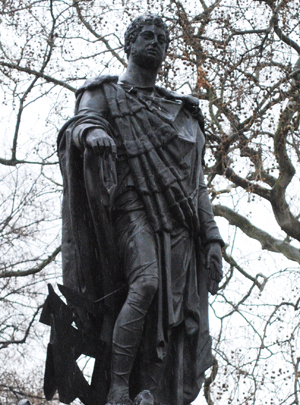
Russell Square still houses one of London’s 13 extant Cabmen’s Shelters while monuments within the gardens include a small memorial to the 7th July, 2005, bombings – two of which occurred nearby – and a statue of the 5th Duke of Bedford, another which is the work of Sir Richard Westmacott and which was erected in 1807-08 (pictured).

10 Historic London Garden Squares…7. Bloomsbury Square

Initially known as Southampton Square, Bloomsbury Square – located just to the east of the British Museum – was first developed in the mid-1660s, making it London’s oldest formal square.

Bloomsbury-SquareIt was the fourth Earl of Southampton, Thomas Wriothesley, who developed the square – his rather grand house, Southampton House, was located on the northern side of the square which initially featured gardens at the centre laid out in a cruciform pattern.

In 1723 – via the marriage of Southampton’s daughter, Lady Rachel Vaughan, to the ill-fated William, son of the 5th Earl of Bedford (he was implicated in the Rye House Plot and beheaded) – it passed to the Dukes of Bedford, becoming part of the Bedford Estates (and with it the earl’s house, later renamed Bedford House). The square took on its new name of Bloomsbury Square around this time.

Initially popular among the well-to-do, it had fallen somewhat from favour by the 19th century and with the 5th Duke preferring to live in the West End, in 1800 Bedford House was auctioned off and demolished. Terraced houses were later built along the now vacant north side of the square.

About 1806, the 5th Duke commissioned Humphry Repton to redesign the square and by the 1820s a garden including trees in the centre and a perimeter shrubbery. The gardens have gone through several makeovers since, including in the 1960s when an underground carpark was built underneath.

Most recently refurbished in 2006-2007 so they once again reflect Repton’s design, the gardens – which have been open to the public since 1950 – also contain a bronze statue of Whig politician (and friend of the Dukes of Bedford) Charles James Fox, which was designed by Sir Richard Westmacott and erected in 1816 (pictured, it was restored in 2006 to mark the bicentenary of Fox’s death).

It remained popular among middle class professionals, however, and among its most notable residents were the writer Isaac D’Israeli, father of the future Prime Minister Benjamin Disraeli, who lived at number six in the early 19th century (his son with him) while architect Sir Edwin Lutyens lived and worked at number 29 for more than 15 years after his marriage in 1897. Literary and artistic figures like Leonard and Virginia Woolf and Lytton Strachey, who became part of what was known as the ‘Bloomsbury Group’, were also famously known to have lived in the area around the square.

Most of the houses in the square are now used as offices but among the notable buildings there are the former home of the Royal Pharmaceutical Society of Great Britain (based in a building partly credited to architect John Nash) and, dating from 1930, Victoria House.

One of the more famous events to have taken place in the square occurred in 1780 during the anti-Catholic Gordon Riots when rioters burned down the house of the Lord Chief Justice. Almost 100 years earlier, in 1694, the square was site of a deadly fencing duel between Scottish financier John Law and Edward Wilson. Law killed Wilson, was subsequently convicted of his murder and sentenced to death but escaped by fleeing to the continent. He later become the founder of the Mississippi Company.

Famous Londoners – Edward Lloyd…

The founder of Lloyd’s Coffee House, Edward Lloyd – who died 300 years ago this year – is perhaps not so much famous in his own right as for the fact his name lives on in the Lloyd’s insurance business today.

Lloyd's_Coffee_House_plaqueLloyd is believed to have been born around 1648 but little is known of his early day (it’s thought he may have come from Canterbury). By 1688, he was the proprietor of a licensed coffee house in the now long gone Tower Street and was living nearby with his wife Abigail (the first reference to the coffee house dates from 1688).

In 1691, the coffee house moved to a premises at 16 Lombard Street – not far from the Royal Exchange – and it’s here that the coffee house gained a reputation as the centre of the ship-broking and marine insurance business (a blue plaque marks the site today).

Lloyd, meanwhile, was building up a network of correspondents at major ports around the world, and according to Sarah Palmer, writing in the Oxford Dictionary of National Biography, was also involved in the publication of a weekly news sheet featuring shipping-related news – initially published on a Saturday, it became a Friday publication in 1699 and continued until at least 1704 – and the rather shorter-lived single sheet newspaper Lloyd’s News, founded in 1696. (Lloyd’s List wasn’t founded until well after Lloyd’s death in 1734).

Lloyd and his first wife had at least nine children, with four daughters surviving into adulthood – it was the youngest, Handy, who with her first husband William Newton (he was head waiter at the coffee house and married her just prior to her father’s death) and, following his death, her second husband Samuel Sheppard, continued the family business after her father’s death in 1713.

Following Abigail’s death in 1698, he married Elizabeth Mashbourne and after her death in 1712, married again – this time to Martha Denham.

Lloyd died the following year on – 15th February 1713 – and was buried at St Mary Woolnoth – a church at which he’d held positions when alive.

The business which grew to become the Lloyd’s of London insurance business we know today, meanwhile, took its next step forward in 1769 when a group of professional underwriters established New Lloyd’s Coffee House in nearby Pope’s Head Alley. The group, formalised into a committee, later moved to the Royal Exchange and dropped the word new. Lloyd’s was incorporated in 1871 by an Act of Parliament and has gone on to become one of the world’s most famous insurers. It now operates in more than 300 countries and territories worldwide.

What was to become Lloyd’s Register, meanwhile, was founded in 1760 as the Society for the Registry of Shipping.

10 Historic London Garden Squares…6. Grosvenor Square

Grosvenor-Square-1

The largest square in Mayfair, Grosvenor Square was laid out in the 1720s on the orders of  Sir Richard Grosvenor of Cheshire.

Sir Richard owned the Grosvenor Estate, a considerable tract of land in London’s west which includes in its northern part the land upon which the square was created (the estate is now owned by Gerald Cavendish Grosvenor, the 6th Duke of Westminster).

It’s proximity to Hyde Park and Whitehall quickly made it, like many other historic squares, a fashionable place for politicians to live – among those who lived here in the late 18th century were three prime ministers.

The oval-shaped gardens in the middle of the square – which was only opened to the public in 1948 – were once home to a statue of King George I but this was removed at some point. Originally thought to have been laid out by gardener John Alston, they took on their current form in 1948 when they were redesigned by architect BWL Gallannaugh (interestingly, Grosvenor Square is also said to have been the last part of London to exchange gas lighting for electric lighting).

There’s almost no residential buildings on the square these days but among the most prominent buildings (in fact it dominates the west end of the square) is the US Embassy. Designed by Eero Saarinen, the building was completed in 1960 with US President John F Kennedy one of the first visitors.

Grosvenor-Square-2The hulking embassy is only one of the many American connections to the square, connections which at one point led to it being known as “Little America”. Dwight Eisenhower, commander of the US armed forces in World War II, based his headquarters at number 20 in 1944, while number nine – one of the few residences to survive – was home to John Adams, first American ambassador to the Court of St James and later the country’s second president.

The American theme, which has meant the square has been the focus of demonstrations such as those protesting the Vietnam War as well as outpourings of support such as in the wake of the September 11 attacks, is also evident in the statutory in the square’s gardens with grand, full size statues of  President Franklin D. Roosevelt (a bronze by William Reid Dick unveiled by Eleanor Roosevelt on the third anniversary of the president’s death – 12th April, 1948 – it is pictured above), President Eisenhower (a bronze by Robert Dean dating from 1989), and President Ronald Reagan (unveiled on 4th July, 2011, pictured right).

On the eastern side of the garden square is the September 11 Memorial Garden opened in 2003 while on the south side is the Monument to the Eagle Squadrons, the three RAF squadrons in World War II mostly composed of American volunteers before the US entered the war. There’s also a set of memorial “Diplomatic Gates”, installed in 1984 to commemorate the bicentennial of the Treaty of Paris and honour US and UK politician who have worked in the service of peace.

Other notable buildings include number one, the Canadian High Commission (previously the US embassy); and number four, one of  square’s oldest houses. Now demolished, number 44 was the home of the Earl of Harrowby and where the British Cabinet were dining when word arrived of Wellington’s victory at Waterloo.

What’s in a name?…Sloane Square

Sloane-SquareThis upmarket square in west London is named in honor of Sir Hans Sloane, the physician come botanist who bought the manor of Chelsea in 1712 and, in doing so, provided grounds for the Chelsea Physic Garden.

Sloane Square was developed by architect Henry Holland Sr and his son Henry Holland Jr in 1771 as part of a residential development they called Hans Town (also named after Sir Hans, it’s still a ward in the Royal Borough of Kensington and Chelsea). For more on Sir Hans Sloane, see our earlier post here.

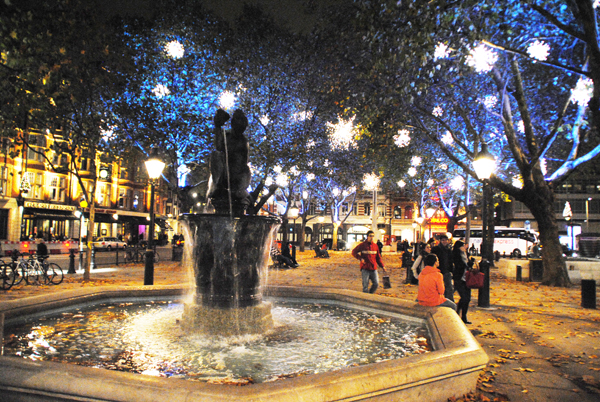
The square, pictured above as it looks decorated for Christmas, initially consisted of a village green bordered with posts and chains and the surrounding buildings were all residential. Apparently the square initially failed to attract the right sort of residents (it was a little too far from Mayfair) but despite this initial setback, it gradually became the centre of a desirable residential precinct.

Private houses began making way for other buildings in the square in the nineteenth century – in 1810, the New Chelsea Theatre opened, subsequently renamed the Royal Court Theatre (this was later moved to another site still on the square and remains there today), and in 1812, the Chelsea, Brompton and Belgrave Dispensary was established for the relief of the sick and the poor.

The Sloane Square Underground station opened in 1868 and rebuilt after it was damaged by bombs in World War II (it’s interesting to note that the River Westbourne actually runs through some iron conduit over the top of the platforms on its way to the River Thames).

Other notable buildings in the square today include the Peter Jones department store which first arrived in the square in the late nineteenth century.

The square itself was redesigned in the 1930s when the war memorial was put in its current position. The Venus Fountain (pictured above) which now stands there – the work of Gilbert Ledward – was erected in 1953.

10 Historic London Garden Squares…5. Berkeley Square…

Berkeley-Square

Located in the south-west of Mayfair in London’s West End, Berkeley Square was originally laid out by architect William Kent in the mid 1700s.

It takes its name from the Berkeley family of Gloucestershire (the first Lord Berkeley of Stratton was a Royalist commander in the Civil War) whose London residence, Berkeley House, stood on what is now the south side of the square until it was destroyed in a fire in 1733 (Devonshire House, whose residents included the 5th Earl of Devonshire and his somewhat notorious wife Georgiana, was subsequently built on the site and remained there until it was demolished in the 1920s).

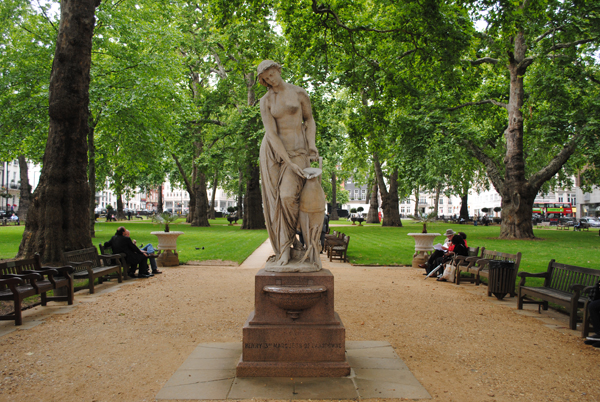
The gardens, which feature some of the city’s oldest London Plane trees (dating from 1789), have a pump house at the centre which was built in 1800 and is now Grade II listed (it stands on the site of an earlier equestrian statue of King George III). Other features including the statue Lady of Sumaria (Water Carrier) – pictured above – which was made by Pre-Raphaelite sculptor Alexander Munro in 1858 and stands at the garden’s southern end.

Among notable buildings which face onto the square are Lansdowne House – located on the south-west corner of the square, it was designed by Robert Adam and now home of the Lansdowne Club – and number 50 Berkeley Square, home of short-lived early 19th century PM George Canning (and said to be the most haunted house in London). The square was also the home of society favorite, Gunter’s Tea Shop, which dated from the mid-1700s.

Famous residents have included wartime PM Sir Winston Church (he lived at number 48 as a child); Horace Walpole, some of the first Prime Minister Robert Walpole (he lived at number 11 during the 1700s), Robert Clive (more famously known as Clive of India, he committed suicide in number 45 in 1774), and the fictional Bertie Wooster and his valet Jeeves (creations of author PG Wodehouse). The square also featured in the famous wartime song, A Nightingale Sang in Berkeley Square.

The square is open from 8am daily with closing times varying based on the season.

10 Historic London Garden Squares…4. St James’s Square…

A quiet square at the heart of the area known as St James, the square’s origins go back to the 1660s when King Charles II granted what was initially a lease (and later the freehold) over a section of St James’s Field to Henry Jermyn, a favourite of King Charles I’s queen Henrietta Maria who was created the 1st Earl of St Alban.

William-IIIThe earl began developing the residential square (the original design had houses on the south-side fronting onto Pall Mall) and, thanks to its proximity to Whitehall and St James’s Palace, quickly attracted some of the who’s who of London to live there.

Indeed it’s said that by the 1720s, seven dukes and seven earls were in residence in the square – other residents included PMs William Pitt the Elder and William Gladstone (both lived in Chatham House, at numbers 9 and 10, albeit at different times) as well as two of James II’s mistresses, Arabella Churchill and Catherine Sedley, who apparently lived at number 21 in the late 1600s.

Among the architects who designed houses around the square were Robert Adam, Sir John Soane, and, in more recent times, Edwin Lutyens.

The square – which reached its final layout, designed by John Nash, around 1854 – remained a desirable place to live even as in the 19th century, some of the houses gave way to financial institutions, private clubs, offices and even lodging houses. These days it’s dominated by business and other institutional organisations.

Organisations located in the square today include the Naval and Military Club (number four – former home of Nancy Astor), the East India Club (number 16) and the London Library (located at number 14, it was founded by Thomas Carlyle in 1841) as well as the international headquarters of BP.

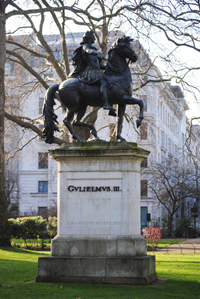
The gardens feature an equestrian statue of King William III at their centre (the work of John Bacon Sr and Jr, it was installed in 1808 and is pictured above). Other monuments include The Stag (located in the south-west corner, it is the work of Marcus Cornish and was installed in 2001) and, just outside the garden railings in the north-east corner, a memorial to WPC Yvonne Fletcher who was killed when a gun was fired from the Libyan Embassy (known as the Libyan People’s Bureau, it was located at number 5) during a demonstration on 17th April, 1984. The pavilion on the south side was designed by John Nash.

The gardens are private – managed by the St James’s Square Trust – but open to the public on weekdays from 10am to 4.30pm.

10 Historic London Garden Squares…1. Leicester Square…

In the first of a new Wednesday series looking at historic London garden squares, we take a look at what next to Trafalgar Square, is the most famous square in the entire city – Leicester Square.

Located in the heart of the West End, Leicester Square’s history finds its origins back in the 17th history when Robert Sidney, the 2nd Earl of Leicester acquired property on the site where the square now stands. Then known as St Martin’s Field and located within the parish of St Martin’s, Sidney purchased four acres in 1630 and constructed Leicester House on land now located at the square’s northern end.

Leicester-SquareThe earl raised the ire of locals, however, when – having subsequently fenced off the land to prevent people from wandering on to his property – he enclosed what had previously been common land.

The people appealed to King Charles I who appointed three members of the Privy Council to look at the issue. Their decision? That the earl keep a section of his land open for the use of the parishioners of St Martin’s.

First known as Leicester Field, it was this land which later became known as Leicester Square. Fine homes were built around the square (its proximity to the Royal Court and centre of government made it a desirable place to live for the well-to-do and those seeking influence) with the centre enclosed with rails (it’s pictured here in 1750).

The square’s reputation also had a royal boost when, in 1717/1718, Leicester House became home to Prince George (later King George II) and his wife Princess Caroline along with their court after the prince fell out with his father King George I and was banished from St James’ Palace (this story is recounted in marvellous detail in Lucy Worsley’s terrific book, Courtiers: The Secret History of the Georgian Court).

The prince remained at the house for 10 years and was proclaimed King George II after his father’s death at its gate. Interestingly, King George II’s eldest son, Prince Frederick, also lived here for a time after he too fell out with his father (King George II). Apparently their relationship was even worse than the previous generation’s had been.

Despite its royal attractions, even at this stage the square apparently had it’s darker side with some less than savoury characters attending the hotels and livery stables that were built there. But things were to get worse as the wealthy moved out – a situation not helped when Leicester House was demolished in the 1790s.

Leicester Square became known as an entertainment venue in the 19th century (among attractions was the short-lived Royal Panopticon of Science and Art which showcased the best in science and art and Wyld’s Great Globe which contained a gigantic model of the earth) and received a new injection of life when theatres and music halls moved in, bringing the crowds back with them.

Shakespeare-StatueMeanwhile, the status of the square – and whether it could be built upon – remained a matter of debate well into the 19th century. That ended in 1874 when businessman Albert Grant bought the freehold of the land, had the garden created upon it and then donated it to the Metropolitan Board of Works as a gift to the city.

Responsibility for the management of the square now rests with the City of Westminster. The square area – which is now known for hosting film premieres as well as the tourists who inevitably gather there – was pedestrianised in the 1980s and has just undergone a redevelopment and modernisation which was unveiled last year.

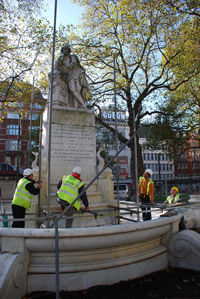
Meanwhile, work to restore the 19th century Shakespeare statue and fountain in the square’s centre is about to be completed (pictured). The square also contains a statue of actor Charlie Chaplin in the square as well as busts of scientist Sir Isaac Newton, painter and first president of the royal Academy Sir Joshua Reynolds, 18th century pioneer surgeon John Hunter, and painter William Hogarth.

The tradition of the entertainment continues in the modern era through the cinemas which now stand in the square and regularly host film premieres (an interesting, if oft-repeated, film-related anecdote connected to the square is that it was in a phone booth located at the square that during the 1960s a young actor Maurice Micklewhite saw a poster for The Caine Mutiny and decided to change his name to Michael Caine).

PICTURES (top) Wikipedia and (below) City of Westminster.

Where is it?…#61…

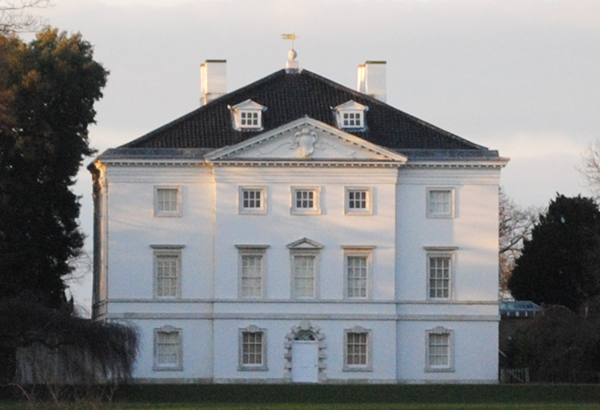
Where-is-it--#61Can you identify where in London this picture was taken and what it’s of? If you think you can, leave a comment below. We’ll reveal the answer early next week. Good luck!

Well done to Sue and Helen – this is, of course, Marble Hill House, located in south-west London on the banks of the River Thames between Richmond and Twickenham (this picture is taken from the opposite side of the Thames). Built for Henrietta Howard, mistress of King George II when he was Prince of Wales, for the lady in her “retirement” from court, the Palladian villa is set among 66 acres of parkland. We’ll look at the house in more detail in a later post.

WHERE: Marble Hill House, Richmond Road, Twickenham (nearest Tube station is Richmond (1 mile) or train station, St Margarets (0.5 mile)); WHEN: 10am-2pm Saturday, 10am to 5pm Sunday (cafe and park are open daily); COST: £5.70 adults/£5.10 concessions/£3.40 child (5-15 years); WEBSITE: www.english-heritage.org.uk/daysout/properties/marble-hill-house/.

Lost London – Mrs Salmon’s Waxworks…

Before Madame Tussaud arrived in London, there was Mrs Salmon and her famous waxworks, one of several such establishments in London.

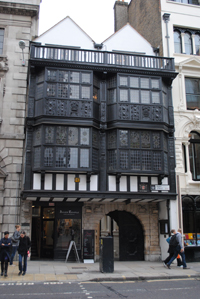
Prince-Henry's-RoomsFirst sited at the Sign of the Golden Ball in St Martin’s Le Grand – where it filled six rooms – in 1711, the display was relocated to the north side of Fleet Street where it remained until 1795 when it moved across the road to number 17 Fleet Street, now housing Prince Henry’s Room (pictured, room takes its name from Prince Henry, eldest son of the king, who died at the age of 18 and was apparently the inspiration for an inn which previously occupied the building called The Prince’s Arms).

The waxworks were apparently originally run by Mr Salmon – there are references to him being a “famous waxwork man” – but his wife, Mrs Salmon, continued it alone after his death in 1718 until her own death, variously said to have been in 1760 or as late as 1812. At some point after his death, Mrs Salmon is said to have remarried, to a Mr Steers.

Described in a handbill published soon after its initial move to Fleet Street, the exhibitions were said to include a scene of King Charles I upon the scaffold, another of the ill-fated Queen Boudicea, and more exotic tableaux including one showing Canaannite ladies offering their children in sacrifice to the god Moloch, another of a Turkish seraglio, and another of Margaret, Countess of Heningbergh with the 365 children she is said to have given birth to (all at once!). There was also a mechanised figure of the “famous English prophetess” Old Mother Shipton, who is said to have given a boot to visitors as they left.

While some accounts say the waxworks – which, according to the City of London website remained at the site until 1816 – were taken over by a Chancery Lane surgeon named Clarke after Mrs Salmon’s death (and by his wife after his death), it is also suggested that at some point they moved to Water Lane in east London where they were ruined by thieves.

Whatever its fate, it’s generally accepted that the famous waxworks were visited by the likes of James Boswell and artist William Hogarth. They were also mentioned by author Charles Dickens in David Copperfield. 

For more of London’s past, see Philip Davies’ Lost London 1870-1945.

Around London – Bedchamber secrets at Hampton Court; Roman remains at the British Museum; Easter chocolate at Kew Gardens; Harry Beck’s blue plaque; and, Underground art…

Happy Easter! We’re taking a break over the Easter weekend…Our next update will be on Tuesday, 2nd April.

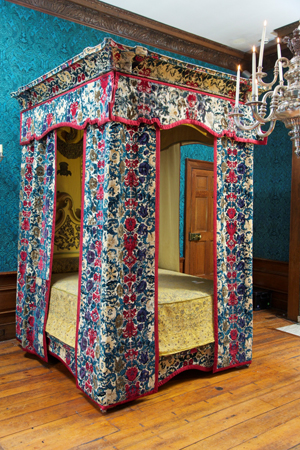
Mary-of-Modena's-bedA new exhibition exploring the secrets of the bedchambers of the Stuart and Hanoverian courts of the 17th and 18th centuries opened at Hampton Court Palace this week. At the heart of Secrets of the Royal Bedchamber are six royal beds which tell the story of why the bedchamber became the most important part of the palace and detail some of the events that took place there before an audience of courtiers, politicians and family members – from births and deaths to the consummation of marriages and the discussion of important affairs of state. It tells of why courtiers would fight for positions such as the ‘groom of the stool’ or ‘necessary woman’ and how beds which could cost the same as a London townhouse were sometimes never slept in. Among the beds on display is the ‘Warming Pan Bed’ (pictured), the State Bed of King James II’s queen, Mary of Modena, and scene of the royal birth that ultimately led to the end of the Stuart line, and the ‘Travelling Bed’ of King George II which travelled as far afield as Hanover and the battlefields of Europe. The exhibition also gives rare access into the Prince of Wales’ Apartments, designed by 17th and 18th architect Sir John Vanbrugh, and now open for the first time in 20 years.  Admission charge applies. Runs until 3rd November. For more, see www.hrp.org.uk. PICTURE: HRP

The Roman cities of Pompeii and Herculaneum are the subject of a major exhibition opening at the British Museum today. Life and death in Pompeii and Herculaneum brings together more than 250 objects from the two cities which were buried in just 24 hours during the eruption of Mount Vesuvius in 79 AD. The objects include celebrated finds and recent discoveries, many of which have never before been seen outside Italy, and help explore what daily life was like for the inhabitants. Artefacts include a beautiful wall painting from Pompeii showing baker Terentius Neo and his wife, wooden furnishings including a linen chest, inlaid stool, and even a baby’s crib from Herculaneum, and casts of victims including a family of four and a dog who died at Pompeii. Runs until 29th September. Admission charge applies. For more, see www.britishmuseum.org.

Find out more about the history of chocolate at Kew Gardens this Easter, from the ritualistic use of cacao in ancient Mayan and Aztec cultures to the arrival of chocolate in 17th century London, where it was a luxury item for high society to indulge in at newly fashionable chocolate houses. Running from tomorrow until 14th April, there will be a range of workshops taking place at the gardens around the chocolate theme along with a traditional Easter Egg Hunt on Easter Sunday (31st March). The garden’s cocoa tree can be found in the Princess of Wales Conservatory. Admission charge applies. See www.kew.org.

Harry Beck, designer of the innovative first diagrammatic Tube map, has been honoured by an English Heritage blue plaque – inscribed in the Underground’s new Johnston typeface – at his birthplace in Leyton in London’s east. Beck, who was born in a small terraced house at 14 Wesley Road in 1902, was working with London Transport as a draughtsman in the London Underground Serial Engineer’s Office, when, in 1931, he produced his first design for a diagrammatic map. He continued to update the map with new stations and lines even after leaving London Transport with the last version of his map published in 1960. Beck died in 1974. Meanwhile, a blue plaque commemorating railway engineer Sir Nigel Gresley (1876-1941) has been returned to King’s Cross station following the completion of building work. It can be found on platform 8. For more, see www.english-heritage.org.uk/discover/blue-plaques/.

On Now: The Underground. A commission from Art on the Underground, this exhibition of artist Mark Wallinger’s work at the Anthony Reynolds Gallery (60 Great Marlborough Street) features some examples of 270 labyrinth designs – one representing each of the Underground stations – which are being installed at the Tube stations themselves. Among those stations represented at this showing are Westminster, St James’s Park, Oxford Circus, Victoria, Embankment, Green Park, King’s Cross St Pancras, Baker Street and Tottenham Court Road. While labyrinths are already in place at these locations, the remainder of Wallinger’s labyrinth designs will be appearing at Tube stations over the coming months. Runs until 27th April. For more, see www.anthonyreynolds.com.