London Pub Signs – The Cutty Sark…

Cutty-Sark-pubAnother Greenwich pub whose name references an aspect of maritime history (see our previous posts on the The Gipsy Moth and the Trafalgar Tavern), this riverside establishment takes its name from a former tea clipper (which, not coincidentally, is on display nearby).

The clipper Cutty Sark was constructed in Dumbarton in 1869 to facilitate the transport of tea from China to Britain in as short a time span as possible. It made its maiden voyage the following year and but only ended up working the tea route for a few years before being used to bring wool from Australia.

Later sold to a Portuguese company, the vessel continued to be used as a cargo ship until she was sold in 1922 and used as training ship, first in Cornwall, and later at Greenhithe in Kent.

In 1954, the vessel found a new permanent dry dock at Greenwich and was put on public display. Damaged by fire in 2007, the ship underwent extensive restoration and is now displayed in a state-of-the-art purpose-built facility which allows you to walk underneath the vessel.

The three level Cutty Sark pub, located at 4-6 Ballast Quay (formerly known as Union Wharf), features a Georgian-style bow windows on the first and second floors (the first floor is home to the Willis Dining Room which has great views of the Thames).

The present Grade II-listed building apparently dates from the early 19th century (although the sign out the front suggests 1795 and it’s been suggested the building was substantially altered in the mid-19th century) but there is evidence of a public house on the location by the early 18th century.

Known at one stage at the Green Man, in 1810 it became the Union Tavern – a reference, apparently, to the union of England and Ireland which took effect in 1801. It took its current name after the Cutty Sark arrived in Greenwich in the 1950s.

For more on the pub, see www.cuttysarkse10.co.uk. For more on the ship, see www.rmg.co.uk/cutty-sark.

Lost London – The Hindoostanee Coffee House…

Hindoostane_Coffee_House_(7599806070)Described as the first dedicated Indian restaurant in Britain, the Hindoostanee (also spelt Hindoostane) Coffee House was established by Dean Mahomet (later Sheikh or ‘Sake’ Dean Mahomet), an Indian who served with the East India Company Army before coming to Britain.

Accompanying East India Company man Godfrey Baker to Ireland, he lived initially with the Baker family before meeting and marrying a young woman while learning English and subsequently establishing his own household in Cork.

In 1794, he published a book, The Travels of Dean Mahomet, which, written as a series of letters to an imaginary friend, described his own life and Indian customs. It is credited as the first book to be written and published in English by an Indian.

Around 1807, he and his wife and son moved to London where he initially found employment with Sir Basil Cochrane at a “vapour spa” Sir Basil had established in Portman Square. While Mahomet introduced Indian innovations such as “shampooing” to the spa, he was given little credit for his work, however, and so decided to break out on his own.

In 1810, he set-up the coffee house at 34 George Street, Portman Square, just behind Sir Basil’s house.

The establishment was aimed at Anglo-Indians who had spent time in India and offered them Indian-style foods – such as curries and spiced dishes – along with other reminders of the sub-Continent such as a room set up for the use of the hookah with “real Chilm tobacco”  – all in an Indian-style setting.

Sadly, the establishment was only rather short-lived and, despite taking on a partner, Mahomet was forced to declare bankruptcy in 1812. But he did go on to establish a very successful Indian-style baths in Brighton, Mahomet’s Baths (and later even opened a second branch in St James’s London which would be managed by his son).

A plaque was erected by the City of Westminster close to the site of the former coffee house in 2005.

PICTURE: Simon Harriyott from Uckfield, England [CC BY 2.0 (http://creativecommons.org/licenses/by/2.0)%5D, via Wikimedia Commons.

10 iconic London film locations…5. Belle at Kenwood House (but not as you know it)…

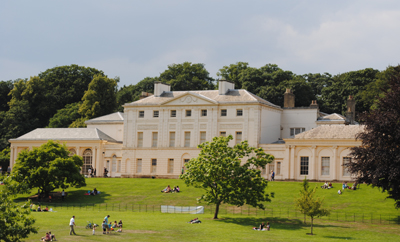
Kenwood-HouseThis is the case of a movie stand-in. While Kenwood House on Hampstead Heath in north London (pictured above) was the real life home of late 18th century figure Dido Elizabeth Belle, the subject of the 2014 Amma Asante-directed film Belle – the movie wasn’t actually shot there.

Thanks to the fact that parts of Kenwood House – in particular the famed Robert Adam interiors – were undergoing restoration at the time, the scenes representing the home’s interiors were instead shot at three other London properties – Chiswick House, Syon Park and Osterley Park, all located in London’s west (West Wycombe Park in Buckinghamshire, meanwhile, was used for the exterior).

While some other scenes were also filmed in London – Bedford Square represented Bloomsbury Square where the London home of Lord Mansfield was located, for example, other locations were also used to represent London – scenes depicting Kentish Town, Vauxhall Gardens and the bank of the River Thames were all actually shot on the Isle of Man, for example.

When the real life Belle – the illegitimate mixed race daughter of an English naval captain who was raised by her great-uncle William Murray, Lord Mansfield (she was played by Gugu Mbatha-Raw in the film; Lord Mansfield by Tom Wilkinson)  – is believed to have lived at Kenwood, it was the weekend retreat of Lord Mansfield, then Lord Chief Justice of England (for more on her life, see our previous post here).

Interestingly, the property was also once home to a 1779 painting (previously attributed to Johann Zoffany but now said to be “unsigned”) which depicts Belle and which was apparently the inspiration for the movie. While a copy of the painting still hands at Kenwood, the original now lives at Scone Palace in Scotland.

For more on Belle’s story, see Paula Byrne’s Belle: The True Story of Dido Belle.

What’s in a name?…Camden Town…

Camden-Lock

As with so many London locations, the name Camden Town comes from a previous landowner – but more indirectly it originates with the great 16th and 17th century antiquarian and topographer William Camden.

The story goes like this: late in his life William Camden – author of Britannia, a comprehensive description of Great Britain and Ireland – settled near Chislehurst in Kent on a property which became known as Camden Place.

In the 18th century, the property came into the possession of Sir Charles Pratt, a lawyer and politician (among other things, he was Lord Chancellor in the reign of King George III), who was eventually named 1st Earl of Camden.

It was Pratt who, having come into the possession of the property by marriage, in about 1791 divided up land he owned just to the north of London (which has apparently once been the property of St Paul’s Cathedral) and leased it, resulting in the development of what became Camden Town (Pratt, himself, meanwhile, is memorialised in the name of Pratt Street which runs between Camden High Street and Camden Street).

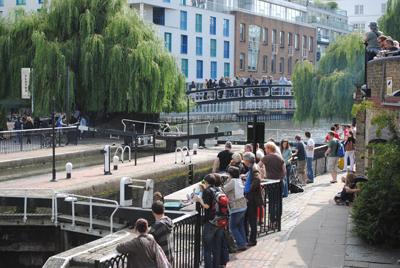
In 1816, the area received a boost when Regent’s Canal was built through it – the manually operated, twin Camden Lock is located in the heart of Camden Town.

Although it has long carried a reputation of one of the less salubrious of London’s residential neighbourhoods (a reputation which is changing), Camden Town is today a vibrant melting pot of cultures, thanks, in no small part, to the series of markets, including the Camden Lock Market, located there as well as its live music venues.

Past residents have included author Charles Dickens, artist (and Jack the Ripper candidate) Walter Sickert, a member of the so-called ‘Camden Town Group’ of artists, and, in more recent times, the late singer Amy Winehouse.

Of course, the name Camden – since 1965 – has also been that of the surrounding borough.

Lost London – The King’s Mews at Charing Cross…

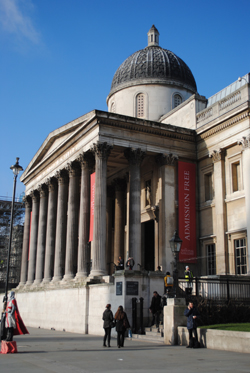
National-Gallery2The Royal Mews – a stables and carriage house – is these days located at Buckingham Palace but prior to being moved there, the Royal Mews, previously usually referred to as the King’s and Queen’s Mews depending who was on the throne, was located on the site where the National Gallery (pictured) and Trafalgar Square now stand.

The name ‘mews’ actually refers to the fact that, from at least the reign of King Richard II in the late 14th century (although official records suggest there may have been a mews on the site as far back as the reign of King Edward I), the royal hawks were initially housed on the site – then in the village of Charing Cross – (the word ‘mew’ refers to the moulting of the birds and originally referred to when they were confined here for that purpose but later come to simply mean the place were the birds were caged).

The title of Keeper of the King’s Mews became a sought-after honour during the 15th century (although largely honorary with the actual work done by deputies) but among those who held the honour were Richard Neville, Earl of Warwick, known, during the Wars of the Roses as the ‘Kingmaker’.

In 1534, the King’s Mews was destroyed by fire and when it was rebuilt a few years later, it took the form of a stable but kept the original name of mews (although it has been suggested the change of use took place before the fire).

During the Civil War, the Mews were apparently used as a prison by the Parliamentarians for captured Royalists and during the Commonwealth, soldiers were apparently quartered here. Diarist Samuel Pepys also apparently visited several times.

In 1732 the building was again rebuilt, but this time it was to the grand designs of William Kent – images show a grand building with turrets and a great open square before it. In the 1760s, King George III had some of his horses and carriages moved to facilities on the grounds of Buckingham Palace (he had purchased this from the Duke of Buckingham for his wife’s use) but the bulk remained on the Charing Cross site.

In the early 19th century they were opened to the public but in the 1820s, King George IV – making Buckingham Palace his main residence – had the entire stables moved (the Royal Mews which now stand at Buckingham Palace were designed by John Nash and completed in 1825).

The old mews were subsequently demolished and Trafalgar Square – another Nash design – built on the site between 1827 and 1835 while the National Gallery opened in 1838.

A Moment in London’s History – ‘The London Gazette’ first published 350 years ago…

The-London-Gazette

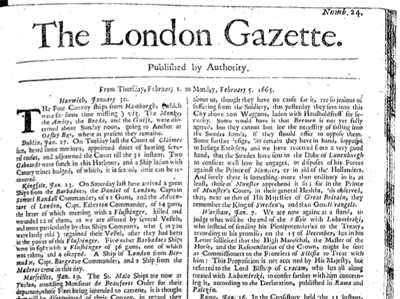
An official public record of the British Government, The London Gazette, initially known as The Oxford Gazette, was first published on 7th November, 1665. 

But its publication didn’t take place in London – rather it was in Oxford (hence its being initially named – The Oxford Gazette) where King Charles II, having fled London due to the plague, ordered the publication to be printed at the University Press.

There’s several reasons behind its publication – one is that courtiers were apparently so worried about the plaque they didn’t even want to touch newspapers from London for fears of contagion of the plaque. But there was also a need, amid the swirl of rumours, gossip and sensationalism found in other publications, for a reputable publication of record (not the least because the introduction of censorship a few years before had suppressed other publications).

Published for the first couple of months under its Oxford masthead, it wasn’t until the following year – on 5th February, 1666 – that the gazette was first published in London (issue 24) after the royal court’s return.

The gazette had unparalleled access to government information – including reports from foreign embassies about what was happening abroad (important when news from overseas was limited), and official reports, including those ‘Mentioned in despatches’ from the War Office and Ministry of Defence.

Adopting the same model, official government gazettes followed in the coming years in Edinburgh (1699) and Dublin (1706 – later The Belfast Gazette). All three, from 1889, were published by Her Majesty’s Stationery Office. Today, The Gazette is published by The Stationary Office (TSO), on behalf of The National Archives (and is now online as well as in print).

Initially published only a couple of days a week, it is now published every weekday except on Bank Holidays.

Notable events published in The London Gazette include the Great Fire of London in 1665 (issue 85), the founding of the Bank of England in 1694 (issue 2982), the burial of Sir Isaac Newton in 1727 (issue 6569), the announcement of the American Declaration of Independence in 1776 (issue 11690), the outcome of the Battle of Waterloo in a “Gazette Extraordinary” in 1815 (issue 17028), and the Coronation of Queen Elizabeth II in 1953 (Supplement 40020).

You can see The London Gazette today and back issues as well as to order commemorative editions, head to www.thegazette.co.uk.

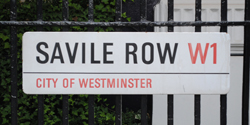
What’s in a name?…Savile Row

Famous around the world as the home of bespoke tailoring in London, Savile Row owes its name – like so many other streets in Mayfair – to landowner Richard Boyle, the 3rd Earl of Burlington.

Savile-RowBurlington (1612-98) resided at Burlington House (now home of the Royal Academy of Arts) on Piccadilly and after his death the land around his former home was developed and the streets named for Burlington and members of his family.

Among them was his wife, Lady Burlington, née Lady Dorothy Savile, after whom Savile Row was named. Laid out in 1695, the street was actually located on the site of the former kitchen gardens of Burlington House and was given its name (originally Savile Street) in the 1730s.

The first to reside here were apparently mostly military and politicians (these included PM William Pitt the Younger) and it was only in the early 19th century that the first tailors started to set up shop here. With clients including society dandy Beau Brummell (see our our earlier post here) and the Prince Regent (later King George IV), the street’s fame grew rapidly and continued into the 20th century when customers included some of the biggest names in Hollywood – Cary Grant, Bing Crosby and Frank Sinatra among them.

Among the famous tailoring firms still operating in Savile Row are Anderson & Sheppard (at number 30, it’s where the Prince of Wales has his suits made), Henry Poole (at number 15, Victorian-era owner Henry Poole is credited as the inventor of the tuxedo), and Hardy Amies.

Headquartered at number 14 (with a shop at number 8), Amies gained an international reputation when appointed dressmaker to Queen Elizabeth II in 1955/the address was previously owned by the playwright Richard Brinsley Sheridan and was also the address Jules Vernes gave Phileas Fogg in Around the World in Eighty Days).

One last tailor worth a particular mention is that of Tommy Nutter, who set up shop at number 35 in the late Sixties with a nameplate out front simply reading Nutters and shocked traditionalists with his modern take on tailoring – this modern approach continues among some tailors in the street even today.

The street also has a famous claim in the story of the Beatles – the moved their company Apple Corps Company into number 3 in July, 1968, and it was on the roof of this building that they played their last live gig on 3rd January, 1969.

10 London ‘battlefields’ – 8. The Gordon Riots…

Well, not so much a battle as a widespread civil insurrection, the Gordon Riots, often described as the worst riots London has ever seen, resulted in considerable property destruction and numerous deaths.

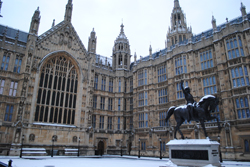
Houses-of-Parliament10The riots, which took place against a backdrop of high taxation, widespread poverty, and unjust laws, had its origin in the passing of the Catholic Relief Act of 1778 which intended to reduce entrenched discrimination against Roman Catholics in Britain and redress some of anti-Catholic laws which had been introduced 80 years earlier, partly in an attempt to get more Catholics to join the British Army to fight against the United States of America in what’s now known as the War of Independence.

While it initially passed without any real hostility, an attempt to extend the Act’s provisions to Scotland in 1779 provoked such a serious response there that the action was withdrawn. Following the Scottish success in having the provisions withdrawn, the Protestant Association of London was founded with the aim of spear-heading opposition to the act’s provisions. Lord George Gordon was elected president of the newly formed Protestant Association of London in November of that year.

Following failed attempts to have King George III repeal the Act (Lord Gordon had several audiences with the King but failed to convince him of his case and was eventually banned from His Majesty’s presence), on 2nd June, 1780, Gordon and the members of the association marched on the Houses of Parliament (pictured above although the current buildings date from much later than these events) to deliver a petition demanding the Act be repealed.

They crowd, estimated to have been as big as 60,000 strong although a figure in the mid-40,000s is generally accepted, attempted unsuccessfully to force their way into the House of Commons before Lord Gordon, wearing a blue cockade (the symbol of the Protestant Association in his hat) was granted access to deliver the document.

Outside, meanwhile, things went from bad to worse and the crowd erupted into rioting, attacking members of the House of Lords, including bishops, as they attempted to enter and damaging carriages (including that of Lord Chief Justice William Murray, 1st Earl of Mansfield). Soldiers were eventually summoned to quell the riot which they did without violence. Inside, the members of the House of Commons voted down the petition by an overwhelming majority.

That night violence flared up again with the Roman Catholic Sardinian Embassy Chapel in Lincoln’s Inn Fields set alight while the chapel of the Bavarian Embassy in Golden Square, Soho, was destroyed and random violence carried out in streets known to be the residence of wealthy Catholics.

The next day, a crowd gathered in Moorfields – known to be home to many poor Irish Catholic immigrants – and that night attacked many homes.

The violence spread over the following days and among the buildings attacked was Newgate Prison (which was set on fire), the Fleet Prison, and the Clink in Southwark – hundreds of prisoners escaped – as well as Catholic churches, more embassy chapels, homes of known Catholics and politicians who had been associated with the passing of the act (including that of Lord Mansfield and Sir George Savile, who had proposed the Catholic Relief Act) and the Bank of England (the attack on the bank led to the long-standing tradition of soldiers guarding the bank).

Without a standing police force to tackle the mobs, on 7th June the army was called out with orders to fire on groups of four or larger who refused to disperse. In the next few days, well over 200 people (possibly more than 300) were shot dead and hundreds more wounded. Hundreds of the rioters were arrested and, of those, about 25 eventually executed. Gordon himself was arrested and charged with high treason but found not guilty.

What’s in a name?…Harley Street…

A Marylebone street which is synonymous the world over with the private medical profession, Harley Street’s name is taken from the surname of the second Earl of Oxford, Edward Harley.

Harley-StreetHis Lordship, who lived between 1689 and 1741, was a land developer and was responsible for the development of land north of Oxford Street in the early 18th century.

As was the fashion, he named Harley Street after himself – but it’s certainly not the only street  which he dubbed with his own moniker. The earl also held the titles of Earl Mortimer (Mortimer Street) and Baron Wigmore (Wigmore Street, Wigmore Place and hence the music venue Wigmore Hall) and also came to own Wimpole Hall in Cambridgeshire (Wimpole Street) and Welbeck Abbey in Northamptonshire (Welbeck Street and Welbeck Way).

But the ties to the earl don’t end there: in 1713 he married Lady Henrietta Cavendish Holles (Henrietta Place, Cavendish Square, New Cavendish Street and Holles Street) while their daughter Margaret married William Bentinck (Bentinck Street), the 2nd Duke of Portland (Great Portland Street, Little Portland Street and Portland Place).

Incidentally, after the earl’s death, the area passed to his daughter and become known as the Portland Estate. It remained the property of the Dukes of Portland for five generations until the fifth duke died without issue in 1879 and the land passed to Lucy Joan Bentinck, widow of the 6th Baron Howard de Walden. Thus Harley Street now forms part of a 92 acre area known as the Howard de Walden Estate.

But back to Harley Street itself. Its association with the private medical profession dates from the latter half of the 19th century when there was a dramatic increase in the number of those engaged in the profession moving into the area, attracted by its quality housing and accessibility (the numbers still remain significant today). The name Harley Street today refers to both the street and also more generally to the surrounding area.

The long list of famous residents who have lived in the street have included painter JMW Turner (number 64 between 1799 and 1805), Victorian-era PM William Ewart Gladstone (number 73 and geologist Sir Charles Lyell also lived here in a premises which is now The Harley Street General Practice) and, made famous through the film, The King’s Speech, Australian speech therapist Lionel Logue who had his practice at number 146.

Treasures of London – Royal Charter for the Society of Artists in Great Britain……

RA-Charter-10

The Charter for the Society of Artists of Great Britain and its associated Roll of Obligation have been rediscovered at the Royal Academy of Arts, 250 years after was society was founded. The documents, long thought to have been missing, date from 1765 and signify the formation of artists as a professional group in Britain. They form a crucial piece in history of the development of the Royal Academy of Arts, which formed in 1768 when a group of artists broke away from the society. The Charter, which consists of three pages of vellum with a portrait of a young King George III, hadn’t been seen since 1918. It and the Roll of Obligation – which features the crossed-out names of artists ‘expelled’ from the society, including the RA’s first president, artist Joshua Reynolds and German-born Johann Zoffany – were rediscovered earlier this year during an audit of the RA collections. The finding coincides with the 250th anniversary of the formal foundation of the society when it was granted a Royal Charter by King George III. Both documents will go on show from 2018 – the 250th anniversary of the founding of the RA – in new exhibition areas being created as part of the transformation taking place at the RA. For more on the Royal Academy, see www.royalacademy.org.uk.

LondonLife – An illuminated Christmas at Kew…

Kew-GardensIt was Queen Charlotte who first dressed the branches of a Christmas tree in Kew Palace in the 1790s and, drawing on that tradition, Kew Gardens is once again hosting a mile long winter light experience. Visitors can walk through ribbons of light, count the festooned Christmas trees and listen to a holly bush choir as well as see larger than life winter flora such as snowdrops and Christmas roses and pause at the scented Fire Garden for a moment of reflection. Santa and his elves are appearing on stage at the Princess of Wales Conservatory and a Victorian carousel and other rides are located at the White Peaks Cafe where visitors can sample goodies like mulled wine, spiced cider and roasted chestnuts.  The after-dark event runs from 5pm to 10pm on select dates until 2nd January. Admission charge applies. For more, see www.kew.org. PICTURE: The Palm House at Kew Gardens lit up for Christmas. Courtesy Kew Gardens.

This Week in London – Alice in Wonderland’s 150th; Remembering Julia Margaret Cameron; and, Imperial Britain’s artistic influence…

John-Tennial-illustrationA new exhibition has opened at the British Library in Kings Cross to mark the 150th anniversary of the publication of Alice’s Adventures in Wonderland. The free exhibition explores the story of how the tale came to be written and features Lewis Carroll’s handwritten manuscript of Alice’s Adventures Under Ground (complete with 37 illustrations by Carroll) as well as an entry from Carroll’s diary in which he relates how he first came to tell the story to Alice Liddell and her sisters on the “golden afternoon” of 4th July, 1862. Other highlights include two first editions of Alice’s Adventures in Wonderland with illustrations by Sir John Tenniel (including the suppressed first edition; suppressed because Carroll and Tenniel were unhappy with the quality of the illustrations), the first movie adaption of the story – a 1903 silent film, early Alice memorabilia, and three new computer game concepts. The exhibition, which runs until 17th April, is accompanied by a series of events and a pop-up shop. For more, see www.bl.uk/events/alice-in-wonderland-exhibition. PICTURE: Sir John Tenniel’s illustration of Alice and the Cheshire Cat from the 1866 edition of Alice’s Adventures in Wonderland by Lewis Carroll © The British Library Board.

An exhibition featuring more than 100 photographs by celebrated 19th century photographer Julia Margaret Cameron opens at the V&A on Saturday to mark the bicentenary of her birth. The display at the South Kensington museum offers a retrospective of her work and looks at her relationship with the V&A’s founding director Sir Henry Cole who presented the only exhibition of her work during her lifetime in 1865. Her relationship with the museum goes back to the very start of her work – within two years of being given a camera by her daughter she was selling and giving photographs to what was then the South Kensington Museum while, in 1868 she was granted the use of two rooms at the institution to use as a portrait studio, becoming the museum’s first artist-in-residence. The exhibition features original prints acquired from Cameron as well as a selection of her letters to Cole, his 1865 diary, the first photograph identified as being of her studio and a variety of her portraits in which family, friends and servants posed as characters from Biblical, historical and allegorical stories. The free exhibition runs until 21st February. For more, see www.vam.ac.uk/juliamargaretcameron.

The influence of the British Empire on art over the past 400 years is the subject of a new exhibition which opened in Tate Britain’s Linbury Galleries yesterday. Artist and Empire will showcase art from across the empire – including the British Isles, North America, the Caribbean, the Pacific, Asia and Africa – and features some 200 paintings, drawings, photographs, sculptures and artefacts. These include paintings by the likes of George Stubbs and Anthony Van Dyck through to Indian miniatures, Maori objects, and the works of contemporary artists such as Sonia Boyce and Judy Watson. Runs until 10th April at the Milbank gallery. The exhibition is free. For more, see www.tate.org.uk.

Send all items for inclusion to exploringlondon@gmail.com.

10 small, ‘secret’ and historic gardens in central London…10. Geffrye Museum Gardens…

Geffrye-Garden

We’ve mentioned the Geffrye Museum gardens before but they’re well worth a more detailed mention.

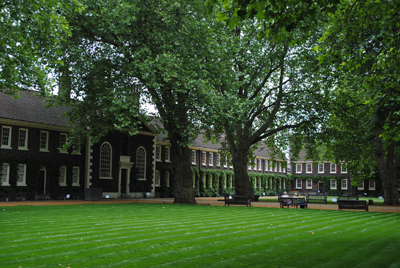
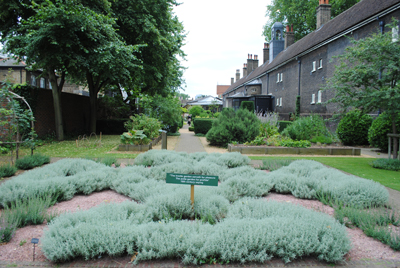
There are two distinct gardens at the Geffrye – the first are the public gardens located just off Kingsland Road which were originally laid out when the almshouses in which the museum is now based were constructed while the second is the walled herb garden and series of period garden ‘rooms’ which are much more recent additions.

While origins of the former date back to when the almshouses – 14 homes of four rooms each with a central chapel – were built in 1712-14 by the Ironmonger’s Company under instructions in the will of Sir Robert Geffrye (for more on him, see our earlier Famous Londoners entry here), they weren’t opened to the public until 1912 when the London County Council took over the site (for more on the history of the almshouses, see our earlier entries here and here).

These gardens originally featured a series of lime trees and by the early 19th century, an image shows lawns surrounded by railings with some flower beds and trees. The front lawns were apparently grazed by sheep or employed for growing crops of potatoes.

By the mid-1800s, the lime trees had been replaced by London plane trees, most of which are still standing. The gardens were again laid out in 1900-01 and again after the LCC took over in 1910 when a small pool was added in front of the chapel and a bandstand and playground elsewhere in the gardens.

The grounds also include a small graveyard – that of the Ironmongers’ – and among those buried here are Geffrye and his wife, their remains brought here from the chapel of St Dionis Backchurch in Lime Street when it was demolished in 1878.

The walled herb garden and period garden ‘rooms’, meanwhile, were added in the 1990s. The herb garden opened in 1992 on a what had been a derelict site to the north of the building – it features four square beds containing more than 170 different herbs and plants.

The period garden ‘rooms’, meanwhile, were laid out in 1998 to showcase middle class town gardens from different eras. They currently include a Tudor “knot garden”, a Georgian garden, a Victorian garden and an Edwardian garden.

Each of these gardens has been carefully constructed using evidence gathered from drawings and prints, maps and garden plans along with plant lists, diaries and literature.

WHERE: Geffrye Museum, 136 Kingsland Road, Shoreditch (nearest tube station is Old Street; nearest Overground station is Hoxton); WHEN: 10am to 5pm, Tuesday to Sunday (front gardens are open all year round by period and herb gardens are only open until 1st November and reopen on 28th March; COST: Entry is free; WEBSITE: www.geffrye-museum.org.uk/explore-the-geffrye/explore-gardens/.

The-Knot-Garden

10 small, ‘secret’ and historic gardens in central London…9. Garden of Rest, Marylebone…

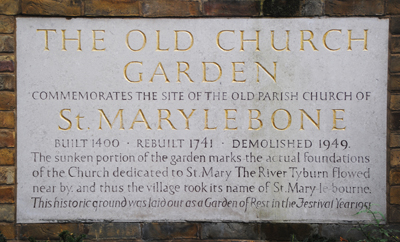
Marylebone2This pocket park is another of those located on the site of a former church – in this case the Marylebone Parish Church which now stands to the north.

The church – the third to serve the parish – was built here in 1740 but was replaced when the current parish church was built between 1813 and 1817.

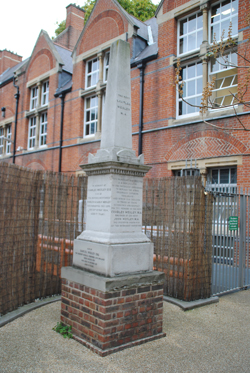
Wesley-MonumentThe former church didn’t close until 1926, however, continuing use as a parish chapel, and even then wasn’t demolished until 1949  after it was damaged by bombing during World War II.

In 1951, the St Marylebone Society created a Memorial Garden of Rest on the site (also known as the Old Church Garden). It was opened in March, 1952, by Viscount Portman.

The foundations of the former church were marked out in the sunken portion of the garden. The predominantly paved garden also contains numerous gravestones and memorials.

These include that of Methodist movement leader Charles Wesley, erected in 1858 to commemorate his burial in 1788 (pictured right). There’s also a plaque recording notable burials at the church, including the painter George Stubbs (1806), royal apothecary John Allen (1774), architect James Gibbs and bare knuckle boxer James Figg (1734). Other plaques detail some of the church’s history.

Also of note in the garden is a Judas tree (Cercis siliquastrum), named for being the variety upon which Judas hung himself or, alternately, because its fruit pods resemble bags of silver. The current tree replaces an earlier one.

WHERE: Garden of Rest Marylebone, Marylebone High Street (nearest tube stations are St Paul’s and Barbican); WHEN: 7am to dusk; COST: Entry is free; WEBSITE: www.myparks.westminster.gov.uk/parks/garden-of-rest-marylebone/.

What’s in a name?…Kew…

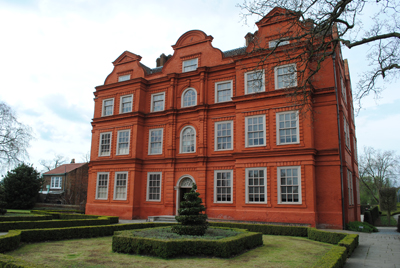
Kew-PalaceFamed as the location of the Royal Botanic Gardens, Kew is a Thames-side suburb in London’s west.

It’s the riverside location which gives the area its name – Kew is apparently a corrupted form of Cayho, a word first recorded in the early 14th century which is itself made of two words referring to a landing place (the ‘Cay’ part) and a spur of land (the ‘ho’ part). The latter may refer in this case to the large “spur” of land upon which Kew is located, created by a dramatic bend in the Thames. The former may refer to a ford which crossed the river here (explaining the name of Brentford on the other side).

While the area had long been the home of a small hamlet for the local farming and fishing community, more substantial houses began to be developed in Kew in the late 15th and early 16th centuries thanks to the demand for homes for courtiers attending the King Henry VII and his successors at nearby Richmond Palace (the royal connections of the area in fact go back much further to the early Middle Ages).

But it was during the Georgian era, when the Royal Botanic Gardens were founded and Kew Palace, formerly known as the Dutch House, became a royal residence (it is pictured above), that Kew really kicked off (and by the way, Kew Palace is not the only surviving 17th century building in the area – West Hall, once home of painter William Harriot, is also still here).

While King George II and his wife Queen Caroline used Richmond Lodge, now demolished but then located at the south end of what is now the gardens, as their summer residence, they thought Kew Palace would make a good home for their three daughters (their heir, Frederick, Prince of Wales, lived opposite his sisters at the now long-gone White House). Kew Palace, meanwhile, would later be a residence of other members of the Royal Family as well, including King George III during his bouts of madness.

Other buildings of note from the Georgian era in Kew include Queen Charlotte’s Cottage, a thatched property built between 1754 and 1771 and granted to Queen Charlotte by her husband, King George III (like the palace, it now lies within the grounds of Kew Gardens). St Anne’s Church, located on Kew Green, dates from 1714 and hosts the tombs of artists Johann Zoffany and Thomas Gainsborough.

In 1840, the gardens which surrounded the palace were opened to the public as a national botanic garden and the area further developed with the opening of the railway station in 1869, transforming what was formerly a small village into the leafy largely residential suburb which we find there today (although you can still find the village at its heart).

As well as Kew Gardens (and Kew Palace), Kew is today also the home of the National Archives, featuring government records dating back as far as 1086.

LondonLife – Kenwood’s architect James Adam rediscovered…

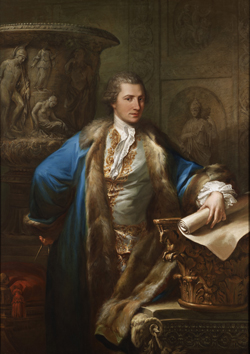
Antonio-Zucchi-'Portrait-of-James-Adam'-Credit---Adam-Williams-Fine-Art-LtdA painting of James Adam, unseen for almost 150 years, has gone on show at Kenwood House in London’s north.

Antonio Zucchi’s Portrait of James Adam, dating from 1763, depicts Adam who, along with his brother Robert, created the splendid villa which now sits on the northern edge of Hampstead Heath between 1767 and about 1779.

The Adams’ first encountered Zucchi while on a “grand tour” in Italy and engaged him as their draughtsman, recording what they were seeing.

They subsequently had him decorate ceilings and walls at Kenwood and his signature was also recently discovered on the painting of Adam – the only known portrait the artist completed – after it was cleaned.

The painting depicts Adam as both architect and “man of fashion” and shows his interest in classical statues and ornamentation, showing the famous Medici vase in the background.

The painting hadn’t been seen by the public since 1867. The painting, loaned to English Heritage – managers of Kenwood House – by Adam Williams Fine Art Ltd in New York, can be seen until 4th January.

WHERE: Kenwood House, off Hampstead Lane, Hampstead Heath (nearest Tube stations are Golders Green and Archway/nearest rail is Gospel Oak and Hampstead Heath); WHEN: daily, 10am to 5pm; COST: Free; WEBSITE: www.english-heritage.org.uk/kenwood

PICTURE: Adam Williams Fine Art Ltd.

London Pub Signs – The Mawson Arms/The Fox and Hounds…

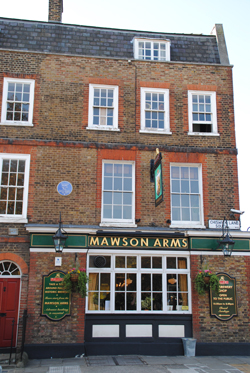
This curiously named Chiswick institution, one of few pubs in England with two names, owes its existence to the brewery located next to the terraces in Mawson Row.

Mawson-ArmsThomas Mawson founded the brewery on the site in the late 1600s/early 1700s and it eventually became what is now known as Fuller’s Griffin Brewery located a few doors down from the pub.

The Grade II*-listed building in which the pub is located dates from about 1715 when the terrace of five houses was constructed for Mawson.

The 18th century poet Alexander Pope was among residents at number 110 (between 1716-1719, when he published his translation of The Iliad and his first collected works). A function room in the pub now bears his name and there’s a blue plaque mentioning his stay on the outside.

While there had long been a pub here called the Fox and Hounds, in the late 19th century, the old pub was extended into the corner building and gained its second name, The Mawson Arms.

The pub, only a short walk away from the Thames, now serves as the starting point for a tour of the brewery. It’s traditionally been a favoured watering hole of brewery workers.

For more, see www.mawsonarmschiswick.co.uk.

This Week in London – Party like a Georgian; a playground with a history; and, a Dickens whodunnit…

Kensington-Palace• Join the Georgian Queen Caroline for a garden party in the grounds of Kensington Palace this weekend. The Georgian Court will be taking to the palace gardens for a summer celebration featuring music, military drills and theatre as they bring the era to life. Visitors are encouraged to immerse themselves in the experience as a courtier with the gardens decked out in a range of tents where they can try out costumes and powdered wigs as well as learn court etiquette, swordplay and dancing while the ice-house will feature Georgian ice-cream (and it’s rather odd flavours such as parmesan). Runs from tomorrow until Sunday. Admission charges apply (under 16s go free with a maximum of six children per paying adult). For more, see www.hrp.org.uk/KensingtonPalace/. PICTURE: ©Historic Royal Palaces

First created in 1923, a playground in Victoria Tower Gardens – newly named the Horseferry Playground – has been reopened after improvement works. The works, carried out under the management of Royal Parks, have seen the reintroduction of a sandpit as well as the installation of new swings and slide, dance chimes and a stare play installation to represent the River Thames. The playground, located close to the Houses of Parliament in Westminster, also features a series of timber horse sculptures, new seating and a refreshment kiosk with metal railings designed by artist Chris Campbell depicting events such as the Great Fire of London and Lord Nelson’s funeral barge and views of the River Thames. The project has also seen the Spicer Memorial, commemorating role of paper merchant and philanthropist Henry Spicer in the establishment of the playground – then just a large sandpit, restored. For more, see www.royalparks.org.uk/parks/victoria-tower-gardens.

Now On – A Dickens Whodunnit: Solving the Mystery of Edwin Drood. This temporary exhibition at the Charles Dickens Museum in Bloomsbury explores the legacy of Dickens’ final novel The Mystery of Edwin Drood, left unfinished after his death in 1870. Visitors are able to investigate crime scenes, search for murder clues and see the table on which the novel was penned as well as clips from theatrical adaptations, and a wealth of theories on ‘whodunit’. The exhibition runs until 11th November. Admission charge applies. For more, see www.dickensmuseum.com.

Send all items for inclusion to exploringlondon@gmail.com.

Treasures of London – Daniel Defoe grave memorial, Bunhill Fields…

Daniel-Defoe-memorial2
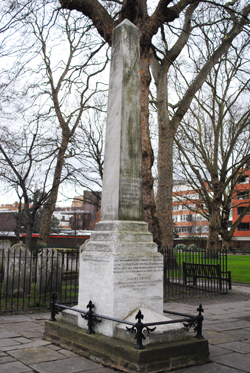
Located in Bunhill Fields Burial Ground in City Road, this memorial to Daniel Defoe, the author of numerous books including Robinson Crusoe and Moll Flanders as well as a journalist, pamphleteer and ‘provocateur’ or spy, wasn’t erected until 1870, almost 140 years after his death.

After he died in 1731 at the age of 70, Defoe was among the more than 120,000 people buried in Bunhill Fields, a Nonconformist cemetery which opened in 1665 and had closed by 1853. He was apparently buried under the name Dabow, thanks to a spelling mistake made by the gravedigger.

Daniel-Defoe-memorialWhen he died in relative obscurity (he was believed to have been hiding from his creditors at the time), his fame rose after his death – due in large part to the rising popularity of Robinson Crusoe, and by the mid-19th century, it was believed that the simple headstone over his grave didn’t do justice to him.

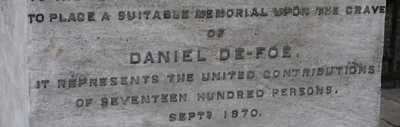
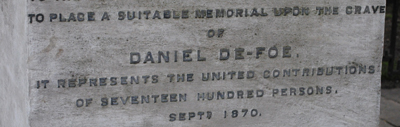
Hence an appeal was run by children’s magazine Christian World for a more suitable memorial for the writer – named as Daniel De-Foe on the memorial – and more than £150 was raised from 1,700 people, an amount which apparently exceeded expectations.

Sculptor Samuel Horner was subsequently commissioned to carve the memorial obelisk, which features projections at the base resembling a coffin lid, to the designs of CC Creeke of Bournemouth. It was unveiled on 16th September, 1870, in a ceremony attended by three of Defoe’s great grand-daughters.

There was apparently a newspaper story that the sculptor uncovered a coffin bearing Defoe’s name in preparing the site for the monument and had to get the aid of police to prevent watchers from making off with the bones from within.

The monument, which may not mark the exact location of Defoe’s grave site due to the movement of graves in the burial ground, is now Grade II*-listed (and the burial ground itself Grade I-listed). Others buried at Bunhill Fields include author John Bunyan, artist William Blake and Susanna Wesley, mother of John Wesley, founder of Methodism.

WHERE: Bunhill Fields Burial Ground, 38 City Road (nearest Tube station is Old Street); WHEN: 7.30am to 7pm or dusk; COST: Free; WEBSITE: www.cityoflondon.gov.uk/things-to-do/green-spaces/city-gardens/visitor-information/Pages/Bunhill-Fields.aspx

What’s in a name?…Drury Lane…

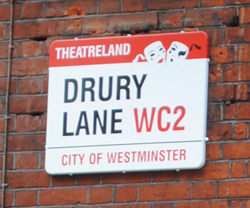
Famous for its associations with London’s theatreland, Drury Lane takes its name from the Drury family who once owned a mansion here.

Drury-LanePreviously known as the Via de Aldwych (apparently for a stone monument the Aldwych Cross which stood at the street’s northern end), Drury Lane – which runs between High Holborn and Aldwych – was renamed after Drury House which was built at the southern end of the street.

Some accounts suggest it was Sir Robert Drury (1456-1535), an MP and lawyer, who built the property around 1500; others say it was his son, Sir William Drury, also an MP and a Privy Councillor, who did so  in around 1600 – which may mean there were two versions of the one property.

The street, meanwhile, is said to have been briefly renamed Prince’s Street during the reign of King James I (1603-1625) but, following the Restoration in 1660, the name Drury once more gained supremacy.

The origins of the street’s famous theatre (London’s oldest), the Theatre Royal Drury Lane, dates from the same year (see our earlier post here). Other theatres in the street included the Cockpit Theatre which had been designed at one stage by Inigo Jones.

The street is also famous for being the site of the worst outbreak of the plague in London – the Great Plague of 1665, burned away the following year by the Great Fire – and by the 18th century was a slum noted for its seediness, in particular for prostitution (it features in William Hogarth’s work The Harlot’s Progress).

This didn’t change until the second half of the 19th century – author Charles Dickens had been among others who had commented on the poverty he had seen there – when gentrification took hold. Among the shops opened there during this time was the first Sainsbury’s, founded at number 173 in 1869.

Alongside the Theatre Royal Drury Lane (although the main entrance is in Catherine Street), other theatres in the street today include the New London Theatre and the London Theatre.