This Week in London – A Queen’s garden party; the Great Fire 350 Festival; and, getting behind the scenes at the Museum of London…

Kensington-Palace-garden-partyJoin Queen Caroline, wife of King George II, for a garden party in the grounds of Kensington Palace this weekend. The celebrations include music, military drills and live performances in a bid to bring the era of the Georgians to life. Visitors can listen to court gossip, learn how to play popular music and devise ways to amuse the queen as they pop in and out of a range of tents set up in the gardens, each of which contains a different activity, from uncovering dress secrets to designing a mini-garden fit for a king or queen. There’s even the chance to sample some Georgian ice-cream in the ice-house. The days will be held from today until 21st August. Admission charges apply. For more, see www.hrp.org.uk/kensington-palace/. PICTURE: Via HRP

The Great Fire 350 Festival – marking the 350th anniversary of the Great Fire of London – is underway and there’s a range of events being held in London over this month and next. While we’ll be mentioning some of these a little closer to actual anniversary date, meantime there are bi-weekly walks, a ‘Fire Trail’ treasure hunt and a new Monument app to keep you busy. The latter allows visitors to conduct a self-guided ‘Great Fire journey’ focusing on the fire itself, the commemoration of the blaze and London as we know it now as well as taking users into the minds of Sir Christopher Wren and Robert Hooke – designers of The Monument. Available for download from Android Market and Apple App Store. For more on the events running as part of the anniversary, see www.visitlondon.com/greatfire350/events.

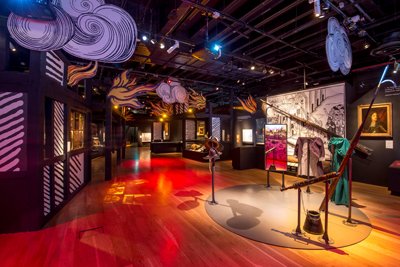
 Take a behind the scenes look at the Museum of London – and see some rarely exhibited objects – in an exhibition which opened late last month. The free display allows visitors to catch a glimpse of some of the work that goes on behind the scenes and see objects usually housed in the museum’s extensive stores including a detailed model of the process engraving department at the Evening Standard newspaper in 1977, an ice-cream maker and moulds from around 1910, and a confectioner’s icing stand from about 1900. The exhibition can be seen until 15th September. For more, see www.museumoflondon.org.uk.

Send all items for inclusion to exploringlondon@gmail.com.

10 sites commemorating the Great Fire of London – 2. The Golden Boy of Pye Corner…

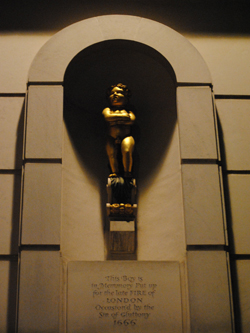
Golden-Boy-of-Pye-CornerWe’ve mentioned this memorial before but it’s worth a revisit. While last week’s entry looked at a plaque marking the site of the start of the Great Fire of London in September, 1666, this week we’re taking a (second) look at one of the sites where it was stopped.

Positioned high on a building on the corner of Giltspur Street and Cock Lane in Smithfield, this small wooden gilt 17th century statue, by an unknown maker, was once located on front of the pub, The Fortune of War, which stood on the site until it was demolished in 1910 (it was apparently used by body-snatchers as a place to display stolen corpses for surgeons from the nearby St Bartholomew’s Hospital to take their pick from).

The statue marks one of the locations on the city fringes where the fire was ‘stayed’ through the demolition of buildings. It bears an inscription which reads “This Boy is in Memmory put up for the late Fire of London Occasion’d by the Sin of Gluttony 1666”.

Well below it is an explanatory note below explains that the boy was made deliberately fat (the statue was apparently originally known as ‘The Fat Boy’ although to the modern eye it doesn’t look particularly so) in reference to the rather odd claim the fire was started in Pudding Lane as a result of the sin of gluttony and not by Papists as had been originally claimed on The Monument.

It has been said that the statue – which is believed to have once had wings and which is the reason why the building it is upon carries a Grade II heritage listing – was merely a shop sign and originally had nothing to do with the Great Fire, which may well be the case, but that said it is known that the fire stopped here (sparing St Bart’s further up Giltspur Street).

PICTURE: David Adams

A Moment in London’s History – The rebuilding of London in the aftermath of the Great Fire…

It’s the 350th anniversary of the Great Fire of London ands we thought we’d take a quick look at what happened in the aftermath.

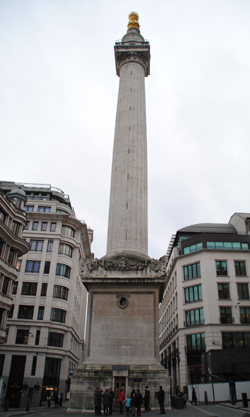
The-MonumentWith much of the city razed in the four day fire of early September, 1666, attention quickly turned to the rebuilding of the City and within just a few days, proposals began coming in for the recreation – and transformation – of London.

Christopher Wren, John Evelyn and Robert Hooke were among those who put forward new designs for the city along with the likes of one Richard Newcourt, whose proposed rigid grid featuring churches set in squares wasn’t adopted for London but was eventually for the streets of Philadelphia in what is now the United States of America.

None of these plans – Wren’s vision had apparently been inspired by the Gardens of Versailles while Evelyn’s was an Italianate city with wide piazzas – were eventually adopted, however, thanks largely to the difficulty in working out who owned which properties in the city (people had more on their mind, such as survival perhaps).

In October, 1666, King Charles II – who had encouraged many of those left homeless to move out of the City out of fears that a rebellion was in the offing – joined with the City authorities in appointing six commissioners to regulate the rebuilding (a key factor in which was the mandatory use of brick in place of wood).

Their actions were supported by a couple of parliamentary acts – drawn up to regulate the rebuilding and allow for the opening and widening of roads, among other things – and the establishment of specially convened Fire Courts to deal with property disputes (owners had to clear roadways of debris and establish their rights of ownership before they could start reconstruction).

Rebuilding was, not surprisingly, to take years – after all, almost 400 acres had been burned within the City walls and 63 acres outside them with more than 80 churches, 44 livery halls and more than 13,000 houses among the casualties. And it was patchy with new buildings standing alongside empty blocks awaiting reconstruction.

Construction of the many grand public buildings destroyed in the fire, such as St Paul’s Cathedral, would also take years (the cathedral, Wren’s Baroque masterpiece, wasn’t completed until 1711).

PICTURE: The Monument, which commemorates the Great Fire of London, is among the works of Sir Christopher Wren (for more on the Monument, see our earlier post here).

This Week in London – Turner back at the Tate; another Great Fire exhibition; and, Heroes and Villains…

Some of painter JMW Turner’s greatest works have returned to the Tate Britain – home of the largest collection of the artist’s works – where they have been put into a new free display. The works, which include Norham castle – Sunrise (c1845), Peace – Burial at Sea (exhibit 1842) and The Dogani, San Giorgio (exhibit 1842), have travelled more than 12,000 miles and been seen by more than 750,000 people in the UK, US and Canada as part of The EY Exhibition: Late Turner – Painting Set Free. They now form part of a new display of more than 100 works spread over eight rooms of the Tate Britain’s Clore Gallery. The three central spaces of the gallery present an overview of the major paintings Turner exhibited during his lifetime – his Self-Portrait (c1799), which will feature on the Bank of England’s new £20 note, is among works shown here – while four smaller galleries located to the sides will show themed groups of work. One brings together scenes from the artist’s British travels and another those from his European jaunts while the final two show the artist’s works on paper and a group of “radical late works” found in his studio after his death. For more, see www.tate.org.uk/visit/tate-britain

A new exhibition exploring the Great Fire of London to mark its 350th anniversary opens at the Guildhall Library in the City of London on Monday. That Dreadful Fire: The Hand of God, a Great Wind and a Very Dry Season explores the story through the collections of the Guildhall Library, including English and foreign accounts, sermons and public records. Runs until 30th November. For more and walks and talks, see www.cityoflondon.gov.uk/things-to-do/guildhall-library/events-exhibitions/Pages/the-dreadful-fire.aspx.

On Now: Heroes and Villains. This exhibition at the Cartoon Museum in Bloomsbury features art “depicting real life, the cartoon and comic world that highlights those we love and those we love to hate”. Featuring political cartoons, cartoon and comic strips, and caricatures, including some selected by celebrities and members of the public, it runs until 30th October. Admission charge applies. For more, see www.cartoonmuseum.org.

Send all items for inclusion to exploringlondon@gmail.com.

10 sites commemorating the Great Fire of London – 1. Thomas Farriner’s plaque

This year marks 350 years since the Great Fire of London destroyed much of the City of London and to mark the anniversary, we’re today launching a new special series looking at some of the lesser known – and, in some cases, more unusual – memorials and plaques commemorating the event.

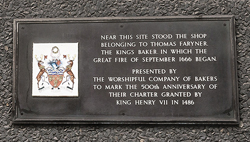
Thomas-Farriner-plaqueSure, everyone knows about The Monument near London Bridge erected to commemorate the event (see our earlier post on it here). But often overlooked is the plaque located in nearby Pudding Lane commemorating the site where the fire began in the early hours of 2nd September, 1666 – the bakery of Thomas Farriner (also variously spelt Faryner or Farynor).

The plaque, located close to the corner of Pudding Lane and Monument Street, was erected in 1986 by the Worshipful Company of Bakers to mark the anniversary of their Royal Charter being granted by King Henry VII some 500 years earlier. It reads (in part): “Near this site stood the shop belonging to Thomas Faryner, the King’s baker, in which the Great Fire of September 1666 began.”

While that fits with the long-held idea that the location of the bakery was 202 feet (61 metres) from the where the Monument stands, the same height of the memorial column itself, new research claims that the site of the bakery was not actually where Pudding Lane now stands but in nearby Monument Street instead.

Drawing on a planning document dating from 1679 and found within the London Metropolitan Archives, academic Dorian Gerhold reportedly cross-referenced the document with later maps and concluded that the baker’s oven was actually located on what is now Monument Street, 60 feet to the east of the intersection with Pudding Lane.

Farriner, meanwhile, was, as a king’s baker, a supplier to the Royal Navy. During the fire, the widower managed to escape the flames along with his three children (although their housemaid, unable or unwilling to escape out a window, perished). He was later able to rebuild the bakery and his home and when he died only a few years after the fire, left considerable sums to his children.

Incidentally, Farriner, his daughter Hanna and his son Thomas were all in the jury which convicted Frenchman Robert Hubert of starting the fire in their bakery by tossing a grenade in through the window (Hubert had confessed and, despite the fact that it’s believed few thought him actually guilty, he was convicted and hanged at Tyburn on 27th October, 1666, for the crime of arson.)

PICTURE: Steve James/Flickr/CC BY_NC-ND 2.0 (cropped and straightened)

Treasures of London – Restored 17th century fire engine…

Fire-Engine-Restoration

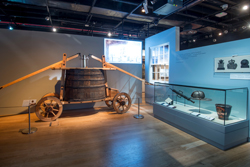
Originally built in the late 1670s by John Keeling in the aftermath of the Great Fire of London, the engine was acquired by the Museum of London in 1928.

Late-19th-century-photographThen only consisting of the central barrel and pump, it has been restored for the current exhibition, Fire! Fire!, being held to mark the 350th anniversary of the fire which wiped out much of the City of London.

Based on a 19th century photograph (pictured) which showed it still intact with undercarriage, wheels, tow bar and pumping arm, the restoration was carried out by the museum in partnership with Kent-based Croford Coachbuilders using traditional techniques and materials over a three month period.

Meriel Jeater, curator of the Fire! Fire! exhibition, said the reconstruction had revealed new insights into how the fire engine worked and shows that, weighing more than 500 kilograms without water, it would have been extremely difficult to manoeuvre along London’s narrow streets.

“Also, the relatively crude pump mechanism was only able to squirt out about six pints of water over a rather short distance, so it would have been perilously close to the flames to have had any chance of putting them out.”

Fire! Fire! can be seen at the Museum of London until 17th April. Admission charge applies. For more, see www.museumoflondon.org.uk/fire-fire.

PICTURES: © Museum of London.

This Week in London – Remembering the Great Fire of 1666; rediscovering the Palace of Whitehall; and, the Queen’s dresses go on show…

Fire2• A new “theatrical” exhibition marking the 350th anniversary of the Great Fire of London is opening at the Museum of London on Saturday. Fire! Fire! takes visitors on an interactive journey from before, during and after the great fire, looking at how the fire started and spread and the personal stories of Fire1Londoners present at the time. Visitors will be able to step in Pudding Lane and see what life was like for 17th century Londoners, walk into the bakery where the fire started, and identify objects melted by the flames. Exhibits on show include a restored 17th century fire engine, originally built in London in the last 1670s, other firefighting equipment including a squirt, a leather bucket and fire hook, a pair of bed hangings, a burnt Geneva Bible, and letters written in the fire’s aftermath. Admission charges apply. Can be seen until 17th April next year. A series of events, including walks, tours, lectures, workshop and family activities, accompanies the exhibition. For more, see www.museumoflondon.org.uk/fire-fire.  The museum has also commissioned a Minecraft building group recreate London as it was in 1666 with the first of three interactive maps to be released next week (available for free download from www.museumoflondon.org.uk) and further maps to follow in September and February. For more information on other events surrounding the anniversary, see www.visitlondon.com/greatfire350.

The long lost Palace of Whitehall is the subject of a new visitor experience which kicks off at the last surviving part of the palace – the Banqueting House – today. Handheld devices, binaural 3D sound and haptic technology is being made available to guests as they stroll around the streets of modern Whitehall, allowing them to immerse themselves in the former palace during the time of the Tudors and the Stuarts. The Lost Palace experience, created in a collaboration between Historic Royal Palaces and Chomko & Rosier and Uninvited Guests, includes a chance to see the jousts which so delighted Queen Elizabeth I at Horse Guards Parade, accompany King Charles I as he walks through St James’s Park to his execution at the Banqueting House, meet Guy Fawkes following his arrest in the Gunpowder Plot, take part in a performance of King Lear and eavesdrop on an encounter between King Henry VIII and Anne Boleyn before their doomed love affair began. The Palace of Whitehall was once the largest palace in Europe with 1,500 rooms spread across 23 acres. Tickets can be purchased at the Banqueting House. Runs until 4th September. For more details, see www.hrp.org.uk/thelostpalace.

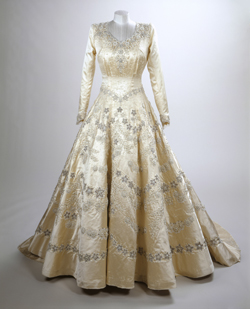
DressDresses worn by Queen Elizabeth II during two of the most significant events in Her Majesty’s life – her wedding and her coronation – can be seen as part of the Summer Opening of the State Rooms at Buckingham Palace from Saturday. The two dresses will form part of a special exhibition – Fashioning a Reign: 90 Years of Style from The Queen’s Wardrobe, the largest display of the Queen’s dress ever held. Alongside the two feature dresses, both designed by British couturier Sir Norman Hartnell, are around 150 outfits created by designers including Hartnell, Hardy Amies and Ian Thomas. The then Princess Elizabeth’s wedding dress (pictured), made for her marriage to the Duke of Edinburgh on 20th November, 1947, was made in ivory silk, decorated with crystals and 10,000 seed pearls and attached to a 15 foot long train, while the Queen’s Coronation dress – created for the event on 2nd June, 1953, is made of white duchesse satin and encrusted with seed pearls, sequins and crystals (along with an extra four-leaf shamrock on the left side of the skirt, added secretly by Sir Norman, to bring her good luck). The exhibition, open to 2nd October, is being accompanied by special displays at both Windsor Castle and Holyroodhouse in Edinburgh. Admission charges apply. For more, see www.royalcollection.org.uk. PICTURE: Royal Collection Trust/© Her Majesty Queen Elizabeth II 2016. 

The world’s largest collection of London images – more than 250,000, dating from 1450 to now – are being made available on a free-to-access website hosted by the London Metropolitan Archives from today. Collage – The London Picture Archive features more than 8,000 historical photographs of capital’s streets as well as images of the Great Fire of London in 1666 and photographs of the construction of Tower Bridge along with maps, prints, paintings and films, all drawn from the collections at the City of London Corporation’s Guildhall Art Gallery and the Clerkenwell-based London Metropolitan Archives. The collection can be accessed at www.collage.cityoflondon.gov.uk.

It’s hands-on gaming at the Science Museum for two weeks from Friday with more than 160 systems and hundreds of games available to play on. Power UP spans 40 years of gaming with games ranging from classics like Pong and Pac-Man to modern games like Halo and systems from Atari and SEGA to PS4 and Xbox One. Ninety minute sessions are being held four times daily from 11am tomorrow until 7th August. Ticket charges apply. For more , see www.sciencemuseum.org.uk/powerup.

Send all items for inclusion to exploringlondon@gmail.com.

Treasures of London – Great Parchment Book…

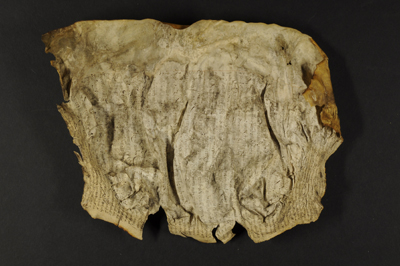
Great-Parchment-BookHeld in the collections of the London Metropolitan Archives, the Great Parchment Book of The Honourable the Irish Society was recently inscribed upon the UK register of the UNESCO Memory of the World.

Described as a “hugely significant record of the Ulster Plantation of the early 17th century”, the book was compiled in 1639 by a commission instituted under the Great Seal of King Charles I and is a survey of all the estates in Derry managed by the City of London Corporation through the Irish Society and City of London livery companies.

As such, manuscript and provides a unique insight into this important period in the history of Northern Ireland, containing key data about landholdings and the population in Ulster at the time of its creation including for both English and Scottish settlers and the native Irish population (as well as, exceptionally, for many women at all levels of society).

The Great Parchment Book was badly damaged in a fire in 1786 and as a result was unavailable to researchers for more than 200 years until its successful reconstruction using cutting edge digital imaging technology.

It is the fourth item in the care of the London Metropolitan Archives to be inscribed to the UK register of the UNESCO Memory of the World, a programme which aims to facilitate preservation of the world’s documentary and audio-visual heritage, to assist universal access and to increase awareness worldwide of the existence and significance of this documentary heritage.

The three other objects inscribed on the list which are in the LMA’s care include the Charter of William I to the City of London, London County Council Bomb Damage Maps and Robert Hooke’s Diary 1672-83.

~ www.greatparchmentbook.org

WHERE: London Metropolitan Archives, 40 Northampton Road, Clerkenwell (nearest Tube stations are Farringdon and Angel); WHEN: Open Monday to Thursday and selected Saturdays (check website for times); COST: Free; WEBSITE: www.cityoflondon.gov.uk/things-to-do/london-metropolitan-archives/Pages/default.aspx.

PICTURE: Courtesy London Metropolitan Archives.


10 notable blue plaques of London – 5. Five Londoners with more than one blue plaque…

There’s quite a few whose London residence (or otherwise) is commemorated by more than one blue plaque. So, breaking away from our usual ‘one plaque’ format, here were listing five of those who have made the grade…

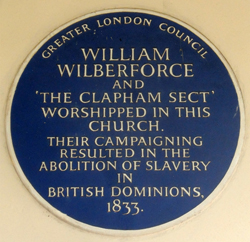
William-Wilberforce-blue-plaque1. William Wilberforce (1759-1833). The late 18th century and early 19th century politician and anti-slavery campaigner tops our list with three English Heritage blue plaques. The first is at 111 Brookwood Road in Battersea – the site of Brookwood House where Wilberforce resided during his anti-slavery campaign. The second is on Holy Trinity Church on Clapham Common, the church where Wilberforce and the Clapham Sect with whom he is associated worshipped. And the third is on a property at 44 Cadogan Place in Chelsea where Wilberforce died.

2. Dr Samuel Johnson (1709-1784). Like Wilberforce, the 18th century lexicographer Dr Johnson has three English Heritage blue plaques to his name. The first, on his famous Gough Square property in the City of London we’ve already mentioned (see our earlier post here), while the second is on a property at 8 Russell Street, Covent Garden, then occupied by bookseller Thomas Davies, which was where Dr Johnson famously first met James Boswell in 1763. The third time Dr Johnson’s name appears, more unusually, is on a plaque commemorating Essex Street – Dr Johnson is among a number of names listed on it for his role in establishing an “evening club” at the pub, the Essex Head, in the street in 1783.

3. Samuel Pepys (1633-1703): The 17th century diarist seems to pop-up everywhere in central London so it’s not surprising there are two plaques in the English Heritage blue plaques scheme dedicated to him (although both are located in the same street – one he apparently liked very much). The plaques are located at number 12 and number 14 Buckingham Street in Covent Garden and both mark the site of a Pepys residence.

4. Virginia Woolf (1882-1941): The writer, publisher and literary critic’s name appears on two properties – at 29 Fitzroy Square in Fitzrovia where Woolf lived between 1907-1911 and on Hogarth House at 34 Paradise Road in Richmond where she and Leonard Woolf lived between 1915-1924 (and also where they founded the Hogarth Press in 1917).

5. William Morris (1834-1896): The poet and artist has two English Heritage blue plaques to his credit – the first on 17 Red Lion Square in Holborn where Morris lived in a flat from 1856-1859 with Sir Edward C Burne-Jones, and the second on Red House in Bexleyheath where he and his wife Jane Burden lived from 1860-1865.

PICTURE: Spudgun67/Wikimedia/CC BY-SA 4.0 (image cropped)

What’s in a name?…Fitzrovia…

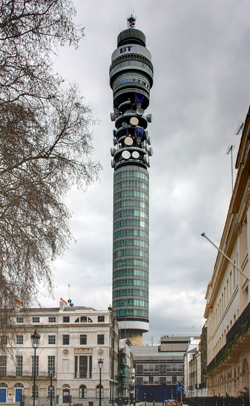
BT_Tower-1This West End district, located between Bloomsbury, Marylebone and Soho, probably owes its name to the Fitzroy Tavern, a public house which in turn is believed to owe its name to the Dukes of Grafton, whose family name was Fitzroy.

The Fitzroys (the name derives from  a Norman-French phrase and was typically associated with base-born royal sons), owned land in the area until the end of the 1800s.

The family first become associated with the area after the Manor of Tottenham (more on that name in an upcoming post) came into the possession of Henry Fitzroy, an illegitimate son of King Charles II who became the Earl of Euston and later Duke of Grafton.

Incidentally, the grand Fitzroy Square, developed by the duke’s great-grandson, and Fitzroy Street are both also named after the family as are numerous other locations in the area including Grafton Street.

Fashionable as a residential area in the 1700s, the houses were gradually transformed into workshops – the area was noted for furniture-makers in particular – or cheap tenements and it’s during this period in the early 1800s that artists like John Constable were living in the area.

The name Fitzrovia apparently became popularised for the district which in the inter-war years, due to the community of artists and writers that met at the pub; it is said to have first appeared in print in the 1940s. Among those who were associated with the area during this period were the likes of writers Dylan Thomas and George Orwell and artists like Roger Fry and Augustus John.

More recently the area has become home to numerous media companies, particularly TV-related companies, and still hosts ample pubs, restaurants and cafes.

Notable buildings in the area include the BT Tower, a communications tower completed in 1964 which was until 1980, the tallest building not only in London but in the UK (and from where panoramic views could once be had – sadly it’s been long closed to the public).

Fitzrovia is also home to the quirky Pollock’s Toy Museum.

PICTURE: David Castor (caster)/Wikipedia

Correction: Fitzroy Square was developed by the great grandson of the 1st Duke of Grafton, not grandson as was originally stated.

Lost London – The Three Tuns, Guildhall Yard…

Guildhall-Yard

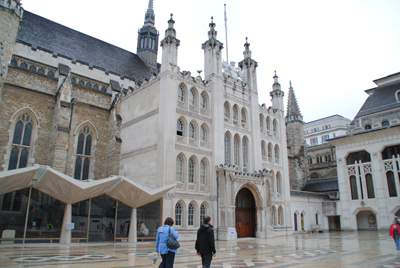
A medieval tavern, The Three Tuns once stood in Guildhall Yard in the City (picture above).

The tavern, which was located by Guildhall Gate, is noted for having served as lodgings for the Royalist military commander General George Monck when he arrived in the city in early 1660 in the lead-up to the Restoration of the monarchy later that year. It was also, according to poet Robert Herrick, a haunt of playwright Ben Jonson.

The Three Tuns – meaning three great wine casks – was incidentally a popular name for taverns and there were several others in London which bore the same name including, in the 17th century, one in Ludgate Hill, another in Cheapside and another in Gracechurch Street.

The Museum of London has a trade token, which was worth half a penny, and was issued by the tavern’s proprietor, Thomas Ailay, in the mid-17th century for use at the business.

A Moment in London’s History – ‘The London Gazette’ first published 350 years ago…

The-London-Gazette

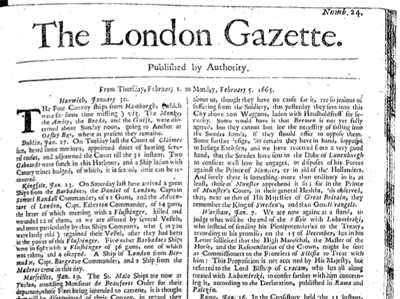
An official public record of the British Government, The London Gazette, initially known as The Oxford Gazette, was first published on 7th November, 1665. 

But its publication didn’t take place in London – rather it was in Oxford (hence its being initially named – The Oxford Gazette) where King Charles II, having fled London due to the plague, ordered the publication to be printed at the University Press.

There’s several reasons behind its publication – one is that courtiers were apparently so worried about the plaque they didn’t even want to touch newspapers from London for fears of contagion of the plaque. But there was also a need, amid the swirl of rumours, gossip and sensationalism found in other publications, for a reputable publication of record (not the least because the introduction of censorship a few years before had suppressed other publications).

Published for the first couple of months under its Oxford masthead, it wasn’t until the following year – on 5th February, 1666 – that the gazette was first published in London (issue 24) after the royal court’s return.

The gazette had unparalleled access to government information – including reports from foreign embassies about what was happening abroad (important when news from overseas was limited), and official reports, including those ‘Mentioned in despatches’ from the War Office and Ministry of Defence.

Adopting the same model, official government gazettes followed in the coming years in Edinburgh (1699) and Dublin (1706 – later The Belfast Gazette). All three, from 1889, were published by Her Majesty’s Stationery Office. Today, The Gazette is published by The Stationary Office (TSO), on behalf of The National Archives (and is now online as well as in print).

Initially published only a couple of days a week, it is now published every weekday except on Bank Holidays.

Notable events published in The London Gazette include the Great Fire of London in 1665 (issue 85), the founding of the Bank of England in 1694 (issue 2982), the burial of Sir Isaac Newton in 1727 (issue 6569), the announcement of the American Declaration of Independence in 1776 (issue 11690), the outcome of the Battle of Waterloo in a “Gazette Extraordinary” in 1815 (issue 17028), and the Coronation of Queen Elizabeth II in 1953 (Supplement 40020).

You can see The London Gazette today and back issues as well as to order commemorative editions, head to www.thegazette.co.uk.

10 London ‘battlefields’ – 7. Battle of Brentford…

Syon-Park

Yes, we’re a bit out of order here given we looked at the subsequent Battle of Turnham Green last week, but today we’re taking a look at the Civil War fight known as the Battle of Brentford.

As recounted last week, having taken Banbury and Oxford in the aftermath of the Battle of Edgehill, the Royalist army marched along the Thames Valley toward London where a Parliamentarian army under the Earl of Essex waited.

Battle-of-BrentfordHaving arrived at Reading to the west of London, King Charles I, apparently unconvinced peace talks were heading in the right direction, ordered Prince Rupert to take Brentford in order to put pressure on the Parliamentarians in London.

On 12th November, 1642, up to 4,600 Royalists under the command of the prince engaged with two Parliamentarian infantry regiments at Brentford, one of the key approaches the City of London. The Parliamentarians were under the command of Denzil Hollis (who wasn’t present) and Lord Brooke – various estimates put their number at between 1,300 and 2,000 men.

Prince Rupert’s men – consisting of cavalry and dragoons – attacked at dawn under the cover of a mist. An initial venture to take a Parliamentarian outpost at the house of Royalist Sir Richard Wynne was repulsed by cannon fire but Sir Rupert ordered a Welsh foot regiment to join the fight and the outpost was quickly taken.

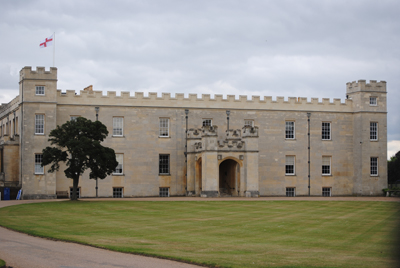
The Cavaliers then pushed forward across the bridge over the River Brent (which divided the town) and eventually drove the Parliamentarians from the town and into the surrounding fields (part of the battle was apparently fought on the grounds of Syon House – pictured at top).

Fighting continued into the late afternoon before the arrival of a Parliamentarian infantry brigade under the command of John Hampden allowed the Roundheads to withdraw.

About 170 are believed to have died in the battle (including a number who drowned fleeing the fighting). Followed by the sack of the town, the battle was a success for the Royalists who apparently captured some 15 guns and about 400 prisoners. The captured apparently included Leveller John Lilburne, a captain in Brooke’s regiment.

The Royalists and Parliamentarians met again only a few days later – this time at Turnham Green (for more on that, see last week’s post).

Incidentally, this wasn’t the first battle to be fought at Brentford. Some time over the summer of 1016, English led by Edmund Ironside clashed with the Danes under the soon-to-be-English king Canute. Edmund was victorious on the day, one of a series of battles he fought with Canute.

Meanwhile, more than 1000 years earlier, it was apparently at Brentford that the British under the King Cassivellaunus fought with Julius Caesar’s men in 54 BC on their approach to St Albans (Verulamium).

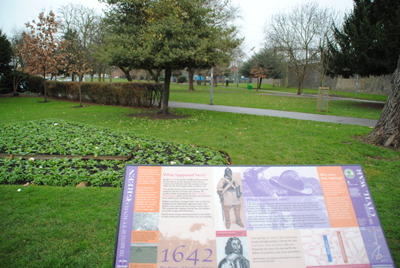
A pillar stands High Street in Brentford commemorating all three battles while there is an explanatory plaque about the battle in the grounds of Syon Park.

For more the Battles of Brentford and Turnham Green, see www.battlefieldstrust.com/brentfordandturnhamgreen.

10 London ‘battlefields’ – 6. Battle of Turnham Green…

Battle-of-Turnham-Green

Part of the English Civil War, this battle – really no more than a skirmish – between the Royalists and the Parliamentarians which prevented the Royalists from attacking London which ultimately forced the Royalists to spend winter in Oxford.

Having taken Banbury and Oxford in the aftermath of the inconclusive Battle of Edgehill, a Royalist army had marched along the Thames Valley toward London.

On the 12th November, 1642, the Royalists had defeated two Parliamentarian regiments at Brentford to the west of the City of London. Under the command of Patrick Ruthven, Earl of Forth, but with King Charles I among them, the Royalists, who numbered some 12,000 men, then camped overnight at a site believed to be at or near the village of Turnham Green, now in west London.

Meanwhile, a Parliamentarian army under command of Robert Devereux, Earl of Essexjoined up with London militia under the command of Major General Philip Skippon at Chelsea Field. Numbering some 24,000, they advanced upon Turnham Green where the Royalists awaited them.

By 8am on the 13th, the two armies had formed lines running roughly north to south across Turnham Green, Chiswick Common Field and Acton Green with the Parliamentarian line stretching from the site of what is now Turnham Green Tube station to the grounds of Chiswick House and the Royalist lines stretching from south of Chiswick Park Tube station to the Great West Road.

Both lines apparently had infantry at the centre with cavalry on the flanks. Essex, attempting to outflank the Royalists, sent troops to high ground at Action but, concerned about splitting his army, soon withdrew them.

The battle them became something of a stalemate – Essex, not seeking to do any more than block the Royalist advance, was happy to wait while the Royalists, outnumbered, short of ammunition and said to have been unwilling to put the Londoners offside, did likewise.

Eventually, late in the afternoon, the Royalists withdrew westward and Essex, who was much criticised for it afterward, gave a half-hearted pursuit. King Charles I then ordered his army back up the Thames Valley to Oxford where they ended up passing the winter.

Less than 50 men in total are said to have died in the indecisive clash which, it can be argued, helped to ensure that the Civil War would go on for another four long years.

While much of the site of the skirmish has been built upon, glimpses of the open ground which once stood here can still be seen. There is an information panel about the battle opposite Turnham Green Tube station.

For more on the English Civil War, see Blair Worden’s The English Civil Wars: 1640-1660.

Famous Londoners – William Hewer…

The National Maritime Museum is hosting a new exhibition on the life of Samuel Pepys and, while we’ve looked at the life of the famous diarist before (see our earlier post here), we thought we’d take a look at his not-so-famous manservant and clerk William Hewer.

“Will” Hewer, who is mentioned several times in Pepys’ diary and, as well as being a business partner also became a fast friend of Pepys, is thought to have been born in about 1642.

He was first introduced to Pepys when still a young man – about 17 – by his uncle Robert Blackborne in 1660. They obviously hit it off because Hewer, who was the son of a stationer, was soon working as a manservant and clerk for Pepys in his role as Clerk of the Acts to the Navy Board.

Hewer, who was subjected to some bullying by Pepys who apparently could reduce him to tears (but at the same time Pepys also defended him at work from attacks from others), at first lived with Pepys at his Seething Lane home. However, by late 1663 – apparently thanks to his misbehaviour which included staying out late, drunkenness and corrupting maids – he was told to leave Pepys’ house and moved into his own lodgings.

Pepys moved to the Admiralty in 1673 and Hewer went with him, appointed Chief Clerk the following year. In 1677, he was appointed as Judge Advocate-General.

Hewer’s star continued to climb and in 1685, he was appointed MP for Yarmouth, on the Isle of Wight. The following year he was appointed to the Special Commission which replaced the Navy Board and had a special responsibility for accounts.

After King James II fled the country in 1688, Hewer, along with Pepys, lost their patronage from the Crown; both were briefly imprisoned, but were released without trial.

Thanks largely to his involvement in trading with his uncle Blackborne – who served as both Secretary to the Admiralty and Secretary to the British East India Company and to an inheritance he received from his father, Hewer became a wealthy man (as was the case with Pepys, there have been suggestions he may have made considerable illicit sums from people doing trade with the Navy thanks to his position, but these claims have not been substantiated).

Hewer, who never married (but he did apparently have a special attachment to Pepys wife Elizabeth who was of a similar age), owned a house near The Strand which became the Admiralty Office when he followed Pepys from the Navy Board. Pepys lived with him in the house when he was at the Admiralty.

He also owned other properties, including a country retreat on Clapham Common which he bought in 1688. It was here that Pepys lived in during his latter years (and where he died in 1703).

Hewer was the executor of Pepys’ will and kept his library – including, of course, his famous diary until his own death on 3rd December, 1715. He was buried in St Paul’s Church, Clapham. In an odd twist, his estate was left to his godson Hewer Edgeley but only on the condition that he change his surname to Hewer, becoming Hewer Edgeley-Hewer.

Hewer is depicted in a painting by Godfrey Kneller (1689) now in the National Maritime Museum’s collection. It was a pair with another painting by Kneller of Pepys.

WHERE: Samuel Pepys: Plague, Fire, Revolution is at the National Maritime Museum, Greenwich (nearest DLR station is Cutty Sark; nearest railway stations are Greenwich and Maze Hill; and nearest river pier is Greenwich); WHEN: 10am to 5pm daily; COST: £12 adults/£6 children WEBSITE: www.rmg.co.uk/see-do/exhibitions-events/samuel-pepys-plague-fire-revolution-exhibition.

For more on Pepys, see Margarette Lincoln’s book Samuel Pepys: Plague, Fire, Revolution.

This Week in London – Samuel Pepys and his world revealed; the world of contemporary cycling; and, Indian jewellery traditions…

Samuel-PepysThe largest exhibition ever mounted about the life of 17th century diarist Samuel Pepys opens at the National Maritime Museum in Greenwich tomorrow. Samuel Pepys: Plague, Fire, Revolution features more than 200 paintings and objects brought together from museums, galleries and private collections which explore the life of the famous diarist (depicted here in a bust outside the Guildhall Art Gallery) against the backdrop of the tumultuous events of Stuart London, from the execution London of King Charles I in 1649 through the Great Fire of London and the Glorious Revolution on 1688. Objects on show include the famous painting, Portrait of Charles II in Coronation Robes, objects connected to Pepys’ mistresses including one of his love letters to Louise de Kéroualle (aka ‘Fubbs’ or ‘chubby’) and other personal items such as a lute owned by Pepys. The exhibition is accompanied by a series of events including Pepys Show Late: Party like it’s 1669 (26th November) and a series of walks and talks. Admission charge applies. The exhibition runs until 28th March. For more, see www.rmg.co.uk/national-maritime-museum.

Cycles are in the spotlight at the Design Museum in Shad Thames with a new exhibition, Cycle Revolution, opening yesterday. The display, which focuses on the world of contemporary cycling, features dozens of bicycles from key manufacturers as well as high end accessories, items belonging to celebrated cyclists Sir Chris Hoy and Sir Paul Smith and specially commissioned films and photography. It looks at cycling subcultures – everyone from the “high performers” to the “cargo bikers”, examines manufacturing techniques and innovations in the use of materials and design with exhibits including a large scale recreation of a bespoke bicycle making workshop, and tackles questions about the future of cycling particularly in relation to the urban environment. The exhibition is being accompanied by a ‘cycle cafe’, large scale installations and a series of public events. Runs until 30th June. Admission charge applies. For more, see www.designmuseum.com.

The jewellery traditions of the Indian sub-continent are set to sparkle at a new exhibition opening at the V&A in South Kensington this Saturday. Part of the V&A India Festival, Bejewelled Treasures: The Al Thani Collection features 100 items, drawn from a single private collection, including a Golconda diamond given to Queen Charlotte by the Nawab of Arcot in South India in 1767, a jade-hilted dagger that belonged to the 17th century emperor Shah Jahan (builder of the Taj Mahal), and a jewelled gold tiger’s head from the throne of the Tipu Sultan of Mysore. As well as showcasing the types of jewels collected by the Mughal emperors, the exhibition reveals the influence of India on European jewellery houses in the early 20th century and the ongoing impact of Indian influences on more modern pieces. The exhibition runs until 28th March. Admission charge applies. For more, see www.vam.ac.uk/BejewelledTreasures.

Send all items for inclusion to exploringlondon@gmail.com

10 Questions – Sheila Dunsmore, a State Apartment warder at Hampton Court Palace…

HamptonCourtPalace500thBirthday-3

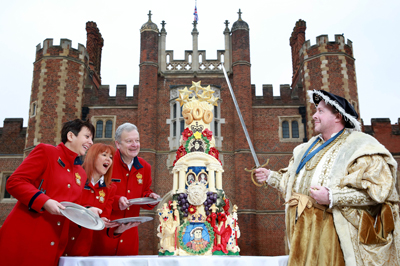
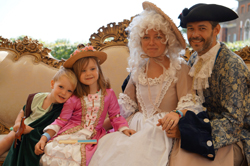
This year marks the 500th anniversary of the building of Hampton Court Palace in Greater London’s south-west. We speak to Sheila Dunsmore, a State Apartment warder at Hampton Court Palace (pictured above in centre on the left)…

1. It’s Hampton Court Palace’s 500th anniversary – who first built the palace and why? “In 1514, Thomas Wolsey came to survey the land at Hampton Court. He wanted to find a suitable place to build a sumptuous country retreat away from the dirt of London, but close enough to the capital to travel back for meetings. It was also to be a place to entertain the important company his position as Archbishop of York provided, of which none were more important than young King Henry VIII.”

2. Where are the oldest parts of the palace today? “The oldest part of the palace is the Tudor kitchens, more specifically the area were the great fire is. This was once part of Sir Giles Daubeney’s original kitchen, and dates back to the manor already on the site when it was acquired by Wolsey. Sir Giles Daubeney was Lord Chamberlain to Henry VII, and acquired an 80 year lease on the property from the Knights Hospitallers of St John of Jerusalem, the then owners. The bell in the tower above the astronomical clock is also said to have come from the Knights Hospitallers’ original manor house.”

3. Hampton Court’s 500 years of history spans a number of definable eras – from Tudor to the 21st century. Which is your favourite and why? “My favourite era is the 1660s when Charles II came back to England to take up his rightful place as king. Although visitors do not really associate Charles with the palace, he did spend time here, most famously his honeymoon!”

4. With this in mind what is your favourite part of the palace? “I love the west front façade – it just looks so imposing and mysterious. Whether you are driving or walking past it it’s guaranteed to draw you in under its spell!”

5. Do you have a favourite anecdote from the palace’s history? “I love the story of Horace Beauchamp Seymour, a dashing military hero who had fought at the Battle of Waterloo. He came to live at the palace in 1827 and, as a handsome eligible widower, he caused quite a sensation amongst the ladies, especially when he joined the Sunday services at the Chapel Royal. It was not long before a series of fainting episodes began, with the strategically placed young lady fainting into the arms of the dashing Horace, who then proceeded to carry the lady out and stay with her until she regained her composure. After a third successive Sunday of fainting’s, the epidemic was brought to a swift halt by the aunt of Mr Seymour, herself also a palace resident. The feisty old lady pinned a sign to the chapel door warning any lady feeling faint that forthcoming Sunday that Bransome the dustbin man would be carrying her out. Needless to say the fainting ceased!”

6. A complex of buildings dating back as far as 500 years obviously requires considerable upkeep. What are the greatest challenges with regard to maintaining the palace? “I think the biggest challenge would have to be generating the money to keep restoring and conserving this historic palace. To do this we have to keep making sure that people want to visit, from international tour groups to local families who might visit again and again. To do this teams right across the palace work to create exciting exhibitions, immersive events and guided tours to ensure we’re offering people a memorable experience.”

7. Are there any areas of the palace which remain unseen by the public? And any plans to open further areas up? “The palace contains over 1,000 rooms, and visitors get to discover about a quarter of these during their visit. Some years ago we held a Servants, Soldiers and Suffragettes exhibition in a suite of rooms on the top floor of Fountain Court (previously unseen). It was incredibly popular so I’d imagine that in the future we’d look for other such opportunities to share other areas of the palace with our visitors. For anyone that can’t wait that long, on one night of the year (Halloween no less), our adults-only ghost tour offers the chance to peek behind the scenes and explore some areas of the palace off the beaten track!”

8. Are there any ‘secrets’ about the palace you can reveal to us? “A palace as old and as large as Hampton Court holds its fair share of secrets…When the fire took hold in 1986 it was devastating, but in a strange twist of fate some good came from it as well. As restoration of the damaged interiors took place little secrets were revealed to us; behind wood panelling in King William’s damaged rooms hand prints were found in the plaster from the palace’s builders, and sketches were found from the architects with designs for the rooms, all worked directly onto the bare walls. Most exciting of all, however, was the object found downstairs. During work to return King William’s private dining room (which had lost its original look over the years and been used as a function room for the grace and favour residents) to its former glory, a gun was found behind some wooden panelling. The gun dated from the late 1800s, and had a regimental dinner menu was wrapped around it. This is so intriguing – what was the story behind this gun? Who did it belong to? Why did they hide the weapon?”

9. If someone has just one day to visit the palace, what’s your ideal itinerary? “This is a tricky one, and depends very much on the individual…and the weather! I would say on a sunny day start by enjoying a historic welcome with our costumed interpreters, which really helps to set the scene. If it’s a bit chilly pick up a cloak to wear – you can choose between dressing as a Tudor or Georgian courtier. Heading inside, I’d start in the Tudor State Apartments to discover the rich opulence of Henry VIII’s Hampton Court, then visit the recently opened Cumberland Art Gallery, which contains masterpieces by Rembrandt, Canaletto and Van Dyck. Next I’d take in the baroque splendour of the Queen’s State Apartments, then explore the maze, East Front Garden and Privy Garden (weather permitting!). After a spot of lunch I’d suggest visiting the Mantegna Gallery, then the Young Henry exhibition which explores the life of the young Henry VIII, before finishing the day in King William III’s apartments.”

10. Finally, Historic Royal Palaces has already commemorated the 500th anniversary in numerous ways – from a spectacular fireworks display to a jousting tournament. Are there any more events coming up? “The beginning of September saw our costumed interpreters back with their own inimitable brand of entertainment, while at the end of September we’re hosting a sleepover inside the palace! As the evenings draw in, our popular ghost tours return for the winter season. Even further ahead we’ve got a series of carol evenings and even an ice rink for our visitors to enjoy!”

WHERE: Hampton Court Palace, East Molesey, Surrey (nearest station is Hampton Court from Waterloo); WHEN: 10am to 6pm until 24th October after which it’s open to 4.30pm); COST: Adult £19.30, Concession £16, Child under 16 £9.70 (under fives free), family tickets, garden only tickets and online booking discounts available; WEBSITE:www.hrp.org.uk/HamptonCourtPalace/.
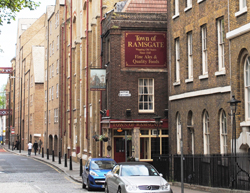
Famous Londoners – Judge Jeffreys…

The-Town-of-Ramsgate2

Best known as the “Hanging Judge” thanks to his role in the so-called Bloody Assizes of 1685, George Jeffreys climbed the heights of England’s legal profession before his ignominious downfall.

Born on 15th May, 1645, at the family home of Acton Hall in Wrexham, North Wales, Jeffreys was the sixth son in a prominent local family. In his early 20s, having been educated in Shrewsbury, Cambridge and London, he embarked on a legal career in the latter location and was admitted to the bar in 1668.

Town-of-RamsgateIn 1671, he was made a Common Serjeant of London, and despite having his eye on the  more senior role of Recorder of London, was passed over. But his star had certainly risen and, despite his Protestant faith, he was a few years later appointed to the position of solicitor general to James, brother of King Charles II and the Catholic Duke of York (later King James II), in 1677.

The same year he was knighted and became Recorder of London, a position he had long sought, the following year. Following revelations of the so-called the Popish Plot in 1678 – said to have been a Catholic plot aimed the overthrow of the government, Jeffreys – who was fast gaining a reputation for rudeness and the bullying of defendants – served as a prosecutor or judge in many of the trials and those implicated by what turned out to be the fabricated evidence of Titus Oates (Jeffreys later secured the conviction of Oates for perjury resulting in his flogging and imprisonment).

Having successfully fought against the Exclusion Bill aimed at preventing James from inheriting the throne, in 1681 King Charles II created him a baronet. In 1683 he was made Lord Chief Justice and a member of the Privy Council. Among cases he presided over was that of Algernon Sidney, implicated in the Rye House Plot to assassinate the king and his brother (he had earlier led the prosecution against Lord William Russell over the same plot). Both were executed.

It was following the accession of King James II in February, 1685, that Jeffreys earned the evil reputation that was to ensure his infamy. Following the failed attempt by James Scott, 1st Duke of Monmouth and illegitimate son of the late King Charles II, to overthrow King James II, Jeffreys was sent to conduct the trials of the captured rebels in West Country towns including Taunton, Wells and Dorchester – the ‘Bloody Assizes’.

Of the almost 1,400 people found guilty of treason in the trials, it’s estimated that between 150 and 200 people were executed and hundreds more sent into slavery in the colonies. Jeffreys’, meanwhile, was busy profiting financially by extorting money from the accused.

By now known for his corruption and brutality, that same year he was elevated to the peerage as Baron Jeffreys of Wem and named Lord Chancellor as well as president of the ecclesiastical commission charged with implementing James’ unpopular pro-Catholic religious policies.

His fall was to come only a couple of years later during Glorious Revolution which saw King James II overthrown by his niece, Mary, and her husband William of Orange (who become the joint monarchs Queen Mary II and King William III).

Offered the throne by a coalition of influential figures who feared the creation of a Catholic dynasty following the birth of King James II’s son, James Francis Edward Stuart, William and Mary arrived in England with a large invasion force. King James II’s rule collapsed and he eventually fled the country.

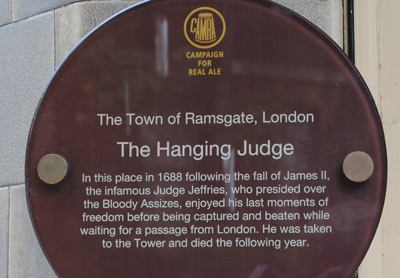
Remaining in London after the king had fled, Lord Jeffreys only attempted to flee as William’s forced approached the city. He made it as far as Wapping where, despite being disguised as a sailor, he was recognised in a pub, now The Town of Ramsgate (pictured above).

Placed in custody in the Tower of London, he died there of kidney problems on 18th April, 1689, and was buried in the Chapel Royal of Saint Peter ad Vincula (before, in 1692, his body was moved to the Church of St Mary Aldermanbury). All traces of his tomb were destroyed when the church was bombed during the Blitz (for more on the church, see our earlier post here).

10 small, ‘secret’ and historic gardens in central London…5. Seething Lane Garden…

Seething-Lane-Garden

This small, simply laid out garden in the City of London is redolent with history.

It was once the site of the Navy Office, the workplace of diarist Samuel Pepys, and it was in the garden of this building that he and Sir William Penn buried their wine and parmesan cheese for safety during the Great Fire of London in 1666.

The office survived the Great Fire but was, oddly enough, destroyed by fire only a few years later in 1673 (there is a blue plaque commemorating it in the garden) and a new office, designed by Sir Christopher Wren, was built here in the early 1680s before it was demolished in 1788.

Seething-Lane-Garden2It’s due to its association with Pepys (who also lived in the street and was buried in the nearby church of St Olave Hart Street) that it boasts a bronze bust of him which was erected by the Samuel Pepys Club in 1983, designed by Karin Jonzen and funded by public subscription. It was presented to the garden by Fred Cleary who played an instrumental role in encouraging green spaces in the Square Mile in the 1970s.

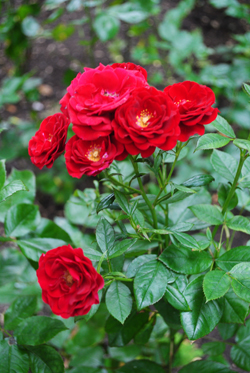
The garden, which was laid out in about 1950, is also notable for its beds of red roses, planted to commemorate the deal struck in 1381 in which the Sir Robert Knollys was belatedly granted permission for a footbridge his wife had built over Seething Lane. She had done so contrary to planning rules while he was away fighting with John of Gaunt (ostensibly so she could avoid the dust of the street when crossing from her house to her rose garden), and so when he returned, the City of London Corporation allowed the bridge (now long gone) to remain, but only in exchange for the symbolic “penalty” of one red rose a year.

The occasion is still marked each June in a ceremony overseen by the Company of Watermen and Lightermen of the River Thames in which a red rose is plucked from the garden and delivered to the Lord Mayor of London at Mansion House.

WHERE: Seething Lane Garden, Seething Lane, City of London (nearest Tube stations is Tower Hill); WHEN: Daily; COST: Free; WEBSITE: www.cityoflondon.gov.uk/things-to-do/green-spaces/city-gardens/Pages/default.aspx.

This garden reopened in 2018 after being redeveloped as part of the Trinity Square redevelopment.


LondonLife – Crossrail unearthed mass burial believed to be of Great Plague victims…

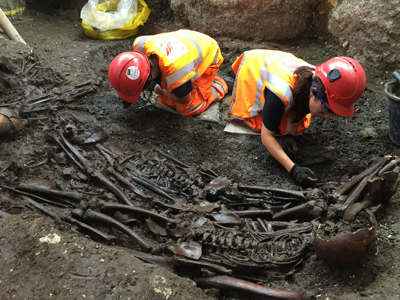
Plague-Pit---Crossrail

Thirty skeletons found in a mass burial – the latest archaeological find at Crossrail’s Liverpool Street site – are believed to have been victims of the Great Plague of 1665. Made during the excavation of the former Bedlam burial ground in order to make way for a new eastern entrance to the station, the discovery comes during the 350th anniversary year of the Great Plague. Jay Carver, the lead archaeologist for Crossrail, said the mass burial – with the bodies placed in now long gone wooden coffins – was unlike other individual burials found in the cemetery and thus “is likely a reaction to a catastrophic event”. “Only closer analysis will tell if this is a plague pit from the Great Plague of 1665 but we hope this gruesome but exciting find will tell us more about one of London’s notorious killers.” Clues which suggest that may be the case include a headstone found nearby marked “1665” and the fact that the 30 people all seem to have been buried on the same day. Museum of London Archaeology osteologists will now analyse the skeletons to find out the cause of death. Archaeologists have excavated more than 3,500 skeletons from the site since excavation of the burial ground – used between 1569 to at least 1738 – began earlier this year. It suggested 30,000 Londoners were buried there during that period. For more on the the Great Plague, see our earlier post herePICTURE: © Crossrail Ltd.