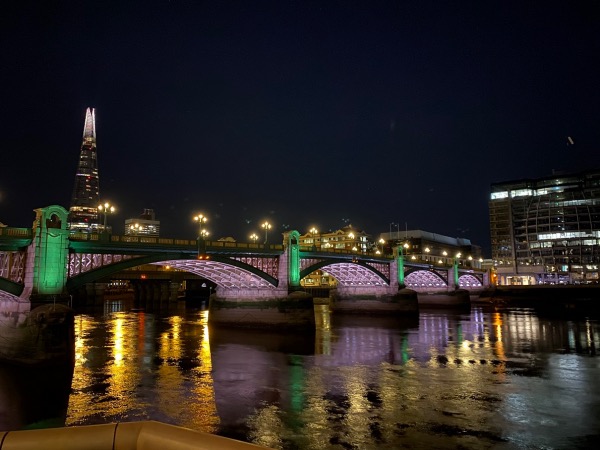
Southwark Bridge lit up to mark its 100th birthday. PICTURE: Courtesy of the City of London Corporation.
Southwark Bridge celebrated its 100th birthday earlier this month so we thought it a good time to have a quick look at the bridge’s history.
The bridge was a replacement for an earlier three-arch iron bridge built by John Rennie which had opened in 1819.
Known by the nickname, the “Iron Bridge”, it was mentioned in Charles Dickens’ Our Mutual Friend and Little Dorrit. But the bridge had problems – its narrow approaches and steep gradient led it to become labelled “the curse of the carman [cart drivers] and the ruin of his horses”.
Increasing traffic meant a replacement became necessary and a new bridge, which featured five arches and was made of steel, was designed by architect Sir Ernest George and engineer Sir Basil Mott.
Work on the new bridge – which was to cost £375,000 and was paid for by the City of London Corporation’s Bridge House Estates which was originally founded in 1097 to maintain London Bridge and expanded to care for others – began in 1913 but its completion was delayed thanks to the outbreak of World War I.
The 800 foot long bridge was finally officially opened on 6th June, 1921, by King George V who used a golden key to open its gates. He and Queen Mary then rode over the bridge in a carriage.
The bridge, now Grade II-listed, was significantly damaged in a 1941 air raid and was temporarily repaired before it was properly restored in 1955. More recently, the bridge was given a facelift in 2011 when £2.5 million was spent cleaning and repainting the metalwork in its original colours – yellow and ‘Southwark Green’.
The current bridge has appeared in numerous films including 1964’s Mary Poppins and, in more recent times, 2007’s Harry Potter and the Order of the Phoenix.
• The glittering world of playwright and songwriter Noël Coward is on show in a new exhibition openingat the Guildhall Art Gallery this Monday. The much delayed Noël Coward: Art & Style, which marks the 100th anniversary of Coward’s West End debut as a 19-year-old earlier this year, brings together never-before-seen materials from the Coward Archive and demonstrates the impact he and his creative circle had on the culture of his time – and today. Highlights include an original page of Coward’s handwritten lyrics for Mad Dogs and Englishmen, the chocolate brown evening suit he wore in the film Boom!, two of his signature silk dressing gowns, his iconic ‘Hamlet’ chair, and several of his own paintings. There’s also a specially commissioned new reconstruction of the iconic white satin dress that Molyneux designed in 1930 for Gertrude Lawrence in Private Lives and a never-before-exhibited gold lamé theatre cape by Lucile (Titanic survivor Lady Duff Gordon) from 1920. The exhibition, which is free, runs until 23rd December. Tickets must be booked in advance. For more, see www.cityoflondon.gov.uk/noelcoward.
• A new portrait depicting Dido Belle (1761-1804) has gone on display at Kenwood House – one of six works depicting historic figures from the African diaspora now on show at English Heritage properties across the nation. Belle, who is depicted by artist Mikéla Henry-Lowe, was the illegitimate daughter of a young black woman named Maria Bell and a Royal Naval officer, Sir John Lindsay. She spent much of her life at Kenwood House with her great-uncle William Murray, 1st Earl of Mansfield, the Lord Chief Justice. Other portraits in the series depict the likes of African-born Roman Emperor Septimius Severus (the work of Elena Onwochei-Garcia, it’s on display at Corbridge Roman Town on Hadrian’s Wall, Northumberland), North African-born 7th century Abbot Hadrian (the work of Clifton Powell, it’s on display at St Augustine’s Abbey in Kent) and Queen Victoria’s god-daughter Sarah Forbes Bonetta (the work of Hannah Uzor, it’s on display at Osborne House on the Isle of Wight). For more, see www.english-heritage.org.uk/learn/histories/black-history/.
• More than 25 works by Australian artists exploring debates around land rights and colonialism have gone on show in a new exhibition at the Tate Modern. A Year in Art: Australia 1992 takes as its starting point the High Court of Australia’s landmark 1992 Mabo ruling which overturned the doctrine of terra nullius. Works on show include Emily Kame Kngwarreye’s 1989 Untitled (Alhalkere) – an expression of her cultural life as an Anmatyerre elder, Gordon Bennett’s 1991 work Possession Island (Abstraction) which is presented in dialogue with Algernon Talmage’s 1937 work The Founding of Australia 1788, and Tracey Moffatt’s 1997 photographic series Up in the Sky, which speaks to the ‘Stolen Generations’ – the forced separation of Aboriginal families by government agencies. At the heart of the display is Vernon Ah Kee’s 2010 four-screen video installation tall man which shows footage of the protests and riots following the death in custody of Mulrunji Doomadgee on Palm Island in 2004. The exhibition is free. For more, see www.tate.org.uk.
Send all items for inclusion to exploringlondon@gmail..com
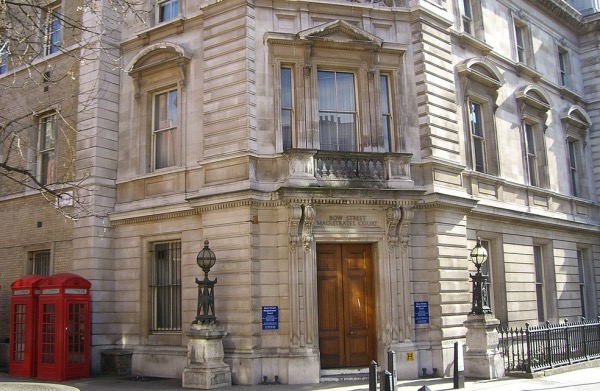
The Bow Street Magistrates’ Court in 2006, the year of its closure. PICTURE: Edward (public domain)
The Bow Street Police Museum, located on the site of the 1881 Bow Street Magistrates’ Court and Police Station, has opened its doors in Covent Garden. The museum tells the story of the early Bow Street Runners, the first official law enforcement service in the city, and the Metropolitan Police officers who came after. Visitors can explore the former cells and hear the stories of those who once worked in the building. The connections between Bow Street and the constabulary dates back to 1740 when Thomas de Veil opened a Magistrates’ Court in his family home at number four Bow Street in the 18th century and continued until the closure of the Bow Street Magistrates’ Court in 2006. Among the famous faces who passed through Bow Street’s police station and court over that time were Oscar Wilde, Suffragettes Sylvia Pankhurst, Christabel Pankhurst and Mrs Drummond, and the Kray twins. For more, head to https://bowstreetpolicemuseum.org.uk.
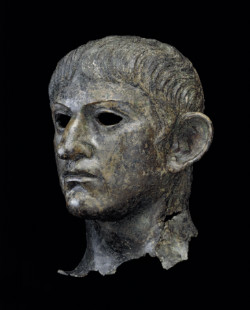
• A bronze head of the Roman Emperor Nero found in the River Alde in Suffolk – long wrongly identified as being that of the Emperor Claudius – and the Fenwick Hoard – which includes Roman coins, military armlets and jewellery – are among the star sights at a new exhibition on Nero at the British Museum.Nero: the man behind the myth is the first major exhibition in the UK which takes Rome’s fifth emperor as its subject. The display features more than 200 objects charting Nero’s rise to power and his actions during a period of profound social change and range from graffiti and sculptures to manuscripts and slave chains. Other highlights include gladiatorial weapons from Pompeii, a warped iron window grating burnt during the Great Fire of Rome of 64 AD, and frescoes and wall decorations which give some insight into the opulent palace he built after the fire. The exhibition, which opens today, runs until 24th October in the Sainsbury Exhibitions Gallery. Admission charge applies. For more, see www.britishmuseum.org/whats_on/exhibitions/nero/events.aspx.
• The office of late theoretical physicist Professor Stephen Hawking will be recreated at the Science Museum, it was announced this week. The contents of the office, which Hawking, the author of the best-selling A Brief History of Time, occupied at Cambridge’s department of applied mathematics and theoretical physics from 2002 until shortly before his death in 2018, includes reference books, blackboards, medals, a coffee maker and Star Trek mementoes as well as six of his wheelchairs and the innovative equipment he used to communicate. The museum, which reportedly initially plans to put the objects on display in 2022 and later recreate the office itself, has acquired the contents through the Acceptance in Lieu scheme, which allows families to offset tax (his archive will go to the Cambridge University Library under the same scheme).
• Nineteenth century civil engineer Ardaseer Cursetjee Wadia – the first Indian Fellow of the Royal Society – has been honoured with an English Heritage Blue Plaque at his former Richmond home. The plaque, which can be found on 55 Sheen Road – the villa Cursetjee and his British family moved to upon his retirement in 1868, was installed to mark the 180th anniversary of his election as a Fellow of the Royal Society. Cursetjee is considered the first modern engineer of India and was the first Indian at the East India Company to be placed in charge of Europeans. He was at the forefront of introducing technological innovations to Mumbai including gaslight, photography, electro-plating and the sewing machine. Cursetjee first visited London in 1839 and travelled regularly been Mumbai (formerly Bombay) and London until his retirement. For more, see www.english-heritage.org.uk/visit/blue-plaques.
Send all items for inclusion to exploringlondon@gmail.com.
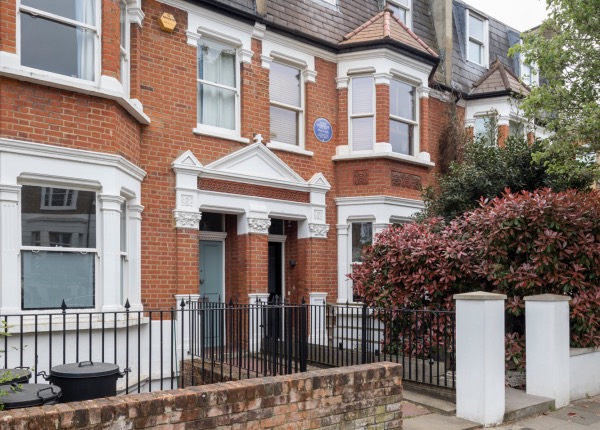
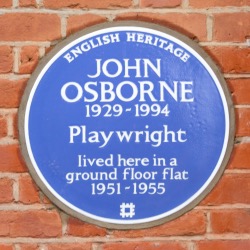
Blue Plaque to John Osborne at 53 Caithness Road in Hammersmith. PICTURE: Courtesy of English Heritage.
Blue Plaque to John Osborne. PICTURE: Courtesy of English Heritage.
Post-war playwright John Osborne (1929-1994) was honoured with an English Heritage Blue Plaque last week at his former Hammersmith home. The announcement came 65 years after his seminal play, Look Back in Anger, was first performed at the Royal Court Theatre on 8th May, 1956. The terraced red brick property at 53 Caithness Road was his London base when he wrote Look Back in Anger, arguably his best known work. Playwright and director Sir David Hare said Osborne “had the most sensational London debut of any playwright in the English language in the 20th century”. “It was John’s brilliance and originality which led so many to help relocate the theatre at the centre of Britain’s cultural and intellectual life. Everyone who followed owes him a debt.” For more on Blue Plaques, see www.english-heritage.org.uk/visit/blue-plaques.
The word is believed to have been first popularised around 1890. Underground lines had previously been constructed using the ‘cut and cover’ method – that is, digging out the trench for the Underground line, lining the tunnel with iron and them covering it.
Thanks to its depth (due to the fact it had to pass under the Thames), City and South London Railway’s line from King William Street (a now disused station) to Stockwell was the first to be created by boring a tunnel through the earth and then lining it to create a tube. The line, a forerunner of what is now the Northern Line, opened in December, 1890. It was the first true ‘tube’ of the Underground system.
The construction of the line was followed in 1900 by the opening of the Central London Railway’s line from Shepherd’s Bush to Bank (now part of the Central Line) which was given the nickname the “Twopenny Tube”.
The name stayed and was soon applied to the entire network of Underground lines (and interestingly, it wasn’t until 1908 that the word “Underground” first appeared in stations).
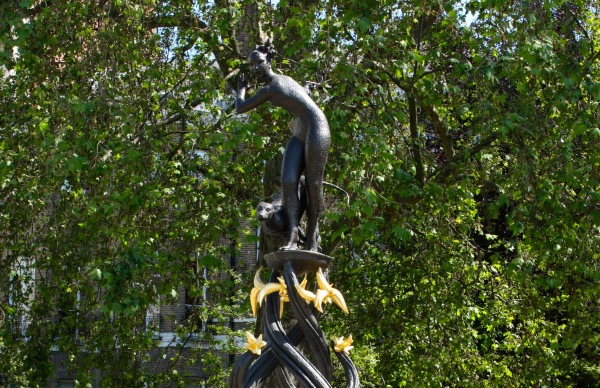
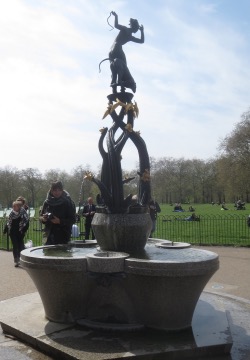
This fountain and statue ensemble – also known as Diana of the Treetops and the Constance Fountain (and not to be confused with the Diana, Princess of Wales Memorial Fountain in Hyde Park or the Diana Fountain in Bushy Park) – for many years stood at the centre of Green Park.
The fountain replaced an earlier one by Sidney Smirke – installed in 1860 – that had fallen into disrepair.
The Ministry of Works approached the Constance Fund – which had been established by artist Sigismund Goetze and was administered by his wife Constance following his death – to provide finances for a replacement and after they agreed, a competition for the design was held overseen by Sir William Reid.
Escourt J “Jim” Clack, a teacher from Devon, won and designed a bronze statue of the Greek goddess Diana to top the fountain. Depicting a naked Diana unleashing a hunting dog, it sits atop a stylised tree under which sit the fountain basins. The fountain was unveiled in 1954.
In 2011, the statue was removed, restored and some gilding added and then placed near the entrance to Green Park tube station in the north-east corner of the park.
• As the inauguration of US President Joe Biden took place in the US this week, the Museum of London announced it had taken possession of the larger-than-life ‘Trump Baby’ balloon. The blimp first appeared at protests in July, 2018, during then-US President Donald Trump’s first visit to the city, and has since followed the President around the world. The museum said it will now form part of its protest collection which also includes objects relating to the Suffrage movement, banners, flags, and tents that belonged to Houses of Parliament protestor Brian Haw and placards used recently by protestors against public spending cuts. Sharon Ament, director of the museum, said: “From the Suffragettes of the early twentieth century to the anti-austerity marches, free speech and Black Lives Matter most recently – the capital has always been the place to have your say. By collecting the baby blimp we can mark the wave of feeling that washed over the city that day and capture a particular moment of resistance – a feeling still relevant today as we live through these exceptionally challenging times – that ultimately shows Londoners banding together in the face of extreme adversity.” The Trump Baby team added that it was their hope the blimp “will stand as a reminder of when London stood against Trump – but will prompt those who see it to examine how they can continue the fight against the politics of hate”. “Most of all we hope the Trump Baby serves as a reminder of the politics of resistance that took place during Trump’s time in office.”
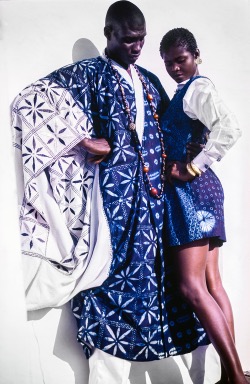
• The V&A is seeking to contact people who have worn fashions designed by the likes of Shade Thomas-Fahm, Chris Seydou, Kofi Ansah, and Alphadi – a group who, along with their peers, represent the first generation of African designers to gain international attention. The call out comes as the South Kensington museum announces plans to hold an exhibition, supported by GRoW @ Annenberg, which aims to celebrate the creativity, ingenuity and global impact of contemporary African fashions in June. The display will feature more than 250 objects, drawn from the personal archives of African fashion creatives, alongside textiles and photographs from the V&A’s collection (many of which are being displayed for the first time). Alongside the objects, the museum is seeking a range of items – and the stories that go with them – from the public. They include Chris Seydou’s 1980s experimental garments in bògòlanfini, 20th century kente, bògòlanfini, khanga and commemorative cloths from the independence and liberation years in Africa, and family portraits and home movies showing African and African diasporic fashion trends. Members of the public with objects that fit the above description are asked to get in touch by email at africafashion@vam.ac.uk, and to share their pictures and memories on social media, using the hashtag #AfricaFashion. For the full list of sought after items, head to www.vam.ac.uk/blog/news/va-africa-fashion-call-out.
Send all items for inclusion to exploringlondon@gmail.com.
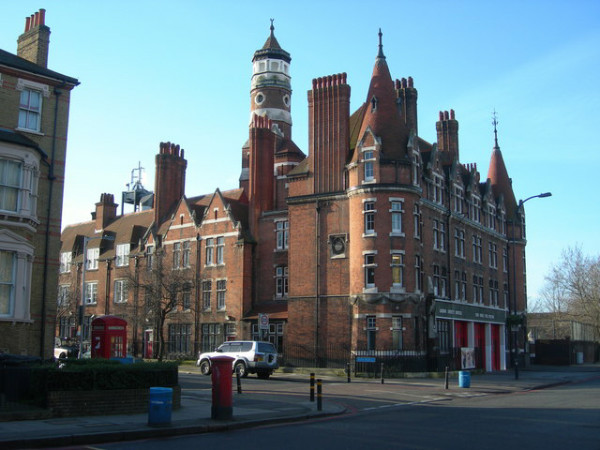
The closure of two fire stations in 2014 – Clerkenwell (which opened in 1872) and Woolwich (which opened in 1887) – has left New Cross Fire Station in the city’s south as the oldest in London (and, according to the London Fire Brigade, the oldest in Europe as well.)
The station, which was designed in a rather grand “chateau-style” by the brigade’s chief architect Robert Pearsall, was opened at 266 Queen’s Road in New Cross in 1894. It was built to accommodate the divisional superintendent, a station foreman and 16 firefighters – eight married and eight unmarried – as well as two coachmen and stables for four horses.
The fire station initially housed a steam-powered and a manual firefighting appliance as well as a hose cart and van, a long ladder (which had its own shed in the yard) and four fire escapes.
The fire station underwent a major upgrade in 1912, improvements included the addition of more flats for married officers and self-contained houses for the superintendent and foreman as well as a sliding pole to give firefighters a quicker trip to the engine house. In 1958, a third appliance bay was added.
One of the most infamous incidents the firefighters from New Cross attended was in November, 1944, when a V2 bomb hit a Woolworths store in New Cross just after midday on a busy Saturday. Some 168 people were killed, 33 of whom were children, and a further 123 were injured in the attack.
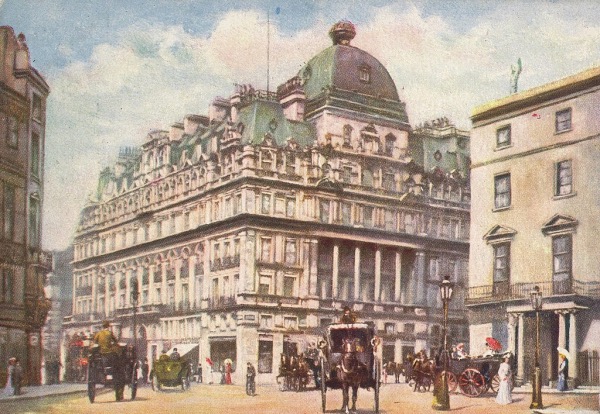
A luxury hotel built at the turn of the 20th century in the West End, the massive Carlton Hotel was part of an even larger redevelopment that included the (still standing) fourth version of Her Majesty’s Theatre (which provides a good idea of what the overall building looked like).
Located on the Crown estate on the corner of Pall Mall and Haymarket, the hotel was designed by CJ Phipps (who died before it was completed). Building started in 1896 and was completed by 1899.
Swiss hotelier César Ritz – who had been dismissed from his position as the manager of the Savoy Hotel in 1897 and subsequently successful opened his own establishment, the Hôtel Ritz, in Paris the following year – agreed to take a 72-year lease of the new hotel and a new company, The Carlton Hotel, Limited, was formed.
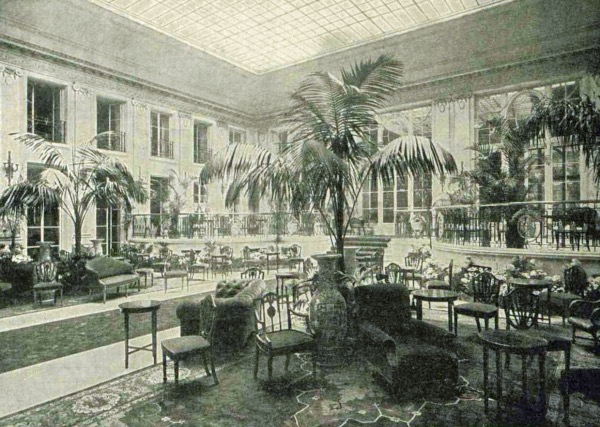
The building, which had interiors designed in the French Renaissance style, contained more than 300 guest rooms, all with telephones, including 72 suites which came with en suite bathrooms. There were also private dining and reception rooms for guests as well as reading and smoking rooms and a highly regarded Palm Court. And, of course, a restaurant in which Auguste Escoffier, who had left the Savoy under a cloud with Ritz, was employed as a head chef.
The Palm Court at The Carlton Hotel as featured in the Illustrated London News on 5th August, 1899.
The hotel, the upper floors of which contained private residences, was a hit and quickly threatened the status of the Savoy as the city’s most fashionable hotel. But in 1902, as the hotel was preparing to mark the coronation of King Edward VII, the king fell ill and the festivities were postponed indefinitely. Ritz suffered a nervous breakdown – apparently from the shock – and Escoffier was left in charge.
While its reputation was never again as high as it had been in the years immediately after opening, the Carlton Hotel remained profitable until World War II when it was heavily damaged during German bombing in 1940. Residential parts of the building were closed and in 1942 the remainder of the building was requisitioned by the British Government (with the exception of the American Bar and Grill Room which remained open).
The hotel never fully reopened, however, and, in 1949, the lease was sold to the New Zealand Government. The Carlton Hotel was demolished in 1957-58 and the New Zealand High Commission subsequently built on the site.
Among the hotel’s most famous clientele was Winston Churchill who was apparently dining in the restaurant with Lloyd George when World War I was declared.
Another famous association is commemorated by an English Heritage Blue Plaque which records the fact that Ho Chi Minh, founder of modern Vietnam, worked there as a cook in 1913 (when he was then known as Nguyen That Tanh).
There’s a story that Tanh, seeing how much food was being thrown away, asked Escoffier if he could give it to the poor, to which Escoffier told him to put aside his revolutionary ideas so he could teach him “the art of cooking, which will make you a great deal of money”. Tanh clearly choose another path.
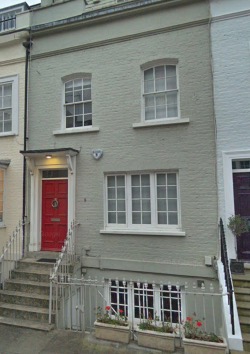
News this week that spy turned novelist John Le Carré has died at the age of 89. His family reportedly confirmed the author had died of pneumonia at the Royal Cornwall Hospital on Saturday night.Born as David Cornwall, Le Carré worked as an intelligence officer for the British Foreign Service and, drawing in his work, began writing Cold War spy thrillers under the pseudonym of Le Carré with his first, Call for the Dead, published in 1961. It was in this novel – Le Carré went on to write others – that his most famous character, George Smiley, made his first appearance. Initially a minor character, Smiley went on to become a star in three novels published in the 1970s, the most famous of which is Tinker Tailor Soldier Spy (Smiley’s last appearance was in a later book, 2017’s A Legacy of Spies). In tribute to Le Carré and George Smiley, pictured is 9 Bywater Street in Chelsea, the fictional home of Smiley (albeit a very real property!)
This tradition, the origins of which go back centuries, centres on a ceremony at the Royal Hospital Chelsea which involves the blessing and cutting of a ‘Christmas Cheese’ with a sword.
The origins of the tradition go back to 1692 when a local cheesemonger donated cheese to the Chelsea Pensioners – retired members of the British Army – for Christmas. Since 1959, it’s been organised by industry body Dairy UK and sees cheesemongers from across the UK donate cheeses to the hospital.
The ceremony involves the largest cheese among those donated being blessed and then cut with a sword by a selected pensioner. The cheese is then distributed to the pensioners at meal times in the run-up to Christmas.
This year a special COVID-safe ceremony was held and some 258 kilograms of cheese were donated to the hospital. The largest cheese – a 25 kilogram Montgomery Cheddar – was cut by Chelsea Pensioner George Reed who had a 25 year career in military as well as a career at the BBC.
As well as last year’s 60th anniversary ceremony aside, other milestones have taken place in 2016 – when Chelsea Pensioner Mary Johnston became the first woman to cut the ceremonial cheese – and in 2009, when two members of Territorial Army London Regiment bound for Afghanistan joined the ceremony for the first time.
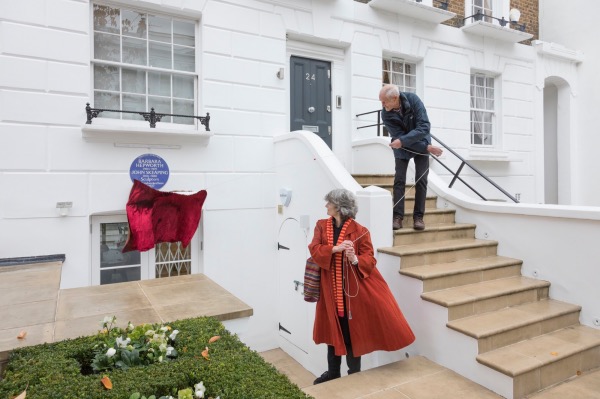
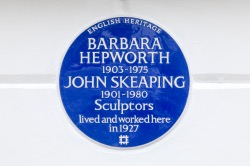
Twentieth century sculptors Barbara Hepworth (1903-1975) and John Skeaping (1901-1980) have been recognised with an English Heritage Blue Plaque at their former home in St John’s Wood. The couple lived in the basement flat at 24 St Ann’s Terrace for less than a year in 1927 but during that time held a joint exhibition (Hepworth’s first ever) in the studio, located in a former billiards room at the rear of the house. The room was also where Hepworth created one of her earliest Mother and Child sculptures as well as works including Doves and Seated Figure. Present at the unveiling last Friday were Sophie Bowness, Barbara Hepworth’s grand-daughter, and Nicholas Skeaping, John Skeaping’s son. For more, on English Heritage Blue Plaques, head to www.english-heritage.org.uk/visit/blue-plaques/.
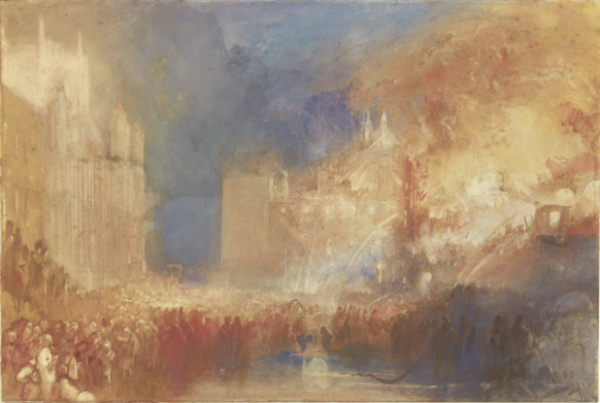
JMW Turner, ‘The Burning of the Houses of Parliament’ (c 1834-35), oil paint on canvas, Tate (accepted by the nation as part of the Turner Bequest 1856)
• A landmark exhibition on the work – and times – of JMW Turner opens at the Tate Modern in Millbank today. Turner’s Modern World features some 160 works and attempts to show how the landscape painter found “new ways to capture the momentous events of his day, from technology’s impact on the natural world to the dizzying effects of modernisation on society”. Highlights include war paintings such as The Battle of Trafalgar (1806-8) and Field of Waterloo (1818), works capturing political events like The Burning of the Houses of Lords and Commons (1835) and maritime disasters like A Disaster at Sea (1835) and Wreck of a Transport Ship (c1801), as well as works related to the industrial advances taking place such as Snow Storm (1842), The Fighting ‘Téméraire’ (1839), and Rain, Steam and Speed (1844). Admission charge applies. Runs until 7th March (online booking required). For more, see www.tate.org.uk.
• An exhibition at the National Army Museum in Chelsea marks the 100th anniversary of the Unknown Warrior being laid to rest in Westminster Abbey. Using objects, paintings, photography and personal testimony, Buried Among Kings: The Story of the Unknown Warrior tells the story of the creation of this symbolic memorial dedicated to the hundreds of thousands of British servicemen who died during World War I. Highlights include a union flag on loan from the Railton family (it was Chaplain David Railton who conceived the original idea for an Unknown Warrior following an encounter in 1916 with a wooden cross on the Western Front which was inscribed ‘An Unknown British Soldier’), a Bible carried by Chaplain George Kendall during the selection of the Unknown Warrior, a fragment of the original wooden Cenotaph erected in 1919-1920, and Frank O Salisbury’s large scale painting, The Passing of the Unknown Warrior, which depicts the procession of the Unknown Warrior from Victoria Station to Westminster Abbey. In connection with the exhibition, Victoria Station is hosting a pop-up display between 9th and 16th November on the journey of the Unknown Warrior from the Western Front to Westminster Abbey (the coffin actually arrived in London on 10th November, 1920). Admission charge applies (at Chelsea). Runs until 14th February (online booking required). For more, see www.nam.ac.uk.
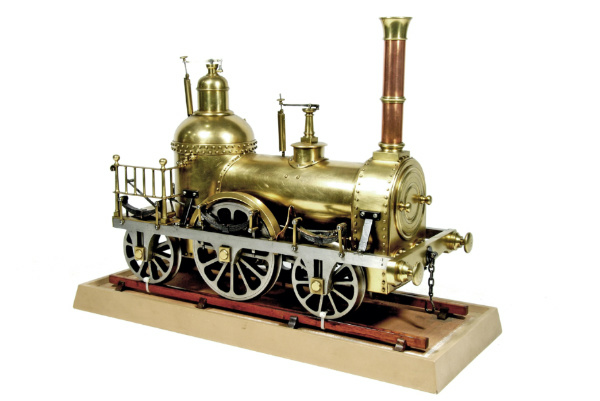
Model steam locomotive, 1:12 scale, working, represents a standard passenger type locomotive c.1837, made by Mr. J. Dawson, District Superintendent at Southampton of the London & Southampton Railway.
• Model making in the “age of the railways” is the subject of a free exhibition now on at the Science Museum in South Kensington. Brass, Steel and Fire features intricate models from the Science Museum Group Collection as well as stunning miniature locomotives and a display of almost 200 tools used by model-maker Keith Dodgson. Highlights include ‘Salamanca’, the world’s oldest model locomotive (on loan from Leeds Museums and Galleries), a model of ‘Fire King’ – made in the 1840s by apprentice Josiah Evans who used his experience to later build full size locomotives, and the world’s oldest working model steam engine, the Etherley winding engine model. The exhibition is free and runs until 3rd May. Online booking required. For more, see sciencemuseum.org.uk/see-and-do/brass-steel-and-fire.
Send all items for inclusion to exploringlondon@gmail.com
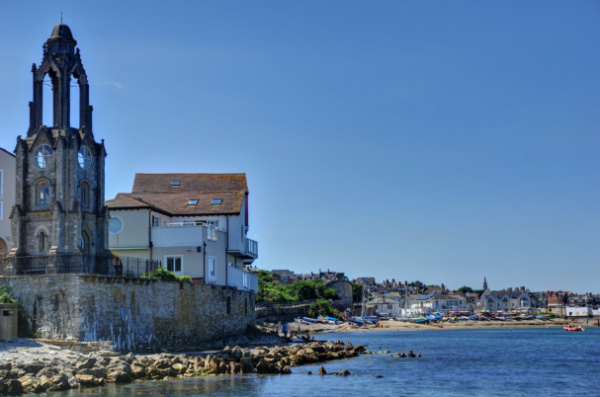
Now situated on the seafront of the town of Swanage in Dorset, the Wellington Clock Tower was originally located at the southern end of London Bridge.
The tower was erected in 1854 as a memorial to the Duke of Wellington, Arthur Wellesley, who had died two years earlier.
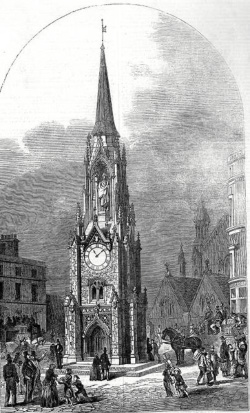
The then proposed Wellington Clock Tower depicted in the London Illustrated News in June, 1854
Its construction was funded through public subscription and contributions of railway companies with the support of the Commissioners for Lighting the West Division of Southwark. It was designed in the Perpendicular Gothic style by Arthur Ashpitel and, after the foundation stone was laid on 17th June, 1854, took six months to build.
The three level structure, which was topped with a tall spire, housed a clock with four faces. The clock was made by Bennett of Blackheath for the 1851 Great Exhibition but the constant rumbling of the carts passing its new location apparently meant the mechanism never kept good time.
There was also small telegraph office in the ground floor room of the tower. A statue of Wellington was intended to be placed within the open top level but funds apparently ran out before it could be commissioned and it never appeared (Wellington’s declining popularity at the time may have also been a factor).
The location of this rather splendid structure meant, however, that it was soon overshadowed by construction of nearby raised railway lines. When the Metropolitan Police condemned the tower as an obstruction to traffic, it was the final straw and having spent little more than a decade in position, the decision was made to demolish the tower.
It was taken down in 1867 but rather than simply being scrapped, Swanage-based contractor George Burt had the building shipped in pieces – they apparently served as ballast during the journey – to his hometown in Dorset where he presented it as a gift to fellow contractor Thomas Docwra. Docwra had the tower reconstructed in a seafront location on the grounds of his property, The Grove, at Peveril Point.
The rebuilt tower lacked the original clock – its faces were replaced with round windows – and in 1904 the spire was also removed and replaced with a small cupola (there’s been various reasons suggested for this, including that the spire was damaged in a storm or because it was felt to be sacrilegious by the religious family which then owned the property).
The tower, which was granted a Grade II heritage listing in 1952, can still be seen on the Swanage waterfront today.
One of the lost churches of the City of London, All Hallows Lombard Street once stood on the corner of this famous City street and Ball Alley.
Dating from medieval times, the church was badly damaged in the Great Fire of London and, while the parishioners initially tried their own repairs, it was subsequently rebuilt by the office of Sir Christopher Wren and completed by 1679.
The result was apparently a rather plan building but it did feature a three storey tower (in fact, so hemmed in by other buildings did it become that some called it the “invisible church”). The church also featured a porch which had come from the dissolved Priory of St John in Clerkenwell and had, from what we can gather, been part of the previous building.
Among those who preached in the rebuilt church was John Wesley in 1789 (he apparently forgot his notes and, after some heckling from the congregation, it’s said he never used notes again).
The parish of St Dionis Backchurch was merged with All Hallows when the latter was demolished in 1878 (All Hallows has already been merged with St Benet Gracechurch when that church was demolished in 1868 and St Leonard Eastcheap in 1876). Bells from St Dionis Backchurch were brought to All Hallows following the merger.
The declining residential population in the City saw the consolidation of churches and following World War I, All Hallows Lombard Street was listed for demolition. There was considerable opposition to the decision but structural defects were found in the building’s fabric and demolition eventually took place in 1937.
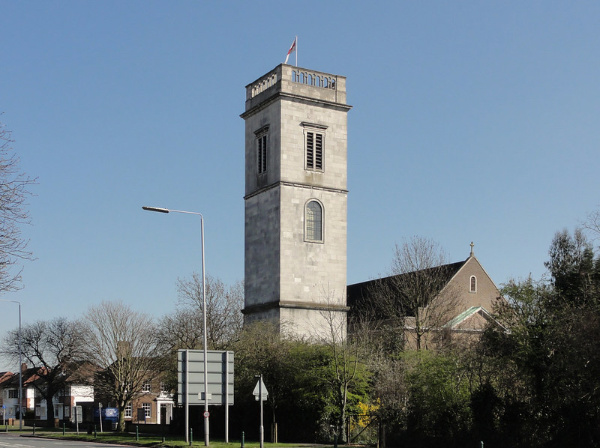
But there was to be a second life of sorts for the church. The square, stone tower, including the porch and fittings from the church such as the pulpit, pews, organ and stunning carved altarpiece, were all used in the construction of a new church, All Hallows Twickenham in Chertsey Road.
Designed by architect Robert Atkinson, it was one of a couple of new churches built with proceeds from the sale of the land on which All Hallows Lombard Street had stood.
Replacing an earlier chapel, the new Twickenham church was consecrated on 9th November, 1940 by the Bishop of London, Geoffrey Fisher (apparently with the sound of anti-aircraft fire in the background).
The 32 metre high tower houses a peal of 10 bells, including some of those from St Dionis Backchurch, as well as an oak framed gate decorated with memento mori carvings – including skulls and crossbones – which came from All Hallows Lombard Street.
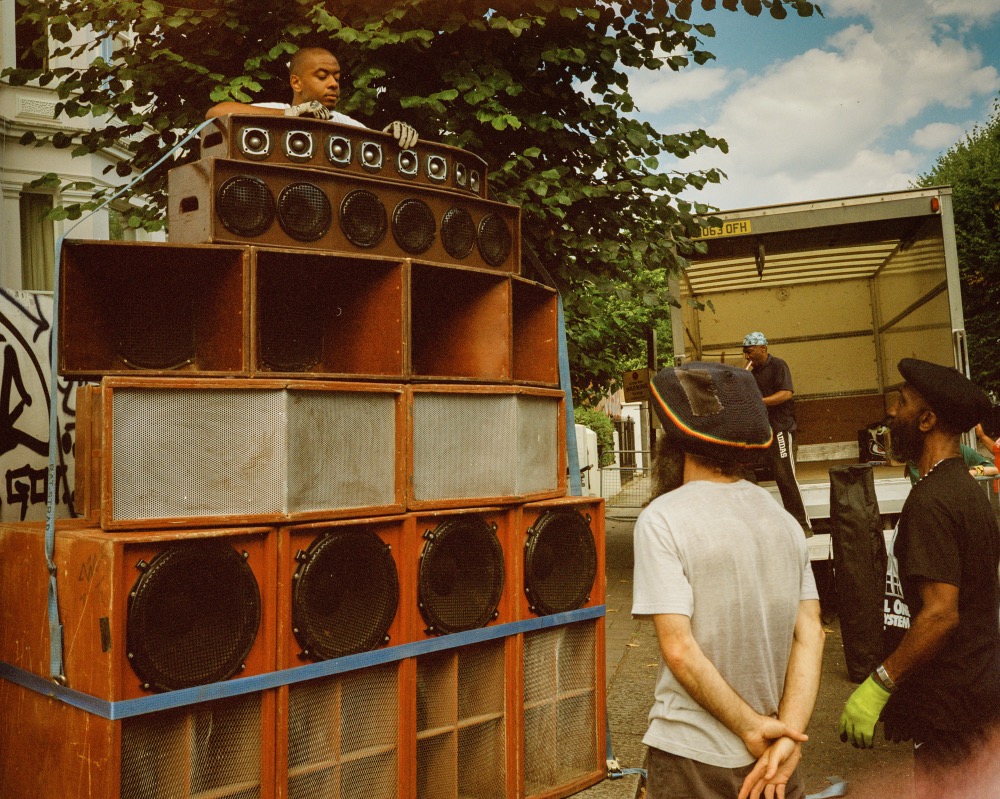
• Dub music and the impact it’s had on London’s identity and people is the subject of a new, long delayed, exhibition which opened at the Museum of London late last week. Dub London: Bassline of a City, which had been postponed due to the coronavirus pandemic, charts how, from its roots in Jamaican reggae, dub music went on to influence multiple genres and played a key role in the development of punk bands like The Clash. The display includes the iconic speaker stack belonging to Channel One Sound System that has appeared yearly at Notting Hill Carnival since 1983 (pictured above) and a specially created bespoke record shop with a selection of 150 vinyl records chosen by 15 London based independent record shops which can be listened to. Runs until 31st January. Admission is free but must be booked in advance (and bring your own headphones). For more, see www.museumoflondon.org.uk/museum-london/whats-on/exhibitions/dub-london.
• The concept of sin is at the heart of a new free exhibition at The National Gallery. Sin brings together 14 works dating from the 16th century to now by artists ranging from Jan Brueghel the Elder and William Hogarth to Andy Warhol and Ron Mueck. Among the paintings on show are Lucas Cranach the Elder’s Adam and Eve (1526), Hogarth’s The Tête à Tête and Marriage A-la-Mode, Diego Velázquez’s Immaculate Conception, William Holman Hunt’s The Scapegoat (1854-55), and Ron Mueck’s sculpture Youth (2009). The display can be seen in Room 1. For more, see nationalgallery.org.uk.
• The science of the coronavirus is explored in a special night event at the Science Museum next Wednesday, 14th October. Staff from the Francis Crick Institute will be joining with those from the Science Museum in exploring how the immune system remembers and evolves and how the Crick was turned from a biomedical research centre into a COVID-19 testing facility. Visitors can also hear from NHS transplant surgeon Pankaj Chandak who has been using 3D printing tech to make life-saving PPE for frontline staff while the Leonard Cheshire charity shows how assistive eyegaze technology has played a vital role in helping to keep people with access needs connected. There will also be a chance to make a facemask as part of the museum’s #MaskSelfie campaign and the opportunity to explore the museum’s new Medicine: The Wellcome Galleries. Admission charge applies and pre-booking is essential. Head to sciencemuseum.org.uk/see-and-do/lates.
Send all items for inclusion to exploringlondon@gmail.com.
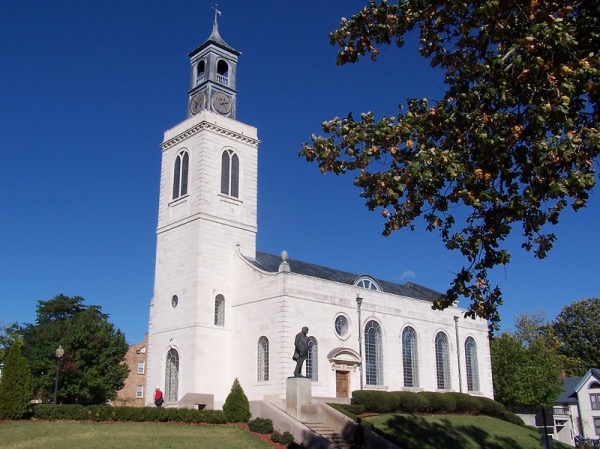
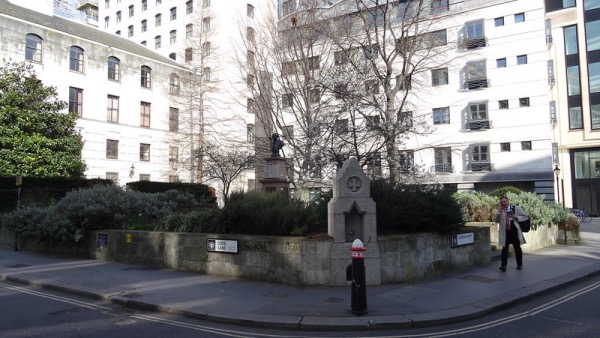
This church – not to be confused with the similarly named but still existing St Mary Aldermary – once stood at the corner of Love Lane and Aldermanbury in the City of London.
St Mary Aldermanbury, now part of the National Churchill Museum on the campus of Westminster College, Fulton, Missouri, in the US. PICTURE: J. Stephen Conn (licensed under CC BY-NC 2.0)
Founded in the 11th or early 12th century, the church – the name of which apparently relates to an endowment it received from an Alderman Bury, was destroyed in the Great Fire of London in 1666 and rebuilt by Sir Christopher Wren in a simple form with no spire.
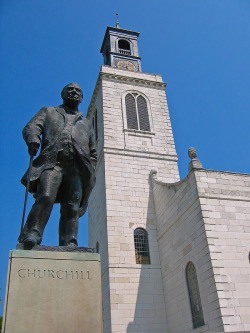
It was gutted during the Blitz – one of 13 Wren churches hit on the night of 13th December, 1940 – and the ruins were not rebuilt. Instead, in the 1960s (and this is where we get to the relocation part) a plan was put into action to relocate the church so it could form part of a memorial to Winston Churchill in the grounds of Westminster College in Fulton, Missouri.
It was only after four years of planning and fundraising (the project apparently cost some $US1.5 million with the money raised from donors including actor Richard Burton) that the relocation process finally began in 1965.
It started with workers in London cleaning, removing and labelling each of the church’s 7,000 stones so they could be reconstructed correctly on the other side of the Atlantic.
They were shipped free-of-charge – the US Shipping Board moved them as ship’s ballast – and then taken by rail to Fulton.
By the time the stones reached Fulton they had been jumbled. And so began the painstaking process of reassembling what was described as the “biggest jigsaw puzzle in the history of architecture” (with the stones spread over an acre, it apparently took a day just to find the first two stones).
While the first shovel on the project had been turned by former US President Harry S Truman on 19th April, 1964 (his connection to the project will become clear), the foundation stone was laid in October, 1966, 300 years after the Great Fire of London.
The shell of the church was completed by May, 1967. Two more years of work saw the church’s interior recreated with English woodcarvers, working from pre-war photographs, to make the pulpit, baptismal font, and balcony (new glass was also manufactured and five new bronze bells cast for the tower). The finished church, which was rededicated in May, 1969, was almost an exact replica of the original but apparently for a new organ gallery and a tower window.
Why Fulton for a tribute to Churchill? The connection between Churchill and Westminster College went back to the post war period – it was in the college’s historic gymnasium building that, thanks to a connection the institution had with President Truman, Churchill was to give one of his most famous speeches – the 1946 speech known as ‘Sinews of Peace’ in which he first put forward the concept of an “Iron Curtain” descending between Eastern and Western Europe.
The church is now one part of the National Churchill Museum, which also includes a museum building and the ‘Breakthrough’ sculpture made from eight sections of the Berlin Wall. It was selected for the memorial – planned to mark the 20th anniversary of Churchill’s speech – thanks to its destruction in the Blitz, commemorating in particular the inspiring role Churchill had played in ensuring the British people remained stalwart despite the air raids.
Meanwhile, back in London the site of the church has been turned into a garden. It contains a memorial to John Heminges and Henry Condell, two Shakespearean actors who published the first folio of the Bard’s works and were buried in the former church. The footings upon which the church once stood can still be seen in the garden and have been Grade II-listed since 1972.
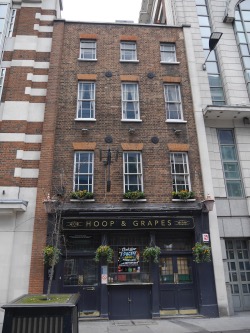
This historic pub in Farringdon bears a common enough name (and it’s not to be confused with the Hoop and Grapes located in Aldgate which we’ll look at in an upcoming post).
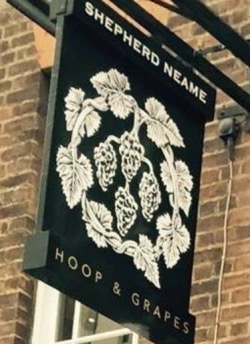
The hoop in the name refers to the metal bands binding together barrels staves and the grapes are obviously a reference to wine. But the ‘hoop’ could be a corruption of hops with the sign possibly once featuring a garland of hops and a bunch of grapes.
The pub, the current sign of which depicts grapes wrapped around a hoop (pictured below), is located in a four storey building first constructed for a vintner in about 1720 as a terraced house and converted to a pub more than a century later in the early 1830s.
Located on ground which one formed part of the St Bride’s Burial Ground, the brick vaults underneath are said to pre-date the rest of the building, having been built as warehouse vaults in the 17th century.
Its location on 80 Farringdon Street means it stood near the Fleet River (now covered) and close by to the former Fleet Prison (largely used as a debtor’s prison before its demolition in 1864).
As a result, it has been claimed that it was one of a number of pubs which hosted so-called ‘Fleet Marriages’, secret ceremonies performed by dodgy clergymen – for a fee – and without an official marriage license. But, as has been pointed out to us, the timing of the passing of the Marriage Act in 1753 outlawing such activities – and this only becoming a pub, according to its Historic England listing, much later – does make this seem unlikely (we’d welcome any further information on this claim).
The location also meant it was popular with printers who worked in nearby Fleet Street (in fact, it was apparently given a special licence to serve such customers at night or in the early morning).
The pub was scheduled for demolition in the early 1990s but saved with a Grade II-listing in 1991.
A rare survivor from an earlier time among the street’s more modern buildings, it is now part of the Shepherd Neame chain and it’s during renovations held after this purchase that burials were uncovered (the remains were moved into the British Museum). This has apparently led to rumours that the pub is haunted.
Sorry for the confusion – We’ve corrected references to grapes in the second paragraph (and amended our comments on the current sign). And we’ve also clarified comments that the pub was used for Fleet Marriages given the timing discrepancy.
• The history of Black British mariners is the subject of a new exhibition opening at the Old Royal Naval College in Greenwich on Saturday. Marking Black History Month, Black Greenwich Pensioners explores the history of the Black Royal Navy personnel and how they formed one of Britain’s earliest Black communities when they became pensioners at the Royal Hospital for Seaman on the site where the Old Royal Naval College stands today. Through paintings, prints, photographs and a small selection of objects, the display looks at the role Black mariners played in British naval conflicts as well as the personal histories of prominent Greenwich pensioners including John Thomas, who escaped slavery and was later returned to enslavement in Barbados, John Simmonds, a Jamaican veteran of the 1805 Battle of Trafalgar whose descendants still reside in the UK, and Briton Hammon, author of the first slave narrative. Entry is free. Runs until 21st February in the mezzanine gallery at the Visitor Centre. For more, see https://ornc.org/uncovering-the-history-of-black-british-mariners/
• The first exhibition to showcase the full spectrum of American artist Bruce Nauman’s work in more than 20 years opens at the Tate Modern on Wednesday.Bruce Nauman features more than 40 works and “unfolds” over a sequence of immersive installations. Highlights include a selection of early works such as Henry Moore Bound to Fail (1967/70) and A Cast of the Space Under My Chair (1965/68), the moving image installation MAPPING THE STUDIO II with color shift, flip, flop & flip/flop (Fat Chance John Cage) (2001), ground-breaking neon signs like The True Artist Helps the World by Revealing Mystic Truth (Window or Wall Sign) (1967), Human Nature Knows/Doesn’t Know (1983/86) and One Hundred Live and Die (1984) and large scale works such as Going Around the Corner Piece with Live and Taped Monitors (1970) and Double Steel Cage Piece (1974) as well as the whole-room installation, Shadow Puppets and Instructed Mime (1990). Runs until 21st February. Admission charge applies. For more, see www.tate.org.uk.
Send all items for inclusion to exploringlondon@gmail.com.

 Exploring London
_(cropped).jpg)