10 notable blue plaques of London – 4. Oldest surviving blue plaque commemorating a woman…

Much has been made about the dearth of women featured on blue plaques in this 150th year of the scheme – according to English Heritage, only 13 per cent of the 900 odd blue plaques in London commemorate a woman.
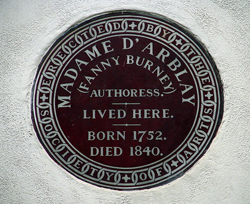
Fanny-Burney-plaqueAmong them are ballet dancer Margot Fonteyn, suffragette Sylvia Pankhurst, socialite Nancy Astor, and, in recent times, cookery writer Elizabeth David.

The oldest surviving blue plaque commemorating a woman, however, is that commemorating what is today a less well-known name, that of Fanny Burney.

Burney (1752-1840), who was known as Madame D’Arblay after she married, was a widely applauded novelist who was also noted for her diaries which record her involvement in the literary circles around Samuel Johnson and the Bluestocking Group.

The blue plaque commemorating her residence at 11 Bolton Street in Mayfair was erected in 1885 by the Society of Arts (which means that like others erected by the society, later the Royal Society of Arts, it’s brown not blue).

Burney, whose most profitable work, Camilla, was published in 1796 after she had spent five years as Second Keeper of the Robs to Queen Charlotte, lived in the house following the death of her husband, the Frenchman Alexandre D’Arblay.

She spent 10 years here – from 1818 until 1828 – and had apparently thought it would be her last residence but she went on to move into three further properties after this one.

PICTURE: Simon Harriyott/CC BY 2.0
London Pub Signs – The Bricklayer’s Arms, Putney…

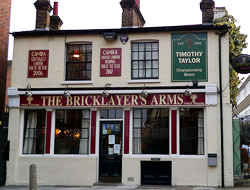
OK, so it doesn’t look like the most historic of pubs but the Bricklayer’s Arms in Putney does boast an interesting history (as well as a much accoladed menu ales).

The-Bricklayer's-ArmsThe Waterman Street pub is apparently the oldest in the south-western riverside district, dating back to 1826 when it was constructed on the site of a former coaching house and blacksmith’s forge.

Then named the Waterman’s Arms, thanks no doubt to its Thames proximity and the fact that, as a result, most of the clientele were freeman and lightermen working on the river, it changed its name to the Bricklayer’s Arms around the turn of the 20th century when, thanks to the extension of the District line railway, there was a sizeable amount of construction going on in the area.

It was briefly known as the Putney Brick before the current owners – actress Becky Newman and her husband John – took over the pub just over 10 years ago, during which time it has won a swag of awards including being named one of the top 10 English pubs by National Geographic and winning the CAMRA National Pub of the Year Award in 2007 and 2009.

For more on the pub (and the plans to extend it), check out www.bricklayers-arms.co.uk.

PICTURE: Ewan Munro-Flickr/CC BY-SA 2.0 (image has been cropped and brightened)

This Week in London – Architecture on show; designing London’s transport system; and, the Battle of the Somme commemorated…

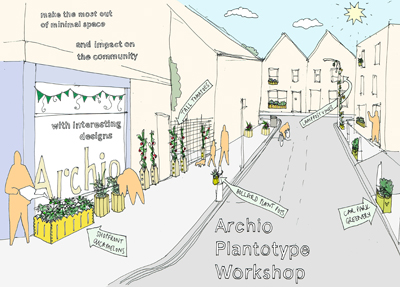
Archio-Plantotype-Workshop-1The London Festival of Architecture kicked off this week with more than 200 events planned for the capital across the month of June. Highlights include “open studios” in which 50 architectural practices across London open their doors to the public, a series of film showing at the BFI concerning the portrayal of the built environment in documentaries and hosted tours through some of London council estate’s green spaces and private gardens. The festival, which centres around three key themes – housing renewal and regeneration, creative workspaces and community engagement, also features a range of exhibitions, installations, talks and workshops including the Archio Plantotype Workshop on 25th June in which participants are asked to help design and build model prototype planters to grow compact and hybrid plants (pictured). For the full programme, check out www.londonfestivalofarchitecture.org.

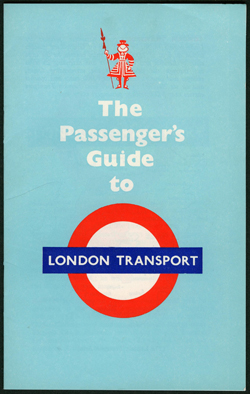
1997-14154-Booklet;-The-Passenger's-Guide-to-London-Transport,-issued-by-London-Transport,-March-1962The design of London’s transport system – from posters, maps and signage to the styling of trains and stations – is the subject of a new exhibition at the London Transport Museum in Covent Garden. Designology – Shaping London explores the role design has played in London’s public transportation systems, spanning the period from the system’s Victorian origins to today. Among the objects on display are an 1834 Shillibeer Woolwich Omnibus timetable, original architectural drawings by Charles Holden of Arnos Grove and Sudbury art deco stations, and a 1994 magnetic ticket hall station model. There are also case studies on key design features found across the transport network such as the New Johnston typeface and the design of Moquette fabric used on the Underground and buses. Visitors are also encouraged to design their own bus stop sign (and share it on social media with the hashtag #pimpmybusstop) and visit a pop-up design studio to find out more about contemporary design innovation. There’s an accompanying programme of events. Admission charges apply. For more, see www.ltmuseum.co.uk. PICTURE: The Passenger’s Guide to London Transport, issued by London Transport, March, 1962./The London Transport Museum.

The “worst day” in the history of the British Army – 1st July, 1916, when almost 60,000 died during the Battle of the Somme – is being commemorated in an exhibition marking the battle’s centenary in Guildhall Yard. Fields of Battle, Lands of Peace: Somme 1916, features a series of evocative photographs by Michael St Maur Sheil of the battlefields as they look today contrasted with images taken at the time. The outdoor exhibition is being accompanied by a display of Somme-related artefacts in the City of London Heritage Gallery at the Guildhall Art Gallery. Admission to the display is free. Runs until 5th July.

Send all items for inclusion to exploringlondon@gmail.com.

10 notable blue plaques of London – 3. The City of London’s only ‘blue plaque’ (and it’s not even blue)…

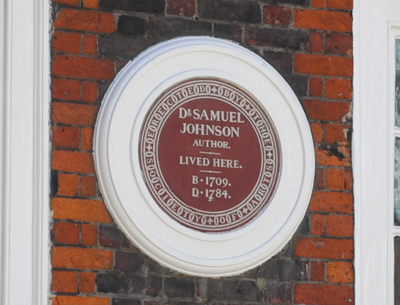
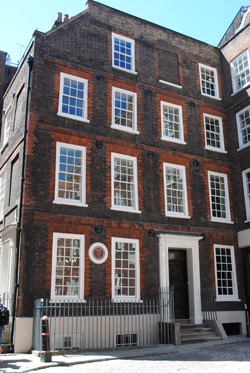
Samuel-Johnson-plaqueThere is only one official blue plaque in the square miles of the City of London – that which marks the property of lexicographer Dr Samuel Johnson in Gough Square (he always did like to stand out from the crowd) – and, like many of the plaques in the scheme, it’s not even blue.

Samuel-Johnson-plaque2The plaque was among the 35 erected in the first 35 years of the scheme – this one in 1876 – and was done so by the Society of Arts which then ran the scheme (later the Royal Society of Arts). In common with most of the first 35 plaques, it is brown in colour.

In 1879, just three years after this plaque was erected, the Society of Arts came to an agreement with the Corporation of the City of London that the corporation – the governing body of the square mile – would commemorate sites of historic significance within its boundaries and the agreement has stood ever since.

The hundreds of “blue plaques” since erected by the City of London Corporation are rectangular in nature and commemorate everything from structures like the long-gone historic gate of Aldgate (88 Aldgate High Street) to homes of the notable such as martyred Archbishop of Canterbury Thomas á Becket (86 Cheapside).

There’s a searchable database of all the City of London plaques which can be found here.

And, of course, Dr Johnson’s house, which he lived in from 1748-59 which compiling his famous A Dictionary of the English Language (the first comprehensive English language dictionary), is now a museum – for details of that, see our earlier post here.

10 notable blue plaques of London – 2. The (now long gone) first Blue Plaque…

The concept of a scheme involving placing commemorative plaques on what was once the homes of notable people was first raised by MP William Ewart in 1863 in Parliament.

Byron-plaqueThree years later, in 1866, the idea was adopted by the then Society of Arts (later the Royal Society of Arts) and in 1867 it erected two blue plaques, the first being one commemorating the birthplace of Lord Byron at 24 Holles Street just south of Cavendish Square in Marylebone and the second being that erected to Emperor Napoleon III in King Street (see last week’s post).

But the Byron plaque had the honour of being the first and it remained on the property until it was demolished in 1889 and the plaque, presumably, lost.

It has, however, been replaced several times on subsequent buildings on the site – the latest incarnation, is a “green plaque” erected by Westminster City Council on what is now a John Lewis store and was unveiled on National Poetry Day in 2012 (it replaced a non-standard, rectangular-shaped plaque – pictured above – which was installed after the building was bombed during World War II).

The current plaque describes Lord Byron as “one of the greatest British poets” and quotes him: “Always laugh when you can. It is a cheap medicine.”

Byron is said to have been born at the property on 22nd January, 1788 and was baptised George Gordon Byron at the nearby St Marylebone Parish Church. Interestingly, English Heritage says that recent research has shown there is no clear evidence for which house in Holles Street Lord Byron actually lived in meaning none of the plaques may have actually marked the correct site.

During the first 35 years of the scheme’s existence it erected on some 35 plaques (there are now some 900 in existence, so the pace has quickened since).

Less than half of them now survive but among those that do are plaques to poet John Keats (erected in 1896 on Keats’ House in Hampstead), novelist William Makepeace Thackeray (erected in 1887 on 2 Palace Green in Kensington) and politician and author Edmund Burke (erected in 1876 on 37 Gerrard Street in Soho.

PICTURE:  Wikimedia

What’s in a name?…Fitzrovia…

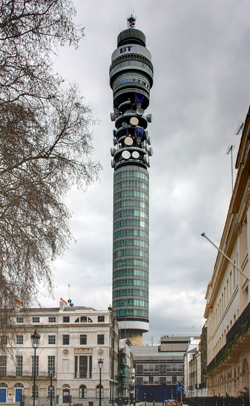
BT_Tower-1This West End district, located between Bloomsbury, Marylebone and Soho, probably owes its name to the Fitzroy Tavern, a public house which in turn is believed to owe its name to the Dukes of Grafton, whose family name was Fitzroy.

The Fitzroys (the name derives from  a Norman-French phrase and was typically associated with base-born royal sons), owned land in the area until the end of the 1800s.

The family first become associated with the area after the Manor of Tottenham (more on that name in an upcoming post) came into the possession of Henry Fitzroy, an illegitimate son of King Charles II who became the Earl of Euston and later Duke of Grafton.

Incidentally, the grand Fitzroy Square, developed by the duke’s great-grandson, and Fitzroy Street are both also named after the family as are numerous other locations in the area including Grafton Street.

Fashionable as a residential area in the 1700s, the houses were gradually transformed into workshops – the area was noted for furniture-makers in particular – or cheap tenements and it’s during this period in the early 1800s that artists like John Constable were living in the area.

The name Fitzrovia apparently became popularised for the district which in the inter-war years, due to the community of artists and writers that met at the pub; it is said to have first appeared in print in the 1940s. Among those who were associated with the area during this period were the likes of writers Dylan Thomas and George Orwell and artists like Roger Fry and Augustus John.

More recently the area has become home to numerous media companies, particularly TV-related companies, and still hosts ample pubs, restaurants and cafes.

Notable buildings in the area include the BT Tower, a communications tower completed in 1964 which was until 1980, the tallest building not only in London but in the UK (and from where panoramic views could once be had – sadly it’s been long closed to the public).

Fitzrovia is also home to the quirky Pollock’s Toy Museum.

PICTURE: David Castor (caster)/Wikipedia

Correction: Fitzroy Square was developed by the great grandson of the 1st Duke of Grafton, not grandson as was originally stated.

This Week in London – Photography and art at the Tate; punk’s 40th birthday; and, Sunday dome openings at St Paul’s…

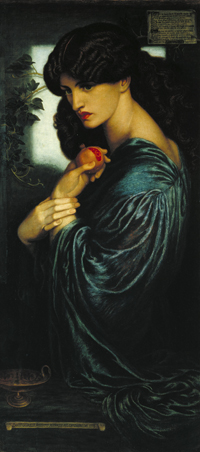
proserpineThe “dynamic dialogue” between British painters and photographers is the subject of a new exhibition which opened at Tate Britain in Millbank this week. Painting with Light: Art and Photography from the Pre-Raphaelites to the Modern Age features almost 200 works, revealing their common influences and showing how photography adapted many of the “Old Master traditions” to create new works. Among those whose works are featured in the exhibition are everyone from David Octavius Hill and Robert Adamson to JMW Turner, John Everett Millais, Dante Gabriel Rosetti and photographer Julia Margaret Cameron. Highlights include examples of three-dimensional photography which used models and props to recreate popular works of the time, including a previously unseen private album in which the Royal Family re-enact famous paintings. Runs until 25th September in the Linbury Galleries. For more, see www.tate.org.uk. PICTURE: Dante Gabriel Rossetti (1828-1882),  Proserpine 1874. Tate.

The 40th anniversary of punk is being commemorated in a new exhibition which opens at the British Library tomorrow. Punk 1976-78 traces the impact of punk from its roots in the French Situationist movement and New York City art-rock scene through to the rise and fall of the Sex Pistols and looks at the impact punk had on music, fashion and design in the mid-Seventies. Located in the library’s Entrance Hall Gallery, the free display – which includes materials from the UK’s biggest punk-related archive held at Liverpool John Moores University – features a rare copy of the Sex Pistol’s God Save the Queen single, fanzines such as the first punk fanzine Sniffin’ Glue, flyers, posters and gig tickets from venues including the Roxy Club, Covent Garden and Eric’s Club, audio recordings, and original record sleeves such as John Peel’s personal copy of the Undertones’ single Teenage Kicks. There’s a full calendar of events to accompany the exhibition including John Lydon’s only live interview of the year. Runs until 2nd October. For more, see www.bl.uk/events/punk-1976-78.

Climb St Paul Cathedral’s dome on special Sunday openings during May. And in order not to disturb Sunday services, visitors who wish to climb to the dome’s Stone Gallery and Golden Gallery will see parts of the cathedral not normally open to the public as they enter through a not-normally used side door and climb 22 extra steps. Admission charge applies. For more, see www.stpauls.co.uk.

Send all items for inclusion exploringlondon@gmail.com.

10 notable blue plaques of London – 1. The oldest surviving blue plaque…

English Heritage are celebrating 150 years of the blue plaque scheme this year – the oldest of its kind in the world – and so to celebrate we’re looking at 10 of the most notable among them.

Napoleon-III-blue-plaqueFirst up, it’s the oldest surviving blue plaque. Located in King Street in Mayfair, just off St James’s Square, it commemorates the last French Emperor, Napoleon III, who lived at the property while a prince in 1848.

It was only a brief stay for the then soon-to-be emperor. The nephew and heir of Emperor Napoleon I, he , like other members of his family was exiled from France after the Battle of Waterloo in 1815 and spent the following years in various other countries in Europe as well as, finally, London where he lived firstly at Carlton Gardens and then at the King Street property.

He took the lease on this newly built house in February, 1847, and created what English Heritage has called a “shrine to the Bonapartes” inside, displaying such relics as Napoleon I’s uniforms and a portrait of his famous uncle by the celebrated French artist Paul Delaroche.

The prince was something of a society favourite during his time in London and was invited to join various of St James’s clubs and apparently even enrolled as a special constable during the Chartist riots of 1848.

When the Bourbon monarchy – in the person of King Louis Philippe – was overthrown in France in September that year, the prince abandoned the house to rush back to France (apparently in such a hurry that the story goes that he left his bed unmade and his bath still full of water).

The prince was elected first President of the Second Republic on his return to Paris and in 1852 took his place as Emperor Napoleon III on the restoration of the empire (incidentally, he ended up returning to England in exile following his defeat in the Franco-Prussian War and died in Kent in 1873).

The plaque, installed in 1867, also has the distinction of being the only one installed while the person it commemorates was still alive. The rule now is that those commemorated by a blue plaque need to have been dead for at least 20 years before the honour can be bestowed.

The plaque, which is rather more elaborate than modern versions, was put up by the Society of Arts (they’re mentioned on it) and the design features a French imperial eagle. It was manufactured by Minton Hollins & Co.

For more on Blue Plaques, see www.english-heritage.org.uk/visit/blue-plaques/.

This Week in London – Talking Shakespeare; Dickens’ letter in support of ‘fallen women’; and, wallpaper at the Geffrye…

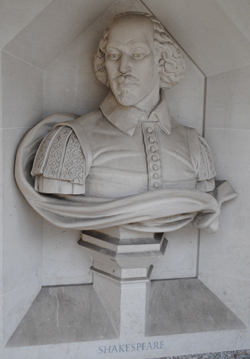
William-Shakespeare6• Guildhall is hosting an “open mic” Shakespeare day this Tuesday as part of commemorations marking the 400th anniversary of his death. Speeches, Soliloquies and Songs from Shakespeare will be opened with recitals from actors Simon Russell Beale and John Heffernan before members of the public will have their chance to recite their favourite piece from Shakespeare. Participants are invited to sign up by emailing ghlevents@cityoflondon.gov.uk or calling 020 7332 1868. The event will run between 10am to 12pm and 1.30pm to 3.30pm at the Basinghall Suite in the Guildhall Art Gallery. For more, see www.cityoflondon.gov.uk/things-to-do/visit-the-city/attractions/guildhall-galleries/Pages/guildhall-art-gallery.aspx.

A letter written by author Charles Dickens to the governors of the Foundling Hospital has gone on display at the Foundling Museum in Bloomsbury. The letter was written to the governors in support of an application for a new matron and touches on Dickens’ belief that the downward path of a ‘fallen woman’ wasn’t irreversible and inevitable but that reform was possible. Tempted to Virtue: Dickens and the Fallen Woman can be seen until 22nd May. In a related event, Lynda Nead, curator of the recent exhibition, The Fallen Woman, will join Jenny Earle, programme director at the Prison Reform Trust, in discussing the hidden stories of vulnerable women in the 19th century and today on 21st May. This event is free but booking is essential. For more, see www.foundlingmuseum.org.uk.

An exhibition celebrating how wallpaper is made is running at the Geffrye Museum in Shoreditch as part of London Craft Week. The Craft of Wallpaper demonstrates the variety of processes being used to make wallpaper in today’s world and features papers by some of the UK’s most innovative makers including Claire Coles, Elise Menghini, Helen Morley, Identity Paper, Juliet Chadwick, Linda Florence, Erica Wakerly, Fromental, CUSTHOM, Tracey Kendall and Graham & Brown who are showcasing six of their most successful wallpaper designs: from its first design in 1946, Original, to the 2016 Wallpaper of the Year, Marble. You’ll have to be quick – only runs until Sunday. For more, see www.londoncraftweek.com.

Send all items for inclusion to exploringlondon@gmail.com.

London Pub Signs – The Punch Tavern…

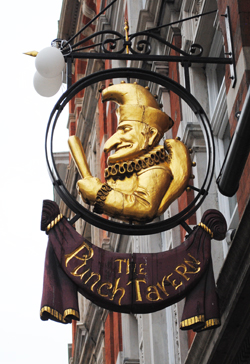
This Fleet Street institution was originally known as The Crown & Sugarloaf, but took on the name Punch thanks to its connection with the famous satirical magazine (and not, despite the sign, the notorious thug, Mr Punch).

The-Punch-TavernThe now defunct Punch magazine – its name apparently comes from a comment at the first meeting of staff that a magazine should be like a good punch mixture – was apparently founded in 1841 at the Edinburgh Castle Tavern in the Strand, just up the road.

Following its launch, the staff apparently began to meet at The Crown & Sugarloaf and it was this fact which apparently led the to the name change.

While there has apparently been a pub here since the 17th century, in 1890s, the property at 99 Fleet Street was rebuilt and the pub, under the guidance of architects Saville and Martin, was transformed into a gin palace.

Now located in a Grade II listed building, the pub has retained much of its original Victorian character – with etched mirrors, a marble bar, dark oak panelling, banquette seating and a series of original Punch and Judy paintings dating from 1897.

The pub is now owned by Punch Taverns – the company took its name from this famous pub.

Incidentally, the name The Crown & Sugarloaf lives on just around the corner in Bride Lane – this small pub, which has a rather complicated history but is now part of the Samuel Smith chain, was once connected to the Punch Tavern.

For more, see www.punchtavern.com.

This Week in London – Beacons to mark Queen Elizabeth II’s 90th; 4,000 years of Sicilian history; underwear’s history exposed; a Shakespearean banknote remembered…

• Queen Elizabeth II’s 90th birthday is being marked in various ways across the capital today. Along with street parties, gun salutes in Hyde Park and at the Tower of London, beacons will be lit in numerous locations across the city (as well as around the country and even internationally) tonight. Further celebrations will be held across May and June.

Sicily

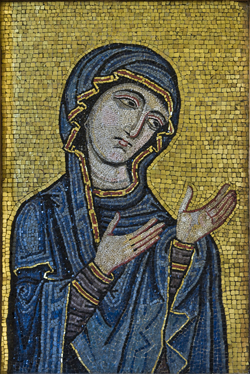
More than 4,000 years of Sicily’s history is being explored in a new exhibition opening at the British Museum in Bloomsbury today. Sicily: culture and conquest features more than 200 objects and focuses on two major eras: the arrival of the Greeks in the latter half of the 7th century BC and their subsequent encounters with earlier settlers and the Phoenicians; and, the period under Norman rule between 1100 and 1250 AD. Highlights include a spectacularly well preserved terracotta altar from about 500 BC, a terracotta sculpture of a Greek Gorgon, an iconic marble sculpture of a warrior from ancient Akragas, a bronze battering ram used by the Romans to sink enemy ships, a 12th century Byzantine-style mosaic and marble, and wooden Islamic-influenced architectural decorations along with ceremonial glassware and ivory, gold pendants and intricate enamel mosaics and cameos from the Norman period. The exhibition, being run in conjunction with Regione Siciliana, Assessorato dei Beni Culturati e dell’Identita Siciliana, runs in Room 35 until 14th August. Admission charges apply and a programme of events accompanies the exhibition. For more, see www.britishmuseum.org/sicily.

• The largest ever museum exhibition of underwear has opened at the V&A in South Kensington. Undressed: A Brief History of Underwear charts the history of underwear from the 18th century to today and features some of the more than 60 individual pieces of mostly contemporary underwear the museum recently acquired for its permanent collection as well as loaned objects. Among the objects on display are an “austerity corset” dating from 1917-18 which has been made from woven paper twine, a man’s waist belt used on the wearer’s wedding day which dates from 1842, a late 19th century corset designed for cycling as well as a rare surviving example of a 1978 panty thong designed by Rudi Gernreich (credited with giving the thong its name) and numerous contemporary pieces – everything from a butt lifter and waist trainer for women to a pair of EnlargetIt briefs designed by aussieBum to add volume to a man’s crotch and a mastectomy bra and prosthesis. The exhibition can be seen until 12th March next year. For more, see www.vam.ac.uk/undressed.

Banknote designer Harry Norman Eccleston’s Shakespearean-related design for the now out of circulation £20 banknote is the subject of an exhibition at the Bank of England Museum in the City. Held as part of commemorations marking 400 years since the Bard’s death, Eccleston’s Shakespeare explores the design elements used in the note, first issued in July, 1970, from his rendering of William Kent’s statue of Shakespeare to his drawing of the balcony scene of Romeo and Juliet. Entry is free. For more, see www.bankofengland.co.uk.

Send all items for inclusion t0 exploringlondon@gmail.com.

Lost London – The Tabard Inn…

Famed for its mention in Geoffrey Chaucer’s iconic 14th century work, The Canterbury Tales, The Tabard Inn once stood on Borough High Street in Southwark.

The inn was apparently first built for the Abbot of Hyde in 1307 as a place where he and his brethren could stay when they came to London and stood on what had been the main Roman thoroughfare between London and Canterbury.

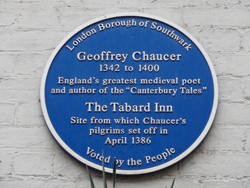
Blue_plaque,_Tabard_InnIt became a popular hostelry for pilgrims making their way from the Chapel of St Thomas á Becket on London Bridge to the saint’s shrine in Canterbury Cathedral and was one of a number of inns which eventually came to be built in Southwark at the London end of the pilgrim route.

It’s in this context that it earns a mention in Chaucer’s 14th century work as the pilgrims set off on their journey.

The inn passed into private hands following the Dissolution and in 1676, 1o years after the Great Fire of London, burned down in a fire which devastated much of Southwark (the back part of it had been damaged by fire a few years earlier). Earlier patrons may have, it’s been suggested, included the Bard himself, William Shakespeare.

It was subsequently rebuilt as a galleried coaching inn and came to be renamed The Talbot (it’s been suggested this was due to a spelling mistake by the signwriter). Its neighbour, the George Inn, still stands in Talbot Yard (it was also apparently burnt down and rebuilt after the 1676 fire).

Business for the coaching inns dropped away, however, with the coming of the railways and the building was converted into stores before eventually being demolished in 1874.

A plaque to the inn can be seen in Talbot Yard (named for the inn’s later incarnation) – it was unveiled by Terry Jones in 2003.

PICTURE: BH2008/Wikimedia.

LondonLife – Gothic spires…

Houses-of-Parliament3

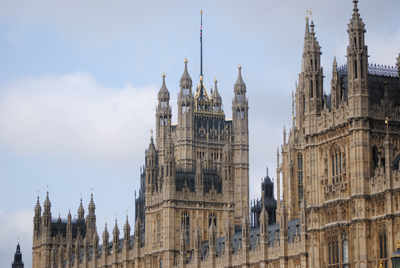
The Houses of Parliament in the early morning light. For more on their history, see our earlier post here.

What’s in a name…Hatton Garden…

A street and small district based just to the north of Holborn in the Borough of Camden, the origins of Hatton Garden’s name stem from the Elizabethan-era courtier Sir Christopher Hatton.

Hatton_Garden_Road_SignSir Christopher, Lord Chancellor during the reign of Queen Elizabeth I and one of her favourites, acquired land here in the 1570s after the Queen forced the bishops of Ely to rent him some of the land they owned which was attached to their London residence, Ely Palace (commemorated today in nearby Ely Place, still home to London’s oldest Catholic church).

Hatton, whose annual rent was apparently fixed at £10, 10 stacks of hay and a red rose at midsummer, subsequently built a property, Hatton House, on the garden.

This survived until the mid-1600s when a series of properties were laid out on the site, centred on what is now the street known as Hatton Garden (Sir Christopher, who was buried in Old St Paul’s Cathedral, had died in 1591). Wren House, originally apparently a chapel and later a charity school, which still stands in Hatton Garden, was built around this time.

The houses were mostly replaced in the mid 18th century with new homes built for prosperous merchants but, as the years passed, while the street itself remained home to some of the wealthy, the same could not be said of some other streets nearby, like Saffron Hill, which became notorious slums.

In the early 1800s artisans started moving into Hatton Garden – London’s Little Italy was born around this time just to the north when Italian craftsmen started moving in (the St Peter’s Italian Church opened in 1863 in Clerkenwell Road) – and the area was gradually transformed into a commercial district.

Jewellery and watch-makers, who had long been based in Clerkenwell, started moving in and the street soon became particularly noted as a centre for cutting diamonds, initially those from India. It was an association which only grew stronger following the discovery of diamonds in South Africa’s Kimberley diamond field in the 1870s.

Today, the street known as Hatton Garden – which runs between Holborn and Clerkenwell Road – still contains the most concentrated cluster of jewellery retailers in the UK (as well as apparently an extensive subterranean network of tunnels and passageways as well as many heavily guarded underground vaults) and is still the centre of London’s diamond trade.

Incidentally, the street was also home to workshops at number 57 which, from 1881, produced the rapid firing Maxim Gun following its invention by Sir Hiram Maxim (and, of course, it was also the location of last year’s safe depository robbery and another famous jewellery robbery back in 1993).

A short side note – it was the wife of Sir Christopher Hatton’s nephew, Lady Elizabeth Hatton, who become associated with Bleeding Heart Yard (you can revisit that story in our earlier post here).

Treasures of London – The Knowledge of London…

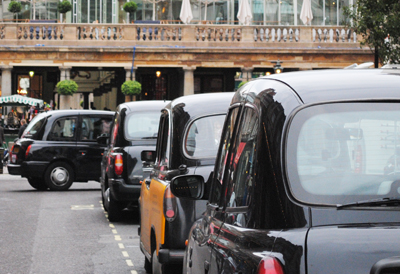
Black-cabsHaving celebrated its 150th anniversary last year, The Knowledge of London is the world famous test given to the city’s black cab drivers.

The test dates back to 1865 and involves drivers memorising 320 routes, 25,000 street names and some 20,000 landmarks and places of public interest including museums, theatres, churches, police stations, schools and parks within a six mile radius of Charing Cross.

The routes through central London – which previously numbered as many as 468 – are contained within the Blue Book (there’s also a series of ‘Knowledge schools’ to help would-be drivers prepare for the test).

The test includes a written exam and a series of one-to-one interviews, known as appearances, in which the prospective driver is given start and finish points and expected to describe the shortest route between them. It is overseen by the Public Carriage Office, once part of the Metropolitan Police Force, but now part of Transport for London.

It was introduced by Sir Richard Mayne, First Joint Commissioner of the Metropolitan Police Service, after thousands of complaints were received about the lack of knowledge of London cabbies from visitors to the Great Exhibition in Hyde Park in 1851.

It apparently takes on average between two and four years to learn all you need to know to pass the test and you can often spot what are fondly known as ‘knowledge boys (or girls)’ riding scooters around the city with a clipboard attached to the handlebars as they learn what they need to know for the test.

This Week in London – Russia’s finest portraiture on show, Scottish art from the Royal Collection; and photographer/film-maker Paul Strand revisited…

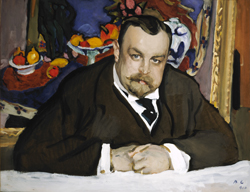
Russia The “most important exhibition of Russian portraits ever to take place at a British museum” opens at the National Portrait Gallery off Trafalgar Square today. The portraits of key figures from Russia spanning the period from 1867 to 1914 come from Moscow’s State Tretyakov Gallery which is simultaneously displaying a selection of portraits of famous Britons from the National Portrait Gallery in a joint event being held to mark the 160th anniversary of both institutions. Russia and the Arts: The Age of Tolstoy and Tchaikovsky features portraits of the likes of Akhmatova, Chekhov, Dostoevsky, Mussorgsky, Rimsky-Korsakov, Rubinstein, Tchaikovsky, Tolstoy and Turgenev by artists including Nikolai Ge, Ivan Kramskoy, Vasily Perov, Ilia Repin, Valentin Serov and Mikhail Vrubel. The majority of the works featured were commissioned directly from the artists by Pavel Tretyakov, a merchant, philanthropist and founder of the State Tretyakov Gallery, whose own portrait by Repin opens the exhibition. The exhibition at the National Portrait Gallery runs until 26th June. Admission charge applies. For more, see www.npg.org.uk/russia. PICTURE: Ivan Morozov by Valentin Serov (1910) © State Tretyakov Gallery, Moscow.

The best Scottish art in the Royal Collection goes on show at The Queen’s Gallery, Buckingham Palace, from tomorrow. Scottish Artists 1750-1900: From Caledonia to the Continent brings together more than 80 works collected by monarchs since King George III. It tells the story of the emergence of a distinctly Scottish school of art through works painted by the likes of Allan Ramsay – who in 1760 was commissioned to paint King George III’s State portrait and subsequently became the first Scot appointed to the role of Principal Painter in Ordinary to His Majesty, and Sir David Wilkie – whose works depicting small-scale scenes of everyday life attracted the attention of the Prince Regent (later King George IV) in the early 17th century. Other artists represented in the collection include Sir Joseph Noel Paton, David Roberts, James Giles, John Phillip, William Leighton Leith, and William Dyce. Runs until 9th October. Admission charge applies. For more, see www.royalcollection.org.uk.

The work of American photographer Paul Strand is on show at the V&A from Saturday in the first retrospective showing of his art in the UK in 40 years. One of the greatest photographers of the 20th century, Strand (1890-1976) was instrumental in defining the way fine art and documentary photography is understood and practiced today. He is also credited with creating the first avant-garde film, Manhatta. The exhibition, Paul Strand: Photography and Film for the 20th Century, features more than 200 objects including vintage photographic prints, films, books, notebooks, sketches and Strand’s cameras and includes newly acquired photographs from his only UK project – a 1954 study of the island of South Uist in the Scottish Hebrides. Can be seen until 3rd July. Admission charge applies. For more, see www.vam.ac.uk/paulstrand.

Send all items for inclusion to exploringlondon@gmail.com.

London Pub Signs – The Cutty Sark…

Cutty-Sark-pubAnother Greenwich pub whose name references an aspect of maritime history (see our previous posts on the The Gipsy Moth and the Trafalgar Tavern), this riverside establishment takes its name from a former tea clipper (which, not coincidentally, is on display nearby).

The clipper Cutty Sark was constructed in Dumbarton in 1869 to facilitate the transport of tea from China to Britain in as short a time span as possible. It made its maiden voyage the following year and but only ended up working the tea route for a few years before being used to bring wool from Australia.

Later sold to a Portuguese company, the vessel continued to be used as a cargo ship until she was sold in 1922 and used as training ship, first in Cornwall, and later at Greenhithe in Kent.

In 1954, the vessel found a new permanent dry dock at Greenwich and was put on public display. Damaged by fire in 2007, the ship underwent extensive restoration and is now displayed in a state-of-the-art purpose-built facility which allows you to walk underneath the vessel.

The three level Cutty Sark pub, located at 4-6 Ballast Quay (formerly known as Union Wharf), features a Georgian-style bow windows on the first and second floors (the first floor is home to the Willis Dining Room which has great views of the Thames).

The present Grade II-listed building apparently dates from the early 19th century (although the sign out the front suggests 1795 and it’s been suggested the building was substantially altered in the mid-19th century) but there is evidence of a public house on the location by the early 18th century.

Known at one stage at the Green Man, in 1810 it became the Union Tavern – a reference, apparently, to the union of England and Ireland which took effect in 1801. It took its current name after the Cutty Sark arrived in Greenwich in the 1950s.

For more on the pub, see www.cuttysarkse10.co.uk. For more on the ship, see www.rmg.co.uk/cutty-sark.

This Week in London – John Dee’s library; Botticelli and Dante; and, women in war at the IWM…

John Dee (1527-1609), the enigmatic Elizabethan “mathematician, magician, astronomer, astrologer, imperialist, alchemist and spy”, is the subject of an exhibition currently running at the Royal College of Physicians Museum in Regent’s Park. Scholar, courtier, magician: the lost library of John Dee explores his life through remnants of his personal library and features mathematical, astronomical and alchemical texts, many of which he elaborately annotated and even illustrated. The texts are drawn from the collection of the college library which has more than 100 of the doctor’s volumes and which forms the largest collection of Dee’s books in the world. The books represent only a fraction of the more than 3,000 books and 1,000 manuscripts he claimed to own before his library was, so Dee claimed, sold off illicitly by his brother-in-law Nicholas Fromond after he gave them into his care when he travelled to Europe in the 1580s. Many of them apparently fell into the hands of Nicholas Saunder, possibly a former student of Dee’s and later passed into the hands of book collector Henry Pierrepont, the Marquis of Dorchester, whose family gave his entire library to the Royal College of Physicians after his death in 1680. The free exhibition runs until 29th July. For more, see www.rcplondon.ac.uk.

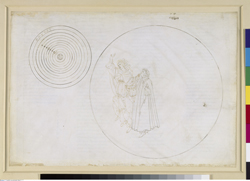
Image_2_Paradiso-II• Botticelli’s drawings for Dante’s epic poem, the Divine Comedy, are at the heart of a new exhibition which opened earlier this month at the Courtauld Gallery in Somerset House. Botticelli and Treasures from the Hamilton Collection, which is being run in collaboration with the Kuperferstichkabinett (Prints and Drawings Museum) in Berlin, features treasures which were sold to Berlin by the 12th Duke of Hamilton in 1882 despite efforts by Queen Victoria to prevent the transaction. They include a selection of 30 of Botticelli’s drawings – which date from about 1480-95 – as well as illuminated manuscripts including the Hamilton Bible. Said to be one of the most important illuminated manuscripts in the world, it is being returned to the UK for the first time since 1882. The exhibition, which coincides with Botticelli Reimagined opening at the V&A next month, runs until 15th May. Admission charge applies. For more, see www.courtauld.ac.uk. PICTURE: Sandro Botticelli – Beatrice explains to Dante the order of the cosmos (Divine Comedy, Paradiso II), around 1481-1495/© Staatliche Museen zu Berlin, Kupferstichkabinett/Philipp Allard.

The stories of women in times of war form the heart of a new display on show at the Imperial War Museum in Lambeth. Eleven Women Facing War features photographs and films taken by award-winning British photographer and film-maker Nick Danziger. He first photographed the 11 women, who all lived in conflict zones, in 2001 for an International Committee of the Red Cross study documenting the needs of women facing war before setting out 10 years later to find each of the women and see what had become of their lives. The exhibition features 33 photographs and 11 short films from conflict zones including Bosnia, Kosovo, Israel, Gaza, Hebron (West Bank), Sierra Leone, Colombia and Argentina. Among the stories told are those of Mah Bibi, a 10-year-old orphan who was begging for food for herself and two brothers when first photographed in Afghanistan and who, 10 years later, had vanished and is believed to have died in 2006. Another is that of Mariatu, who was struggling to rebuild her life in Sierra Leone after her hands had been forcibly amputated by guerrilla soldiers at the age of 13 when she was photographed in 2001 and who 10 years later had moved to Canada. The exhibition runs until 24th April. Admission is free. For more, see www.iwm.org.uk.

Send all items for inclusion to exploringlondon@gmail.com.

LondonLife – Images of London past…

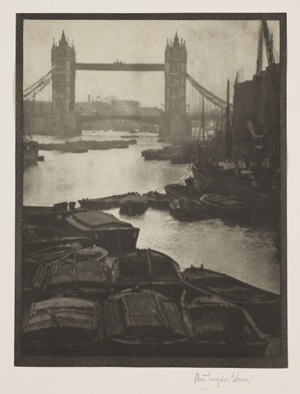
Tower_Bridge_1910_Alvin_Langdon_CoburnTower Bridge, here depicted in an image by Alvin Langdon Coburn, taken in about 1910. The image is one of more than 400,000 vintage prints, daguerreotypes and early colour photographs as well as other photography-related objects including the world’s first negative from the Science Museum Group’s 3,000,000 strong photography collection which is being transferred to the Victoria and Albert Museum under an agreement between the two institutions. The images are joining the V&A’s existing collection of 500,000 photographs to create an International Photography Resource Centre, providing the public with a “world class” facility to access what will be the single largest collection on the art of photography on the planet. It’s a reunion for some of the images which were once part of a single collection housed at the South Kensington Museum in the 19th century before it divided into the V&A and the Science Museum. For more on the museums, see www.vam.ac.uk and www.sciencemuseum.ac.ukPICTURE: © Royal Photographic Society/National Media Museum/ Science & Society Picture Library


What’s in a name?…Camden Town…

Camden-Lock

As with so many London locations, the name Camden Town comes from a previous landowner – but more indirectly it originates with the great 16th and 17th century antiquarian and topographer William Camden.

The story goes like this: late in his life William Camden – author of Britannia, a comprehensive description of Great Britain and Ireland – settled near Chislehurst in Kent on a property which became known as Camden Place.

In the 18th century, the property came into the possession of Sir Charles Pratt, a lawyer and politician (among other things, he was Lord Chancellor in the reign of King George III), who was eventually named 1st Earl of Camden.

It was Pratt who, having come into the possession of the property by marriage, in about 1791 divided up land he owned just to the north of London (which has apparently once been the property of St Paul’s Cathedral) and leased it, resulting in the development of what became Camden Town (Pratt, himself, meanwhile, is memorialised in the name of Pratt Street which runs between Camden High Street and Camden Street).

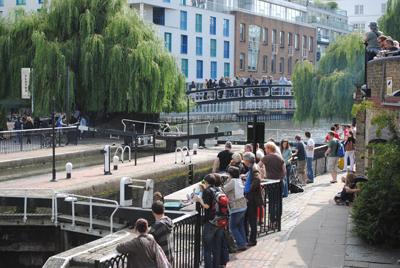
In 1816, the area received a boost when Regent’s Canal was built through it – the manually operated, twin Camden Lock is located in the heart of Camden Town.

Although it has long carried a reputation of one of the less salubrious of London’s residential neighbourhoods (a reputation which is changing), Camden Town is today a vibrant melting pot of cultures, thanks, in no small part, to the series of markets, including the Camden Lock Market, located there as well as its live music venues.

Past residents have included author Charles Dickens, artist (and Jack the Ripper candidate) Walter Sickert, a member of the so-called ‘Camden Town Group’ of artists, and, in more recent times, the late singer Amy Winehouse.

Of course, the name Camden – since 1965 – has also been that of the surrounding borough.