• Emma Hamilton, the mistress of Horatio Nelson – hero of the Battle of Trafalgar, is the subject of a new exhibition at the National Maritime Museum in Greenwich. One of the most famous figures of her time, Hamilton rose from obscure beginnings to the heights of celebrity and is best remembered for the scandalous affair she had with Lord Nelson for the six years prior to his death in 1805. Emma Hamilton: Seduction and Celebrity brings together more than 200 objects, many of which have never been displayed before, including paintings, letters, costumes and jewellery. Highlights include works by artists George Romney, Sir Joshua Reynolds and Sir Thomas Lawrence, letters from Hamilton and her lovers, betrothal rings exchanged between Hamilton and Nelson, her songbooks and decorative objects. The exhibition, which runs until 17th April, is accompanied by a series of events including walking tours and late openings. Admission charges apply. For more, see www.rmg.co.uk/national-maritime-museum.
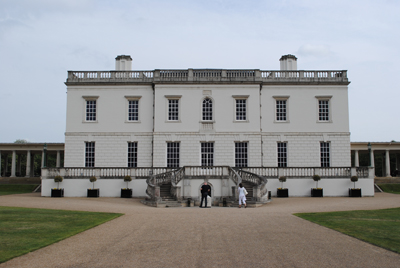
• The first-ever exhibition of portraits of artists in the Royal Collection opens at The Queen’s Gallery, Buckingham Palace, tomorrow. Portrait of the Artist features more than 150 paintings, drawings, prints, photographs and decorative arts including a self-portrait by Sir Peter Paul Rubens (1623) which was hung in Whitehall Palace, a portrait of his former assistant Anthony van Dyck (c1627-28), and Cristofano Allori’s work Head of Holofernes (1613) in which the artist appears as the decapitated Holofernes as well as self-portraits by everyone from Rembrandt to Lucien Freud and David Hockney. The exhibition runs until 17th April. Admission charges apply. For more, see www.royalcollection.org.uk/visit/the-queens-gallery-buckingham-palace.
• Sir Joseph Lyons, founder of Lyons tea shops and the ‘Corner Houses’ of London – among the first chain restaurants in England, has been honoured with an English Heritage Blue Plaque at his former home in Hammersmith. Sir Joseph, who lived at the property in the 1890s close to the now-demolished headquarters of his catering empire at Cadby Hall, opened the doors to his first teashop at 213 Piccadilly in 1894. He was knighted by King George V in 1911. For more, see www.english-heritage.org.uk/visit/blue-plaques/.
• On Now: Garnitures: Vase sets from National Trust Houses. Being run in conjunction with the National Trust, the display at the Victoria & Albert Museum in South Kensington explores the history of ‘garniture’ – sets of ornamental vases unified by their design and a specific context. A status symbol for a period between the 17th and 19th century, garnitures fell out of fashion and complete sets are now extremely rare. The display features garnitures loaned from 13 different National Trust houses as well as objects from the V&A’s collection. Highlights include a garniture made in miniature for a doll’s house, an extremely rate 17th century silver set of jars, a Rococo set and Wedgwood ceramics. The free exhibition runs until 30th April. For more, see www.vam.ac.uk/exhibitions/garnitures.
Send all items for inclusion to exploringlondon@gmail.com.



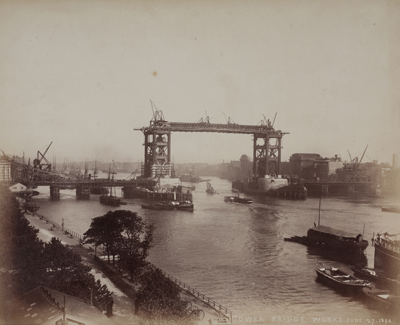
 Albury Street in Deptford, 1911. The image, taken by the London County Council, is just one of thousands which form part of a new free, online resource, Collage – The London Picture Archive. The world’s largest collection of images of London, the archive contains more than 250,000 images of London spanning the period from 1450 to the present day. It includes more than 8,000 historical photographs of life on the capital’s streets as well as major events – everything from the Great Fire of London in 1666 to the construction of Tower Bridge in the late 19th century. The photographs, maps, prints, paintings and films in the collection are all drawn from the collections of the City of London Corporation’s Guildhall Art Gallery and the London Metropolitan Archives in Clerkenwell. Other images shown here include (above right) ‘Street Life in London’, 1877 (taken by Adolphe Smith and John Thomson, this image was an early use of photography); (below) ‘Construction of the Metropolitan Railway (the first tube line)’, 1862 (taken at King’s Cross Station); and (far below), ‘The Construction of Tower Bridge’, 1891-1892 (taken from Tower Embankment). Collage – The London Picture Archive is free to access and available at
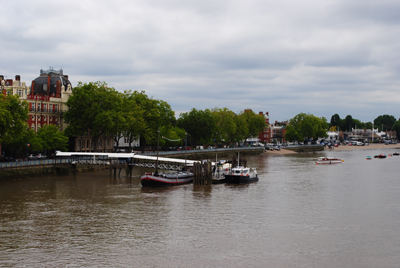
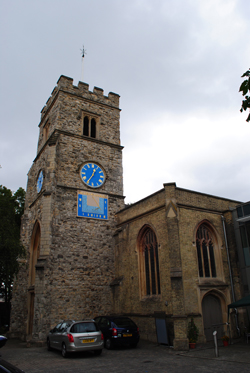 Recorded in the Domesday Book as Putelei and known in the Middle Ages as Puttenhuthe, it apparently goes back to a Saxon named Puttan who lived in the area and the Old English word ‘hyp’, which means ‘landing place’. Hence, “Puttan’s landing place” (or Puttan’s wharf).