This barrel-shaped object, which can be found in the church of All Hallows by the Tower in the City of London, was used the crow’s nest on the ship Quest during Sir Ernest Shackleton’s third – and last – Antarctic voyage in the early 1920s.
Historic ships
10 historic vessels in London’s Thames…A recap…
Before we launch a new Wednesday series, here’s a recap of our last…
10 historic vessels in London’s Thames…10. The ‘Knocker White’…
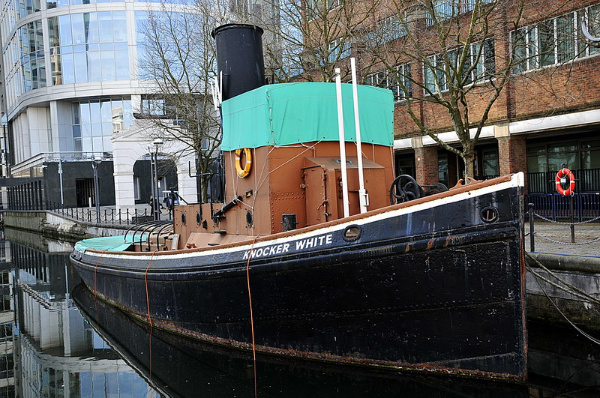
A Dutch-built tugboat, the Knocker White (originally called the steam tug Cairnrock) was built in 1924 by T Van Duijvendijk’s yard at Lekkerkek near Rotterdam, Netherlands for Harrisons (London) Lighterage Ltd.
Following the installation of a steam engine and boiler at Great Yarmouth, the steel-hulled Cairnrock – which was designed for general towage work and featured a drop-down funnel for travelling under bridges – was initially used to Tow the Harrisons’ floating steam-powered coal elevator Wotan around the lower reaches of the Thames.
In 1960, the 77 foot long tug was sold and passed through the hands of a couple of different owners and ended up, by 1962, in the hands of WE White and Sons. It was during this time that its name was changed (after a White family nickname), marine diesel engines installed and the steam engines and boilers removed.
The Knocker White continued in service, operating out of the WE White & Sons base at Hope Wharf in Rotherhithe, working on the Thames and the Solent until 1982.
In November of that year, it was sold for scrap to Todd (Breakers) Ltd of Dartford but, after being drawn to the attention of the Museum of London, was acquired by them in March 1985 as a classic example of an early tall-funnelled Thames steam tug.
In November, 2016, the Knocker White – along with the Varlet – was acquired by Trinity Buoy Wharf with the aim of restoring the vessel and putting on public display. It can be seen moored at the wharf today.
10 historic vessels in London’s Thames…9. PS ‘Waverley’…
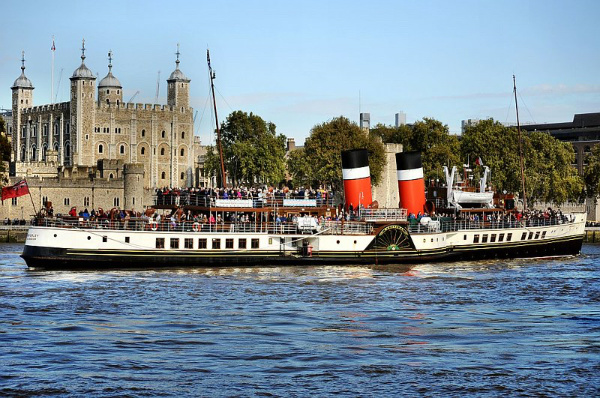
A visitor rather than a permanent resident in London’s Thames, the Waverley is described as the world’s last seagoing paddle steamer.
The Waverley, which returns to London on 22nd September for a short season lasting into early October, was the last paddle steamer to be built for use on the River Clyde in Scotland and launched on 2nd October, 1946.
Named after Sir Walter Scott’s famous novel, her maiden voyage – on 16th June the following year – saw the Waverley cruise along what was to be her primary route for the next few years up Loch Long and Loch Goil to the villages of Lochgoilhead and Arrochar.
In 1952, the Waverley joined the British Railways Caledonian Steam Packet Co Clyde coast fleet, a role she remained until the company’s end in 1972. Briefly subsequently part of Caledonian MacBrayne’s fleet offering Clyde cruises and ferry duties, she was withdrawn from service in September, 1973, and in November the following year was “sold” for £1 to the Waverley Steam Navigation Co Ltd, which had been formed by the Paddle Steamer Preservation Society.
Following restoration work, the Waverley made her first visit south of the Scottish border to Liverpool and North Wales to celebrate the centenary of Llandudno Pier. Further visits south followed and in April, 1978, she sailed along the Thames for the first time.
From 1981 to 1983, the Waverley completed an annual circumnavigation of Great Britain and in 1985 visited the Isle of Man and Ireland for the first time.
A substantial refit and rebuild took place in the early 2000s returning the ship to her original 1947 livery, and in 2019 she was withdrawn from service so new boilers could be installed before being returned to service in 2020, offering excursions around the coast.
During its London season, the Waverley departs from Tower Pier and travels under Tower Bridge.
For the Waverley‘s timetable and booking information, head to https://waverleyexcursions.co.uk.
10 historic vessels in London’s Thames…7. Lightship 95…

This red-painted vessel once served as a beacon at South Goodwin Sands off the Kentish coast but, now permanently moored at Trinity Buoy Wharf, has been converted into a recording studio.
The 550 tonne ship was built in 1939 by Philip and Sons of Dartmouth for Trinity House, a company established during the reign of King Henry VIII initially to regulate pilotage on the River Thames. It later established lighthouses and floating lightships and took over responsibility for all buoys in England. It currently maintains 65 automated lighthouses.
The steel-hulled vessel, one of three built to the same design (one, converted into a home, is now at Victoria Dock in Silvertown – and currently for sale with an asking price of £595,000 – and another in Rotterdam, The Netherlands), features a central light tower and originally had crew quarters.
It was mostly used to mark South Goodwin Sands but was also deployed to other locations including Inner Dowsing off the coast of Norfolk.
In the 1990s, it became the first light vessel in the UK to be converted to solar power to enable unmanned operation and underwent a complete refit in 1999.

It was taken out of service in 2003 and subsequently sold at auction by Trinity House. Initially bought by the Port Werburgh Marina on the Medway, it was later onsold to Ben Phillips who converted it to a floating music recording studio. Since 2008, it has been based at Trinity Buoy Wharf.
10 historic vessels in London’s Thames…6. ‘Portwey’…
One of only two twin screw, coal fired steam tugs still active in the UK, the steam tug Portwey can these days be found in London’s Docklands.
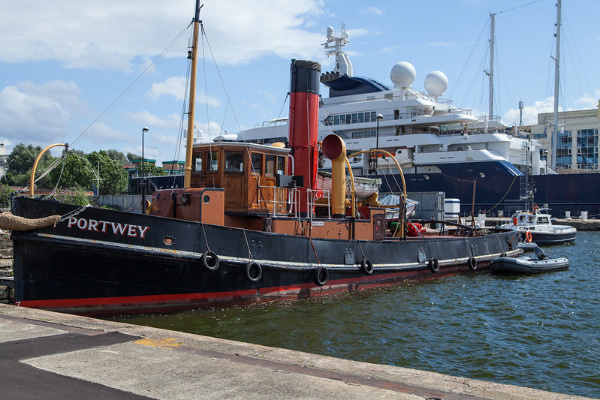
Ordered by the Portland & Weymouth Coaling Co Ltd, Portwey (the name comes from the company’s) was built by Harland & Wolff at Govan yard in Glasgow and launched on 10th August, 1927.
The 80 foot long vessel was based in Weymouth, Dorset, performed a range of tasks including carrying coal to steamers and being on call for any ship in distress requiring assistance or salvage. This included extinguishing a fire aboard the Danish timber-carrier Bodil in 1928, assisting ships like the cargo steamer Winslow (which had developed a list in heavy seas in 1932), and the Winchester Castle which had run aground in 1936, and even being involved in the search for a sunken submarine in 1932.
The Portwey was seconded by the Admiralty and moved to Dartmouth in Devon during World War II. Narrowly avoiding German bombs while in the harbour, during this time the tug was went to the assistance of ships attacked by the enemy. In 1944, she was assigned to US forces as they prepared for D-Day and her duties including clearing obstructions from the channel and supplying fresh water to naval vessels as well as, when a rehearsal for the landings went wrong at Slapton Sands, rescuing personnel and landing craft.
After the war, the Portwey resumed duties as a harbour tug including ferrying pilots and customs officers out into the Channel. In 1947, she helped put out a fire at the Queen’s Hotel in Dartmouth.
The Portwey was sold to the Falmouth Dock and Engineering Company in Cornwall in 1952. As well as rescuing the captain and first officer of the cargo ship Flying Enterprise, during this period she was involved in the construction of the Lizard Lifeboat Station in Cornwall, and a car ferry slipway at Holyhead in north Wales.
In 1967, with coal-fired steam tugs being replaced by diesel-engined ships, she was laid up to be scrapped. But it wasn’t the end for the Portwey, which was bought by Richard Dobson, the assistant harbour master at Dartmouth. Along with a group of friends, he returned her to working condition and during the 1960s and 1970s, she took part in many events on the River Dart and around Torbay.
In 1982, the Portwey joined the Maritime Trust’s Historic Ship Collection at St Katharine’s Dock where the newly formed Friends of Portwey continued with restoration and operation of the tug.
The Friends of Portwey became the Steam Tug Portwey Trust in 2000 and purchased the tug from the Maritime Trust, moving the vessel to West India Dock.
WHERE: Steam Tug Portwey, West India Dock (South Quay) (nearest DLR station is South Quay); WHEN: 2pm to 9pm Wednesdays; WEBSITE: www.stportwey.co.uk.
10 historic vessels in London’s Thames…4. ‘Massey Shaw’…
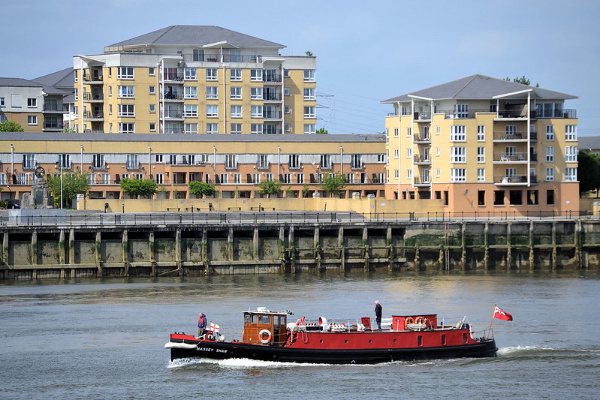
Moored at West India Dock, the Massey Shaw is a former London Fire Brigade fireboat.
The fireboat was constructed in 1935 for a cost of £18,000 by the J Samuel White company in Cowes on the Isle of Wight. Named for Sir Eyre Massey Shaw – the first Chief Officer of what was then named the Metropolitan Fire Brigade, the vessel was designed to London County Council specifications with a deliberately low profile so it could fit under the Thames bridges in all tides.
The vessel, which was was powered by two eight cylinder diesel engines and featured a main deck monitor as well as eight deck outlets (and a wheelhouse which was added later), soon proved its worth, playing an important role in saving what the press said was a million pounds worth of stock at a large warehouse fire on Colonial Wharf.
During World War II, the Massey Shaw took part in Operation Dynamo, forming part of the small boat flotilla which evacuated British troops from the beach at Dunkirk. She ferried more than 500 troops to a larger ship offshore and transported almost 100 back to England and it’s believed she was the last of the small boats to leave Dunkirk harbour (rescuing survivors from a French vessel which struck a mine along the way).
Back in London, Massey Shaw performed a critical role during the Blitz, pumping large quantities of Thames water to douse fires along the city’s waterfront.
It remained in service until the early 1970s, although it had operated as a reserve boat since 1960 with newer models taking over frontline duties.
Decommissioned in 1971, the Massey Shaw was found abandoned 10 years later at St Katharine Dock by a group who went on to found The Massey Shaw Fireboat Society with a view to preserving the vessel. They were granted a 50 year lease on the vessel.
In 1985, the Massey Shaw joined the Association of Dunkirk Little Ships on their return to Dunkirk for the first time since 1965 and two years later, she attended the centenary of Sir Eyre Massey Shaw’s review of 1000 firemen at Oxford.
In 1990 the Massey Shaw was sunk close to the London Fire Brigade headquarters at Lambeth but was subsequently salvaged and the following year, after restoration work, joined the 50th anniversary return trip to Dunkirk.
The society gained full ownership of Massey Shaw in 2002 and restoration work was carried out by the TV programme Salvage Squad (a second appearance on the show and more work followed two years later).
In 2008, a £500,000 Heritage Lottery Grant was used to fund the restoration of the vessel at Gloucester docks. She returned to London by road in 2013 where the restoration was completed and in 2015 was officially launched back on the River Thames with an event at the Westminster Boating Base.
Later that year she participated in another “little ships” armada to Dunkirk, this time commemorating the 75th anniversary of the evacuation. Massey Shaw has since taken part in other events including celebrations marking Queen Elizabeth II’s record as longest reigning monarch in 2015.
The vessel is now moored at the eastern end of West India Docks on the Isle of Dogs.
While Massey Shaw did appear in the 1958 film, Dunkirk, recapturing its role as one of the “little ships”, it did not appear in the 2017 film of the same name.
WHERE: Massey Shaw, West India Dock, Poplar (nearest DLR station is South Quay; nearest Tube station is Canary Wharf); WHEN: Between March and November, from 11am to 3pm daily (check website for details); WEBSITE: https://masseyshaw.org.
10 historic vessels in London’s Thames…2. HQS Wellington…
A former World War II convoy escort ship, the HQS Wellington, which is moored alongside Victoria Embankment in the River Thomas, is unusual in that for the past 75 years it has served as the headquarters of the Honourable Company of Master Mariners.

Constructed in the Devonport Dockyard, Plymouth, in 1934 for the Royal Navy as a two-masted Grimsby-class sloop, the HMS Wellington served in the Pacific in the lead-up to World War II, based mainly in New Zealand (she was named for the capital of New Zealand) and patrolling the South Pacific.
Following the outbreak of war, the HMS Wellington – which featured two 4.7-inch guns and one 3-inch gun as well as carrying other anti-aircraft guns and depth charges – served mainly as a convoy escort in the North Atlantic.
During this time, the vessel was involved in the sinking of an enemy U-boat, the evacuation of Allied forces from St Valery-en-Caux, north of Le Havre, and the Allied landings in North Africa in late 1942. In 1943, the HMS Wellington was one of the first escort ships to be fitted with Hedgehog, an anti-submarine weapon, which replaced the three inch gun.
The ship ended the war having travelled almost 250,000 miles and escorting 103 convoys.
Following the war, the 265 foot long ship was initially transferred to the Reserve Fleet in Milford Haven before, in 1947, the Admiralty made the ship available to the Honourable Company of Master Mariners to serve as a floating livery hall. She was converted for that purpose – and renamed the HQS Wellington – at Chatham Dockyard using funds raised through a public appeal.
The interior features a grand wooden staircase taken from the 1906 Isle of Man ferry SS Viper which was being broken up at the time.
The HQS Wellington arrived at Victoria Embankment in 1948 for service as the livery company HQ.
The ship had a major refit in 1991, during which it was fitted out with carpet and new displays showing off the Company’s collections, and in 2005, ownership of the ship was transferred to The Wellington Trust.
In April this year it was announced that due to safety concerns the Honourable Company of Master Mariners would have to leave the vessel. The company, which has relocated to a temporary on-shore headquarters in Greenwich, are now developing plans for a new floating headquarters.
10 historic vessels in London’s Thames…1. PS Tattershall Castle…
HMS Belfast is one of London’s star tourist sites. But what are some of the other vessels moored in the Thames? In this series, we’re taking a look at the history behind 10 other vessels, starting with PS Tattershall Castle.

Now a floating restaurant moored off Victoria Embankment, the steam-driven, steel-hulled PS Tattershall Castle was constructed by the West Hartlepool-based company William Gray & Company as a ferry. Its name comes from a castle in Lincolnshire built in the first half of the 15th century/
Launched on 25th September, 1934, with a license to carry 1,000 people, the 209 foot-long ferry was one of three sister ships – the others being the PS Wingfield Castle (now a museum ship in Hartlepool) and the PS Lincoln Castle – which were built to transport passengers along the Humber between Kingston upon Hull, in Yorkshire, and New Holland, in Lincolnshire. It could make eight trips a day and could carry vehicles and livestock.
World War II broke out not long after her launch and the ferry was used to transport troops and supplies along the Humber. Due to the heavy fogs on the river, the Tattershall Castle became one of the first civilian vessels to be equipped with radar.
Following the war and the 1948 nationalisation of the railways, the PS Tattershall Castle became part of part of British Rail’s Sealink service. In 1973, the vessel, with repairs deemed too costly, was retired from service.
Subsequently towed to London, the PS Tattershall Castle was converted into a floating art gallery which was formally opened by the Lord Mayor of London on 27th February, 1975.
In 1981, the former ferry was acquired by the Chef & Brewer Group. After some repairs on the River Medway, she was opened in 1982 as a bar restaurant.
There have been several refits since, the most recent being in 2015, when the former ferry was returned to Hull for some £1.5 million work to be carried out. The former ferry is typically moored off Victoria Embankment opposite the London Eye.
For bookings, head to www.thetattershallcastle.co.uk.
A Moment in London’s History…The Mayflower leaves London
This year marks 400 since the Mayflower set off from Plymouth in England’s south to Massachusetts in North America.
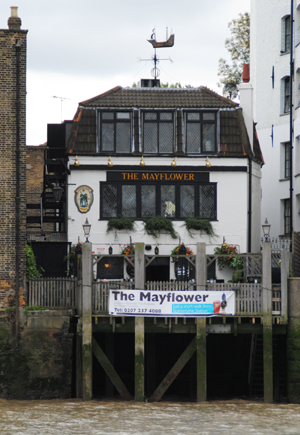 But what isn’t as well known is that the ship was hired in London and so it is from London – commonly believed to be from Rotherhithe on the south bank of the Thames – that the ship set off for Plymouth to pick up its passengers and supplies.
The Mayflower departed from London in mid July, 1620, and was already in Plymouth by the time another ship, the Speedwell, arrived from Delfshaven in the Netherlands in late July. The two ships would depart Plymouth for their journey across the Atlantic Ocean on 5th August (although the Speedwell proved less than seaworthy and so, after a couple of aborted attempts, the Mayflower eventually proceeded alone).
Rotherhithe was home to many of the 30 crew of the Mayflower including Captain Christopher Jones.
As a result, there’s numerous memorials to the voyage in the area, including, most famously, the pub, The Mayflower, which is said to overlook the site from where the ship sailed (pictured above). There’s also a statue of Jones himself in the churchyard of St Mary the Virgin where he was buried in an unmarked grave – he died soon after returning from America.
A series of events, including the Mayflower 400 London Lectures, had been planned to commemorate the event this year but are currently suspended. We’ll keep you informed.
This Week in London – Flying cars and iconic vehicles at V&A; 150th anniversary of the Cutty Sark’s launch; and, Eco-Visionaries at the RA…

• An autonomous flying car is among exhibits at a new exhibition focusing on the automobile at the V&A on Saturday. The flying car is one of 15 vehicles in Cars: Accelerating the Modern World which also features the first production car in existence – a 1925 Ford Model-T, a converted low-rider and a Firebird I concept car from 1953 (pictured). There’s also 250 associated objects to see – everything from a 1920s cloche hat designed for car travel to a series of hood ornaments produced by René Jules Lalique in the 1920s and a Michelin travel guide from 1900 – in an examination of how the car changed our relationship to speed, the way we make and sell, and the landscape around us. Runs until 19th April. Admission charge applies. For more, see www.vam.ac.uk. PICTURE: General Motors Firebird I (XP-21) © General Motors Company, LLC
• The 150th anniversary of the launch of tea clipper, Cutty Sark, is being celebrated in Greenwich this weekend. Along with family friendly events including face painting, storytelling and craft, there will be an after dark anniversary classical concert and bespoke birthday cupcakes in the cafe. Admission charge applies (except for the 150th visitor who will go free as well as residents of Greenwich and Dumbarton, where the ship was built in 1869 – provided they have ID). For more, see www.rmg.co.uk/cuttysark
• Artists, designers and architects from across the globe come together in a new exhibition at the Royal Academy addressing humanity’s ecological impact on the planet. Eco-Visionaries features works by 21 international practitioners in a range of media including film, sculpture, immersive installation, architectural models and full-scale prototypes. Highlights include the UK debut of the Rimini Protokol’s win > < win (2017) featuring a tank of live jellyfish, Alexandra Daisy Ginsberg’s The Substitute (2019) in which visitors come face-to-face with a life-size digital reproduction of the now extinct northern white rhinoceros, Danish-Icelandic artist Olafur Eliasson’s The ice melting series (2002), and New York-based architecture studio WORKac’s 3.C.City: Climate, Convention, Cruise (2015). Admission charge applies. Runs until 23rd February. For more, see www.royalacademy.org.uk.
Send all items for inclusion to exploringlondon@gmail.com.
LondonLife – A Greenwich streetscene…
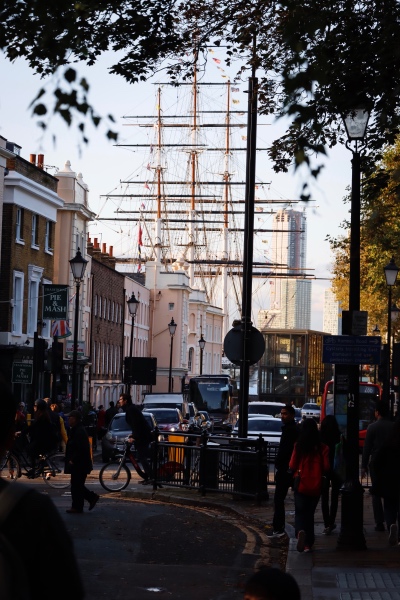
Greenwich with the masts of the Cutty Sark in the background. PICTURE: Robert Likovski/Unsplash
Eight historic department stores in London…2. Liberty & Co…
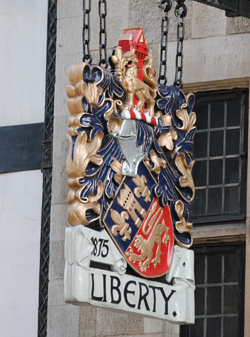
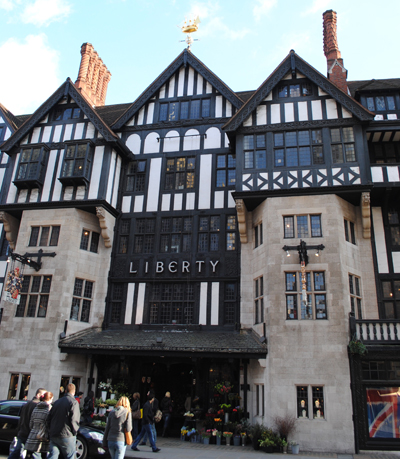 Liberty, now a West End institution, was founded by Arthur Lasenby Liberty in 1875 with a vision to transform the way people thought of fashion and homewares.
Born the son of a Buckinghamshire draper, Liberty worked with relatives from a young age before he eventually started work with a women’s fashion house, Farmer and Rogers. Rising to management, when they refused to make him a partner in the business, he decided to strike out on his own and established Liberty & Co at 218a Regent Street, an ‘oriental warehouse’ selling ornaments, fabric and objets d’art. He named the property East India House.
 Only 18 months after he first set up shop – financed with a £2,000 loan from his future father-in-law and employed three staff – he was already expanding his premises into properties to the south in Regent Street to house furnishings and carpets. He eventually took over all the buildings between 140 to 150 and named the extended building Chesham House.
The costume department was introduced in 1884 and together with its director EW Godwin, Liberty created in-house fashions to challenge those of Paris. He is also noted for having encouraged and collaborated with designers like Archibald Knox and William Morris.
Liberty, who took the company public in 1894, was knighted in 1913. He died in 1917, seven years before the current Liberty store – the mock-Tudor building on the corner of Regent Street and Great Marlborough Street – was built.
Designed by Edwin T Hall and son, the shop was built from the timbers of two ships, the HMS Impregnable and the HMS Hindustan (and the shop frontage measures the same length as the latter). It was built around three light wells, each of which was surrounded by smaller rooms – many of which have fireplaces and were designed to give the feel of rooms in a house.
Features on the Grade II*- listed building include its weathervane – an exact replica of the Mayflower, which took pilgrims to the US in 1620, decorative shields including the arms of Shakespeare and those of the wives of King Henry VIII, and the clock above the Kingly Street entrance.
Liberty, which is generally acknowledged to have been a powerful influence on 19th and 20th century fashions and tastes, was bought by its current owners, BlueGem in 2010.
LondonLife – HMS Belfast marks 45 years on the Thames…

The HMS Belfast has marked 45 years since it sailed up the River Thames to its current mooring site off The Queen’s Walk, just to the west of Tower Bridge. The ship, which is Europe’s only surviving World War II cruiser and which, as well as taking part in that conflict, also saw action in the Korean War, opened to the public in 1971. More than nine million people have since visited the ship which features nine decks, all of which are open to sightseers. For more on the ship, see www.iwm.org.uk/visits/hms-belfast.
A Moment in London’s History – The ‘Great Tea Race’ crosses the finish line…
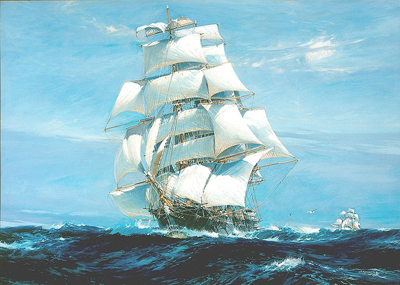 It’s 150 years ago this month that the ‘Great Tea Race’ of 1866 ended in London with the clipper ship Taeping taking the honours followed just 28 minutes later by the Ariel.
The race, which had started in China, was part of a tradition for ships carrying cargoes of tea from the east to engage in a race to be the first to dock in London – and quite a lucrative one, for it was common for the first ship to arrive to receive a premium of at least 10 per cent (although 1866 was apparently the last time this was offered).
At least 57 ships apparently sailed in the 1866-67 ‘tea season’, departing for Britain from a range of ports including Shanghai, Canton and Hong Kong. But it was the fastest which gathered the most attention – these chosen clippers set sail for Britain from the Min River, downriver from Foochow (now Fuzhou), in late May, 1866.
As well as the Taeping, launched in 1863 and captained by Donald MacKinnon, and the Ariel, launched only the previous year and captained by John Keay, other favourites in the 1866 race included Fiery Cross, Serica and Taitsing.
The race was followed breathlessly in the London press although details were limited – largely due to the time it took for the news to reach London – as the ships set a course which took them through Indonesia via the Sunda Strait and around the southern tip of Africa and up via the Atlantic to the UK.
The Taeping, the race winner, reached London Docks at 9.47pm on 6th September while Ariel arrived at the East India Dock at 10.15pm. The Serica, meanwhile, reached West India Docks at 11.30pm. (It wasn’t to be too unfortunate for the runner-up – Captains McKinnon and Keay had apparently agreed to split the premium of 10 shillings a ton).
Amazingly, this means the three ships – which had all left China on the same tide – had sailed more than 14,000 miles in a race of 99 days yet had managed to dock with just two hours between them.
PICTURE: The Ariel and Taeping, by Jack Spurling (1926)/Wikimedia Commons
This Week in London – Totally Thames; Sixties revolution at the V&A; and, French portrait drawings…
 • It’s September and that means Totally Thames, an annual month of events celebrating London’s great watery artery. Highlights among this year’s 150 events include this Saturday’s Great River Race in which more than 300 boats from across the UK and around the world compete on a course running from Millwall Slipway to Ham House in Richmond, Life Afloat, an exhibition looking at the evolution of the houseboat living on the Thames across the last 100 years, and the 8th annual Classic Boat Festival at St Katharine Docks this weekend as well as walks, talks, performances, art installations and boat trips including a tour of Brunel’s London. Runs until the end of the month. For more information and the full programme of events, see www.totallythames.org. PICTURE: Totally Thames/Barry Lewis.
• The changes that swept across society in the late 1960s are the subject of a new exhibition which opens at the V&A this weekend. You Say You Want a Revolution? Records and Rebels 1966-70 is divided into six distinct sections, and starts with a recreation of Carnaby Street as it was before moving on to subjects like clubs and counterculture, revolution on the street, revolution in consumerism, festivals and alternative communities. Among the objects on display are costumes designed for Mick Jagger, a Cecil Beaton portrait of Twiggy, Roger Corman’s 1967 film about LSD, The Trip, a wall of protest posters, film, sound and still footage from the 1967 Montreal and 1970 Osaka World Expos, a kaftan worn by Grace Slick of Jefferson Airplane at Woodstock, and a rare Apple 1 computer. Runs from 10th September to 26th February at the South Kensington institution. For more, see www.vam.ac.uk/revolution.
• A new exhibition showcasing the British Museum’s holdings of French portrait drawings opens at the Bloomsbury establishment today. French portrait drawings from Clouet to Courbet offers the chance to see some well-known French portrait drawings alongside others that have never been exhibited before. Pictures on show include Francois Clouet’s portrait of Catherine de’Medici, Jean-Michel Moreau le Jeune’s chalk drawing of his infant daughter, and a ‘playful’ portrait of artist Artemisia Gentileschi by Pierre Dumonstier. The free display can be seen in Room 90 until 29th January.
Send all items for inclusion to exploringlondon@gmail.com.
10 notable blue plaques of London – 7. A blue plaque for a ship…
As mentioned last week, there are a number of official English Heritage blue plaques in London which commemorate events rather than people.
Alongside the blue plaque commemorating the first V1 flying bomb to hit London (the subject of last week’s entry) is a blue plaque commemorating the site where one of world’s most famous ships – the SS Great Eastern – was built.
 The plaque is located at Burrells Wharf, 262 Westferry Road, on the Isle of Dogs in the Docklands, and it was there that the design of Isambard Kingdom Brunel, who had previously designed the SS Great Western and the SS Great Britain, was realised under the direction of naval architect and ship builder John Scott Russell, of J Scott Russell & Co.
The ship, which had a double hull and immense paddle wheels, took some five years to build at a site in Millwall on the Isle of Dogs (if you’re interested in the etymology of the latter, see our earlier post here).
It was supposed to be launched before a crowd of thousands on 3rd November, 1857, (the Great Eastern Ship Company had sold tickets). But the launch was unsuccessful as the equipment supposed to haul the ship to the water failed (and it was during this unsuccessful attempt that the ship was apparently initially christened SS Leviathan; her name was changed to the SS Great Eastern soon after).
A couple of further unsuccessful attempts were made before, on 31st January, 1858, the 211 metre long ship – aided by an unusually high tide – was finally sent into the Thames (unusually, it was launched sideways).
The outfitting of the ship, which started in January, 1859, took six months and on 6th September, the ship made its maiden voyage from London to Weymouth, a voyage which was marred by the tragic death of a number of stokers in a boiler explosion. Sadly, Brunel himself died soon after the maiden voyage, not in the sort of triumphant circumstances he might have hoped for.
While it was originally designed to sail to India and the Far East, it was in the Atlantic where the ship took up the passenger trade. Her first voyage to North America took place in June the following year and the SS Great Eastern continued to cross the Atlantic over the next few years (including during the American Civil War when she took British troops to Canada) but, blighted by back luck (including, in 1862, running into an uncharted rock in New York harbour) and facing the competition of faster, smaller ships, she was never really a commercial success.
Sold off, the SS Great Eastern was reinvented in the mid 1860s as a cable-laying ship and did so in various parts of the world until, after being laid-up in 1874, sailing to Liverpool where she became something of a tourist attraction and a floating billboard before eventually being scrapped in 1889.
There was legend that two skeletons were found between the two hulls when the ship was broken up – that of a riveter and his ‘bash boy’ (a young lad charged with heating and putting the rivets in the hole) – and it was believed by some that it was their deaths which had brought the ship such bad luck.
The plaque was erected in 1992.
PICTURE: Spudgun67/CC BY-SA 4.0/Wikipedia
Treasures of London – The Golden Hinde II…
Launched in 1973, this full-sized, working replica of the galleon sailed by Elizabethan seafarer and courtier Sir Francis Drake on his circumnavigation of the globe between 1577 and 1580 is moored at St Mary Overie Dock in Bankside.
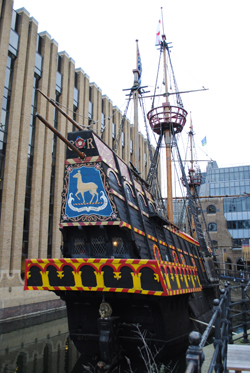 The ship was made at the behest of two American businessmen, Albert Elledge and Art Blum, who wished to commemorate the 400th anniversary of Sir Francis Drake’s landing on the west coast of North America in 1579.
The ship was designed by Loring Christian Norgaard, a Californian naval architect, who spent three years researching it, drawing on original journals of the crew members and other manuscripts.
The two year job of building the vessel was given to J Hinks & Son who did so in Appledore, North Devon, using traditional methods and tools (with a few modern concessions).
The ship was officially launched from the Hinks shipyard by the Countess of Devon on 5th April, 1973. She sailed out of Plymouth on her maiden voyage in late 1974 and arrived in San Francisco the following May to commemorate Sir Francis’ proclamation of New Albion at a site believed to have been in northern California in 1579.
Since then, the ship has sailed more than 140,000 miles around the world – like its forebear, it has circumnavigated the world – and been feared in various films including Shogun (1979), Drake’s Venture (1980) and St Trinian’s 2: The Legend of Fritton’s Gold (2009).
It has been moored in Southwark since 1996 – it did leave briefly for a visit to Southampton in 2003 – and as well as hosting school visits, is also open for tours and can be booked for private functions.
WHERE: Golden Hinde II, Bankside (nearest Tube station is London Bridge); WHEN: Self-guided tours 10am to 5.30pm daily (check website for other tour times and dates); COST: Various (depending on tour); WEBSITE: www.goldenhinde.com.
London Pub Signs – The Cutty Sark…
 Another Greenwich pub whose name references an aspect of maritime history (see our previous posts on the The Gipsy Moth and the Trafalgar Tavern), this riverside establishment takes its name from a former tea clipper (which, not coincidentally, is on display nearby).
The clipper Cutty Sark was constructed in Dumbarton in 1869 to facilitate the transport of tea from China to Britain in as short a time span as possible. It made its maiden voyage the following year and but only ended up working the tea route for a few years before being used to bring wool from Australia.
Later sold to a Portuguese company, the vessel continued to be used as a cargo ship until she was sold in 1922 and used as training ship, first in Cornwall, and later at Greenhithe in Kent.
In 1954, the vessel found a new permanent dry dock at Greenwich and was put on public display. Damaged by fire in 2007, the ship underwent extensive restoration and is now displayed in a state-of-the-art purpose-built facility which allows you to walk underneath the vessel.
The three level Cutty Sark pub, located at 4-6 Ballast Quay (formerly known as Union Wharf), features a Georgian-style bow windows on the first and second floors (the first floor is home to the Willis Dining Room which has great views of the Thames).
The present Grade II-listed building apparently dates from the early 19th century (although the sign out the front suggests 1795 and it’s been suggested the building was substantially altered in the mid-19th century) but there is evidence of a public house on the location by the early 18th century.
Known at one stage at the Green Man, in 1810 it became the Union Tavern – a reference, apparently, to the union of England and Ireland which took effect in 1801. It took its current name after the Cutty Sark arrived in Greenwich in the 1950s.
For more on the pub, see www.cuttysarkse10.co.uk. For more on the ship, see www.rmg.co.uk/cutty-sark.
This Week in London – Greek sculpture at the British Museum; Hew Locke at HMS Belfast; an interactive high seas adventure at the National Maritime Museum; and, coral reefs at the Natural History Museum…
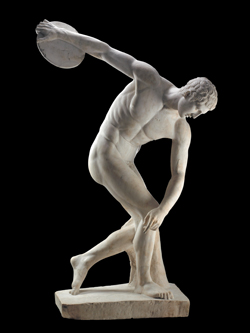 • The ancient Greek “preoccupation with the human form” is the subject of a new exhibition which opens at the British Museum in Bloomsbury today. Defining beauty: The body in ancient Greek art features about 150 objects dating from the prehistoric to the age of Alexander the Great. Highlights include a newly discovered bronze sculpture of a new athlete scraping his body with a metal tool after exercise before bathing, six Parthenon sculptures from the museum’s collection including a sculpture by Phidias of the river god Ilissos, and copies of Greek originals including the Towny Discobolus (discus-thrower – pictured) – a Roman copy of Myron’s lost original – and Georg Romér’s reconstruction of Polykleitos’ Doryphoros (spear-bearer) . Runs until 5th July. Admission charge applies. For more, see www.britishmuseum.org/definingbeauty. PICTURE: © The Trustees of the British Museum.
• London-based contemporary artist Hew Locke has transformed an entire deck of the HMS Belfast in a major new work, ironically titled work, The Tourists. The installation – which is on show until 7th September – depicts imaginative events in which the crew of the ship are preparing to arrive at Trinidad in time for Carnival in 1962 (the ship’s last international journey – to Trinidad – actually arrived three months after the celebration). Free with general admission charge. For more see www.iwm.org.uk/visits/hms-belfast. Meanwhile, the Imperial War Museum in Lambeth is hosting a free exhibition of Locke’s work in which he explores the idea of naval power through a series of ship sculptures. This free exhibition can be seen until 4th May. For more, see www.iwm.org.uk/visits/iwm-london.
• Families are invited to take part in a new interactive experience on the “high seas of maritime history” which launches at the National Maritime Museum in Greenwich on Saturday. The museum has joined with Punchdrunk Enrichment to take six to 12 year-olds and their families on an adventure, Against Captain’s Orders: A Journey into the Uncharted. Visitors don life jackets as they become part of the crew of the HMS Adventure and take on various seafaring roles as they navigate their way through the exhibition. Admission charge applies. Runs until 31st August. For more, see www.rmg.co.uk/againstcaptainsorders.
• See a real coral reef and take a virtual dive in new exhibition at the Natural History Museum in South Kensington. Coral Reefs: Secret Cities of the Sea – which opens tomorrow on World Oceans Day – also features more than 200 specimens including coral, fish and fossils. These include examples collected by Charles Darwin on the voyage of the HMS Beagle in the 1830s, giant Turbinate coral and creatures ranging from the venomous blue-ringed octopus to tiny sponge crabs. For more see www.nhm.ac.uk.
Send items for inclusion to exploringlondon@gmail.com.
 Exploring London