Famous Londoners – Sir Peter Lely…

One of the most famous painters of his age, Dutchman Sir Peter Lely – currently the subject of an exhibition at London’s Courtauld Gallery – rose to become the foremost portrait painter at the English Court during the latter half of the 17th century.

Born to Dutch parents on 14th September, 1618, in Westphalia (now part of Germany) where his father was serving as an infantry captain, Peter – originally named Pieter van der Faes – studied art as an apprentice in Haarlem in what is now The Netherlands. While there he is believed to have changed his name to Lely based on a heraldic lily which appeared on the gable of the house where his father was born in The Hague.

Lely appeared in London in the early 1640s and, while he initially devoted himself to the sort of narrative-style paintings inspired by classical mythology, the Bible and literature he had been working on in Haarlem but having found no great success there, soon turned his hand to portraiture.

The death of court portraitist Anthony van Dyck in 1641 had left a vacuum he stepped into the gap, soon becoming the most in-demand portrait painter at the Royal Court, his sitters including none other than King Charles I himself.

However, Lely, who was made a freeman of the Painter-Stainers Company in London in 1647, managed to straddle the political divide and after the beheading of King Charles I and the end of the English Civil War in 1651, was able to continue painting portraits of the most powerful people in the land including Oliver Cromwell – whom he painted “warts and all” as per the Lord Protector’s request – and his Cromwell’s brother Richard.

Already renowned as the best artist in the country, following the Restoration in 1660, Lely became Principal Painter of King Charles II, placed on an annual stipend as van Dyck had been before him during the reign of King Charles I.

Lely’s workshop was large and its output prolific, with his students and employees – who at one stage apparently included scientist and architect Robert Hooke – often completing his paintings after he sketched out some details, only painting the sitter’s face in any great detail.

Among his most famous works are a series of 10 portraits known as the Windsor Beauties (currently at Hampton Court Palace), a series of portraits of senior naval officers who served in the Second Anglo-Dutch War, known as the Flagmen of Lowestoft (most of the works at are the National Maritime Museum in Greenwich) and Susannah and the Elders (currently at Burghley House in Cambridgeshire) as well as some of the paintings in the current Courtauld exhibition including Nymphs by a Fountain (usually found at the Dulwich Picture Gallery) and Boy as a Shepherd (also the Dulwich Picture Gallery).

Lely was also known as an avid collector of art and is credited as being the first artist in England to do so in any serious manner – among his purchases were works which formerly formed part of King Charles I’s collection. At the time of his death, he is said to have owned more than 500 paintings, although more than half of these were works of his or his studio.

Sir Peter, who never married but had two children who survived him with a common-law wife Ursula, lived at a house in the north-east corner of Covent Garden from about 1650 until his death in 1680 (some sources have him knighted in this year, others in 1679) but also had a house at Kew and owned property outside of London including in Lincolnshire and The Hague.

He was apparently working at his easel in the studio of his Covent Garden house when he died on 30th November, 1680. He was buried at St Paul’s Church, Covent Garden. The monument to him, the work of Grinling Gibbons, was destroyed by fire in 1795.

Peter Lely: A Lyrical Vision – which focuses on some of his early non-portrait works – runs at The Courtauld Gallery until 13th January. For more on the exhibition, visit www.courtauld.ac.uk/gallery/exhibitions/2012/peter-lely/index.shtml. Running alongside the exhibition is a display of some of the drawings from Sir Peter’s own collection, Peter Lely: The Draughtsman and His Collection.
10 Historic London Markets – 6. Old (and New) Spitalfields Market…

There has been a market on the site now known as Old Spitalfields Market, located on the eastern outskirts of the City of London next to what was the Priory and Hospital of St Mary Spital, since the thirteenth century.

But it was centuries later when, following the tumult of the Civil War, in 1682, John Balch was formally granted a Royal Charter by King Charles II to hold a “flesh, fowl and roots” market on Thursdays and Saturdays in or on the rectangle of land known as Spital Square. A ‘market-house’ was built on the site around this time for administrators with traders selling their wares from stalls.

The success of the market drew people to the area – in particular, Huguenots fleeing France who brought with them new skills in silk-weaving, and later Irish fleeing the Potato Famine and Jews escaping the harsh political climate in Eastern Europe – and the market gained a name for itself as a place to buy fresh produce.

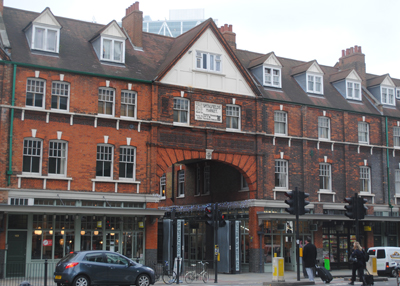
By late in the 19th century, the market had fallen into decline. So, in 1876, a former market porter by the name of Robert Horner decided it needed an upgrade and, buying the lease, had the central market square roofed with glass and new market buildings, known as the Horner Buildings (pictured above), constructed around the northern, eastern and southern sides of the site. Having cost £80,000, it was completed in 1893.

In 1920, the City of London took over control of the market and later than decade expanded the original buildings. Having continued to grow over the ensuing years and with traffic congestion continuing to increase in the surrounding streets, it was decided to move the fresh produce aspect of the market to a new location at Leyton to the north-east.

The new market, known as New Spitalfields Market, covers more than 31 acres and boasts more than 100 traders.

Meanwhile, Old Spitalfields Market, the western end of which was redeveloped in the late 20th century, continues to operate on the original market site – now known as Horner Square, with stalls selling everything from contemporary and vintage fashion to music, gems and jewellery, bric-a-brac and antiques as well as various themed market days – check the website for more details.

Old Spitalfields Market
WHERE: Horner Square, Spitalfields (nearest Tube stations are Shoreditch High Street and Liverpool Street); WHEN: Markets are held every day – times vary so check website for details; COST: Free; WEBSITE: www.oldspitalfieldsmarket.com.
.
New Spitalfields Market
WHERE: 23 Sherrin Road, Leyton (nearest Tube station is Leyton); WHEN: Trading hours midnight to around 9am, Monday to Saturday; COST: Free; WEBSITE: www.cityoflondon.gov.uk/business/wholesale-food-markets/new-spitalfields/Pages/default.aspx.

10 Historic London Markets – 5. Covent Garden Market…

We’ve had a quick look at the origins of Covent Garden before (as part of our What’s in a name? series) but it’s worth a recap.

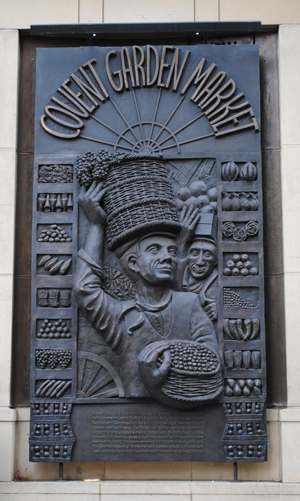
Now a favorite of tourists visiting London, Covent Garden is these days largely known as a specialty shopping and entertainment precinct in the West End. But its beginnings as a market go back at least to the 1600s when a licence was formally granted to hold a market in the piazza.

The land had been formerly owned by the Abbey (or Convent) of St Peter in Westminster which had established 40 acre kitchen garden here (hence ‘Convent Garden’) and had passed into the hands of the Crown at the Dissolution. Later owned by the Earls of Bedford, it was the 4th earl, Francis Russell, who commissioned Inigo Jones to design a great residential square- including St Paul’s Church, known as the Actor’s Church – on the site.

By 1650, fruit and vegetable markets were regularly been held on the site and, interestingly, around this time the market adopted the pineapple, a symbol of wealth, as its emblem (it was also around this time that Punch and Judy shows were introduced to the area (see our earlier post on Mr Punch here)). Covent Garden’s rise to prominence as a market came when the Great Fire of London destroyed many of London’s other markets leaving it as the foremost fruit, vegetable and flower market. In May 1670, the 5th Earl of Bedford, William Russell (later 1st Duke of Bedford), obtained the formal right to hold a market on the site from King Charles II.

The growth of the market and the development of fashionable residential developments further west in Soho and Mayfair saw many of the affluent people who had lived around the market move out and the character of the square changed (in an indication of this, a list of Covent Garden prostitutes was published in 1740).

In 1813, the 6th Duke of Bedford, John Russell, secured an Act of Parliament regulating the market and in the late 1820s began to redevelop the site, commissioning architect Charles Fowler to design new buildings (up until then the market was housed in makeshift stalls and sheds). These include the grand main market building which still stands on the site today.

The market continued to grow – there is said to have been 1,000 porters employed at the market’s peak – and in 1860 a new flower market was built on the south piazza (where the London Transport Museum now stands), while in the 1870s, a glass roof was added to the market building. A “foreign” flower market opened in what is now Jubilee Hall in 1904.

In 1918, the Bedford family sold the market to the Covent Garden Estate Company. The next major installment in the market’s life came in 1974 when the market, which had outgrown the West End site, moved out to a new site in Nine Elms at Vauxhall in London’s inner south.

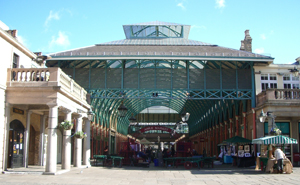
The Covent Garden site was left to fall into disrepair but, saved from demolition and redevelopment largely through the efforts of Geoffrey Rippon, then Secretary of State for the Environment, it subsequently underwent restoration, reopening as a speciality shopping centre in 1980 with areas including the Apple Market (pictured above), the East Colonnade Market and the Jubilee Market. Now owned by Capital & Counties who purchased it in 2006, the market – along with the larger 97 acre Covent Garden area – remain under the care of the Covent Garden Area Trust.

Meanwhile, the New Covent Garden Market at Nine Elms is these days the largest fruit, vegetable and flower market in the UK and boasts more than 200 businesses. There are currently plans to redevelop the 57 acre market site which will include providing more space for market tenants as well as new homes, shops and community facilities like parks.
.
Covent Garden
WHERE: King Street, Covent Garden (nearest Tube stations are Covent Garden, Leicester Square and Embankment); WHEN: Public areas are open 24 hours; check with individual shops for opening times; COST: Free; WEBSITE: www.coventgardenlondonuk.com
.
New Covent Garden Market
WHERE: New Covent Garden Market, Nine Elms, Vauxhall (nearest Tube station is Vauxhall); WHEN: The fruit and vegetable market’s core trading hours are between midnight and 6am, Monday to Saturday, while the flower market’s core trading hours are between 2am and 8am, Monday to Saturday (times may vary for individual businesses); COST: Free (charge for cars); WEBSITE: www.newcoventgardenmarket.com.
.
PICTURE: Apple Market Picture courtesy of www.coventgardenlondonuk.com.

Around London – Naval caricatures; James Bond; a Taliban motorbike; and Sir Peter Lely at the Courtauld…

Naval caricatures of the late 18th and early 19th century go on display in a new exhibition which opens at the National Maritime Museum today. Broadsides! Caricature and the Navy 1756-1815 features a small selection of the museum’s extensive collection of caricatures – one of the largest in the world, it features works by James Gillray, George M Woodward and Thomas Rowlandson. It explores the role the caricatures played in shaping public opinion during the period which included the American War of Independence and wars against revolutionary and Napoleonic France. The exhibition features 20 prints with visitors able to see others in the museum’s collection via the website www.rmg.co.uk/collections. Admission is free. Runs until 3rd February. For more, see www.rmg.co.uk.

Celebrate the 50th anniversary of James Bond and the premiere of the latest film in the franchise, Skyfall, with a look at a rare collection of James Bond posters and other memorabilia as well as the latest Bond vehicle this weekend. The Hospital Club in Covent Garden is hosting the event, in conjunction with Blue Robin, which features about 50 vintage posters from movies such as 1973’s Live And Let Die and 1963’s From Russia With Love. There’s also the chance to have your photo taken beside the double-cab Land Rover Defender which features in the opening chase sequence of Skyfall. Also exhibited will be M’s chauffeur-driven Jaguar XJ long wheel base and the black Range Rover driven by Bill Tanner, M’s chief of staff. The free exhibition is open to the public from 11am to 7pm from tomorrow until Monday (please call reception on 020 7170 9100 before visiting). For more, see www.thehospitalclub.com.

A motorbike captured from Taliban insurgents in Afghanistan by members of the 1st Battalion The Rifles has gone on display at the Imperial War Museum in London. The Honda motorbike forms part of the interactive display, War Story: Serving in Afghanistan, in which visitors can delve into the lives of service personnel taking part in Operation Herrick through personal artefacts, photographs and video. The bike was recovered by soldiers after it was left behind by two insurgents during an encounter on 4th May last year. It is the largest item to be donated through the War Story project and is the only item of enemy equipment acquired by the project to date. The motorbike will be displayed until 18th December. For more, see www.iwm.org.uk.

Now On: Peter Lely: A Lyrical Vision. This newly opened exhibition at the Courtauld Gallery is the first to look at the group of large scale narrative paintings produced by Sir Peter during the turmoil of the Civil War in the 1640s and 1650s. Renowned as the principal painter of King Charles II and the “outstanding artistic figure of Restoration England”, Sir Peter apparently never wished to be seen principally as a portraitist and following his arrival in England in the early 1640s, initially devoted himself to paintings inspired by classical mythology, the Bible and contemporary literature. The exhibition centres on The Courtauld’s own work, The Concert, and features an important group of little known paintings from private collections. Runs until 13th January. Admission charge applies. For more, see www.courtauld.ac.uk/gallery/index.shtml.

Famous Londoners – Grinling Gibbons…

A late 17th and early 18th century wood carver and sculptor, the curiously named Grinling Gibbons is remembered for his magnificent carvings in numerous English buildings including such London icons as St Paul’s Cathedral and Hampton Court Palace.

Not much is known about Gibbons’ early life. The son of English parents (his father was apparently a draper), he was born in Rotterdam in The Netherlands on 4th April, 1648, and, as a young man, is believed to have undertaken an apprenticeship as a sculptor in that country.

Around the age of 19, he moved to England – first to York and to Deptford in the south. It was the quality of his work which led diarist John Evelyn, having discovered Gibbons working on a limewood relief of Tintoretto’s Crucifixion in a small cottage near Deptford in early 1671, that led him to introduce him to Christopher Wren, the architect of the age, and fellow diarist Samuel Pepys and to eventually present him (and his relief) to King Charles II at Whitehall Palace on 1st March the same year.

But Gibbons’ work apparently failed to initially impress at court and it was only following his ‘discovery’ later that year by the court artist Sir Peter Lely that he began to receive major commissions.

It’s apparently not known when Gibbons married his wife Elizabeth and moved to London they were living there by 1672 and were having the first of their at least 12 children (while at least five of their daughters survived into adulthood, none of their sons did).

In 1672, they were living in an inn, called La Belle Sauvage or The Bell Savage, located on Ludgate Hill near St Paul’s, and, while Gibbons continued to maintain a workshop here into the 1680s, the family moved to Bow Street in Covent Garden around the end of the 1670s (the house here apparently collapsed in 1702 and was subsequently rebuilt in brick).

Gibbons, who was admitted to the Draper’s Company in 1672 and held various posts within it over ensuing years, reached the pinnacle of his success when he was made master sculptor and carver in wood to King William III in 1693, and was later made master carpenter to the king, then King George I, in 1719.

Having worked mostly in limewood, Gibbons, recently called the “British Bernini”, is known for his distinct and exuberant style which features cascading foliage, fruit, animals and cherubs. While he worked on numerous important buildings outside of London – including carvings in the Chapel Royal and king’s dining room at Windsor Castle, in a chapel at Trinity College in Oxford, at Blenheim Palace in Oxfordshire and a famous ‘carved room’ at Petworth House in Sussex – and beyond (he also created two presentation panels – known as the ‘Cosimo’ and ‘Modena’ panels which were sent to Italy as royal gifts), Gibbons is also noted for his work on a number of prominent buildings in London.

Among the buildings he worked on or in around London are the churches of St James’s in Piccadilly, St Mary Abchurch, St Michael Paternoster Royal and, famously, St Paul’s Cathedral (where he carved choir stalls, the bishop’s thrones and choir screen) as well as Hampton Court and Kensington Palaces.

While he is primarily remembered for his limewood carvings, Gibbons’ workshop was also responsible for sculpting statues, memorials and decorative stonework. A couple of the workshop’s statues can still be seen in London – one of King Charles II in Roman dress at the Royal Hospital in Chelsea and another of King James II outside the National Gallery in Trafalgar Square – while the magnificent Westminster Abbey memorial to Admiral Sir Clowdisley Shovell is also attributed to him.

Gibbons died at his Bow Street home on 3rd August, 1721, and was buried in St Paul’s Church in Covent Garden (his wife had been buried there several years before).

For more on Grinling Gibbons, check out David Esterly’s Grinling Gibbons and the Art of Carving.

Famous Londoners – Mr Punch…

Infamous, perhaps, rather than famous, Mr Punch (one half of Punch & Judy) this year celebrated the 350th anniversary of his first public appearance in London (which, in our view, makes him an honorary Londoner!).

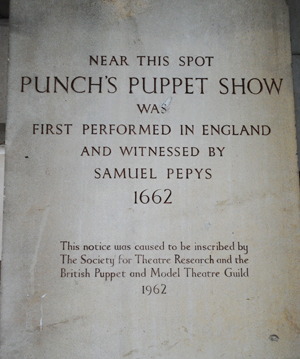
The first documented appearance of the hook-nosed Mr Punch – known for his acrimonious relationship with his wife Judy –  dates back to 9th May, 1662, when diarist Samuel Pepys recorded seeing a Mr Punch puppet performing as part of an Italian marionette show at Covent Garden (officially awarded a Guinness World Record title earlier this year for being the first recorded Mr Punch puppet show).

Mr Punch’s origins go back to Italy (Punchinello is thought to be an anglicised version of the character name of Pulcinella), typically wears a jester’s motley and tall, ‘sugarloaf’, hat with a tassel. Now generally a hand-puppet rather than a marionette, these days he usually performs in a mobile puppet booth with a cast of characters who as well as Judy can include a baby, a police constable and a crocodile.

Storylines – which were initially aimed at adults but are now generally aimed at children – vary but usually include references to current events (and perhaps also some mocking of public figures) and inevitably involve the unruly and often bawdy trickster, Mr Punch, doing away with his foes before uttering the line: “That’s the way to do it!”

Interestingly, Punch & Judy performers refer to themselves as “professors”  – there’s a story, apparently apocryphal, that this title was granted to the performers by King Charles II thanks to his enjoyment of the show. Collecting money from an audience watching the show is known as ‘bottling’ and those who assist the professor by doing so as ‘bottlers’, thanks to the tradition of using a bottle for the task.

Mr Punch reached the height of his popularity in the Victorian and Edwardian ages and could typically be seen carrying on in seaside resorts across the country. The dramatic decline in his popularity since means it can be harder to find a Punch & Judy show today (and even when you do, much of his more brutal antics have been excised from plays so as not to offend modern sensibilities), but it’s still possible to see Punch and Judy performances in many places across the UK including, on occasion, at Covent Garden where there is a plaque (shown above) commemorating the performance seen by Mr Pepys.

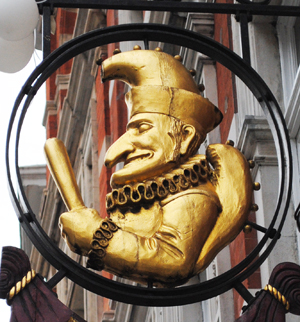
Mr Punch is still celebrated every year at Covent Garden’s May Fayre and Puppet Festival (held close to 9th May – not only the day Mr Pepys saw the puppet but now regarded as Mr Punch’s ‘birthday’) and there is a fellowship of Punch and Judy performers – The Punch & Judy Fellowship – who aim to “preserve, promote and protect” the traditions of the puppet show. Punch can also be seen on the facade of the Punch Tavern in Fleet Street – the sign is pictured above (keep on eye out for our upcoming Pub Signs look at the pub’s history).

Where is it?…#38


The latest in the series in which we ask you to identify where in London this picture was taken and what it’s of. If you think you can identify this picture, leave a comment below. We’ll reveal the answer early next week. Good luck!

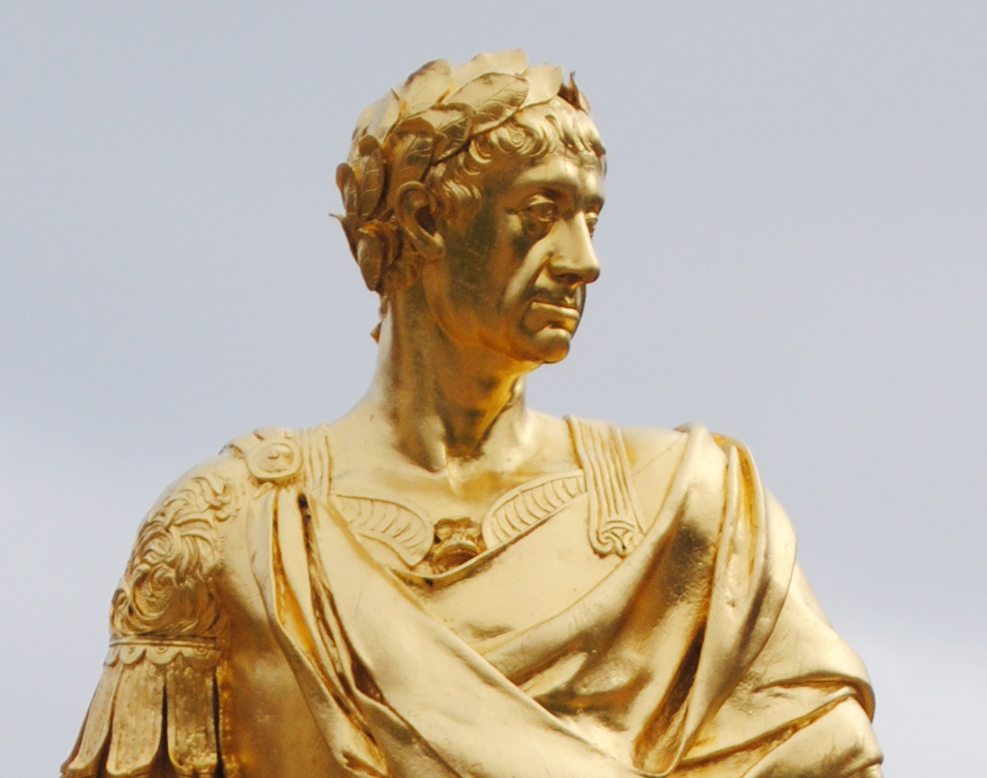
No-one managed it this time. This gilded bronze statue depicts King Charles II dressed as a Roman general and is located in the Figure Court of the Royal Hospital in Chelsea. The king founded the hospital in 1682 to provide a home for retired soldiers (the grand buildings you see are the work of Sir Christopher Wren – see our earlier entry here for more). The 7’6” tall statue, which was re-gilded to celebrate Queen Elizabeth II’s Golden Jubilee in 2002, was presented to the king in 1682 and moved to the hospital after his death in 1685. Although generally attributed to Grinling Gibbons, according to Walking London’s Statues and Monuments, it’s probably actually the work of Arnold Quellin, who worked in Gibbons’ studio. The statue is covered in oak branches on a date around 29th May each year – on a day known as Founders Day or Oak Apple Day – in commemoration of the legendary escape of the future king (by concealing himself in an oak tree) after the Battle of Worcester in 1651, the last battle of the English Civil War. For more on the hospital see www.chelsea-pensioners.co.uk.

Celebrating the Diamond Jubilee with 10 royal London locations – 6. The Mall…

For many Londoners, an opportunity to see the Queen means heading to Buckingham Palace to watch her wave from the balcony – or standing in the Mall to watch as her carriage goes by.

Given that, we thought we’d take the time to have a quick look at the history of The Mall, an important player in events like the annual Trooping the Colour.

This one kilometre long grand processional route which links Trafalgar Square to Buckingham Palace, was originally cut through St James’s Park in 1660 when King Charles II was looking for a new paille-maille pitch (see our earlier entry on Pall Mall for more on this). Two long avenues of trees were planted on either side, giving it a leafy feel that’s still in evidence today.

The Mall had become notorious by the 18th century and was spruced up in 1911 under the eye of Sir Aston Webb (who also designed other elements in the area including a new facade for Buckingham Palace, the Queen Victoria Memorial in front of the palace, and Admiralty Arch at the western end of the route) to become the grand avenue, complete with red-carpet like surface (this was done later), that it is today.

It is bordered by St James’s Park on the south side and on the north side is overlooked by various grand buildings – including Clarence House and the Institute of Contemporary Arts – as well as, toward the western end, Green Park.

These days the Queen publicly processes down The Mall for a number of events throughout the year – among them are the State Opening of Parliament (held earlier this month) as well as military ceremonies like Trooping the Colour and events like last year’s Royal Wedding when is it said that more than a million people were said to have filled the broad street.

The Mall is also the route along which Heads of State process in a horse drawn carriage during official visits (the road is then decorated with Union Jacks and flags of the visitor’s country). During the Olympics, it will be the start and end location of the marathons and cycling road races.

Apart from the Queen Victoria Memorial at the eastern end of The Mall, statues and monuments lining the road include the Queen Mother Memorial, a statue of explorer Captain James Cook, and a recently installed statue of cosmonaut, Yuri Gagarin.

There are apparently a series of tunnels underneath with link Buckingham Palace with Whitehall.

We should also briefly mention Horseguards, which is at The Mall’s eastern end and where Trooping the Colour and Beating Retreat takes place. This was formerly the site of a tiltyard of the Palace of Whitehall and jousting tournaments were held here during the time of King Henry VIII. It has been used for parades and ceremonies since the 17th century. While cars were parked here for much of the 20th century, this practice was stopped in the mid-1990s.

Daytripper – Windsor Castle…

Given we’re marking the Queen’s Diamond Jubilee with a look at sites of significance to her story located in London, it’s perhaps only fitting that we take a look at the nearest royal residence outside the city.

Windsor, located as close as half an hour by train from London’s Paddington station (or around 50 minutes to an hour from Waterloo), boasts plenty to see including the historic town centre, nearby Eton, great river and country walks and, of course, Legoland. But today our attention will remain on Windsor Castle, the oldest and largest inhabited castle in the world.

There has been a fortress on this site since shortly after the Norman invasion when in about 1080 King William the Conqueror ordered it constructed on a ridge above the river bank as part of a series of defensive fortifications around London. The earth and timber Norman castle was gradually added to over the years – King Henry I (reigned 1100-1135), the first king to live here, added domestic quarters while King Henry II (reigned 1154-1189) built substantial royal apartments transforming the castle into a palace and began replacing the outer timber walls with stone fortifications as well as rebuilding the Norman Keep as the Round Tower (parts of which still date from this period). King Henry III (reigned 1216-1272) built upon and expanded his work.

But it was in the reign of King Edward III (1307-1327) that the castle was expanded enormously. This included the reconstruction of the lower ward including the rebuilding of the chapel, naming it St George’s (although the current chapel dates from the reign of King Edward IV – 1461-1470), and the reconstruction of the upper ward complete with apartments for him and his wife, Queen Phillipa, arranged around courtyards (although some of the work wasn’t completed until the reign of his successor, King Richard II – 1377-1399). It was also during King Edward III’s reign that the castle became the base for the Order of the Garter (which he created in 1348), a role it still fulfills.

Other works were ordered by successive Tudor monarchs including King Henry VIII, Queen Elizabeth I, and Queen Mary I. Parliamentary forces seized the castle during the Civil War (Oliver Cromwell did use it as his headquarters for a time) and Royalists were imprisoned here (King Charles I was in fact buried in a vault beneath St George’s Chapel after his execution having been previously imprisoned here).

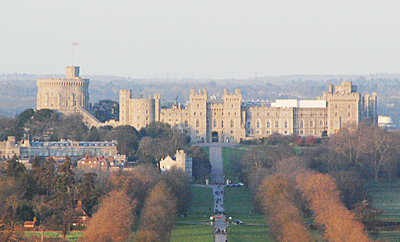
The next major additions came in the reign of King Charles II (1660-1685) when the Upper Ward and State Apartments were reconstructed in baroque splendor, the latter complete with splendid murals ceiling paintings by Italian artist Antonio Verro (the murals were later destroyed but some of the ceiling paintings survive).

From the time of King William III (1689-1702), monarchs began spending more time at Hampton Court Palace but the focus returned to Windsor with King George III. He ordered a range of improvements and updates including modernising Frogmore House in the Home Park for his wife Queen Caroline (the property was subsequently used by various royals but no-one currently lives there), but many of these were stopped prematurely due to his illness. His son, King George IV, picked up where his father left off.

In the reign of Queen Victoria, Windsor became the royal family’s principal residence and was visited by heads of state including King Louis Philippe in 1844 and Emperor Napoleon III in 1855. The Queen’s husband, Prince Albert, died here on 14th December, 1861.

King Edward VII (1901-1910) and King George V (1910-1936) both had a hand in redecorating the palace and the Queen’s father, King George VI (1936-1952), was living in the Royal Lodge in Windsor Great Park when he succeeded to the throne.

In more recent times, the castle was the home to the Queen, then Princess Elizabeth and her sister Princess Margaret, for much of World War II. The castle suffered its greatest setback in recent times in 1992 when a serious fire broke out in the Queen’s Private Chapel which destroyed several rooms including the ceiling of St George’s Hall which dated from the reign of King George IV. Restoration works took five years to complete.

Today the Queen spends many private weekends at the castle while the court is officially in residence here for a month over the Easter period and during Ascot Week in June – it’s at this time that the Garter Day celebrations take place with the installation of new knights.

The Queen also hosts State Visits here with banquets held in St George’s Hall as well as what are known as a ‘sleep and dine’ in which high profile figures are invited to dinner with the Queen before being shown a special display of items from the Royal Library and then spending the night. The Royal Standard flies from the Round Tower when the Queen is in residence.

As well as touring the State Apartments, the Gallery, Queen Mary’s Dolls’ House (completed in the 1920s for Queen Mary, wife of King George V), and St George’s Chapel, visitors to the castle can experience the Changing of the Guard at 11am every day but Sundays between May and early August (and every second day after that).

WHERE: Windsor (a short walk from either Windsor Central Station or Windsor & Eton Riverside Station); WHEN: 9.45am to 5.15pm until 27th July (times vary after this date – check the website); COST: £17 an adult/£10.20 a child (under 17s – under fives free)/£15.50 concession/£44.75 family (price includes an audio tour); WEBSITE: www.royalcollection.org.uk/visit/windsorcastle.

LondonLife – All is revealed at Hampton Court Palace

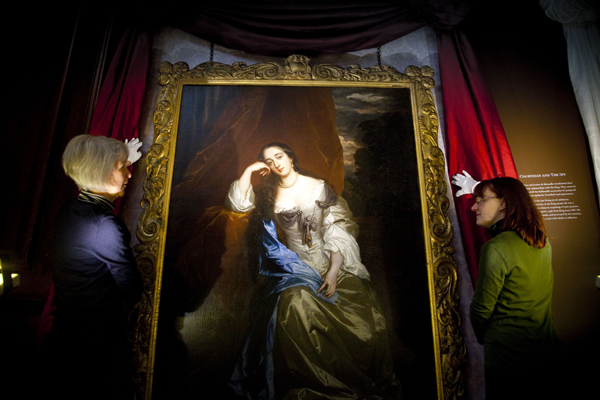
A portrait of King Charles II’s mistress, Barbara Villiers, is put into place ahead of The Wild, The Beautiful and the Damned exhibition which opened at Hampton Court Palace earlier this month. The portrait, which dates from about 1662, was painted by Sir Peter Lely – he also painted a picture King Charles II’s other principal mistress, Nell Gwyn, which is being shown together with the Villiers portrait for the first time. The exhibition, which focuses on the beauty, mistresses and debauchery of the Stuart Court, spans the reigns of the Stuarts from Charles II to Queen Anne and looks at how kings, queens and courtesans “swept away the Puritanical solemnity of the mid-17th century, and attempted to rewrite the moral code of social behaviour”. Runs until 30th September (admission is included in entry ticket; free to Historic Royal Palaces members). There are late openings on the first Monday of each month and note that the exhibition includes adult content. For more, see http://bit.ly/HvyiOE.

PICTURE: Richard Lea-Hair/newsteam.

Famous Londoners – Jack Ketch

A 17th century public executioner famed for his botched executions, Jack Ketch looms as an infamous figure in British history and a byword for brutality and executioners in general.

Ketch’s origins are unknown (he’s also known as John Catch) but he is believed to have received his appointment as a public hangman sometime in the early to mid 1660s – the first recorded mention of him in that role, in a pamphlet celebrating his handiwork, dates from 1678. Such was his self-importance that he apparently adopted the title Esquire and apparently asked for his letters to be addressed to Dr John Ketch.

Among those who died at his hand were those accused of involvement in the Popish Plot against the Crown – a Catholic conspiracy to assassinate King Charles II which was all apparently fabricated by Titus Oates. These included William Staley and Edward Coleman both of whom were hung, drawn and quartered in 1678 (Ketch was also charged with whipping Oates following his perjury conviction).

But Ketch’s most infamous executions, the only two beheadings he is known to have performed, became notorious because of the botched manner in which they were carried out.

It was reported that it took Ketch three blows to strike off the head of William, Lord Russell, when he was executed for treason on 21st July, 1683 (he had opposed the succession of James II and was accused of involvement in the Rye House Plot), although Ketch apparently denied suggestions he had turned up drunk and blamed Lord Russell for flinching.

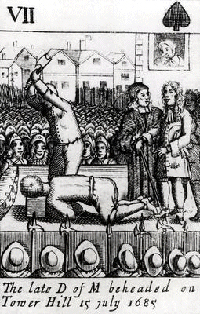
The beheading of James Scott, the Duke of Monmouth (and illegitimate son of King Charles II), on 15th July, 1685 (pictured above in a print from the time), was apparently even worse – it took Ketch five blows to take off his head and he apparently finished the job with a knife after having almost given up halfway through. Monmouth had been captured following the Battle of Sedgemoor in July 1685 in which he led an army having declared himself king (more on that another time).

Ketch fell out of favor with the authorities later that year and was briefly gaoled in Bridewell prison. He was reinstated but his return to the job of public executioner was only short-lived for he died in 1686 and is believed to have been buried in St James’ in Clerkenwell on 29th November, 1686.

He was survived by his wife Katherine, who apparently stood by her man despite the public feeling against him, and is it generally assumed a girl Susanna who was baptised at the church in Clerkenwell in 1668 – some 18 years before his death – was his daughter.

Following his death, Ketch’s name was adopted by subsequent public hangmen – he even appeared as an ongoing character in Punch and Judy shows.

For more on Ketch, see Tim Wales’ article Jack Ketch in the Oxford Dictionary of National Biography (a subscription is required for access).

PICTURE: Wikipedia.

Around London – Crown Jewels polished for Diamond Jubilee; Diana’s dresses at Kensington Palace; a plaque for Ziggy Stardust; and At Home with the World…

• A revamped Crown Jewels display opens today at the Tower of London to mark the Diamond Jubilee of Queen Elizabeth II. The new display features graphics, music and newly restored film footage and will focus on the coronation ceremony as its central theme, exploring how the regalia are used in the ceremony. The regalia – which includes some of the most extraordinary diamonds in the world such as the Star of Africa and Koh-i-Nur – is being displayed in the order in which it is used at the coronation ceremony. The Crown Jewels have been on show to the public at the Tower of London since at least 1661 after they were remade for King Charles II’s coronation. The previous collection had been largely destroyed in the Civil War although some pieces survived including a gilt silver spoon probably made for King Henry II or King Richard I (the “Lionheart”). For more information, see www.hrp.org.uk/TowerOfLondon/.

Five dresses worn by Diana, Princess of Wales, have gone on display at Kensington Palace  which re-opened to the public this week following a £12 million overhaul. The five dresses include a black silk taffeta gown (designed by Emanuel) which Diana wore to a fundraising event at the Goldsmith’s Hall in 1981 – her first official engagement with Prince Charles as well as a formal dinner dress of ivory silk (Catherine Walker) created for a State Banquet for the King and Queen of Malaysia in 1993 and a black ribbed silk shift evening dress (Gianni Versace) worn to the London premiere of Apollo 13 in Hammersmith in 1995. For more on the revamp of the palace see our earlier post. Or visit www.hrp.org.uk/KensingtonPalace/.

• A plaque commemorating the site where the iconic image for the cover of David Bowie’s 1972 album The Rise and Fall of Ziggy Stardust and the Spiders of Mars was photographed has been unveiled in the West End. The plaque at the somewhat innocuous site at 23 Heddon Street, just off Regent Street, was installed by the Crown Estate and unveiled this week by Gary Kemp of Spandau Ballet. The image for the album cover was shot by the late photographer Brian Ward who managed to persuade Bowie to step outside the ‘studio’ space he had rented upstairs despite the fact it was a cold, wet January night.

• On Now: At Home with the World. This exhibition at the Geoffrye Museum explores the cosmopolitan nature of London’s homes over the past 400 years and looks at how diverse cultures have helped shaped the homes – covering everything from Chinese porcelain and the tea craze of the 1700s to the use of Islamic and Indian patterns in the 1800s, the popularity of Scandinavian and American design in the 1900s and the globalism of today. The period rooms on show at the museum have been reinterpreted to highlight the international influences. This is one of a series of Stories of the World: London exhibitions taking place across the city which are exploring four aspects of life – home, identity, journeys and place – as part of the London 2012 Cultural Olympiad program. Runs until 9th September. Entry is free. For more, see www.geffrye-museum.org.uk.

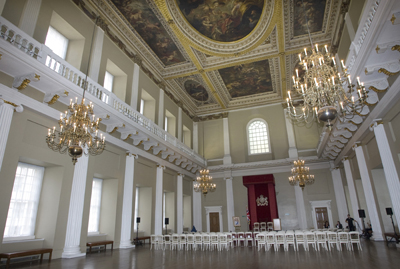
Treasures of London – The Banqueting House…

While we’ve looked at some of the history of the Banqueting House during last year’s special on King James I’s London, we thought we’d take a more in-depth look as part of our Treasures of London series…

A perfect double cube with a sumptuous painted ceiling, this early 17th century building is the only remaining complete structure from the Palace of Whitehall which was destroyed by fire in 1698.

The building replaced an earlier banqueting hall built on the orders of Queen Elizabeth I and another, shorter-lived hall, built by King James I, which was destroyed by fire in 1619.

Following its destruction, King James had Inigo Jones design a new hall to provide, as the previous hall had, a location for state occasions, plays and masques – something of a cross between an organised dance, an amateur theatrical performance and just a chance to dress up.

Jones, who partnered with Ben Jonson to produce masques, designed the hall – which has a length double the width – with these performances specifically in mind. The first one – Jones and Jonson’s Masque of Augurs – was performed on Twelfth Night, 1622, even before the building was completed (the last masque was performed here, incidentally, in 1635, after which, thanks they were moved to a purpose built structure nearby, ostensibly to save the newly installed paintings from being damaged by the smoke of torches – see below).

The incredible paintings on the ceilings, which celebrate the reign of King James I and will be the subject of their own Treasures of London article at a later date, were installed by March 1636. Produced by Flemish artist Sir Peter Paul Rubens, they had been commissioned by King Charles I, King James’ son, in commemoration of his father. Ironically, it was outside the building where the monarchy was so celebrated that King Charles I was beheaded in 1649 (this is marked in a ceremony held at the Banqueting House on 30th January each year).

Following the king’s execution, Whitehall Palace wasn’t used for several years until Lord Protector Oliver Cromwell took up residence there in 1654, using the Banqueting House as a hall if audience. It stood empty after Cromwell’s death in 1658 until the Restoration in 1660 when King Charles II again used it as a grand ceremonial hall for receiving foreign embassies and conducting court ceremonies (these including the ancient custom of what is known as ‘Touching for the King’s Evil’ to cure those afflicted with the disease of scrofula as well as the washing of the feet of the poor by the sovereign on Maundy Thursday.)

King James II was the last king to live at Whitehall Palace and during his reign, from 1685-88, it was used as a royal storehouse. But it was revived for formal use following his reign – it was here that King William III and Queen Mary II were officially offered the crown on 13th February, 1689.

During their reign, the court’s focus shifted to Kensington but the Banqueting House was used for Queen Mary to lay in state after her death in 1694.

Following the destruction of the remainder of Whitehall Palace in 1698 – the origins of this fire are apparently owed to a maid who had put some linen by a charcoal fire to dry – the Banqueting Hall was used briefly as a Chapel Royal and, following a renovation in the late 1700s, it was used for concerts and, from 1808, as a place of worship for the Horse Guards.

Further renovation works followed and in 1837, it was re-opened as a Chapel Royal and used as such until 1890 when this practice was formally discontinued. In 1893, Queen Victoria gave the Royal United Services Institute the use of the building as a museum – among the things displayed there were the skeleton of Napoleon’s horse, Marengo. In 1962, the exhibits were dispersed and the Banqueting House today is used for a range of royal, corporate and social events.

There is an undercroft underneath, designed as a place where King James I could enjoy drinking with his friends. It was later used for storage.

WHERE: Corner of Whitehall and Horse Guards Avenue (nearest Tube stations are Westminster and Embankment); WHEN: Monday to Saturday 10am to 5pm; COST: £5 adults/£4 concessions/children under 16 free (Historic Royal Palaces members free); WEBSITE: www.hrp.org.uk/BanquetingHouse/.

PICTURE: Courtesy of Historic Royal Palaces/newsteam.co.uk

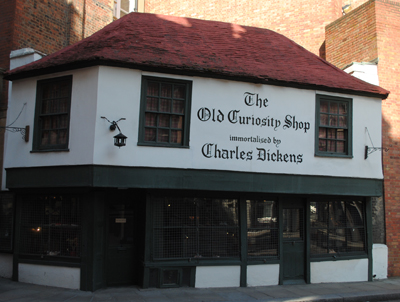
Where’s London’s oldest…shop?

We’re celebrating the bicentenary of the birth of Charles Dickens this year so it’s only fitting that we look at a building which has been, rightly or wrongly, associated with one of his books.

Located at 13-14 Portsmouth Street in Westminster, The Old Curiosity Shop now operates as a shop selling handmade fashions and footwear but the building apparently dates back 1567, making it a strong contender for the title of London’s oldest shop.

The name – The Old Curiosity Shop – was apparently applied to the building some years after Dickens first published his story, The Old Curiosity Shop, in the weekly serial, Master Humphrey’s Clock, in 1840 and 1841. The belief subsequently arose that it was this building the author had in mind when writing the book which tells the tale of Little Nell and her grandfather, a shopkeeper, and their interactions with the evil moneylender Daniel Quilp.

The claim is disputed by some, author Ed Glinert among them. In his book Literary London: A Street by Street Exploration of the Capital’s Literary Heritage he says the model for Dickens’ building was located at either 24 Fetter Lane or 10 Orange Street near Leicester Square and notes that at the end of the novel, Dickens said the building had long since been pulled down.
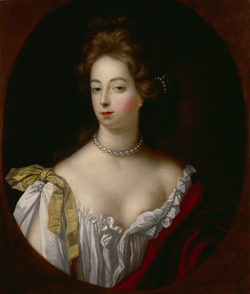
The Grade II* listed building, which survived the Great Fire of 1666 and the Blitz of World War II, is said to have been made from wood taken from old ships. Apparently at one stage it was a dairy which belonged to an estate awarded by King Charles II to one of his mistresses.

For more, see www.curiosityuk.com.

10 curiously named churches of London – 8. St Lawrence Jewry

The reason for the name of this church, founded in 1136, may seem obvious – it was associated with London’s Jewish community, thanks to its location on the edge of the area in which they lived (this area was centred on the street just to the south still known as Old Jewry).

What is perhaps more amazing may be the fact that the name stuck despite the expulsion of all Jews from London in 1291, the name was still used to distinguish it from other churches.

The church – named in honor of St Lawrence, a Roman era martyr who was slow grilled over a fire – was among those consumed in the Great Fire of London and rebuilt by Sir Christopher Wren afterwards. This new church had the honor of being reopened by King Charles II in 1677 – it was badly damaged in the Blitz before being rebuilt by Cecil Brown to Wren’s original design.

Located just off Guildhall Yard – home of the City’s authorities – St Lawrence Jewry is the official church of the Corporation of London and as such hosts a number of special services for the Lord Mayor and Aldermen during the year. Some 11 livery companies have links with the church – among them are those of tallow chandlers, loriners, girders, haberdashers and actuaries.

Worth noting on the inside is the painting of the martyrdom of St Lawrence – this survived the Blitz along with the tower and outer walls – and the many beautiful stained glass windows, painstakingly restored after World War II. There’s also a pond, complete with fish, outside the main entrance.

WHERE: Guildhall Yard (nearest Tube stations are St Paul’s, Bank and, a little further off, Moorgate and Mansion House). WHEN: 8am to 6pm Monday to FridayCOST: Free; WEBSITE: www.stlawrencejewry.org.uk.

Famous Londoners – Nell Gwyn…

Perhaps now best known as the most prominent of the many mistresses of King Charles II, Eleanor ‘Nell’ Gwyn – currently subject of a new exhibition at the National Portrait Gallery – was a renowned actress in the years after the Restoration, known for her wit and beauty – “Pretty, witty Nell “as diarist Samuel Pepys called her.

Gwyn’s (variously spelt as Gwynn or Gwynne) origins remain something of a mystery – believed to have been born around 1651, her parents remain something of a mystery (some have suggested a Cavalier, Captain Thomas Gwyn, as her father) as does the place of her birth, variously claimed to be London, Hereford or Oxford – one source from 1715 claims she was born in Coal Yard Alley, off Drury Lane in Covent Garden.

Ascribed as having various jobs during her childhood – everything from helping at a bawdyhouse to a street vendor or cinder girl – around 1663, she was working as an “orange girl” at a theatre then known as the King’s Theatre in Bridge Street (now the site of the Theatre Royal Drury Lane).

She clearly made an impression for a year later she was working as an actress and is believed to have taken prominent actor Charles Hart as her lover. It has been suggested her first recorded stage appearance was in March, 1665. She wasn’t viewed as a brilliant dramatic actress but instead came into her own in comedies where her wit, as well as her beauty, could shine.

Having already been known to have had at least two lovers – Charles Hart and aristocrat Charles Sackville, Lord Buckhurst – by 1667 George Villiers, Duke of Buckingham, had decided to bring her to the attention of the king as a possible new mistress and so increase his influence. By 1668 or 1669, Nell is believed to have succeeded in this, joining the growing number of women who could claim the title (Charles II ended up having at least 12 children by his many mistresses).

Her acting work gradually decreased and in 1670, she gave birth to Charles, her first son and believed to be the king’s seventh illegitimate child. She briefly returned to the stage in 1670-71 before retiring from the theatre for good.

In February, 1671, Nell moved into a townhouse at 79 Pall Mall (she was granted freehold of the property five years later and the property, which still stands, remains the only one on the south side of Pall Mall not owned by the Crown) and in December, she gave birth to her second child by the king, another son James (he died in Paris while attending school there 10 years later).

Both sons were given titles – Charles was later named Duke of St Albans – and given the surname Beauclerk. In the 1670s, Charles granted Nell Burford House in Windsor where she resided when the king was resident there.

In the 1670s, Nell – who continued to maintain her friendships with the likes of Villiers – successfully fought off several rivals for the king’s affection and by the 1680s, her position as the king’s mistress was not in doubt. It was during this period that the story goes when her coach was mistaken by an angry to be that of the unpopular Duchess of Portsmouth, she put her head out the window to tell them “Pray good people be silent, I am the Protestant whore”.

When King Charles II died on 6th February, 1685, he left instructions she was to be looked after – his brother King James II both paid her debts and continued to pay her an annual pension.

Nell died less than three years later – still only aged in her thirties – on 14th November, 1687, have suffered strokes in previous years. She was buried in the church of St Martins-in-the-Fields.

Gwyn is seen as a key figure in London during the period after the Restoration and a symbol of the hedonism of the court of King Charles II, and her rise from apparently humble origins to the royal court has been the subject of numerous books, plays and films.

Gwyn is currently featured in an exhibition currently being held at the National Portrait Gallery: The First Actresses – Nell Gwyn to Sarah Siddons. The exhibition runs until 8th January (an admission charge applies). For more information visit www.npg.org.uk.

PICTURE: Eleanor ‘Nell’ Gwyn, by Simon Verelst, © National Portrait Gallery, London

The Royal Parks – 6. Greenwich Park

The oldest of the royal parks, the 74 hectare (183 acre) Greenwich Park has been associated with royalty since at least the 15th century.

The area covered by the park had been occupied by the Romans (there are some remains of a building, possibly a temple, near Maze Hill Gate) and later the Danes, who raised protective earthworks here in the 11th century. After the Norman Conquest, it became a manor.

Its enclosure only happened in 1433 after the land came into the possession of Humphrey of Lancaster, Duke of Gloucester and brother of King Henry V. At the time regent to the young King Henry VI, Duke Humphrey also built a tower on the heights above the park – where the Royal Observatory now stands.

Following the duke’s death in 1447, the land was seized by Margaret of Anjou – wife of King Henry VI – and subsequently became known as the Manor of Placentia. King Henry VII later rebuilt the manor house, creating what was known as Greenwich Palace or the Palace of Placentia.

Not surprisingly, it was King Henry VIII, who, having been born at Greenwich Palace, introduced deer to the park. Indeed the park was to have strong associations with others in his family – the king married Catherine of Aragorn and Anne of Cleeves at Greenwich Palace, and his daughters, later Queen Mary I and Queen Elizabeth I, were born there while his son, King Edward VI, died there in 1553 at the age of only 15. (There’s a tree in the park known as Queen Elizabeth’s Oak, which is said to be where she played as a child).

In 1613, King James I gave the palace and accompanying park – which he had enclosed with a high wall – to his wife, Queen Anne of Denmark, apparently as an apology after swearing at her in public when she accidentally shot one of his favorite dogs. Queen Anne subsequently commissioned Inigo Jones to design what is now known as the Queen’s House – for more on that, see our earlier post.

Following the Restoration, King Charles II ordered the palace rebuilt and while this work remained unfinished, the king did succeed in having the park remodelled – it is believed that Andre Le Notre, gardener to King Louis XIV of France, had a role in this.

The works included cutting a series of terraces into the slope – these were known as the Great Steps and lined with hawthorn hedges – as well as creating a formal avenue of chestnut trees (now known as Blackheath Avenue), and some woodlands. Work is currently taking place on restoring an orchard which dates from 1666 at the park.

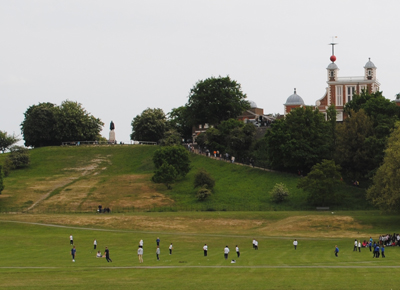
King Charles II also commissioned Sir Christopher Wren to build the Royal Observatory that still stands on the hill overlooking the park – it stands on the site once occupied by the Duke Humphrey Tower (the Royal Observatory is home of the Prime Meridian – see our earlier post on the Royal Observatory for more).

King James II was the last monarch to use the palace and park – his daughter Queen Mary II donated the palace for use as a hospital for veteran sailors and the park was opened to the pensioners in the early 1700s. The hospital later become the Royal Naval College and the National Maritime Museum later moved onto the site (for more on this, see our earlier post).

As an aside, Royal Parks say the truncated shape of some of the trees in the park is apparently due to the fact that when anti-aircraft guns were positioned in the flower garden during World War II, the trees had to be trimmed to ensure a clear field of fire.

Facilities in the park today include a tea house, a children’s playground, sporting facilities such as tennis courts and, of course, the Wilderness Deer Park where you can see wildlife at large. Statues include that of Greenwich resident General James Wolfe, an instrumental figure in establishing British rule in Canada – it sits on the crest of the hill opposite the Royal Observatory looking down towards the Thames.

The park, which is part of the Greenwich World Heritage Site, is slated as a venue for next year’s Olympics – it will host equestrian events and the shooting and running events of the pentathlon.

WHERE: Greenwich Park (nearest DLR station is Cutty Sark – other nearby stations include Greenwich, Maze Hill and Blackheath); WHEN: 6am to at least 6pm (closing times vary depending on the month); COST: Free entry; WEBSITE: www.royalparks.gov.uk/Greenwich-Park.aspx

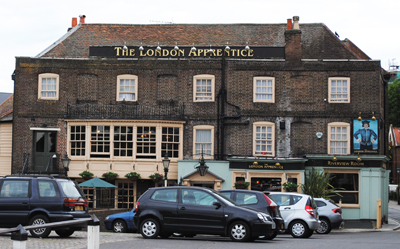
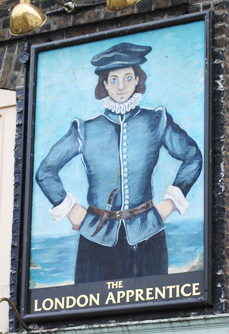
London Pub Signs – The London Apprentice

Sitting on the bank of the Thames at Old Isleworth in the city’s west stands The London Apprentice public house.

The pub’s licence dates back to at least 1731 and it has been associated with the likes of such luminaries as King Henry VIII (it’s suggested he met Catherine Howard here – she was later imprisoned in nearby Syon House), King Charles I and King Charles II (the latter apparently cavorted with his mistress, actress Nell Gwynne, here), as well as the ill-fated Lady Jane Grey and Lord Protector Oliver Cromwell.

Others whose names come up in reference to the pub include the ever-present author Charles Dickens (this is said to have been one his favorite pubs) and notorious highwayman Dick Turpin.

While there remain some doubts over its origins, the name of the pub – which stands opposite the small isle known as the Isleworth Ait – is said to stem from the fact that it was here that London apprentices, having faithfully served their masters, came to while away the hours in their downtime. They are said to have entertained themselves by playing about in decorated barges on the river.

There is said to be a tunnel, now blocked, which links the pub with the nearby All Saint’s Church – the story goes that this was used by smugglers to get their contraband into the pub’s cellars.

For more information or to pay a visit, see www.thelondonapprentice.co.uk.

The Royal Parks – 4. St James’s Park

The fourth in a line of parks stretching from Kensington Palace to Westminster, St James’s Park largely owes its foundation to King James I. 

Given its early history is covered in our earlier post, we’ll skip forward to the time of King Charles II when, under to instruction of Frenchman Andre Mollet, the park was redesigned with new landscaping including wide lawns, avenues of trees and a wide, centrally positioned canal. It was King Charles II who also opened the park up to the public (he even mingled with them there along with his mistress Nell Gwynn). Interestingly the first pelicans were also introduced to the park around this time when the Russian ambassador presented a pair of pelicans to the king.

In the 18th century, Horse Guards Parade was added to the park by filling in one end of the park’s canal and was later used for parades. The ceremonies of Beating Retreat and Trooping the Colour are still held there today.

The next major changes came in the 19th century when in 1827-28, architect John Nash oversaw a more romantically inspired renovation, including the transformation of the canal into a natural looking lake and the addition of winding paths, as part of his grand scheme which still shapes much of London today.

It was also at this time that The Mall (which like Pall Mall takes it name from the game of Pelle Melle – see our earlier post) was transformed into a grand processional route (it was opened to traffic later, in 1887). The park, bounded to the west by Buckingham Palace, also takes in the Queen Victoria Memorial – completed in 1914 to replace the Marble Arch which was moved to its current location at the corner of Oxford Street and Park Lane in 1851 – and flower beds which are planted annually with 12,000 geraniums, the color of which is chosen to match the guardsmen’s tunics.

Meanwhile, in 1837, the Ornothological Society of London erected a cottage for the birdkeeper (the thatched cottage can still be seen there today and the post of birdkeeper still exists). The first bridge was placed across the lake in 1851 (and replaced in 1951 with the one that now stands there).

Little has changed in the 23 hectare (58 acre) park since Nash’s day. Newer facilities include a restaurant and a playground at the western end.

WHERE: St James’s Park (nearest tube station is St James’s Park); WHEN: 5am to midnight daily; COST: Free entry; WEBSITE: www.royalparks.gov.uk/St-Jamess-Park.aspx 

PICTURE: © Anne Marie Briscombe  (courtesy Royal Parks)

The Royal Parks – 3. Green Park

Perhaps the most overlooked and least celebrated of central London’s Royal Parks, Green Park (officially The Green Park) is a peaceful oasis of leafy trees between the bustle of Piccadilly and traffic of Constitution Hill and part of an unending swathe of green which connects Kensington Gardens with, eventually, St James’ Park.

Originally meadowland used for hunting, the earliest known mention of the area where the park now stands was apparently in 1554 when it was believed to be a staging point for Thomas Wyatt (the younger) who led a group of rebels protesting against the marriage of Queen Mary I to King Philip II of Spain. The unfortunate – and unsuccessful (in terms of his rebellion at least) – Wyatt was later beheaded for treason.

In 1668, King Charles II had the park enclosed with a brick wall and stocked with deer, as well as having a ranger’s lodge and icehouse built (to keep his drinks cool when entertaining in summer). While it was initially known as Upper St James’s Park, by 1746 Green Park had its own name. It’s not really known what prompted the name change but the unofficial story is that Queen Catherine of Braganza, wife of King Charles II, found out that her philandering husband had picked some flowers there for another woman – a milkmaid. In revenge, she had every flower in the park pulled up with orders they were not to be replanted. To this day, while some 250,000 daffodils bloom here in spring, there remain no formal flowerbeds in the park.

The 47 acre (19 hectare) park, which was also used on occasion as a duelling ground, underwent further development at the beginning of the following century with the creation of the ornamental Tyburn Pool near the centre of the park.

Queen Caroline, the wife of King George II, meanwhile, had a reservoir built to supply water to St James’s Palace and Buckingham Palace (it was known as the Queen’s Basin) as well as a library and the Queen’s Walk. Planted in 1730, this runs along the eastern side of the park and helped to turn it into a fashionable place in which to be seen (and led to the building of many a mansion in nearby Piccadilly).

Other buildings in the park have included two temporary ‘temples’ – the Temple of Peace (erected in 1749 to mark the end of the War of Austrian Succession) and the Temple of Concord (erected in 1814 to mark 100 years of the rule of the Hanoverian dynasty). Both of these, believe it or not, burnt down during the celebrations they were built for.

The park, which underwent a redesign in which the first trees were planted in the 1820s as part of architect John Nash’s grand plans for St James’s Park, was opened to the general public in 1826 but by then many of its earlier features – including the ranger’s house, Tyburn Pool and the Queen’s Basin – were already gone.

In more recent times, war memorials have been added to the park – the maple-leaf daubed, Pierre Granche-designed memorial to Canadian soldiers in 1994 (Canada is also remembered in Canada Gate on the park’s south side, installed in 1908 to mark the nation’s contribution to the Empire), and a set of memorial gates on Constitutional Hill at the park’s western end which is dedicated to the five million people from the Indian Sub-Continent, Africa and the Caribbean who served in World War II in 2004. The park also features the ‘Diana fountain’, installed in 1952 by the Constance Fund (and currently undergoing restoration).

On 14th June, a 41 royal gun salute is fired here to mark the Queen’s birthday. Salutes are also fired here for the State Opening of Parliament in November or December, Remembrance Sunday, and for State Visits.

WHERE: Green Park (nearest tube station is Green Park and Hyde Park Corner); WHEN: daily; COST: free; WEBSITE: http://www.royalparks.gov.uk/Green-Park.aspx

PICTURE: Courtesy of Royal Parks. © Anne Marie Briscombe