Around London – Open House London; Magna Carta on display; Fashion Week photography; and, Henry Moore returns to Greenwich…

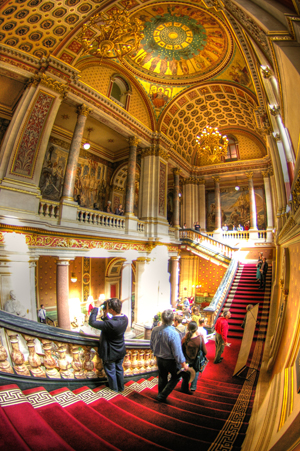
It’s Open House London weekend again and there’s scores of properties across the city which will be opening their doors to allow the curious a rare glimpse inside. The properties which will be open include architect’s homes and cutting edge housing as well as historic city landmarks, landscape projects and government buildings (including the Foreign Office & India Office – pictured). Other highlights of this year’s event – conducted under the theme of ‘The Liveable City’ –  include a night hike, a festival aimed at kids and families, talks, walks and cycle tours and competitions. Among the buildings flinging their doors wide are Lambeth Palace, home of the Archbishop of Canterbury, livery company halls, the newly reopened St Pancras Renaissance Hotel and the Bevis Marks Synagogue in the City. Most properties can simply be visited on a first come, first in basis but some do require advance booking so check before you go. Open House London was first started 19 years ago and has since spread to many other cities around the world including New York, Jerusalem and Helsinki. For more information and to purchase an online guide, see www.londonopenhouse.org. PICTURE: (c) Nick Woodford.

• King Edward I’s Magna Carta will go on show at the Guildhall Art Gallery in the City this weekend, presenting a rare opportunity to see this pivotal document. The City of London Corporations 1297 Magna Carta – regarded as one of the finest 13th century copies – will be on display in the Roman Amphitheatre during Open House London. The document features King Edward I’s seal and the original writ to the Sheriffs of London ordered that the charter be promulgated within the City. Admission over the weekend is free. For more see, www.guildhallartgallery.cityoflondon.gov.uk/gag/


The Museum of London has launched an online collection of early Twentieth century fashion photographs to coincide with London Fashion Week. The more than 3,000 glass negative plates come from the collection of Bassano Limited, founded by Italian-born Alexander B. Bassano, and were taken between 1912 and 1945. They record a wide range of fashions as well as designers and retailers and can be accessed via the Museum’s Collections online web portal. Meanwhile, the museum is hosting it’s first ever professional catwalk show on Friday night. It features the works of Christopher Raeburn. For more, see www.museumoflondon.org.uk.

A Henry Moore sculpture, Large Standing Figure: Knife Edge, has been returned to Greenwich Park, more than four years after it was removed. The almost five metres tall sculpture, made by Moore in 1976, was originally placed in the park in 1979 but was removed for conservation in early 2007 before joining a Moore exhibition at Kew Gardens and then forming part of the Henry Moore display at the Yorkshire Sculpture Park. The bronze, on loan from The Henry Moore Foundation for two years, has now been returned to its original location between The Avenue and Croom’s Hill Gate.

LondonLife – The Royal Menagerie

A new exhibition has opened at the Tower of London celebrating the Royal Menagerie which was located there for more than 600 years.

Over the years featuring everything from lions and leopards to elephants, camels, kangaroos and crocodiles, the menagerie was founded at the Tower of London during the reign of King John (1199-1216), although as far back as the reign of King Henry I (1100-1135) animals were being presented to the king as gifts. Some notable early animals included a ‘white bear’ believed to be a polar bear from Norway and an African elephant, a gift of King Louis IX of France, both of which were presented to King Henry III.

While the early location of the menagerie – which had a long history of attracting curious sightseers – remains unknown, during the rein of King Edward III (1327-1377) there is reference to it being in a position near the Middle Tower (now the main entrance to the Tower) which suggests it was then already located in what became known as the Lion Tower – a now ruined barbican built by King Edward I in 1276-77.

Animal accommodations in the Lion Tower were substantially upgraded during the reign of King James I (1603-1625) – James was noted to have enjoyed watching the lions fight other animals in the tower’s exercise yard). Further upgrades were made under the watchful eye of Sir Christopher Wren, then Surveyor of the King’s Works, between 1672 and 1675.

The office of the menagerie’s ‘keeper’, meanwhile, had been  formalised in the 1400s with the title awarded for life – it was subsequently held by some important officials.

While in 1687 some of the beasts and birds were transferred to new accommodations at St James’s Park, the menagerie remained at the Tower until 1830 when, following the death of King George IV, the decision to move the animals – then said to number 150 – to the recently founded Zoological Society of London’s zoo at Regent’s Park. Initially only some animals were sold to the zoo but by the end of 1835 the menagerie had been completely emptied with many of the remaining animals apparently sold to an American ‘showman’ Benjamin Franklin Brown who exported them to the US.

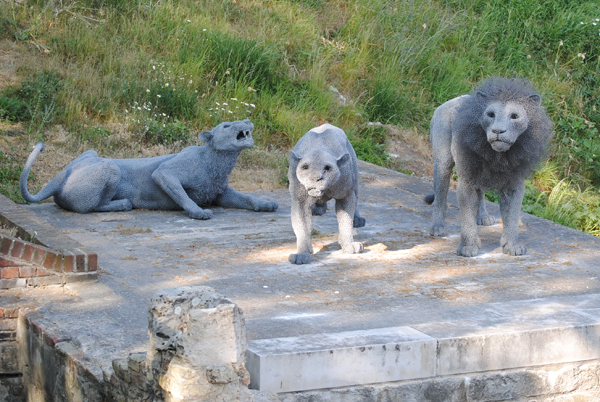
The new exhibition, Royal Beasts, is housed in the newly opened Brick Tower (entry via the Martin Tower, itself entered via the wall walk), and gives visitors views from a hitherto closed-off part of the north wall. There are also a series of life-size sculptures of various animals (see the three lions pictured), created by artist Kendra Haste, located around the tower. And, to gain a feel for how the menagerie was viewed during different eras, you can watch the short live action show featuring some of the “rarees” and “curiosities” which were housed within the tower (check with staff for times).

For more on the menagerie’s history, see Geoffrey Parnell’s guide, ‘The Royal Menagerie at the Tower of London’, available for sale at the Tower (£3.99).

WHERE: ‘Royal Beasts’, Tower of London (nearest tube station Tower Hill); WHEN: 9am to 5.30pm, Tuesday to Saturday, 10am to 5.30pm Sunday to Monday (until 31st October); COST: Included in Tower of London admission – £19.80 adults; £10.45 children under 15; £17.05 concessions; £55 for a family (prices include a voluntary donation); WEBSITE: www.hrp.org.uk/toweroflondon/.

What’s in a name?…Knightsbridge

Now famed for its shopping and proximity to museums, the former village of Knightsbridge takes its name from a bridge which once spanned the Westbourne River (a river now located underground which flows from Hampstead down through Sloane Square to enter the Thames at Chelsea) and linked the village of Kensington with London.

While the origins of the bridge’s name remain shrouded in mystery (the bridge itself reportedly stood at what is today Albert Gate), the anecdotal stories which might explain it include a tale that two knights once fought here and another which attributes the name to the fact that the area was thought so unsafe that to come without a knight was considered foolhardy. Indeed the name Knightsbridge was once synonymous with highwayman and robbers waiting to plunder passersby.

While the name is apparently not mentioned in the Doomsday Book, by the 13th century it is listed as a manor belonging to the monks at Westminster Abbey (this was apparently a gift from King Edward I – in fact some accounts have the area also recorded as King’s Bridge, Kyngesbrigg). One of the key events which the area apparently hosted was the meeting of Empress Matilda with representatives of London’s citizens in 1141 during her ongoing fight for supremacy with King Stephen.

The area remained relatively rural – and as a village in its own right – until the late 18th century when the area finally became joined to the ever-expanding metropolis.

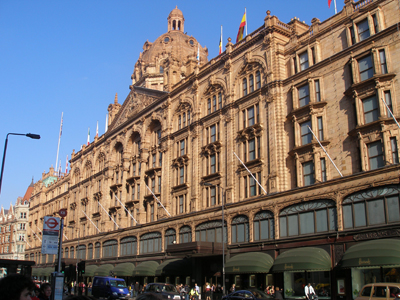
These days Knightsbridge is little more than a road and a strip of highly developed land to the south (Westminster City Council’s Knightsbridge conservation area, which contains more than 275 listed buildings, runs as far east as Queen’s Gate) but it does boast some very high end shopping – think Harrods (pictured), founded in 1824 and opened on the current site almost 30 years later, and Harvey Nichols, founded in 1813.

There’s also some very grand late Victorian residential real estate (much of which is owned by the the Duke of Westminster and Earl Cadogan), which, along with new developments, have made Knightsbridge one of the highest price property markets in London (and indeed, the world).

The eastern end of Knightsbridge – Westminster Council include Royal Albert Hall in its Knightsbridge Conservation Zone – runs into the museum district of South Kensington, home to some of London’s best museums, including the Victoria & Albert Museum and the National History Museum.

PICTURE: Wikipedia

Lost London – Blackfriars Priory

The London area of Blackfriars – centred on Blackfriars Railway Station – takes its name from the former Dominican friary (known as the “black friars” thanks to their dark robes) which stood on the site.

The Dominicans first came to England in the 1220s and soon took up residence in Holborn. But the limitations of that site led them to move to a new location between Ludgate and the River Thames in the latter part of the 13th century. There, they constructed a substantial priory.

The priory subsequently played an important part in London’s civic and religious life – Parliament and the Privy Council is known to have met here and in 1529, a hearing was held here with regard to the divorce of King Henry VIII and Catherine of Aragon.

It was also a place of burial for the wealthy and influential – among those buried there was the beloved wife of Edward I, Eleanor of Castille (at least her heart was – her body was buried at Westminster Abbey).

The priory was dissolved in 1538 during the Dissolution. The Blackfriars Playhouse was built on the site during Elizabethan times and the Apothecaries Company also took up residence there. Those of the original buildings that survived were destroyed in the Great Fire of 1666. In more recent times, the area became the site of Blackfriars Railway Station.

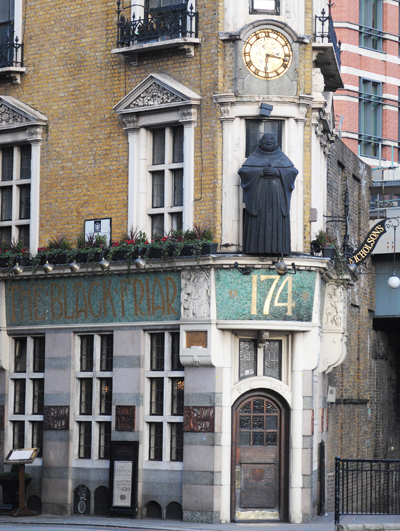
A reminder of the area’s origins can be found on the facade of The Black Friar pub (1875) which sits opposite Blackfriars Bridge at the western end of Queen Victoria Street (pictured). There you can see a statue of a black friar, the work of Henry Poole which dates from around the beginning of the 20th century. There is also a plaque commemorating the friary in nearby Carter Lane.

What’s in a name?…Charing Cross

The West End location of Charing Cross is named after the large stone cross that once stood at the top of Whitehall on what is now the southern side of Trafalgar Square – a site currently occupied by a statue of King Charles I.

The cross – an embellished Victorian-era replica of which can be found standing outside Charing Cross Station in the Strand – was one of a series of 12 erected by King Edward I in 1291-94 to commemorate his wife Eleanor of Castile.

They marked the sites where her funeral cortege rested overnight as it made its way from near Lincoln where she died south to Westminster Abbey where she was to be buried (for more on the cross and the Victorian replica, see our previous post here).

The final of these ‘Eleanor Crosses’ – which were originally made from wood before being replaced with stone ones –  was erected on a site which stood in the medieval village of Charing, located between the City of London and Westminster. The cross was pulled down in the 1640s by order of Parliament. Since 1675, the statue of King Charles I (pictured, with Trafalgar Square, once the site of the royal mews, in the background) has occupied the site.

The word Charing is an Anglo-Saxon or “Old English” term and is believed to relate to the nearby bend in the River Thames.

Between the mid-1700s until the mid-20th century, the former site of the Charing Cross was the point from which all distances from London were measured. There was also a famous pillory located here.

The Royal Wedding – London’s Royal Wedding venues

In the first of a series this week looking at aspects of royal weddings in London in days past, we canvas some of the venues which have hosted the sometimes glittering occasions.

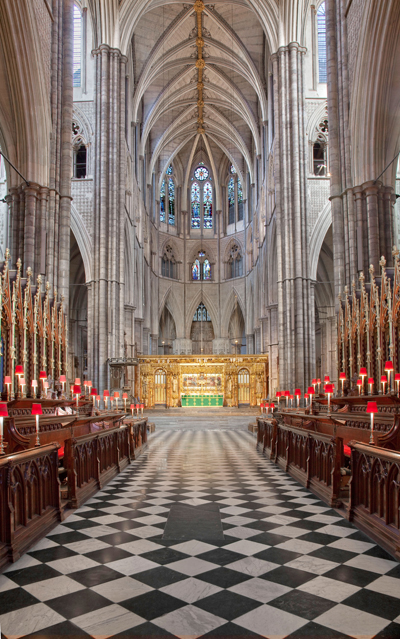
First up is Westminster Abbey (pictured), the location of Prince William and Kate Middleton’s wedding this Friday, which, despite its thousand year history, is only believed to have hosted 15 royal weddings.

Among them is said to have been the wedding of King Henry I to Matilda of Scotland on 11th November, 1100, as well as that of Richard, Earl of Cornwall and brother of King Henry III, who married his second wife, Sanchia of Provence, there on 4th January, 1243, and Joan of Acre, daughter of King Edward I, who married Gilbert, Earl of Gloucester, on 30th April, 1290 (her sister Margaret married John, Duke of Brabant, at the same venue less than three months later). The abbey also hosted the wedding of King Richard II to Anne, daughter of Emperor Charles IV of Bohemia, on 20th January, 1382.

The abbey church has become increasingly favored as a venue for royal weddings in more recent times. Among the most prominent hosted there last century were that of Prince Albert, Duke of York (later King George VI), who married Lady Elizabeth Bowes-Lyon on 26th April, 1923 and that of their daughter Princess Elizabeth (later Queen Elizabeth II) who married Prince Philip of Greece (later the Duke of Edinburgh) there on 20th November, 1947.

Two of the current Queen’s children were also married there – Princess Anne, who married Captain Mark Phillips on 14th November, 1973, and Prince Andrew, who married Sarah Ferguson on 23rd July 1986. (For more on Royal Weddings at the Abbey, see www.westminster-abbey.org/our-history/royals/weddings)

A notable break with the trend in recent times was the marriage of Prince Charles and Lady Diana Spencer – they were married in a fairytale ceremony at St Paul’s Cathedral on 29th July, 1981.

Other London locations for royal weddings have included the now non-existent Greenwich Palace (King Henry VIII married Katherine of Aragon on 11th June, 1509) and Hampton Court Palace (another of King Henry VIII’s marriages – that in which he was wed to Catherine Parr – was held here in a private chapel on 12th July, 1543).

Along with St George’s Chapel at Windsor, the Chapel Royal at St James’s Palace  in London was particularly popular in Victorian times – Queen Victoria married Prince Albert there on 10th February, 1840, and their eldest daughter, Princess Victoria, married Prince Frederick (the future German Emperor Frederick III) there on 25th January, 1858. On 6th July, 1893, the chapel also hosted the wedding of the future King George V and Princess Mary of Teck.

PICTURE: Copyright Dean and Chapter of Westminster

Curious London Memorials – 3. Charing Cross

Another royalty-related memorial, the Charing Cross – located outside Charing Cross railway station – is actually an embellished Victorian replica of one of a series of medieval memorials the apparently heartbroken King Edward I had erected in memory of his wife, Eleanor of Castile.

The original cross, which was originally located in the south of Trafalgar Square at Charing, was one of 12 built between 1291 and 1294 to mark the nightly resting places of the Queen’s funeral procession as it made it way from Lincoln to Westminster Abbey where she was buried.

The Queen had died at Harby near Lincoln in 1290 while on her way to meet her husband in Scotland. The original monument was demolished in 1647 by Parliamentary order. A plaque on the site indicates it is the point from where all distances on road signs to London were measured.

Only three of the original 12 crosses still stand – at Waltham Cross, Northampton and Geddington – although some remnants of others can be seen. Another London cross – in Cheapside – was demolished in the mid 1600s.

The Victorian era replica outside Charing Cross station dates from 1865. It was unveiled last year following a five year restoration project.

Treasures of London – The Magna Carta

It’s regarded as one of the seminal documents of medieval England. First issued 15th June, 1215, the Magna Carta (“Great Charter”) was endorsed by England’s barons and King John at Runnymede near Windsor Castle and put limits in the power of the king by demanding he govern according to established feudal law.

The document was forced upon King John by rebellious barons after he broke away from established customs and imposed oppressive taxes and fines and seized the estates of nobles.

Its terms were immediately repudiated by the king, leading to further rebellion which ended when the king died on 18th October, 1216. Less than a month after the king’s death, the regent, William Marshal, issued a revised version of the document and a second revision almost exactly a year later. A further version was later issued by King Henry III and later confirmed by King Edward I.

Copies of the document were sent throughout the land in 1215. There is now a copy in the Lincoln Cathedral Archives and another in Salisbury Cathedral Chapter House while the British Library has two copies, both from the collection of Sir Robert Cotton, who died in 1631. One of the library’s two copies was burned in a fire 100 years after Sir Robert’s death and still bears fire damage.

The text of the Magna Carta is not abstract in nature but deals in detail with practical realities, covering issues ranging from what happens when a noble who holds land from the Crown dies through to who heirs may marry, standard measures of wine, ale and corn and the removal of foreign knights from the country.

Only three of the Magna Carta’s 63 clauses are still law: one guaranteeing the liberties of the English Church; another confirming the privileges of London and other towns; and a third, often viewed as a forerunner of clauses contained in documents such as American Bill of Rights and Universal Declaration of Human Rights, which states that no free man shall be imprisoned, dispossessed, outlawed or exiled without the lawful judgement of his equals or by the law of the land.

The legacy of the Magna Carta is not however in the individual rights it seeks to uphold but rather the principle that for the first time in English history, it elevates the law above all men, even the king.

WHERE: Sir John Ritblat Gallery: Treasures of the British Library: Magna Carta and associated documents, The British Library, 96 Euston Road (nearest tube station is Kings Cross St Pancras or Euston); WHEN: 9.30am to 6pm Monday, Wednesday, Thursday and Friday; closes 8pm Tuesday and 5pm Saturday; 11am to 5pm Sunday; COST: Entry is free; WEBSITE: www.bl.uk or for a detailed guide and virtual tour of the Magna Carta, see  www.bl.uk/treasures/magnacarta/index.html.