A Moment in London’s History – The opening of “new” London Bridge…

This month marks the 187 years since the opening of “new” London Bridge – the first bridge built over the Thames in London for more than 600 years.

Designed by John Rennie (who had won a competition, beating the likes of Thomas Telford for the honour), work on the new granite bridge had began in 1825 and was completed in 1831.

It was constructed alongside the medieval bridge which had been first completed in the 13th century and added to over the years since (and was eventually completely demolished after the opening of the ‘new’ bridge).

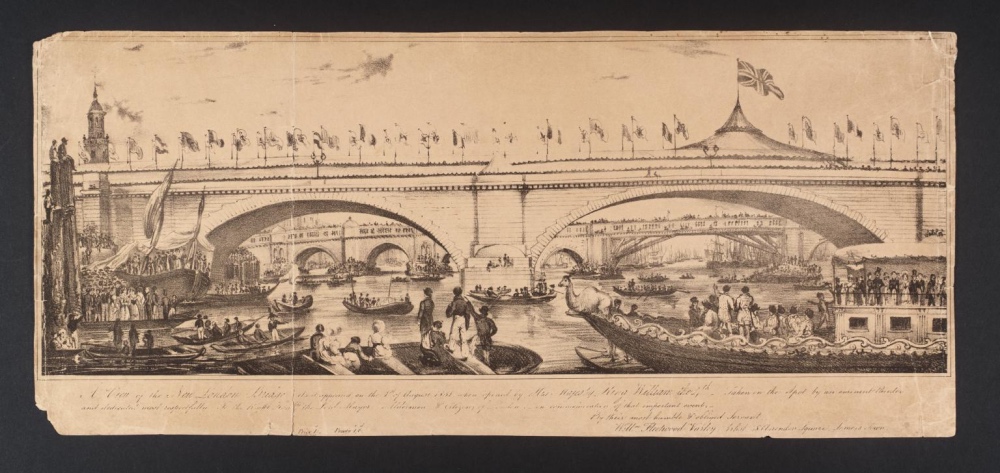
The ‘new’ bridge, said to have cost £506,000 to construct, was formally opened by King William IV on 1st August, 1831, in an event described by The Times as “the most splendid spectacle that has been witnessed on the Thames for many years”.

The royal party – which included Queen Adelaide – had approached the bridge, lined with flags for the occasion, after setting off from Somerset House amid cheering described as “almost deafening” (to add to cacophony of sound, church bells were rung and cannon fired throughout the day).

Watched by thousands of onlookers (who were entertained by bands at various locations), the royal party had processed their way downstream on the river to the bridge with the royal bargemen wearing new livery specially designed for the occasion. Two parallel lines of rivercraft – including barges and steamers – had gathered along the river to provide a sort of honour guard and ensure they had clear passage.

The royals arrived at the bridge at 4pm and the royal party made their way up red carpeted stairs to the bridge’s City end. Following a short ceremony in which the King was presented by the Lord Mayor of London with the sword and keys to the City of London as well as a specially made gold medal to mark the occasion, their Majesties then walked across from the across the bridge to the Southwark end where entertainments had included the ascension of a hot air balloon.

The King and the royal party then returned to the City end of the bridge to attend a banquet – guests were said to number 1,500 people – held under a pavilion erected atop the new structure.

The Gentleman’s Magazine reported that food was provided by a coffee house proprietor, a Mr Leech, and was said to include 150 hams and tongues, 370 “dishes of chickens”, and 300 turtles as well as 200 fruit tarts and 300 “ice-creams”.

The King and royal party then returned up the river.
Rennie’s bridge was replaced in the mid-20th century with another bridge which was officially opened by Queen Elizabeth II in 1973 and rather than being demolished, was sold to US oil magnate Robert P McCulloch who had it dismantled and shipped to Arizona where it was reconstructed at Lake Havasu City where it can now be seen.

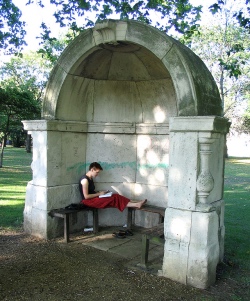
A couple of sections of the bridge survive in London – two of its pedestrian alcoves, one of which can be found in Victoria Park in London’s east and the other at King’s College London.

There is a famous painting – Clarkson Stanfield’s, The Opening of New London Bridge, 1 August 1831 – which captures the moment of the bridge’s opening and is part of the Royal Collection.

PICTURES: Top – ‘A View of the New London Bridge as It Appeared on the 1st August 1831, When Opened by His Majesty, King William the 4th’, Unknown artist, Lithograph on paper, Photo © Tate (licensed under CC-BY-NC-ND 3.0 (Unported)); Right – The alcove in Victoria Park (Public Domain).
Treasures of London – The Great Hall at Eltham Palace…

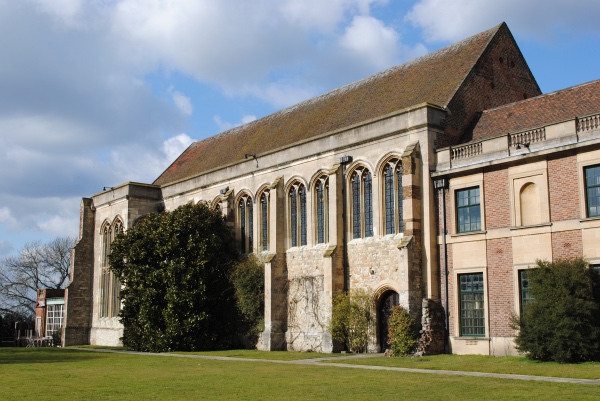
Originally built as a dining hall for King Edward IV in the 1470s, the Great Hall is a survivor of the medieval royal palace that once stood on the site and later become incorporated into the Art Deco home created by Stephen and Virginia Courtauld in the 1930s.

The hall, which is comparable in size to that of Hampton Court Palace, was designed by Thomas Jordan, chief mason to the king, and Edmund Graveley, his chief carpenter.

It is 101 foot long and 36 foot wide and has a magnificent oak roof described as a ‘false’ hammerbeam construction (the ‘false’ because the posts are morticed into the ends of the hammerbeams rather than resting on them).

The hall would have once had a raised dais at one end while the other end joined to the rest of the would have featured a screen behind which doors led to a buttery, pantry and kitchen. A hearth was located near the dais end of the hall.

The windows, which are set high in the walls, would have been of stained glass (the stained glass there now was added in 1936 and is the work of George Kruger Gray) and the walls below them would have been decorated with tapestries.

Eltham was a favourite residence of King Edward IV and one of the most lavish feasts ever held there was at Christmas, 1482, when some 2,000 people were fed (it was the king’s last visit to the palace before his death the following April). The hall would have also been familiar to King Henry VIII who spent much of his childhood here but later in his life rarely came to Eltham.

King Charles I was the last king to visit the palace and in 1651 it was sold off by Parliament to Colonel Nathaniel Rich who, as well as demolishing many buildings, stripped the lead off the hall’s roof. The property was later used as a farm and the hall became a barn.

In the early 19th century a campaign was launched to save the hall from demolition which saw the roof propped up and during the latter half of the 1800s it was used as an indoor tennis court.

Further repairs were made in the 1890s and again between 1911 and 1914 when the roof was dismantled and reassembled under the direction of the Office of Works.

The Courtaulds, who had their spectacular adjoining property built in the 1930s, apparently intended to use the hall as a music room and carried out a number of repairs – including to the roof – and additions including a minstrel’s gallery (there is no evidence of such a feature in the original).

After World War II, the Ministry of Works assumed responsibility for the Great Hall (and other palace remains) – opening the hall to the public for three days a week – before in 1984 English Heritage took over management of the Great Hall (and later the entire site).

PICTURE: David Adams

WHERE: The Great Hall, Eltham Palace, Court Yard, Eltham, Greenwich (nearest train station is Mottingham); WHEN: 10am to 6pm Sunday to Friday; COST (without Gift Aid): £15 adults/£9 children/£13.50 concessions/£39 family (English Heritage members free); WEBSITE: www.english-heritage.org.uk/visit/places/eltham-palace-and-gardens/.


A Moment in London’s History – Alexandra Palace burns down (again)…

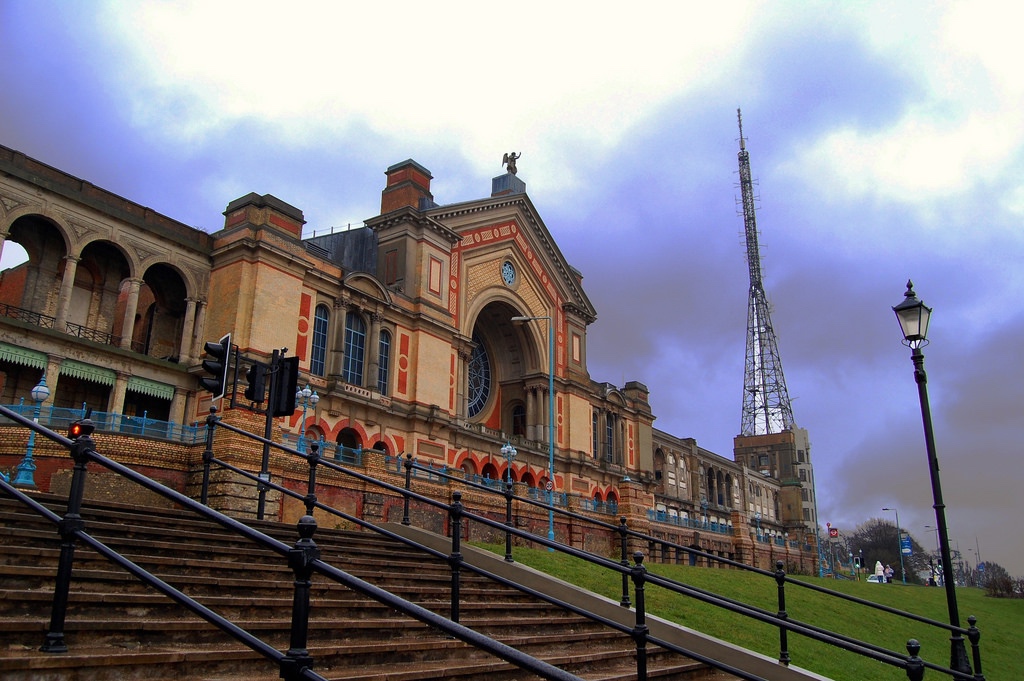
This month marks 38 years since Alexandra Palace, known to many as the ‘People’s Palace’, in north London burned down – for the second time.

The palace – named for Princess Alexandra, wife of the then Prince of Wales (later King Edward VII), and subsequently nicknamed ‘Ally Pally’ – was originally opened in 1873 as an entertainment and recreation centre inspired by the success of the Crystal Palace in London’s south.

But just 16 days later – having already attracted some 120,000-plus visitors – Alexandra Palace burned down when a fire started in the dome. A second palace complex was opened on the site two years later, on 1st May, 1875, and this palace, which a 1900 Act of Parliament declared was to remain forever available for public use, stood until 1980.

It served various purposes over the years including, of course, hosting various musical and threatrical events as well as hosting shooting events during the 1908 Olympics, acting as an internment camp during World War I, and being used as the transmitting centre for BBC radio and television – a role which saw it, in 1936, become the home of the world’s first regular public television service.

On 10th July, 1980 – having been transferred into the ownership of Haringey Council from the Greater London Council six months earlier and now in the early stages of a renovation project, it caught fire during a jazz festival.

Starting behind the venue’s historic Willis Organ in the Great Exhibition Hall, the fire spread through the roof and destroyed about a third of the building including the hall, Banqueting Suite, former roller rink and theatre dressing rooms. Only the Palm Court and area occupied by the BBC – including the theatre and transmitting tower – escaped damage (interestingly, the burnt out shell of the Great Hall featured in the film 1984, representing Victory Square).

The building was subsequently redeveloped and restored and reopened again on 17th March, 1988. Offering a range of recreational facilities including performance spaces, an ice rink, boating lake and animal enclosure, it now operates as a charitable trust administered by the London Borough of Haringey.

Grade II-listed since 1996, the palace is currently undergoing a £27 million restoration and development project which will see a new public space created in the East Court and allow visitor access to a range of historical artefacts, including photographs and early film, for the first time, as well as see the Victorian-era theatre restored.

The theatre will reopen in December but before that – on 1st September – will host the Proms with the BBC Concert Orchestra performing Gilbert and Sullivan’s Trial by Jury (the event is already sold out). For more, see www.alexandrapalace.com.

PICTURE: Alexandra Palace today (Dun.can (licensed under CC BY 2.0))

Lost London – Monmouth House…

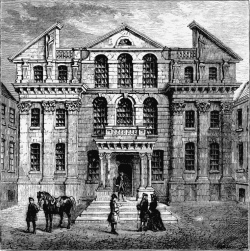
This grand mansion, which once stood on the south side of Soho Square (then called King’s Square), was built for James Scott, the Duke of Monmouth (and ill-fated illegitimate son of King Charles II) in the early 1680s during the early development of the square.

The duke only lived in the property briefly before he headed off to the Netherlands (and was later, in 1685, was executed on Tower Hill for his failed rebellion against the king).

The three storey brick house stood around three sides of a courtyard (some suggest it was designed by Sir Christopher Wren).

The house, which was left unfinished, stood empty for some time after the duke’s death before, in 1689, part of it was briefly turned into a chapel for Huguenot refugees, known as the L’Église du Quarré (they located in 1694).

The house was sold by the Duchess of Monmouth to Sir James Bateman, Lord Mayor of London and a Sub-Governor of the South Sea Company, in 1716, and subsequently remodelled, apparently to the designs of architect Thomas Archer.

Bateman died in 1718 and his eldest son, William (later 1st Viscount Bateman), lived here until 1739. The property was late let to a succession of dignitaries – including the French and Russian ambassadors – and briefly was under consideration for use as a boy’s school.

It was eventually demolished in 1773 and Bateman’s Buildings now occupy the site. A plaque identifies the site as the former location of the mansion.

PICTURE: An 18th century engraving of Monmouth House.

This Week in London – Jousting at Hampton Court; into the shadows at the NHM; and, Bauhaus designers honoured…

Jousting returns to Hampton Court Palace this weekend with visitors invited to join King Henry VIII and his court as they watch this sporting spectacle. Along with the thrills and spills of the tourney, visitors can also partake of the delights of Tudor food and music and a specially commissioned play featuring chief minister Thomas Cromwell as he prepares a royal banquet to celebrate the king’s marriage to Anne of Cleves. The event kicks off with a royal procession in which knights will greet the king with a display of heraldic pageantry before they head to the jousting arena at the East Front Gardens. Admission charge applies. Runs on 14th and 15th July. For more, see www.hrp.org.uk. PICTURE: A previous jousting event at Hampton Court Palace (David Adams).

Venture into the hidden world of shadows in a major new exhibition opening at the Natural History Museum in South Kensington on Friday. Afraid of the dark? takes visitors deep into underground caves, to the depths of the oceans and into the pitch blackness of night as it recreates habitats usually hidden from view and presents hundreds of incredible creatures, some brand new to science, which have adapted to a life without sunlight. The sensory display allows visitors to touch some of Britain’s nocturnal animals, hear the sounds of the deep sea, smell the distinctive aromas of a bat cave and see through the eyes of a cave boa using infrared technology. Runs until 6th January. Admission charge applies (children aged up to 16 are free). For more, see www.nhm.ac.uk.

Bauhaus designers and teachers Walter Gropius, Marcel Breuer and László Moholy-Nagy have been honoured with an English Heritage Blue Plaque at the Belsize Park home where they lived and worked in the 1930s. Gropius (1883-1969) founded the art school known as Staatliches Bauhaus in Weimar in 1919 with Breuer (1902-1981), who initially joined as a student before becoming director of furniture workshops in 1924, and Moholy-Nagy (1895-1946) who joined the staff in 1923 and edited the house magazine and 14 books. All three went on to have successful careers in the field of design and architecture and live in flats in the Grade I-listed Isokon Building, completed in 1934 and originally known as the Lawn Road Flats, in Belsize Park. For more, see www.english-heritage.org.uk/visit/blue-plaques/.

Send all inclusions to exploringlondon@gmail.com.

This Week in London – Queen’s Diamond Jubilee Galleries to open at Westminster Abbey; Royal Collection’s Indian treasures on show; and, Thomas Cole…

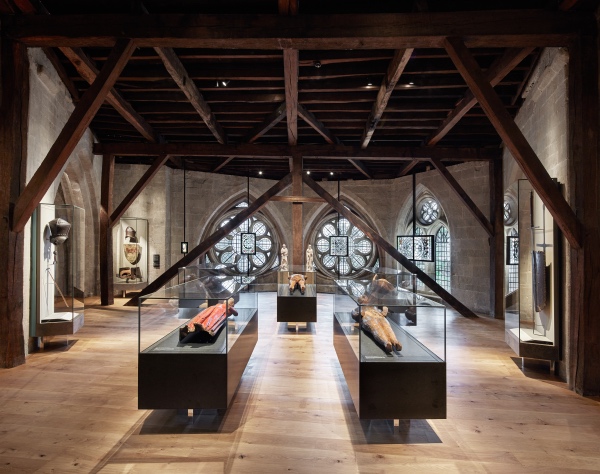
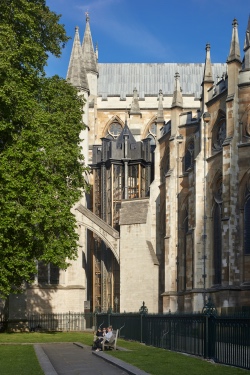
The new Queen’s Diamond Jubilee Galleries at Westminster Abbey open to the public on Monday. The museum galleries, located more than 50 feet above the abbey’s floor in the medieval Triforium, tell the 1,000 year history of the abbey through some of its greatest treasures. Entry to the Triforium – never before open to the public – is via the new Weston Tower, the first major addition to the abbey since 1745 which comes with previously unseen views of the neighbouring Palace of Westminster. The exhibition in the galleries, meanwhile, features some 300 objects and tells the abbey’s story around four major themes – building the abbey, worship and daily life, the abbey’s relationship to the monarchy and its role as a national place of commemoration and remembrance. Among the items on show are a column capital from the cloister of St Edward the Confessor’s Church (built around 1100), a scale model of the abbey commissioned by Sir Christopher Wren which features a never built massive central spire, The Westminster Retable (1259-69) – the oldest surviving altarpiece in England, the Litlyngton Missal – an illuminated 14th century service book, Queen Mary II’s Coronation Chair dating from 1689, the 2011 marriage licence of the Duke and Duchess of Cambridge, and early abbey guidebooks for visitors. The new galleries and tower were completed in a £22.9 million project funded through private donors and trusts. Admission charge applies. For more, see www.westminster-abbey.org/visit-us/plan-your-visit/the-queens-diamond-jubilee-galleries/.  PICTURES: Top – The Queen’s Diamond Jubilee Galleries; Right – The Weston Tower (Images courtesy of Westminster Abbey/Alan Williams).

The Royal Collection’s South Asian art goes on show at the Queen’s Gallery in Buckingham Palace from tomorrow. Splendours of the Subcontinent: A Prince’s Tour of India 1875-6 centres on the historic four month visit made by Albert Edward, Prince of Wales (later King Edward VIII) to the subcontinent prior to his mother, Queen Victoria, being formally declared Empress of India. It brings together some of the finest examples of Indian design and craftsmanship in the Royal Collection including some of the 2,000 gifts presented to the Prince on his tour. Highlights include an enamelled gold and diamond perfume holder given by Ram Singh II, Maharajah of Jaipur, a 10 piece gold service given by the Maharaja of Mysore, and a jewelled walking stick featuring a concealed gun, thought to have been the gift of Maharao Ram Singh of Bundi. There are also enamelled peacock feather fans, a gold and emerald turban ornament, and a brooch and necklace featuring a depiction of the Prince and Princess of Wales. The display can be seen until 14th October. Admission charge applies. The exhibition is being shown alongside Splendours of the Subcontinent: Four Centuries of South Asian Paintings and Manuscripts, which features highlights from the Royal Collection’s world-class holding of paintings and manuscripts from the region. For more, see www.royalcollection.org.uk.

British-born artist Thomas Cole’s depictions of the unspoiled American wilderness form the centre of a new exhibition at The National Gallery. Thomas Cole: Eden to Empire includes 58 works, mostly on loan from North American collections, including his iconic painting cycle The Course of Empire (1834-6), and the masterpiece that secured his reputation (and which has never been seen in the UK before), View from Mount Holyoke, Northampton, Massachusetts, after a Thunderstorm – The Oxbow (1836). Cole’s paintings will be shown alongside those of artists who had the greatest influence on him including JMW Turner and John Constable. Opens on 11th June and runs until 7th October. Admission charge applies. As a bonus, The National Gallery is also hosting a free exhibition of a series of 10 works created by Ed Ruscha in response to Cole’s The Course of Empire. These can be seen in Room 1. Admission is free. For more, see www.nationalgallery.org.uk.

Send all items for inclusion to exploringlondon@gmail.com.

10 islands in the Thames – 9. Taggs Island…


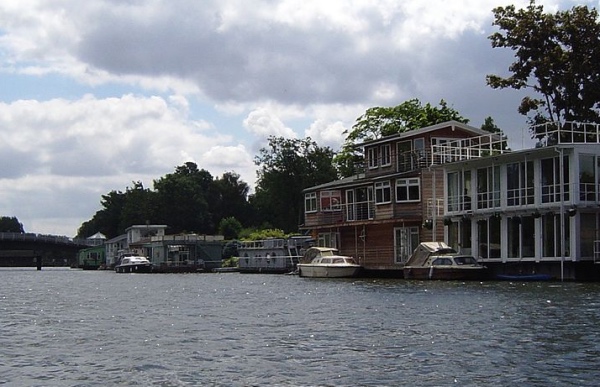
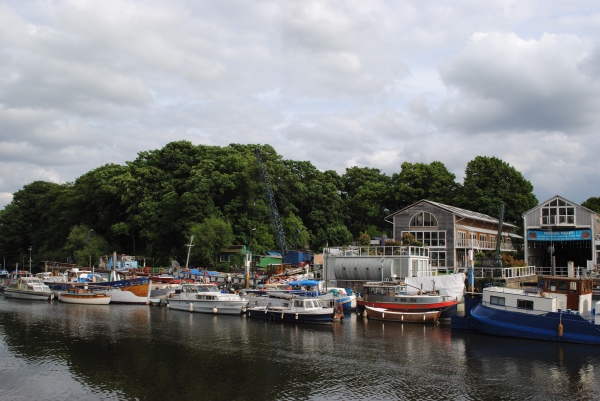
Formerly known as Walnut Tree Island (among other names), this Thames River island, which lies just upstream of Hampton Court Place, was once a playground for the wealthy and is now home to about 100 residents living in houseboats.

The island was once part of the manor of Hampton Court and by the mid-19th century was home to a number of squatter families who made a living by harvesting osiers (willow rods) used in basket weaving.

In 1850, it was purchased by a property speculator and lawyer Francis Kent (another name for the island was Kent’s Ait) who evicted the squatters and rented part of the island to Joseph Harvey, who established a pub called The Angler’s Retreat there. Another part he leased to a local boatbuilder and waterman named Thomas George Tagg who set up a boat rental and boat-building business there.

In the 1870s, Tagg – whose name became that of the island’s – took over the licence of the pub and built a larger, more imposing hotel in its place, transforming the backwater establishment into a high society favourite. Among its patrons were none other than Edward, Prince of Wales (later King Edward VII) and the actress Sarah Bernhardt.

The island also become a mooring site for luxurious houseboats and by the 1880s, the island was ringed with the craft – among those who rented one was none other than JM Barrie, later the author of Peter Pan.

In 1911, Tagg’s original lease of the island ran out and it was subsequently taken by Fred Karno (formerly known as Fred Westcott), a theatre impresario who is credited with having ‘discovered’ Charlie Chaplin and Stan Laurel and who had stayed in houseboats on the island.

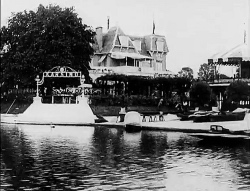
He subsequently built a luxurious hotel there, The Karsino, which he sold in 1926, but which went on to change hands several time over the ensuring years (and names – it became known variously as the Thames Riviera and the Casino Hotel).

Eventually, in a badly dilapidated state, the hotel once known as The Karsino was demolished in 1971 (but not before putting in an appearance in Kubrick’s A Clockwork Orange).

Karno also owned a luxurious houseboat, the Astoria, which was once moored on the island but which is now owned by Pink Floyd guitarist David Gilmour (who adapted it into a rather stylish recording studio in the Eighties – A Momentary Lapse of Reason and The Division Bell were apparently both recorded here) and moored upstream on the northern bank of the Thames.

A road bridge was built to connect the island to the mainland in the 1940s – when the island was being used to produce munitions – but this collapsed in the 1960s.

A new bridge was built to the island in the 1980s and a small lagoon carved out of the centre to increase the number of mooring sites for houseboats.

No homes are these days permitted to be constructed on the island but it’s still a mooring place for houseboats, some 62, in fact. These days the island owned by an association of the houseboat owners who each have their own garden on the island.

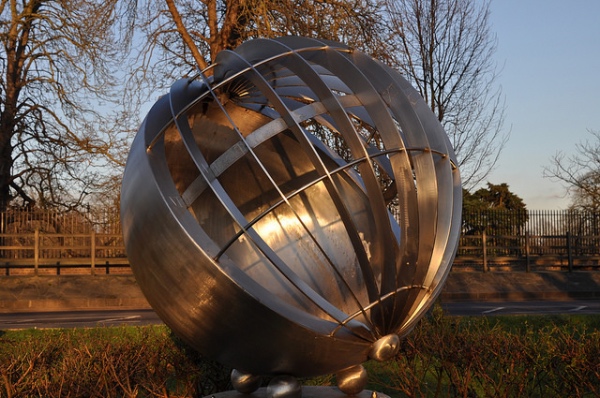
In the centre of the island is a rather unique sundial (see below). And just to the south-east of Taggs Island lies the much smaller Ash Island; the stretch of water separating the two was apparently once known as Hog’s Hole.

PICTURES: Top – Houseboats on Taggs Island ( Motmit at en.wikipedia/licensed under CC BY-SA 3.0) ; Right – The Karsino in 1924 (Adam37/licensed under CC BY-SA 4.0); Below – The sundial (stevekeiretsu/licensed under CC BY-NC 2.0)

10 islands in the Thames – 8. Thames Ditton Island…

We’re skipping upstream, past a few islands this week, to take a look at Thames Ditton Island which lies in Kingston Reach, above Teddington Lock. The island is the largest of a group of three which also includes Swan Island (the smallest) and Boyle Farm Island.

Located opposite the grounds of Hampton Court Palace (built by Cardinal Thomas Wolsey in the early 16th century and then, following his fall from grace, claimed by King Henry VIII in 1525), the 320 metre long Thames Ditton Island owes its existence to King Henry who had the river widened and straightened here so that he could use the river for an uninterrupted journey up the river from Westminster to Hampton Court. In doing so, the island was created.

Used as pasture land for the local manor (and known apparently at one point as Colly’s Ait, ait being a word for a river island, before being renamed Thames Ditton after the village on the west bank) for several centuries, the island became a popular recreation spot for the wealthy interested in water sports during the Edwardian era, thanks to the arrival of the railway in the area in the late 19th century.

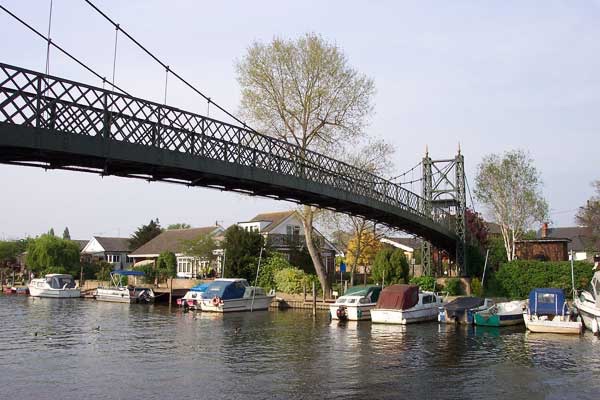
The island is these days connected to the Thames Ditton bank by a 1930s suspension bridge which ends near the 13th century Ye Olde Swan pub. It is now home to more than 45 rather exclusive riverside properties (almost all are in stilts to help ward off the danger of flooding, a phenomenon with which long-term residents in the area are familiar).

Swan Island, while lies just to the south of Thames Ditton Island, is tiny and the location of the home of the ferryman, who up until 1911, would take people across the river to Hampton Court.

Further to the south likes Boyle Farm Island which also has a single house open it. It stands opposite the mainland property formerly known as Boyle Farm but now a nursing home known as the Home of Compassion.

Interestingly, while Thames Ditton Island is part of Greater London, Boyle Farm Island is part of Surrey (along with Thames Ditton village).

PICTURE: Andrew Lewin (licensed under CC BY-NC-ND 2.0)

10 islands in the Thames – 7. Eel Pie Island…

And so we come to one of the most curiously named, yet perhaps most famous, of all the Thames islands in London.

First, to the name. The almost nine acre island, which was previously divided into two and perhaps even three, was previously known by other names including Twickenham Ait and Parish Ait. A place of recreation since perhaps as early as the start of the 17th century – there’s an early reference to a bowling alley being located there, since at least the mid-18th century it was also home to an inn, known variously as The Ship and The White Cross.

During the 19th century, the island became a popular destination for steamer excursions and the inn was rebuilt on a grander scale in about 1830. It became famous for the eel pies that could be bought there – so popular were they that the island’s name was apparently changed in tribute (although there’s a very dubious story that it was King Henry VIII who first made the island’s eel pies famous by stopping to sample one from a stall there – that, however, seems unlikely).

Second, to the fame. Now known as the Eel Pie Hotel, in the first half of the 20th century the inn began an association with music which would see it one day make an important contribution to the development of British pop music.

Dances were held there in the 1920s and 30s and in the mid-1950s, jazz sessions were held there. By the Sixties, the venue – under the stewardship of Arthur Chisnall – had started to attract R&B bands and among those who played here in the following years were everyone from Eric Clapton (as part of John Mayall’s Bluesbreakers) and The Rolling Stones to The Who, The Moody Blues, David Bowie and Rod Stewart. In 1967, the venue was forced to close due to the cost of repairs but reopened briefly in 1969 as ‘Colonel Barefoot’s Rock Garden’, attracting bands including Black Sabbath, Hawkwind and the Edgar Broughton Band.

The new venture didn’t last. Squatters moved in and in 1971, the hotel burned down in a “mysterious” fire while it was being demolished.

The island, the centre of which was again damaged by fire in 1996, now hosts about 50 homes and a few boatyards as well as other businesses and artist’s studios. It’s also home to the Twickenham Rowing Club, which was first established in 1860 and moved to the island in 1880.

While for many years it could only be accessed by ferry, the island can these days be accessed via a footbridge (the first bridge was installed in 1957 and replaced in 1998).

Notable residents on the island have included William Hartnell, the original Dr Who, and inventor Trevor Baylis (best known for the wind-up radio). The island has appeared in several books and TV shows including the 2005 series How To Start Your Own Country in which TV personality Danny Wallace attempted to “invade” the island. He was unsuccessful.

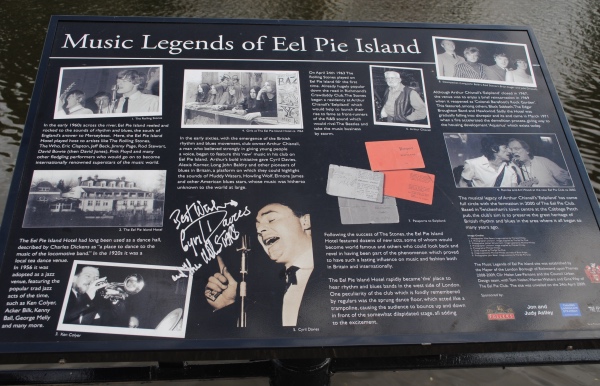
PICTURES: Above – Eel Pie Island from Twickenham. Below – A signboard tribute to the island’s musical heritage. (David Adams).

Treasures of London Special – The “new” Royal Academy of Arts…

Celebrating its 250th anniversary this year, The Royal Academy of Arts opens its “new” expanded £56 million campus on Saturday.

Designed by Sir David Chipperfield, the new two acre Royal Academy campus features 70 per cent more public space than the RA’s original Burlington House blueprint which will enable the institution to expand its programs of exhibitions and events and create new free displays of art and architecture.

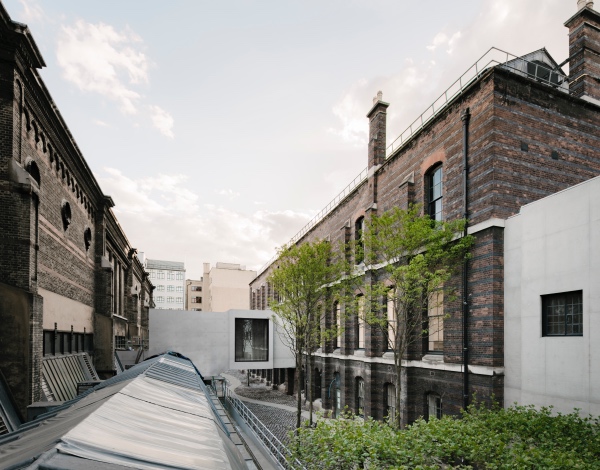
One of the key features of the redevelopment is the new Weston Bridge between the institution’s landmark property, Burlington House, and the RA’s formerly “unloved” building at 6 Burlington Gardens which unites the two-acre campus and creates a new route between Piccadilly and Mayfair.

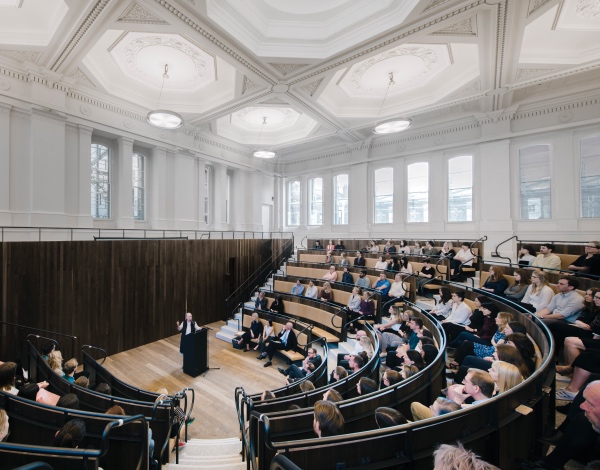
The Grade II-listed building on Burlington Gardens, which the RA bought in 1991 and which was previously home to, among other things, the Museum of Mankind, has been refurbished and a 250 seat lecture theatre, the Benjamin West Lecture Theatre, inserted along with a new architecture studio within The Dorfman Senate Rooms – restored by architect Julian Harrap – for free architectural displays.

A new public route through the campus has integrated the Royal Academy Schools into the visitor experience with the new Weston Studio, a public project space for students and alumni, and provides views of the Schools’ Corridor and the newly landscaped Lovelace Courtyard, providing visitors with a “greater insight into Britain’s longest established art school”.

It also takes visitors through the Gabrielle Jungels-Winkler Galleries, a suite of three day-lit galleries for temporary exhibitions (Tacita Dean’s LANDSCAPE, the inaugural display, opens Saturday) and past the new Royal Academy Collection Gallery where works by the likes of Michelangelo, Reynolds, Kauffman, Thornhill, Constable, Gainsborough and Turner can be seen. There’s also a new Clore Learning Centre.

New places to eat and drink within the complex include the Senate Room bar and restaurant, and cafes and shops located on either side of the Burlington Gardens entrance.

The Royal Academy was founded by King George III in 1768 after he was presented with a petition by architect Sir William Chambers which had been signed by 36 artists and architects seeking to “establish a society for promoting the Arts of Design”. Initially based in Pall Mall, the institution’s first official home was in the new Somerset House. In the 1830s, it moved to Trafalgar Square where it shared premises with the newly created National Gallery and in 1867, the institution has moved to Burlington House where it’s been located ever since.

To celebrate the opening of the “new” Royal Academy, there will be a weekend-long “art party” this weekend with free workshops, tours, displays, late-night performances and DJs. Highlights will include performances by The Uncollective and Rachael Plays Disco; collaborative mural drawing, party hat making, architectural model making, RA Collection gallery tours, and a family printmaking workshop in the new Clore Learning Centre. The Annenberg Courtyard will host street food and cocktail bars.

For more, see www.royalacademy.org.uk/plan-your-visit.

PICTURES: Top – The Weston Bridge and The Lovelace Courtyard/Below – The Benjamin West Lecture Theatre. (Both images by Simon Menges).

LondonLife – ‘The Last Days of Anne Boleyn’ at the Tower…


The final days of Anne Boleyn are being brought to life in a new play running at the Tower of London. Written and directed by Michael Fentiman, The Last Days of Anne Boleyn tells the story of the last 17 days of the Queen’s life before her execution in 1536 following her spectacular fall from grace. The performance is staged on the site of the lost Tudor palace at the Tower where Anne spent her final days and is based on contemporary sources including letters to her husband, King Henry VIII, and her final speech on the scaffold in the moments before she was beheaded. The outdoor show (suitable for all ages) runs for 35 minutes with two performances a day – 11am and 2pm, from Friday to Tuesday until 28th August (weather permitting). Admission is included in the entry price. For more information, head here. PICTURES: Courtesy of Historic Royal Palaces.

London Pub Signs – The Queen’s Head and Artichoke…

This corner pub was originally located in a former royal hunting lodge in what became The Regent’s Park.

It was one of several inns which were in the park which were demolished when it was created.

But unlike others, The Queen’s Head and Artichoke was rebuilt on its current site at 30-32 Albany Street in 1811. The existing building apparently dates from around 1900.

The licence for the pub is said to date back to the time of Queen Elizabeth I. The story goes that the establishment received its rather odd name thanks to Daniel Clarke, head gardener and master cook to the Queen and her successor, King James I – and, later, the pub’s proprietor.

For more, see www.theartichoke.net.

PICTURE: Ewan Munro (licensed under CC BY-SA 2.0)

Lost London – Merton Priory…

Little remains of this priory which once stood on the banks of the River Wandle in Surrey (and is now encompassed in Greater London).

The priory, which was founded as an Augustinian house in the early 12th century, rose to become one of the most influential in all of southern Britain.

The institution was created thanks to Gilbert, the Sheriff of Surrey, Huntington and Cambridge, who was granted the village of Merton by King Henry I. Gilbert came to live in Merton and there established a priory, building a church and small huts on land thought to be located just to the west of where the priory was later located.

Gilbert had been impressed with what he’d seen of the Augustinians, also known as the Austin friars, at Huntington and so gave control of the new church to their sub-prior, Robert Bayle, along with the land and a mill.

It was based on Bayle’s advice that the site of the priory was then moved to its second location and a new, larger wooden chapel built with William Gifford, Bishop of Winchester, coming to bless the cemetery. The canons – there were now 17 – moved in on 3rd May, 1117.

Among the high profile people to visit the new priory was Queen Matilda, who brought her son William with her. In the early 1100s, a certain Thomas Becket (later the ill-fated Archbishop of Canterbury) received an education here as did Nicolas Breakspeare (later the first English Pope, Adrian IV).

The priory expanded considerably over the next century and in 1217 its chapter house was the location of a peace conference between King Henry III and Louis, the Dauphin of France. The Statutes of Merton – a series of legal codes relating to wills – were formulated here in 1236.

The connection with royalty continued – in the mid-1340s, King Edward III is thought to have passed the Feast of the Epiphany here while King Henry VI apparently had a crowning ceremony here – the first outside of Westminster Abbey for more than 300 years – in 1437.

The priory remained in use until the Dissolution of King Henry VIII. The demolition of the buildings apparently started even before the priory had been formally surrendered to the commissioners – stones from its building was used in the construction of Henry’s new palace – Nonsuch – as well as, later, in the construction of local buildings.

The site came to be referred to as ‘Merton Abbey’ and, passing through various hands, was used to garrison Parliamentarian troops during the Civil War. It later became a manufacturing facility, works for the dying and printing of textiles, one of which became the workshops of William Morris.

Some of the priory buildings survived for some years after but the only remains now left as sections of the perimeter wall (the arch which now stands over the entrance to Merton parish church is reconstructed – there’s another ornamental gateway in the outer court wall which was also replaced with a replica in the 1980s).

The foundations of the unusually large chapter house, meanwhile, have been excavated and are now preserved in a specially constructed enclosure under a roadway. Construction is now underway to build better public access to the remains.

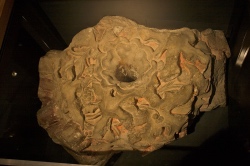
PICTURE: A ceiling boss from Merton Priory which still bears traces of its original red paint and guilding. It was found during excavations at Nonsuch Palace in 1959-60 is now on display in the Museum of London. Photograph by Mike Peel (www.mikepeel.net) (licensed under CC-BY-SA-4.0).

This Week in London – Hampton Court Palace breathes new life into Tudor kitchens; Kew’s Temperate House to reopen; and, World War I commemorated in Guildhall Yard…

Hampton Court Palace will on Saturday launch a major representation of its Tudor kitchens with a new display designed to give visitors a ringside seat to preparations for a royal feast. Visitors will be immersed in the sights, sounds and smells of King Henry VIII’s kitchens as they explore the stories of everyone from cooks to liveried pages who made the great court feasts possible and meet the likes of Thomas Cromwell, right-hand man to the king, master cook John Dale and Michael Wentworth, clerk of the kitchen. A specially commissioned play will be launched for the summer and during holiday periods there will be workshops, games and competitions. Admission to the kitchens is included in the palace admission. For more information, head to www.hrp.org.uk/hampton-court-palace/.

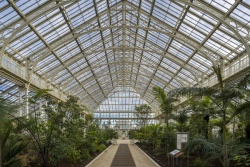
Kew’s iconic Temperate House – the world’s largest Victorian glasshouse – will reopen on Saturday after the biggest renovation project in its history. The five year restoration project has seen its entire framework repaired and thousands of panes of glass replaced. Some 500 plants were taken out and housed in a temporary nursery and some 10,000 plants, consisting of 1,500 species, have gone back in. A programme of events will take place involving the Temperate House, which dates from 1863, over the summer and there are special preview openings on Friday and Saturday night. For more, see www.kew.org. PICTURE: Gareth Gardner/Kew.

The City of London Corporation is marking the centenary of the end of World War I with a new open-air exhibition highlighting the global nature of conflict. Fields of Battle, Lands of Peace: 1918-2018, which opened on Monday, is the third and final display by photographer Michael St Maur Sheil to go on show in Guildhall Yard. The display can be seen until 28th May. Accompanying the exhibition is a free guided walk – The City’s Great War Heroes – which enables people to walk in the footsteps of City men and women who went off to the Great War. It departs from Bishopsgate every Monday and Saturday at 11am and 2pm until 28th May with an extra walk at 1.30pm on the final day. For more, follow this link.

Send all items for inclusion to exploringlondon@gmail.com.

What’s in a name?…Horseferry Road…

There’s no prizes for guessing that this Westminster road, which runs from Greycoat Place to Millbank and Lambeth Bridge, in pre-bridge days led down to a horse ferry across the Thames.

The ferry was, in fact, the only licensed horse ferry along the river and did quite a trade in conveying horses and their riders as well as carriages across the river. Mentions of the ferry date back to medieval times but it’s suggested there may have been a ford here back as far as the Roman era.

The income from the ferry went to the Archbishop of Canterbury (his official London residence lay across the river at Lambeth). So lucrative were the ferry rights that when Westminster Bridge was built in the mid 18th-century, the archbishop was paid £3,000 in compensation.

There are a number of famous figures associated with the ferry – Princess Augusta, later the mother of King George III, reportedly used it on the way to her wedding in 1736, and almost 50 years before that, the ferry pier is said to have been the starting point for King James II’s flight from England in 1689.

There are also a couple of high profile disasters associated with the horse ferry – Archbishop Laud’s belongings apparently sank to the bottom when the ferry overturned in 1633 and  Oliver Cromwell’s coach was apparently lost during a similar incident in 1656 – both events were apparently seen as bad omens (not to mention expensive).

Horseferry Road, meanwhile, is these days home to government buildings including Horseferry House and the City of Westminster Magistrate’s Court, as well as the Royal College of Veterinary Surgeons and, since the mid 1990s, Channel 4’s HQ.

Horseferry Road was also the location of the Australian Imperial Force’s administrative HQ during World War I and it was in this thoroughfare that Phyllis Pearsall was living when she conceived the London A to Z.

PICTURE: Top – Lambeth Bridge, site of the horse ferry which gives Horseferry Road its name/Right – Horseferry Road (Tagishsimon, licensed under CC BY-SA 4.0)


A Moment in London’s History – The execution of George, Duke of Clarence…

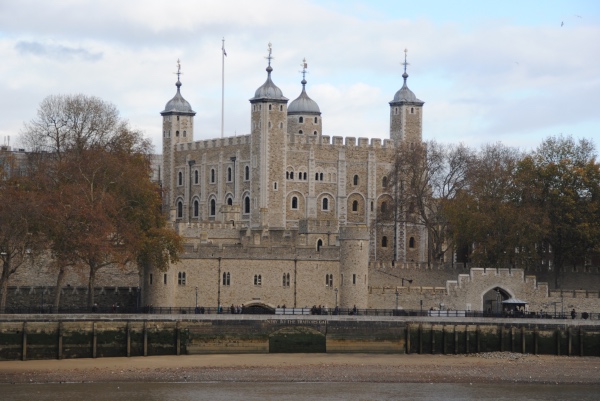
Among the gruesome deaths said to have taken place at the Tower of London is that of George, the Duke of Clarence, who, so the story goes, was drowned in a butt of Malmsey wine on 18th February, 1478 – 540 years ago this year.

George, who was born on 21st October, 1449, was the younger brother of King Edward IV and older brother of (although he was only king after George’s death) King Richard III.

George, who was made Duke of Clarence and Lord Lieutenant of Ireland soon after the House of York’s King Edward IV’s ascendancy to the throne in 1461 during the volatile period known as the Wars of the Roses, had betrayed his brother King Edward IV at least twice before his death.

The first time came in the late 1460s when he joined with Richard Neville, Earl of Warwick, in helping the previously deposed Lancastrian King Henry VI back onto the throne. The second time came after his brother Edward has retaken the throne in March, 1471, and the two of them had reconciled. George had sought to wed Mary of Burgundy, but Edward had objected – one of a series of events which apparently led George, whose mental state was said to be deteriorating fast by this point, to once again scheme against the king and eventually saw King Edward IV have him thrown in prison in June, 1477.

The King brought charges – including that he had slandered the King and prepared for rebellion – against George in Parliament in January, 1478, and both houses subsequently passed a bill of attainder with the sentence of death carried out in private (thus perhaps sparing him the humiliation of a public execution?) in the Tower soon after.

The story that he had been drowned in a butt of his favourite malmsey (a sweet wine) in the Bowyer Tower apparently circulated soon after his death – among proponents of the story was William Shakespeare who in Richard III has the duke stabbed and then drowned in a butt of malmsey – and to this day it remains something of a mystery as to whether it actually occurred (although, interestingly, his body when exhumed was not beheaded which was the common means of executing members of the nobility).

It has been suggested that sawn down wine butts were used for baths at the time – which may mean George was drowned in a wine butt, but one he was using to take a bath rather than one which had wine stored in it. It has also been suggested that the reference to a butt of wine refers to a barrel used for storing his body for removal to Tewkesbury where he was buried alongside his wife rather than his actual execution.

PICTURES: Top – The Tower of London where the Duke was executed; Right – A virtual re-enactment of George’s death at the Tower.


This Week in London – Charles I’s ‘Royal Collection’ on show; John Constable; and, 18th century satire…

Anthony van Dyck, Charles I, 1635-6, Oil on canvas, 84.4 x 99.4 cm, RCIN 404420 Royal Collection Trust/© Her Majesty Queen Elizabeth II 2017

A landmark exhibition which reunites one of the most extraordinary art collections ever assembled opens in the main galleries of the Royal Academy of Arts in Piccadilly this Saturday. Presented in partnership with the Royal Collection Trust, Charles I: King and Collector features about 150 of the most important of the works collected by King Charles I during his reign, spanning the period from 1600 to 1649. They are among 1,500 paintings and 500 sculptures he collected  prior to his execution in 1649, after which the collection was offered for sale and dispersed across Europe. Many of the works were retrieved by King Charles II during the Restoration but others now form the core of collections at institutions such as the Musée du Louvre and the Museo Nacional del Prado. Among those on show in this exhibition, which includes more than 90 works borrowed from the Royal Collection, are several monumental portraits of the king and his family by Anthony van Dyck as well as the artist’s most celebrated portrait of the king, Charles I (‘Le Roi a la chasse’) (pictured), which returns to England for the first time since the 17th century. Other works include Peter Paul Rubens’ Minerva Protects Pax From Mars (‘Peace and War’) – this was commissioned by Charles and painted between 1629-30, Andrea Mantegna’s series, The Triumph of Caesar (c1484-92), and Titian’s Supper at Emmaus (c1530) while artists including Correggio, Tintoretto, Paolo Veronese, Albrecht Durer, Hans Holbein the Younger and Pieter Bruegel the Elder are also represented. The exhibition also shows off the celebrated Mortlake tapestries depicting Raphael’s Acts of the Apostles (c1631-40) and paintings, statuettes, miniatures and drawings once kept in the Cabinet at Whitehall Palace. Runs until 15th April. Admission charge applies. For more, see www.royalacademy.org.uk.

• John Constable’s oil sketch, Salisbury Cathedral from the Meadows, 1829–31, is one of 10 works which have gone on display at the Guildhall Art Gallery as part of its Victorian Landscapes exhibition. The painting takes centre-stage in the display in the gallery’s Temple Room; other works on show include John Brett’s Echoes of a Far-Off Storm (1890); Edward William Cooke’s Triassic Cliffs, Blue Anchor, North Somerset (1866), and Benjamin Williams Leader’s The Church at Betwys-y-Coed (1863). The paintings can be seen until early May. For more, follow this link.

Eighteenth century satire portrayed on ceramics and prints is the subject of a new free display at the British Museum. Pots with Attitude: British Satire on Ceramics, 1760-1830 features some 80 objects, some of which have not been on show for decades, including mugs and jugs (which make up the bulk of the items on show) as well as items like a cotton handkerchief printed with the “Peterloo Massacre” of 1819 and a rather grisly folding fan showing hidden profiles of executed French sovereigns (1794). Other objects show off copies of prints by satirists such as James Gillray and Charles Williams, with one of the latter’s showing a colossal Napoleon about to cross the Channel into England but prevented from doing so by a pint-sized, sword-carrying John Bull, who has sliced off his toes and is telling him, ‘Paws off, Pompey’ – the comment a reference to a lap-dog known as Pompey the Little who was the hero of a popular novel at the time. The display can be seen in Room 90a, Prints and Drawings Gallery, until 13th March. For more, see www.britishmuseum.org.

Send all items for inclusion to exploringlondon@gmail.com.

This Week in London – The Royal Collection and Charles II; convicts lives explored; and, ‘Gold’ at the National Gallery…

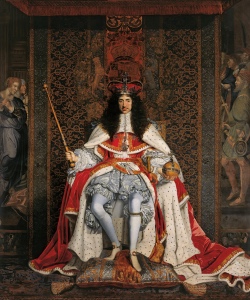
A new exhibition celebrating the role of the court of King Charles II in promoting the arts in England has opened at The Queen’s Gallery in Buckingham Palace. Charles II: Art and Power highlights the key role Charles II played in developing the Royal Collection following the Restoration in 1660 as a means of decorating royal apartments and, perhaps more importantly, of glorifying the restored monarchy and helping it to take its place back on the European stage. The display features works ranging from John Michael Wright’s monumental portrait of the king in coronation robes (pictured) to Henry Greenway’s silver-gilt dish that adorned the high altar of Westminster Abbey and Wenceslaus Hollar’s The Coronation of King Charles the II in Westminster Abby the 23 of April 1661. Other paintings on show include Titian’s Madonna and Child in a Landscape with Tobias and the Angel (c1535-40), Antonio Verrio’s The Sea Triumph of Charles II (c1674), Pieter Brugel the Elder’s The Massacre of the Innocents (c1565-67), and Sir Peter Lely’s Barbara Villiers, Duchess of Cleveland (c 1665) as well as tapestries and silver-gilt furnishings. The exhibition, which will be accompanied by a major exhibition in the Royal Academy of Arts in January and a series of documentaries on various BBC channels under the banner of a BBC Royal Collection Season, runs until 13th May. Admission charge applies. For more, see www.royalcollection.org.uk. PICTURE: John Michael Wright, Charles II, c.1676 Royal Collection Trust/© Her Majesty Queen Elizabeth II 2017.

The lives of convicts in 18th and 19th century London are the subject of a new exhibition opening at the London Metropolitan Archives. Criminal Lives, 1780-1925: Punishing Old Bailey Convicts includes original documents from the Old Bailey archives and items such as a policeman’s truncheon, a reproduction Millbank Prison uniform and convicts’ photographs drawn from collections in Britain and Australia to provide insights into the lives of offenders, from the time of the Gordan Riots in 1760 to the early 20th century. Among those whose lives are featured are prostitute and pickpocket Charlotte Walker, notorious receiver of stolen goods Ikey Solomons and serial thief Thomas Limpus. The exhibition, created in collaboration with the Arts and Humanities Research Council Digital Panopticon Project, opens on Monday and runs until 16th May. Admission is free. There is an accompanying programme of events. For more, see www.cityoflondon.gov.uk/lma.

The National Gallery is running a season of events aimed at exploring the theme of ‘gold’ in its collection in the run-up to Christmas. Running until 1st January, the programme includes free lunchtime talks, a life drawing session this Friday, a workshop on the traditional intaglio printmaking technique of drypoint, drawing sessions and a series of films. For the full season of events, check out www.nationalgallery.org.uk/whats-on/christmas-at-the-gallery/christmas-events.

Send all items for inclusion to exploringlondon@gmail.com.

10 subterranean sites in London – 6. Guildhall crypts…

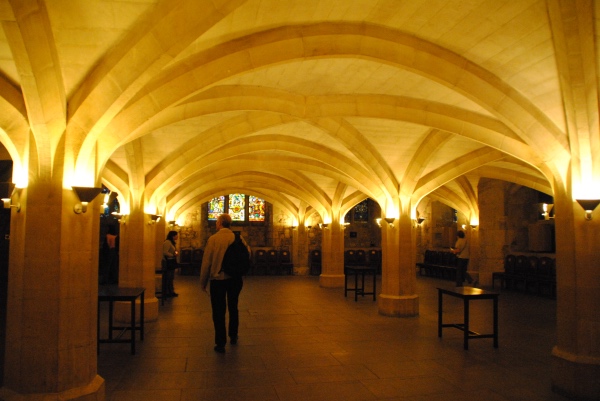
Located beneath Guildhall’s Great Hall is the oldest surviving part of the structure, the largest of London’s medieval crypts.

Dating from the reign of King Edward the Confessor in the 11th century, the vaulted East Crypt is considered to be one of the finest examples of its kind in England with a ceiling featuring a series of carved bosses depicting heads, shields and flowers.

It features a series of stained glass windows depicting five famous Londoners – Geoffrey Chaucer, William Caxton, Sir Thomas More, Sir Christopher Wren and Samuel Pepys.

The pillars holding up the roof, meanwhile – once located at ground level – show signs of where horses were once tied up while their riders went about their business.

The West Crypt, which is believed to date from the 13th century, was sealed off after collapsing under the weight of the roof of the Great Hall which fell down during the Great Fire of London in 1666. It was reopened in 1973.

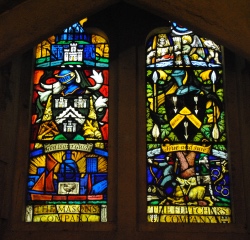
The windows of the West Crypt represent some of the City of London’s livery companies (pictured above, right).

One of the most famous incidents took place in the crypts on 9th July, 1851, when Queen Victoria attended a banquet here during a state visit.

The crypts today are available to hire for atmospheric events.

WHERE: Guildhall, Guildhall Yard, City of London (nearest Tube stations are Bank, Mansion House and Moorgate); WHEN: 10am to 4.30pm daily (when not being used for events); COST: Free; WEBSITE: www.cityoflondon.gov.uk/things-to-do/visit-the-city/attractions/guildhall-galleries/Pages/guildhall.aspx.

10 subterranean sites in London – 5. Whitefriars Priory crypt…

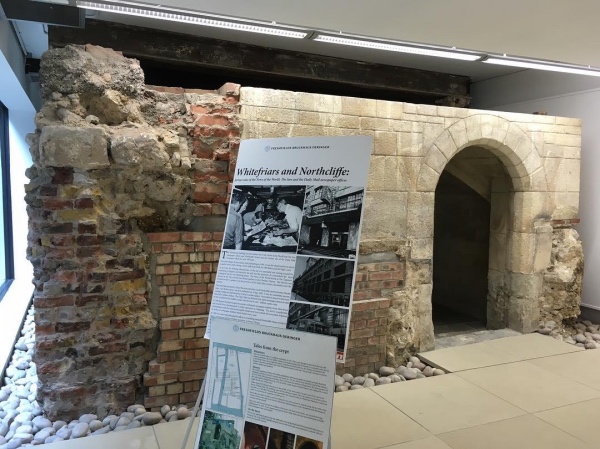
Located in the basement of a modern office building (and visible through glass) are the remains of a 700-year-old crypt that once lay beneath Whitefriars Priory.

Reached via Magpie Alley (off Bouverie Street which runs south from Fleet Street), the remains are all that is visibly left of the priory, founded here in the 13th century.

Known as ‘White Friars’ because of the white mantle they wore over their brown habits, the Carmelites (their proper name) were founded in what is now Israel in the mid-12th century. After the region fell to the Saracens in the mid-13th century, some members of the order made their way to England with the aid of Richard, Earl of Cornwall, brother of King Henry III. In  1241, Sir Richard Grey of Codnor founded the Priory of Our Lady of Mount Carmel on this site.

The priory – which counted towering medieval figure John of Gaunt among its patrons – once stretched from Fleet Street to the Thames and to the Temple in the west and what is now Whitefriars Street in the east. It included a church – enlarged in the 14th century – as well as cloisters, a garden and cemetery.

The priory survived until the Dissolution after which King Henry VIII granted various buildings to the King’s Physician and the King’s Armourer and the great hall become the famous Whitefriars Playhouse.

Whitefriars became part of the rather infamous slum known as Alsatia, a ‘liberty’ seen as a place of sanctuary for those fleeing the law. The priory was gradually subsumed into the slum – there’s a suggestion that the crypt may have been used as a coal cellar.

The remains of the 14th century vaulted crypt, which had been located beneath the prior’s house on the east side of the former priory site, were apparently found in the late 19th century and restored in the 1920s when the now defunct newspaper News of the World was expanding. During a redevelopment in the 1980s (which came after News International moved out to Wapping), the remains were moved to their current location.

WHERE: Whitefriars Crypt, Ashentree Court, City of London (nearest Tube stations are Temple and Blackfriars); WHEN: Daily; COST: Free; WEBSITE: None.

PICTURE: The crypt at seen at this year’s Open House London event. (Andrea Vail licensed under CC BY-ND 2.0.)