Lost London – Monfichet’s Tower…

A relatively short-lived Norman fortification located on Ludgate Hill, this tower or ‘castle’ was probably built in the late 11th century and was one of several new fortress located in the city post 1066.

Ludgate-HillBelieved to have been built by Gilbert de Monfichet – a relative of King William the Conqueror who hailed from Rouen (and is believed to have been connected with Monfichet family of Stansted Monfichet in Essex), the tower apparently comprised a stone keep on a motte surrounded by ditches. It was located on Ludgate Hill near the city wall, to the north of Carter Lane, on what was then the western edge of the walled city.

First appearing in documents in the 1130s, it was apparently strengthened during a revolt against King Henry II in 1173-1174 but was eventually demolished in the 13th century (some accounts suggest it was King John who ordered its demolition in 1213, after Gilbert’s successor Richard was banished).

The site was given to the Dominican priory of Blackfriars in 1275 (there’s a suggestion that the tower was already in ruins by 1278 meaning it must have been at least partially demolished some time prior). Apparently some of the masonry from the tower was used in the priory’s construction.

Excavations in the 1980s revealed the remains of a ‘V’ shaped defensive ditch – interpreted as one of three defensive ditches which protected the tower – and rubbish and cess pits – interpreted as standing within what was the tower’s bailey.

10 Historic London Garden Squares…6. Grosvenor Square

Grosvenor-Square-1

The largest square in Mayfair, Grosvenor Square was laid out in the 1720s on the orders of  Sir Richard Grosvenor of Cheshire.

Sir Richard owned the Grosvenor Estate, a considerable tract of land in London’s west which includes in its northern part the land upon which the square was created (the estate is now owned by Gerald Cavendish Grosvenor, the 6th Duke of Westminster).

It’s proximity to Hyde Park and Whitehall quickly made it, like many other historic squares, a fashionable place for politicians to live – among those who lived here in the late 18th century were three prime ministers.

The oval-shaped gardens in the middle of the square – which was only opened to the public in 1948 – were once home to a statue of King George I but this was removed at some point. Originally thought to have been laid out by gardener John Alston, they took on their current form in 1948 when they were redesigned by architect BWL Gallannaugh (interestingly, Grosvenor Square is also said to have been the last part of London to exchange gas lighting for electric lighting).

There’s almost no residential buildings on the square these days but among the most prominent buildings (in fact it dominates the west end of the square) is the US Embassy. Designed by Eero Saarinen, the building was completed in 1960 with US President John F Kennedy one of the first visitors.

Grosvenor-Square-2The hulking embassy is only one of the many American connections to the square, connections which at one point led to it being known as “Little America”. Dwight Eisenhower, commander of the US armed forces in World War II, based his headquarters at number 20 in 1944, while number nine – one of the few residences to survive – was home to John Adams, first American ambassador to the Court of St James and later the country’s second president.

The American theme, which has meant the square has been the focus of demonstrations such as those protesting the Vietnam War as well as outpourings of support such as in the wake of the September 11 attacks, is also evident in the statutory in the square’s gardens with grand, full size statues of  President Franklin D. Roosevelt (a bronze by William Reid Dick unveiled by Eleanor Roosevelt on the third anniversary of the president’s death – 12th April, 1948 – it is pictured above), President Eisenhower (a bronze by Robert Dean dating from 1989), and President Ronald Reagan (unveiled on 4th July, 2011, pictured right).

On the eastern side of the garden square is the September 11 Memorial Garden opened in 2003 while on the south side is the Monument to the Eagle Squadrons, the three RAF squadrons in World War II mostly composed of American volunteers before the US entered the war. There’s also a set of memorial “Diplomatic Gates”, installed in 1984 to commemorate the bicentennial of the Treaty of Paris and honour US and UK politician who have worked in the service of peace.

Other notable buildings include number one, the Canadian High Commission (previously the US embassy); and number four, one of  square’s oldest houses. Now demolished, number 44 was the home of the Earl of Harrowby and where the British Cabinet were dining when word arrived of Wellington’s victory at Waterloo.

LondonLife – Celebrating the 60th anniversary of Queen Elizabeth II’s coronation…

Regent-Street-turns-purple-to-celebrate-The-Queen’s-Coronation-

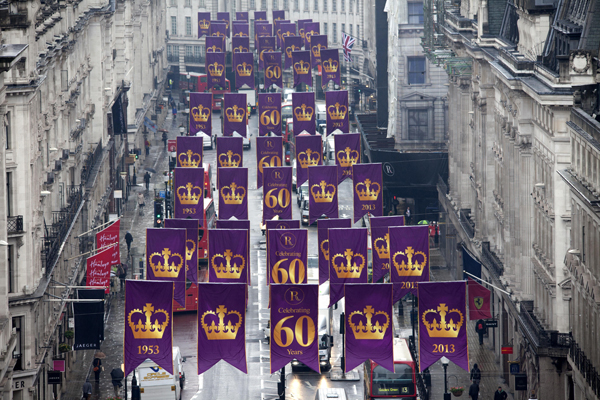
Regent Street is adorned with flags in celebration of the 60th anniversary of Queen Elizabeth II’s coronation, among the many ways in which London has been celebrating the occasion. The official anniversary was on Sunday – it was 2nd June, 1953, some 16 months after the 25-year-old Queen took the throne following the death of her father King George VI, that Queen Elizabeth II was crowned in Westminster Abbey. In celebrations yesterday, the King’s Troop Royal Horse Artillery fired a 41-gun salute in Green Park at midday followed an hour later by a 62-gun salute fired by the Honourable Artillery Company across the River Thames from the Tower of London. The Queen and other members of the royal family (along with some 2,000 guests) is attending a special service at Westminster Abbey today (for more on how the abbey is celebrating the event, see our earlier post here). More than 8,000 people attended the coronation which was watched by an estimated 27 million people across the country. PICTURE: RegentStreetOnline


Treasures of London – Coins at the Tower…

Coin2

In this special edition of Treasures of London, we’re taking a quick look at a new permanent exhibition which has opened at the Tower of London focusing on the 500 years it served as the Royal Mint.

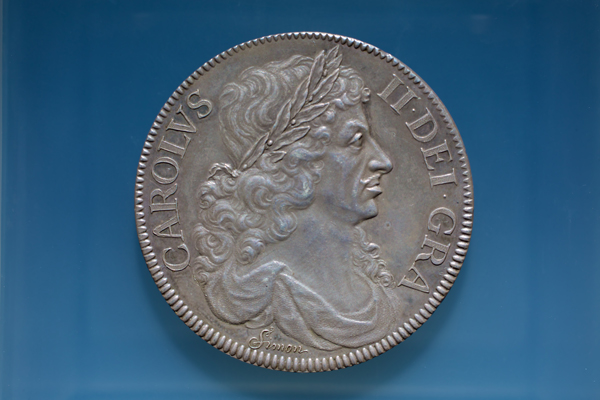
Opened in partnership with the Royal Mint Museum, the new exhibition, Coins and Kings: The Royal Mint at the Tower, features a series of rare coins and other coin-related paraphernalia, including a rare silver groat from the time of King Edward I (1279-1307), a gold “trial plate” dating from 1542 in the reign of King Henry VIII, and a Charles II petition crown dating from 1663 – pictured above, it was sent to King Charles II by engraver Thomas Simon as an example of his work (Simon never got the job and died of plague three years later).

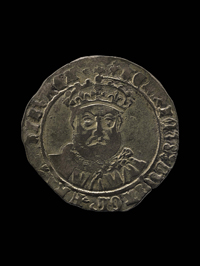
Coin1There’s also a silver ‘testoon’ from the reign of King Henry VIII (it bears a Holbein-style portrait of him) which has been debased – indeed, such was the state of coinage during his reign that the “silver” coins often contained more cheap metal, like copper, than silver so that as they wore down, the copper shone through earning the king the delightful nickname, ‘Old Coppernose’ (pictured right).

The tower was used as the country’s mint from about 1279 – when King Edward I moved the Royal Mint inside the Tower as part of his efforts to clean up England’s coinage – to 1812 – when the Royal Mint was relocated out of the Tower to a purpose-built premises on Tower Hill – and the exhibition focuses on five moments from its history.

They include a look at the efforts of Sir Isaac Newton, Warden (and later Master) of the Royal Mint, in tracking down forgers in the late 1600s (his rather zealous prosecutions of those creating forgeries, in particular one William Chaloner, is retold with aplomb in Thomas Levenson’s book Newton and the Counterfeiter), King Edward I’s harsh punishments for people who dared to tamper with his coinage, Queen Elizabeth I’s restoration of the coinage after her father, King Henry VIII’s meddling with the currency, and King Charles II’s rejection of Commonwealth money.

There’s a series of events to go with the exhibition’s opening including the change to see some of the coins up close and family activities (check out the Tower of London website – link below – for more details).

WHERE: Tower of London (nearest tube station Tower Hill); WHEN: 9am to 5.30pm, Tuesday to Saturday, 10am to 5.30pm Sunday to Monday; COST: £21.45 adults; £10.75 children under 15; £18.15 concessions; £57.20 for a family; WEBSITE: www.hrp.org.uk/toweroflondon/.  

PICTURES: Historic Royal Palaces/newsteam

Around London – Celebrating the Coronation’s 60th anniversary; Benjamin Britten; Keat’s House Festival; and, silver service in Roman Britain…

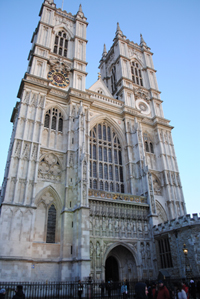
Westminster-Abbey3Sunday marks 60 years since Queen Elizabeth II’s coronation and Westminster Abbey – site of that event – is celebrating with a series of events. These include a special 60th Anniversary of the Coronation Service on Tuesday (4th June) to be attended by the Queen, Duke of Edinburgh and members of the royal family as well as a public lecture to be given by the Bishop of London Richard Chartres on Friday night (7th June – booking is essential), a concert performed by the abbey choir (13th June), and a new exhibition in the chapter house featuring archive images of the 1953 coronation ceremony and of preparations which took place at the abbey. Meanwhile the Coronation Chair, used in most coronations since the 14th century and having just undergone conservation work, is the subject of a new display in St George’s Chapel, and two new commemorative stained glass windows have been installed in King Henry VII’s Lady Chapel – the first commissioned by the abbey for more than a decade, they have been designed by artist Hughie O’Donoghue. For more on the abbey’s celebrations, see www.westminster-abbey.org.

Composer Benjamin Britten is the subject of a new exhibition opening at the British Library tomorrow. Poetry in Sound: The Music of Benjamin Britten (1913-1976) looks at the poetic and literary influences on the work of the man often described as the greatest English composer since Purcell. In particular it examines his collaboration with WH Auden and the interplay of his work with authors such as William Blake, Wilfred Owen, Alfred Lord Tennyson and William Shakespeare. As well as composition manuscripts, the exhibition features photographs, concert programmes and unpublished recordings of his music. There are a range of events accompanying the exhibition which runs until 15th September. An admission charge applies. For more, see www.bl.uk.

The Keats House 2013 Festival is underway this week with activities ranging from poetry readings to felt-making demonstrations, free family workshops and musical performances. The programme of events runs until 2nd June, all under this year’s theme of ‘Health is My Expected Heaven’: The Body and The Imagination. Poet John Keats lived at the house in Hampstead, not far from Hampstead Heath, from 1818 to 1820 and it is the setting for some of his most acclaimed poetry including Ode to a Nightingale. It was this house that he left to travel to Rome where he died of tuberculosis at the age of 25. For more on the festival programme, follow this link.

On Now: Silver Service – Fine dining in Roman Britain. This free exhibition at the British Museum recreates the experience of dining late in the Roman era and uses the Mildenhall Great Dish, Britain’s finest late Roman silver dining service, as an example of the type of large platter on which food for sharing would have been presented. The exhibition, which runs until 4th August, is free (keep an eye out for our upcoming Treasures of London on the Mildenhall Great Dish). For more information, see www.britishmuseum.org.

10 Historic London Garden Squares…4. St James’s Square…

A quiet square at the heart of the area known as St James, the square’s origins go back to the 1660s when King Charles II granted what was initially a lease (and later the freehold) over a section of St James’s Field to Henry Jermyn, a favourite of King Charles I’s queen Henrietta Maria who was created the 1st Earl of St Alban.

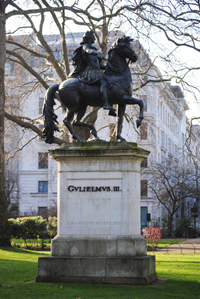
William-IIIThe earl began developing the residential square (the original design had houses on the south-side fronting onto Pall Mall) and, thanks to its proximity to Whitehall and St James’s Palace, quickly attracted some of the who’s who of London to live there.

Indeed it’s said that by the 1720s, seven dukes and seven earls were in residence in the square – other residents included PMs William Pitt the Elder and William Gladstone (both lived in Chatham House, at numbers 9 and 10, albeit at different times) as well as two of James II’s mistresses, Arabella Churchill and Catherine Sedley, who apparently lived at number 21 in the late 1600s.

Among the architects who designed houses around the square were Robert Adam, Sir John Soane, and, in more recent times, Edwin Lutyens.

The square – which reached its final layout, designed by John Nash, around 1854 – remained a desirable place to live even as in the 19th century, some of the houses gave way to financial institutions, private clubs, offices and even lodging houses. These days it’s dominated by business and other institutional organisations.

Organisations located in the square today include the Naval and Military Club (number four – former home of Nancy Astor), the East India Club (number 16) and the London Library (located at number 14, it was founded by Thomas Carlyle in 1841) as well as the international headquarters of BP.

The gardens feature an equestrian statue of King William III at their centre (the work of John Bacon Sr and Jr, it was installed in 1808 and is pictured above). Other monuments include The Stag (located in the south-west corner, it is the work of Marcus Cornish and was installed in 2001) and, just outside the garden railings in the north-east corner, a memorial to WPC Yvonne Fletcher who was killed when a gun was fired from the Libyan Embassy (known as the Libyan People’s Bureau, it was located at number 5) during a demonstration on 17th April, 1984. The pavilion on the south side was designed by John Nash.

The gardens are private – managed by the St James’s Square Trust – but open to the public on weekdays from 10am to 4.30pm.

LondonLife – Celebrating 100 years of the RHS Chelsea Flower Show…

Chelsea2

Queen Mary (wife of King George V) with group at the RHS Chelsea Flower Show in 1913. The show, which was first held in the grounds of the Royal Hospital, Chelsea, in 1913, is celebrating its centenary this year. The 244 exhibitors at the inaugural event have grown to more than 500 today with 161,000 visitors now attending the show each year. Other pictures released to mark the centenary include (see below) gardeners carrying pots at the show in 1931; visitors looking at a display of cacti at the 1964 show; and, an aerial view of the show in the 1990s. The show runs from today until 25th May. For more on the RHS Chelsea Flower Show, see www.rhs.org.uk/Shows—events/RHS-Chelsea-Flower-Show/2013PICTURES: RHS Lindley Library. 

Gardeners-carrying-pots-at-the-Show.-Date-1931.-Credit,-RHS-Lindley-Library

Chelsea3

Chelsea4

Around London – Tudor and Stuart fashion; Wellington Arch treasures; Hunterian celebrates 200 years; Regent Street and the world; and, Kaffe Fassett at the FTM…

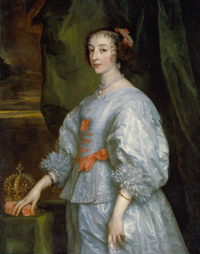
Queen-Henrietta-Maria-(Royal-Collection)A landmark exhibition looking at fashion in the Tudor and Stuart eras opens at The Queen’s Gallery, Buckingham Palace, tomorrow. In Fine Style: The Art of Tudor and Stuart Fashion features everything from a diamond ring given by King Charles I to his then 19-year-old wife Henrietta Maria, an ornate set of armour which belonged to 13-year-old Henry, Prince of Wales (the older brother of King Charles I – he died of typhoid fever at the age of 19), and a diamond-encrusted box in which Queen Mary II kept black fabric patches worn to conceal blemishes or highlight the creaminess of skin. A 58.5 carat pearl, named ‘La Peregrina’ (‘The Wanderer’) and given to Queen Mary I as an engagement gift from Philip II of Spain (and later presented to Elizabeth Taylor by Richard Burton on Valentine’s Day, 1969), is also among the objects on show along with a pendant featuring a miniature of Queen Elizabeth I. The exhibition also features more than 60 portraits from the Royal Collection showing the fashions of the time, including a portrait by Sir Peter Lely of court beauty Frances Stuart, Duchess of Richmond, who famously refused to become King Charles II’s mistress. Admission charge applies. Runs until 6th October. For more, see www.royalcollection.co.uk. PICTURE: Sir Anthony van Dyck, Queen Henrietta Maria, 1609-69. Royal Collection Trust/© 2013, Her Majesty Queen Elizabeth II.

A medieval crozier and bejewelled ring discovered in Cumbria in 2010 are on public display for the first time in a new exhibition at Wellington Arch. The artefacts, which were discovered at Furness Abbey, are featured in an English Heritage exhibition, A Monumental Act: How Britain Saved Its Heritage, which explores how the Ancient Monuments Act of 1913 helped protect Britain’s historical fabric. Other objects in display include some of the historic artefacts found in the 20 years following the act – a Roman bronze weight from Richborough Roman Fort in Kent and a 13th century sculpture of Christ found at Rievaulx Abbey in Yorkshire. Admission charge applies. The exhibition runs until 7th July. For more, see www.english-heritage.org.uk/daysout/properties/wellington-arch/.

The Hunterian Museum at the Royal College of Surgeons is celebrating its bicentenary this year and to mark the occasion, they’re holding a free exhibition focusing on the museum’s collections of human anatomy and pathology; natural history and artworks. The display will consider how the objects in the collection have informed the medical world and fallen under the gaze of visitors who have included surgeons as well as monarchs. The exhibition in the Qvist Gallery at the museum in Lincoln’s Inn Fields opens on Tuesday, 14th May, and runs until 9th November. For more, see www.rcseng.ac.uk/museums/hunterian.

The world comes to Regent Street this Sunday with the ‘InsureandGo The World on Regent Street’ festival. Representatives from countries including Argentina, Egypt, Trinidad and Tobago, Turkey and China as well as the UK will showcasing the best of each country’s culture, music and dance, art, food and fashion. Activities will include tango lessons from Argentina, professional henna drawing from Egypt, a steel band from Trinidad and Tobago, and a Chinese drumming performance and lion dancing. The street will be closed for the day. For more, see www.regentstreetonline.com.

On Now: Kaffe Fassett – A Life in Colour. This exhibition at the Fashion and Textile Museum in Bermondsey Street celebrates the work of American-born artist Kaffe Fassett and features more than 100 works including nine foot wide knitted shawls, coats and throws, patchwork quilts and a ‘feeling wall’ where visitors can touch the textiles on display. Admission charge applies. Runs until 29th June. For more, see www.ftmlondon.org.

10 Historic London Garden Squares…3. Soho Square…

Soho-Square

Originally named King’s Square in honour of King Charles II, Soho Square was laid out on what had been known as Soho Fields as a residential square with a garden at its centre in the late 1670s – part of the general demand for homes that came about after the Great Fire of London in 1666.

A fashionable place to live when built, among the early mansions was Monmouth House, a grand mansion originally built for James Scott, the Duke of Monmouth (and illegitimate son of King Charles II who lost his head after leading a rebellion against King James II) and later used by the French ambassador before it was demolished in the 1770s. Two of the square’s original homes are located at numbers 10 and 15.

A number of trees and shrubs were recorded as being planted here including cherry, peach and almond trees as well as lilacs, jessamine and honeysuckle – it’s suggested these may have been chosen by botanist Sir Joseph Banks who lived at number 32 from 1777 until his death in 1820.

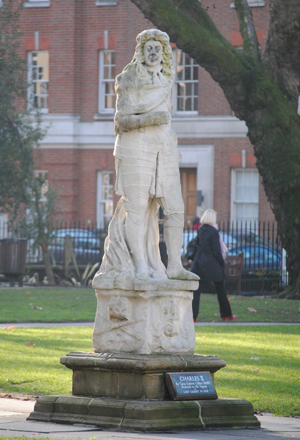
King-Charles-IIThe square, which was opened to the public in 1954, is today at the heart of the West-End district of Soho, once synonymous with late night entertainment including the sex industry but also home to a growing number of film and media-related organisations (for a look at the derivation of the name Soho, see our earlier post).

Indeed, a number of media companies are based in the square itself – British Movietone, which was produced the Movietone news, was located here at number 22 for years while current inhabitants include Twentieth Century Fox (located in a building at number 31-32 where the botanically minded Linnean Society once met).

Other buildings of note in the square include the French Protestant Church, built in 1891-93 and located at numbers eight and nine and St Patrick’s Church, located at on the corner of Soho Square and Sutton Row. While a chapel was first consecrated here in 1792, the current building dates from the 1890s (reopened in 2011 after a £3.5 million restoration) and has catacombs which spread a considerable distance under the square. In a nod to less savoury aspects of the square’s past, the White House Brothel was also located here – at number 21 – in the late 18th century (the building is now known as Manor House).

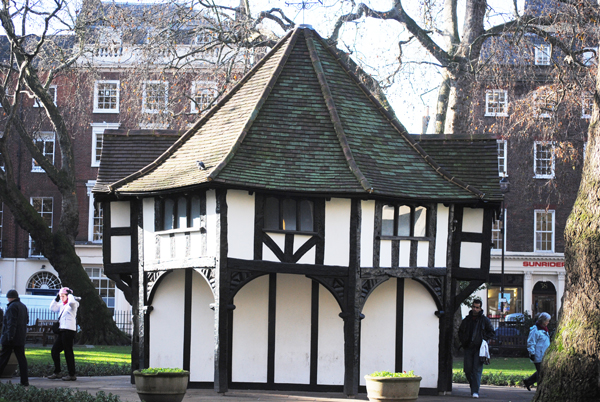
The oldest statue in the square is that of Caius Gabriel Cibber’s King Charles II which dates from 1681 (pictured right) – a reminder of the square’s past name.  Originally part of a larger monument containing a fountain, it was removed in 1875 to make way for the distinctive half-timbered Tudor-style hut (pictured above) used by gardeners which, having been rebuilt in the 1930s, currently sits at the square’s centre and only returned to the gardens in 1938. There’s also a bench in the square which commemorates the late singer Kirsty MacColl, writer of the song Soho Square.

For more on London’s squares, see Gary Powell’s Square London.

Daytripper – New Forest…

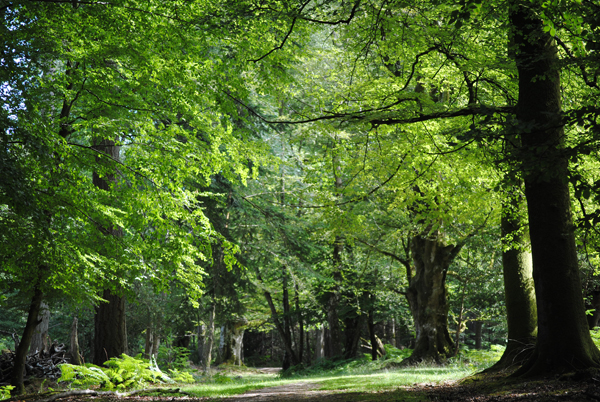
New-Forest

At roughly 56,000 hectares (about half of which is woodland), the New Forest National Park is the smallest national park in the UK. But it packs a lot into a small space and makes for great daytrip destination from London now that the sun (hopefully) is coming out.

The ‘Nova Foresta’, encompassing a coastal swathe of land located about 65 miles south-west of London, was first designated as a new hunting forest by William the Conqueror in 1079 – indeed, his won, King William II (William Rufus), died there in an apparent hunting accident in 110o (his death is marked by a memorial stone, just off the A31 near Stoney Cross, which tells the story although this is apparently not the site where he actually died).

Later a source of wood for the Royal Navy, the forest gained government protection with the passing of the New Forest Act in 1877. Most the of land is still owned by the Crown whose assets here have been managed by the Forestry Commission since 1923. The forest was designated a national park in 2005.

The journey from London takes about an hour and a half by train – Waterloo to the town of Brockenhurst (buses travel around the forest area including an open top tourist bus). While a car is useful if you want to visit several sites in a single day, traffic can get heavy, particularly if the sun is out.

A good place to start is the New Forest Visitor Centre, located in main town of Lyndhurst, which has plenty of information about the region (including a small museum) and on some terrific walks (included guided walks if you so desire).

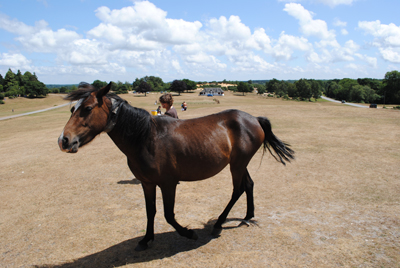
New-Forest-ponyA good short walk, starting only a couple of miles out of Lyndhurst, takes in the Knightwood Oak – reputed to be more than 600 year, it’s the largest oak in the forest and boasts a girth of more than 7.5 metres – and the Reptile Centre (inhabitants include adders, the only poisonous snake in the UK) and a walk through some stunning conifers.

One of the highlights of New Forest are the 3,000 free-roaming wild ponies – they can get rather friendly, particularly if you’re having a picnic, and you’re advised not to feed or touch them. They can be seen all over the forest including wandering through some of the villages.

Other attractions in the New Forest include the 26 miles of coastline from where you can get terrific views of the Isle of Wight across the Solent – the coastal village of Buckler’s Hard is also worth stopping by for its maritime history, and car buffs will love the Beaulieu National Motor Museum (complete with the remains of Beaulieu Abbey and the intact Palace House, built in the Abbey gatehouse and home to the Montagu family since 1538), located on land which once housed Beaulieu Abbey (really a day in itself).

There’s also plenty of outdoor activities you can take part in – everything from walking and cycling to horseriding to kayaking.

And if you do decide to stay overnight, there’s plenty of accommodation and the option of camping (designated places only) if you so wish.

For a novel about the forest and its history, check out Edward Rutherfurd’s The Forest.

10 Historic London Garden Squares…1. Leicester Square…

In the first of a new Wednesday series looking at historic London garden squares, we take a look at what next to Trafalgar Square, is the most famous square in the entire city – Leicester Square.

Located in the heart of the West End, Leicester Square’s history finds its origins back in the 17th history when Robert Sidney, the 2nd Earl of Leicester acquired property on the site where the square now stands. Then known as St Martin’s Field and located within the parish of St Martin’s, Sidney purchased four acres in 1630 and constructed Leicester House on land now located at the square’s northern end.
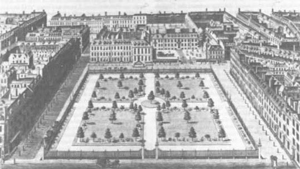
Leicester-SquareThe earl raised the ire of locals, however, when – having subsequently fenced off the land to prevent people from wandering on to his property – he enclosed what had previously been common land.

The people appealed to King Charles I who appointed three members of the Privy Council to look at the issue. Their decision? That the earl keep a section of his land open for the use of the parishioners of St Martin’s.

First known as Leicester Field, it was this land which later became known as Leicester Square. Fine homes were built around the square (its proximity to the Royal Court and centre of government made it a desirable place to live for the well-to-do and those seeking influence) with the centre enclosed with rails (it’s pictured here in 1750).

The square’s reputation also had a royal boost when, in 1717/1718, Leicester House became home to Prince George (later King George II) and his wife Princess Caroline along with their court after the prince fell out with his father King George I and was banished from St James’ Palace (this story is recounted in marvellous detail in Lucy Worsley’s terrific book, Courtiers: The Secret History of the Georgian Court).

The prince remained at the house for 10 years and was proclaimed King George II after his father’s death at its gate. Interestingly, King George II’s eldest son, Prince Frederick, also lived here for a time after he too fell out with his father (King George II). Apparently their relationship was even worse than the previous generation’s had been.

Despite its royal attractions, even at this stage the square apparently had it’s darker side with some less than savoury characters attending the hotels and livery stables that were built there. But things were to get worse as the wealthy moved out – a situation not helped when Leicester House was demolished in the 1790s.

Leicester Square became known as an entertainment venue in the 19th century (among attractions was the short-lived Royal Panopticon of Science and Art which showcased the best in science and art and Wyld’s Great Globe which contained a gigantic model of the earth) and received a new injection of life when theatres and music halls moved in, bringing the crowds back with them.
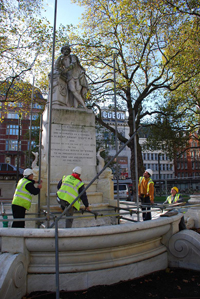
Shakespeare-StatueMeanwhile, the status of the square – and whether it could be built upon – remained a matter of debate well into the 19th century. That ended in 1874 when businessman Albert Grant bought the freehold of the land, had the garden created upon it and then donated it to the Metropolitan Board of Works as a gift to the city.

Responsibility for the management of the square now rests with the City of Westminster. The square area – which is now known for hosting film premieres as well as the tourists who inevitably gather there – was pedestrianised in the 1980s and has just undergone a redevelopment and modernisation which was unveiled last year.

Meanwhile, work to restore the 19th century Shakespeare statue and fountain in the square’s centre is about to be completed (pictured). The square also contains a statue of actor Charlie Chaplin in the square as well as busts of scientist Sir Isaac Newton, painter and first president of the royal Academy Sir Joshua Reynolds, 18th century pioneer surgeon John Hunter, and painter William Hogarth.

The tradition of the entertainment continues in the modern era through the cinemas which now stand in the square and regularly host film premieres (an interesting, if oft-repeated, film-related anecdote connected to the square is that it was in a phone booth located at the square that during the 1960s a young actor Maurice Micklewhite saw a poster for The Caine Mutiny and decided to change his name to Michael Caine).

PICTURES (top) Wikipedia and (below) City of Westminster.
What is a name?…Spitalfields…

This curiously named area in London’s east – located outside the medieval walls – is named for a priory and hospital founded here in the late 12th century.

The Priory and Hospital of Blessed Mary without Bishopsgate (more commonly known as St Mary Spital), was founded by London citizen Walter Brunus and his wife Roisia (both later said to have been buried before the chapel’s high altar), possibly along with other Londoners, in 1197 (although the priory was apparently “refounded” in 1235 when the church was moved).

An Augustinian institution, it also housed what became one of the largest hospitals in England – as well as caring for pilgrims, widows and the infirm poor, it is said to have provided care for pregnant women and the young children of those who died in childbirth – and the site of a large cemetery.

The hospital survived until the reign of King Henry VIII (although apparently barely with the church said to have been in some disrepair by this time) when it fell prey to Thomas Cromwell and his agents in the Dissolution. It was closed in 1539.

The church and most of the buildings were subsequently demolished with part of the area subsequently used as an artillery ground under the jurisdiction of the Tower of London (the area of the inner priory, meanwhile, reverted to the Crown and retained its status outside the jurisdiction of local authorities, known as the Liberty of Norton Folgate).

But the name remained in use for the suburb which had started to appear around the priory and on its former lands (Spitalfields) and in the seventeenth century a market was established here which ensured its longevity. For more on Old (and New) Spitalfields Market and the area’s later history, see our previous post here.

Major excavations were carried out at the priory cemetery between 1991 and 2007 when more than 10,500 skeletons were unearthed. More than 5,000 of these were analysed providing archaeologists with considerable insight into medieval burials. The remains of a charnel house, dating from about 1320, which was once part of the cemetery still exist in Bishop’s Square.

For more, check out Christopher Thomas’ Life and Death in London’s East End: 2000 Years at Spitalfields.

Where is it?…#61…

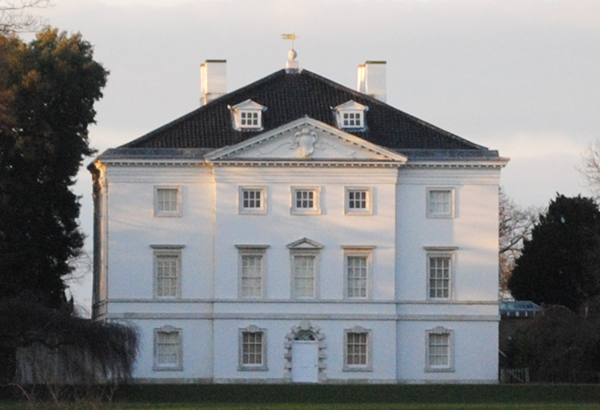
Where-is-it--#61Can you identify where in London this picture was taken and what it’s of? If you think you can, leave a comment below. We’ll reveal the answer early next week. Good luck!

Well done to Sue and Helen – this is, of course, Marble Hill House, located in south-west London on the banks of the River Thames between Richmond and Twickenham (this picture is taken from the opposite side of the Thames). Built for Henrietta Howard, mistress of King George II when he was Prince of Wales, for the lady in her “retirement” from court, the Palladian villa is set among 66 acres of parkland. We’ll look at the house in more detail in a later post.

WHERE: Marble Hill House, Richmond Road, Twickenham (nearest Tube station is Richmond (1 mile) or train station, St Margarets (0.5 mile)); WHEN: 10am-2pm Saturday, 10am to 5pm Sunday (cafe and park are open daily); COST: £5.70 adults/£5.10 concessions/£3.40 child (5-15 years); WEBSITE: www.english-heritage.org.uk/daysout/properties/marble-hill-house/.

Lost London – Mrs Salmon’s Waxworks…

Before Madame Tussaud arrived in London, there was Mrs Salmon and her famous waxworks, one of several such establishments in London.

Prince-Henry's-RoomsFirst sited at the Sign of the Golden Ball in St Martin’s Le Grand – where it filled six rooms – in 1711, the display was relocated to the north side of Fleet Street where it remained until 1795 when it moved across the road to number 17 Fleet Street, now housing Prince Henry’s Room (pictured, room takes its name from Prince Henry, eldest son of the king, who died at the age of 18 and was apparently the inspiration for an inn which previously occupied the building called The Prince’s Arms).

The waxworks were apparently originally run by Mr Salmon – there are references to him being a “famous waxwork man” – but his wife, Mrs Salmon, continued it alone after his death in 1718 until her own death, variously said to have been in 1760 or as late as 1812. At some point after his death, Mrs Salmon is said to have remarried, to a Mr Steers.

Described in a handbill published soon after its initial move to Fleet Street, the exhibitions were said to include a scene of King Charles I upon the scaffold, another of the ill-fated Queen Boudicea, and more exotic tableaux including one showing Canaannite ladies offering their children in sacrifice to the god Moloch, another of a Turkish seraglio, and another of Margaret, Countess of Heningbergh with the 365 children she is said to have given birth to (all at once!). There was also a mechanised figure of the “famous English prophetess” Old Mother Shipton, who is said to have given a boot to visitors as they left.

While some accounts say the waxworks – which, according to the City of London website remained at the site until 1816 – were taken over by a Chancery Lane surgeon named Clarke after Mrs Salmon’s death (and by his wife after his death), it is also suggested that at some point they moved to Water Lane in east London where they were ruined by thieves.

Whatever its fate, it’s generally accepted that the famous waxworks were visited by the likes of James Boswell and artist William Hogarth. They were also mentioned by author Charles Dickens in David Copperfield. 

For more of London’s past, see Philip Davies’ Lost London 1870-1945.

Special – Five famous London funerals…

With former PM Margaret Thatcher’s funeral held in London today, we take a look at five prominent funerals in the city’s past…

Queen Eleanor of Castile: King Edward I was lavish in his funeral for Queen Eleanor (perhaps in an effort to restore her reputation given suggestions she had been unpopular among the common people although it may well have simply been because of the king’s level of grief) and when she died at Harby, a village near Lincoln, on 28th November, 1290, he ordered her body to be transported from Lincoln Cathedral to Westminster Abbey where the funeral was held, with a series of elaborate memorial crosses to be built close to where-ever her body rested for the night. Twelve of these were built including at Westcheap in the City of London and Charing (hence Charing Cross, see our earlier post here), the latter thanks to her body “resting” overnight at the Dominican Friary at Blackfriars. Her funeral took place on 17th December, 1290, with her body placed in a grave near the high altar until her marble tomb was ready. The tomb (one of three built for the queen – the others were located at Lincoln – for her viscera – and Blackfriars – for her heart) still survives in the abbey.

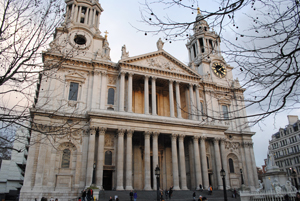
St-Paul's-CathedralVice Admiral Lord Nelson: Heroic in life and perhaps seen as even more so after his death, Nelson’s demise at the Battle of Trafalgar was a national tragedy. His body, preserved in brandy, was taken off the HMS Victory and transported to Greenwich where he lay in state for three days in the Painted Hall. Thousands visited before the body was again moved, taken in a barge upriver to the Admiralty where it lay for a night before the state funeral on 9th January, 1806, more than two months after his death. An escort said to comprise 10,000 soldiers, more than 100 sea captains and 32 admirals accompanied the body through the streets of the city along with seamen from the Victory to St Paul’s Cathedral (pictured)  where he was interred in a marble sarcophagus originally made for Cardinal Wolsey located directly beneath the dome. The tomb can still be seen in the crypt of St Paul’s.

Arthur Wellesley, the Duke of Wellington: Given the last heraldic state funeral ever held in Britain, the Iron Duke’s funeral was held on 18th November, 1852, following his death on 14th September. His body, which had been brought to London from Walmer where it had laid in state by rail, lay in state a second time at Chelsea Hospital. On the morning of the funeral, the cortege set out from Horse Guards, travelling via Constitution Hill to St Paul’s. The body was conveyed in the same funeral car used to convey Nelson’s and accompanied by a guard of honour which included soldiers from every regiment in the army. Masses – reportedly more than a million-and-a-half people – lined the streets to watch funeral procession pass through the city before a service was held in St Paul’s Cathedral under the great dome and he was interred in a monumental sarcophagus alongside that Vice Admiral Lord Nelson. Like Nelson’s, it can still be seen there today.

Sir Winston Churchill: Widely regarded as one of the great wartime leaders of the 20th century, the former British Prime Minister died in his London home on 24th January, 1965, having suffered a stroke nine days earlier. His funeral (plans for which had apparently been code-named ‘Hope-Not’), was the largest state funeral in the world at the time of his death with representatives of 112 nations attending and watched on television by 25 million people in Britain alone. His body lay in state for three days (during which more than 320,000 people came to pay their respects) before on 30th January, it was taken from Westminster Hall and through the streets of London to a funeral service at St Paul’s Cathedral. After the service, a 19 gun salute was fired and the RAF staged a flyby of 16 fighter planes as the body was taken to Tower Hill and then by barge to Waterloo Station. From there it was taken by a special funeral train (named Winston Churchill) to Bladon near Churchill’s home at Blenheim Palace.

Diana, Princess of Wales: Having died in a car crash in Paris on 31st August, 1997, her body was flown back to London and taken to St James’s Palace where it remained for five days before being transported to her former home of Kensington Palace. More than a million people crowded London’s streets on 6th September, 1997, to watch the funeral procession as it made its way from the palace to Westminster Abbey. Among those present at the funeral (which was not a state funeral) were members of the royal family as well as then Prime Minister Tony Blair, former PMs including Margaret Thatcher and foreign dignitaries and celebrities, the latter including Elton John who sang a rewritten version of Candle in the Wind. After the service, Diana’s body was taken to her family’s estate of Althorp in Northamptonshire where the “People’s Princess” was laid to rest.

Our new series will be launched next week due to this week’s events…

Treasures of London – The Barbor Jewel…

While the style of the setting means this pendant is said to date from the early 17th century, a family tradition holds that it was made for a Protestant William Barbor, variously described as a London tradesman or grocer.

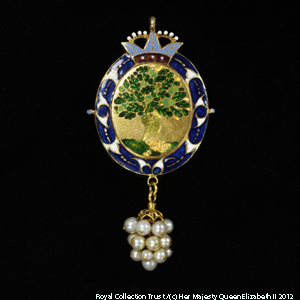
The-Barbor-JewelThe story, said to have been first recorded in the early 18th century, goes that the jewel was made to commemorate Barbor’s escape from being burnt at the stake (thanks to his Protestantism) due to the accession of Queen Elizabeth I in 1558 following the death of her half-sister, Queen Mary I (‘Bloody Queen Mary’).

Barbor had been regarded as a heretic during Queen Mary’s reign and is said to have condemned to death for his faith but the death of the queen meant he no longer faced a sentence of death.

Even so, Barbor died in 1586, and while the onyx cameo of Queen Elizabeth I in the centre of the jewel dates from about 1575-85, the “pea-pod-style” setting of the jewel – which features rubies and diamonds and a cluster of pearls – has been dated to between 1615-25, during the reign of King James I, which places its creation well after Barbor’s demise.

The enameled jewel features an oak tree on the reverse side (pictured).

The Barbor Jewel is currently on display in the exhibition, Treasures of the Royal Courts: Tudors, Stuarts and the Russian Tsars, at the V&A which runs until 14th July. Admission charge applies. For more, see www.vam.ac.uk.

PICTURE: Courtesy of Victoria and Albert Museum, London 

Around London – Margaret Thatcher’s funeral; telling the Jewel Tower’s story; depot open weekend; and, Designs of the Year…

Margaret Thatcher’s funeral will be held next Wednesday at St Paul’s Cathedral from 11am with Queen Elizabeth II among those attending (the first time she has attended the funeral of a British politician since Sir Winston Churchill’s in 1965). The funeral procession of the former Prime Minister, who died on Monday aged 87, will start at the Houses of Parliament and make its way down Whitehall to Trafalgar Square before moving down the Strand, Fleet Street and Ludgate Hill to St Paul’s Cathedral. Baroness Thatcher’s coffin will carried in a hearse for the first part of the journey and will be transferred to a gun carriage drawn by six horses of the King’s Troop Royal Horse Artillery at St Clement Danes church on the Strand for the final part of the journey. There will be a gun salute at the Tower of London. Meanwhile, a Book of Condolence has opened at St Margaret’s Church, beside Westminster Abbey, this morning and will be available for people to pay their respects until 17th April, during the church’s opening hours. St Margaret’s – which stands between Westminster Abbey and the Houses of Parliament – is commonly known as the parish church of the House of Commons.

The story of the Jewel Tower – one of the last remaining parts of the medieval Palace of Westminster – is told in a new exhibition at the historic property. Now in the care of English Heritage, the tower – located to the south of Westminster Abbey, was built in 1365 to house King Edward III’s treasury, later used as King Henry VIII”s ‘junk room’, the record office for the House of Lords, and, from 1869, served was the “testing laboratory” for the Office of Weights and Measures. The exhibition, which opened this month, is part of the English Heritage celebrations commemorating the centenary of the 1913 Ancient Monuments Act. The Jewel Tower is open daily until November. Admission charge applies. For more, see www.english-heritage.co.uk.

See some of the earliest underground trains, a Lego version of Baker Street station and ride the Acton Miniature Railway. The London Transport Museum’s depot in Acton is holding it’s annual spring open weekend this Saturday and Sunday and in celebration of the Underground’s 150th anniversary, attractions will include the Metropolitan Steam Locomotive No. 1 and the recently restored Metropolitan Carriage 353 along with model displays, rides on the miniature railway, film screenings, talks, and workshops. Wales’ Ffestiniog Railway team – celebrating their own 150th anniversary – will also be present with the narrow gauge train, Prince. Open from 11am to 5pm both days. Admission charge applies. For more, see www.ltmuseum.co.uk.

Now On: Designs of the Year. The Design Museum has unveiled contenders for the sixth annual Designs of the Year competition and you can what they are in this exhibition. Consisting of more than 90 nominations spanning seven categories, the nominated designs include the Olympic Cauldron by Heatherwick Studio, The Shard – western Europe’s tallest building – by Renzo Piano, a non-stick ketchup bottle invented by the Varanasi Research Group at MIT, and Microsoft’s Windows phone 8. The exhibition runs until 7th July – the winners will be announced this month. Admission charge applies. For more, see www.designmuseum.org.

10 most viewed posts of 2013 (so far)..

Stay tuned – we’re launching our new Wednesday series next week. In the meantime, here’s a link to our 10 most viewed posts on Exploring London for the first quarter of this year (counting backwards from 10)…

10. LondonLife – The city illuminated…

9. Treasures of London – Admiral Lord Nelson’s coat

8. Where is it?…#58

7. LondonLife – A new crown for King Henry VIII…

6. Where is it?…#60…

5. Where’s London’s oldest…church?

4. Where’s London’s oldest…Thames tunnel?

3. Lost London – The ‘Tyburn Tree’

2. Treasures of London – The Cheapside Hoard

1. Where’s London’s oldest…department store?

LondonLife – New pelicans fly into St James’s Park from Prague…

Pelicans

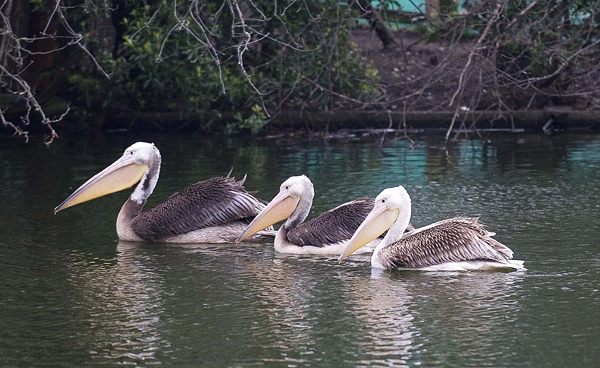
Following a tradition that dates back to 1664, three new pelicans have taken up residence in St James’s Park in front of Buckingham Palace. A gift from the City of Prague in the Czech Republic (the birds were donated by Prague Zoo), one of the pelicans is named Tiffany (in honour of New York-based The Tiffany & Co Foundation – which funded transport of the birds) while the other two have yet to be named with the public invited to join in the process by voting for their favourite name for one of the birds from a shortlist published on the Royal Parks Foundation website, www.supporttheroyalparks.org (the poll closes on 16th April). Choices include Bela, Karola, Queenie and Isla. The first pelican to live in the Royal Parks was a gift to King Charles II from the Russian ambassador in 1664 and they have been there ever since. The new arrivals, join the existing ‘scoop’ of pelican residents in the park – Gargi, Vaclav and Louis. PICTURE: Courtesy of Royal Parks Foundation.

Where’s London’s oldest…Catholic church?

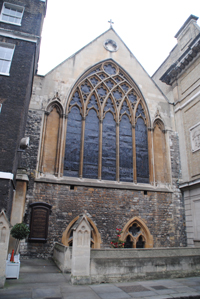
Hidden away to the north-west of the City of a quiet cul-de-sac, the oldest still-in-use Roman Catholic church in London (indeed, in England) is St Etheldreda’s Church in Holborn.

St-EtheldredaLocated in Ely Place, this atmospheric church – named for Etheldreda, seventh century female abbess of Ely – opened as a Roman Catholic Church in 1878, although the building in which it is lodged is much older, indeed a rare survivor from the 13th century. It was built in 1290 by John De Kirkeby, the Bishop of Ely and Treasurer of England during the reign of King Edward I, as a chapel to a residence he constructed on the site.

It and the adjoining palace remained in use by subsequent bishops and other nobles (including John of Gaunt who lived here after his own residence, Savoy Palace , was burnt down during the Peasant’s Revolt) up to and after the Reformation – the first reformer Bishop to use it was Thomas Goodrich, who built the nearby Mitre Tavern. (Worth noting is that the church also has some strong links to Shakespeare – there’s a great article on the church’s website exploring these).

In 1620, the Spanish Ambassador, the Count of Gondomar, moved into Ely Place and the chapel was used once again for Catholic masses (the residence was considered part of Spanish territory) – this was a relatively short-lived development for, thanks to deteriorating relations between England and Spain following a failed match between Prince Charles (later King Charles I) and the Infanta of Spain, the next ambassador was refused permission to live there.

Having escaped destruction in the Great Fire of London, the chapel was requisitioned by Parliament as a prison and hospital during the Civil War and subsequently fell into disuse before in 1772, the property – including the chapel – was sold to the Crown who in turn sold it to a surveyor and builder, Charles Cole.

Cole demolished the palace buildings with the exception of the chapel and had the current Ely Place built with neat rows of Georgian homes, modernising the chapel for the use of residents as an Anglican place of worship. The church attracted few worshippers, however, and in 1820 was taken over by the National Society for the Education of the Poor.

In 1873, the chapel was again to be sold and following a somewhat controversial auction was bought by the Catholic Institute of Charity (aka the Rosminians) and restored under the eye of Father William Lockhart (the Catholic Emancipation Act had been passed in 1829, allowing Catholics to have churches and say mass).

Interestingly, it was during this work that 18 bodies were discovered buried in the crypt – they had died in the ‘Fatal Vespers’ of 1623 when, during a secret meeting of Catholics at the French ambassador’s house in Blackfriars, the floor collapsed and more than 100 were killed. Not able to be buried publicly due to anti-Catholic feeling, they were buried in secret with some of them buried here.

A mass commemorated the completion of the restoration work on 23rd June, 1878, and the church has been in use as a Roman Catholic Church ever since (although years of repairs were needed following significant bomb damage in World War II). Further restoration work was carried out in the 1990s when Flemish tiles from the original cloister were discovered.

These days the church – which features a relic of St Etheldreda contained in a bejewelled cask sitting by the altar – is a quiet oasis in the midst of the bustling city – a great place to take some time out in the midst of a busy day. Also of note is the east window – the work of Joseph Edward Nuttgens, it was completed in 1952 and, like all the other windows, replaced a Victorian window destroyed in the Blitz (look for the image of St Etheldreda) – and the  west window – the work of Charles Blakeman, it is apparently the largest stained glass window in London and depicts a series of English Catholic martyrs.

WHERE: St Etheldreda’s Church, Ely Place (nearest Tube stations are Chancery Lane and Farringdon); WHEN: 8am to 5pm Monday to Saturday; 8am-12.30pm Sunday; COST: Free; WEBSITE: www.stetheldreda.com.